fbpx

June 19, 2020

Some Black Lives Matter Supporters Are Assassinating Martin Luther King Jr.’s Legacy

A petition demanding that accounting professor Gordon Klein be fired from his position at UCLA’s Anderson School of Business, where he has been teaching for nearly four decades, has garnered more than 21,000 signatures since it began circulating earlier this month. In the meantime, the university has suspended him until June 24, as death threats against him and his family multiply.

Klein’s transgression? Rejecting a request by students—self-described as “non-Black allies” of their African-American peers—that he extend the Black people under his tutelage extra leniency on their final exams.

The stated reason for the plea was the trauma that Black students are suffering in the wake of George Floyd’s killing on May 25 by a Minneapolis police officer and in the face of ensuing civil unrest throughout America.

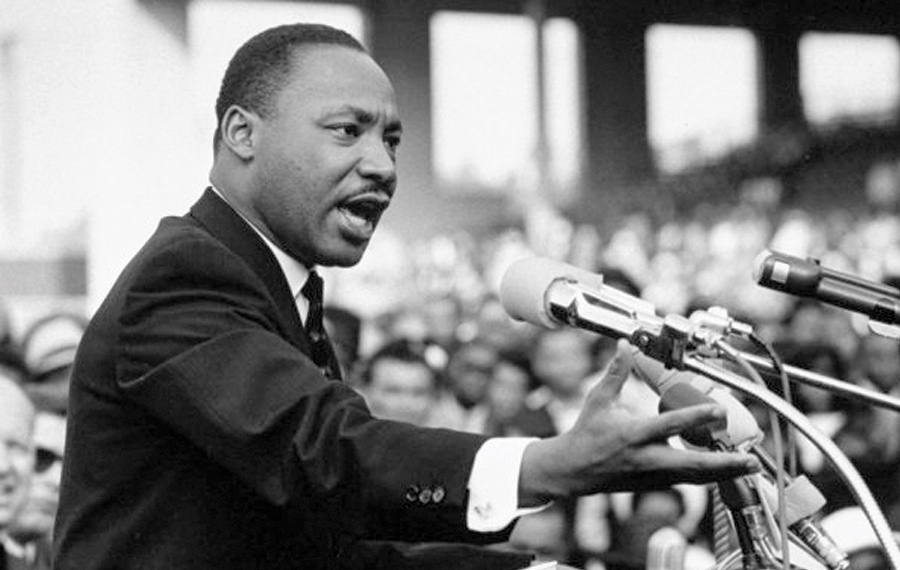
Klein responded to the June 2 e-mail asking that he forego normal standards and procedure by invoking Dr. Martin Luther King Jr.’s “I have a dream” speech.

“Thanks for your suggestion … that I give Black students special treatment, given the tragedy in Minnesota,” he wrote. “Do you know the names of the classmates that are Black? How can I identify them since we’ve been having online classes only? Are there any students that may be of mixed parentage, such as half Black-half Asian? What do you suggest I do with respect to them? A full concession or just half? Also, do you have any idea if any students are from Minneapolis? I assume that they probably are especially devastated as well. I am thinking that a white student from there might be possibly even more devastated by this, especially because some might think that they’re racist even if they are not … One last thing strikes me: Remember that MLK famously said that people should not be evaluated based on the ‘color of their skin.’ Do you think that your request would run afoul of MLK’s admonition?”
Rather than appreciating their professor’s aversion to discrimination, the students in question called Klein’s decision “extremely insensitive, dismissive and woefully racist.”

Such charges are so ridiculous that they barely warrant a rebuttal. Another of their accusations, however—that he was being “tone deaf”—is worth taking seriously. For what it reveals is that MLK’s legacy is out of fashion, if not obsolete.

Though obfuscated by the noise of the Black Lives Matter movement, King’s lifelong dream—that his children “one day [will] live in a nation where they will not be judged by the color of their skin, but by the content of their character”—has become his successors’ nightmare.

Though obfuscated by the noise of the Black Lives Matter movement, King’s lifelong dream—that his children “one day [will] live in a nation where they will not be judged by the color of their skin, but by the content of their character”—has become his successors’ nightmare.

Yes, the sad fact is that BLM members and supporters now scoff at such a notion, even while paying lip service to King as a paragon. Indeed, if they weren’t in the process of renouncing his philosophy, Professor Klein would be hailed for his moral stance, not persecuted and placed on leave.

Nor is the aspiration to an America that puts character over color the only aspect of King’s ideology that the current climate has eradicated. His views on Israel, too, are ignored or denied by BLM anti-Zionists and their Jewish fellow travelers.

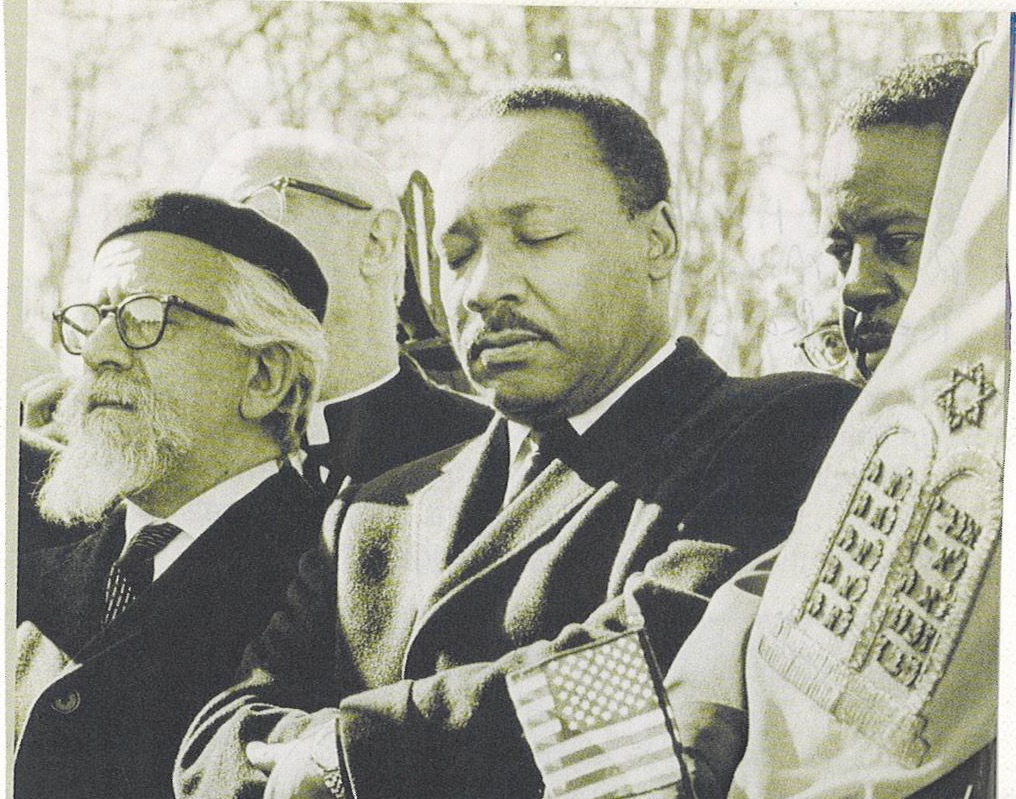
In a letter to Jewish Labor Committee national chairman Adolph Held on Sept. 29, 1967, less than four months after the Six-Day War, King denounced an anti-Israel resolution introduced at the Chicago Conference of New Politics.

“If I had been at the conference during the discussion of the resolution,” he wrote, “I would have made it crystal clear that I could not have supported any resolution calling for Black separatism or calling for a condemnation of Israel and an unqualified endorsement of the policy of the Arab powers.”

He went on to say, “Israel’s right to exist as a state of security is incontestable,” adding, “It is not only that anti-Semitism is immoral—though that alone is enough. It is used to divide Negro and Jew, who effectively collaborated in the struggle for justice. It injures Negroes because it upholds the doctrine of racism which they have the greatest stake in destroying.”

How King would have reacted to the way in which Black and Jewish radicals are distorting the spirit of the joint effort that he had championed is anyone’s guess. Though their endeavor does involve “struggle,” it bears no resemblance to “justice,” certainly not where color-blindness and Israel are concerned.
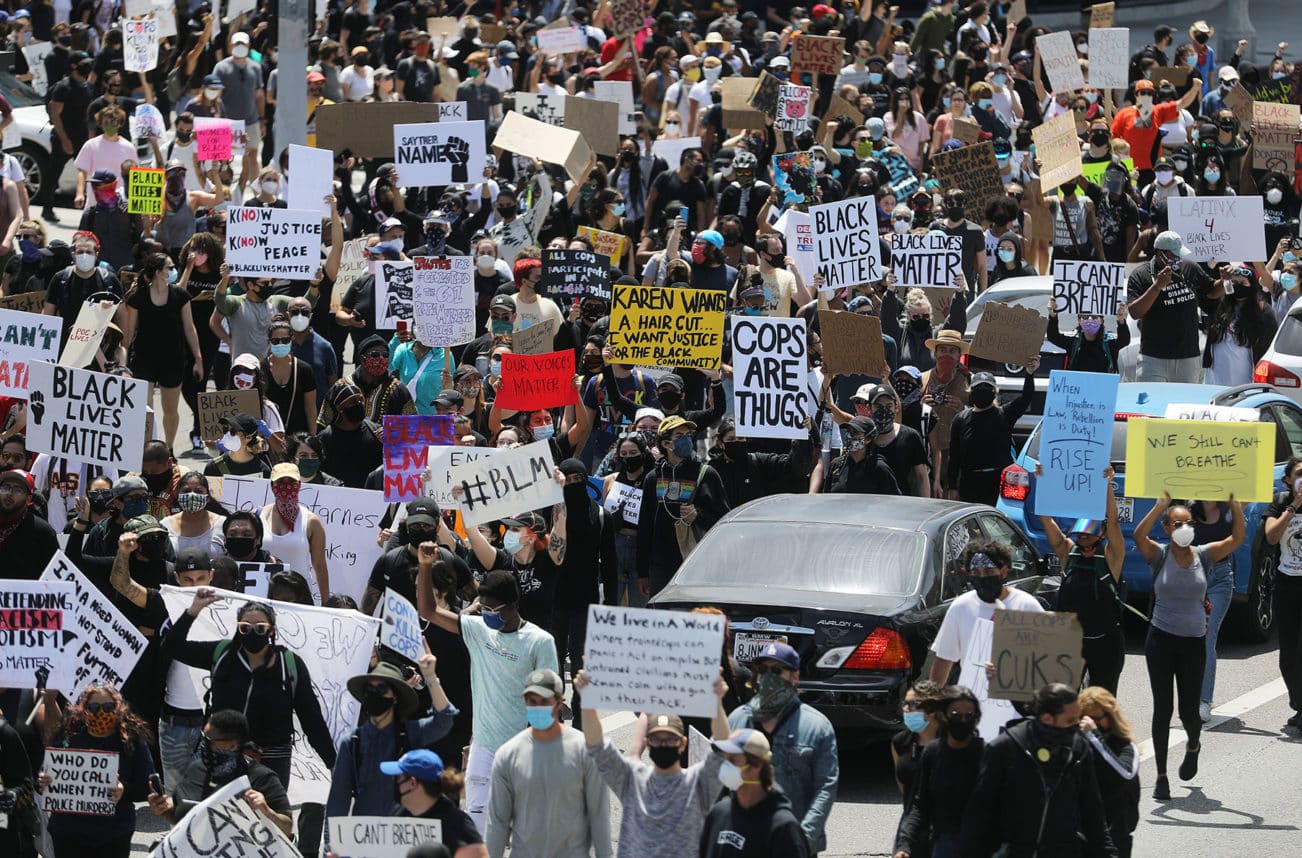
LOS ANGELES, CALIFORNIA – MAY 30: Protestors march during a demonstration organized by Black Lives Matter following the death of George Floyd on May 30, 2020 in Los Angeles, California. (Photo by Mario Tama/Getty Images)

Three years after its establishment in 2013, BLM and an alliance of more than 60 affiliated groups issued a policy platform labeling Israel an “apartheid state” that perpetrates “genocide” against Palestinians, and therefore should be subjected to a complete academic, cultural and economic boycott.

Experiencing pangs of unrequited love, liberal Jews were miffed. After all their efforts to equate racism and anti-Semitism, viewing their battle against blanket hatred as being shared by their black counterparts, they were (foolishly) surprised at the vitriol.

Left-wing Jewish ideologues, on the other hand, had no problem with the platform, as it jibed sufficiently with their politics.

This explains the attitude of the latter to today’s protests, riots and looting spurred by and in the name of BLM.

Take the Union for Reform Judaism (URJ), for example. In a June 12 statement titled “Black Lives Matter is a Jewish value,” URJ announced, in part: “Throughout the past 400 years, Black people in America have been enslaved, subjugated, disenfranchised, murdered and discriminated against. From generation to generation, white Americans, including white Jews, have failed to own and end the systemic racial injustices on which the nation was founded, and instead have actively or passively perpetuated these injustices …

“To affirm that Black Lives Matter is to commit to a human and civil rights movement, working to end systemic racism against Black people and white supremacy …

“To affirm that Black Lives Matter is to accept discomfort, knowing that actions or inaction of white Jews have contributed to ongoing racial injustice…

“To affirm that Black Lives Matter is to acknowledge that Black people risk their personal comfort and safety every day in white dominated institutions, and that white Jews must commit to risking their personal comfort and even safety in the struggle for racial justice …

“To affirm that Black Lives Matter is for white Jews to reflect on their own thoughts and behavior, to build meaningful relationships with Jews of Color and People of Color generally, and to work for reforms that will achieve real, lived freedom for Black people.”

MLK was gunned down in 1968 by a confirmed racist. Today, his legacy is being assassinated by racists in denial.

Stuck in the middle of the peculiar declaration is the following: “To affirm that Black Lives Matter is to recognize the imperative to live with complexity and know that we can be steadfast in our love of and support for Israel while working side by side with those who hold differing views and express them respectfully.” As though BLM’s dim view of the Jewish state is merely a “differing” one.

Perhaps the URJ believes that its mea culpa manifesto will grant it immunity from the movement’s anti-Semitic elements. It won’t, of course, but a far more significant point about the document is that it goes against everything that Martin Luther King Jr. stood and fought for throughout his career.

MLK was gunned down in 1968 by a confirmed racist. Today, his legacy is being assassinated by racists in denial.

Ruthie Blum is an Israel-based journalist and author of “To Hell in a Handbasket: Carter, Obama, and the ‘Arab Spring.’ ”

Some Black Lives Matter Supporters Are Assassinating Martin Luther King Jr.’s Legacy Read More »

Why Can’t You Get Canceled for Anti-Semitism?

In the weeks since the brutal and unjustified killing of George Floyd by a Minneapolis police officer, America has been undergoing what The New York Times approvingly called a “reckoning” that marks a fundamental shift in attitudes about race.

But the onset of this surge of public soul-searching and consciousness-raising about race has brought with it a trend that is deeply troubling. The heightened sensitivity about racism has led not merely to an epidemic of insincere virtue signaling about racism. It’s also brought about a flood of accusations against alleged offenders that have more to do with politics, and out-of-control illiberal and intolerant social-media mobs, than making the country a better place. The widespread “canceling” of people who are deemed racists is becoming a serious problem.

The question is, if it’s so easy to cancel someone for not going along with the prevailing orthodoxy about what constitutes racism, why does engaging in anti-Semitism not bring about the same moral opprobrium from the media and the cultural forces taking down people for dissenting from the Black Lives Matter catechism?

Why does engaging in anti-Semitism not bring about the same moral opprobrium from the media and the cultural forces taking down people for dissenting from the Black Lives Matter catechism?

Examples abound of instances in which people’s careers and lives are being ruined because of their refusal to bend the knee—literally or metaphorically—to a Black Lives Matter movement that is determined to condemn anyone who dissents from their ideology or even question it.

One involves Gordon Klein, a professor at UCLA’s School of Management who was placed on leave and had his classes taken away from him after refusing to grant African-American students exemptions from taking final exams because of their collective state of mind after the death of Floyd. The university took that action after angry students accused him of racism and because he had paraphrased Dr. Martin Luther King Jr.’s famous statement about judging people by the content of their character, rather than the color of their skin. Klein, who had taught at the school for 39 years, was doxxed by the students (they made public his email and home addresses) and is now under police protection because of death threats.

He isn’t alone.

Tiffany Riley, a Vermont school principal, was placed on administrative leave for a Facebook post that said that while she agreed that black lives matter, she didn’t support coercive measures to advance that cause or the demonization of police.

Harald Uhlig, an economics professor at the University of Chicago, was fired from a consulting job at the Federal Reserve for saying that Black Lives Matter had “torpedoed itself” by aligning the movement with calls for defunding the police. A mob of outraged economists and journalists led by The New York Times’ Paul Krugman wanted Uhlig’s head on a spike for this offense. Though Uhlig had issued a groveling apology for his heresy, the Fed acceded to their demand, saying there was no room at the institution for “racism,” even though the economist’s statement could not credibly be described as such a thing.

There are many other examples of similar incidents of people being canceled over dubious accusations of racism. But what is also interesting about what’s going on is that far more egregious examples of anti-Semitic hate aren’t producing the same results.

There are many other examples of similar incidents of people being canceled over dubious accusations of racism. But what is also interesting about what’s going on is that far more egregious examples of anti-Semitic hate aren’t producing the same results.

One prominent example was that of popular comedian and television star Chelsea Handler, who approvingly posted a video of National of Islam hatemonger Louis Farrakhan on her Instagram page this past weekend.

Handler said a Farrakhan statement on racism from an old clip from “The Phil Donahue Show” was “powerful.” Farrakhan is a purveyor of anti-Semitic conspiracy theories and vituperation against Jews. But according to Handler, his comments about the evils of racism directed at blacks deserved to “stand alone.”

When a commenter asked her if she would single for praise out some out-of-context statement of Adolf Hitler, she argued that Farrakhan’s hate was different because “he is just responsible for his own promotion of anti-Semitic beliefs. They are very different.”

In other words, anti-Semitism is just another opinion an otherwise laudable person might hold, not evidence of murderous hate.

In the current moral panic about racism, one might have expected a surge of anger directed towards Handler by her colleagues in the entertainment industry, in addition to announcements that indicated that both individuals and companies wouldn’t work with her in the future. That didn’t happen. Instead, several celebrities even more famous, such as Jennifer Anniston, Jennifer Garner and Michelle Pfeiffer, voiced support for Handler.

Handler’s ability to survive this incident with her career intact shows that myths about Hollywood being controlled by the Jews are nonsense. It’s also likely that most Jews in the entertainment industry are either so cowed by the Black Lives Matter movement that they wouldn’t dare to act against her or actually agree that anti-Semitism shouldn’t disqualify Farrakhan from being considered a respected voice. But the pass for anti-Semitism doesn’t just exist in the arts.

Handler’s ability to survive this incident with her career intact shows that myths about Hollywood being controlled by the Jews are nonsense.

In early 2019, newly elected Rep. Ilhan Omar (D-Minn.) made a splash by engaging in anti-Semitic incitement against Jews and Israel with accusations about AIPAC buying congressional support for Israel with “the Benjamins,” coupled with charges that supporters of the Jewish state were guilty of dual loyalty.

While many on both sides of the aisle condemned her remarks, when push came to shove, congressional Democrats refused to censor her. While at the same time Republicans were punishing Rep. Steve King (R-Iowa) for remarks that seemed an endorsement of white nationalism, Omar was rewarded with a seat on the Foreign Affairs Committee, where she could pursue her vendetta against Israel and support for the anti-Semitic BDS movement.

More than that, she got a pass from the same cultural forces that are canceling dissenters from the BLM mantra by being treated as an honored celebrity. Nor has that changed, since during the past two weeks she has made the rounds of the Sunday-morning talk shows, where hosts like CNN’s Jake Tapper fawn on her.

The practice of shaming, shunning and silencing those with unpopular or even offensive views is antithetical to democracy and the free exchange of ideas. That is especially true when it involves actions or statements that are not actually racist.

At the same time, it says something truly ominous about our society and culture that questioning the BLM movement—even while avowing that, of course, black lives matter—can destroy a career, while endorsing anti-Semites and even engaging in Jew-hatred is not considered a big deal. We already know that the consequences of giving anti-Semites a pass can lead to horror. Apparently, those who pose as the supposedly enlightened guardians of our culture have either forgotten that or no longer care about it.

Jonathan S. Tobin is editor in chief of JNS—Jewish News Syndicate. Follow him on Twitter at: @jonathans_tobin.

Why Can’t You Get Canceled for Anti-Semitism? Read More »

Report Highlights Incitement of Hatred Against Israelis, Zionists in Palestinian Textbooks

A new report highlights how Palestinian textbooks promote hatred against Israelis and Zionists.

The Jerusalem Post reported that the comprehensive review was written by Arnon Gross of the Meir Amit Intelligence Center, and David Bedein of the Center for Near East Policy Research. Gross and Bedein studied almost 400 Palestinian textbooks from 2013 to 2020.

Gross and Bedein found that the textbooks promote “delegitimization of the State of Israel’s existence, including the denial of Jewish holy sites within Israel; demonization of Israel and the Jews, who are regularly referred to as ‘the Zionist enemy’; and incitement to violent struggle to reclaim the whole of Israel as Palestine, with no education for peace and co-existence,” according to the Post.

Additionally, the authors found that Palestinian textbooks also deny any Jewish connection to Jerusalem and don’t have any references to peace or a two-state solution.

Some specific examples from the textbooks include a math problem that reads, “One of the settlers [Israelis] shoots at [Palestinian] cars that pass on one of the roads. If the probability of his hitting a car in one shot is 0.7, and the settler shot at 10 cars, what will you expect to be the number of cars that were hit?”

A textbook also refers to Fatah terrorist Dalal al-Mughrabi as a “female martyr” and “super heroine.” Al-Mughrabi was involved in the 1978 Coastal Road massacre, where Palestinian militants hijacked a bus on Israel’s coastal highway and killed 38 people, including 13 children. It is considered to be the worst terrorist attack in Israeli history.

Associate Dean and Director of Global Social Action Agenda at the Simon Wiesenthal Center Rabbi Abraham Cooper told the Post, “Another generation of children [are being] brainwashed to hate and glorify terrorist murderers. Donor nations and international agencies funding these schools must demand change from the Palestinians. Unless and until this educational model is scrapped there is no hope for any peace plan, however brilliantly crafted, if this is the narrative of hate universally imposed by Palestinian leaders upon their constituents from generation to generation.”

The Institute for Monitoring Peace and Cultural Tolerance in School Education (IMPACT-se) released a similar report in September explaining that hatred in Palestinian textbooks has worsened since 2000. The report stated, “There is a systematic insertion of violence, martyrdom and jihad across all grades and subjects in a more extensive and sophisticated manner, embracing a full spectrum of extreme nationalist ideas and Islamist ideologies that extend even into the teaching of mathematics and science.”

In May, the European Parliament, the legislative branch of the European Union (EU), passed a resolution condemning hate in Palestinian textbooks and stating that EU funding should never go to “textbooks and educational material which incite[s] religious radicalization, intolerance, ethnic violence and martyrdom among children.”

Report Highlights Incitement of Hatred Against Israelis, Zionists in Palestinian Textbooks Read More »

david suissa podcast curious times

Pandemic Times Episode 59: Interview with a Millennial

New David Suissa Podcast Every Monday, Wednesday and Friday.

What does my daughter think about the state of the world? We discuss.

How do we manage our lives during the coronavirus crisis? How do we keep our sanity? How do we use this quarantine to bring out the best in ourselves? Tune in every day and share your stories with podcast@jewishjournal.com.

Pandemic Times Episode 59: Interview with a Millennial Read More »

The Greater Part of Valor – Thoughts on Torah Portion Shelach Lekha

The Greater Part of Valor

Thoughts on Torah Portion Shelach Lekha 2020 (adapted from 2019)
All Ohr HaTorah regulars know about my little bit of a trick question: “How long did it take the Israelites to get from Mt. Sinai to the land of Canaan?” The uninitiated almost always say, “Forty years.” This incorrect answer is based on a mistranslation of Numbers 14:33. The Israelites had rebelled against Moses when they were faced with the prospect of fighting their way back into their homeland. Ten of the 12 who spied out the land, tribal leaders all of them, rooted for going back to Egypt. The rest of the Israelites, by and large, fell for this distraction from their life’s purpose. These demagogues and those who fell under their sway did not realize that going back to Egypt was not an option. They found out the hard way.

The punishment for rebellion? In Numbers 14:33 we are told, “Your children (i.e., of that rebellious generation) shall be shepherds in the desert for 40 years, and they shall bear (the guilt of) your straying, until the last of your carcasses (fall) in the desert.” Hard stuff. The children will not enter the land until the last of their parent mutineers had died.

But where did this rebellion happen? On the borders of the land of Canaan. The promised land was just over the horizon. The Israelites had already arrived, had already made the journey from Mt. Sinai to Canaan. The Israelites had left Mt. Sinai on the 20th day of the second month (May 14th year), as we were told in last week’s Torah portion. They arrived at the first harvest of the grapes – late July, early August. The journey took about six to eight weeks. That’s it, six to eight weeks.

Where did the “40 year” misconception come from? Many Bibles mistranslate Numbers 14:33, and render “desert shepherds” (ro’im bamidbar) as “desert wanderers.” I can find no Bible dictionary that translates ro’eh as “wanderer” – the word simply means “shepherd.” This mistake goes back to the King James translation, and continues thereon.

Aside from this being a great trivia question, what is the lesson of all this?

Very simple: we were not in the desert for 40 years because we lacked geographical directions; we were in the desert for 40 years because we lacked inner direction. We lacked courage.

This idea, “courage,” is a tough one. I actually like the saying, “the better part of valor is discretion” (“discretion” meaning here using discernment to determine a course of action) spoken by the character Sir John Falstaff in Act 5, Scene 4 of Shakespeare’s Henry the 4th, Part One. As with many of Shakespeare’s most famous sayings, the line is said in great irony. The corrupt and dishonest “false staff” has acted with great cowardice, and then justifies this cowardice with the this often quoted saying.

Does the fact that the origin of the saying’s is it’s being said by such a duplicitous man diminish the power of this epigram? To think so commits what is called the “genetic fallacy,” the concept that the worth of an idea depends on who said it. (This fallacy is discussed in Morris Cohen and Ernest Nagel’s book, Logic and the Scientific Method (1934).)

It is fallacious to doubt the validity of the idea that “the better part of valor is discretion” just because Shakespeare wrote it (if only to be spoken by a notable scoundrel). I trust the profound wisdom of Shakespeare to at least pause a moment.

Acting with valor at a given moment can be foolhardy; the risk is great and the benefit minimal.

On the other hand, as I have counseled people through the years, I have heard vast and complex presentations of discretion, the whole point of which was to avoid being courageous. I much prefer a person who can say, “I have a completely irrational fear of doing that” as opposed to the person who rationalizes away their fear as actually being the virtue of discretion.

Much of the time, courage is an instinct to act, to do the righteous thing in spite of great risk, even if just risking of the disapproval of others. For others, courage is discovered through a careful process of thought, where one weighs all of the alternatives and arrives at the most righteous one, the act that creates the most good, all things considered. Courage is the will to do what is discovered as right, in the face of risk. Every path we take includes a path not taken. Everything we do has a cost.

As a person considers an act, and whittles things down to their basic alternatives, one often discovers resistance to doing the right thing. Sometimes what we discover is just weakness – a given action or inaction is easier or more immediately gratifying that another action. We discover that we need strength and moral direction, to do the right thing.

Other times, though, as we consider an action, we discover not weakness in face of the temptation to take the easier route, but fear. If we do a certain thing, we are risking. The “discretion” part of valor is asking: is this course of action truly worth it; is it right enough to risk something?

One might say that the greater part of the courage that comes from deliberation – as opposed to the courage that comes more spontaneously and instinctively – is honesty. Discretion perhaps talks you out of a courageous but foolhardy deed, but honesty might talk you into it. Deep, searching honesty might guide you into doing something that involves the possibility of incurring pain or harm, but the act must be done. Honesty sometimes leads to the fact that, in some existential way, there just is no alternative.

The Israelites, as they considered fighting their way back into Canaan apparently used Falstaffian discretion. The enemy was too great, the land too poor, and Egypt, upon careful reflection, was actually not all that bad.

Joshua and Caleb, the two who recommended valor, realized something very simple. At the most basic level, there was no alternative. The true deed must be done. It will involve risk and loss, and maybe death. So be it. This kind of courage amounts to the resolute will, prompting us to do the most true thing.

Maybe in most day-to-day things, discretion is the greater part of valor. There are times, though, when the greater part of valor is just valor.

The Greater Part of Valor – Thoughts on Torah Portion Shelach Lekha Read More »

Juneteenth and Anti-Racism with Rabbi Ron Stern

Over the past week, Rabbi Ron Stern from Stephen Wise Temple shared his personal journey into a deeper understanding of the complexities of race in America. I found it so inspiring, I asked for permission to share all 5 days again here.


My grandmother had a maid’s bathroom.

I was born in the Jim Crow South. I didn’t know it at the time, of course. We belonged to the country club where we’d go to swim, waited on by Black attendants dressed in immaculate white uniforms. There wasn’t a Black face in the water, nor seated on a lounge chair. It was just the way it was. In my grandmother’s house there was a special bathroom where white uniforms were hung on gray cinderblock walls. It was undecorated, just off the rather large laundry room, and from time to time I’d venture in because it was closest to the kitchen. What I didn’t know then, and only found out after reading The Help was that this was the maid’s bathroom, built by the original owners in keeping with southern custom so that the Black maids wouldn’t use the bathrooms anywhere else in the house. I also didn’t know that those uniforms were a vestige of a time when they were required attire for a Black nanny when she took her white charge out for a walk. Failure to wear the uniform could result in accusations of abduction or at the very least harassment by the all-white police force.

What astounds me is that I realized none of this until I was well into my 40’s. It was then that I began my journey into understanding the enduring and systemic racism that is still tragically pervasive in this country. As a white Jew in the south, and even growing up in the more “enlightened” north (or so I thought), the circumstances of Black America just weren’t on my radar.

While the uniforms are gone and there is more integration at the country clubs, plenty of older houses still have that bathroom, of course. Charlotte, North Carolina is a far more integrated and enlightened city than it was when I lived there but old habits die hard. Despite the disappearance of the most obvious signs of discrimination and the meaningful progress, profound and discriminatory racial biases continue all these years later.

Educate yourself. Take the time to listen to the Code Switch Podcast.

Looking to have the conversation with your kids? Please do! Look here.

I was thrown against the wall…

Ten years ago I attended a gathering of clergy associated with the PICO National Network (info here). We went to New Orleans five years after hurricane Katrina revealed some of the deepest racial disparities in the local and national response to the devastating event. There, with clergy from across the country, a significant percentage of them Black, I was first exposed to the idea of systemic racism. As the legal scholar and civil rights attorney Michelle Alexander spoke about the premise of her book, The New Jim Crow, I was thrown against the wall by the power of her message and its deeply disturbing content.

“Jim Crow” is a term that describes the cultural, economic, and geographic unintended policies and systemic behaviors that result in racial inequality. Alexander uses the term to characterize our current justice system (prisons, courts, police) that ultimately results in huge inequities in the way Blacks and whites are treated—disparities that cannot be accounted for by crime rates in communities of color. For the most part it is the result of a “war on drugs” that puts minor offenders behind bars. By criminalizing drug use rather than considering it a medical condition, we’ve reached a time where Black men make up one third of the prison population though they are only 12% of the general population. Contrary to popular belief they do not commit offenses in greater proportion to whites.

As one of only a handful of rabbis in the room, we felt the burden of our whiteness and our Jewishness. After all, we were the ones who marched with Martin Luther King. We are proud of our past in the civil rights movement! To learn that our system continues to discriminate in ways that were outlined by Alexander in her speech and further clarified in her book was devastating. How could this great country and its storied justice system be so unjust for people of color?

Hear Michelle Alexander speak about the New Jim Crow.

“An articulate Black woman.”

LA Voice is the affiliate of the PICO National Network. Founded by Catholic theologian John Baumann as the Pacific Institute for Community Organization (now called People In Communities Organizing) in Oakland in 1972, the organization has a heavy Black and Catholic presence. My involvement with PICO has put me in touch with some incredible activists and thought leaders around areas of poverty and race. To say that my eyes have been opened is an understatement—I feel like I was once truly blind. I am grateful for the gentle (and sometimes necessarily disturbing) lessons taught to me by its leadership.

At a gathering in Los Angeles, we were challenged to explore our own racial biases. “Me, racially biased!?” I thought. No way! I’m totally aware! Just then a Black woman rose to speak about her experiences with racial bias. I thought, “she’s so articulate.” And then she asked the provocative question: “When a white woman rises to speak, how often do you say she’s an articulate white woman?” Uh-oh…how did she know what I was thinking?

Here’s the lesson. I thought that I’d devoted a great deal of time to making myself aware of my internal biases. From my encounters with Black churches after the LA riots in 1992, to my work with PICO, to the books I’ve read—I believed I had it figured out. Until this insightful woman asked me to plumb deeper into my own proclivities. And it was then that I discovered, it is always a work in progress.

Here’s a good place to start learning about implicit bias. Or just Google it!

What I tell my son.

Shortly after my son learned to drive, he was pulled over by a cop after completing what was described as a “reckless turn” on his ticket. I was glad! It put him in his place and provided a learning opportunity. We took public transportation to the juvenile traffic court office in South LA. It took hours! I wanted him to experience the obvious result of losing one’s license. Mom and dad would not be his taxi service (this was long before Uber). I’ve never had “the talk” with my son, I never felt I had to. But millions of Black parents believe they must have “the talk.” It’s not about sex, it’s about what they must do when pulled over by the police. Put your hands on the wheel, do nothing suspicious, ask before you do anything, never reach quickly for your wallet, phone, or into the glove compartment. Never, ever resist anything the officer tells you to do and so on… Black parents know that all too often non-aggressive actions are interpreted as life threatening actions by arresting officers. Philando Castile’s death as he reached for his gun permit (after telling the officer what he was doing) is the most infamous example. The truth is that most Ashkenazi or Sephardic Jews don’t know what it is to go through life as Black (unless, of course we are both Black and Jewish). So it’s easy to forget that once all Jews were Black by association. Country clubs, neighborhoods, and schools all prohibited Jews and Blacks. But after the Shoah, white America reclassified some Jews – upon seeing so many people who looked just like them in newsreels of the camps, World War II turned some of us white. As I walked amidst the protestors in Pan Pacific Park last weekend and saw the predominantly white faces in the crowd of thousands (and the many Jewish stars on the signs), I was heartened to know that so many of our young people are doing their best to understand what it is to be Black in America. Here’s an important podcast with episodes exploring race and poverty.

A new reading list.

My daughter is on the front lines of racial equality. She works at Vista del Mar—once a Jewish orphanage, it now serves at-risk children of all ethnicities. (You can support their work here.) As a clinical social worker she provides counseling to mostly children of color who are some of the most traumatized by their birth circumstances and usually victims of drug abuse, sex-trafficking, and violence. These kids have fallen through the cracks. Her level of awareness far exceeds mine. So, when she says to read something, I do it.

Some time ago, she recommended Ta-Nehisi Coates’ book Between the World and Me. Each turn of the page brought me face to face with what it means to be Black in America today. It’s a poignant letter to his son, that is, quite frankly, required reading for all of us trying to understand our present circumstances. He asserts that to grow up as a Black man today is to fear “friskings, detainings, beatings and humiliations” from those who “have been endowed with the authority to destroy your body.” He lays bare the myth of the American dream that for most Black people is not only unattainable but is held out of reach by a society that places overwhelming obstacles before them.

This is not an easy read. It is painful and it is disheartening—but it is the story that Black Americans read and understand. It is their life. The most important thing we can do is to educate ourselves. To reach an awareness we didn’t have before George Floyd’s brutal murder opened our eyes. We could shelter ourselves behind a fortress of denials and refutations by those who can’t countenance the disruption of our comfortable world view. I just hope we don’t.

You can read a review here.

Learn more about anti-racism and find resources here.

Today is Juneteenth, a holiday that celebrates the ending of slavery in the United States. Learn more here.

Juneteenth and Anti-Racism with Rabbi Ron Stern Read More »

Ready to Change the World

When your child is in “Zoom school,” the silver lining is watching him or her participate in class. The past few days, kindergarten students practiced their end-of-the-year song, belting out:

The future’s lookin’ good to me.

I’m ready to go! I’m ready to go!

Yeah, the future’s lookin’ good to me.

I am ready as I can be.

My time has come. I’m on my way.

I’m really ready. This is the day.

I worked so hard to make it so. Now I’m ready. I’m ready to go!

Tears formed when I heard my son repeat the words, “I’m really ready.” I couldn’t help but wonder, are any of us really ready to face what the future is throwing at us? To ease the pain of many moments, we often use the phrase, “This too shall pass.” But I’m using the phrase way too often and praying with much vigor, that all of this — the isolation, confusion, hatred, anger, belittling, narrowmindedness and bullying — passes quickly, long before my kindergartner steps forward into a world filled with contention and rage.

But because that reality doesn’t currently exist, perhaps my prayers should look different. Stop praying that “this too shall pass” and instead, consider the following prayer:

“Dear God, help me create a home that looks like a microcosm of the world you intended. A world in which we pause before we speak. A world in which we hold someone with their tears even if we don’t understand a word they are saying. A world in which our children understand that kindness is valued more than competition or wealth. A world in which we see one another, cultivating a deep conviction to work against complacency and indifference.”

The kindergartners will sing their song with pride and eagerness. And they are as ready as they can be, exuding compassion gleaned within their classroom.

But the task is on us. We must create a world that is ready to accept their light and their love. One home, one family, one person at a time. Let us not pray that we wake up tomorrow and the world looks different. Rather, let us pray that we learn how to wake up tomorrow, ready to change the world.

Yeah, the future’s lookin’ good to me.

I am ready as I can be.

Shabbat shalom.


Rabbi Nicole Guzik is a rabbi at Sinai Temple.

Ready to Change the World Read More »

London Man Shouts ‘Shame Nazis Didn’t Put the Gas Higher’ at Jewish Mother, Baby on Bus

A man riding a bus in London on June 17 shouted a couple of pro-Nazi Germany statements at a Jewish mother holding a baby, according to a tweet posted by a volunteer group.

The volunteer group Shomrim in Stamford Hill tweeted that that the man, said to be 60, shouted at the Jewish woman, “shame Nazis didn’t put the gas higher” and “the Germans should have killed all of them [Jews].” The Jewish mother felt “extremely traumatized” afterward, according to the Shomrim tweet.


The Campaign Against Anti-Semitism said in a statement, “Anti-Semitic abuse on public transport has become a regular feature of London life for many Jews, and the police and prosecuting authorities take action to bring offenders to justice.”

The Simon Wiesenthal Center similarly tweeted, “Winston Churchill and the millions of Brits who survived the [Blitzkrieg] then helped defeat Nazis must be rolling in their graves as neo-Nazis spout their genocidal hatred of Jews in #UK 75 [years] later.”


The June 17 incident comes after another anti-Semitic incident was tweeted about that allegedly had occurred on a London bus on June 16, when a man flipped his middle finger at a Jewish man and said, “Jews are all spies, [I] will beat you up, what’s wrong with all you lot.” Additionally, the Shomrim tweeted that on June 17, someone threw dog feces and eggs on a Jewish family’s front door; the family believes the incident was anti-Semitic.


According to the Campaign Against Anti-Semitism, Jews face around three instances of anti-Semitic incidents a day in the United Kingdom.

London Man Shouts ‘Shame Nazis Didn’t Put the Gas Higher’ at Jewish Mother, Baby on Bus Read More »

Jewish Fashion Brand Owner to Turn Anti-Semitic Graffiti Into Mural

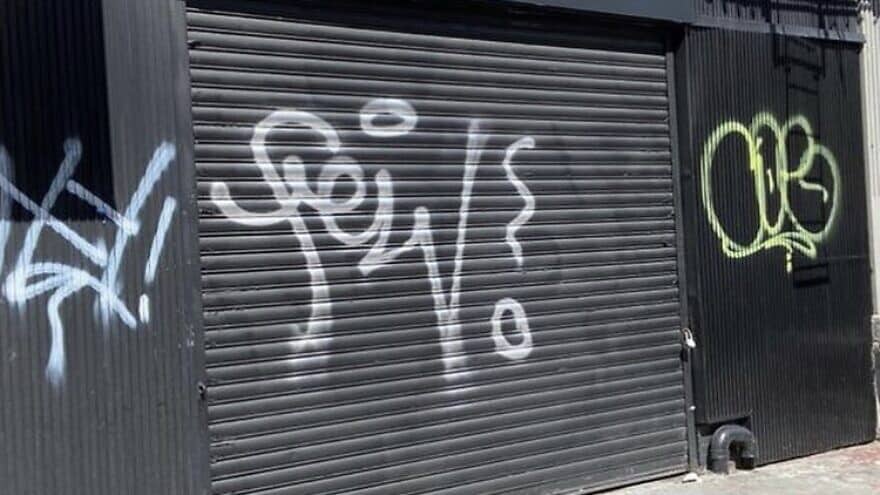
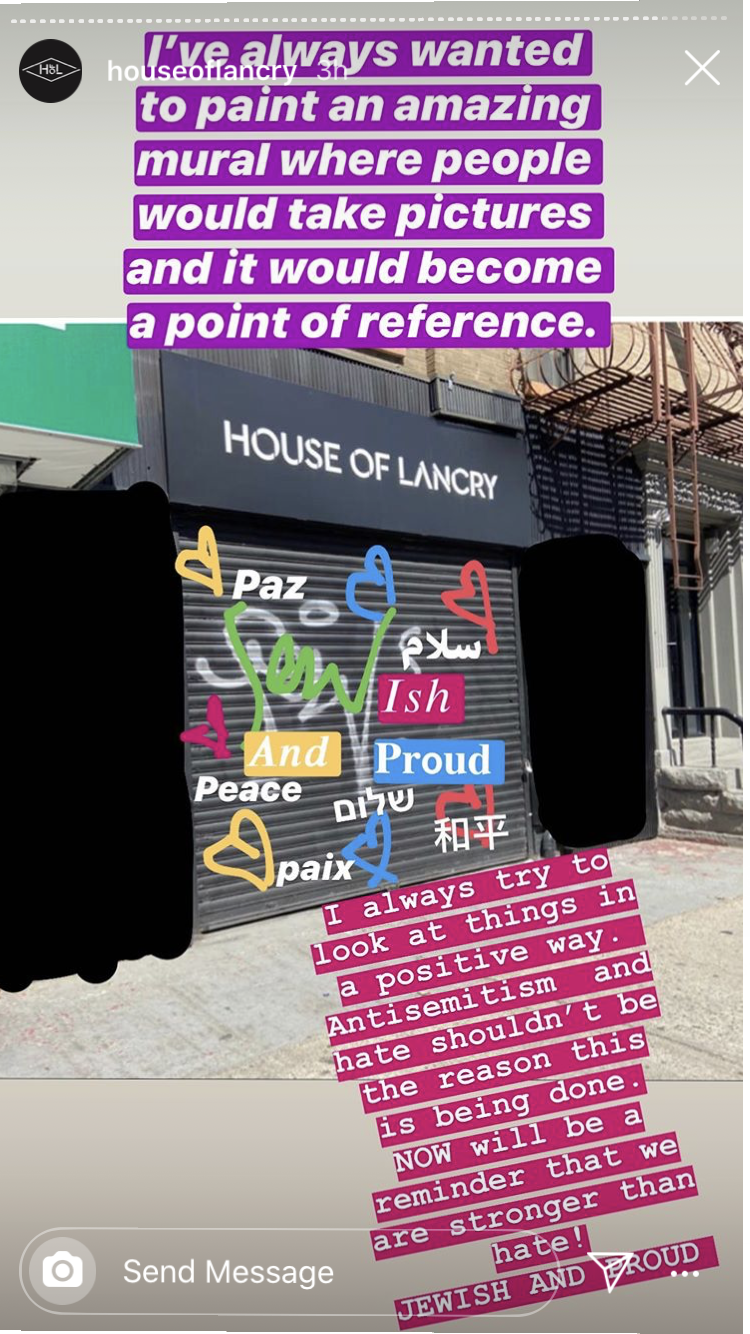
The Jewish founder and owner of a British fashion brand that sells modest attire is hoping to turn recent anti-Semitic vandalism to her store in Brooklyn, N.Y., into an art mural.

Hannah Lancry Sufrin, the London-based visionary behind House of Lancry, told JNS that on Monday an employee sent her a photo showing that the word “Jew!” was spray-painted on the gate outside of her flagship store in the Crown Heights neighborhood of Brooklyn. The store, which has been in business for a year, was preparing to reopen that day after being closed for three months due to the coronavirus pandemic.

Appalled by the graffiti, Sufrin, 34, said, “I feel like it wasn’t just an assault toward my property, it was an assault toward my identity and for me that’s worse than anything. … It’s hurtful, it’s hateful, and it’s upsetting in so many levels. Especially you’d think during a lockdown, people would learn a little bit of compassion and respect toward another human being. It made me so sad, like, where is the hope?”

On Wednesday, the mother of three, who was born and raised in Brazil, decided that she “could not stay silent about the injustice” and took to Instagram to share what happened. She received tremendous support from some of her 21,000 followers, including other Jewish businesses, and called on artists to help her turn the graffiti into artwork.

Jewish Fashion Brand Owner to Turn Anti-Semitic Graffiti Into Mural Read More »

ADL Calls for July Boycott of Facebook Over Hate Speech

The Anti-Defamation League, along with several civil-rights groups, is calling for corporations to boycott Facebook in July over its unwillingness to ban hate speech on the social-media company’s platform.

The groups, including the National Association for the Advancement of Colored People (NAACP), Sleeping Giants, Color of Change, Free Press and Common Sense, launched a full-page ad in The Los Angeles Times on Wednesday saying Facebook has not done enough to combat hate and disinformation.

“We have long seen how Facebook has allowed some of the worst elements of society into our homes and our lives. When this hate spreads online, it causes tremendous harm and also becomes permissible offline,” ADL national director and CEO Jonathan Greenblatt said in a statement.

Noting that Facebook had “repeatedly failed” to act, Greenblatt said that “we hope this campaign finally shows Facebook how much their users and their advertisers want them to make serious changes for the better.”

Last November, actor and comedian Sasha Baron Cohen, upon receiving the Anti-Defamation League’s International Fellowship Award, ripped into Facebook and other social-media giants for allowing hate speech to flourish on their platforms.

“I believe it’s time for a fundamental rethink of social media and how it spreads hate, conspiracies and lies,” Cohen said at the ADL conference.

Last October, the ADL accepted a $2.5 million donation from Facebook’s COO Sheryl Sandberg in the aftermath of the anti-Semitic attack on a synagogue in Halle, Germany.

Facebook CEO Mark Zuckerberg has faced continued criticism for not doing more to police its platform for false or misleading statements, including from U.S. President Donald Trump. Instead, the social media company has launched a massive drive to boost voter registration across its platforms as part of a “Voting Information Center” to help educate voters on how to register, find polling places or vote by mail.

On Thursday, Facebook removed Trump campaign ads targeting Antifa that featured an upside-down red triangle that apparently resembled a Nazi symbol. Facebook removed the ads after the ADL said it closely resembled badges the Nazis used to identify political prisoners in concentration camps, reported The Washington Post.

ADL Calls for July Boycott of Facebook Over Hate Speech Read More »