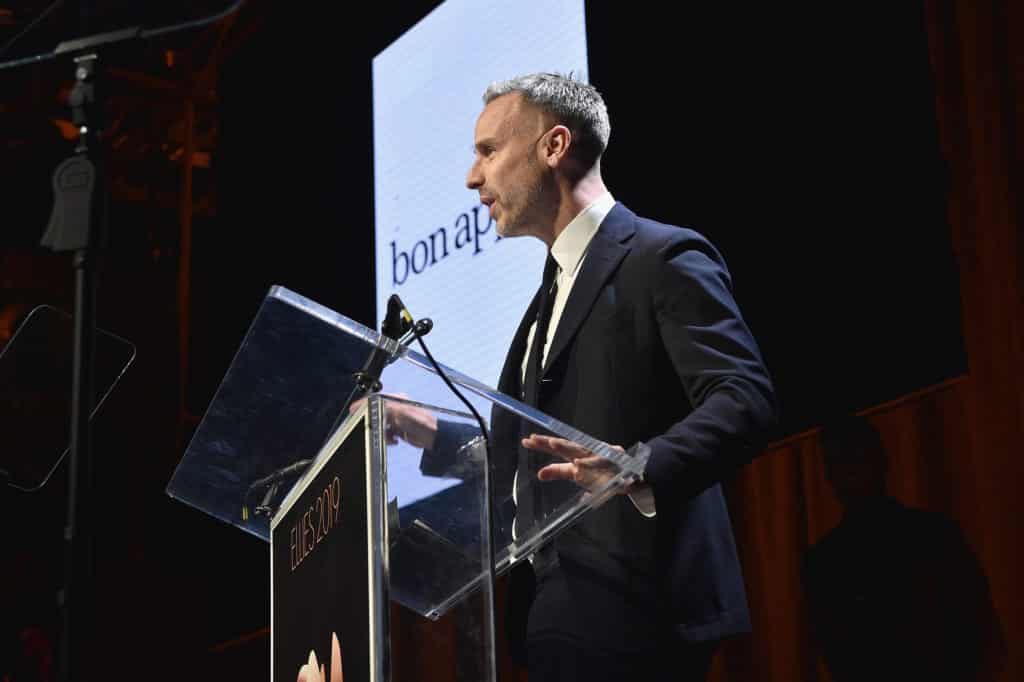
The editor-in-chief of the monthly food and entertainment magazine Bon Appetit stepped down on June 8 after a past photo of him wearing brown face circulated on social media.
The 2013 photo shows Adam Rapoport and his wife, Simone Shubuck, “at a Halloween party wearing stereotypical costumes meant to portray Puerto Rican dress,” according to National Public Radio (NPR).
After a growing backlash from Bon Appetit employees, Rapoport announced his resignation on Instagram.
“I am stepping down as editor-in-chief of Bon Appetit to reflect on the work I need to do as a human being and allow to get to a better place,” Rapoport wrote.
https://www.instagram.com/p/CBMT4rVg0H4/
Journalist Yashar Ali noted that Rapoport had deleted his Twitter account after he issued a tweet mentioning “slutty Chinese food.”
Was just reminded why Adam Rapoport is no longer on Twitter…he deactivated his account after he tweeted about “slutty Chinese food” and got called out for it.
Rapoport is Jewish and previously has talked about Rosh Hashanah recipes and other Jewish holiday foods as well as how he has learned to like Easter food since Shubuck isn’t Jewish.
One of the most important aspects of the legacy of George Floyd will be a series of police reforms designed to improve relations between law enforcement officers and residents of minority communities. What’s less certain is how ambitious those changes will be — and their potential impact on this country’s political landscape on the precipice of a critically important election.
The public’s mood has swung decisively in favor of more assertive police reform, and polls show former Vice President Joe Biden enjoys a roughly 2-to-1 margin of support over President Donald Trump on questions of which candidate is better equipped to bring together the country and to handle race relations. But while Trump’s incendiary behavior since Floyd’s death has caused the president significant political damage, Trump’s advisers believe that overly aggressive efforts to rein in law enforcement could present him with an opportunity to regain that lost ground with a “law and order” message designed to project these reforms as dangerous to public safety.
Biden will be forced to navigate a tricky landscape within his own Democratic Party as his allies begin an argument over exactly how hard to push a police reform agenda. Biden understands that while public opinion is overwhelmingly on the side of reform, many voters also will be wary of any measures that compromise the ability of law enforcement to protect public safety.
Congressional Democrats recently unveiled a comprehensive proposal to crack down on police wrongdoing, and while much of their package will enjoy broad public support, other aspects will be more controversial. Some proposals seem likely to be accepted with broad bipartisan support, most notably those having to do with strengthened use-of-force standards and enhanced anti-bias and de-escalation training procedures. That’s the low-hanging fruit: No one is going to be arguing in favor of choke holds. Another achievable reform may include the institution of a national police registry that would prevent so-called “rogue cops” from moving from one department to another after just-cause dismissal.
Trump has stepped up efforts to tie Biden to the defunding movement
But beyond those less-controversial goals, the discussion becomes more precarious for Biden. In the past, mandatory body cameras have raised issues relating to privacy and civil liberties. Opponents argue that a prohibition of no-knock warrants may make it easier for drug dealers to dispose of their products while police are waiting for entry. Even more challenging will be the argument about qualified legal immunity — the protections police officers have to shield them from lawsuits. Every one of these has the potential to cause great unease among key voter groups who have swung away from Trump toward Biden over the past few months.
Most challenging of all for Biden is the growing call for “defunding” police departments, an idea that is not part of the Democratic congressional package but is enjoying growing support from many party activists and elected officials. Most advocates make it clear their goal is not to shut down police departments but rather to redirect some funding from the police to social-service organizations to take on oversight of issues such as homelessness, drug abuse and other societal problems that have fallen to law enforcement over the years. But there is a sizable cohort demanding even more dramatic changes that would dismantle local police departments altogether.
Biden already has rejected these proposals, as have congressional Democratic leaders. But other voices from the left are less restrained. The Minneapolis City Council voted to move in this direction, and Rep. Ilhan Omar (D-Minn.) has said the city’s police department should be disbanded.
None of this is lost on Trump, who has stepped up efforts to tie Biden to the defunding movement. Biden’s challenge has always been to balance the demands of his party’s base with the needs of swing voters. While the national discussion over race relations is of tremendous benefit to Democratic candidates this year, the accompanying conversation over public safety and law enforcement could be more treacherous.
Dan Schnur teaches political communications at UC Berkeley, USC and Pepperdine. He hosts the weekly webinar “Politics in the Time of Coronavirus” for the LA World Affairs Council Town Hall.
On June 7, I was privileged to offer keynote remarks at the virtual graduation ceremony for the Maher Fellowship, a young leadership training program for Iranian American Jews, organized by 30 Years After. The following is an abridged version of those remarks. (I served as director of the fellowship in 2014, 2015 and 2019.)
Let me begin by sharing words of gratitude I spoke to my parents last year, which they admitted they’d waited a lifetime to hear: “Thank you for everything you’ve done for me, which I’ve seen or heard, but more importantly, thank you for all you’ve done for me of which I probably will never know.”
We may never know the tortured thoughts that lingered in our parents’ minds or the panic in their hearts as they spent their last moments on Iranian soil, and we may never have seen all the times they cried in helpless longing for their former country. This is precisely why I don’t reflect that our parents “escaped Iran.”
They escaped home. And there’s a crucial distinction between the two that I hope you will always recognize.
I’d be remiss if I didn’t acknowledge the current civil unrest in our country. Being American-born, you probably view freedoms of speech and assembly as inalienable rights; having been born in Iran, I still view these precious gifts as privileges. I know I’m wrong.
In Iran, Jews don’t protest in the streets because they know their Jewish identity will be a lethal liability should they be arrested, particularly during anti-government protests, and jailed, tortured or murdered on false charges of being “Zionist spies.” The only time Jews in Iran “protest” is when the regime parades them front and center at anti-Israel rallies.
Meanwhile, in Los Angeles, some young Persian Jews recently exercised their freedom to assemble or to write “Black Lives Matter” on the rear windows of their electric vehicles.
Had this been a graduation program in 1990, every speaker would have offered advice on how to survive now that we’re in America. Today, your generation knows much more about this country than your parents.
But there’s a challenge in having been born into the gloriously accommodating arms of American assimilation, and I call it the “or” dilemma: As young Iranian Americans, I suspect many of you don’t feel fully Persian or American. Perhaps you’re not sure when to be Jewish or when to be Persian; when to be American or when to be Jewish (the latter is always a dilemma when Coachella is scheduled during Passover).
I’d like to propose a new paradigm that replaces “or” with ”and.”
You are Persian and Jewish. American and Persian. Jewish and American.
The only challenge — and it’s a big one — is whether you know enough about any one of these identities that defines your heart (America), heritage (Iran) and soul (Judaism).
When you were young, it was your parents’ responsibility to teach Jewish, American and Persian values. They now are off the hook. If they share stories or photos, consider this a privilege, because you now are solely responsible for all of the information you want (or do not seek) about who you are.
But if you really want to know, ask your family questions. Ask until they beg you to leave them alone. Ask how they felt when the Six-Day War broke out 53 years ago or what Shabbat looked, smelled and tasted like in Tehran in 1979 or Beverly Hills in 1983.
A final thought: As you invest in your careers, don’t ignore your souls. Author Tzvi Freeman summarizes the Lubavitcher Rebbe’s thoughts on this matter with the following: “Every one of us must have two careers. Just as you must seek out a material career, so you must also seek out a spiritual one. But there is a difference: With a material career, you can only plow and sow and await the rains. With your spiritual career, you must provide the rain as well. It is up to you to fill your deeds with life.”
I’m proud to see the future of our community leaders in you. Congratulations!
Tabby Refael is a Los Angeles-based writer, speaker and activist.
Chabad of Sherman Oaks launched its Share4Justice campaign on June 8, encouraging community members to engage in acts of kindness in response to a June 3 White House tweet claiming that Chabad’s security barriers were bricks being supplied to antifa.
The White House tweet, which has since been deleted, stated, “Antifa and professional anarchists are invading our communities, staging bricks and weapons to instigate violence. These are acts of domestic terror.” The Anti-Defamation League (ADL) describes antifa (short for “anti-fascist”) as “a loose collection of groups, networks and individuals who believe in active, sometimes aggressive opposition to far right-wing movements.”
Before the White House tweet, Chabad of Sherman Oaks wrote in a June 1 Facebook post that the bricks had been in front of the Chabad for nearly a year as a security barrier in response to the April 2019 Chabad of Poway shooting.
“To alleviate people’s concerns that they may be vandalized and used by rioters, they were temporarily removed,” the post read.
Chabad of Sherman Oaks is a client of Shmuli Rosenberg, CEO of the fwd/NYC marketing agency. Rosenberg told the Journal in a phone interview, “We launched the initiative Share4Justice focusing on what we believe to be true justice, which is kindness. Caring for one another. Doing charitable deeds. Doing good deeds. This initiative will allow people to spread that positivity and that connection with one another that hopefully will accomplish the goals of justice that we’re all looking for.”
He added that within hours of the campaign being launched, there already had been an overwhelming response. “People are calling, texting, wanting to know what they can do, how they can be involved in spreading this.”
“We are looking [for] people to push themselves to do something good and at the same time, encouraging another person [to do something good].” — Rabbi Mendel Lipskier
Chabad of Sherman Oaks Director Rabbi Mendel Lipskier told the Journal that as part of the campaign, it is urging the Jewish community to do something Jewish, such as lighting Shabbat candles, donning tefillin or studying Torah.
Community members also are encouraged to donate to the Chabad Relief program, which provides funds to families in need during the COVID-19 pandemic. The Chabad of Sherman Oaks also has a program in which it matches volunteers with families who are homebound as a result of the pandemic.
“[Volunteers] call on [families] every few days [and ask], ‘How are you doing? Can we run an errand for you? Can we go shopping for you?’” Lipskier said, adding they also have a food distribution program and are offering Zoom programs.
“Many people are feeling lonely, like they’re stuck and they’re not seeing all their friends,” Lipskier said. “[We] created an online community so people can be in touch with each other.”
He urged people to spread the word about the campaign on social media. “We are looking [for] people to push themselves to do something good and at the same time, encouraging another person [to do something good],” Lipskier said, adding that the goal is to create a chain reaction of acts of kindness as if it were a Facebook post or a tweet.
Rosenberg added that Chabad of Sherman Oaks has long been an advocate for people helping one another out. The campaign, he said, is essentially “bringing Chabad of Sherman Oaks out to the public, because we feel and see that the reception is there. People want this now. I hope that people will see this and … really use it to promote popular change in the world.”
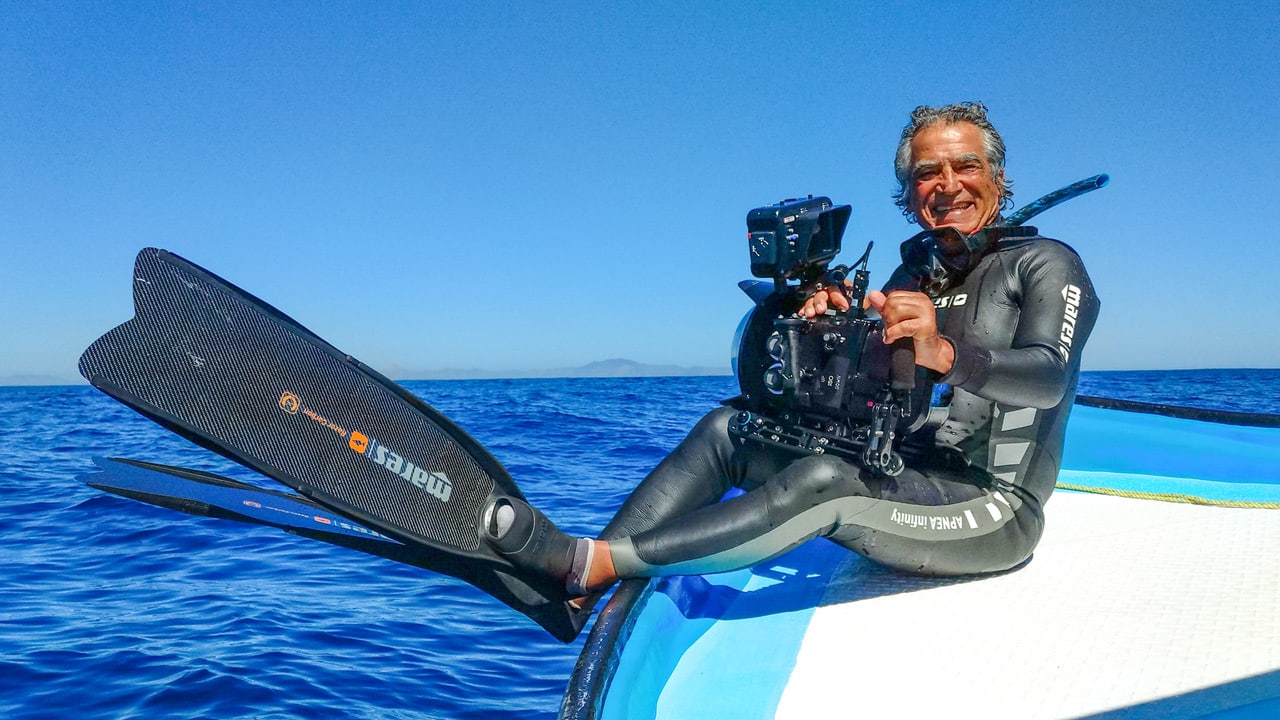
Despite photographing snow leopards, Bengal tigers and jaguars up close and personal without protective gear, photojournalist/conservationist Amos Nachoum proclaims that, contrary to popular belief, he isn’t suicidal nor does he flirt with danger.
“If I was drawn to danger, I’d be dead by now,” the Israeli-born Nachoum told the Journal by phone from his home in Monterey, Calif. “I want to dispel the myth of dangerous wildlife, but it takes a lot of planning and patience. No animal is dangerous to people. People endanger themselves because they misbehave towardanimals.”
He points out, for example, that it’s not uncommon for encaged photographers (sometimes with scuba diving tourists in tow) to hurl bloodied tuna fish slabs into the water to attract Great White Sharks, which in turn become agitated and aggressive. It’s an artificial situation spawned at the animal’s expense in order to create a photo op and bring in the big bucks.
However, he stressed, “I’m not fearless. In the [Israeli] army, I learned fear puts you on high alert and that’s a good thing, but you also have to know when fear is necessary. The first time I faced a great white shark unprotected, I discovered how wonderfully freeing and safe it was.”
Photo courtesy of Amos Nachoum
Set in the Canadian arctic on a land and seascape that’s spare and desolate and frozen, the visually striking, award-winning documentary, “Picture of His Life” (directed by Dani Menkin and Yonatan Nir) zeros in on Nachoum as he prepares to become the first still photographer to shoot the polar bear while swimming with one in open water. It’s been an obsessive desire over decades. “Only five people have swum with polar bears,” he said. “There have been far more men on the moon.”
Interspersed through the film, he recounts his military service during the Yom Kippur War (’73) and the long, scarring shadow it has cast. The film also touches on his estranged relationship with his late father who had little use for his son’s profession or lifestyle as a single, child-free man.
Without leaning on it the film evokes a driven and contradictory figure who has found solace and inspiration through nature at its wildest and paradoxically most pure and innocent. He is a humanist who is most at home in the ocean. He is a minimalist.
Nachoum’s photos have appeared in such publications as National Geographic, Time, Life and The New York Times among many others. A fashion and war photojournalist, he initially was drawn to the sea as a career move. But he also felt its restorative strength. The blueness of the water, its clarity and, yes, just his ability to float on top of the water, all of it in stark contrast to the sun-baked, dry, brown dusty desert that he identified with Israel in general and his tour of duty in particular. It was a tonic, a revelation.
Photo courtesy of Amos Nachoum
He wanted to share its beauty with the world and later when he saw the damage to the coral reef and the absence of fish that had previously been there he was determined to spread the word on that too. Not coincidentally, he conducts scuba diving/photography cruises all over the globe.
Polar bears, of course, have their own mythology, Nachoum said. To Westerners, they represent huge, dangerous animals to be feared; to the Inuit, polar bears are threatening but also awe-inspiring. For Nachoum, they aroused curiosity, raising questions about what their family lives were like, their shared levels of intimacy and how they expressed it.
The odds of finding a polar bear family were slim and the clock was ticking, but the team persevered, sitting in a small boat in the Arctic Sea watching the polar bears moving from island to island, climbing the rocks, finding food and then disappearing into the waters. Finally, a polar bear family came into view. Nachoum and his videographer slipped into the water and swam toward the mama bear and her two cubs and then stopped.
“We were 200 yards away,” Nachoum recalled. “The mother bear looked at us. The baby bears looked at us. It was silent, nobody moved and then she and the babies swam toward us. Our eyes were on each other and then, when she was about 10 feet away, we swam 15 feet beneath the surface and started shooting as she and the two cubs swam directly above us. She was about nine feet tall and weighed anywhere between 800 and 1,000 pounds. But what most struck me was how she was pushing the water with her front legs, her dark brown claws visible. At the same time, her rear legs, submerged in water, did the steering. At one point she was holding one of the babies on her side. They cared for each other and they were not threatening to us. All of it gave me confidence that my understanding of the wilderness is correct.”
Photo courtesy of Amos Nachoum
Nachoum hopes the film serves as an antidote to Hollywood’s vision, specifically Steven Spielberg’s “Jaws,” and its legacy of untamed wildlife as the monster.
Spielberg’s sister, Nancy, who served as executive producer on the film, said only half kidding, the documentary represents her apology on behalf of the family name. Identified with Jewish-Israeli themed films (from “On the Map” to “Who Will Write Our History?”), she said Nachoum’s story resonates with her on several fronts: her love of animals, the environmental motifs and the interconnectedness of families (for good and bad). As a Jew, she was moved by the Inuits who served as guides, with their deeply rooted tribal elements, the close-knit relationship between the grandfather and grandson, and the adherence to tradition in the face of potential extinction.
Making the film represented a labor of love for all the players, most pointedly for Israeli-born directors Nir and Menkin, each of whom boasts many credits and had previously partnered on “Dolphin Boy,” a documentary that also celebrates the nature.
Beyond the limited budget, time restraints, unforgiving conditions (five days on the water, heavy rains, subfreezing gusts of wind) and the very real possibility that none of it would work, their challenge was to learn something about Nachoum, an intensely private figure who revealed very little until they arrived in the Arctic. Inexplicably mystic, the natural setting in all its rawness made it possible for him to open up about his wartime experiences, his father and the healing powers of nature.
“Of course, he had to reassure us that we wouldn’t be eaten by polar bears,” Menkin said. “You have to understand I cannot go into a pool that’s not heated and New York winters still traumatize me. In the Arctic, I felt I was walking on the moon. But I connected with Amos as an artist, his focus and determination.”
He was further fascinated by him as an almost prototypical Sabra-born Israeli: the young boy brought up to serve the country, revere the military and develop a thick skin as a survival tactic in a harsh place where equivocation and sensitivity are viewed as weakness.
Photo courtesy of Amos Nachoum
“At the same time, he was able to transform himself in a totally unique way,” Menkin said. “Still, like many Jews, he was brought up to believe he had to make the world a better place.”
Nir echoed his views, although his connection with Nachoum is more personal. They first met years earlier as fellow photojournalists, but when Nir served in the army, he was traumatized by the loss of life and his serious injury sustained in a landmine explosion, and he contacted Nachoum for support and they shared a special bond. Nachoum urged him to become a filmmaker.
The polar bear trip was life-altering for all. Nir said he never had a greater appreciation of nature and that through Nachoum’s singular lens he saw “the beauty and grace of magnificent animals like polar bears in a brand new way and understood that we are all part of one animal kingdom.”
As for Nachoum, whose future adventures include filming Siberian tigers, clouded leopards and blue whales, he said that with each wildlife encounter he’s increasingly humbled and feels his own solitude most keenly, even at the very moment he experiences an inarticulate connectedness with the universe.
“Picture of His Life” premieres at Laemmle Virtual Cinema on June 19. For more information, click here.
Simi Horwitz is a New York-based, award-winning feature writer/film reviewer.
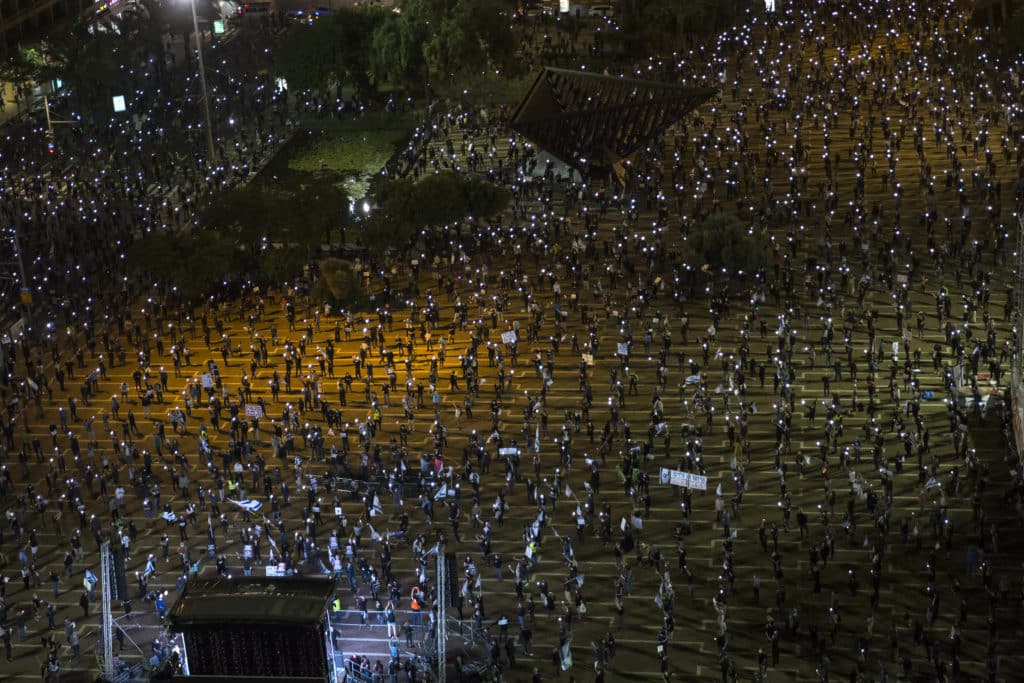
JERUSALEM (JTA) — Israel is hitting an “emergency brake” on its ongoing reopening of the economy due to a sharp rise in the rate of coronavirus infections in recent days.
Some 800 new COVID-19 cases were identified in the past week, as opposed to a total of about 300 infections of the coronavirus confirmed in the two weeks before that.
Plans to reopen railway transportation have been scrapped but will be revisited next week. The reopening of cultural and sport venues will be pushed back at least a week from June 14. The Education Ministry also said Sunday that 130 schools and kindergartens have closed in the past 10 days due to student and staff coronavirus infections.
One exception is event and wedding halls, which will be allowed to reopen with 250 people, as long as they wear masks and observe social distance protocols.
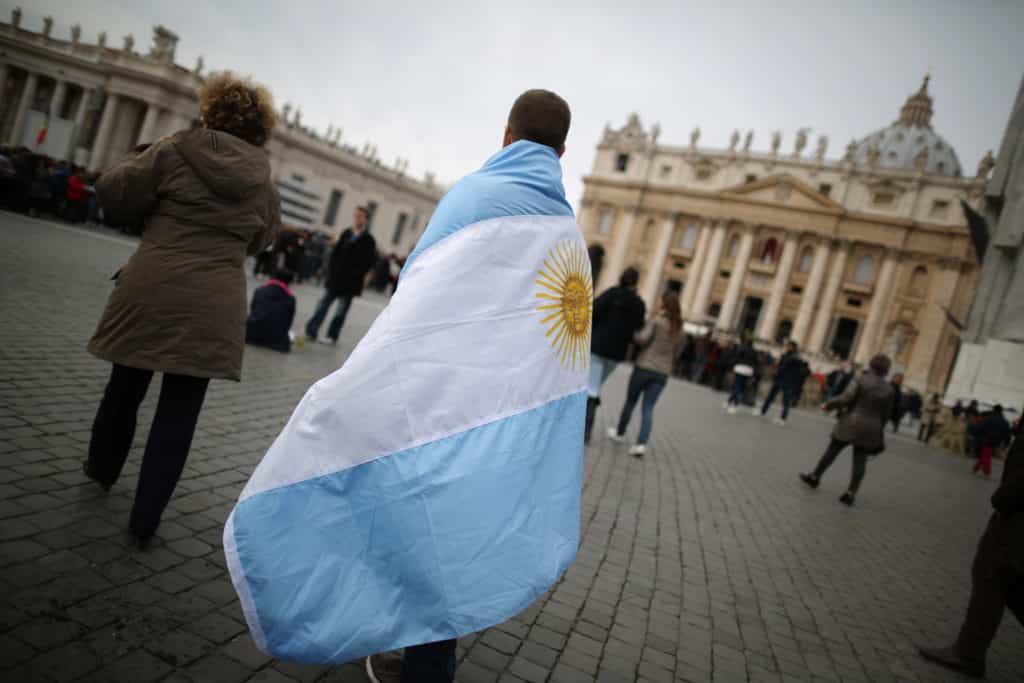
BUENOS AIRES (JTA) — Argentina’s ministry of foreign affairs adopted the International Holocaust Remembrance Alliance’s definition of anti-Semitism on Monday, promising to use it as “a tool to sanction and elimination of behaviors and attitudes based on hostility and prejudice, to reinforce prevention measures and to deepen the education of respect for plurality,” the ministry said in a statement.
Jorge Knoblovits, president of the Argentine Jewish political umbrella group DAIA, said it will allow the country to better combat domestic anti-Semitism.
The definition calls anti-Semitism “a certain perception of Jews, which may be expressed as hatred toward Jews” that is “directed toward Jewish or non-Jewish individuals and/or their property, toward Jewish community institutions and religious facilities.”
But it also includes “Denying the Jewish people their right to self-determination … by claiming that the existence of a state of Israel is a racist endeavour,” and “Drawing comparisons of contemporary Israeli policy to that of the Nazis.”
The latter parts of the definition have come under fire in recent years, as some critics say it stifles free speech and the right to critique Israel.
Since 2002, Argentina has been the only Latin American member of the International Holocaust Remembrance Alliance.
Written in the 14th Century as the Black Plague raged through Europe, Giovanni Boccaccio’s “The Decameron” featured 100 stories told by a group of seven young people sheltering in a secluded villa outside Florence, weaving tales to pass time in quarantine. Now, during a modern pandemic, a new group of storytellers have banded together—virtually—to tell tales in “Decameron 2020.” The June 9 installment features Michael Aloni (“Shtisel”) performing the work of playwright Ariel Dorfman.
The brainchild of producers Erri De Luca and Paola Porrini Bisson under the direction of Michael Mayer, the project reflects the contributions of performers and writers from many disciplines offering their talents. “In an epidemic that attacks lungs and stifles breaths, this ‘no-gated’ community has started to supply the oxygen of its art,” De Luca said.
“Collaborating with such diverse and passionate artists, many of whom I have admired for years, feels like a real privilege,” added Mayer. “Getting to do all that in such tumultuous times, is truly uplifting.”
New stories will be added regularly on YouTube here, where all of the pieces will be archived.