A swastika was found inside a residence-hall elevator at Southern Oregon University (SOU) on May 15.
KDRV-TV reported the swastika was carved inside Shasta residence hall’s elevator; the university reported the incident to local police.
SOU President Linda Schott wrote in a May 16 letter to community members that she condemned the swastika and that the university will be installing cameras in residence halls in an effort to hold perpetrators of such vandalism accountable. Schott added the university will be holding events to discourage acts of hate.
“I assure you as president of this university and with all that I hold dear, that I denounce acts of bias and hatred and will not stop working to eliminate them from our campus,” Schott wrote. “I will remain vigilant, with your help, and look forward to keeping you informed of SOU’s progress.”
In February, a swastika was drawn inside an SOU residence hall as well as the “N” word written on a black student’s whiteboard. Students told News 10 that the swastika and racial slur were in Shasta residence hall, although the university did not confirm it.
Schott wrote on her personal Facebook page at the time that the university had been investigating the matter but has yet to determine who was behind the acts of hate.
“I assure you that these actions are being taken seriously and will not be tolerated,” she wrote.
The American Association of University Professors (AAUP) selected San Francisco State University (SFSU) professor Rabab Ibrahim Abdulhadi, who in a May 2019 guest lecture at UCLA reportedly said Zionists are white supremacists, for an award on May 20 highlighting academic leadership and activism.
The AAUP’s website lists Abdulhadi, an expert on the Middle East, as one of five recipients for the Georgina M. Smith award, which the website describes as given to those who have “exceptional leadership in a given year in improving the status of academic women or in academic collective bargaining and through that work improved the profession in general.”
The website praises Abdulhadi for her “concern for human rights, including union organizing, gender and sexual justice, in her scholarship, teaching, public advocacy, and collaboration with a diverse group of academic, labor, and community organizations. Her commitment to global scholarship that builds mutual understanding is evident in the collaborations she has initiated.”
It added: “As a director of the Arab and Muslim Ethnicities and Diasporas (AMED) Studies Program [at SFSU] she brings together scholars, activists, academics, and organizers to create justice-centered knowledge, build broad-based coalitions, and advance the agenda for social change in Palestine, the United States, and internationally. Her leadership transcends the division between scholarship and activism that encumbers traditional university life.”
AMED Studies at SFSU celebrated the news, writing on its Facebook page that their nomination letter touted Abdulhadi’s Teaching Palestine research project as well as “advocacy campaign against the increased influence of Zionism over academic institutions and policies in the U.S.”
Jewish groups condemned the AAUP’s decision to give the award to Abdulhadi.
“It’s hard to imagine someone less deserving of such an award,” StandWithUs Center for Combating Anti-Semitism director Carly Gammill said in a statement to the Journal. “This professor has personally targeted a Persian Jewish student who objected to her equating Zionism to ‘white supremacy,’ used her academic department’s social media pages to spread anti-Semitic and anti-Israel propaganda, and actively worked to marginalize the vast majority of Jewish students who support Israel’s existence. The AAUP should rescind this award immediately and apologize.”
AMCHA Initiative director Tammi Rossman-Benjamin similarly said in a statement to the Journal, “The AAUP specifically applauds Abdulhadi for ‘leadership’ that ‘transcends the division between scholarship and activism that encumbers traditional university life.’ The division between scholarship and activism doesn’t encumber traditional university life, it protects it. It ensures students receive an education based on scholarship, and it protects our vulnerable youth from being politically indoctrinated by activist professors who attempt to weaponize their course curricula and advocate for personal political missions, like [boycott, divestment and sanctions] BDS, in the campus square. And the frightening truth is our research demonstrates that BDS promotion incites anti-Semitism.”
She added: “Someone who posts on her department’s official university Facebook page that ‘Zionism = Racism’ and ‘welcoming Zionists to campus … [is] a declaration of war’ should not be commended for her work on behalf of students, faculty or academia. In the days following her post, numerous vandals had written ‘Zionists Off Our Campus’ all across SFSU. Commending professors who use their classrooms and positions to promote politics, and in turn encouraging others to join this activism army, is disturbing and dangerous.”
Associate Dean and Director of Global Social Action Agenda at the Simon Wiesenthal Center Rabbi Abraham Cooper also said in a statement to the Journal, “While Arabs in the real world are increasingly cooperating and working with Zionist Israel in real-time including delivering real help to Gazans during pandemic, some cannot get past their lurid anti-Semitic and anti-Israel fantasies that deliver real hate in the real world. Shame [that] taxpayers [have to] foot the bill for hate peddlers masquerading in academic garb.”
Academic Engagement Network executive director Miriam Elman tweeted, “What a terrible selection & poor choice @AAUP! Sadly, @SFSU Prof. Abdulhadi has worked against inclusivity on her campus & has sowed division & polarization. She has a long history of demoralizing #Jewish, #Zionist students!”
The AAUP and Abdulhadi did not respond to the Journal’s request for comment.
In the May 2019, UCLA student Shayna Lavi told the Journal that Abdulhadi said during a guest lecture “that those who support Israel want to ethnically cleanse the Middle East and those affiliated with Israel and pro-Israel organizations are white supremacists.” When Lavi told Abdulhadi she was offended at Abdulhadi’s assertion Israel supporters are white supremacists, Abdulhadi responded: “That’s your opinion but you’re wrong. I stand with Jews who do not support Israel and I hope that Jews will disalign themselves with white supremacy.”
StandWithUs filed a complaint on behalf of Lavi against UCLA on the matter in October; in January, the Department of Education announced that it would be investigating the matter.
Reflections on some uplifting stories in the midst of these pandemic times.
How do we manage our lives during the coronavirus crisis? How do we keep our sanity? How do we use this quarantine to bring out the best in ourselves? Tune in every day and share your stories with podcast@jewishjournal.com.
President Donald Trump issued a statement on May 22 declaring all houses of worship “essential.” He also threatened to veto any governors’ attempt to keep houses of worship closed.
Speaking to reporters at a press briefing, Trump said: “Today I am identifying houses of worship — churches, synagogues and mosques — as essential places that provide essential services.”
He said it was a travesty that some governors have deemed liquor stores and abortion clinics as essential but not houses of worship.
“I call upon governors to allow our churches and places of worship to open right now,” Trump said. “If there’s any question, they’re gonna have to call me but they’re not going to be successful in that call. These are places that hold our society together and keep our people united.”
He added: “If they don’t do it, I’m going to have to override the governors.”
NEW: President Trump declares his view that houses of worship should now be “essential,” and calls on governors to open them “right now.” pic.twitter.com/hTJw3BRpOL
On May 20, the Department of Justice sent a letter to California Gov. Gavin Newsom, a Democrat, warning him that keeping houses of worships closed could put the state in violation of the First Amendment. Newsom responded to the letter in a May 21 interview on MSNBC, saying: “I have deep reverence for congregants and parishioners that want to reconnect with their community and to their faith and be able to practice accordingly. We’re just a few weeks away from meaningful modifications that will allow just that to happen.”
The Washington Post reported in February that Trump doesn’t belong to any church in the Washington, D.C., area but occasionally has attended services at St. John’s Episcopal and an Episcopal church in Florida.
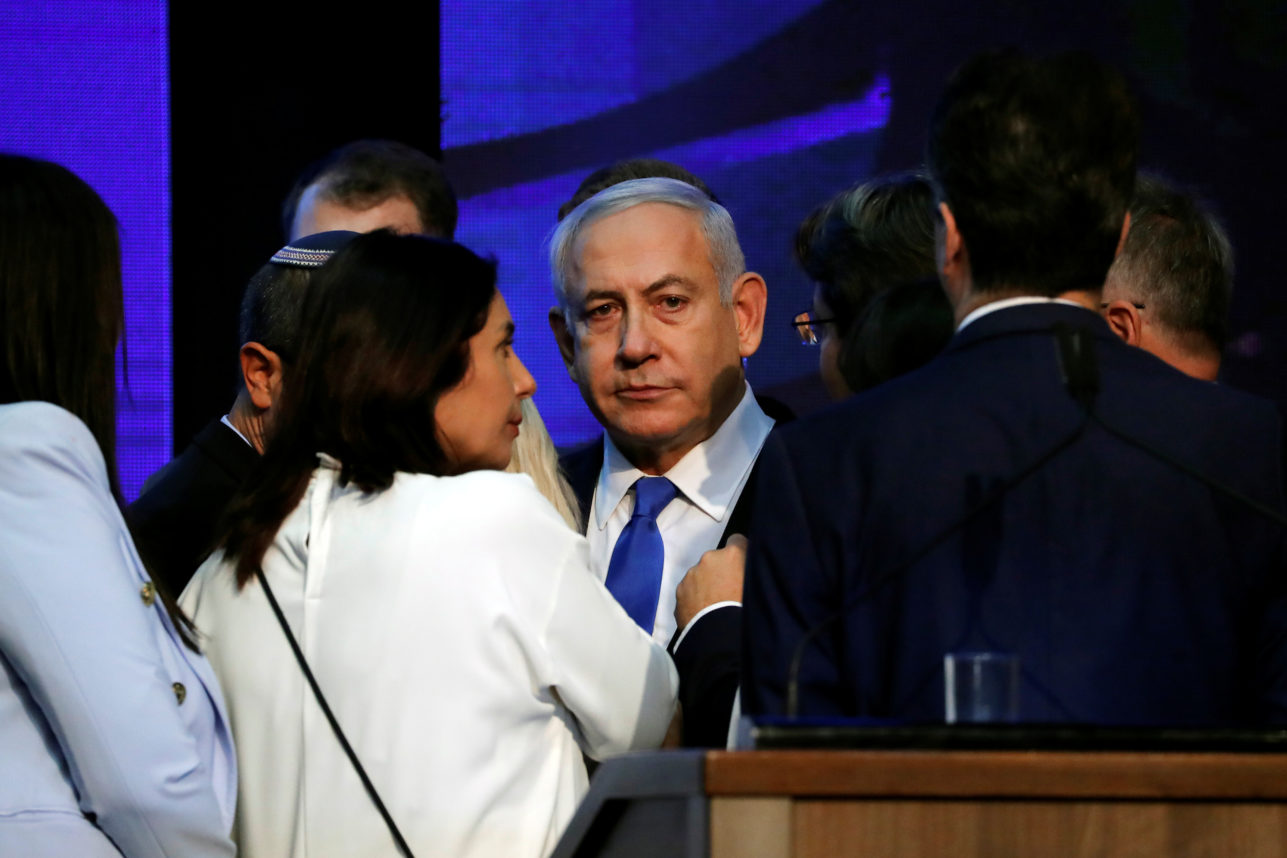
After more than three years of investigation, charges in three cases and three national elections, Israeli Prime Minister Benjamin Netanyahu will enter a Jerusalem courtroom Sunday for the start of his corruption trial.
Netanyahu was indicted more than a year ago on three charges that you can read more about here. Two have to do with allegations that he bought himself positive press, and the third alleges that he received illegal gifts from a rich donor. He has denied them all and called the investigations against him a “witch hunt.”
Netanyahu’s trial was delayed by two months after emergency measures put in place to battle the coronavirus pandemic effectively shut Israeli courthouses. Now with Israel’s infrastructure creaking back to life, the district court here is open for business again.
During that time, Netanyahu narrowly managed to hold onto power — meaning that on Sunday he will finally become Israel’s first sitting prime minister to go on trial. (Every other prime minister for the past two decades have been investigated; Ehud Olmert, who ultimately went to jail for corruption, resigned prior to his indictment.)
The trial is “really unprecedented,” Yuval Shany, vice president of research for the Jerusalem-based Israel Democracy Institute, said Thursday.
Here are five things to know as the trial gets underway.
JERUSALEM, ISRAEL – JANUARY 21: Israeli Prime Minister, Benjamin Netanyahu speaks to supporters at a Likud Party campaign rally on January 21, 2020 in Jerusalem, Israel. Israel to hold third election in less than a year after politicans faild to form a coalition. (Photo by Amir Levy/Getty Images)
1. Netanyahu will make only limited appearances in court.
Every day that Netanyahu spends in the courtroom keeps him away from other government business — and deepens the troubling optics of having Israel’s leader sitting at the defendant’s table.
Netanyahu last week asked the three-judge panel hearing his case to excuse him from the first day of the trial, claiming in part that his five bodyguards would violate the Health Ministry guidelines setting limits on the number of people allowed in the courtroom and that the first day is just a “technical” discussion among the attorneys.
The judges responded that he had to be there for the trial’s first day.
“This is the case in every criminal procedure, including the current criminal procedure,” they said.
But the judges likely will not insist that Netanyahu show up for every session after the first one, according to Israel Democracy Institute researcher Amir Fuchs. Still, Fuchs notes, he will need to be briefed and consulted with after every court session.
“He will have to be inside the process even if he is not physically there,” Fuchs said.
Israeli Prime Minister Benjamin Netanyahu attends the weekly cabinet meeting at the Prime Minister’s office in Jerusalem December 3, 2017. REUTERS/Sebastian Scheiner/Pool
2. The trial could last at least a year – and a final verdict could take longer.
Olmert’s did, even with the court meeting several times a week. In Netanyahu’s case, it could be several months before court is in session in the trial again since the defense must be given time to review all the materials generated during the investigation. When the court reconvenes, it could hear over 300 witnesses for the prosecution, according to reports.
That means the trial could take up to a year, and with appeals to the Supreme Court, a final verdict could take even longer. Olmert’s appeals after his conviction, for comparison, took more than three years.
Even if the court rules in Netanyahu’s favor, the saga may not be over. In Israel, the prosecution can appeal a court’s acquittal of a defendant, and often does.
JERUSALEM, ISRAEL – NOVEMBER 18: (ISRAEL OUT) In this handout image provided by the Israeli Government Press Office (GPO), Prime Minister Benjamin Netanyahu speaks with IDF Chief of Staff Lt.-Gen. Benny Gantz ahead of the weekly cabinet meeting on November 18, 2012 in Jerusalem. Israel. Israeli shelling of Gaza has entered its fifth day, with two media buildings being recently struck and several journalists injured. According to health officials in Gaza, at least 50 Palestinians have been killed since Israel launched operation Pillar of Defence. So far three Israelis have died in the exchange of missiles which followed an air strike on Wednesday that killed Hamas military chief Ahmed Jabari. (Photo by Kobi Gideon/GPO via Getty Images)
3. Netanyahu will probably be able to serve out his term as prime minister.
According to Israeli law, a prime minister who has been convicted of a crime must step down — but only once there is a final verdict. Under the terms of a governance deal that Netanyahu struck this month, he is set to remain prime minister only for 18 months before handing the reins to his coalition partner Benny Gantz on Nov. 17, 2021.
After that date, Netanyahu is set to take on the title of deputy prime minister. That could cause trouble for him, even if a final verdict still has not been reached. That’s because other government ministers and lawmakers do have to resign or take a leave of absence while under indictment.
But a recent lawsuit suggests that things won’t be cut and dry then, either. In response to a lawsuit making the case that Netanyahu should not be allowed to form a government while under indictment, the court ruled that it did not have the legal grounds to interfere with the workings of the Knesset, or the executive branch.
Once Netanyahu steps down as prime minister, the court will likely be asked to force him to resign. Doing so would require undermining the precedent it just set.
Israeli Prime Minister Benjamin Netanyahu looks on after speaking to supporters at his Likud party headquarters following the announcement of exit polls during Israel’s parliamentary election in Tel Aviv, Israel September 18, 2019. REUTERS/Ammar Awad
4. Netanyahu is not the only person on trial here.
A host of prominent Israelis will parade through the courtroom. Also on trial are Arnon Mozes, publisher of the daily Hebrew-language Yediot Acharonot newspaper, and Shaul and Iris Elovitch, the controlling shareholders of Israel’s Bezeq telecommunications company and also owners of the Walla news website. They are charged with providing Netanyahu with favorable coverage in exchange for political favors.
Also, three former government workers whom Netanyahu hired are expected to testify against him. Shlomo Filber was the director-general of the Communications Ministry who allegedly proposed regulatory changes to benefit Elovitch at Netanyahu’s request. Ari Harow was Netanyahu’s former chief of staff and recorded Netanyahu’s in-person meetings with Mozes. And Nir Hefetz was a Netanyahu media adviser and spokesman who allegedly directed the positive coverage of the prime minister on Walla. All have been given immunity from prosecution.
5. The trial will not be televised.
Israelis who are eager to hear what the star witnesses and others in the trial have to say are likely to have to get their information after the fact. In a pilot program launched last month to make Supreme Court proceedings more transparent, the high court streamed a hearing. But while there have been calls from many quarters asking the Jerusalem court to televise the Netanyahu trial, thus far there are no plans to include it in the pilot.
Hadara Bilsky thought she’d spend her first semester of college making friends in her dorm, having discussions with professors and students in class, and attending Shabbat services at Hillel. Now the 18-year-old isn’t sure if any of that will happen.
Emory University, her school of choice, has yet to announce whether it will hold classes in the fall. But many U.S. colleges have said they are likely to hold at least some classes virtually this fall because of the coronavirus pandemic.
Rather than starting at the Atlanta school this year as planned, Bilsky is “highly considering” enrolling in Year Course, a Young Judaea program in which high school graduates spend a year in Israel traveling the country, participating in internships and volunteer programs, and taking college-level classes.
She wants to pick up where she left off when the pandemic cut short her high school’s Israel trip this spring. And Bilsky hopes that by spending a year in Israel, she can “ride out the wave” of the pandemic while immersing herself in a new culture and learning Hebrew — and then start college a year later than planned.
“I wanted a more normal college experience, and no matter what Emory decides to do, it won’t be that experience,” said Bilsky, who lives in Gaithersburg, Maryland.
Under normal circumstances, hundreds of American Jews travel to Israel after they graduate from high school for what’s known as a gap year. Orthodox Jewish teens tend to study in seminaries and yeshivas before beginning college, while dozens of programs — including Year Course — primarily offer Israel experiences to non-Orthodox teens.
This year, the uncertainty about what college will look like in the fall, coupled with Israel’s relative success beating back coronavirus cases, appears to be driving up demand. Gap year programs say they are seeing a rise in last-minute applications as the possibility of not being able to be on campus next semester has students scrambling for other plans.
“This is the time of year when normally we’re pretty zipped up for the next year and we’ve usually gotten most of the applicants that we can expect,” said Dafna Laskin, Young Judaea’s director of engagement.
“This is the time of year when normally we’re pretty zipped up for the next year and we’ve usually gotten most of the applicants that we can expect,” said Dafna Laskin, Young Judaea’s director of engagement. “But in the last two to three weeks, where normally we’d see one to two applicants a week registering, I say we’re seeing maybe six or seven.”
In addition, fewer participants than usual have been dropping out, Laskin said.
Israel was among the earliest countries to institute strict social distancing measures to curb the spread of the coronavirus. Its death toll has remained below 300 and the country has now reopened, with businesses and schools operating while following social distancing and other measures to curb disease spread.
That makes studying there appealing to those coming from the United States, where many schools remain closed and summer camps have been canceled.
Nativ, a gap year program run by the Conservative movement, is seeing a rise in interest from students who say they do not want to spend a year doing online classes.
“We’re able to offer them an opportunity to come to Israel, study at Hebrew University in an academic institution with real classes, face to face with their professors, still have social opportunities with their friends and do everything that we would do on a regular year,” director Yossi Garr said.
Though Nativ ended up sending home this year’s participants early and foreigners are still barred from entering Israel, Garr is working under the assumption that the program will be able to go on in the fall with increased hygiene and sanitation, as well as other protocols to limit disease spread.
Nishmat, an Orthodox women’s seminary in Jerusalem, also is making adjustments to ensure its gap year program can start in the fall. After shutting down during the height of the pandemic in Israel and sending home its participants, the program has been able to reopen classes to Israeli students by taking a number of precautions. They include wearing masks and separating students into small groups at all times by Plexiglas partitions in classrooms.
“We saw that it’s possible to run school under those conditions. We’re doing it now,” said Rabbi Joshua Weisberg, who directs the seminary’s gap year program.
The seminary, too, is seeing a rise in interest. Usually the class is mostly finalized at this time of year, and one or two potential students might still be finishing their applications. But in recent weeks, a handful of young women have reached out about joining the program.
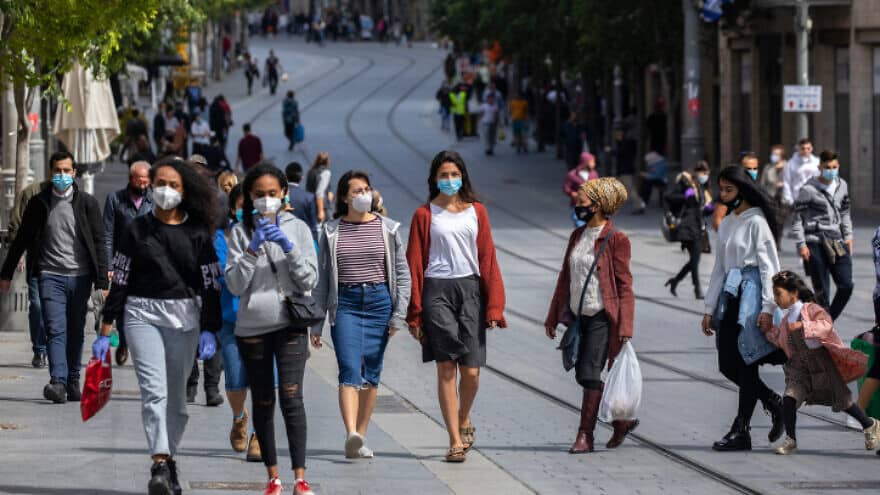
Israelis wearing face masks for fear of coronavirus do their shopping in Jerusalem City center after the government eased some lockdown measures that it had imposed in order to stop the spread of the coronavirus, on May 06, 2020. Photo by Olivier Fitoussi/Flash90
“It’s students who are rethinking their whole plan” because of the pandemic, Weisberg said.
The pandemic might still throw a wrench in students’ gap year plans. It’s unclear whether colleges and universities will approve gap year requests for all the students who might request them, and a second wave of infections could make travel inadvisable.
“I am worried that I won’t be able to go at all,” said Reena Bromberg Gaber, who is planning to participate in Nativ in the fall. “It will be really sad, and it will be another cancellation in a really long series of cancellations.”
The 17-year-old has spent the last few months doing courses virtually and her high school graduation was canceled. Bromberg Gaber had planned to participate in United Synagogue Youth’s spring convention but that was nixed. Nor will she be working as a junior counselor at Camp Ramah of the Poconos this summer: Like most camps, it won’t be operating because of the pandemic.
Still, Bromberg Gaber says the fact that Israel has been reopening gives her hope that the same fate won’t befall her plans for the coming year.
“It will be the first time in a while that I’ll be able to hang out with friends,” she said, “and start getting back into real life.”
When season 3 of the acclaimed Israeli drama “Fauda” dropped on Netflix in mid-April, the lockdown where I live was entering its second month and the hunt for new streaming material was growing desperate.
So I was pleased to discover that somehow I had never gotten around to watching season 2. Days of binging lay blessedly in front of me.
If you’re not up to speed, “Fauda” follows an elite Israeli counterterrorism unit conducting undercover missions deep in the West Bank. The third season opens with leading man Doron Kabilio working undercover as a boxing coach for Bashar, a young Palestinian whose cousin is an elusive Hamas operative. The plan is to use Bashar to get to the cousin, but naturally this doesn’t unfold as planned, and an entire season of gunfights and associated mayhem ensues.
“Fauda” didn’t grab me after season one, which you might have concluded since it took a pandemic to get me watching again. Maybe my anxiety meter is particularly sensitive right now, but I was white-knuckled for most of these episodes. Much of the chatter around the show centers on its politics, which is understandable. But for the sheer suspense factor, “Fauda” is one of the best things out there.
Enjoying the show entails multiple acts of suspension, the most obvious being political.
Enjoying the show entails multiple acts of suspension, the most obvious being political. If you’re so inclined, you can see the show as asking us to empathize with a bunch of Israeli vigilantes who spray bullets around the West Bank and then get all bent out of shape about it, taking out their anger and frustration and general moral disquiet on their spouses and children. Or maybe it’s telling us that the river-to-the-sea Palestinians who mourn the killers of Israeli children are just regular people buffeted by forces beyond their control.
Or maybe it’s just recycling that most tired of Middle East conflict cliches — the well-worn cycle of violence, where killings beget killings and no one enjoys the moral upper hand. You’ll enjoy the show more if you aren’t wedded to any of these narratives.
You’ll also need to suspend your disbelief. Wait, this seemingly hyper-realistic portrayal of Israeli counter-terrorism ops isn’t actually how it is? You mean, Palestinians haven’t gotten hip to the fact that the same four guys and (and one hijab-wearing woman) keep showing up on West Bank street corners just when the bombs start exploding? You mean, Israeli commandos aren’t routinely seducing Palestinian doctors to get close to their patients? You mean, Bashar and his dad managed to smuggle two kidnapped Israelis across the breadth of the country while a full-scale manhunt is underway (or that they even thought it was a good idea to try)? The list goes on — but you should suspend this line of thinking too.
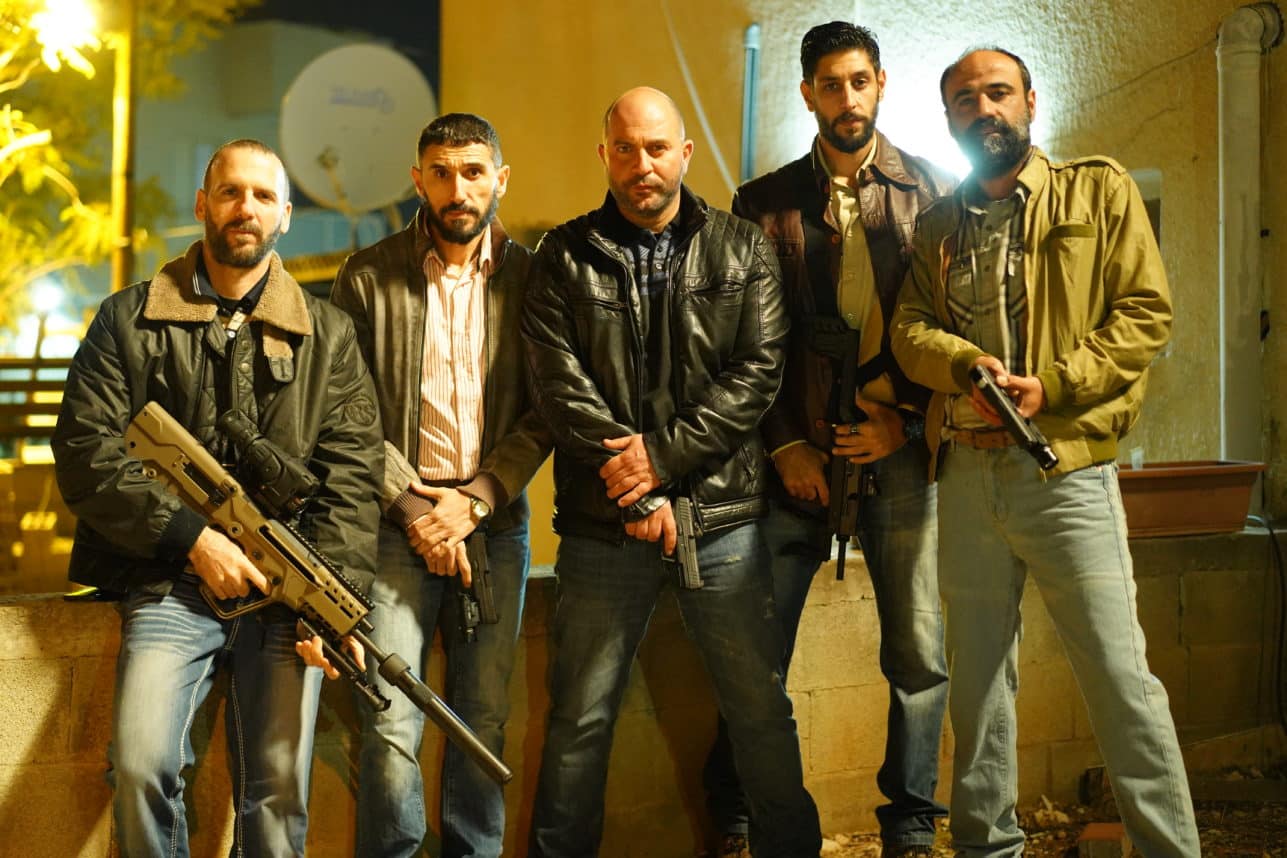
The cast of “Fauda” (Photo courtesy Netflix)
I found these plot absurdities galling at times, but let it go. At the end of the day, “Fauda” is just good television. Not perfect, mind you. There’s the “Game of Thrones”-esque tendency to kill off characters we’ve grown fond of, though perhaps that’s one concession to realism the writers couldn’t avoid making.
And then there’s the sense, familiar to fans of “Narcos,” that every scene has happened a dozen times already — the team taking up poses of practiced nonchalance in a some dusty village; the drones above streaming buckets of data to a command center; IDF officers pensively adjusting ear pieces as they prepare to wage cyber war. The all-seeing IDF can’t possibly miss this time, you think. But they miss this time. And the next time. Until this time is the last episode of the season, in which case, they don’t.
There’s a million things wrong with this show, but ignore them all. You’ll thank me for it, even if your cardiologist won’t.
It’s all quite pat, but I fall for it reliably — just like I did when Pablo Escobar escaped the clutches of the DEA for the hundredth time. No other show reliably spikes my blood pressure quite like “Fauda.”(Whether that’s a wise form of recreation for a man in his 40s during a public health crisis is a topic for another time.)
No matter how many times I see Doron and company do their thing, I find myself digging nails into the fabric of the couch. For the half-season the team was in Gaza, I nearly tore the cushions to shreds. (Gaza is way scarier than the West Bank — trust me on this.)
There’s a million things wrong with this show, but ignore them all. You’ll thank me for it, even if your cardiologist won’t.
Growing up in Wharton, Texas, I learned three lessons about being Jewish from my parents: We were obligated to do everything within our power to support the State of Israel. Jewish unity is of critical importance. And all leadership starts at home.
Our strength as a Jewish people lies in our willful acts of solidarity even in the face of disagreement. But recently, disagreement within one of our most important American Jewish institutions has spilled out into the public forum, undermining our sacred work.
After electing Dianne Lob to serve as board chair, a public controversy led to the Conference of Presidents of Major American Jewish Organizations voting overwhelmingly for current board chair Arthur Stark to remain in his position until April 2021.
It is no secret that there are people of good faith on many sides of every issue within the Conference of Presidents, and that robust discussions and disagreements are common. The fact that the Conference of Presidents includes the full spectrum of American Jewish opinion is key to its critical and indispensable role for American Jewry, and indeed for Jews everywhere.
For decades I have been involved in the leadership of a veritable alphabet soup of Jewish organizations. While I have not always agreed with everyone else in the room, once a decision was made, I believed it was my duty as a member to keep my grievances in-house. We must support Dianne Lob and the rest of the leadership as they direct the Conference of Presidents in its important work.
We must support Dianne Lob and the rest of the leadership as they direct the Conference of Presidents in its important work.
The Conference of Presidents was created in response to President Eisenhower’s Secretary of State John Foster Dulles’ declaration that he would only deal with one Jewish organization and not a multitude who had different — and sometimes opposing — views. Typical of our ingenuity, we created the Conference of Presidents, comprised of the leaders of those same organizations. Out of many, we made one.
Over its history, the Conference of Presidents has engaged both American and global leaders to discuss the most critical issues facing world Jewry, anti-Semitism and American policy toward the State of Israel. The Conference of Presidents successfully fulfills this role as one entity — even as its members may vigorously disagree internally on particular policies. With today’s fractious political climate in the United States, we often forget that our political opponents can also be our brothers and sisters in arms on the causes we all care about.
From left: Conference of Presidents CEO William Daroff, Israeli Prime Minister Benjamin Netanyahu, executive vice chairman Malcolm Hoenlein and chairman Arthur Stark speaking at the 2020 Conference of Presidents Summit in Jerusalem. Source: Conference of Presidents via Twitter.
When we take our internal squabbles outside of the Conference of Presidents forum, we endanger the organization’s ability to represent our Jewish community. Conference of Presidents members would be hampered in deliberating honestly and openly if they fear that their words will be used against them or that their viewpoint will be vilified externally.
The critical role of the Conference of Presidents is jeopardized if its members do not honor the rules of deliberation as they attack each other or undermine each other’s organizations. The more we drag these disagreements into the spotlight, the more we damage American Jewry as a whole.
The critical role of the Conference of Presidents is jeopardized if its members do not honor the rules of deliberation as they attack each other or undermine each other’s organizations. The more we drag these disagreements into the spotlight, the more we damage American Jewry as a whole.
The Conference of Presidents’ relevance and importance has grown exponentially from its founding in the 1950s. When Jews around the world are in danger — when they are jailed by authoritarian regimes or threatened by anti-Semitism — the first call is to the Conference of Presidents. It is this umbrella group’s leadership who works behind the scenes tirelessly to protect and save Jewish lives.They leverage relationships across the community to make a difference. These same leaders work with the American administration to understand the plight of Jews and the State of Israel, as well as sharing insights on America with the Israeli government.
One of the most foundational obligations of the Torah is the mitzvah of “ahavat yisrael,” the love for one’s fellow Jews. I personally have seen how the Conference of Presidents forges ties with key leaders around the world and acts silently to support and protect our brothers and sisters. As leaders representing organizations within the Conference of Presidenets, we must put aside our differences and remember the important role that we all play in supporting the Jewish people. Our disagreements should only make us stronger, not weaken and divide us.
FRED ZEIDMAN is Co-Chairman of the Council for a Secure America. He is the Chairman of the Gordian Group and is the Chairman Emeritus of the United States Holocaust Memorial Museum appointed by President George W. Bush.
One of my earliest memories was from Kindergarten, when our cantor took the class on a behind the scenes tour of the sanctuary. The greatest part of the tour was learning the secret passage that the clergy used to magically appear on the Bimah.
And so …. I wanted to take the opportunity to show our community here a behind the scenes look at Shabbat during the pandemic.
It’s all in the photo above.
A ladder.
A computer (to broadcast via zoom).
Another computer (to monitor the livestream).
An iPad (to have the service outline and liturgy in front of me).
Pretty complicated. Pretty simple.
From this set up (and our cantor and other service leaders have similar set ups in their homes) we magically appear each Shabbat on our virtual Bimah.
None of us trained to lead services via zoom. But all of us trained to search our souls in order to teach, to reach, and to touch. And at this moment in time of our world, we use whatever tools we can to harness community to visualize hope!
See this fig tree here? It’s my favorite tree on the block.
It’s got this really lush honeysuckle vine that has just entwined itself to the tree, like two lovers spooning in a big bed or maybe like two best friends, walking, arms around each other’s waist.
Every day I wonder whether or not they get an oxytocin rush from touching.
I guess that shows where my mind is at.
In other very, very big news from Les Baux: yesterday was the first outdoor farmers market.
At first I was hesitant.
I’ve seen basically zero humans up in my little hamlet and even though France is slowly opening up and we are now allowed to congregate in groups of 10, the prospect of being even in a six feet proximity of humans, even in the open air, scared me a bit.
But life for the next year or two is going to be a long series of risk-assessment conversations with oneself and I figured I may as well get used to it.
So I drove down the mountain.
And damn if that market wasn’t a scene of pure, unadulterated happiness!
Responsible happiness, to be clear— nearly everyone kept a distance and the majority wore a mask—but still, there was a kind of grateful glow in the air.
The cute cheese-maker lady flirted with me from behind her face mask (camouflage print, avocado green).
The older couple who sold me a giant bunch of magenta peony buds beamed from behind their tartan pink and green masks.
And the mustached sausage guy looked at me like I was his long-lost granddaughter and became highly animated explaining all the sausage varieties – green pepper, black pepper, hazelnut – from behind his white paper mask.
And all held out the super-sized bottle of hand gel after we exchanged money, all thanked me for my purchase with an unfamiliar sincerity.
When we thanked each other there was a depth in the thank you.
I came home with black radishes, green and orange tomatoes, yellow courgettes, green pepper salami, raw cow milk cheese, a baguette still warm from the oven.
And wondered how I would have reacted in January to the notion that in four months, an hour at the market would be such a source of elation.