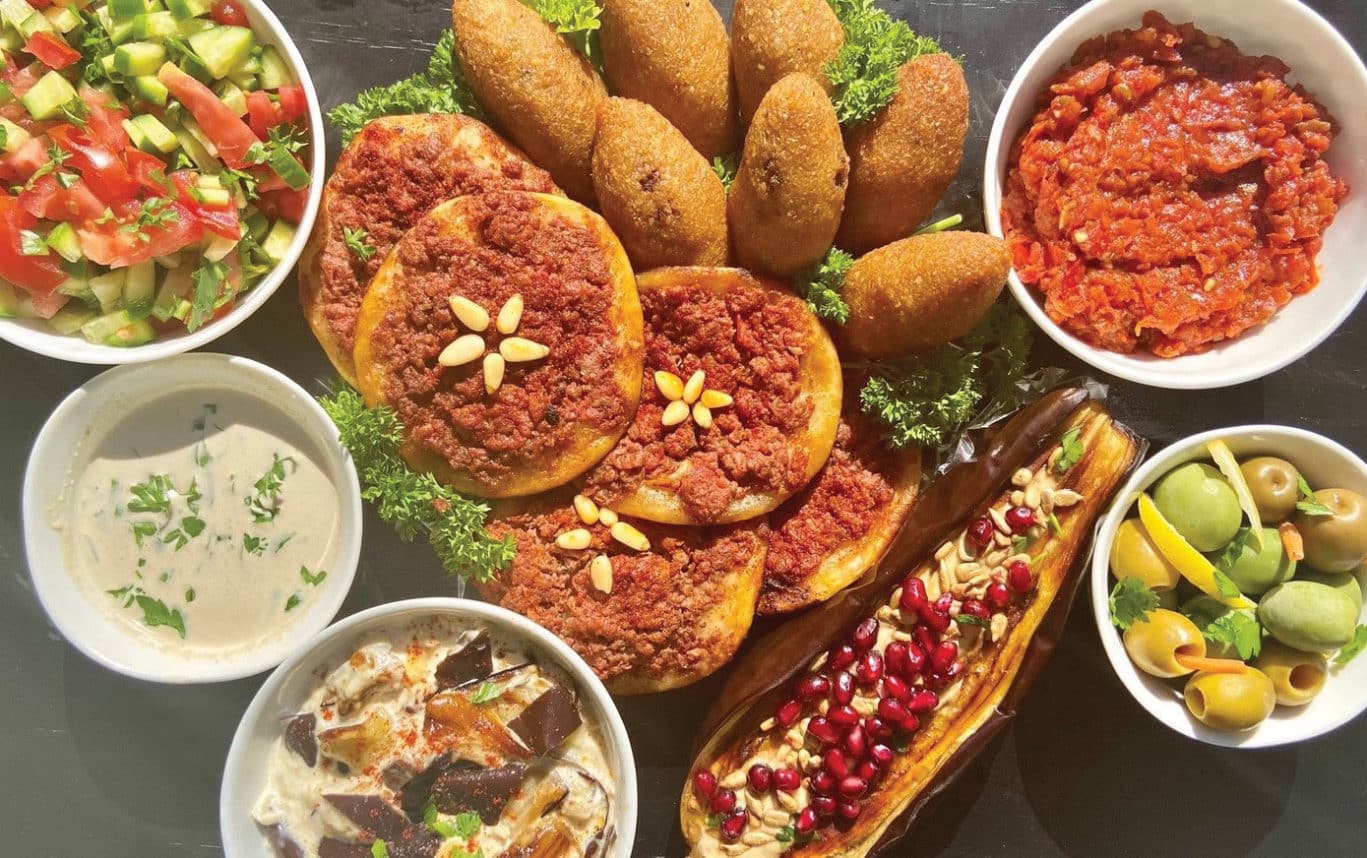
With its colorful array of brightly colored salads, savory dips, exotic finger foods and freshly baked breads, the mezze (or maza) is a feast for the senses. While this selection of small dishes serves as the appetizer course of the Sephardic Shabbat meal, the mezze is common to all the lands of the former Ottoman Empire.
Although some say that the name derives from “mezzo,” the Italian word for half, referring to the small size of the dishes, and others say it is from the Arabic “t’mazza,” meaning to eat in small bites, it more likely comes from the Persian word “maze,” which means taste or snack. The small dishes are perfect for sharing and are meant to encourage slow eating and warm conversation.
The sheer brilliance of this cuisine is the emphasis on taking common ingredients and enabling them to shine. The flavors of beets, carrots and eggplant are enhanced through cooking with the judicious use of garlic, cumin, coriander, paprika or turmeric. Bright red peppers and tomatoes show up in Moroccan matboucha and Turkish salad. Potato salad takes on a unique twist when seasoned with lemon, cumin and Aleppo pepper. Tomatoes, cucumbers, onion and parsley glisten with a refreshing dressing of lemon juice and extra virgin olive oil.
Some of the dips, such as hummus, tahini and smoky eggplant baba ghanoush, are now common on the American table. Turshi, preserved lemons, pickled turnips and olives lend extra flavor and crunch.
The menu might feature stuffed grape leaves, served hot or cold; as well as bourekas, delicious puff pastry filled with potato, spinach, mushrooms or meat. The stars of the Levantine maza are kibbe and lach’majin, the great classics of Syrian cuisine.
The incredibly delicious kibbeh nabelsieh is a crispy deep-fried, torpedo-shaped bulgur shell with a delicately spiced onion-and-meat filling. It is a time-consuming dish that requires great talent. Like all who master the complex art of making kibbeh, our good friend Jazmin Daian Duek learned to make them from her mother, renowned Argentinean Chef Eva Helueni. Luckily for us, Duek runs a catering business and delivers a mouthwatering repertoire of exotic dishes.
Fortunately, lach’majin is much easier to master. These little ground beef pizzas get their unique flavor from the use of tamarind. An ingredient featured in the cuisines of Persia, India, Southeast Asia and Mexico, tamarind makes the mouth pucker with its sweet, sour and tangy notes. In our recipe, we take a shortcut and buy frozen mini pizza rounds to make lach’majin at home.
Break out a bottle of Arak and share these gastronomic pleasures with friends and family.
ROASTED EGGPLANT WITH POMEGRANATE SEEDS
2 medium eggplants, washed
2 tablespoons avocado or canola oil
1/2 teaspoon kosher salt
6 tablespoons tahini
4 tablespoons sunflower seeds
1 pomegranate, seeded
Cut eggplants in half vertically and place on baking sheet face up.
Drizzle with oil and salt.
Broil in middle of oven for 8 to 10 minutes, making sure not to burn. Cool slightly and drizzle center of eggplant with tahini. Sprinkle with sunflower seeds and pomegranate seeds.
Serves 4-8.
LACH’MAJIN
For dough:
2 dozen store-bought small pizza dough rounds
1/2 cup avocado or canola oil
For topping:
1 pound ground beef
2 onions, finely chopped
3 ounces tomato paste
Juice of one lemon
1 cup tamarind concentrate
1 tablespoon allspice
1 teaspoon cinnamon
1 teaspoon kosher salt
1 teaspoon pepper
Pine nuts for garnish
Preheat oven to 350 F.
Combine beef, onion, tomato paste, lemon juice and tamarind concentrate with all the spices.
Mix well.
Grease baking sheets with oil, then place pizza rounds on sheets. Place heaping tablespoon of meat onto each round, spread and press firmly. Bake pies for 15 to 20 minutes or until crust is golden brown. Garnish with pine nuts.
Makes two dozen pies.
Rachel Sheff’s family roots are Spanish Moroccan. Sharon Gomperts’ family hails from Baghdad and El Azair in Iraq. Known as the Sephardic Spice Girls, they have collaborated on the Sephardic Educational Center’s projects, SEC Food Group and community cooking classes. Join them on Facebook at SEC FOOD.
The coronavirus lockdown has tested everyone’s resilience and ability to roll with the punches — physically, mentally and emotionally. And on the days when things seem insurmountable, sometimes a funny cat meme or an inspirational quote can help lift you out of your funk. But if you really want to be inspired, then the best people to look to are those who grapple with adversity every single day.
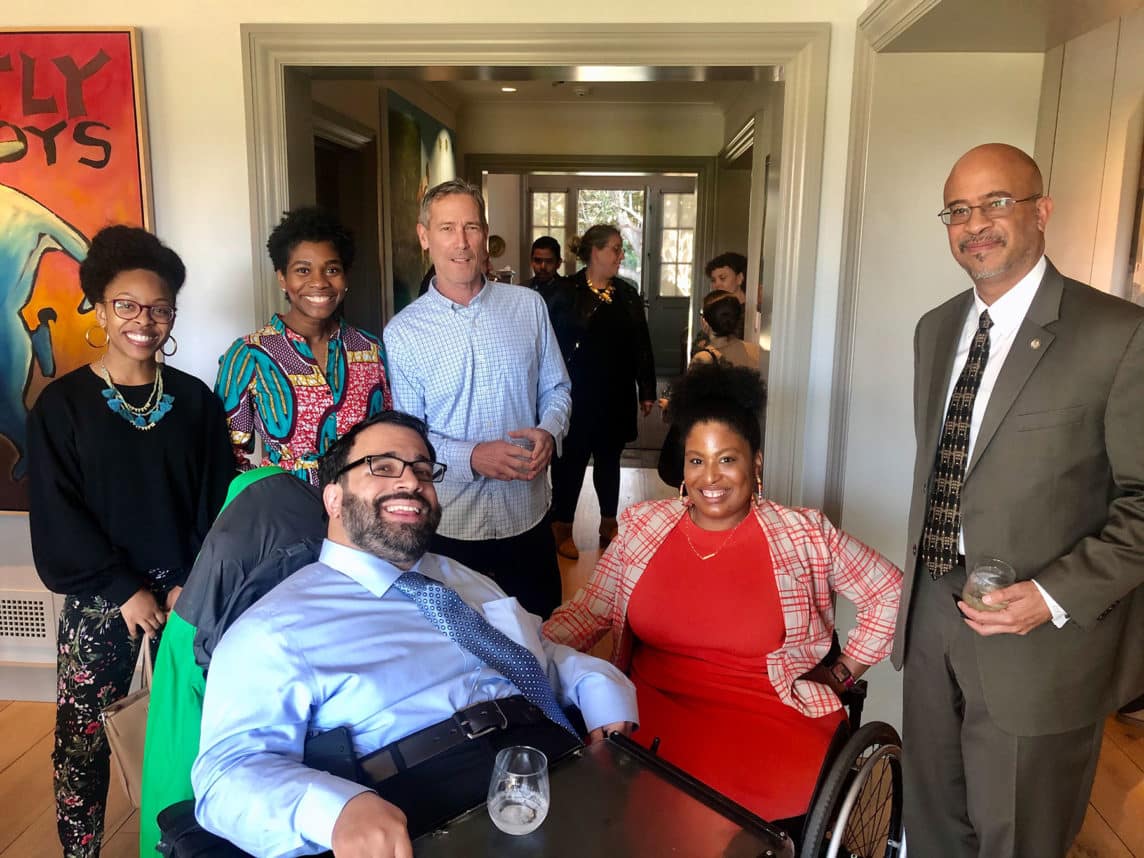
Matan Koch is one of those people.
The 38-year-old who lives in Los Angeles is a quadriplegic, born with cerebral palsy. But that didn’t stop him being admitted to Yale University at the age of 16, serving as his alma mater’s president of the student disability community, becoming a Senate-confirmed appointee on the National Council on Disability in the Barack Obama administration, and working as a consultant for Jewish organizations, advising Jewish professionals and students on how to be more inclusive of people with disabilities.
But as the son of a rabbi, Koch decided his next move was to attend rabbinical school. That is, until he was approached by philanthropist and former political consultant Jennifer Mizrahi, founder of RespectAbility — the Rockville, Md.-based nonprofit working to erase stigmas and advance opportunities for individuals with disabilities.
Mizrahi was looking to expand the organization to Los Angeles and she set her sights on Koch. “If you go on Google to figure out who are the smart people that you really want to know about, in five minutes you know that you want to know Matan Koch,” Mizrahi told the Journal. In persuading Koch to take the position, she told him, “I am hoping you will come to see this as the alternative path, that rabbinical school was not for you.”
“We’ll find out once I have been walking the path for a while,” Koch replied.
He’s been walking that path since December, serving as the director of RespectAbility California and Jewish leadership. He also has led the group’s training and job placement program, Project Moses. Drawing on his legal background (after graduating from Yale, Koch studied law at Harvard and then spent a decade as a commercial litigation lawyer in New York), he also serves as general counsel at RespectAbility.
Yet like everyone else in the aftermath of the coronavirus outbreak, Koch has found himself adapting to a new normal, and advocating for much-needed support to address the specific needs now facing the disability community.
“I could be sitting at home bored, but instead I am leading the charge to save and improve lives in the community, especially for people with disabilities, which is my mandate,” he told the Journal. “I normally talk access to Jewish life and employment but you can’t have access to any of those unless you are alive.”
“I could be sitting at home bored, but instead I am leading the charge to save and improve lives in the community.” — Matan Koch
That’s not hyperbole. As Mizrahi told the Journal, given their underlying health issues, ongoing economic struggles and unique living circumstances, people with disabilities are among the most vulnerable to the coronavirus.
“In a way I am privileged,” Koch noted. “At a time of difficulty and fear, I get to actively [do what I love].” That includes ensuring the disability community’s needs are being addressed. The three most important areas, Koch said, are food security, employment and health care. “Our goal is to be able to answer all three in the affirmative,” he said. “It is sort of the nature of the world that people who are the most vulnerable are the least thought of when times are hard.”
Nationwide, approximately 11 million people with disabilities are enrolled in the Supplemental Nutrition Assistance Program (SNAP), and 1 million people with disabilities in California are enrolled in CalFresh — the statewide version of SNAP.
While SNAP recipients can use their Electronic Benefit Transfer cards, known as food stamps, to purchase food, most states did not permit SNAP enrollees to use food stamps for online food purchases before the outbreak of the pandemic. In April, RespectAbility wrote to the U.S. Department of Agriculture to address this gap. As part of a coalition called the Consortium for Citizens With Disabilities, RespectAbility successfully advocated for that expansion in several states, including California.
“It’s a very big deal,” Mizrahi said. “We’re talking about billions of dollars of food and millions of people’s ability to eat safely during a pandemic. It is something we never envisioned working on, because no one envisions a COVID-19 crisis, but it was very clear that it was what the community needed most urgently.”
While Koch is employed and therefore not eligible for food assistance, he is nonetheless limited in his ability to shop for groceries. He is unable to buy fresh produce on his own because he cannot put fruits and vegetables away in his refrigerator without the help of his overnight caregiver.
A member of IKAR, at the start of the pandemic, members brought him meals. He also has received frozen meal deliveries from Jewish Family Service of Los Angeles. “[I am] subsisting on things I can throw in the microwave,” he said.
“We’re talking about billions of dollars of food and millions of people’s ability to eat safely during a pandemic. It is something we never envisioned working on, because no one envisions a COVID-19 crisis, but it was very clear that it was what the [disability] community needed most urgently.” — Jennifer Mizrahi
Aside from his overnight caregiver, Koch is very much on his own during the day in his motorized wheelchair. Living on his own, he said is far safer during this pandemic than the institutional care facilities many of his disabled peers call home, where, he noted, the population is at a higher risk of contracting COVID-19 if receiving treatment in densely packed settings. “The deeper one’s disability the less one can socially isolate,” Koch said.
Regarding unemployment in the disability community, Koch wrote an article in the Journal in November stating, “The employment rate of people with disabilities in Los Angeles ranks lower than that of the lowest ranked state, West Virginia, at less than 23%, more than 14 points below the national average.”
Now, with the lockdown resulting in more than 30 million people filing for jobless benefits, Koch said, “Now we’re looking at massive widespread unemployment.”
“Attitudinal barriers — the perceptions of people with disabilities, are a far bigger barrier to employment than anything physical or logistical,” he said. “I don’t think working from home will change that, and I am quite worried that with millions of nondisabled Americans looking for work, people with disabilities will be left out.”
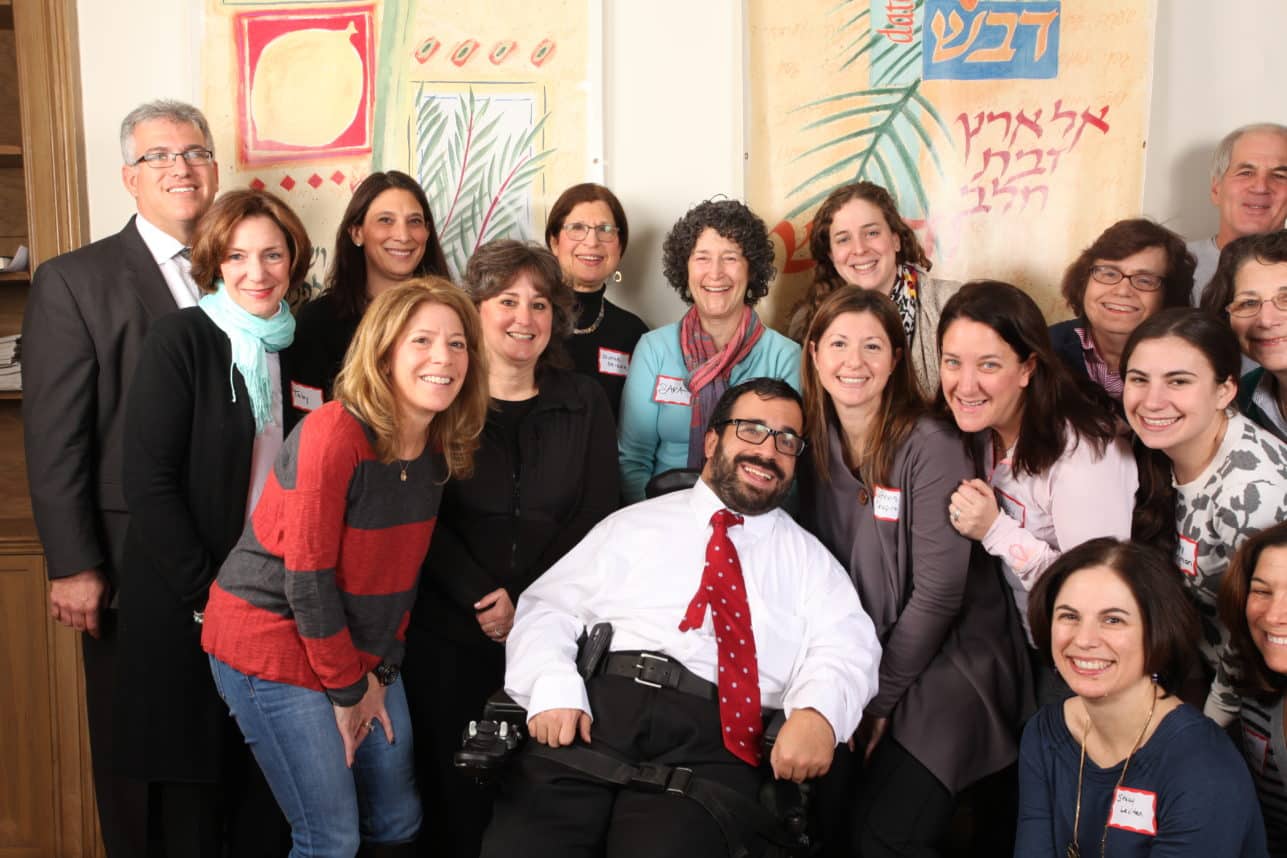
Matan Koch meets with the disability inclusion committee of Temple Beth Hillel-Beth El, outside Philadelphia, Pennsylvania, a few years ago. Photo by Aaron Benau
RespectAbility has been working to offset these concerns, offering general guidance to the disability community during the pandemic, including how they can receive their $1,200 economic stimulus payments. Before Passover, when it became clear people would be holding their seders via video-conferencing, the organization promoted virtual events in American Sign Language on its website, respectability.org. Currently, it is preparing to launch a virtual Jewish disability access and inclusion training and credentialing program, from June 23-July 30, spearheaded by Koch.
Leah Siskin Moz, director of wellness at Hillel International, told the Journal that Koch is the perfect person to lead these trainings. Moz worked with Koch when he was an inclusion consultant for Hillel and was impressed with his ability to explain the diversity of the disability community. “He has both the passion, the lived experience and the depth of Jewish learning,” Moz said.
Koch’s talents also have been on display during recent RespectAbility Zoom events. During these sessions, members of the community have exchanged feedback on practical issues and have shared their feelings on their greatest personal challenges during the pandemic.
Mizrahi also has championed Koch’s efforts during the pandemic, noting that the fruits of his labors are being recognized in ways he may have been seeking had he gone to rabbinical school.
“You go to rabbinical school partially because you want to do a lot of Jewish learning and partially because you want a career where you are comforting or mentoring or shepherding Jewish neshamot — Jewish souls — and he is doing that in his job,” Mizrahi said. “We’ve had, since the crisis broke out, numerous Zoom sessions of just Jews with disabilities supporting other Jews with disabilities. So, in essence, it’s like he already has a congregation.”
As for Koch, he’s just busy doing his best for his “congregation” during these challenging times and trying to focus more on the positives than the negatives.
“There is some sweetness in all of the bitter,” he said, “and sometimes it is about finding it.”
We like to think of hope as a useful, even indispensable emotion. “No matter what,” we often are told, “never lose hope.”
No matter how low we go, how dark things get, how painful life becomes, hope keeps us in the game. The alternative is despair, which gives us no chance.
Proclaiming the value of hope, however, isn’t enough. The more urgent question is: How do we nourish hope and make it actionable? And what is the Jewish view on hope?
“The Greeks gave the world the concept of tragedy. Jews gave it the idea of hope,” Rabbi Jonathan Sacks wrote. “The whole of Judaism — although it would take a book to show it — is a set of laws and narratives designed to create in people, families, communities and a nation, habits that defeat despair.”
Sacks characterizes this impulse as the refusal to accept darkness as inevitable. That’s why, he wrote, “It is no accident that so many Jews are economists fighting poverty, or doctors fighting disease, or lawyers fighting injustice.”
No matter how low we go, how dark things get, how painful life becomes, hope keeps us in the game. The alternative is despair, which gives us no chance.
Last year, I met one of those activist lawyers, Matan Koch, just before he moved to Los Angeles. Koch, who gets around in a wheelchair, is the subject of our cover story this week.
Since December, he has been the California Director of RespectAbility, a fast-rising nonprofit working to advance opportunities for people with disabilities.
Koch, 38, is a quadriplegic, born with cerebral palsy. But, as Staff Writer Ryan Torok wrote, “that didn’t stop him being admitted to Yale University at the age of 16; serving as his alma mater’s president of the student disability community; becoming a Senate-confirmed appointee on the National Council on Disability in the Obama administration; and working as a consultant for Jewish organizations, advising Jewish professionals and students on how to be more inclusive of people with disabilities.”
Koch’s life embodies hope through action. When you’re born with severe physical limitations, hope is not the obvious choice — despair is. Koch refuses to see despair as inevitable.
There are millions more like him, human beings who have been dealt difficult hands and who must learn to muster hope from the toughest hardship.
We can learn from them as we navigate the bewildering storms of COVID-19.
The news that spews daily from this pandemic is unbearable. In just a few months, more than 90,000 people have lost their lives and 35 million people their livelihoods. No one seems to know how long this will go on. Every new low seems to come with a trap door.
This is a recipe for despair. And yet, despair is the one emotion we cannot afford. Sadness, melancholy, certainly; despair, no.
Through a sustained struggle against the reality he was born with, Koch created a new reality, one of hope and possibility.
“To be a Jew is to be an agent of hope in a world serially threatened by despair,” Sacks wrote. “Every ritual, every mitzvah, every syllable of the Jewish story, every element of Jewish law, is a protest against escapism, resignation or the blind acceptance of fate.
“Judaism is a sustained struggle, the greatest ever known, against the world that is, in the name of the world that could be, should be, but is not yet.”
The devastation of COVID-19 is the world that is, it is our reality, but it is not our fate.
The existence of Koch’s physical disability is his world that is, it is his reality, but it is not his fate.
Through a sustained struggle against the reality he was born with, Koch created a new reality — one of hope and possibility.
Today, in the midst of a historic crisis, our collective mission is to create this new reality, to engage in a sustained struggle toward the world that could be and should be.
If a lawyer who uses a wheelchair can get up every morning and do his share in the struggle, so can we. What gives me hope are the millions of acts of kindness happening across our nation that sustain this struggle — volunteers delivering supplies to the needy, caring for the elderly and the lonely, offering their expertise and talents, and simply trying to help out any way they can.
There are forces working against this unity of purpose. The fiery passion of political partisanship is clearly one of them. We ought to engage in vigorous debates on how to move forward, but we can’t allow poisonous and divisive forces to undermine our common struggle.
That may be easier said than done, but that is the very essence of a struggle — not taking the easy way out.
Matan Koch has never taken the easy way out. Emulating his spirit of commitment will ensure we never lose hope.