Israeli soldiers shot and killed a Palestinian teen during clashes Wednesday morning in a Palestinian refugee camp near Hebron.
The troops were conducting a manhunt for the person who dropped a rock from the top of a home on Sgt. Amit Ben-Yigal a day earlier, killing him.
Residents of the Al-Fawar refugee camp attacked the soldiers with firebombs and rocks; gunshots were heard during the clashes. The troops responded with live fire and riot dispersal methods, the Israel Defense Forces said.
The Palestinian Wafa news service reported that Zeid Fadel Qeisieh, 15, was shot in the head and killed during the clashes. One Israeli soldier was injured, according to the IDF.
The IDF has mounted an extensive manhunt for the rock thrower.
Meanwhile, residents of the central West Bank village of Baytin, near Ramallah, discovered a so-called price tag attack on Wednesday morning.
The phrases in Hebrew spray-painted on the walls of several homes read “I don’t sleep when blood is spilled here” and “our soldiers’ lives come before the lives of the enemy.” The statements included several Stars of David.
A knife-wielding man who stabbed a security guard at the entrance to a Tel Aviv-area hospital was shot and killed by security officers.
Mustafa Yunes, 26, from the Arab-Israeli village of Arara, in northern Israel, attacked the security guard at the Sheba Medical Center at Tel Hashomer following a row with shoppers at a nearby shopping center over his not wearing a mask, Israel’s Channel 12 first reported. Yunes had brandished the knife in front of the shoppers and put it away. He reportedly became angry when guards stopped him at the main entrance to the Tel Aviv-area medical center because he was carrying a knife.
Yunes, who had an appointment with psychiatric services at Sheba, stabbed a security guard before at least three guards fired shots at the assailant. Yunes later died of his injuries. The guard was lightly injured.
The incident which was captured on video broadcast by Channel 12, will be investigated, according to the report. Israeli officials have ruled out a nationalist motive for the stabbing.
Yunes’ family said he suffered from serious mental health problems.
“He is sick,” Yunes’ brother told Ynet. “He came here for a psychologist evaluation. I don’t know why he was shot. He has a disability.”
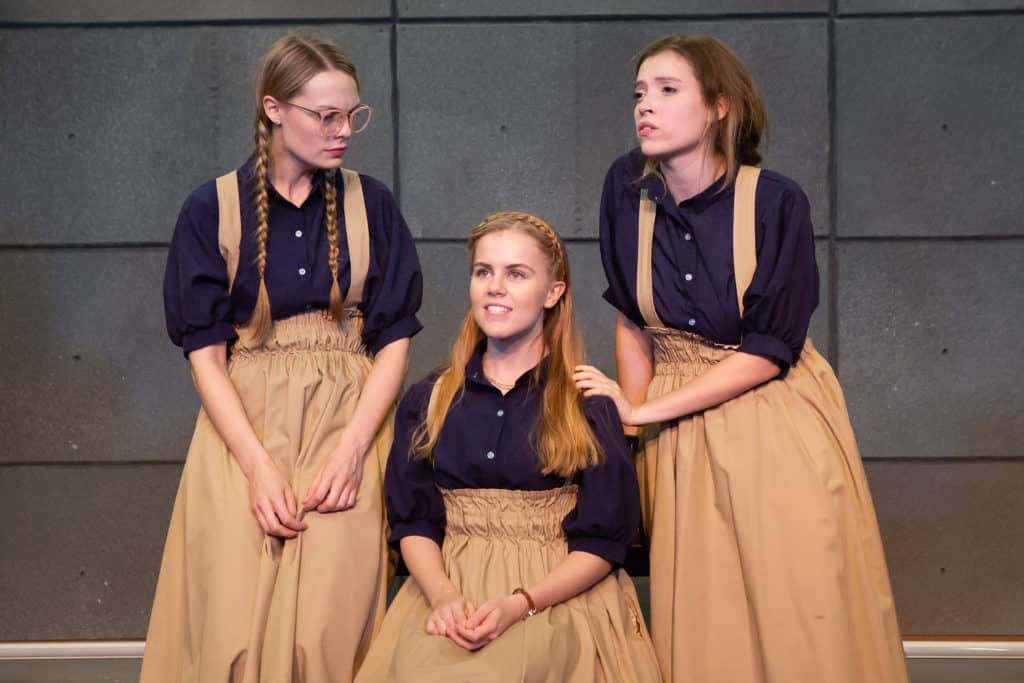
A trio of young women is at a dining table, gossiping about movie stars and taking selfies. But it’s 1943 in Germany, and the matinee idols are Marlene Dietrich and Frank Sinatra. These mädchen are Hitler’s guinea pigs, chosen to taste his food — and if it’s poisoned, die agonizing deaths for their Führer.
“Hitler’s Tasters” is a compelling dark comedy that turns a historical footnote into a provocative social study. Its run at the Electric Lodge Theater in Venice cut short by the COVID-19 pandemic is streaming online through May 21.
Playwright Michelle Kholos Brooks learned of the story four years ago on a visit to a World War II museum that displayed an article about the last living taster, Margot Woelk. Intrigued, Kholos Brooks delved into research, aided by her enthusiastic husband, writer and World War II-obsessive Max Brooks, who presented her with a pile of books and movies. She wrote the first draft as part of a 48-hour play challenge, workshopped it in 2017, and has since seen it performed around the United States and in Edinburgh, Scotland, where it was a winner at the Fringe Festival.
“Being a young woman is hard enough as it is — the way they’re treated in culture and how they treat each other as a result — and these girls are trapped together and could be poisoned at any moment.”
“This story pushed my buttons,” Kholos Brooks told the Journal. “Being a young woman is hard enough as it is — the way they’re treated in culture and how they treat each other as a result — and these girls are trapped together and could be poisoned at any moment,” she said. Although he’s talked about constantly, Hitler never appears in the play. The focus is on the girls’ blind allegiance to their abuser and their forced captivity.
“There are eerie parallels [to today],” Kholos Brooks said. “The girls are stuck in this room and forced to deal with each other, like we are with our families right now. There’s the issue of food safety: Should you get takeout? Who has touched it? Everything that’s supposed to nourish you is suspect. Our leaders aren’t taking care of us or protecting us. We feel abandoned. Our actresses said that the play felt so much closer to them than ever in the context of all this.”
Kholos Brooks also found parallels while she was writing it around the time of the 2106 election. “The rhetoric that I was hearing was terrifying to me,” she said. “That made its way into it, too.” Audiences have been rather quiet after the performances, she noted, but during the New York run in 2018, a theatergoer stood up at the end and exclaimed, “We all have to vote!” Kholos Brooks recalled. Her reaction? “Mission accomplished.”
Michelle Brooks; Photo by Kevin Salter
As for the idea behind the anachronistic selfies, Kholos Brooks explained she “wanted these girls to feel very present. For young people right now, World War II is very much in the rearview mirror. I wanted young people to relate to it and understand, ‘That could have been me.’ ”
She used humor as “a release from the darkness” of the subject, and left room for directors to show the passage of time between meals with time-killing activities such as dancing and hair braiding. The choreography may seem joyous, “but then you see they’re wearing underwear with swastikas on it,” Kholos Brooks noted.
A Los Angeles native, Kholos Brooks always loved writing and became a journalist. While working for a public radio station in Maine, she wrote her first play and loved seeing it come to life on stage. The granddaughter of Jewish immigrants from Eastern Europe, she didn’t grow up in a religious family, and celebrated her bat mitzvah at home, not in shul.
“[I hope people] come away with a visceral understanding of the dangers of complacency. To pretend that things are OK is not OK. To think that you’re safe from madmen like this is living in delusion. There’s no safety.” — Michelle Kholos Brooks
“But I never thought of myself as anything but Jewish,” she said. “I feel like there’s something bigger at work, something bigger than me. I always have. I have trust in that, but at the same time, I am very much responsible for the way I behave.” She and her family are congregants at the Open Temple near their Venice home, where their son Henry, now 15, had his bar mitzvah.
She met her husband, son of Mel Brooks and the late Anne Bancroft, through a mutual friend at a party. “We had a connection, but we kept trying not to date. We both dated other people. But when he came back to L.A from graduate school, we finally got together. He says, ‘I wooed you with my Italian side but I kept you with my Jewish side.’ ” They wrote their love story for the “Tasty Words” podcast a few years ago. Its title was “How Neurotic Jews Fall in Love.”
“Max and I are such different writers,” Kholos Brooks, who now is working on a new play that tells stories of people who served in Iraq and Afghanistan, said. “Our processes and topics are different, so we can support each other and be each other’s sounding board.” She also received valuable feedback from her father-in-law, who has championed the play since its first reading. Initially, she didn’t want its title to spoil what would happen, but Mel advised her to tell the audience outright what to expect, and she’s glad she listened to him.
Kholos Brooks hopes that those who stream “Hitler’s Tasters” will be inspired to see it again when it eventually returns to theaters. She suggests settling in with a glass of wine and dimming the lights to simulate the live-theater experience. More importantly, she hopes viewers will “come away with a visceral understanding of the dangers of complacency. To pretend that things are OK is not OK. To think that you’re safe from madmen like this is living in delusion. There’s no safety. We have to look out for each other a little bit more.”
“Hitler’s Tasters” is streaming through May 21 here, along with information about the production and a downloadable vegetarian cookbook put together by the cast and crew. Cost: $15.