
fbpx

May 12, 2020

Central Park Provides Eternal Messages of Hope During COVID-19

“One can sit alone in the long silence, sit quietly and sing.” — After Wen Cheng Ming

On a chilly, rainy morning last week, Mount Sinai workers began to take down the emergency field hospital in Central Park’s East Meadow. After treating 315 COVID-19 patients, Mount Sinai decided to move those health care workers inside.

As they worked, I walked around the area, paying more attention to the green wooden benches that encircled it. During the six weeks the tents were up, the stable benches had offered comfort to exhausted doctors and nurses, grieving families, and New Yorkers simply stunned by the surreal scene before them.

Had they taken a moment to look at the small silver plaque that accompanies nearly every bench? Had the beautiful dedications also offered solace?

Nearly 10,000 benches are situated throughout the 840-acre park, the inspiration of Parks Commissioner Robert Moses in the 1930s. More than 6,800 benches now wear a silver plaque, bestowing a dedication by a family who has “adopted” it. Many New Yorkers no doubt don’t even notice the plaques; they have become a ubiquitous part of the glorious landscape.

“The poetry of life is created by its imperfections, by its storms, however turbulent.”

But as the park has been stripped of its humanity in the past couple of months, the plaques have taken on new meaning. Indeed, many feel as though they were written explicitly for the patients.

“By your side always, in love, laughter and play.”

“He flew upon the wings of the wind.”

“Please watch over their dreams, Purple Python.”

Many are dedicated to the beauty of the park: “I think that I shall never see a poem as lovely as a tree.”

To fully understand these messages — to understand why someone would donate $10,000 to adopt a bench — one needs to understand what Central Park means to New Yorkers. The goal of the park, designed by Frederick Law Olmstead in the 1850s, was to create a sanctuary for the soul, an oasis of hope. When we’re out in the concrete jungle, our minds never stop racing. But when we enter the park, we begin to feel.

Olmstead understood that not only do we need nature to relax and recharge, but it has much to teach us. This theory often has been called “the wisdom of the trees.” Each tree, branch, leaf is unique yet imperfect — and its imperfection is what makes it beautiful.

Central Park is an oasis of diversity — a mosaic that reflects the mosaic of the city. On its best days, NYC blends and creates a greater beauty just like the park. In the past couple of years, though, hate has again turned us against one another, and the harsh COVID-19 restrictions are just making it worse.

Trees are resilient. Their sturdy trunks have weathered every type of storm. For humans, watching the seasons and storms change the park imparts an acceptance of change: Life, though altered, goes on.

The day before, I had spoken to a friend who knows a handful of families who are moving out of the city. Not just temporarily, but out, for good. Perhaps if they would read these plaques, they would feel differently.

“Took chances, defied conventions, & adored New York.”

“From a small town to the big city, he lived life with integrity & aplomb.”

Most of the names on the plaques near Mount Sinai are Jewish, as is every wing in the hospital.

“Forever in Our Hearts Seymour Cohen (1929-2014) Who Loved This Park & City.”

“For the grandchildren to sit on when they visit. Love, Abba and Michelle.”

Our grandparents built this city, and yes, it’s now going through hell. But we can rebuild it. Now is not the time to desert it — if for no other reason than to honor those who had built it the first time.

As I walked back to my apartment, I promised myself that I would never ignore these eternal messages of hope, that I would point out the more poignant ones to my son. Even more important, I will teach him what they represent — that we have this beautiful treasure in our city, that we must respect its laws and learn from them, that we should never take it, or anything beloved, for granted.

That the poetry of life is created by its imperfections, by its storms, however turbulent.

As Rabbi Jonathan Sacks puts it, “Faith is the courage to live with uncertainty.”


Karen Lehrman Bloch is an author and cultural critic.

Central Park Provides Eternal Messages of Hope During COVID-19 Read More »

Tombstones With Swastikas Are ‘Historic Resources’ and Will Not Be Changed, VA Says

WASHINGTON (JTA) — The Veterans Administration will not replace three tombstones inscribed with swastikas in its military cemeteries, calling them “historic resources.”

A group that advocates for religious freedom in the military on Monday called on the VA to replace two World War II-era POW headstones in Fort Sam Houston National Cemetery in San Antonio, Texas, inscribed with swastikas inside a German cross, and the phrase, “He died far from his home for the Führer, people, and fatherland.” Führer was the title Adolf Hitler assumed for himself.

Replying Tuesday to a Jewish Telegraphic Agency query, Les’ A. Melnyk, a VA spokesman, said the agency was aware of the two headstones, as well as a third at Fort Douglas Post Cemetery in Salt Lake City with the same inscription. He described Hitler as a “divisive historical figure.”

“The National Historic Preservation Act of 1966 assigns stewardship responsibilities to federal agencies, including VA and the Army, to protect historic resources, including those that recognize divisive historical figures or events,” Melnyk said. “For this reason, VA will continue to preserve these headstones, like every past administration has.”

The Military Religious Freedom Foundation, which issued the call Monday, after a retired officer alerted the group to the tombstones’ presence in the San Antonio graveyard, said the VA response fell short.

Mikey Weinstein, the group’s president, noted in an interview that in recent years Democratic and Republican state and local governments have removed Confederate symbology.

“That is a non-reply reply,” Weinstein said, adding that his group was exploring legal action to replace the tombstones.

Tombstones With Swastikas Are ‘Historic Resources’ and Will Not Be Changed, VA Says Read More »

Brazil’s President Criticized for Coronavirus Motto That Recalls ‘Arbeit Macht Frei,’ the Infamous Auschwitz Gate Sign

RIO DE JANEIRO (JTA) — Brazilian president Jair Bolsonaro is being criticized for a new slogan about combating the coronavirus which resembles the infamous Nazi inscription at the entrance to the Auschwitz concentration camp: “Arbeit macht frei,” or “work will set you free.”

The message “Work, unity and the truth will set Brazil free” was featured in a video that Bolsonaro released Sunday, Brazilian newspaper Folha de S. Paulo first reported.

“It is unfortunate to see, once again, issues that are dear to Judaism and humanity in general be trivialized and emulated, offending the memory of victims and survivors, at such a difficult time for our country and the world,” Fernando Lottenberg, president of the Brazilian Israelite Confederation, Brazil’s umbrella Jewish organization, told the Jewish Telegraphic Agency.

Bolsonaro’s supporters claim the phrase is inspired by the biblical passage “And you will know the truth, and the truth will set you free,” from John 8:32, which Bolsonaro often cited during his presidential campaign. Titled “COVID-19: The Truth,” the video slams the Brazilian media and describes his government’s action to fight the pandemic.

“It is impressive. Every government measure is twisted to fit narratives. In the campaign, they used to make swastikas. Now they use functional illiteracy to misinterpret a text and associate the government with Nazism. I, the head of the Communications secretariat, am Jewish!,” tweeted Fabio Wajngarten, the communications minister and the man who helped produce the video.

Last week, Bolsonaro angered Jewish groups for speaking next to an Israeli flag at rally in Brasilia, where some called for disbanding the country’s courts and a return to a state of authoritarian rule. On April 22, the American Jewish Committee demanded an apology from Brazilian foreign minister Ernesto Araujo, who compared COVID-19 social distancing to concentration camps. After a wave of international media coverage, he said he was misunderstood.

“The use of the expression ‘the work sets you free’ attacks the memory of Holocaust victims and offends the sensitivity of the survivors,” said Rabbi Michel Schlesinger, spiritual leader of Latin America’s largest congregation, Sao Paulo’s 2,000-family Congregagao Israelita Paulista synagogue, in an interview with BBC Brasil on Monday. “Unfortunately, it is not possible to disconnect this movement from the other references of the current government to the Nazi regime.”

Brazil’s President Criticized for Coronavirus Motto That Recalls ‘Arbeit Macht Frei,’ the Infamous Auschwitz Gate Sign Read More »

To Keep Their Cleaners On the Payroll, Facetune Turned Them Into High-Tech Employees

Breeah Berezin-Bahr gushes when talking about her employer, Israeli high-tech company Lightricks, which created the global photo editing software Facetune.

“Lightricks is my new religion,” Berezin-Bahr declared. She credits the Jerusalem-based company with turning her life around when she began working there as a cleaner in 2017.

“Lightricks is my new religion,” Berezin-Bahr declared. She credits the Jerusalem-based company with turning her life around when she began working there as a cleaner in 2017.

After Berezin-Bahr broke her leg and was unable to work for five months, the company kept her on the payroll despite it being the National Insurance Institute’s (NII) responsibility to cover her salary. When she finally received a check from the NII, Lightricks wouldn’t accept her offer to pay them back.

But the real litmus test came when the coronavirus hit the country and Berezin-Bahr, along with nine other members of the cleaning staff, were sent home. As a single mother with no help — financial or otherwise — from her ex, she wondered how she would pay her rent or feed her teenage sons. Working from home obviously wasn’t an option for the cleaning staff, or so she thought. However, days after being sent home, the maintenance manager Nadav (“the best boss in the world”) told her and her colleagues that their job description was about to radically change. Lightricks sent them all the trappings to become work-at-home high-tech employees, including a desk, a swivel chair and “a huge freaking real computer.”

As a single mother with no help — financial or otherwise — from her ex, she wondered how she would pay her rent or feed her teenage sons.

Nadav taught the cleaners basic computer skills. Berezin-Bahr, who married young and doesn’t have a college education, had no idea how to operate a computer. “I lived in Sefad for so many years, I didn’t need it,” she said, laughing. “I came from a world where we thought we don’t have to work and that HaShem would provide and if He didn’t, it was probably because we spoke too much lashon harah that month and not because we didn’t have jobs.”

She has since traded her turban head covering for long blond braids.

Nadav tasked the Lightricks cleaning team with inputting photos of faces for image processing. “Control-alt-shift — all these things were really foreign, “Berezin-Bahr said. “Once you start doing it, it’s kind of cool. It’s an unknown field but learning it has been really eye-opening.”

So what will happen after the virus restrictions end and employees are sent back to work?

“Control-alt-shift — All these things were really foreign. Once you start doing it it’s kind of cool.”

“I would love to do this for the rest of my life and not clean,” she said. “But everyone who works [at Lightricks] has serious resumes and went to universities, so for them to take me on will be a miracle. I’d have to learn a lot more skills.”

For now, Berezin-Bahr is happy that her sons have the chance to be exposed to something else. “My boys are amazing cleaners. Whoever they marry will be very lucky but it’s not the only skill I want to pass onto them,” she said.

Berezin-Bahr pulled out a picture of her dressed as Cinderella for Lightricks’ Purim contest, which she won. She’s living her own Cinderella story, she said. “I’m the luckiest cleaning lady at the ball. Like the clock struck Lightricks and my world changed.”

To Keep Their Cleaners On the Payroll, Facetune Turned Them Into High-Tech Employees Read More »

L.A. County Shelter-In-Place Order Likely Will Be Extended for Three Months, Order Could Be Modified

Los Angeles County Public Health Director Barbara Ferrer said in a May 12 County Board of Supervisors meeting that the county’s shelter-in-place order likely will be extended through July, but she left the door open for the order to be modified.

The Los Angeles Times reported that Ferrer said the county hopes to “to slowly lift restrictions over the next three months.” However, she said that until the county has the capacity to have county residents tested daily or the status of the virus changes, there will have to be restrictions.

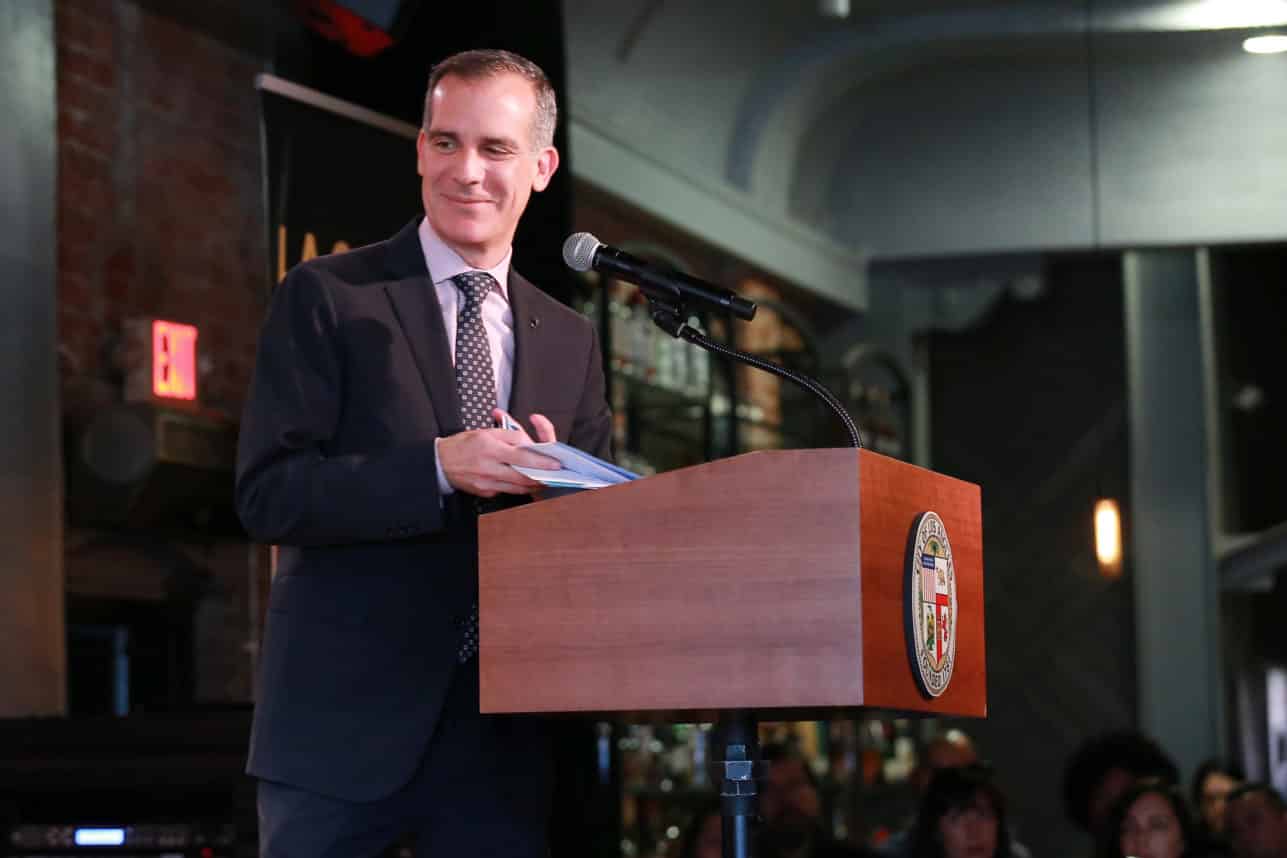
After a backlash ensued on social media, Los Angeles Mayor Eric Garcetti told CNN’s Jake Tapper that just because the shelter-in-place order is going to be extended for three months doesn’t mean that restrictions won’t be eased.

“I think quite simply, [Ferrer’s] saying is that we’re not gonna fully reopen Los Angeles or probably anywhere in America without any protections or any health orders in the next three months. I think we know it’s going to be even longer than three months,” Garcetti said. “And as I’ve said a million times, we’re not moving past COVID-19; we’re learning to live with it. We’re not going to go back to pre-COVID-19 life anytime soon or jump forward to post-COVID-19 time until there is a medicine or vaccine that allows that.”

He added that the county can get its economy going while having residents maintain social distancing measures and wear masks.

Tapper then told Garcetti that Ferrer seemed to be implying that county residents would have to remain indoors until July. Garcetti replied that Ferrer has been doing a great job handling the pandemic, that polls across the country show that people want reopenings to happen in a gradual, slow manner.

“There are some populations who will need to stay at home,” Garcetti said. “People need to know whenever possible, it is safer to stay at home.”

He added that the shelter-in-place order won’t be drastically altered over the next week but “that doesn’t mean three weeks from now, six weeks from now, two months from now, we won’t continuously edit that order and make sure that we open up safely as much as we can.”


The county beaches are going to be partially reopened on May 13; hiking trails also were reopened on May 8, and retail stores in the county are now allowed to offer curbside pickup.

The county announced on May 12 that there were 961 new COVID-19 cases and 45 new deaths from the coronavirus in the county, bringing the county’s respective totals to 33,180 and 1,613.


L.A. County Shelter-In-Place Order Likely Will Be Extended for Three Months, Order Could Be Modified Read More »

ADL: U.S. Had Highest Number of Anti-Semitic Incidents in 2019

The Anti-Defamation League (ADL) released a new report on May 12 revealing there were 2,107 anti-Semitic incidents in the United States in 2019, the highest in ADL’s recorded history. The total number of incidents in 2019 increased by 12% from 1,875 in 2018.

In California, there were 330 anti-Semitic incidents, including 186 instances of harassment, 919 instances of vandalism, and 9 instances of assault, including the Chabad of Poway shooting in April that left one woman dead.

“We grieve for the victims and families affected by the shooting in Poway and every one of these incidents,” ADL Los Angeles Regional Director Amanda Susskind said in a statement. “We continue to be concerned about the historic levels of anti-Semitic incidents over the last three years in California and note with alarm a massive uptick of anti-Semitic vandalism 53% (88 to 135) from 2018 to 2019.”

ADL CEO Jonathan Greenblatt also said in a statement, “We are committed to fighting back against this rising tide of hate and will double down on our work with elected leaders, schools and communities to end the cycle of hatred.”

ADL: U.S. Had Highest Number of Anti-Semitic Incidents in 2019 Read More »

‘Collective Compassion’ Helps Local Teens Struggling with Mental Health During Pandemic

It’s tough being a teenager at the best of times, dealing with pressures from every direction while simultaneously trying to figure out who you are. But imagine being a teen during the COVID-19 pandemic.

“We know that for teens, their peers are everything, and they are not able to be face to face with their peers; that alone is huge,” Shira Rosenblatt, associate chief program officer at the Jewish Federation of Greater Los Angeles told the Journal.

“We know that for teens, their peers are everything, and they are not able to be face to face with their peers; that alone is huge,” Shira Rosenblatt, associate chief program officer at the Jewish Federation of Greater Los Angeles told the Journal.

To support teens during this unprecedented time and to coincide with mental health awareness month, the Jewish Teen Education & Engagement Funder Collaborative has created Collective Compassion, a group of events and experiences − all offered virtually and free to all comers.

The seven-year-old Collaborative is a group of 10 communities across the country, including Los Angeles, represented by the Federation. It receives significant funding from the Jim Joseph Foundation, with each community matching the foundation’s contribution. Its primary mission is to keep Jewish teens engaged with Judaism. But according to Collaborative Executive Director Sara Allen, “[Teen] wellness is foundational to our goals.” So last year, it introduced a new resource called Jewish Teens Thrive. And in January, in Los Angeles, it convened a group of mental health experts as well as representatives from a host of organizations engaged in work in this area to connect and learn from one another.

“Once COVID-19 hit, it really amplified the urgency,” Allen said. Fortunately, the relationships the Collaborative already had meant it was well-positioned to put something together quickly, even though it had never done anything quite like this before. It basically had this “fabulous group of professionals all deeply invested in teen wellness on speed dial,” Allen said.

She added, “We could make a powerful statement by doing it as a cross-community effort. Because we live in a virtual world, everyone could take advantage of the offerings. You no longer have to worry about geography.”

The events and experiences that make up Collective Compassion are divided into three categories: Creativity for Coping: Artist Led Workshops to Increase Resilience; Purpose & Meaning: Programs to Empower Yourself and Help Others; and Education & Awareness: Webinars & Social Media Campaigns to Share.

Some of the offerings, such as the May 20 conversation on managing teen stress and anxiety during a pandemic with Duke University student and “Don’t Tell Me to Relax” author Sophie Riegel, are presented live. Others, such as short “Movement Minyan” videos on activating potential via Jewish wisdom with Ohio-based Mitsui Collective, are available on demand.

However, not everything is exclusively for teens. There are several programs for parents and at least one for parents and teens to actively connect. This is a May 31 cooking class called “Baking for Balance: You Knead to Learn How to Braid Challah and Talk,” led by Atlanta-based Blue Dove Foundation, which works in the mental health and substance-abuse sphere.

“[Teen] wellness is foundational to our goals. Once COVID-19 hit, it really amplified the urgency. Everyone connects differently and there are many dimensions to wellness, so we sought out those that spoke to people’s body, mind and spirit.” — Sara Allen

“We tried to really offer a comprehensive though not exhaustive set of opportunities,” Allen said. “Everyone connects differently and there are many dimensions to wellness, so we sought out those that spoke to people’s body, mind and spirit. I think what they have in common is a creative approach to connecting with folks, and all tap into different elements that people may be seeking. And they’re designed to be very empowering and hands-on, filled with practical ways people can incorporate skills and practices throughout the year.”

In just the first week of May, the Collective Compassion website had nearly 1,000 visitors. But according to Allen, the program’s success can’t be measured in numbers alone.

“We will also look at how people engage in the topics,” she said. “Are parents having different conversations with their teens and feel more comfortable and competent about these issues? Are teens connecting with others and being reflective about what they’re experiencing?

“The other success,” she said, “is truly about the strength of the partnerships — that so many organizations are uniting to raise awareness of these issues and rise up to meet growing needs. I’m humbled by this, particularly.”

For more information visit Collective Compassion online.

‘Collective Compassion’ Helps Local Teens Struggling with Mental Health During Pandemic Read More »

West Hollywood Childhood Friends Provide Meal and Mask to Every LA First Responder

The founder of a West Hollywood travel health care startup has been raising money to deliver personal protective equipment (PPE) and meals to hospitals and first responders.

Dimitri Kermani, CEO and founder of Innover HealthCare, told the Journal the company was established in December to provide materials such as disinfecting wipes to people who travel frequently. When the COVID-19 pandemic broke out, Innover’s manufacturers could no longer sell wipes and sanitizer to Innover.

“Our manufacturers are all in the United States … they come and they us tell us, hey, Defense Production Act, we can’t sell you any more sanitizers, we can’t sell you the products that you essentially need,” Kermani said. “So I thought this is a good opportunity to help our local communities.”

Kermani partnered with his childhood friend, Beverly Hills attorney Kevin Lipton, to raise money for hospital workers and first responders. Kermani has been fundraising money for PPEs; Lipton has been fundraising to provide food to first responders through his Lipton Legal Accidental Relief Fund. When the Relief Fund recently obtained nonprofit status, Kermani and Lipton put all the donations into that fund.

“We were able to collect tens of thousands of dollars,” Kermani said. “We’ve been sourcing masks, we’ve been sourcing goggles, gloves, gowns, all different forms of PPE that we’ve been donating all around the country.”

Kermani and Lipton first used the money to start the Mask and Meal Program, in which they provided one meal and at least one mask to each first responder at the Los Angeles County Sheriff’s Department for 14 days in April. Among the food items included in the meal donations are Thai food, tacos, grilled cheese sandwiches and burrito bowls. “They’re actually full nutritious meals,” Kermani said.

He said the food donations were important to first responders because “In a time where first responders are under extreme duress and a lot more stress than they would normally be under, that extra hour [not spent cooking and cleaning] really means a lot when it comes to improving morale.”

Kermani added that when he and Lipton saw the positive impact the masks and meals had on the first responders in the sheriff’s office, they decided to expand the program to local hospital workers, including staff at Cedars-Sinai Medical Center.

One of the many PPE care packages distributed. Photo courtesy of Dimitri Kermani.

On May 6 — National Nurses Day — the city of West Hollywood held a morning and evening motorcade featuring police officers and firefighters driving to Cedars-Sinai, where they stopped and briefly applauded medical personnel. During the motorcades, Kermani, West Hollywood Mayor Pro Tempore Lindsey Horvath and Los Angeles City Councilmember David Ryu distributed 500 masks and 500 American flags to Cedars-Sinai nurses. Kermani also dropped off 65 meals. “It was a really nice show of appreciation,” Kermani said.

The Mask and Meal program currently is being expanded to two Kaiser hospitals in San Diego as well as to hospitals in Tijuana, Mexico, over the next couple of days. Kermani also planned to hand out masks on May 13 to hospital workers during an appreciation event at Veteran’s Hospital in West Los Angeles.

Additionally, Kermani and Lipton have sent care packages containing PPE  to hospitals in several states, including California, Alabama, Arkansas, New York, New Jersey and Texas.

“Our goal is to continue [the donations for] as long as possible,” Kermani said, “even beyond the pandemic if possible, because we see the incredible impact it’s having on morale.”

West Hollywood Childhood Friends Provide Meal and Mask to Every LA First Responder Read More »

Would a President Biden Be Good for Israel?

Joseph R. Biden Jr. has a 40-year history of outreach to the American Jewish community, with frequent expressions of support for Israel. He opposes anti-Semitism and the boycott, divest and sanctions (BDS) movement, and has endorsed security assistance to Israel, including the Iron Dome system, although he had fiercely opposed the development of missile defense technology.

According to Israeli national security adviser Uzi Arad, then-vice president Biden told him, “I’m your best f-ing friend here.” Biden once said to Israeli Prime Minister Benjamin Netanyahu, “I don’t agree with a damn thing you had to say, but I love you.”

Unfortunately, Biden can be an intemperate friend, frequently confronting Israeli officials and raising red flags about his strategic choices.

Biden once said to Israeli Prime Minister Benjamin Netanyahu, “I don’t agree with a damn thing you had to say, but I love you.”

Vice President Joe Biden visits Israel in March 2016

In recent months, Biden has moved to the political left, pandering to progressives by changing course on border security and the deportation of illegal immigrants, tuition-free college, school busing and the Hyde Amendment, which withholds federal funding for abortions, except in narrow circumstances.

Robert Gates, the widely admired former Barack Obama administration Secretary of Defense, likes Biden personally, but expressed in his memoir the common concern that Biden shifts his principles. “He’s been wrong on nearly every major foreign policy and national security issue over the past four decades.” For example, Biden recommended caution and waiting to embark on the successful operation that took out Osama bin Laden.

Now, by accepting the endorsement of the J Street lobby and by inviting Bernie Sanders’ foreign policy advisers into his campaign brain trust, Biden is signaling his embrace of his party’s growing anti-Israel left-wing.

Now, by accepting the endorsement of the J Street lobby and by inviting Bernie Sanders’ foreign policy advisers into his campaign brain trust, Biden is signaling his embrace of his party’s growing anti-Israel left wing.

Democrat President Franklin D. Roosevelt was hostile to Jews: supporting quotas at Harvard; denying thousands of Jewish World War II refugees entry into the U.S.; and turning away the SS St. Louis, directly resulting in the deaths of hundreds of Jews in the Holocaust. However, he is credited as commander-in-chief while the GIs liberated Nazi death camps.

His successor, President Harry Truman, who also was anti-Semitic, heroically endorsed the establishment of the Jewish State in 1948. President John F. Kennedy and U.S. Sens. Henry “Scoop” Jackson and Joe Lieberman were leading Democrats who affirmed the bipartisan consensus for a special alliance between the United States and Israel.

But Obama formally broke the tradition of unified American public support for Israel, proclaiming there should now be “daylight” between the allies.

Obama considered Biden, a former chairman of the Senate Foreign Relations Committee, a key part of his foreign policy team. As point man on the controversial Iran nuclear deal, Biden stood by while the U.S. administration and its allies promoted dual-loyalty smears against wavering Jewish senators and those lobbying in opposition to the deal.

Scholar Michael Oren summarized this period as the darkest ever for U.S.-Israel relations.

By 2012, growing anti-Israelism on the floor of the Democratic National Convention in Charlotte, N.C., resulted in loud boos during a vote to recognize Jerusalem as Israel’s capital. The 2016 DNC convention in Philadelphia featured harsh critics of Israel such as Keith Ellison, James Zogby and Cornel West.

Now, Joe Biden isn’t Jeremy Corbyn, the recently rejected British Labour leader who panders to Arab terrorists and detests all things Israel.

Now, Joe Biden isn’t Jeremy Corbyn, the recently rejected British Labour leader who panders to Arab terrorists and detests all things Israel.

Members of the Jewish community hold a protest against Britain’s opposition Labour party leader Jeremy Corbyn and anti-semitism in the Labour party, outside the British Houses of Parliament in central London on March 26, 2018. / AFP PHOTO / Tolga AKMEN (Photo credit should read TOLGA AKMEN/AFP/Getty Images)

Biden opposed Sen. Bernie Sanders’ calls to condition aid to Israel as “absolutely outrageous” and a “gigantic mistake.” However, in 1982, as Delaware’s senator, Biden similarly threatened to cut off U.S. aid to Israel, earning a dramatic public rebuke from then-Israeli Prime Minister Menachem Begin that was praised by Sen. Daniel P. Moynihan (D-N.Y.).

The problem with Biden isn’t anti-Semitism or dislike of Israel. Instead, it’s his unpredictable but brash confrontations with Israeli leadership and the mainstream pro-Israel community.

For example, after publicly supporting Jerusalem as Israel’s undivided capital, with statements on the floor of the U.S. Senate in 1983, 1995 and 2008, Biden reversed his position and opposed President Donald Trump’s action to achieve this long-sought, bipartisan goal. Biden says he now would not move the Embassy back to Tel Aviv.

More important, Biden frequently joins in with the most aggressive political and diplomatic attacks on Israeli settlements.

In 2010, Biden led the Obama administration efforts harshly to condemn Israeli authorization to build 1,600 housing units in the Jerusalem suburb of Ramat Shlomo. In 2016, speaking to J Street, Biden controversially criticized the Jewish state.
More recently, when the U.S. State Department clarified that Israeli housing settlements are not per se illegal under international law, Biden stated that settlements are an “obstacle to peace” that will only further inflame tensions in the region.

Biden frequently joins in with the most aggressive political and diplomatic attacks on Israeli settlements.

He is wrong as a matter of law. The West Bank (Judea-Samaria) is inside the land set aside for the Jewish National Home, as envisioned by the 1917 Balfour Declaration; confirmed in the 1922 League of Nations Mandate for Palestine; re-confirmed by the 1945 U.N. Charter, Article 80; and repeatedly affirmed by the late professor Eugene Rostow, the drafter of the 1967 U.N. Security Council Resolution 242.

Biden is wrong as a political analyst as well. The Saudi leadership, fed up with Palestinian irredentism, has warned that if the Palestinian Authority continues to reject all peace proposals like the recent Trump plan, which specifically calls for a Palestinian state, it will deserve to see strategic setbacks vis a vis “facts on the ground.”

When Netanyahu, with the support of new coalition partner Benny Gantz, soon announces the annexation of Jewish-majority portions of the Jordan Valley that form Israel’s defensible eastern border, U.S. Secretary of State Mike Pompeo is likely to approve. Biden likely will not.

Biden asserts a moral equivalency between Israeli housing development and security concerns with Palestinian incitement and terrorism.

Biden asserts a moral equivalency between Israeli housing development and security concerns with Palestinian incitement and terrorism. This past week, Biden announced he would reopen the U.S. consulate in East Jerusalem and the PLO mission in Washington, D.C., and resume “economic and security assistance efforts” to Palestinians.

Biden may be called a friend, but he sides with Israel’s harshest critics, who promote a dangerous Israeli return to its indefensible pre-’67 borders.


Larry Greenfield is a Fellow of The Claremont Institute for the Study of Statesmanship & Political Philosophy.

Would a President Biden Be Good for Israel? Read More »