fbpx

May 9, 2020

Jerusalem Opens Neighborhoods, Commercial and Spiritual Centers to Stimulate ‘Local Tourism’

In light of Israeli Prime Minister Netanyahu’s announced plan for a phased reopening of the economy and easing of restrictions, Jerusalem has reported distinctive challenges, as well as opportunities, for rehabilitation of its tourism industry, which, like major cities around the world, has been hard-hit by the coronavirus.

Touting Israel’s “tremendous success in curbing the corona epidemic,” Netanyahu announced the various reopening on May 4 of some schools for grades one through three, in addition to malls, outdoor markets and take-out restaurants. Restrictions on movement and gatherings of immediate family members were also removed.

According to Jerusalem Deputy Mayor Fleur Hassan-Nahoum, evaluating when Jerusalem schools and neighborhoods reopen is determined by a mathematical risk formula based on the occurrence of COVID-19 diagnoses in a given community. If the prevalence in a given population is more than one in 1,000, “there are immediate restrictions put onto the neighborhood,” Hassan-Nahoum told JNS. “These numbers are very significant and tell us what to open.”

She continued, saying “we are the only city that is tallying the sick according to neighborhoods. As the largest city in Israel, the policy of Jerusalem is to separate the sick from the healthy.”

“We have a command center in the city hall where we have the names of moderately sick, and we call them to try to convince them to go to one of our corona hotels, with special ones for haredim, Arabs and the general population,” she added.
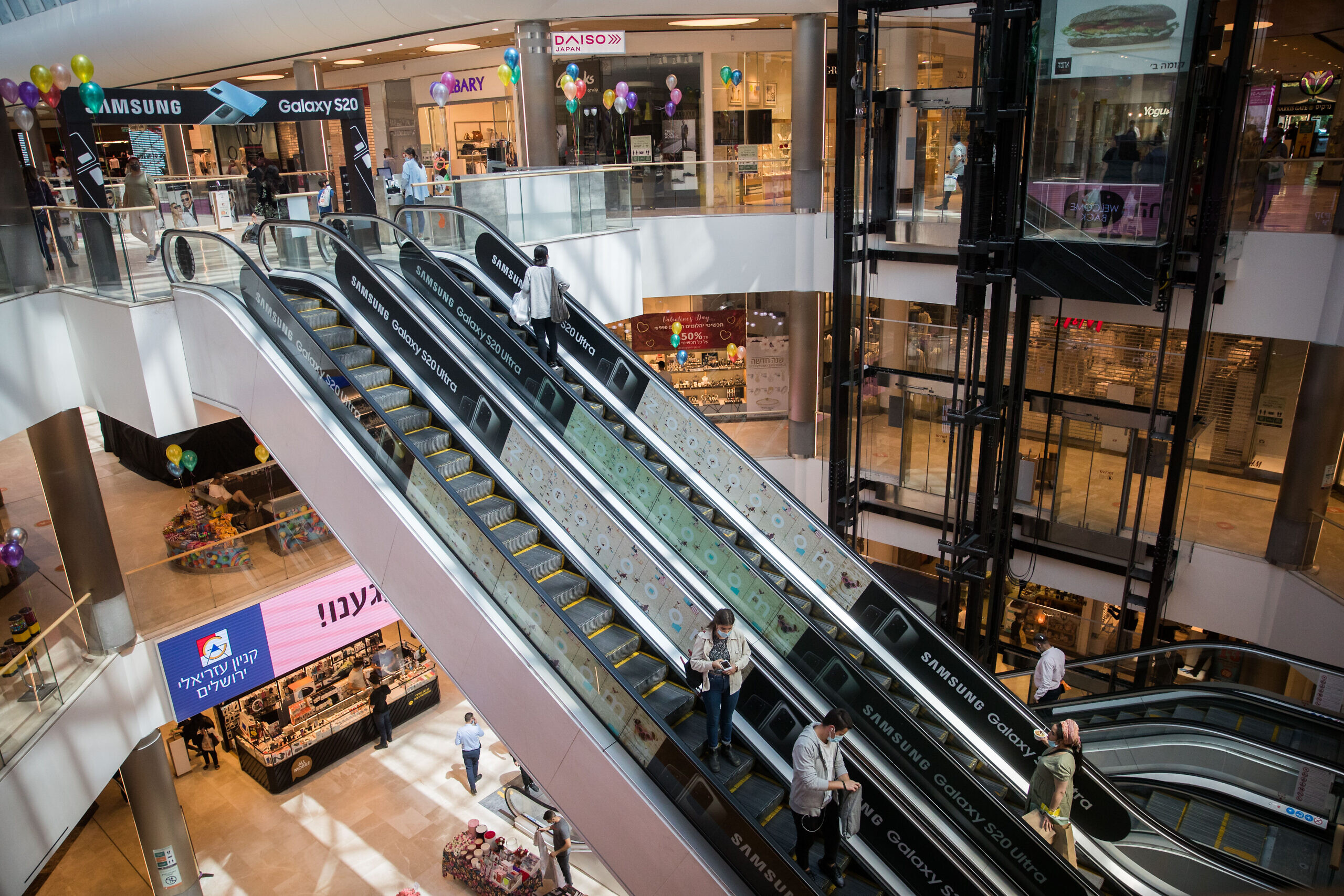
People at the Malha Mall in Jerusalem after it reopened according to the new Israeli government orders, May 7, 2020. Photo by Yonatan Sindel/Flash90.

‘Tourism industry is the backbone of our country’

The use of hotels as quarantine centers, said Hassan-Nahoum, is especially important in preventing the spread of the coronavirus among individuals with big families and small living spaces.

In these rooms, the city provides for the special requirements of each population, including separation of the sexes in the haredi and Arab hotels, also providing food packages and food vouchers for Muslims celebrating Ramadan.

The virus has largely been contained among the Arab population, with “the ones affected mainly being in health-care industries,” said Hassan-Nahoum, explaining that in addition to traveling less, Jerusalemite Arabs often live in multigenerational houses and out of fear of infecting the elderly, children and grandchildren have “been careful.”

The haredi community has not seen such containment, added Hassan-Nahoum, because their densely populated homes are not non-multigenerational, so fewer precautions are taken to contain the virus. Now, with major rabbis encouraging the sick to move to a coronavirus hotel, even on Shabbat, the method has seen better success in separating the sick from the healthy.

Visitors to the Machane Yehuda market in Jerusalem after it reopened according to new orders by the Israeli government to prevent the spread of the coronavirus, May 7, 2020. Photo by Olivier Fitoussi/Flash90.

Regarding efforts to restore internal tourism to Jerusalem’s holy sites, which will be essential to the future reopening of the external tourism industry, Hassan-Nahoum said “piggy-backing from national tourism plan, we want to start opening our public open-air spaces first, limit the number of guests, take their temperatures, require masks and incentivize local tourism first.”

“The tourism industry is the backbone of our country, and people need to get back to their businesses,” she emphasized. “We have just gone from our country’s highest employment rate to the lowest in its history.”

The first step, said Hassan-Nahoum, was the reopening of various Jerusalem sites and centers, from the Western Wall to the Machane Yehuda outdoor market.

The Western Wall Heritage Foundation announced on May 5 that “due to the government’s decision to cancel the restriction of prayer only at a distance of up to 500 meters from one’s place of residence while maintaining the restriction of up to 19 people during prayer in an open area, worshippers may return to the Western Wall while adhering to the Health Ministry directives.”

Preparations for the easing of the restrictions at the Western Wall in Jerusalem’s Old City, after Israeli Prime Minister Benjamin Netanyahu lifted certain lockdown regulations that were in place to prevent the spread of COVID-19, May 5, 2020. Photo by Olivier Fitoussi/Flash90.

Bar and bat mitzvah celebrations are now able to return to the Western Wall in accordance with regulations and coordinated in advance.

“For the next few days,” the Heritage Foundation continued, “up to 300 worshippers will be allowed to come to the Western Wall plaza simultaneously, contingent on them wearing masks. Should all of the prayer areas become full, worshippers will be requested to wait outside the entrances to the Western Wall with the required distances between them until space becomes available.”

Bar and bat mitzvah celebrations are now able to return to the Western Wall in accordance with regulations and coordinated in advance.

The sites of Western Wall tunnels and Temple Mount—the latter specifically closed for Jews, while the Waqf is allowed—remain closed until further notice.

Like commercial centers around the rest of the country, Jerusalem’s malls, markets and gyms reopened on May 7, with the Ministry of Health offering guidelines for the number of entering customers at one given time and the space required between them.

“In tourist cities, we need to rethink how we gather in spaces and use new technology [for that purpose],” said Hassan-Nahoum.

She suggested an application to track the number of people in a space, where people might need to wait to enter “like a car park,” and with tourists receiving a stamp after having their temperatures taken so they don’t need to be tested multiple times.

The public will likely receive this well, she maintained, as “people in general are more careful” and “need to get back to their businesses.”

BY ELIANA RUDEE, JNS
Jerusalem Opens Neighborhoods, Commercial and Spiritual Centers to Stimulate ‘Local Tourism’ Read More »

Sen. Mike Lee Places Hold on Holocaust Education Act

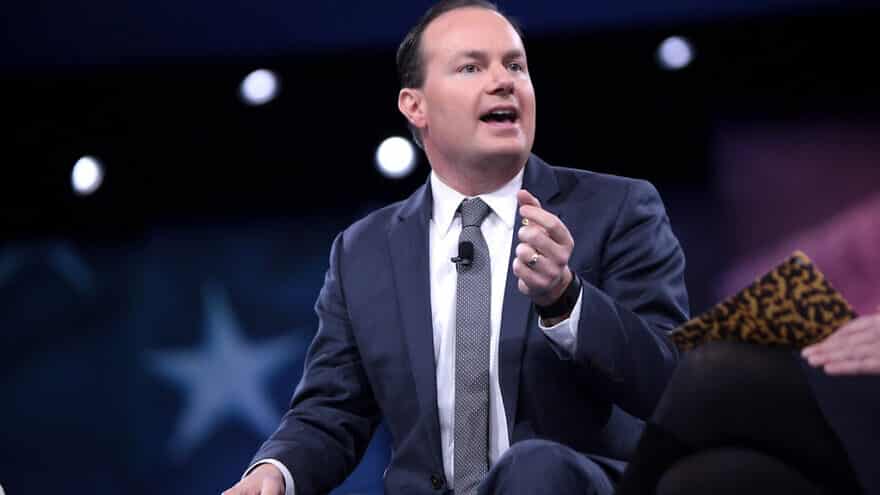
Sen. Mike Lee (R-Utah) has placed a hold on the Never Again Education Act, which seeks to expand Holocaust education in the United States.

If enacted, it would expand the U.S. Holocaust Memorial Museum’s (USHMM) education programming to teachers nationwide, requiring the museum to develop and disseminate resources to improve awareness and understanding of the Holocaust and its lessons.

The U.S. House passed the legislation in January.

Lee’s office told The Washington Free Beacon that the senator is looking for “some really minor changes to some of the wording” and is collaborating with Sen. Kevin Cramer (R-N.D.), who co-introduced the measure, to alleviate these concerns. Lee’s office declined to specify the issue.

A hold is a procedure where a senator tells his or her floor leader that he or she does not want a specific measure to reach the floor for consideration, and therefore may filibuster any motion to proceed to debate the bill or other measure.

The House bill had been expected to pass the Senate by unanimous consent after it was discharged from the Senate Energy and Natural Resources Committee on Wednesday.

The Senate version, which has 75 co-sponsors, was slightly different from the House one in that former had the U.S. Department of Education, not the USHMM, oversee the expansion of Holocaust education in the United States.

Under the legislation, $2 million would be allocated annually for this year and each of the next four years to the Holocaust Education Assistance Program Fund, administered by the USHMM’s governing body, the U.S. Holocaust Memorial Council. Private donations for the fund would be permitted.

The measure would create an online Holocaust-education repository of resources for educators to teach both middle-school and high school students about the genocide that killed 11 million people, 6 million of whom were Jews.

Additionally, the bill would establish a 12-member Holocaust Education Advisory Board to carry out the responsibilities under the bill.

Three of the members would be appointed by the Senate majority leader, three by the House speaker, three by the Senate minority leader and three by the House minority leader. Each member would serve a four-year term with four of the members serving an initial six-year term. Vacancies wouldn’t affect the board’s powers.

Currently, 18 states either encourage or require teaching about the Holocaust.

Sen. Mike Lee Places Hold on Holocaust Education Act Read More »

Kiss Frontman Gene Simmons Tears Up Learning About Mother’s Holocaust Story

Rock legend and KISS frontman Gene Simmons got teary-eyed when reading over historical documents about his late Jewish mother’s experiences in the Holocaust and liberation from the Mauthausen concentration camp during a recent interview with Bild.

Simmons’s mother, Flora Klein—her maiden name—was born in Hungary in 1925 and died in December 2018 in the United States at age 93. She survived living in a ghetto in Budapest and three Nazi concentration camps. Klein was 19 when she was liberated from Mauthausen 75 years ago on May 5, 1945.

In the interview, Bild presented Simmons, 70, with approximately 100 historical papers about his mother’s life that he had never seen. The documents included lists from concentration camps, file cards from the International Red Cross and records about the liberation of the Mauthausen concentration camp by U.S. soldiers.

The rocker was also given files of the former Restitution Office in Koblenz that showed that Klein (who later married and took the surname Witz) applied for financial compensation for the suffering she experienced during the Holocaust. She described in the paperwork as having to wear a yellow Star of David in public while living in Budapest, her experiences living in a ghetto and time in the Ravensbrück concentration camp, in addition to the Venusberg subcamp of the Flossenbürg concentration camp.

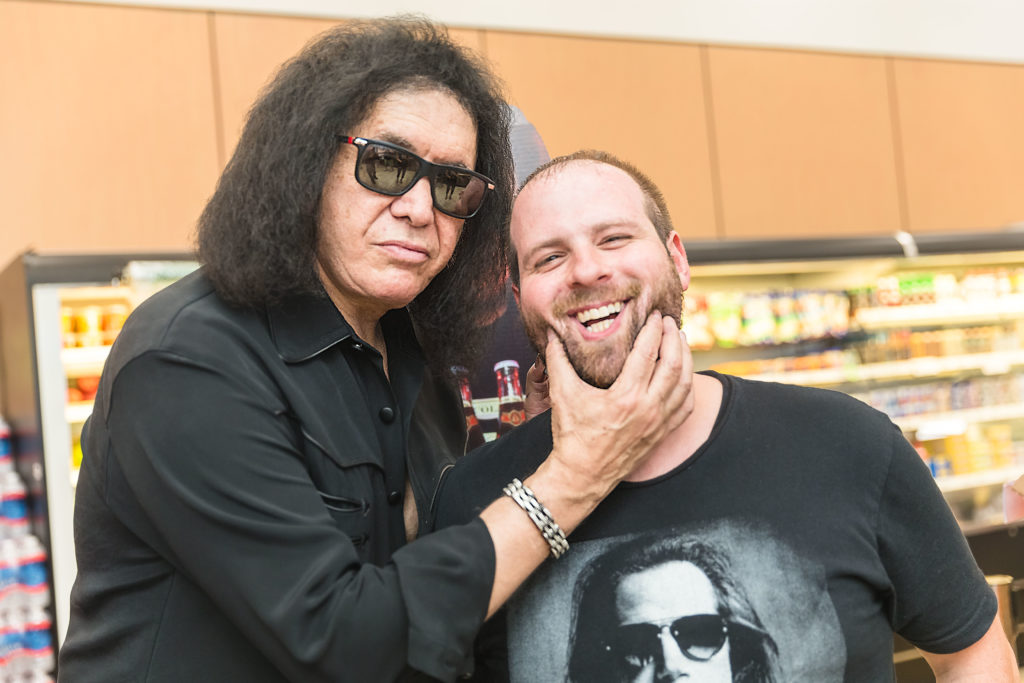
Gene Simmons, Paul Stanley, Tommy Thayer, Eric Singer of KISS (Photo by: Trae Patton/NBC)

Simmons, whose was born in Israel and whose given name is Chaim (Hebrew for “life”) Weitz after his murdered grandfather, was apparently moved to tears after reading the documents. He said his mother hardly ever talked about her past, noting, “I knew almost nothing.”

“My children simply cannot understand all of this. They cannot believe it. The things that happened back then. How many people became victims. Not only Jewish people. Homosexuals, political dissidents, Sinti and Roma. Millions and millions … ,” he said.

Simmons also had to fight back tears when he saw his grandmother’s name on the documents. He recalled his mother telling him about the last interaction she had with her mother before the elder woman was sent to the gas chambers.

“It can happen again and again. That’s why you have to talk about everything. … As long as you talk about things, there is a chance,” Simmons was reported as saying after the interview. “When you see cockroaches in the kitchen, you must point the light at them so you can see them clearly. And you must drive them out of the light.”

Kiss Frontman Gene Simmons Tears Up Learning About Mother’s Holocaust Story Read More »

Legal Group Probes DE Blasio, NYPD Over Alleged Targeting of Jews in Brooklyn

The Lawfare Project, a Jewish legal and civil-rights group, has filed a Freedom of Information Act request as part of an investigation into the alleged targeting of New York City’s Jewish community.

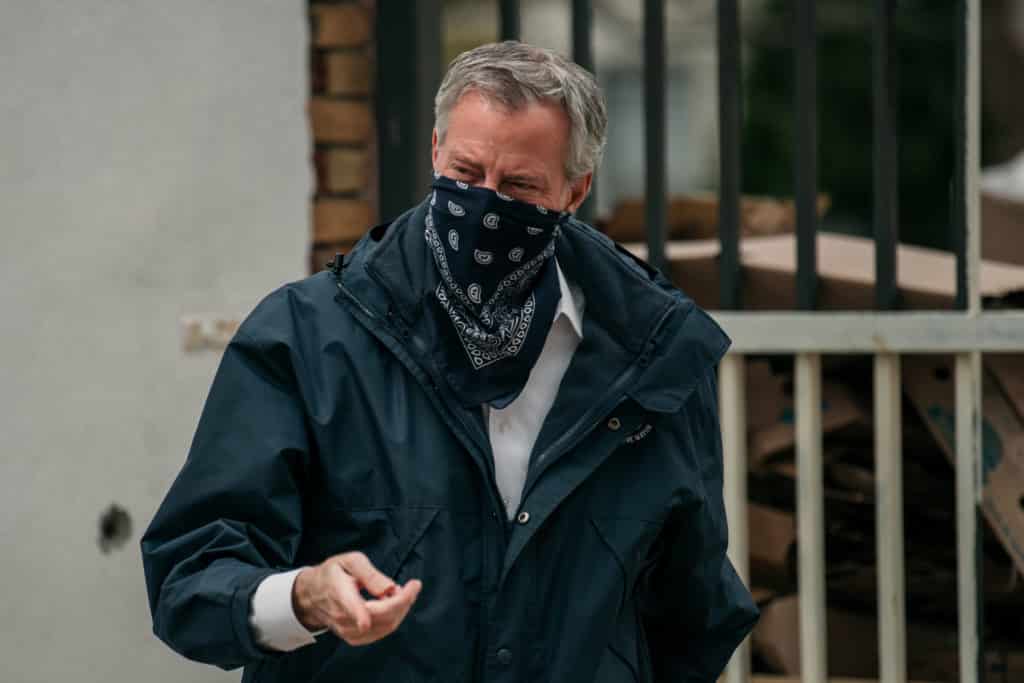
The investigation comes as after New York Mayor Bill de Blasio upset many with a series of tweets about the Jewish community after hundreds gathered in the Williamsburg neighborhood in Brooklyn for the funeral of Rabbi Chaim Mertz. The synagogue that held the gathering later apologized for the crowd.

“The Lawfare Project is concerned that, at a time when anti-Semitic hate crimes are skyrocketing in New York City, Mayor de Blasio has added fuel to the fire by singling out the entire Jewish community for the spread of the coronavirus, even threatening its members with arrest,” Gerard Filitti, senior council at the Lawfare Project, said in a statement. “In light of the mayor’s outrageous statement, we have filed FOIL requests to investigate whether the mayor and the NYPD have taken actions that have disproportionately, and unlawfully, targeted the Jewish community.”

In documentation provided to JNS by the Lawfare Project, several high-profile instances did not result in the NYPD issuing summonses or arrests for social-distancing violations.

A sign warns people of measles in the ultra-Orthodox Jewish community in Williamsburg on April 10, 2019 in New York City. As a measles epidemic continues to spread, New York City Mayor Bill de Blasio recently announced a state of emergency and mandated residents of the ultra-Orthodox Jewish community in Williamsburg at the center of the outbreak to get vaccinated for the viral disease. Those who choose not to will risk a $1,000 fine. (Photo by Spencer Platt/Getty Images)

This includes a March 26 incident where dozens of people were gathered in Astoria Park in Queens; an April 3 event where hundreds of motorcyclists ignored social-distancing guidelines and participated in a funeral procession; and during a flyover of the Blue Angels on April 28, when a number of media reports suggested social-distancing was ignored. No arrests or summonses were reported from these event.

Following de Blasio’s apology, the NYPD also broke up a second overcrowded Jewish funeral later that week.

As part of the request, the Lawfare Project is seeking communications related to the Mertz funeral, the NYPD’s response, the Blue Angels event and other documentation concerning any individuals who violated mandatory social-distancing orders.

In addition to targeting the Jewish community, African-Americans and Latinos have been issued more than 80 percent of summonses for social-distancing violations in the city, reported CNN. Local officials have spoken out regarding the unfair targeting of these communities.

“We will always fight to protect and preserve the civil and human rights of the Jewish community,” said Brooke Goldstein, executive director of the Lawfare Project, in a statement. “It is outrageous for the mayor, charged with protecting the rights of all New Yorkers, to seemingly selectively enforce the law only against the Jewish community. That is the essence of anti-Semitism, and it must stop.”

Legal Group Probes DE Blasio, NYPD Over Alleged Targeting of Jews in Brooklyn Read More »

Jewish Women’s Network Regroups Online to Boost Their Outlooks and Businesses

When Helena Baker launched the Jewish Women’s Global Network last October, she had no idea how her networking-based program would transform in the wake of the imminent coronavirus. And she certainly had no idea how the inspirational, business-focused approach would hit home for those left at home, many recently unemployed.

Baker, 27, started the network a year after making aliyah from England, hoping that a networking group for women might aid her own efforts to find work as a freelance writer. Reaching out to Jewish, female influencers and CEOs in Israel, she brought what she calls some “pretty big names” to Tel Aviv every two weeks to share their passions and best practices in business for an audience of between 10 and 15 Jewish women.

“Jewish people, in general, are networkers, always gathering for Shabbat and holiday meals, gathering in shul and constantly networking and socializing.”

Though this audience may be particularly good at networking, Baker told JNS, as “Jewish people, in general, are networkers, always gathering for Shabbat and holiday meals, gathering in shul and constantly networking and socializing,” with physical meetings no longer relevant during the coronavirus outbreak, a new method was necessary.

Now, as the program has gone online, with both live and recorded videos, Baker maintained that “inspiration is important at this time. Everyone needs a reminder that it’s hard, and we should be open and honest, and after the fact, use [the dialogue] to grow and be stronger.”

One perk of having the sessions online, Baker said, is that the audience can grow, with women so far joining in from England, Germany and the United States, in addition to those in Israel.

Topics and speakers range from Milkstrip CEO Avital Beck, who is teaching “seven tools to help you open a successful startup and enjoy it” to Sarah Encaoua-Guige (TheHassidic HipsterGirl), who taught “how to bring spirituality into your business life” by working learning into a busy schedule.

Encaoua-Guige, who said she hoped to “get the word of God out” and “encourage people to find their own paths,” told JNS that she was deeply impressed with the diversity of the audience.

The lectures, Baker told JNS, offer teachable messages. Each of the women, including Beck, a mother of six whose Israel-based company uses big data derived from breast milk, shows that “it is hard work to build a business, but it is possible to succeed despite the odds, with busy lives outside of professional lives.”

‘The content has been great’

Jamie Geller, originally from the Philadelphia area, said her Jewishness is the “core principle” upon which her digital food-media company is based. During the coronavirus, she has learned that “it’s OK to pull back the covers and show what’s happening behind the scenes.” She plans to explore the idea “of being an authentic, real, honest, open and vulnerable CEO” in her May 20 lecture.

Though the effects of coronavirus on her partner companies have “closed or narrowed the field for us,” Geller’s company has seen a rise of engagement of about 10 percent to 15 percent with more people at home—turning to cooking and food not just as comfort, but also a family and relationship-building activity that Geller believes will last longer than the virus itself.

“People are having more family meals, learning new skills and recipes, and sharing more house-hold responsibilities—one of the positives of this terrible pandemic,” she said.

“People are having more family meals, learning new skills and recipes, and sharing more house-hold responsibilities—one of the positives of this terrible pandemic.”

This message, though brought on by an epidemic, describes her vision and aim for the Jewish world at large, to “inspire more people to celebrate with their families—not just the holidays and not just on Shabbat but even on a regular basis, to learn the value of what it means to come around the table through food.”

The speakers’ messages, as well as the group camaraderie, have already helped many.

Since becoming redundant at her product-management job for a genomics big-data startup, Yael Maoz opened her own consulting business in Israel, helping “biotech and agritech companies handle the challenges of a post-COVID-19 market—whether it be with management or technology,” she told JNS. “I love analyzing and solving complex problems, and with so many businesses needing to downsize, it’s critical that they plan strategically for how they manage with smaller teams, identify and meet their critical goals, and analyze the potential of new technology.”

Maoz has attended the women’s lectures to find an accountability buddy to help build her business. “So far, the content has been great, and I’ve already connected with another budding entrepreneur also looking for accountability and support,” she told JNS. “I’m meeting women from a range of fields, learning tons about business and marketing, and doing it all while properly social distancing. I feel like post-COVID-19 will be a time of tremendous business growth for the women in this network.”

Written by ELIANA RUDEE, JNS

Jewish Women’s Network Regroups Online to Boost Their Outlooks and Businesses Read More »

Hezbol-Law: Behind Germany’s Long-Awaited Ban of the Terrorist Organization

On April 30, Germany officially banned all Hezbollah activities in Germany. In a dramatic demonstration of its execution, authorities raided four mosques believed to have ties to the Lebanese terror group.

Critics of Germany’s reluctance to make a distinction between the political and military wing of Hezbollah, such as the German Jewish community and the Israeli government, praised it as a long-overdue policy. Others called it a partial step.

“Germany has taken a major step, and we’re glad they’ve done so,” U.S. Ambassador to Germany Richard Grenell told JNS. Along with his embassy staff, he has made blacklisting Hezbollah a top priority. The U.S. State Department designated Hezbollah as a foreign terrorist organization in 1997, and U.S. Secretary of State Mike Pompeo has long pushed for Germany to outlaw the group.

The road to banning Hezbollah

The move to ban the Iranian-backed Shi’ite terror group was over a decade-long process in the famously bureaucratic Germany.

The first move to sanction the organization came in 2008, when Germany restricted Hezbollah’s al-Manar satellite station. In 2014, the country banned an alleged charity that was a front for the Martyrs Organization of Hezbollah and the following year, Germany’s Supreme Court ruled that Hezbollah was an organization that “disrupted global peace.”

Despite this, the Germany government and its major political parties seemed to delay a full ban on the terror group.

At a Bundestag debate last June led by the right-wing Alternative for Deutschland (AfD), which introduced a motion to ban Hezbollah’s political arm, German lawmakers stated collective disdain for Hezbollah’s genocidal, anti-Semitic aims but argued the ban might cause instability in Lebanon (where Hezbollah is a central political player) or that it should be a pan-European initiative. The E.U. only recognizes Hezbollah’s so-called “military wing” as a terror organization. Yet other European and E.U. countries, such as the United Kingdom and the Netherlands, list the entire organization as a terror group.

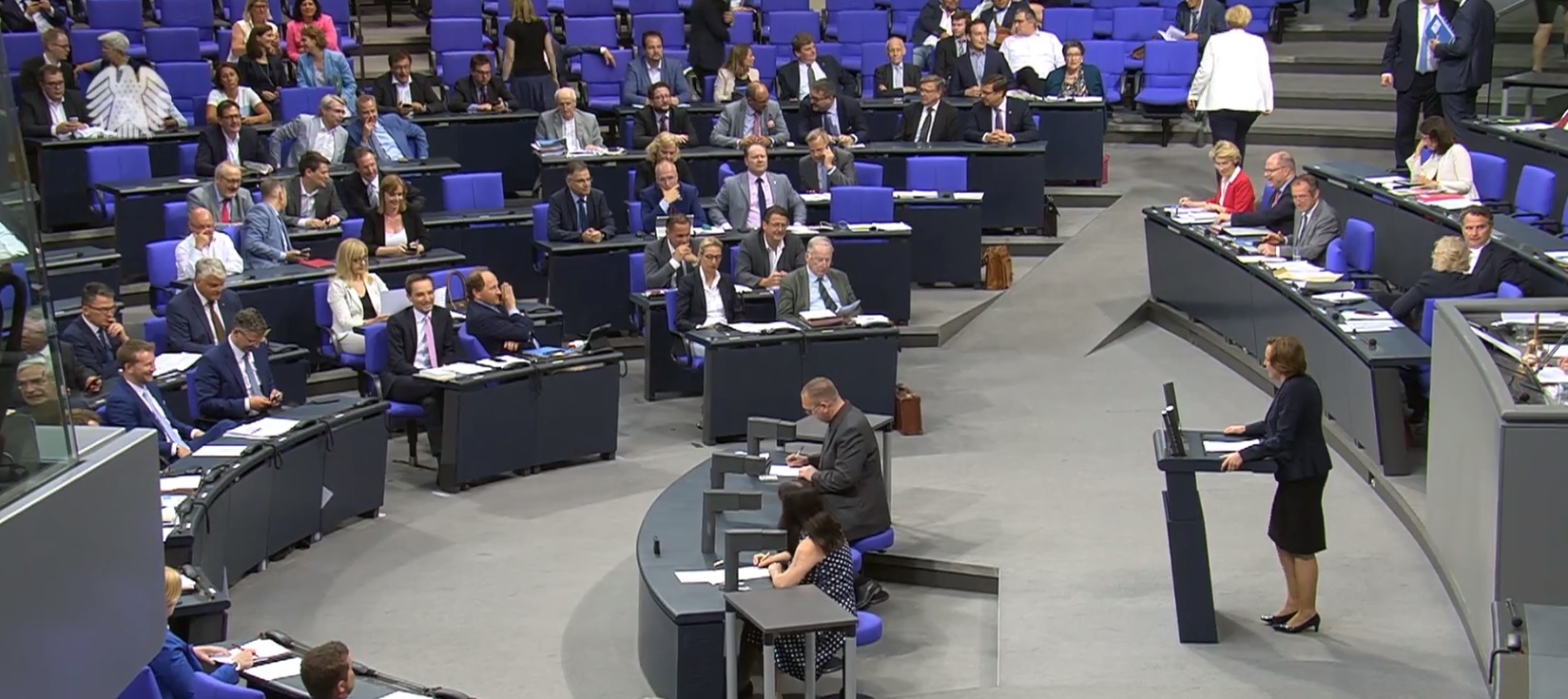
Alternative for Deutschland (AfD) MP Beatrix Von Storch addressing German lawmakers on a proposal to fully ban the Lebanese terror group Hezbollah. Source: Screenshot.

However, the push to outlaw began to gain momentum in December 2019, when the ruling coalition parties, the Christian Democratic Union/Christian Socialist Union and the Socialist Democrats, as well as the Free Democrats (FdP) passed their own non-binding resolution calling on the government to ban Hezbollah’s activities.

“It’s good that, following the clear decision of the joint motion in the Bundestag in December 2019, the Federal Ministry of the Interior has finally become active and brought about the ban on activity,” said MP Strasser, who said he and his party, the Free Democrats (FDP) spearheaded and pushed the motion.

Ban on Hezbollah had to be ‘legally airtight’

Behind the scenes, Grenell and his embassy staff were also working to encourage the Germans to make the ban. Ultimately, the decisive logic employed by the U.S. embassy focused less on ethical, historical and political considerations, but on legal ones.

According to a U.S. official, embassy personnel had extensive discussions with German officials about how the ban fits under the parameters of German federal law, the same laws that justified the banning of ISIS and Al-Qaeda. Any ban on Hezbollah had to be legally airtight to avoid being challenged in court, which could effectively, and permanently, overturn it.

“They did everything that they could under the law, and they’re not going to operate outside the law,” said the U.S. official.

Keeping the letter of the law—i.e., freedom of assembly—has ostensibly prevented Berlin authorities from forbidding the annual Hezbollah-affiliated Al Quds march, which is permitted under strict prohibitions against hate speech, the burning of Israeli flags, and the waving of Hezbollah flags. One the same day that Germany’s Interior Ministry banned Hezbollah, the Al Quds organizers canceled the scheduled May 14 anti-Israel rally, conveniently blaming the Corona pandemic.

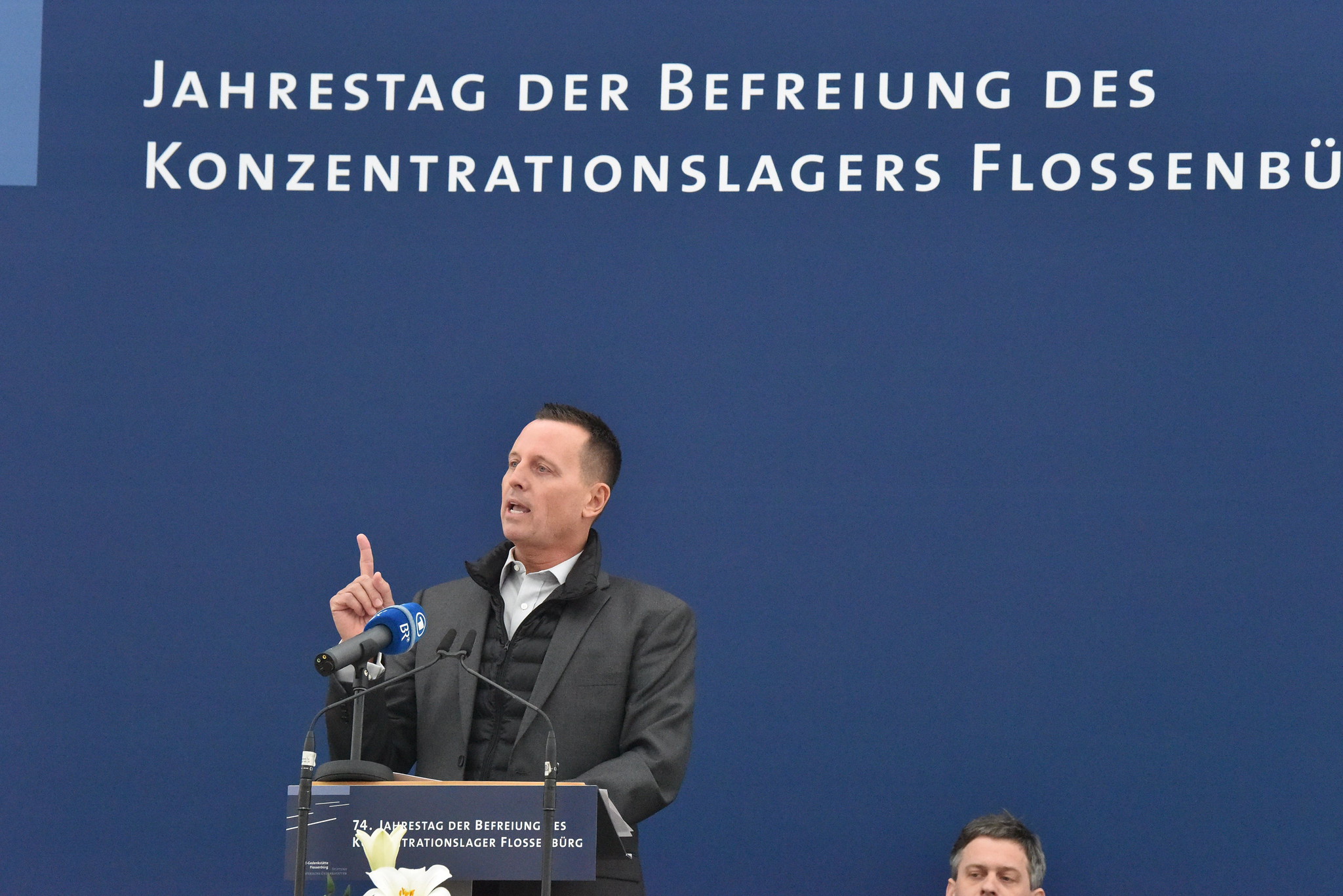
U.S. Ambassador to Germany Richard Grenell participates in the 74th anniversary of the liberation of Flossenbürg Concentration Camp on April 14, 2019. Credit: U.S. Embassy in Germany via Flickr.

According to Berlin’s Interior department, the office had already begun examining, prior to the cancellation, which legal measures could be invoked to get it off Berlin’s streets.

Berlin’s Interior Senator, Andreas Geisel, who participated in counter-demonstrations, said in a statement: “I do not want such anti-Semitic events to take place in Berlin. We are therefore exhausting all constitutional possibilities to make something like this impossible in our city.”

The true test of Germany’s application of the 40-page Hezbollah ban towards the Al Quds rally will therefore be next year (assuming no pandemic).

The AfD, which credits itself as the parliamentary champion of Hezbollah’s demise in Germany, called the move insufficient.

“The German law makes the difference between a ‘Betätigungsverbot’ (Prohibition to Act) and an ‘Organisationsverbot’ (Prohibition of the Organization),” said AfD’s MP Beatrix Von Storch, the sponsor of the June anti-Hezbollah motion. “The German government introduced only a ‘Betätigungsverbot’ for the Hezbollah. That prohibits the Hezbollah to act, but this will not lead to the end of the Hezbollah organization in Germany. But it is necessary to destroy the Hezbollah organization, seize the property and force its extremist members to leave Germany.”

According to the U.S. official, a ban on the activity and the organization are essentially one and the same given that Hezbollah does not exist as a legal entity in Germany (as is the case with ISIS and Al-Qaeda.) The Hezbollah ban on activity subsumes any and all legally incorporated associations, transactions, and assets with proven links to Hezbollah, including those in the digital sphere.

‘Not the beginning of the end’ for Hezbollah in Germany

The question now becomes how vigorously Germany will enforce the ban, said Michael Rubin, a resident scholar at the American Enterprise Institute specializing in Iran.

“Hezbollah will play Three-card Monte with shell organizations and front groups, much like the Muslim Brotherhood does,” Rubin told JNS. “This is the end of the beginning, not the beginning of the end. German authorities will need to show their seriousness by continuing to close front groups as they try to open.”

“I consider it absolutely necessary that the Federal Government does not now sit back and do nothing,” said FDP’s Strasser. “It must use the German E.U. Council Presidency in the second half of 2020 to arrive at a new assessment of Hezbollah at European level as well.”

According to Benjamin Weinthal, fellow for the Foundation for Defense of Democracies who has covered the matter extensively, the next step would be to sanction Hezbollah’s chief sponsor, Iran. “That means pulling out of the deeply flawed Iran nuclear, joining U.S. sanctions targeting Tehran, and not agreeing to allow Iran to buy arms after the weapons embargo on the rogue nation expires in October,” he said, adding that Germany should next outlaw the Islamic Revolutionary Guard Corps, another U.S.-designated terrorist entity.

While Israel and the Jewish community, in addition to several German lawmakers, have rallied for the ban, the credit, said Weinthal, goes to Grenell’s efforts, which won’t stop here. Next up: the European Union.

“But now it’s time for the rest of the E.U. to follow through and take a similarly strong stance,” said Grenell. “There can be no doubt Hezbollah is a global threat. Germany has recognized this, and it’s time to make sure this terrorist organization doesn’t have safe haven anywhere in Europe.”

Hezbol-Law: Behind Germany’s Long-Awaited Ban of the Terrorist Organization Read More »

On the Front Lines of Compassion: What it’s like working at a Jewish cemetery during a pandemic

Whenever I tell anyone where I work, they respond with the predictable, “You work at a cemetery?” or “What’s it like working at Mount Sinai?” or “How do you do it every day?”

In reality, few people know what it’s like to work at a cemetery serving the entire Jewish community of Southern California. In truth, it’s fairly simple. I’ll let you in on a little secret: everybody who works here, whether they are in accounting or mortuary or landscaping or advance planning, is motivated by the same mission: to carry out our responsibility to honor the deceased and care for the living. Admittedly, both have been challenging for all of us these days. 

A few days after California issued the “safer at home” order, Mount Sinai was faced with its first COVID-19 burial. Suddenly, the pandemic became very real. It was no longer about empty shelves at the supermarket, but about a member of our community who lost his life. The day of the funeral, I stood on the grass in the Hollywood Hills park watching the clergy guide four extended family members through the service while the immediate family could only witness this intimate moment at home through livestream. It was heartbreaking and marked day one of the new normal. 

While COVID-19 has forced us to adapt, the human need to grieve and mourn remains.

This has become a familiar scene for mourners across the country. A single landscaper lowering the casket in the ground. Maybe a few, if any, family members shoveling dirt using separate shovels brought from home. Families mourning their loved ones over screens. No large gatherings or services followed by a stream of cars to the gravesite. No pall bearers. No directions to the family home for shiva.

COVID-19 has changed the way we approach ceremonies, forcing many of us to rethink what it means to honor the deceased. Many of the public health guidelines directly contradict some of the most important tenets of Jewish burial. For many, a funeral is a ritual of loss and a connection to comfort the living. But the coronavirus has altered that ritual: the loss remains but the connection changes. That’s why it was never a question of whether my Mount Sinai Memorial Park colleagues and I would continue to work during this pandemic. And while COVID-19 has forced us to adapt, the human need to grieve and mourn remains. Still, we are here. We stand in, connect with and care for grieving families during their time of need. 

The day after the statewide “stay-at-home” order was issued, I spoke with Rabbi Chaim Mentz – who established Chabad of Bel Air – about a personal matter. Our call quickly morphed into a discussion about so much more: Should I stay home as a single mother with a history of health challenges and a chronically ill daughter? Or should I continue to work somewhere where I’d likely be thrown into the COVID-19 crisis?

He comforted me as clergy are known to do, and I realized continuing my work was never a question. The true question was how to navigate the fine line between the person I have become through my years at Mount Sinai Memorial Parks and what I choose to do for a living. A few days later, Rabbi Mentz sent a text that still resonates deeply six weeks later, “Stay safe, u r on the front line of compassion.” Yes, Rabbi, while we may not necessarily be the first COVID-19 frontline workers you think of, we have always been on the front line of compassion. 

While doctors and nurses risk their lives working tirelessly to treat those infected with the virus, our staff risks theirs guiding the deceased to a dignified Jewish burial. We know all too well the risk in being here. While we exercise the utmost caution protecting our team, Mount Sinai’s staff comes to work every day knowing what separates us from potential infection is a pair of latex gloves and a surgical mask. Of course, there is fear but there is also the courage to do what we feel is right.  As Ambrose Redmoon wrote, “Courage is not the absence of fear but rather the judgement that something is more important than fear.” Members of Mount Sinai staff have stood graveside, recited kaddish, acted as pall bearers, held the phones for FaceTime and Zoom services and refused to diminish our responsibility to care for the deceased or our deep sense of care for the community. 

This is the House of the living—the same house where every Mother’s Day we celebrate the lives of the women who made us who we are.

As Mother’s Day approaches, I think back to previous years when visitors created traffic jams and coolers filled with water bottles were quickly emptied. The days would seemingly run on a time-lapse. We’d see so many families with whom we have built relationships with—either through advance planning or during loss—and be greeted with smiles as cars passed through the gates, reminding us that the words on the park entrance translate to “House of the Living.”

And this is the House of the living—the same house where every Mother’s Day we celebrate the lives of the women who made us who we are. We will be here this Mother’s Day, smiling back under our masks, waving with our gloves on and keeping a safe distance. We will be spread throughout the park placing stones on hundreds of markers and visiting gravesites for the families who must stay at home. And, just like many of my colleagues, I will be here all day on Mother’s Day while my children are home alone. We will visit mothers who are not our own; but, this Mother’s Day, they will be. 

It’s hard for most to imagine choosing to work and not being with your children on Mother’s Day, especially at a time when the world has slowed down and the focus has shifted to prioritizing our health, safety and families. However, it reminds me of a story I heard about my colleagues when the Northridge Earthquake hit in 1994.

No one expected the staff to show up to Mount Sinai, yet the employee parking lot was full. My colleagues had dodged electrical fires, water main floods and navigated disintegrated freeways to make it to work—all because they (who are still working here 25 years later) knew that there were those in need of burial and families in need of care. Our team has continued to be on the front line of compassion always and in all ways. In the time of COVID-19, we have adapted to this new reality, following protocol, navigating ever-changing guidelines, and internally struggling as we do our best to provide traditional burials that exceed expectations.

Last shabbat I attended a funeral service. It was not a COVID-19 burial, but the scene was the same as our staff outnumbered the two mourners present. The widow was a mother of young children, and our paths had crossed on the phone months ago. I only met her in person with a masked face in the parking lot minutes before the funeral of her husband. I expressed my heartfelt condolences graveside and then watched the service from afar as I have done so many times. Rabbi Mentz officiated the service; this was the first time we chatted since his text when this all began. We walked to our parked cars talking about his wife’s salmon recipe before wishing each other a good shabbos. As he drove away, I got in my car and cried. This was not the first time. No two days are alike and having the courage to do what we feel is right does not mean that we don’t hurt. And showing up does not mean that we are not tired. I don’t want the new normal to become normal. 

I think about what we at Mount Sinai Memorial Parks would do if faced with the overwhelming situation New York endured. All I know for certain is that we would show up and continue to honor the deceased and care for the living because that is what we do. And this is when I tell all those who say “I could never do that” that—yes—you can. We all have the choice to act, work on ourselves and make commitments to our community. In Judaism, it is said that Deed shapes the Heart. Outward actions can shape our inner character. Day in and day out, we do and do and do again. And therefore, who we are and what we do are so intertwined. We aren’t superheroes, we are just strong enough to do the right thing. Courage is the engine that allows us to move forward perpetually, with intentionality, with compassion and with knowledge that both meaning and purpose is found in our work.#frontlineofcompassion 

Kimber Anapoell Sax is the Director of Advance Planning at Mount Sinai Memorial Parks.

On the Front Lines of Compassion: What it’s like working at a Jewish cemetery during a pandemic Read More »