fbpx

April 30, 2020

It’s Official: Jewish Summer Camps Will Cancel This Summer Due to COVID

All Reform Jewish summer camps will remain closed for the 2020 summer due to the ongoing coronavirus pandemic, the Jewish Telegraphic Agency has learned.

The landmark decision, made Thursday afternoon, will affect 15 overnight camps across the country, which collectively served some 10,000 campers in 2019. The Reform movement, the largest in the United States, is the first to suspend its entire summer camp network. It’s the first time in more than 70 years that the movement is suspending its camps.

The movement is also canceling all of its trips to Israel and other locations, as well as all in-person youth activities. A statement from the Union for Reform Judaism said that if it ends up becoming possible to open the camps, “doing so will be our top priority.”

“After months of carefully following and evaluating the evolving COVID-19 situation, the URJ has reached the heartbreaking, difficult, and values-based decision to cancel all in-person activities this summer,” read the statement. “Although we have continued to plan, prepare, pray, and hope for another transformative summer, the risks posed by COVID-19 threaten our most sacred values: the health and well-being of our children, staff, and faculty that attend camp, along with their communities back home.”

Overnight camp is a centerpiece of the American Jewish community, with children often attending and sometimes then working at the same camps that their parents attended. Lasting anywhere from a few days to eight weeks, camps generally include Jewish education, prayer, Israeli cultural activities and Hebrew — along with sports, arts and crafts, and the like.

Whether the camps can operate given the pandemic has been an increasingly pressing question. Some states are beginning to lift some of the restrictions they imposed to slow the spread of the disease, and mounting evidence suggests that children are less vulnerable than adults.

At the same time, public health officials say returning to business as usual would not be safe, and many camps require campers and their families to travel great distances to attend. Camp directors have told JTA that state and local social distancing regulations, as they are now, would prevent camps from opening.

Also Thursday, two Conservative Jewish Ramah camps, in Colorado and Wisconsin, announced that they would be delaying their start dates to at least July 1 and June 30, respectively, because of the pandemic. A third Ramah camp, in Georgia, is expected to make a similar announcement soon.

But they are continuing to leave open the possibility that overnight camp will be possible for at least a portion of the summer.

“Based on the current situation, including available data, government regulations, and our health standards, it appears unlikely that we will be able to run camp at all this summer, though we remain hopeful that we can join together for at least part of the 2020 camp season,” Ramah in Wisconsin’s executive director, Jacob Cytryn, wrote in an email to community members. Ramah in Wisconsin has run every summer for more than 70 years.

In the Cleveland area, Camp Wise also has canceled this summer due to the coronavirus. The camp, according to its website, was founded in 1907.

“Camps are about groups of children and staff who are together every day,” read a statement from Michael Hyman, president and CEO of the Mandel Jewish Community Center, which runs the camp. “For the well-being of campers, their families, our staff and the community, it was best to cancel the operation of all camp programs for the summer of 2020.”

It’s Official: Jewish Summer Camps Will Cancel This Summer Due to COVID Read More »

Table for Five: Acharei Mot-Kedoshim

One verse, five voices. Edited by Salvador Litvak, the Accidental Talmudist.

Speak to the entire community of the children of Israel, and say to them, “You shall be holy, for I, the Lord your God, am holy.” –Leviticus 19:2


Zvi Dershowitz
Rabbi Emeritus, Sinai Temple

It can’t possibly be true: Does Torah equate God and Israelites, saying both are the same by indicating “For I (God) am holy, therefore you shall be holy, kodesh?” Both are the same, kodesh!

The word “holy” is used in various contexts; the contemporary phraseology for marriage is holy matrimony, for example. The Torah meaning of the word is to set apart, to distinguish from others, to be unique. Thus, holy matrimony implies that the husband shall be unique — holy — unto his wife, and vice versa. Holy is not better, but rather set apart from other ideas and people. Thus, per the text, God, being holy, means that He is different from humanity.

The Kohen is holy is because his function is special. He is not necessarily better than other Israelites. Kohanim serve a unique function to their people and God; that’s what sets them apart as holy. We Jews are holy because of our unique beliefs and moral guidelines (monotheism, the State of Israel). The anti-Semitic diatribe accusing Jews of claiming to be better is based on the false assumption that holy means superior to others. When maintaining rules of kashrut, we emphasize that we are kodesh — no other group keeps kosher nor does it celebrate the variety of holidays, including Shabbat, as we do.

That’s what makes us holy — unique, different — without claiming superiority. “Speak to the entire community” means we all must strive to attain holiness — this lofty goal applies to every Jew.

Rabbi Ari Segal 
Head of School, Shalhevet High School

I find myself more struck by what this verse does not say than what it does. “You shall be holy” is a powerful directive, but it’s also incredibly vague, with no hint as to how we can enact this designated holiness.

This is especially strange because the parsha has just concluded a detailed list of actions that would render us not holy. The opposite side of the coin, however, is blank.

This pattern emerges elsewhere, too. The famous and detail-free phrase from Deuteronomy, “Justice, Justice, you shall pursue,” is presaged by detailed laws. So why do so many litanies of specific no’s culminate in a quotable but nondescript yes?

I think it’s because this “yes” is intentionally vague. It’s not that it is free of detail, but rather it is full of opportunity.

It’s easy to view the detailed laws of the Torah as restricting our behavior to rote responses but, in fact, the opposite is true. God gives us the specifics on what is “not OK” so we can have the powerful creative freedom to define and enact good. These restrictions are what enable our goodness, our holiness, to manifest in creative ways, just like a hose restricts the water within it, so that it can be unleashed powerfully and effectively.

The commandments before this verse provide structure and boundaries, a canvas for our actions that encourages us all to decide not only what our holiness is, but how we can display and use it to the best of our ability.

How will you put your own personal touch on being holy?

Dina Coopersmith
Women’s Trips coordinator and lecturer

Holiness. Such an obscure concept. How should we be holy? This word connotes ashrams and gurus on mountaintops, meditation and asceticism. Judaism has so many physically oriented responsibilities, as well as demands that we eat good food and drink good wine, and enjoy them. Doesn’t sound holy to me!

And yet, Judaism expects us to be a “kingdom of priests and a holy nation.” Our verse is, in fact, one of many exhortations in the Torah involving holiness.

When the Jewish people left Egypt, they were on the 49th level of tumah, ritual impurity, because they were steeped in Egyptian culture. It took them 49 days of “counting the Omer” to reach a level of kedushah, holiness, where they could receive the Torah from God on Mount Sinai.

The midrash says that the Jewish people in Egypt were like a fetus in an animal’s womb, with no uniquely human identity, no ability to think for themselves. They were animalistic slaves, behaving as debased, instinctual creatures. This is the 49th level of tumah — the lowliest possible, the opposite of kedushah. What, then, is holiness?

When we identify with our soul, imbuing our physical actions with mindfulness, dignity and purpose, we engage in a uniquely human endeavor. As Jewish people, we have the unique mission to go beyond human tendencies and reach toward Godliness, by instilling our base actions such as eating, shopping, reading and even having intimate relations with meaning, thought and spiritual goals. The opposite of being animalistic is to be holy, to strive toward the Godly “for I am Holy.”

Lori Shapiro
Rabbi, artistic director, Open Temple

The God voice implores us with its cohortative beckoning, “You Shall Be Holy” toward an undefinable goal. What does kedoshim, holiness, mean, anyway?

In a time of quarantine, “The Holiness Code” feels a bit like “The Twilight Zone.” Rabbi Avraham Hen in Malchut HaYahadut explores the manifold definitions of holiness: concepts of purity, body cleanliness, avoidance of defilement to prepare for an important act, abstaining from permitted things, Kiddush HaShem (martyrdom), and isolating — all things that make pandemics so much fun.

The verse continues: “I, God, Your God, am Holy.” The parallelism in the verse is clear: We are called upon to strive for Godliness, with one important caveat: God is a singular Holiness and we are kedoshim in the plural. We achieve holiness only together.

There is something to these pandemic times that reveals our essence: Who am I when no one is watching? Similarly, the Holiness Code asks of us: Who do we want to become through this time? Whether or not we have the freedoms to walk on the beach, visit a park or go to a restaurant doesn’t define our character. Our smallest actions define our character. And so, who do we want to be after we emerge from this time of quarantine?

Actions matter. May this time of separation be for a blessing to ruminate on our role in this republic as we prepare for the day that we can again emerge into a collective Pluralism of Holiness.

Salvador Litvak 
Accidental Talmudist 

Two elements of this verse have drawn the attention of most Torah commentators: 1) God told Moses to assemble all the people, and 2) these people shall act like a holy people.

Because this command precedes revering one’s parents, keeping Shabbos, desisting from robbery, forgoing revenge, and loving one’s fellow human, 19th-century commentator Maharzav identifies these commands as the essential mitzvot of Torah.

Gur Aryeh defines holiness itself as separating from material desires and aspiring toward the spiritual. Alsich adds that the whole nation was assembled in order to emphasize that holiness is not just for priests and Levites, but for everyone.

What drew my attention, however, is the little word “ki,” because. God is so infinitely beyond human beings that a causal connection between His holiness and ours makes no sense. It would be enough that we should be holy because God said so. Why does He also point to His state of holiness as the reason for ours?

Perhaps it’s because we’re his reps. The world knows we’ve been given the Torah, and with it, a sacred mission. If we then behave badly, we reflect badly on our Master. So it’s not enough to obey the letter of the law. If we look religious and yet appear unholy, we can become what Ramban calls a degenerate with the permission of Torah. Rather, we must conduct ourselves like a nation of holy people who will attract others toward faith in the Eternal. We, His emissaries, need to be admirable people.

Our example thus counts even more than our teachings, and this principle applies to every Jew for all time.

Table for Five: Acharei Mot-Kedoshim Read More »

Palestinian Driver Rams His Car Into West Bank Checkpoint

JERUSALEM (JTA) — A Palestinian man drove his car into a West Bank checkpoint a day after a Palestinian teen stabbed an Israeli woman in central Israel.

The young man from the West Bank Palestinian village of Barta’a reportedly told investigators that he wanted to die, the Defense Ministry reported.

In the incident Wednesday night, he was asked to slow down for inspection at a checkpoint near Jenin but instead sped up and drove toward the security guard at the checkpoint. The driver then slammed into a concrete block protecting the checkpoint, according to the ministry.

The attack came a day after a Palestinian teen stabbed a 62-year-old woman multiple times in front of a mall in Kfar Saba, in central Israel. The woman is slated to leave the hospital on Thursday.

A week ago, a Palestinian driver rammed his car into an Israeli Border Police guard at a checkpoint near the West Bank settlement of Maale Adumim, then exited the car and stabbed him with a pair of scissors.

Palestinian Driver Rams His Car Into West Bank Checkpoint Read More »

Germany Fully Bans Hezbollah

Germany’s Interior Ministry announced in an April 30 statement that the Iranian Shiite terror proxy Hezbollah has been fully banned in Germany.

The German parliament had passed a resolution in December calling for German Chancellor Angela Merkel to implement the ban. Before the Interior Ministry’s announcement, only Hezbollah’s military wing was banned in Germany; the group also wasn’t designated as a terror organization until April 30.

“As the authority responsible for issuing the ban, the Federal Ministry of the Interior, Building and Community is of the opinion that Hezbollah openly calls for the violent elimination of the State of Israel and questions the right of the State of Israel to exist,” the ministry said in the statement. “The organization is therefore fundamentally against the concept of international understanding, regardless of whether it presents itself as a political, social or military structure.”

Under the ban, any Hezbollah activity as well as images of Hezbollah symbols are prohibited.

The German government launched raids against mosques and individuals on April 30 believed to be providing financial support to Hezbollah and disseminating pro-Hezbollah propaganda.

Interior Minister Horst Seehofer told the German news outlet Bild, “Hezbollah is a terrorist organization deemed responsible for numerous attacks and kidnappings worldwide.”

Acting Director of National Intelligence and U.S. Ambassador to Germany Richard Grenell tweeted, “The world is a little bit safer.”

https://twitter.com/RichardGrenell/status/1255814008046845957

Israeli Foreign Affairs Minister Israel Katz praised the move.

“I want to express my appreciation to the German government for this step and am certain many governments in the Middle East and victims of Hezbollah’s terrorism share my gratitude,” he said.

Katz urged other members of the European Union (EU) to follow suit.

“Hezbollah — both its military and political wings — constitutes a terror organization, and that is how it must be treated,” he added.

The only other European countries that have banned Hezbollah are Britain and the Netherlands.

American Jewish Committee (AJC) CEO David Harris said in a statement, “This is a welcome, much-anticipated, and significant German decision. We would like to thank the Government of Chancellor Angela Merkel, and express particular appreciation for the leadership role of Interior Minister Horst Seehofer as well as the important support of Foreign Minister Heiko Maas, in advancing the landmark decision.”

The Simon Wiesenthal Center similarly tweeted, “Simon Wiesenthal Center applauds German Chancellor Merkel and Foreign Minister Maas for decision to totally ban #Hezbollah. It will curb terrorist group’s fundraising, logistical and anti-Semitic efforts in #Germany.”

In September, the AJC released an ad calling on EU countries to ban Hezbollah’s political wing in addition to its military wing.

“As Hezbollah leaders themselves declare repeatedly, it is one indivisible organization,” the ad stated.

Germany Fully Bans Hezbollah Read More »

The Coronavirus Pandemic: A Wake-Up Call

The coronavirus pandemic should be a wake-up call for the urgency of eliminating, or at least sharply reducing, the consumption of animals.
Food and health experts agree that the pandemic began due to the consumption of a wild animal, raised in dirty, cramped, stressed, disease prone,-conditions at one of China’s many live animal markets.
These repulsive places are known as “wet markets,” because animals are often killed in front of the buyer, in the midst of mess and filth, and the slaughtered animals’ blood washes over and mixes with other animals to create perfect conditions for creating and spreading novel viruses that can cross the species barrier.
The pandemic has caused widespread illnesses, the loss of thousands of lives, millions of jobs, and trillions of dollars, and is threatening many businesses and industries. Is eating animals worth all of this devastation?
It is ironic that a disease resulting from animals being kept in closed, confined spaces is causing so many people to be confined in their homes, with their freedom of movement sharply curtailed.
Upon recognizing the great devastation caused, China prohibited the sale of animals at their wet markets.  Will other nations follow their example? After all, modern factory. farms and slaughterhouses also pose many similar dangers, as millions of animals are raised in disease-promoting, crowded conditions and then are slaughtered daily in mass production methods, with blood, feces, and other pollutants spreading widely.
Many previous major disease outbreaks, including swine flu, mad cow diseases, bird flu, SARS, and MERS, were due to human consumption of animals.
Additional reasons for eliminating or at least sharply reducing animal consumption include:
    • Many studies published in peer-reviewed articles in respected medical journals have shown strong links between the consumption of meat and other animal products and incidents of heart disease, several types of cancer, strokes, and other life-threatening diseases. Several studies showed that not only can well-balanced animal-free diets and other positive lifestyle changes not only can reduce risks of such diseases, but in some cases can reverse them.
    • Because factory farmed animals live in unnatural, cramped, unsanitary conditions,  farmers routinely use antibiotics in animal feed in efforts to reduce disease outbreaks.  This has resulted in an antibiotic resistance-related health crisis for people, as antibiotics are becoming less effective in responding to human diseases.
    • Animal-based diets require as much as 20 times as much land, 13 times as much water, and ten times as much energy per person than vegan diets. While an estimated nine million of the world’s people die annually of hunger and its effects and over ten percent are chronically malnourished, 70 percent of the grains produced in the United States is fed to animals destined for slaughter.
    • While climate experts are increasingly warning that unprecedented changes must soon occur in efforts to avert a climate catastrophe, and there seem to be almost daily reports of severe, sometimes record breaking heat waves, droughts, wildfires, storms, floods, and other climate events, the livestock sector is a major contributor to greenhouse gas emissions (GHGs), largely due to huge amounts of methane, a very potent greenhouse gas, emitted from cows and other farmed animals.
    • A 2006 report from the United Nations Food and Agriculture Organization, “Livestock’s Long Shadow,” stated that the livestock industry emits more GHGs, in CO2 equivalents, than all the cars, planes, ships, and other means of transportation worldwide combined.  A 2009 cover story in WorldWatch magazine, “Livestock and Climate Change,” by  two World Bank environmentalists, concluded that the livestock sector is responsible for at least 51 parent of all human-induced GHGs.
    • Climate change is especially threatening to Israel as a rising Mediterranean Sea could inundate the coastal plane where much of Israel’s population and infrastructure are located, and the hotter and dryer Middle East that climate experts are projecting make instability, terrorism, and war more likely, according to military experts. These experts warn that climate change will cause tens of millions of desperate refugees worldwide to flee from severe climate events, resulting in a far much more unstable and violent world.
Diets free of meat and other animal products have the added advantage of being most consistent with basic Jewish teachings on preserving human health, treating animals with compassion, protecting the environment, conserving natural resources, and helping hungry people. It also makes it more likely that one is being consistent with the laws of kashrut.
Hence, shifting to a vegan diet is the best thing one can do for their health and the health of the planet, for animals, for reducing hunger, for the efficient use of water energy, and other natural resources, and for living most consistently with Jewish values and laws. It is a win – win – win – win situation.

We failed to heed the warnings of medical experts and were unprepared for the present coronavirus pandemic. Will we now fail to heed the warnings of climate experts, and face another future catastrophe? To leave a decent, habitable world for future generations, it is essential that there be a major societal shift to plant based diets. As Jerry Brown, former governor of California, expressed it, “Humanity is on a collision course with nature.” There is no Planet B.


Richard H. Schwartz is a professor emeritus at College of Staten Island and author.

The Coronavirus Pandemic: A Wake-Up Call Read More »

Wondering When and How to Reopen? Better Call Saul

As governors, mayors, and the president grapple with the decision on how and when to relax social distancing measures in the coming weeks or months, the Bible offers us a precious bit of advice: Better call Saul.

The Bible’s first king was the first leader in recorded history whose people enacted a shelter-in-place policy, as their leader struggled to balance mounting public pressure against an immeasurable enemy. And Saul’s mishandling of the moment can teach contemporary leaders a few priceless lessons.

The story, as told in the book of Samuel chapter 13, is grim: Around 1050 BCE, the Philistines were on the attack, overwhelming the Israelites with battalions “as numerous as the sand which was on the sea shore.” Running their own version of a diagnostic model, Saul’s subjects determined that facing their foes will lead to too many dead. Instead, they sought to flatten the curve. By hiding.

“The people were distressed,” the Bible tells us, “they hid themselves in caves, and in thickets, and in rocks, and in holds, and in pits.”

The tactic worked for a little bit. Then the Israelites started getting anxious. Some began fleeing abroad, across the Jordan River. They pressured their king to make some decision, or at least tell them when it might be safe to come out of their self-imposed quarantine. Being the nation’s first-ever king after a long line of unruly local chieftains, Saul felt the pressure mounting. He wanted to assure the people that God was on their side, and turned to the prophet Samuel for help the way a modern president might consult the head of the NIAID or CDC, say. But Samuel, we’re told, “tarried seven days” without signaling that it was time to take swift, decisive action. The people, watching closely, groaned louder.

Finally, Saul cracked. He couldn’t wait on the experts any longer. He offered sacrifice to God before his holy adviser, Samuel, gave him the green light. The prophet didn’t take it all too well. “What have you done?!” he shouted at Saul.

Though victory over the Philistines was eventually achieved, it was a pyrrhic one, occurring despite Saul’s efforts, not because of them. Saul was stripped of his crown, soon to be replaced by David. It was the young redheaded shepherd, not the tragic first king, who would father the dynasty that would forever rule the kingdom of Israel, as well as produce a certain Nazarene who would also go on to make quite a name for himself.

Now, science isn’t prophecy, and Dr. Anthony Fauci and Dr. Robert Redfield are surely no prophets, but Saul’s fall offers three hard kernels of wisdom for our contemporary decisionmakers. The first is this: Let us not step outside our lanes. Spawning a system that millennia later inspired America’s own Founding Fathers, God commanded an earlier leader of the Israelites, Moses, to establish a form of government in which political leaders would not assume the duties of priests or prophets. Heaven and earth, went the idea, both benefited when kept separate, each a realm onto itself. Saul betrayed this basic idea, and took on the role of the man of God, bringing the sacrifice before Samuel arrived to execute his duties. It’s no wonder that, in the end, Saul and Samuel’s relationship sundered, the once proud leader left breaking bad and desperately consulting a diviner of bones for advice.

Which leads us to the second lesson we should learn from Saul’s downfall: Never bet on the wisdom of crowds, no matter how loudly they huff and hashtag. A wiser leader would’ve realized the folly of asking his constituents for anything approximating advice, and would’ve understood, also, that people tend not to make the best judgment calls when their psyches are battered and their resources stretched. David, again, realized this all too well: When he marched into battle against the giant Goliath, his soon-to-be subjects laughed and predicted that his downfall was imminent. David tuned them all out and quieted the doubters with his slingshot. He triumphed because he realized that, sometimes, the greatest skill a leader can have is knowing when not to listen.

Finally, there’s one more failing of Saul’s that merits our attention. First rate minds, as a wise man once said, can hold two contradictory ideas simultaneously and still retain the ability to function. Our greatest leaders, in the Bible and beyond, powered through self-doubt, anxiety, even abject terror, and still made good decisions, communicating their thought process clearly to both counselors and constituents. Saul never did. He saw hesitation as a sign of weakness, and rushed to deliver something that looked like decisive action. He blew it, as will anyone who follows in his footsteps.

Saul is long dead, but the drama of his life is still unfolding before us. Let us hope that the men and women running the battle this time deliver far better outcomes than the ill-fated king ever did.

Wondering When and How to Reopen? Better Call Saul Read More »

Israel Could Be Prosecuted for War Crimes with International Criminal Court Ruling That Palestine Is a State

JERUSALEM (JTA) — Palestine is a state and the International Criminal Court has jurisdiction involving its cases, the ICC prosecutor ruled Thursday, which could pave the way for a war crimes investigation against Israel.

A three-judge panel of the ICC Pretrial Chamber must now affirm the decision by Fatou Bensouda.

Israel has been accused of committing war crimes in the West Bank, eastern Jerusalem and the Gaza Strip.

Israel is not a signer of the Rome Statute and therefore is not a part of the ICC. The Palestinian Authority is, even though it is not a full member state of the United Nations.

Under Bensouda’s 60-page decision, the ICC may exercise its jurisdiction in “territory” that “comprises the West Bank, including East Jerusalem, and Gaza.”

Some 50 briefs, both for and against Israel, were filed in the case. The countries that have filed briefs in support of Israel include the Czech Republic, Austria, Germany, Australia, Hungary, Brazil and Uganda, The Jerusalem Post reported.

The ICC is overseen by the Assembly of State Parties, the legislative branch of the organization, which has accepted Palestine as a state.

NGO Monitor, a pro-Israel watchdog group, criticized Bensouda’s decision.

“She completely ignores the overwhelming and decisive information provided to the Court by dozens of Middle East and legal experts as well as seven ICC Member States, proving that the Court has no jurisdiction in this matter,” the group said in a statement. “Instead, she relies on unsupported claims by pro-BDS and terror-linked NGOs and one-sided rhetoric from biased UN bodies, like the Human Rights Council.”

Israel Could Be Prosecuted for War Crimes with International Criminal Court Ruling That Palestine Is a State Read More »

Trump Reiterates His Rejection of Anti-Semitism in Jewish American Heritage Month Proclamation

(JTA) — President Donald Trump reiterated his rejection of anti-Semitic bigotry and hate attacks in a proclamation for Jewish American Heritage Month.

“Tragically, Jewish men, women, and children continue to face anti-Semitic discrimination, persecution, and violence today, and Jewish institutions and places of worship remain targets of vandalism and destruction,” Trump wrote for the commemoration in May. “Such unconscionable acts are an abomination to all decent and compassionate people. Hatred is intolerable and has no place in our hearts or in our society. We must therefore vigorously confront anti-Semitic discrimination and violence against members of the Jewish community.”

The president touted his executive order on anti-Semitism issued in December that directs “robust” enforcement of existing civil rights protections for Jews on college campuses under the Civil Rights Act of 1964. The order, which garnered controversy, says attackers target Jews because they perceive them to be a race or having a shared national identity.

Trump also stressed his administration’s ongoing “efforts to combat racist and anti-Semitic discrimination,” and highlighted his executive order earlier this month in his Holocaust Remembrance Day proclamation.

He also praised the American Jewish community, writing that “Jewish Americans strengthen, sustain, and inspire our country through dedication to family, respect for cherished traditions, and commitment to the values of justice and equality that unite Americans of every faith and background. We give thanks for the profound contributions that Jewish Americans continue to make to our society, and way of life.”

Trump Reiterates His Rejection of Anti-Semitism in Jewish American Heritage Month Proclamation Read More »

Rosner’s Torah-Talk: Parashat Acharei Mot-Kedoshim with Rabbi Avi Strausberg

Rabbi Avi Strausberg is the Director of National Learning Initiatives at Hadar, and is based in Washington, DC. She received her rabbinic ordination from Hebrew College in Boston and is a Wexner Graduate Fellow. She also holds a Masters in Jewish Education. Energized by engaging creatively with Jewish text, she has written several theatre pieces inspired by the Torah and maintains a Daf Yomi haiku blog in which she writes daily Talmudic haikus.

We read two parshas this week. Parashat Acharei Mot (Leviticus 16:1-18:30) – describes the Tabernacle ceremony of the Day of Atonement, establishes general rules for sacrifice and sanctuary, and lays down specific laws about sexual relationships. Parashat Kedoshim (Leviticus 19:1- 20:27)- features God telling Moses to give the people of Israel a set of rules which are meant to help them live a life of holiness. These rules include variations on several of the ten commanments, as well as different laws concerning basic ethical behavior.

https://www.youtube.com/watch?v=idm_SPoLYP0&feature=youtu.be


Previous Torah Talks on Acharei-Mot-Kedoshim

Rabbi Rick Jacobs – discussing the meaning of being holy.

Rabbi Laurence Bazer – discussing the relation between Yom Kippur and the celebration of Passover.

Rabbi Ilan Glazer – discussing the goat that is sent to Azazel on yom Kipur.

Rabbi Elyssa Joy Austerklein – discussing the meaning of holyness.

Rabbi Yosef Kanefsky – on Nadav and Avihu.

Rabbi Elie Abadie – on avoiding unethical behavior.

And only on Kedoshim: 

Rabbi Matthew Sofer Soffer

Rabbi Joel Mosbacher

Rabbi Jeffrey Weill


Rosner’s Torah-Talk: Parashat Acharei Mot-Kedoshim with Rabbi Avi Strausberg Read More »

Rose bly Lisa Niver april 18 2020

#TogetherAtHome We Said Go Travel News April 2020

April News 2020 with We Said Go Travel:

I hope you and your loved ones are #togetherathome and healthy. COVID-19 has impacted our countries, our communities, our companies and every part of our planet.

Spring is here in Los Angeles

This was a very unusual Passover. My family met on ZOOM with 17 screens. If you want more Passover in your life, I highly recommend Stephen Wise Temple’s virtual first night seder (it is only 30min) and the absolutely phenomenal Saturday Night Seder which was also a fundraiser to benefit the CDC Foundation’s Coronavirus Emergency Response Fund.

To me the absolutely best part was Ben Platt singing at 12:05! Make sure to check out his album, Sing to Me Instead!

I know that you might have a bit of CABIN FEVER as myself and the entire world do at this point, so I wanted to share my favorite scene from Muppet Treasure Island that we used to watch in the Kids Club when I worked on cruise ships!

While I miss traveling, I know that I need to stay home and wait until it is safe to wander again around our world. I am sharing my past favorite trips for inspiration in my new series, Tell Me More About:

A rose from my walk around the block on April 18, 2020 #LGV40

Do you want to feel like you are traveling even if you cannot leave your home? Here are over 30 virtual field trips from around our planet which were highlighted on page 28 of April 10, 2020 print edition of the Jewish Journal!

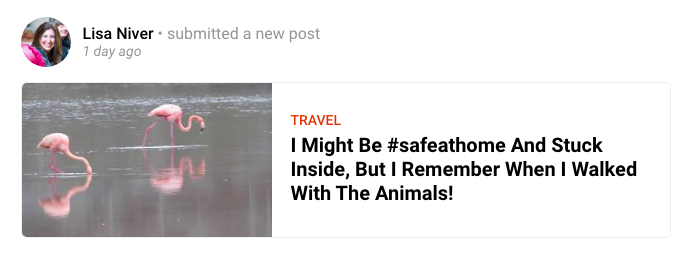
Thank you to BoredPanda for publishing my story about walking with the animals which includes my African safari, Galapagos adventures and Churchill Polar Bear videos as well as my article about walking with Polar Bears.

Thank you to our THEY SAID authors for sharing their stories this month:

Read about ShemeshFarms: A Story About Resilience from Michelle Cait, Traveling to India to meet The Dalai Lama! from Sarah Robarts, A Shaman Shows the Way: Channeling the Pachamama in Machu Picchu from Marian Gerlich and Oranges in the Shower – A Whiff of Hope from Gabrielle Kaufman

My recently published videos are animals from my December 2019 Galapagos sailing on Ecoventura’s THEORY. Never did I ever think I would publish an entire video of mating giant tortoises! I also have new videos of Frigate birds, Blue Footed Boobies, Iguanas and Flamingos!

WHERE CAN YOU FIND MY TRAVEL VIDEOS?

Here is the link to my video channel on YouTube where I have over one million views on YouTube! (Exact count: 1,180,000 views) Thank you for your support! Are you one of my 2,650 subscribers? I hope you will join me and subscribe!

For more We Said Go Travel articles, TV segments, videos and social media: CLICK HERE

Find me on social media: InstagramFacebookTwitterPinterestYouTube, and at LisaNiver.com.  My social media following is now over 160,000 and I am verified on Twitter.

My fortune cookies said:

“You thrive on adventure, try something new.”

and A smooth sea never made a skillful mariner!”

Keep dreaming big dreams, we will travel again in the future! For now, stay safe, stay at home and stay healthy~

Lisa

Sunset in Santa Monica in Feb 2020

#TogetherAtHome We Said Go Travel News April 2020 Read More »