fbpx

April 26, 2020

Who Is a Real Israeli?

What does it mean to be American? Or French? Or British? Is it just me, or is this question asked more about Israelis than anyone else? Well, what does it mean to be Israeli? Do you have to be born here, to live here, to have certain beliefs or characteristics, to be a citizen, to identify with the vision of the state (if it even has such thing), to be Jewish? to support Zionism?

This week, Israel turns 72. And if you want to know how young this is, consider the fact that when the US was about this age it signed the Treaty of Guadalupe Hidalgo that ended the Mexican-American War and concluded the process of acquiring Texas, California, New Mexico and Arizona (for $15 million). In other words — and this is not an attempt to make a statement in support of Israeli annexation of territory — the America of 1848 did not feel obligated to make do with a smaller America or dread the prospect of annexing more land.

The America of 1848 was not the America of 2020. The Israel of 2020 is not the Israel of some distant future (2222?). It is also not the Israel of a less distant past. When Israel was born, in 1948, its population was small, its economy fragile, its military more a militia than a real army, its leaders Ashkenazi, European, Socialist. Israelis aimed to be the new Jews. And in many ways, they succeeded, but not necessarily in the manner it intended. I dedicated a large portion of the last three years investing in the character of this new Jew. I still dedicate time to study the nature of Israeli-ness.

For two years my colleagues and I asked a representative sample of Israelis (Jews and non Jews) to agree or disagree with a string of statements concerning Israeli-ness including: Does one has to serve in the Israel Defense Forces (IDF) to be “a real Israeli”?

Consider this: About half of all Israelis do not serve in the IDF. That includes Arab Israelis (about a quarter of the population), most Haredi Israelis, and most religious women, and then some people with disabilities, psychological problems, radical politics, conscientious objectors and more. Are they not “real Israelis”? In the technical sense, of course they are. In the cultural sense, maybe not as much. A shared national identity helps define the boundaries of a society. If one considers the IDF a meaningful feature of national identity, then it’s possible to argue that serving in the military gives one an extra point of Israeli-ness.

In Israel, Memorial Day is on the day before Independence Day. One day we mourn our fallen soldiers, and the next we celebrate the cause for which they made the ultimate sacrifice. Of course, not all members of society risk their lives to the same degree to protect the country. Moreover, not all members of society identify with the cause for which the sacrifice was made. As in other countries, Israel’s Memorial Day is a civil day of remembrance. But truly, a more appropriate description would be a Jewish day of remembrance. This is a day where the Jewish, rather than the neutral “Israeli” nature is evident. On Yom Hazikaron as we recite the Yizkor memorial prayer. We say, “May the People of Israel remember its sons and daughters.” When we refer to “the People of Israel” at least some of us refer to the ancient Jewish nation, not the young civil state.

This explains (but does not justify, nor does it make it less of a problem) why most Jews in Israel believe that to be a real Israeli one must be Jewish (58%). This explains why most of them believe that one must be a Zionist (70%). Can you be a real Israeli if you cannot wholeheartedly mourn the fallen soldiers and rejoice on the day of Israel’s birth? A majority of Israeli Jews, including a majority of Haredim, believe that to be a real Israeli you must be a Zionist. If this isn’t a sign of Haredi Israelis becoming more mainstream Jewish Israelis, then I don’t know what this is.

*


Consider another question on Israeli-ness, one that would make sense to Americans if they consider English and Spanish. Does a real American have to speak English? Does a real Israeli have to speak Hebrew? For a majority of the country this is not a dramatic question. Israel’s Jews speak Hebrew as their mother tongue — and if they don’t their children do. But for about a quarter of the country, whose mother tongue is Arabic, the question of correlating Israeli-ness with speaking Hebrew is real.

So, we asked the question: Most Arab Israelis define their level of Hebrew as “good” (62%). Just a few (5%) define it as “poor.” And yet, a majority believe that “real Israeli-ness” should not be conditioned on Hebrew proficiency (53%). Speaking Hebrew as a requirement to be a “real Israeli” is one of many dividing lines between the Jewish majority and the non-Jewish minority. In fact, on the Hebrew question, the gap between Jews and non-Jews is relatively narrow, with almost half of the non-Jewish minority accepting Hebrew as a feature that defines Israeli-ness (47%). Other questions present a gap more troubling and more difficult to ignore.

The gaps in understanding the nature of Israeli-ness manifest themselves when we ask Israelis if they (the respondents) feel like “real Israelis.” Almost all Jews say yes (92%, with 73% very much so). A smaller share, but still a clear majority of Arabs say yes (65%). Earlier this week, the Jewish People Policy Institute publicized its findings from the 2020 Pluralism Index and highlighted a dramatic change from last year in the way Arab Israelis define their main identity.

In a survey, Arab Israelis were asked to choose among four options as the best description of their main identity: Arabic, Israeli, Palestinian, Arab-Israeli. But the answers received this year diverge from previous trends. They were dramatically different than the answers for the same question a year ago, the main difference  being a sharp increase in the share of Arabs who define their main identity as “Israeli,” accompanied by a significant decrease in the share of Arabs defining themselves as “Arab” or “Palestinian.” If these numbers are to be trusted — and we need more than one survey to conclude that this is Israel’s new reality — less than one in 10 Arabs in Israel say that their main identity is “Palestinian” while about three in four define themselves as either “Israeli” or “Arab-Israeli.”

*


We don’t know with certainty the reason or this change. More surveys and interviews are needed to see if this is a real change, and whether it is a long-term trend. And yet, in our estimation, this possible move toward Israeli-ization that we see this year is a product of the discourse around the three election campaigns that took place in 2019 and 2020. Consider Arab election-day turnouts. The notable presence of the party representing most Arab voters (the Joint List) in the Israeli political arena — the involvement of Arab MK’s in coalition-building efforts and other parliamentary maneuvers. To this may be added the sense of shared destiny stemming from the joint battle of Arabs and Jews in Israel against the coronavirus epidemic (many Arabs in Israel are health professionals). 2020 is certainly a year in which Arab Israelis are very much connected to the rest of Israel’s society.

But don’t be too quick to celebrate these findings. This year’s survey also brought to the surface less encouraging findings. For example, there is a significant increase in the number of Arabs who believe that most Jews in Israel are “extremists” (presumably, this is also the result of the discourse around the election campaigns, which included a large number of harsh statements). If two years ago only one in five Arabs thought most Jews were extremists (19%), today one in three Arabs (36%) think so.

Another cause for less optimism is the question of whether a Jewish temple ever stood on the Temple Mount. This is a highly fraught issue for both sides of the broader Israeli-Palestinian conflict. Denial by Palestinian leaders of the historical link by Jews to Jerusalem make many Jews in Israel highly suspicious of all Palestinian claims and erode any prospect for honest relations between the two people. A decisive majority of Jews in Israel (and elsewhere) believe that a Jewish temple on the Temple Mount is a historical fact. This belief transcends political camps. A denial can be understood only as an attempt to undercut the historical link between the Jews and their homeland. Unfortunately, about half of non-Jewish Israelis, and a substantial majority of Muslim Israelis (59%) believe that no Jewish temple ever stood on the Temple Mount. Another third say they don’t know.

Luckily, Jewish extremism — that is, what the Arabs perceive as Jewish extremism — and the debate concerning Temple Mount do not sabotage love. Not necessarily love for Jews but for Israel. This is not the place to discuss the question of what love is (or what is meant by love for Israel. Is it the state? the place? the culture?). What is clear is most Arabs feel like real Israelis, and most also say that a condition to being a real Israeli is love for Israel (see graph). In other words, most of them love Israel. We asked the question directly: Do you love Israel? About half of all Israeli Arabs said that to a large extent they do (47%) and almost a third (29%) said that to some extent they do. Here is another glimmer of optimism. Maybe it is possible after all to formulate an Israeli culture inclusive of both the Jewish-Zionist majority and the non-Jewish, not yet Zionist, minority. How does such an effort begin? Start from love and continue from there.

*


This article is based on a study by The Jewish People Policy Institute. The survey was conducted by Prof. Camil Fuchs of Tel Aviv University, and the data was analyzed by Fuchs, Rosner and JPPI’s Noah Slepkov. For the slides and the full analysis by JPPI, including all the technical details about the survey – click here. For more data about Israeli Judaism – click here. For the book #IsraeliJudaism: Portrait of a Cultural Revolution (Rosner & Fuchs) – click here.


Who Is a Real Israeli? Read More »

In This COVID-19 Crisis, It’s Do or Die Time

We’ve never had a time in human history when virtually everyone on the planet has been terrified that one wrong move may lead to death from the same enemy.

This is the cold heart of the COVID-19 crisis— the imminent fear of death. People are spooked by a vicious, mysterious new virus that is hyper contagious and has already taken more than 50,000 lives in the U.S. and more than 200,000 around the world. 

These ghastly figures are why our economy has been frozen, why people are taking extraordinary precautions, and why it will be so difficult to get the economy back on its feet.

It’s not that people are afraid to get sick; it’s that they’re afraid to get sick and die.

Remember those ancient days, when it was so normal to catch the flu “that’s going around” and then be back at work in no time?

The coronavirus has redefined that flu “that’s going around.”

The coronavirus has redefined that flu “that’s going around.”

Now, we’re afraid that touching a door handle at a Starbucks or a plate in a restaurant or a pump at a gas station or even a piece of mail at our front doors may lead to a deadly infection.

We’re afraid that if someone coughs or sneezes within 10 feet of us, or within a few aisles at a supermarket, a lethal microbe might be unleashed in the air that will find its way to our lungs.

This pulsating and pervasive fear of dying, notwithstanding the sophisticated reports from economists and health experts, is the core issue of the crisis. Better testing and tracing and more ventilators and Personal Protective Equipment are important, yes, but until the words “coronavirus” and “death” are no longer spoken in the same breath, no real progress can be expected in the return to normalcy.

We can’t wait for a vaccine; that takes too long. The immediate priority is to develop a treatment that will vastly improve the chances of survival.

We can’t wait for a vaccine; that takes too long. The immediate priority is to develop a treatment that will vastly improve the chances of survival.

“A vaccine is a ways off, but effective treatments need not be,” Yuval Levin wrote on April 9 in Atlantic magazine. “Drugs that help give those with the most acute cases of COVID-19 a much better chance of recovering would be transformative in our fight against the pandemic.”

Levin, a scholar at The American Enterprise Institute and one of my favorite thinkers, emphasized the urgency: “The difference that having a drug available this summer rather than next year could make, in the lives of patients and the health of our economy, would be beyond measure.”

The good news, Levin writes, is that “America’s extraordinary biomedical-research sector is unmatched in the world, which means that any treatment is most likely to come from the United States. The federal government will need to both clear the way and pave a path for that effort.”

Unfortunately, he says, our government has shown “a marked lack of urgency on this front.”

Indeed, how tragic that we could allocate $2 trillion in emergency aid and not have a similar level of urgency to find a treatment.

 “We are in the midst of a global pandemic that threatens countless lives,” Levin writes, “and our response to it threatens economic ruin. An effective drug for those who are most endangered would dramatically alter these circumstances.

 “The FDA should treat its role in facilitating our response to this disaster as the single most important task it has confronted in its history. And enabling the rapid development of a safe and effective treatment must be at the top of its agenda.” 

Here’s a suggestion: Instead of these nightly news conferences at the White House with experts standing glumly behind a blustering president, why don’t they all walk over to a “crisis room” and iron out a plan that will make finding an effective treatment to COVID-19 the nation’s top priority. 

Nobody leaves the room until the plan is finalized and all the players have their marching orders. Order pizza.

Nobody leaves the room until the plan is finalized and all the players have their marching orders. Order pizza.

Mr. President, if you care about your legacy, not to mention re-election in the Fall, you must instantly pivot from MAGA to MASA: Make America Safe Again.

These blundering remarks about disinfectants and your hyping of treatments that have no scientific basis are counterproductive; they convey the impression that your interest is more in PR spin than in getting results.

Your country needs you not on stage in front of cameras, but backstage in a war room. We need you to use your immense executive powers to urgently “clear the way and pave a path” to finding an effective treatment. Nothing good can happen— to our economy or to our society– until that treatment is found and people feel safe leaving their homes.

Give your team all the money and resources it needs. Make personal calls to streamline the bureaucracy and ensure everyone is cooperating. Talk to the top people in the biomedical-research sector. Set an aggressive goal of achieving a promising result by the 4th of July. Instead of checking in constantly on cable news shows, check in constantly on the team’s progress.

Forget political mudslinging, silly preening about ratings and the exhausting bickering with the media. These pandemic times are not normal. Your actions must change accordingly. It’s do or die time.

We know you love your country. Right now, your fellow Americans are afraid of dying. Concentrate your energy on the urgent, historic task of finding a treatment that will save lives and help restart our economy. And don’t get impatient if nobody is watching.

Look at it this way: If your team succeeds, when you announce the results, your ratings will be bigger than the Super Bowl.

Then you can preen all you want.

In This COVID-19 Crisis, It’s Do or Die Time Read More »

Israeli Developers of COVID-19 Vaccine to Initiate Human Clinical Trials in Summer

An Israeli company working on a COVID-19 vaccine will begin human trials this summer, a senior company official said on Wednesday.

MigVax, an affiliate of the Migal Galilee Research Institute, will conduct safety and efficacy assessment in rodents starting next month.

Phase 1 of clinical trials in humans will start during the summer and last six to nine months, said Professor Itamar Shalit, senior MigVax researcher and director, during a webinar hosted by the Israeli crowdfunding investment platform OurCrowd, as reported by The Jerusalem Post.

The startup is working to adapt a vaccine against infectious bronchitis virus (IBV)—a coronavirus strain causing bronchial disease in poultry—for human use.

According to The Jerusalem Post, “MigVax researchers aim to adapt the vaccine for the avian coronavirus into a new oral sub-unit human vaccine against COVID-19, based on their great genetic similarity and identical infection mechanism. Except for some required genetic adjustments, researchers say the same vaccination concepts should apply in humans.”

MigVax said it will be possible to quickly and inexpensively manufacture millions of doses of the potential vaccine, which is made using bacterial fermentation. Since it does not include the virus itself, researchers said it will also be safe to use on immune-compromised patients and has fewer risks of side effects.

On Wednesday, MigVax announced that it had secured a $12 million investment led by OurCrowd to help accelerate efforts to develop the vaccine.

Israeli Developers of COVID-19 Vaccine to Initiate Human Clinical Trials in Summer Read More »

Holocaust Remembrance Week Sees Storm of Online Posts Tying Jews to COVID-19

During the week of April 16-23 that marked both Holocaust Remembrance Day (April 20-21) and Palestinian Prisoner’s Day, a number of anti-Semitic online vitriol linked Israel and Jews to the coronavirus (COVID-19).

An online Holocaust Remembrance Day event held by the Israeli embassy in Germany was suspended after being disrupted by neo-Nazis and on April 20, a pro-Palestinian group’s Facebook page announced an event to be held across Italy marking Italy’s independence from fascist and Nazi occupation, tying it to “the occupation and colonization of Palestine.”

On the evening of Yom Hashoah, the BDS National Committee released a fact sheet titled “Coronavirus Under Israeli Apartheid” that claimed Israel as an apartheid system has been systematically spreading racism throughout the coronavirus crisis.

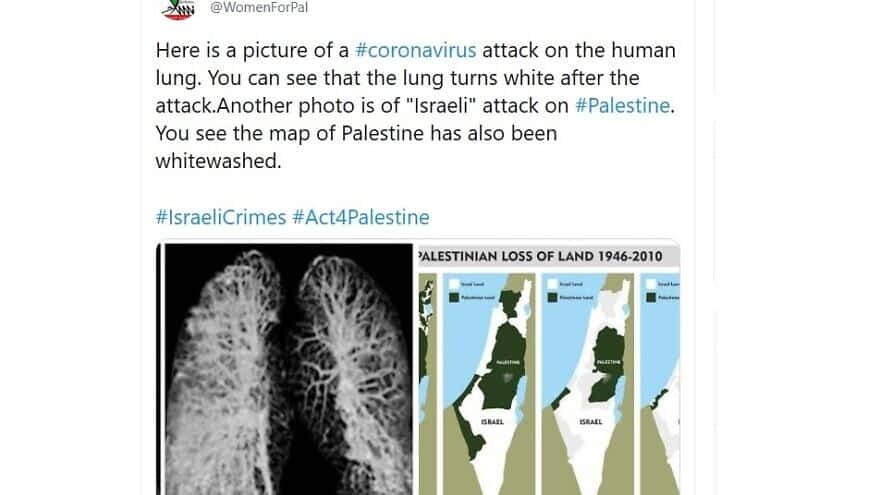
The following day, Women for Palestine tweeted images comparing the growth and “attack” of a Jewish presence in Israel to the spread of coronavirus in the lungs.

Numerous Twitter accounts from the Arab world also employed the hashtag #COVID48 and urged other Twitter users to tweet the hashtag at 7 p.m. on April 20 to coincide with the start of Yom Hashoah (and oddly enough, Adolf Hitler’s birthday). The hashtag was accompanied by images promoting anti-Semitic conspiracies, including the characterization of Israel as COVID-19, and the claim that Israel and the United States created the virus for financial gain.

Research suggests that the #COVID48 hashtag originated from a Facebook event coordinated by a group called “The Children of the Refugee Camps–The Jordanian Group.” The hashtag has already reached more than 500,000 Twitter accounts with an impression count of some 1 million.

Others who participated in activities for Palestinian Prisoner’s Day, including the NGOs Palestinian Youth Movement-USA and NY4Palestine, posted anti-Semitic content on social media, including the conspiracy that Israel is purposely infecting Palestinian prisoners with COVID-19.

On April 20, Jewish Voice for Peace tweeted a quote from former Palestinian political prisoner Sami Mohammed, who compared Israel to a virus, saying, “The social solidarity we witness nowadays due to the corona pandemic reminds me of the First Intifada when Palestinians were united to resist the other heavy virus.”

Holocaust Remembrance Week Sees Storm of Online Posts Tying Jews to COVID-19 Read More »

Court Rules PA Must Pay $142 Million to Families of Israeli Terror Victims

The Jerusalem District Court ruled on Friday that the Palestinian Authority must pay NIS 500 million ($142 million) to the families of those killed in Palestinian terrorist attacks, mostly during the Second Intifada (2000-2005).

Judge Moshe Drori ruled last July that the P.A. was liable for damages of up to NIS 1 billion ($284 million), since which time the Israeli organization Shurat HaDin worked to prove damages on behalf of eight families representing 17 complaints in which 34 Israelis were murdered and seven wounded, mostly between the years 2000 and 2002.

While some of the attacks also involved Hamas and Palestinian Islamic Jihad, the court is holding the P.A. liable based on its statements taking credit for all Second Intifada terrorist attacks, and on its providing support for the groups carrying out the attacks, according to The Jerusalem Post.

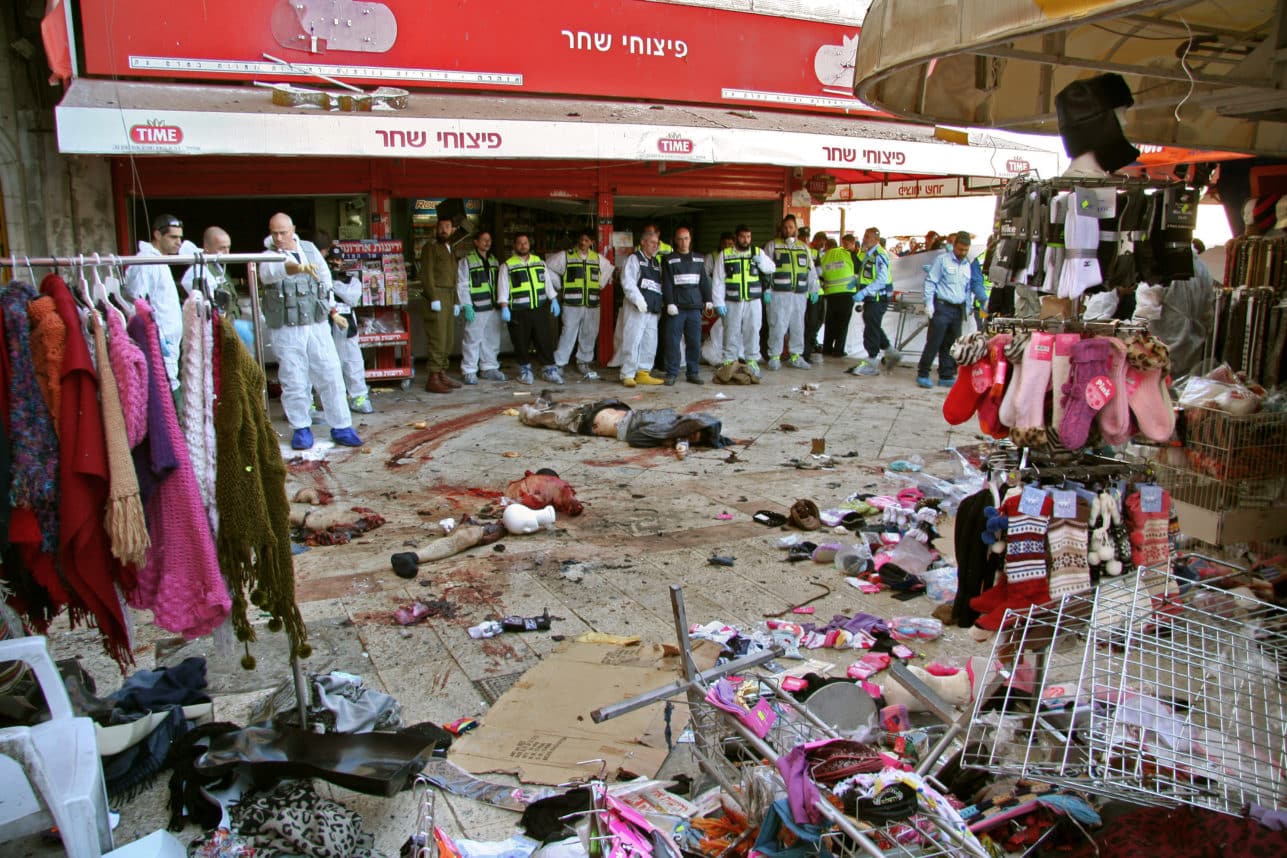
DIMONA, ISRAEL – FEBRUARY 04: (EDITORS NOTE GRAPHIC CONTENT) The remains of two Palestinian militants lie amongst the devastation at the scene of a double suicide bombing attempt February 4, 2008 in the southern Israeli town of Dimona. At least one Israeli was killed in the attack and dozens wounded when one Palestinian detonated his bomb amongst shoppers in a local arcade while the second bomber, whose body lies closest to the line of police and rescue workers, was shot dead by police soon afterwards. (Photo by Getty Images)

Due to what it said were the complex diplomatic implications of the decision, the court ruled that the amount collected would be just NIS 500 million for now, with payment spread out over time, according to the report. The money, it said, will come out of the P.A.’s ‘Pay to Slay’ funds, as well as the customs tax that the P.A. pays Israel each month. (“Pay to Slay” refers to a P.A. fund from which monthly cash stipends are disbursed to the families of Palestinians killed, injured or imprisoned for involvement in terror attacks or other types of politically-motivated violence against Israelis.)

Following the ruling, Shurat HaDin president Nitsana Darshan-Leitner maintained that the organization will not end the fight until there is justice for the victims of terror.

“Convicting the terrorists does not end with their imprisonment, as long as the Palestinian Authority [continues to fund them] and encourages acts of terrorism. The Palestinian Authority will know that there is a price for the blood on its hands, a very expensive price, and now it will need to pay,” she said, according to Ynet.

The decision comes just ahead of Yom Hazikaron, Israel’s memorial day for fallen soldiers and victims of terror attacks, which begins on Monday evening.

Court Rules PA Must Pay $142 Million to Families of Israeli Terror Victims Read More »

UN Mideast Envoy: Israeli Annexation Could ‘Destroy Any Hope of Peace’

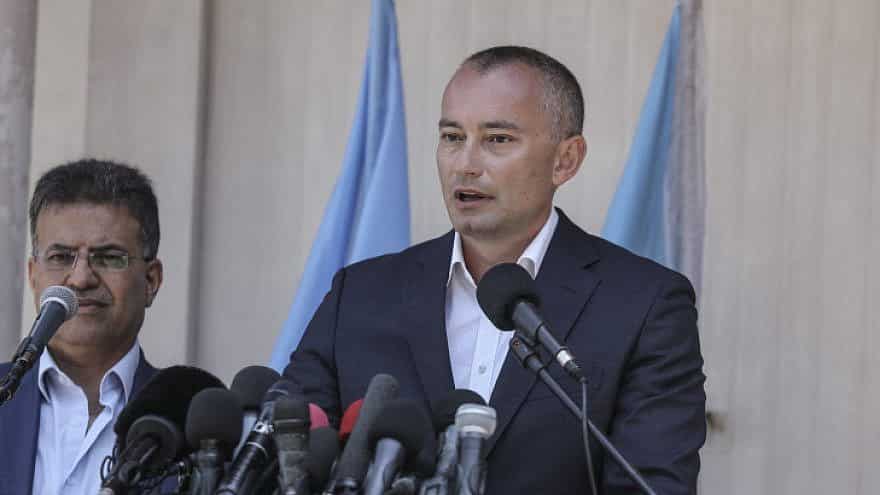
United Nations Mideast envoy Nickolay Mladenov warned the U.N. Security Council Thursday that Israeli moves to annex parts of the West Bank and expedited settlement expansion, along with the coronavirus outbreak, could spark violence between Palestinians and Israelis.

Mladenov said that annexation would also “constitute a serious violation of international law, deal a devastating blow to the two-state solution, close the door to a renewal of negotiations, and threaten efforts to advance regional peace,” according to an AP report.

Also on Thursday, the European Union warned the newly formed Israeli government that annexing parts of the West Bank “would constitute a serious violation of international law.”

Palestinian U.N. ambassador Riyad Mansour told the council that cooperation with Israel to combat the coronavirus pandemic is already being undermined because of the threat of annexation. Moving forward with annexation “will destroy the two-state solution and entrench Israel’s military control over the Palestinian people and land,” said Mansour. He called on the Security Council, General Assembly, parliaments, judicial bodies and other organizations to take “deterrent action” against Israel, according to the report.

Palestinian U.N. ambassador Riyad Mansour told the council that cooperation with Israel to combat the coronavirus pandemic is already being undermined because of the threat of annexation.

Last week, Israeli Prime Minister Benjamin Netanyahu and rival Benny Gantz of the Blue and White Party signed a coalition agreement that includes a plan to annex parts of Judea and Samaria starting on July 1.

U.S. Secretary of State Mike Pompeo said last week that it was up to Israel whether or not to annex territory in Judea and Samaria and the Jordan Valley, and that discussions on the issue are taking place through private channels with the Israeli government.

Israeli U.N. Ambassador Danny Danon speaks at a Security Council meeting after President Trump recognized Jerusalem as the capital of Israel, Dec. 8, 2017. (Stephanie Keith/Getty Images)

“The Palestinian Authority must decide if incitement against Israel is more important than the fruitful cooperation intended to save Palestinian lives,” said Israeli Ambassador Danny Danon.

Israeli Ambassador Danny Danon and acting U.S. deputy ambassador Cherith Norman Chalet did not speak about annexation. Danon said that “Israel has chosen to put aside politics” and increased cooperation with the United Nations and the Palestinian Authority to battle the coronavirus, according to the AP.

Danon accused the Palestinians of accepting aid while the P.A. “spreads lies and incites against Israel in the media and in official letters to the council,” including blaming Israeli soldiers for the virus. Addressing Mansour, he said, “The Palestinian Authority must decide if incitement against Israel is more important than the fruitful cooperation intended to save Palestinian lives.”

UN Mideast Envoy: Israeli Annexation Could ‘Destroy Any Hope of Peace’ Read More »

Hate Group Leaves ‘With Jews You Lose’ Fliers on Homes and Cars in Montana

Two fliers described by local media as anti-Semitic were placed in front of homes and on cars in Livingston, Montana.

One of the fliers discovered on Wednesday morning in the small southwestern Montana city read “With Jews You Lose,” and shows a declining line graph representing the “value of a $1 federal reserve note in 1913 dollars,” the Livingston Enterprise reported.

That flier lists the website of a group called The Brother Nathanael Foundation, which is based in Priest River, Idaho, and is listed as a “General Hate” group by the Southern Poverty Law Center, which monitors hate groups.

A second flier featured a photo of the late John F. Kennedy and included an anti-Semitic quote falsely attributed to him, according to the newspaper. The fliers also referenced Israel, the Federal Reserve and kicking secret societies and Zionists out of the country, Livingston Police Chief Dale Johnson told the Enterprise.

At least one of the people who found a flyer outside their homes was Jewish, according to the paper. Livingston has a few dozen Jewish residents among its population of roughly 7,000.

People who monitor anti-Semitism say graffiti and vandalism have not risen during the pandemic but that those incidents may have a deeper impact on local communities at a time when people are already fearful and isolated.

The flyers were left even as Montanans are under a stay-at-home order because of the coronavirus pandemic. People who monitor anti-Semitism say graffiti and vandalism have not risen during the pandemic but that those incidents may have a deeper impact on local communities at a time when people are already fearful and isolated. An even greater worry, they said, is that online organizing among white supremacists could result in escalating anti-Semitic activity in the future.

Hate Group Leaves ‘With Jews You Lose’ Fliers on Homes and Cars in Montana Read More »

Israeli Who Flew Back and Forth Knowing He Had COVID-19 Loses USA Visa

The United States reportedly has canceled a work visa for an Israeli man who flew home from Newark, New Jersey, despite knowing that he had tested positive for the coronavirus.

The man did not notify the United Airlines crew that he had the virus when he boarded the fight, the Times of Israel reported.

The Israeli passenger is from the largely Haredi Orthodox Jewish settlement of Beitar Illit and reportedly works to certify whether foods are being produced in accordance with Jewish dietary laws.

He flew to the United States last week despite having taken a COVID-19 test in Israel. He was informed of his positive test result while in the United States, Israel’s Channel 12 reported, and he flew back to Israel because he did not have insurance for health care in the United States. His family informed Israeli authorities while he was en route, a health official told the Times of Israel.

The plane carrying 50 passengers landed Friday. The passengers were taken to a hotel allowing people to remain in isolation for 14 days, as is required for all new arrivals right now. The infected man was taken to a separate hotel for people who are carrying the virus, and he could face criminal charges in Israel.

Israeli Who Flew Back and Forth Knowing He Had COVID-19 Loses USA Visa Read More »

Under Fire for Coronavirus Response, Israel’s Health Minister to Resign

After recovering from COVID-19 himself, Israel’s controversial health minister, Yaakov Litzman, has informed Prime Minister Benjamin Netanyahu that he intends to resign after a decade in that position.

Litzman has instead asked to run Israel’s housing ministry, saying in a statement that that time was right for him to make such a change. All ministry leadership positions must be reviewed by the new government formed last week.

“After about a decade in the Ministry of Health, in parallel with the implementation of the exit strategy from the corona crisis in Israel, and toward the establishment of a new government, I have decided not to return to the Ministry of Health for the fourth time, preferring to lead a broad solution to the housing shortage in Israel in the Ministry of Housing,” Litzman’s statement said.

Litzman generated controversy and even calls for resignation earlier this month following reports in the Hebrew press claiming that he had contracted the virus after attending an illicit prayer gathering of the sort that had been banned by his ministry. He has since recovered, and the country has begun lifting some restrictions designed to slow the spread of the disease.

An adherent of the Ger Hasidic sect, Litzman reportedly was instructed by Rabbi Yaakov Aryeh Alter, head of the sect, to move to the housing ministry. Litzman also asked to run the Israel Lands Authority and the Planning Administration, which is overseen by the housing ministry but run separately. The authority allocates land for housing, including affordable housing and public housing of the type that is needed by the country’s growing haredi Orthodox population.

Whoever fills the health ministry position will be responsible for steering Israel through the next phase of the pandemic. The Blue and White party, which joined an emergency government in an effort to combat the coronavirus crisis with a united front, reportedly will call for a health expert to fill the role.

Israel’s Channel 12 first reported Litzman’s request to resign, which he sent to Netanyahu late Thursday and confirmed on Sunday. He is believed to have waited to submit his resignation until the coronavirus situation stabilized in the country to reduce criticism, the channel reported.

Under Fire for Coronavirus Response, Israel’s Health Minister to Resign Read More »

Don’t Believe the Media Hype: Gantz Voters Support Israel’s Unity Government

Reading newspaper articles about Israel’s new government can be misleading. Newspapers love drama and need controversy. If there’s no controversy, there are no clicks on social media. So, the newspapers are telling you a story about an Israeli leader that decided to betray his voters to join the government of his arch-rival. Benny Gantz is that leader. And the Blue and White party is the one that broke its promise against the wishes of its electorate.

Here is one: “In fact, it feels as if Gantz used the Arab vote and support as spare parts in his political game. But his Jewish voters feel pretty much the same. The words ‘betrayal’ and ‘traitor’ are the most popular ones on social media to describe Gantz’s breach of faith.”

Here is another: “The squalid new Israeli ‘coalition’ – in which Benny Gantz betrayed his own supporters and voters by agreeing to a musical chairs premiership with Benjamin Netanyahu – merely provides the mechanism through which the Israeli leadership can enact the ultimate execution of the Palestinian-Israeli two-state solution.”

And another: “For the Israeli left, or whatever is left of it, the Netanyahu-Gantz agreement is an abomination, however, and not because it could perpetuate the occupation.”

You can easily find dozens of these stories on the web. And note the language: Betrayal, treason, abomination. You’d assume that strong words describe a clear and undebatable reality – but your assumption would be wrong. These strong words cover what many of the above-quoted writers dislike. Maybe because it ruins a good story. Maybe because it goes against their own political wishes.

The reality is a majority of Israelis support the new government. Of course, those who voted for Gantz and feel betrayed by him still have a right to those feelings. He vowed not to sit with Netanyahu. And yet, even a majority of Blue and White voters support the new government. In other words, Gantz did not betray his voters. He made a choice that some of his voters rejected, and most of his voters accepted. They accepted it because they realized that Gantz had no choice but to break at least one promise. He vowed not to have a coalition based on the support of the Arab Joint List. He vowed not to sit with Netanyahu. He vowed not to allow a fourth election. He ended up having to choose which promise to break. And he made the choice that most of his own voters would make.

Here’s the proof, based on three public opinion polls from last week. The public in general, voted for and against unity. Center-left voters voted for and against unity. Blue and White voters voted for and against unity. Even among center-left voters there was a tie, and that among Blue and White voters aclear majority supports the government.

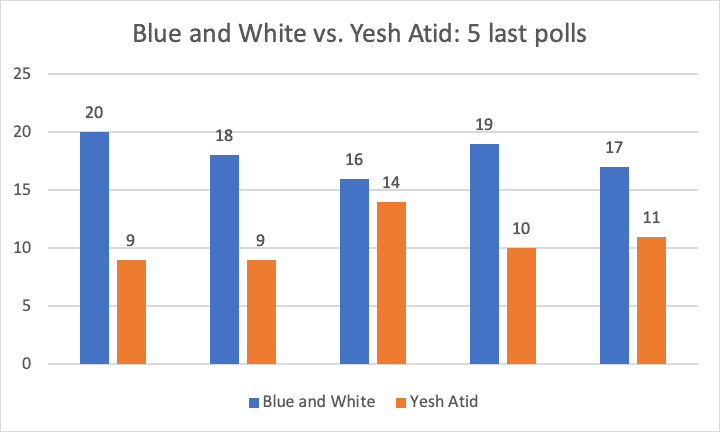
In addition, when Gantz decided to go for unity his party split: Blue and White under him joined the government. Yesh Atid under Yair Lapid became the main opposition. If most voters were against unity, you’d assume that they’d go with Lapid and abandon Gantz. But when voters were asked how they would vote if elections were held today, more voters chose Gantz.

What’s the bottom line? Read all reports about political developments with caution.

Don’t Believe the Media Hype: Gantz Voters Support Israel’s Unity Government Read More »