fbpx

April 21, 2020

The Night I Set God Free

“I want you to know,” my mother used to say when I was a little girl, “God saw what you just did.”

The declaration that God saw my every wicked move was the most frequent phrase uttered by my mother when my family lived in Iran, even more ubiquitous than “Eat your meat” or, “If anyone asks, don’t tell them we’re going to America.”

My mother didn’t mean to frighten me. She loved me deeply but her mother had issued the same warning to her. Generations of mothers believed if their children didn’t listen to them, maybe they’d listen to God.

But in Iran, God seemed more vengeful than merciful, and many mothers didn’t realize weaponizing God could irreparably harm a child.

Any actions my mother deemed defiant prompted her to invoke the name of God, and He always seemed to take her side because there’s a cult of motherhood in Persian culture that demands veneration — to the point of submission — because a mother’s love and unspeakable sacrifices render her perfect. And there’s no arguing with perfection.

In fact, a Persian mother’s seeming perfection is what gives her clout to speak on behalf of  a perfect God.

My skewed understanding of God as a punitive private eye who was just waiting for the chance to strike me down only worsened in the United States, where my mother saw the morally corrupt jungle of uncontrollable teenagers, whether in popular culture or real life, as ultimate proof that she relentlessly needed to drag God into parenting.

“When you’re certain your name is on some sort of celestial hit list, a nightmarish pandemic that seems to ravage the whole world is your personal arrest warrant.”

Our family was not religious and we never delved into the nature of God, so I didn’t have anyone with whom to process my fears that I was a constant disappointment.

I was a miserable teenager, and it didn’t help that every time I yelled at my mother, God showed up. More precisely, my mother insisted on His presence. Sometimes, I wondered if God was in our home against His will.

I never was told that He saw any of my good deeds, so I grew up feeling wretched, unloved and, worst of all, irredeemable in His eyes.

“God heard what you just said to me, and He remembers everything,” my mother would say. That was the anthem of my teenage years. I knew I’d hurt my mother and that she felt overwhelmed and compelled to resort to a higher power.

As an adult, I developed a clear sense of identity: My name was Tabby. I prioritized family, education and community. I tried to be kind, but God knew I wasn’t a good person.

I believed it was just a matter of time before the shoe dropped and punishment was enacted, swiftly and justly.

And then, 2020 arrived.

When you’re certain your name is on some sort of celestial hit list, a nightmarish pandemic that seems to ravage the whole world is your personal arrest warrant.

After the threat of COVID-19 became terrifyingly real, I imagined my comeuppance for every one of my wrongdoings finally had arrived. It was childish and narcissistic thinking, but then again, so was my understanding of God.

Because my children recently have been forced to stay home day and night, there’s been no end to the highs and especially the lows of raising toddlers: the screams, defiance and complete disregard of their parents’ requests. But amazingly, after a month of watching our children’s every move and listening to their every word, I felt more compassion for them, because I’ve witnessed directly their struggles with listening and attempts to do better. As it turns out, it’s easier to love a work-in-progress than someone who’s already perfect.

That doesn’t mean God doesn’t judge. Any good parent knows to hold a child (who’s old enough to understand) accountable for bad choices, but such a parent also ensures the child knows he or she is still deeply loved, even in the face of wrongdoing.

I’ve never spoken to my children about God’s surveillance. Thanks to home quarantine, they’re already burdened with trying to make better choices in the constant presence of their parents.

Quarantine with our kids made me realize maybe God doesn’t see me as wretched and undeserving of forgiveness, but as a frightened, hopeful work-in-progress. I had exiled God to a place of unforgiving darkness, but maybe God is more kind than vengeful; more loving than withdrawn. Maybe He sees me as I see my children.

The recent Passover holiday beseeched us, as it does each year, to find ways to set ourselves free. This year, on the last night of Passover, I took a short walk. Beneath a tree, I removed my face mask, wiped the tears from my cheeks in gratitude, and after three decades, finally set God free.


Tabby Refael is a Los Angeles-based writer, speaker and activist. 

The Night I Set God Free Read More »

Why Bameh Madlikin, the Unsung Hero of Our Liturgy, Matters Now More Than Ever

The most essential question contained in Jewish liturgy is not, strictly speaking, in our liturgy. It’s the first two Aramaic words of several pages of block text small print with all the poetic ambition of a law-school textbook, crammed between prayer services, ostensibly as a stalling device. Everyone says these two words out loud — reflexively, like they’re reporting attendance — then races through the rest. In context, this question does not feel significant at all.

Yet I maintain that all of Judaism — religion, culture, life manual, reason to exist — boils down to the question we encounter shortly after the spiritual high point of Kabbalat Shabbat: Bameh madlikin? With what may we light?

The ensuing Mishnayot discuss the permitted material composition of Shabbat candles. Admittedly, they are arcane and not a little whimsical. We can light using radish oil and fish oil but not uncombed flax. Seaweed’s a no-go, but boiled tallow? Go ahead — that is, if you hold by Nachum the Mede.

The dryness, so conspicuously placed in a moment of religious intimacy seems intentional. The passage presents as a technical counterpunch to the emotional intensity of the Psalms we just recited in Kabbalat Shabbat. There is no closeness to God without songs of praise, and there is no closeness to God without plumbing the depths of Torah observance for wonky hypotheticals. Bameh madlikin? Both.

In its rhetorical simplicity, the question also can go deeper. Bameh madlikin is a value check — a gut check. Yet, it contains multitudes. It floats usefully between “Will this do?” and “Is this sustainable?” and toggles between personal and communal outlooks. Yes, we can light with this, I say, finding myself out of step with some congregants at a new shul. Ein madlikin (We do not light); we have failed our obligation; this will not do, our leaders must say, when a man refuses to grant his wife a Jewish divorce. If we light with this, if our houses of worship are not accessible for the disabled or for the unhoused, or for the stranger who lives in our midst, we have not fulfilled the mitzvah.

In 2020, the questions Bameh madlikin stands for have changed. But it should be some consolation that the answers are no different. We know what our values are.

I have felt Bameh madlikin accelerate essential, long-term questions about my relationships and my politics, such as “Can I build a fulfilling life with this partner?” and “Can we build a society with these priorities?” But in recent weeks, it has assumed more urgent meaning as Judaism — Orthodoxy in particular — grapples with the ritual challenges of the coronavirus pandemic. Can we use a computer on Chag to host a virtual seder if that enables our less-observant family members to participate? Can we instruct people in quarantine to keep a three-day chag in full if that means cutting them off from society in a way that might be emotionally harmful to them?

Other versions of Bameh madlikin are being posed by the economic devastation wrought by non-essential business closures. Whether the full spectrum of Jewish life in a city can be nurtured and supported without a JCC is merely one of the many questions community leaders will face in the months ahead.

In 2020, the questions Bameh madlikin stands for have changed. But it should be some consolation that the answers are no different. We know what our values are. Let the story be that we remembered them and stuck to them when the chips were down.

And it wouldn’t be Bameh madlikin if it weren’t still a bit whimsical. As the quarantine continues, I have begun taking it as a survival challenge. Opening the cupboard to find canned vegetables, a bottle of hot sauce and a dusty tube of polenta — Bameh madlikin? Singing the songs of Kabbalat Shabbat as loudly as I can, to myself, in an empty, silent house — while facing east?  Madlikin.

Back to the siddur. Toward the end of the passage, we read on Friday night is a word of caution. Playing loose with any of the following three mitzvot may cause a woman to die in childbirth, the Mishnah warns: the commandments of Niddah (the menstrual cycle), tithing the dough and lighting Shabbat candles. The stakes of Bameh madlikin are no less than life or death. Unheeded, it has the capacity to turn the miracle of humanity into utter loss — and by implication, the other way around.

That’s an uplifting message, not a dire one. It is permission to improvise with fish oil and radish oil and maybe even boiled tallow. It is an instruction to be resourceful and a guide for how to be resourceful as the losses in our community mount, as we feel farther and farther apart, and as the absence of communal Jewish practices begets new, individual routines. Finally, it is a promise that if we stay the course on the things that are truly non-negotiable, if we hold fast to what we really cannot light with or live without, we eventually will read (or race through) Bameh madlikin in shul together again. We will have a reason to.


Louis Keene is a writer living in Los Angeles. He’s on Twitter at @thislouis.

Why Bameh Madlikin, the Unsung Hero of Our Liturgy, Matters Now More Than Ever Read More »

CA Announces Largest Daily Jump in Coronavirus Cases

California saw the biggest jump in new COVID-19 cases in a single day on April 21.

The Los Angeles Daily News reported that were more than 2,300 new cases in the state — a 7.3% increase April 19 to April 20 — bringing the total number of cases to 34,146, as of this writing. The death toll also saw an increase of 5% over the same timeframe, putting the total death toll at 1,237.

The sharp increase was partly because of a backlog of tests at a Los Angeles laboratory; at least 880 of the new cases came from that backlog.

Gov. Gavin Newsom, a Democrat, cited the aforementioned increases in a press briefing as reason to rebuff calls to lift the state’s shelter-in-place order.

“I caution those, including local elected officials, that practicing physical distancing has worked to keep those numbers relatively modest in terms of growth,” he said. “But if we pull back too quickly, those numbers will go through the roof.”

Newsom added: “If we’re ultimately going to come back economically, the worst mistake we can make is making a precipitous decision based on politics and frustration that puts people’s lives at risk and ultimately sets back the cause of economic growth and economic recovery.”

Counties including San Luis Obispo (SLO) County have sent requests to Newsom to start re-opening their respective economies.

“We have asked our residents to take these desperate measures because of the unique risks posed to the broader community by this virus so that we can flatten the curve and allow our healthcare capacity to catch up,” SLO officials wrote to Newsom on April 20. “Now we need to move to the next phase, which is economic recovery.”

Newsom said that counties can start to ease their shelter-in-place orders so long as they have data to back their decisions. He added that the state could intervene if counties start getting too aggressive in relaxing such measures.

“If they get a little further from our guidance, we’ll try to get them to pull back,” Newsom said.

Los Angeles County Public Officials announced on April 21 that there were 1,400 new cases and 46 new deaths, bringing the county totals to 15,140 and 663, respectively.

County Public Health Director Dr. Barbara Ferrer said that the county has seen “little rises and little dips [in new cases], and this may be a good sign for us.”

However, she cautioned that “in order for us to be able to safely relax the order, we need to make sure we do this in a way that doesn’t result in a surge of hospitalizations and deaths. We can’t open safely until we protect those who are most vulnerable.”

CA Announces Largest Daily Jump in Coronavirus Cases Read More »

If Half the Country’s Deaths Were in Montana, Would New York Shut Down?

According to The New York Times coronavirus report, as of Sunday, April 19, 2:48 p.m. Eastern Standard Time, there were 35,676 COVID-19 deaths in the United States. Of those deaths, 18,690 were in the New York metropolitan area.

(The New York metropolitan area is generally regarded as consisting of the five boroughs of New York City, the five New York State counties surrounding New York City—Nassau, Suffolk, Westchester, Rockland and Orange—and the populous parts of New Jersey and Connecticut.)

That means that more than half (52 percent) of all deaths in America have occurred in the New York metropolitan area.

What makes this statistic particularly noteworthy is that the entire death toll for 41 of the other 47 states is 7,661. In other words, while New York has 52 percent of all COVID-19 deaths in America, 41 states put together have only 21 percent of the COVID-19 deaths. And all the 47 states other than New York, New Jersey and Connecticut have less than half (48 percent).

Now let us imagine that the reverse were true. Imagine that Georgia and North Carolina—two contiguous states that, like the New York metro area, have a combined total of 21 million people—had 18,690 COVID-19 deaths, while metro New York had 858 deaths (the number of deaths in North Carolina and Georgia combined).

Do you think the New York metro area would close its schools, stores, restaurants and small businesses? Would every citizen of the New York area, with the few exceptions of those engaged in absolutely necessary work, be locked in their homes for months? Would New Yorkers accept the decimation of their economic and social lives because North Carolina and Georgia (or, even more absurdly, Colorado, Montana or the rest of what most New Yorkers regard as “flyover” country) had 18,960 deaths, while they had a mere 858?

It is, of course, possible. But I suspect that anyone with an open mind assumes that New Yorkers would not put up with ruining their economic and social lives and putting tens of millions of people out of work because of coronavirus deaths in North Carolina and Georgia, let alone Montana and Idaho (and, for the record, I would have agreed with them).

“One would have to visit people who had never left their rural village in a developing country to find people more insular than New York liberals, which is what nearly all New Yorkers are.”

Even more telling, the media, which controls American public opinion more than any other institution, including the presidency and Congress—but not churches and synagogues, which is why they loathe evangelicals, traditional Catholics, faithful Mormons and Orthodox Jews—would not be as fixated on closing down the country if it were killing far more people in some Southern, Midwestern, Mountain or Western states than in New York City.

The media is New York-based and New York-centered. New York is America. The rest of the country, with the partial exception of Los Angeles (also a media center) and Silicon Valley, is an afterthought.

Having grown up and attended college and graduate school in New York, and having lived in three of the city’s five boroughs, I know how accurate the most famous New Yorker magazine cover ever published was. The cover’s illustration depicted a New Yorker’s map of America: New York City, the George Washington Bridge and then San Francisco. The rest of the country essentially didn’t exist.

One would have to visit people who had never left their rural village in a developing country to find people more insular than New York liberals, which is what nearly all New Yorkers are.

One of the turning points of my life occurred when I was 24 years old and went to give a talk in Nashville, Tennessee. My assumption, having lived all my life in New York, was that I would be meeting and talking to what essentially amounted to country bumpkins. Not only were they not New Yorkers; they were Southerners.

What I found instead was a beautiful city with kind and highly sophisticated people. No one I met was as cynical as most New Yorkers, who confuse cynicism with sophistication. It was on that trip that I decided to leave New York. When I moved to California two years later, my friends, and every other New Yorker I spoke to on visits back to New York, asked why I left and when I was coming back. To most New Yorkers, to leave New York is to leave the center of the world; it is leaving relevance for irrelevance.

In his latest column, New York Times columnist Thomas Friedman inadvertently revealed how New York-centric his view of America is. Friedman, like virtually all his colleagues at The New York Times, opposes opening up any state in America at this time. He writes: “Every person will be playing Russian roulette every minute of every day: Do I get on this crowded bus to go to work or not? What if I get on the subway and the person next to me is not wearing gloves and a mask?”

Only a New Yorker would write those two sentences. In the 40 years, I have lived in the second-largest city in America, I have never ridden on the subway or any other intraurban train or bus. In fact, it is common for New Yorkers to look at Los Angeles with disdain for our “car culture.” Like the vast majority of Americans everywhere outside of New York City, in Los Angeles, most of us get to work, visit family and friends, and go to social and cultural events by car—currently, the life-saving way to travel—not by bus or subway, the New Yorker way of getting around.

But Friedman is a New Yorker, and because his fellow New Yorkers walk past one another on crowded streets and travel in crammed buses and subway cars, South Dakotans should be denied the ability to make a living.


Dennis Prager is a nationally syndicated radio talk show host; president of PragerU, which has a billion views a year; and author most recently of volume two (Genesis) of the bestselling Torah and Bible commentary in America, The Rational Bible.

If Half the Country’s Deaths Were in Montana, Would New York Shut Down? Read More »

Jewish-Italian Family Tiramisu Business Finds New Life During Pandemic

Giovanni Bolla is a master of the art of tiramisu, the Italian dessert featuring coffee-dipped ladyfingers and mascarpone cream. Like most small business operators, Bolla, 71, has been affected by the coronavirus crisis, but he is still open for business, completing deliveries all over Los Angeles while ensuring his customers his deliveries are “100% contact-less.”

Bolla, a native of the Piedmont region of northern Italy, lives in a studio apartment in Encino, wears a kippah and davens every morning. He has been preparing the tiramisu in the commercial kitchen of his synagogue, Temple Knesset Israel of Hollywood. His daughter, Isabelle, told the Journal they are currently looking to rent a kitchen space where Bolla can continue making the dessert.

Italian for “pick me up,” or “cheer me up,” tiramisu may be the perfect desert for these unprecedented pandemic times, according to Isabelle, who has helped her father through challenging personal struggles, including divorce, depression, the death of her half-sister and a period when her father was destitute and living out of his car.

Bolla was once a caterer for the Beverly Hills elite but poor choices led him down a dark path. During her father’s challenging period, Isabelle was living in Spain. She received many anxious phone calls from her father and eventually returned to Los Angeles.

“I think my tiramisu is divinely inspired. I thank God every day when I go to sleep and when I wake up.” — Giovanni Bolla


“For me it was important to come back and give him some foundation,” she said.

Last year, Bolla decided to make Isabelle tiramisu for her birthday, per a long-held family tradition, and he made her so much that she decided to give the leftovers to friends. “It is not that hard to get people to accept tiramisu,” she said.

It was then Isabelle realized that helping her father launch a small tiramisu business could help him get back on his feet. At the time, he couldn’t even afford to pay to do his laundry, she said.

https://www.facebook.com/JewishJournal/videos/2599087013744190/

Drawing on her social media and marketing savvy, Isabelle last July created an Instagram page for her father’s fledgling business, featuring photos of smiling customers receiving the tiramisu delivered to their homes by Bolla himself.

He continues to deliver the tiramisu to customers. The simple act of making it and bringing it to others has reawakened his youthful spirit, Isabelle said, noting, “He’ll make it fresh and with love.”

In a video interview with the Journal, Bolla said, “I think my tiramisu is divinely inspired,” adding “I thank God every day when I go to sleep and when I wake up.”

Since the outbreak of the coronavirus, more people have been having food delivered to their homes, and Bolla has benefited, filling orders for anniversaries and birthdays, Isabelle said. To ensure the safety of his customers, he drops the orders on their doorstep.

The cost of the half-size of tiramisu is $30 and a full-size is $55. Bolla even prepares gluten-free versions of his desserts.

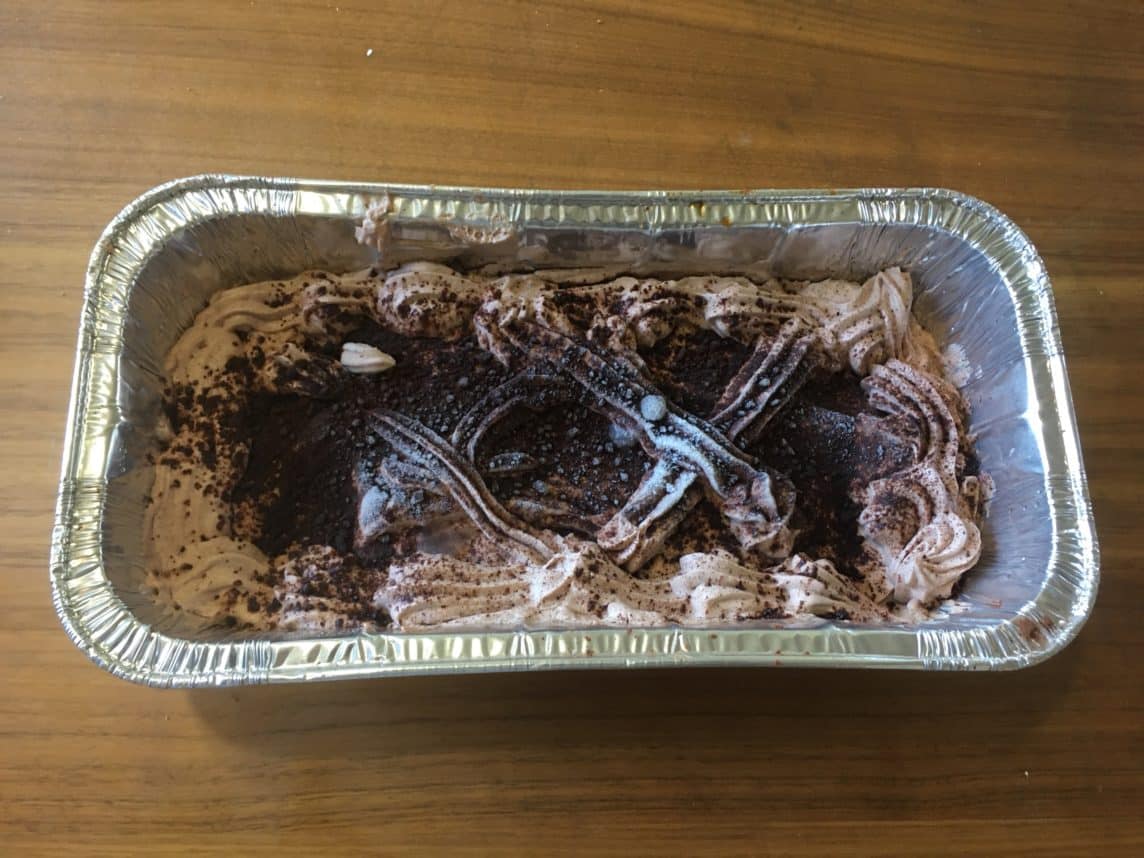
Giovanni Bolla’s tiramisu, which he delivered wearing gloves and a mask to the reporter’s home on Friday April 24, 2020.

Isabelle described the taste of her father’s tiramisu as utterly unique. “The recipe is very specific to him,” she said, adding it’s “sweet but not overly sweet, indulgent but not too rich, and I think it’s perfect any time of the day. You can have some in the morning with your coffee and at night for dinner.”

Asked if her father’s tiramisu was the best she’d had, Isabelle admitted it was hard for her to be objective. “I am biased,” she said, “but it is by far my favorite.”

And for Bolla, he said the response to his little tiramisu business has been “overwhelming. The happiness a little cake brings to [people] in this moment is perfect.”

For more information or to order Bolla’s tiramisu, visit the website.

Jewish-Italian Family Tiramisu Business Finds New Life During Pandemic Read More »

By Gutting Israeli Memorial and Independence Day, COVID-19 Redefines The Meaning of a Jewish Nation

Next week, Israelis will mourn on Memorial Day and celebrate Independence Day the following day. But these observances will be unlike previous observances.

On Memorial Day eve, schools won’t hold their customary assemblies attended by entire neighborhoods. On Memorial Day (Yom HaZikaron), cemeteries, which usually are packed with families, schoolchildren, soldiers, citizens — must remain relatively empty. On Independence Day (Yom HaAtzmaut) eve, torches will be lit in an empty theater on Mount Herzl during the official opening day ceremony. Idan Raichel, a brilliant musician, will light one of the torches. Galia Rahav, head of infectious diseases at the Sheba Medical Center, will light another one. Tzipi Shavit, a legendary entertainer, will light a torch. My heart goes out to Shavit. She is the one I can’t even imagine without a cheering crowd.

On Memorial Day (Yom HaZikaron), cemeteries, which usually are packed with families, schoolchildren, soldiers, citizens — must remain relatively empty.

I know quite a bit about these torches. My father, now in his 80s, worked as a mid-level government official for most of his career. Among the many mundane tasks that he performed, there was one that seemed quite glorious even to his unimpressed children. Every year, for about 30 consecutive Independence Days, he was in charge of the texts that 12 torch lighters recited during the ceremony on Mount Herzl.

The text has a certain format. Every torchbearer introduces himself or herself, explains why he or she is kindling the torch, and ends with the words every Israeli can recite: “To the glory of the State of Israel.” It sounds simple but it’s not. Torchbearers are often stubborn, opinionated people. They want to say a lot when the time allocated for each is limited. They want to speak their truth in a ceremony that must remain civil and unifying. Drafting the texts is the work of a writer and a diplomat. My father isn’t known to be patient, so I’m still not sure how he did it (asking him doesn’t help).

Lighting a torch on Independence Day is one of the great honors the state bestows on deserving citizens. In 2010, a supreme court justice, a businesswoman-philanthropist and the first Ethiopian doctor were among the participants. In 2015, a supermarket ceremony included a supermarket magnate, a pioneering feminist and an important Mizrahi music lyricist. Last year, the charismatic mother of a slain soldier, a space-exploration entrepreneur, a Paralympic basketball player were honored. You get the idea.

Because my father was involved with this ceremony, I attended a few of them as a child. Don’t underestimate that privilege. The ceremonies are packed, as are all general rehearsals. Tickets are hard to get and most Israelis get to see the torches lit only on TV (this is one of Israel’s most-watched TV programs). Of course, I don’t much remember the specific ceremonies that I attended — except for one. In 1979, Paul Michael Glaser of the hit TV series “Starsky & Hutch” was a guest of honor. I remember his entrance, and the crowd’s cheer. He was probably the first true celebrity I met.

Yom HaAtzmaut is a celebration of a nation, not a family. It is a celebration made for city squares and amphitheaters, for parties and shows, for fireworks and beer. We mourn together — we dance together.

The virus is testing us. We were forced to celebrate Pesach in small groups. This was somewhat strange but also somewhat special. Pesach is a family holiday, and for people like me, with two children still at home, the seder was intimate and not without its magic. Yom HaAtzmaut is a different story. It is a celebration of a nation, not a family. It is a celebration made for city squares and amphitheaters, for parties and shows, for fireworks and beer. We mourn together — we dance together. On Independence Day, most of us celebrate while having a barbecue with family and friends (63% say they usually do). The virus will corrupt our Independence Day more than it corrupted Pesach.

The virus forces us to think about the concept of a nation and its meaning. The coronavirus epidemic, as many commentators observed, mostly disapprovingly, is when “the nation-state is making a comeback,” when “national interests are winning out,” when “nation-states increasingly are in the driver’s seat and being strongly supported by their populations.” The warnings deserve their due — because nationalism can become dangerous. But so is the belief that relying on the nation is irreplaceable. Internationalism often fails to connect with the needs and the fears of the public.

The virus forces us to think about the concept of a nation and its meaning.

Independence Day is a reminder that people have such a need. Independence Day under the coronavirus threat is a reminder that no person is an island.


Shmuel Rosner is the Journal’s senior political editor. 

By Gutting Israeli Memorial and Independence Day, COVID-19 Redefines The Meaning of a Jewish Nation Read More »

German Holocaust Survivor Event Zoombombed With Hitler Images

A Holocaust Remembrance Day event featuring a Holocaust survivor was Zoombombed on April 20 with images of Adolf Hitler and other anti-Semitic material.

Israel’s Ambassador to Germany Jeremy Issacharoff tweeted that the Israeli embassy in Berlin hosted the event with Zvi Herschel discussing how he survived the Holocaust. Issacharoff wrote that “anti-Israel activists disrupted his talk posting pictures of Hitler and shouting anti-Semitic slogans.” After a lengthy delay, the event proceeded as planned.

Zoombombing is the unwanted audio and/or video intrusion by one or more individuals, often containing offensive content, that causes a disruption during a session.

Issacharoff told Haaretz, “As I listened to the siren in Israel on the radio this morning, I felt profoundly saddened that after so many years — 75 years after the Holocaust — someone here could desecrate the memory of the Shoah and disrupt a survivor’s testimony.”

Israeli Foreign Minister Israel Katz said in a statement to Ynet News, “Even on Holocaust Remembrance Day in Germany, these shocking incidents of anti-Semitism still occur. It is our duty, as representatives of the Israeli political world, to fight anti-Semitism wherever it raises its head.”

German Foreign Minister Heiko Maas condemned the Zoombombing in a tweet, writing: “What an incredible lack of respect toward survivors and toward the memory of the deceased.”

Anti-Defamation League CEO Jonathan Greenblatt tweeted, “This is unacceptable #antisemitic behavior online and offline.”

Associate Dean and Director of Global Social Action Agenda at the Simon Wiesenthal Center Rabbi Abraham Cooper said in a statement to the Journal, “Gutless Jew-hating lowlifes who leverage technology and hide their identities behind it. Such anti-Semites cannot stomach the thought that Jews congregate virtually, this time to remember our murdered 6 million Shoah martyrs.”

He added that he was Zoombombed in March during Rav Asher Weiss’ lecture about Torah. Cooper called the Zoombombing “shocking and disgusting. There are some security steps Zoom has now installed but it’s not foolproof. By the way, the next night the Rabbi had over 500 people watching and listening. They hate, we heal.”

A spokesperson for Zoom said in a statement to The Hill, “Zoom strongly condemns such behavior and recently updated several features to help our users more easily protect their meetings. We encourage users to report any incidents of this kind either to Zoom so we can take appropriate action or directly to law enforcement authorities.”

There have been several instances of Zoombombing worldwide since March as more people use the platform — including for Shabbat services and online classes — because they must shelter-in-place to prevent the spread of COVID-19. The Anti-Defamation League (ADL) held a webinar with Zoom Chief Product Officer Oded Gal on April 14 during which they discussed how Zoom hosts can prevent Zoombombing.

ADL Center on Extremism Vice President Oren Segal said during the webinar, “This platform is being disrupted for hateful purposes. This is why we’re taking it so seriously.”

German Holocaust Survivor Event Zoombombed With Hitler Images Read More »

Rosner's Domain Podcast

Hizky Shoham: How Israel celebrates

Shmuel Rosner and Hizky Shoham discuss Hizky’s newest book and the differences and similarities of how Israel celebrates Passover and its independence day.

Hizky Shoham is a cultural historian of Israel and Zionism. He is a research fellow in the Shalom Hartman Institute in Jerusalem and a lecturer in the Interdisciplinary Program for Hermeneutics and Cultural Studies at Bar-Ilan University, Israel.

Follow Shmuel Rosner on Twitter.

Hizky Shoham: How Israel celebrates Read More »

Spiritual Engagement Dulls The Pain of Social Estrangement

Although I’m a traditional person, I have never been much for praying. I usually attend services armed with a nonfiction book. Books make sense to me: they inform, change, enlighten, surprise and  inspire. Prayer books always struck me as the spiritual equivalent of laundry instructions: rinse, wash, repeat —  laden with time-consuming obscure rituals and words. Recently, forced by the double-whammy of mourning my mother’s death during a ritualized seven days of shivah followed by two weeks of coronavirus quarantine, I started appreciating prayers —and the books that contain them.

Accepting the obligation to mark my mother’s memory by saying Kaddish in the three daily services for the next 11 months, I’ve been praying regularly since my 86-year-old mother Elaine Troy died on March 3. Addicted to community-building, Judaism demands you say the prayer in a minyan (a quorum of 10), which I did 21 times during the first seven days. Quarantine forced me to pray privately.

Within a week, I discovered something unexpected. The prayers connected me with my people, not just God. Even in isolation I was never alone.

My more devout children informed me that before praying, Jews ritually wash their hands. There’s no better ritual during a pandemic. After reciting the hand washing blessing while walking from the kitchen to the living room, I sneak in the prayer I should have said upon rising — Modeh Ani —  thanking God for restoring my soul for yet another day. While sidestepping questions about God’s essence, I appreciate waking with an appreciation. It gets me tallying all the good in our lives, even while mourning my mother — and so many others — in lockdown.

Now it gets weird. I wrap myself in a tallit. That’s pretty standard American Jewish fare. Then I go medieval. I take tefillin (phylacteries) — the two small square leather boxes filled with Torah clippings, and affix them to my forearm and forehead with leather straps. I never understood this ritual – and fumble like a bar mitzvah boy trying to stabilize my arm box, without cutting off my circulation. The Hebrew word tefillin comes from prayer — tefillah. The English word comes from the Greek, protectant. The verses inside say: wearing these reminds us of our liberation… from slavery.

This, I can handle as a history professor. I’m girding myself for spiritual battle as a supplicant, wearing “armor” at a time when our bodies are especially vulnerable yet also threatening to others. And I’m wearing a uniform, preparing for time travel, remembering the Exodus from Egypt 3400 years ago.  Evoking that story opens the floodgate of Jewish memories and values from our debut as a people, celebrating freedom and inspiring us to persist.

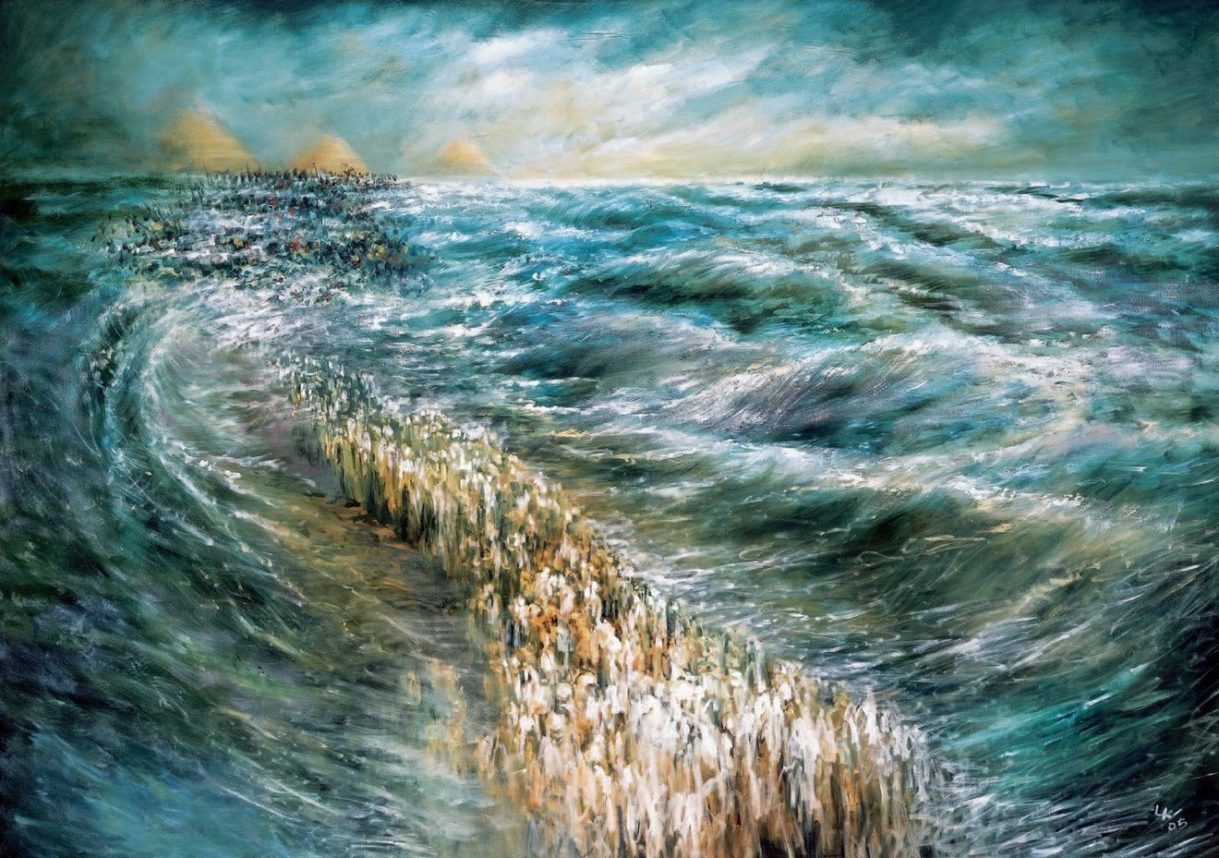
The Parting of the Red Sea, (Painting: Lidia Kozenitzky)

I’ve been up for 15 minutes. I’ve been praying for three, and my mind is already racing, my newly restored soul already soaring. Now, the next ritual I never understood: the Orthodox worshiper’s mumbling marathon. Especially alone, I realize it’s the only way to avoid cheating with supersonic speed-reading. Saying each word engages you, transforming prayer from a passive show to a thought-provoking act.

The script to follow offers a library’s worth of ideas, inspirations, challenges, morals — to set your daily agenda. When writing, I imagine words as keys to open minds or spotlights to illuminate insights. When debating, words become guided missiles, targeting my opponents’ weakest points. I envision these words as thank you notes, historical post-its, ethical strings around my finger and petitions for peace, health, justice, sanity. Then, on Mondays and Thursdays, in the long tachanun (supplication) service, a plea: “Do not abandon us. O Lord… for we are worn out by the sword and captivity, pestilence and plague.” Bingo. Suddenly, we’re both current and cosmic, reassured that we’ve survived worse.

On different days different phrases pop out. I enjoy bumping into Moses, King David, Isaiah and Maimonides regularly. I like the shema’s proud particularism —“Hear O Israel” — balanced with a universalist high five to all monotheists – “the Lord is one.” I respect the challenge to accept communal responsibility and avoid national arrogance in MiPnei Chataynu – “we were exiled because of our sins” and the admonition to avoid gossip and think the best of people at the end of the Amidah, the standing prayer: “keep my tongue and lips from lying.”

Rather than feeling repetitive, the prayer book feels like a menu brimming with traditional favorites and new delicacies. As in any restaurant, some dishes aren’t to my taste. My friends who are Editorial Jews zero in on the one thing they dislike to justify rejecting it all. Instead, I marvel at how much resonates after all these centuries, while navigating around the occasional potholes.

Every morning, as we start, I stumble on the male’s Dawn prayer — “thanks for not making me a woman” — which liberal Jews render as “thanks for making me as You wished.” I dodge the discomfort by speculating about who would want a prayer affirming gender identity and who would want one affirming God’s will.

As each of the three daily services end, I read but pointedly don’t say in the Aleinu – “we are obliged” – prayer: “For they worship vanity and emptiness, and pray to a god who cannot save.” I like that the Orthodox have not eliminated that line. It candidly acknowledges Jews’ traumatic persecution-scarred history; but I love skipping the line, because today, many who were once “they” and “hostile” are now our friends.

The siddur (prayer book) means order. I quickly adjusted to the structure, the ritualized repetition, as an aid not an impediment. It’s why (when not locked down) I jog every morning along the same path. When freed from reinventing basics, your mind can leap further ahead.

The morning service ends particularly nicely for these days. Reciting a different psalm of the day each day, while building up to the Sabbath, restores my sense of time amid the chronological blur of virtual house arrest.

During what ended up being my mother’s last hours, when terminal restlessness had her tossing fitfully, yet too exhausted to speak full sentences, I recited the traditional Jewish vidui confessional with her – Shema Yisrael — affirming God’s oneness.

During what ended up being my mother’s last hours, when terminal restlessness had her tossing fitfully, yet too exhausted to speak full sentences, I recited the traditional Jewish vidui confessional with her – Shema Yisrael — affirming God’s oneness. Still agitated, she conveyed somehow that she wanted different songs. When I sang the Zionist folk songs of her youth, ending with Hatikvah, she relaxed.

Her finale reinforced two of her life lessons. She was never arrogant enough to claim that the Jewish way is the best way, but she believed in finding a way, an identity, in being a “something,” warning, “don’t be so open-minded your brains fall out.” And she deployed prayers, songs, rituals and memories as conveyor belts of good values, spurs toward living ethically, purposefully. At that profound moment, as her life ebbed away, she, a born teacher, demonstrated the power of having tunes, ideas and values, drilled into you in childhood, and how they comfort us when the unknown looms.

Eventually I found a Zoom minyan – which is another story – but the praying alone while so lost and alone served as good basic training for this dramatic life change. I’m now befriending my prayer book. I am embracing it as historical monograph, philosophical treatise, ethical guide, Judaism primer, songster, self-help book. Even the prospect of 1053 praying sessions – or thrice daily as long as I live – now seems manageable.

Perhaps, I am grasping at straws. Forced indoors, facing great uncertainty globally amid this 11-month personal commitment, I may just be trying to make the best of it. But that too is what my wise mother taught me to do. Unhappy people feel oppressed by whatever life sends us. Others try returning the serve no matter how challenging it may be, turning it into a win or at least a meaningful volley.

So now, every morning, after 32 minutes, as I unwrap, fold up, put away and plan for afternoon prayers, I’ve been rooted, challenged, inspired. Spiritual engagement dulled the pain of social estrangement. I’ve crossed the Red Sea, accepted the Ten Commandments at Sinai, danced at the Holy Temple, survived medieval and Nazi persecutions, sampled the Talmud, returned to Zion, been energized by the past, oriented in the present and charged up for the future.

Along the way, I dedicated time to honoring my mother’s legacy, even without that quorum. I also remembered that, thanks to her and my father, I can sally forth confidently, knowing that wherever I am, whatever I face, no matter how isolated I might appear to be, I am never alone — or adrift —always connected to my past, my tradition, my people and soul-stretching ideals.


Professor Gil Troy is a Distinguished Scholar of North American History at McGill University and the author of 10 books on the American presidency. In September, PublicAffairs of Hachette will publish his next book, co-authored with Natan Sharansky,  “Never Alone: Prison, Politics, and My People.”

Spiritual Engagement Dulls The Pain of Social Estrangement Read More »

Israel’s Government Has Been Formed By A Public That Can’t Make Up Its Mind

Meet Israel’s new camel. As the saying goes, a camel is a horse designed by committee. In Israel’s case, it’s what a government looks like when it is designed by a public that can’t make up its mind.

Currently, there is a cabinet of 32 ministers, which will eventually become 36, with an additional 16 deputy ministers. This process is designed to give equal representation to two “blocs”  — one headed by Benjamin Netanyahu and Likud, the other by Benny Gantz and Blue and White. It’s more of a hippopotamus than an agile government. I know, I already said it’s a camel. But it’s both. It’s a camel-opotamus.

After a year and a half of instability, Israel needed stability. The camel-opotamus is well built and hard to move or topple. That’s the whole idea. What are its main features?

  1. Netanyahu will be prime minister for now. He has been given legitimacy by a rival who said that he would  never sit with him because Netanyahu was indicted on corruption charges. In return, Netanyahu agreed to an “expiration date”: In 18 months he is slated to move from the prime minister’s office to the office of the “alternate prime minister” — that’s the title for Netanyahu or Gantz when either isn’t the prime minister. Of course, although Netanyahu signed a document of expiration, it doesn’t mean he’ll step down when the time comes. But the agreement does as much as it can to guarantee that Netanyahu will evacuate the office of the prime minister.
  1. This isn’t a partnership, it’s an arrangement. The government can do only things that  close to 80 members of Knesset (MKs) agree on. It can fight the coronavirus because everyone agrees that Israel must deal with the virus. But no controversial legislation should be expected.
  1. One exception is the annexation of areas in Judea and Samaria. Netanyahu insisted on annexation this summer and will get his way — if the Americans play along. Perhaps  Netanyahu wants the annexation as his legacy. Contrast that with previous prime ministers: Yitzhak Rabin evacuated territory; Ehud Barak, too (in Lebanon); Ariel Sharon, too (in Gaza); Ehud Olmert was ready to hand over almost all of it.
  1. The big question is how long can it last? The answer is: For now. In politics, opportunities determine the moves of the players. If Netanyahu or Gantz sees a better way forward than the one they’ve chosen, both are likely to change course. If this arrangement is the best they can do, they’ll stick to it. Fifty-two MK’s with government positions to lose are the ideal cement for a coalition. The agreement aims to keep everybody happy.
  1. It’s important to note that appeals before the court are in motion, arguing that Netanyahu can’t serve as prime minister or alternate prime minister. The Knesset must change basic laws to make the agreement legal, and each change could trigger legal challenges. What seems like a minor obstacle can easily become a major crisis.
  1. The camel-opotamus is ugly. It has two heads, short legs and is fat. It smells and makes unpleasant noises. Supporters of the right will be frustrated by its many shortcomings (reforming the legal system will have to wait). Supporters of the center-left will feel they’ve been sold out (Netanyahu is still prime minister). No small party will have real power because the two blocs can do without them (Yamina might even stay out of the coalition). No big party will have real power because the other bloc stands in its way. The camel-opotamus is the worst option for Israel aside from a fourth election. So shut your eyes and hold your nose and get ready for a strange ride.

Israel’s Government Has Been Formed By A Public That Can’t Make Up Its Mind Read More »