A politician does not say no to endorsements, unless there is clear damage involved. That’s the first rule one has to take into account as one ponders the recent endorsement of Joe Biden by the Jewish lobby J Street. Biden welcomed the endorsement. Some think it is a big deal. But it’s not. It’s a midsize deal at best (or worst, depending on your point of view).
Let’s consider J Street’s options. This will be a short exercise. J Street had no options except supporting Biden, or not supporting anyone. Supporting Biden might give it a chance to brag (“our candidate won”). Not supporting Biden would give the organization nothing. So, this is a no-brainer.
Now consider Biden’s options. He could accept the endorsement (“welcome it”) or reject it.
What would he gain by rejecting it? A lot of negative attention from lefty activists who have a lot of energy to spend on social media. They would cast him as someone undeserving and inauthentic and disrupt his quest to unite the Democratic party, including all of the disappointed Bernie bros. What is the upside of rejecting J Street? It’d give Biden a chance to win over a few pro-Israel Democrats, and convince them that he is as strong on Israel as Donald Trump.
What did Biden get by accepting the endorsement? Praise from the left, and quiet on the activist front. What did he lose? Rightists will portray him as anti-Israel, or not good enough on Israel. In fact, some of them already started doing this (yes, Caroline Glick, I’m looking at you). Also, this will somewhat complicate his relations with AIPAC, whose view of J Street is, well, unflattering would be a mild way of putting it.
Pretend you are Joe Biden, consider these points, and make a decision. I’m willing to bet that for most of you the decision will be quite easy: if you’re Biden, you’d accept the endorsement.
Why?
Because a rejection is a much more aggressive move than an acceptance. Had he rejected – this would become a big story. Since he accepted, it’s a relatively small one.
Because for him to get attacks from the right is currently tolerable, while getting attacks from the left is dangerous. Biden is worried about Bernie voters staying at home. He is less worried about pro-Israel Democrats staying at home.
Because the attacks on him, alleging that he is not as pro-Israel as Trump, will come no matter what he does. Biden was Obama’s Vice President. There is nothing he can do, short of adopting of the Trump peace plan, that would make him seem as close to Israel as the sitting president.
Because he knows that the vote in November will not be for or against him but rather for or against Trump. Minor issues such as the nuances of the US-Israel alliance will not make a big difference. The Jews – by and large – will vote for him anyhow. And those who don’t are probably a lost cause anyhow.
Because AIPAC is not going to take this too hard. And Biden will make sure to send the organization a kind of don’t-worry message (in fact, someone who knows someone told me today that a message was already sent).
Because in Biden’s view, J Street is not that terrible. This does not mean that he is in favor of their every position, but it does mean that for him there is no shocking-factor involved in being seen as an ally of the organization.
When the deepest darkness meets the brightest light, it can make you kind of dizzy.
For the more than 35,000 Americans who have perished in the COVID-19 pandemic, and those close to them who are grieving, it is the deepest darkness. For those in intensive care whose lives are in peril, it is a darkness of naked fear and apprehension.
And for the more than 22 million Americans who have lost their jobs and livelihoods, it is a darkness of uncertainty, of insecurity, and, for many, a darkness of downright hunger.
Never in my wildest nightmares did I imagine my beloved America would encounter such rampant pain and suffering.
And then, as all of this darkness was swirling in my head, the brightest of lights showed up– my first grandchild was born.
He took his first breath in Israel, a few minutes before midnight on April 16.
Talk about dizziness.
Maybe because I’m in journalism, I can’t afford to step away from the biggest story of our time. So, almost by definition, I’m constantly immersed in the pain of these pandemic times, keeping up with everything that’s going on, no matter how dark.
The first breath of a baby, though, is enough to transport you instantly into another world. This is a world of new beginnings, new promise, new hope. (It helps when the baby has the most adorable face.)
On an average day, about 360,000 babies throughout the world take their first breaths. As we wage war against a lethal and invisible virus, these newborns don’t make the news. The news is in the devastation, as it should be. We must tend to the darkness and to the immediate victims. This is the law of priorities, of basic survival.
Still, no matter how dark the darkness gets, it’s hard to ignore the extraordinary fact that 360,000 new souls enter our world every day.
NO MATTER HOW DARK THE DARKNESS GETS, IT’S HARD TO IGNORE THE EXTRAORDINARY FACT THAT 360,000 NEW SOULS ENTER OUR WORLD EVERY DAY.
Should the arrival of these new souls make us feel better about the societal nightmare we are living through?
No— it’s not about feeling better.
So, what is it about? I’m not sure how to express it. Maybe the simplest way is to say it’s OK tosee both sides.
The darkness of COVID-19 is there, and we see it.
The light of 360,000 new souls is there, and we see that, too.
We react differently to each one, but we don’t diminish them. One triggers sadness and fear and defiance and demands that we fight; the other triggers hope and life and reminds us of the resiliency of the human species.
The birth of babies, as my friend Rabbi Yitz Greenberg wrote to me, reminds us that “The classic Jewish response to death is to increase life.”
The birth of babies, as my friend Rabbi Yitz Greenberg wrote to me, reminds us that “The classic Jewish response to death is to increase life. That is what your children have done. I contend that the ultimate claim of Judaism is that despite the universal reality that all living things die, that in the end, life will win out– because before they die, billions of people loved, created life (children) and built a better world.”
As powerful as life is, we’re also reminded in these dark times how delicate it can be. Like tender babies, the COVID-19 crisis has made us more fragile. Just as we tend to a newborn with maximum care, we are now in maximum protection mode. Faced with a virus that attacks the lungs, we are protecting diligently our precious breaths and that of our loved ones.
How do newborns take their first breath? With great difficulty.
“Your baby will need to work very hard to take their first breath, and their first few breaths may be shallow and irregular,” I learned on the aboutkidshealth.ca website. “With each breath after birth, more air will accumulate in their lungs, which will make it easier for them to breathe.
“After a few breaths, your baby will be able to breathe more easily, and their breaths will start to become deeper and more regular.”
Let us hope and pray that our country is going through a period of shallow and irregular breaths, and that in the near future, we will experience a collective rebirth as our nation’s breathing will become “deeper and more regular” again.
President Donald Trump declared a week of “Remembrance of Victims of the Holocaust” in an official proclamation on Friday, while touting his administration’s ongoing “efforts to combat racist and anti-Semitic discrimination.”
The week of remembrance begins on Sunday, the anniversary of the Warsaw Ghetto Uprising. Yom Hashoah, or Holocaust Remembrance Day, begins on Monday evening.
Trump noted that “among those murdered in the Holocaust were 6 million Jewish men, women, and children who became victims of the Third Reich’s unthinkably evil ‘Final Solution.’”
The proclamation also calls to “remember the millions of lives extinguished in the Holocaust, including those of Jewish, Polish, and Slavic ancestry, Roma and Sinti, individuals with mental and physical disabilities, gays, political dissidents, and dozens of other groups.”
Trump acknowledged that American Jews still face persecution, and pointed to his executive order on anti-Semitism issued in December.
The controversial order directs “robust” enforcement of existing civil rights protections for Jews on college campuses under the Civil Rights Act of 1964 — which says attackers target Jews because they perceive them to be a race or having a shared national identity.
Critics of the order argued that the order implied that Judaism is a nationality.
Two Minnesota high school students were criticized for sharing a video titled “Me and the boys on the way to camp,” which photoshops them dancing in a Nazi boxcar and happily skipping into Auschwitz, on the video social media platform TikTok.
The video contains humorous music whose lyrics include “Tell everybody I’m on my way.”
In response, the two boys shown in the video — posted by a high school student from Minnetonka High School in Nicollet, Minnesota — were assigned a research paper titled “Hitler’s Final Solution at Auschwitz.”
Steve Hunegs, executive director of the Jewish Community Relations Council of Minnesota and the Dakotas, said in a statement that he is “ increasingly concerned about a grave empathy deficit, which enables students and others to weaponize their knowledge about the Holocaust to insult the memory of the victims of the Holocaust, and further traumatize Jews at a time when we are experiencing a demonstrative increase in anti-Semitism.”
Hunegs praised Nicollet Public Schools Superintendent Denny Morrow for the “seriousness” with which he has approached the incident.
Morrow wrote to the students: “Your recent decision to post a video on TikTok depicting the Nazi Auschwitz concentration camp during World War 2 as a playful excursion has crossed several lines of decorum.”
He called it “an affront to our school and community to portray that one could be educated here, and then, choose to demonstrate such a callous disregard for the plight of others.”
TikTok reportedly boasts around 800 million users worldwide.
Israel accused Hezbollah on Saturday of “provocative” activity along its border with Lebanon and announced that it was filling a complaint with the U.N. Security Council.
Israeli Foreign Minister Israel Katz said in a statement that Hezbollah made multiple attempts to breach the border on Friday night, and that Israel expects the Lebanese government to prevent such threats, according to the AP.
Israel Defense Forces fired flares along the Israel-Lebanon border on Friday night after signs of a possible border breach, according to the IDF, and damage to the border security fence was found in three locations. The military said that while the border had not been infiltrated, the IDF viewed this as a “severe” event.
The IDF tweeted: “We can confirm that no infiltration from Lebanon into Israel occurred. This is a severe event. We hold the Lebanese government responsible for actions from its territory.”
Last week, the AP reported that an Israeli drone fired two missiles at a vehicle near the Syria-Lebanon border carrying a pair of Hezbollah members. Neither of the Hezbollah members was wounded in the attack, according to the report, which cited a Hezbollah official.
Taika Waititi is one of the hottest Jewish celebrities on the planet right now.
The director, writer and actor is best known for his humorous “Thor” film and for “Jojo Rabbit,” his poignant Nazi satire that earned him an Academy Award. He was born to a Māori New Zealander father and a Jewish mother.
The premise is simple, if ridiculous: a documentary crew follows four vampires who live together in a house on New York’s Staten Island. The simplicity is what makes the show so successful — the tone is silly, deadpan, absurd and downright hilarious.
Much of the credit goes to the stellar cast — that includes some famous Jewish guest stars such as Nick Kroll, Vanessa Bayer and Beanie Feldstein — and Waititi’s co-creator, the “Flight of the Conchords” star Jemaine Clement.
Waititi and Clement have been collaborating since they attended university together. In 2004, they made the short film “What We Do in the Shadows: Interviews with Some Vampires,” about vampire roommates in Wellington, New Zealand. Ten years later the Kiwi comedy stars turned it into a full-length feature, using the same title, that premiered to critical acclaim at Sundance.
The idea of mocking vampires came from a bit they used to do:
Clement: We had played this thing on stage one time. Taika, Bret [McKenzie] and I all went to Calgary, to do a show, where one of us was on stage playing a vampire, doing vampire jokes. The only one I remember is like [exaggerated Slavic accent]: “I just flew from Transylvania, and boy are my arms tired. Because they were wings, and I flew all the way.” I think that was Taika doing that, and then I’d get up from the audience, dressed as a vampire, too, and I’m heckling him.
Waititi: “You’ve been heckling me for 250 years!”
Clement: “You heckled me in Vienna in 1563!”
Waititi: “And then I chopped your head off!” “Ah, you have a new head, my friend.”
Clement: I forgot that joke. “Yes, I have a different head.”
Waititi: “Ah, but I remember the voice. And the heckles.” When we first met in Wellington, nothing was really open late at night except for video-game parlors. We would hang around, playing air hockey and doing those kinds of characters. “Ah, my old rival.” Just keep the stupid thing going on for ages.
Thankfully they’ve kept “the stupid thing” going through a wildly funny movie and television show.
When they initially pitched the film, Clement said, “The world needs ridiculous shit.” In a world where everything feels terrible, we need ridiculous and absurd and silly more than ever. Sometimes you just need to laugh at vampires trying to plan an orgy, or apply for a green card.
The second season premiered Wednesday on FX and also is available on Hulu (along with Season 1).
Jewish institutions and organizations that hope to keep paying their staffs through the coronavirus pandemic are again in limbo with the federal government having exhausted the $350 billion set aside for payroll relief.
The Paycheck Protection Program, which is administered through the Small Business Administration, doled out all the allocations included in the $2 trillion stimulus passed last month.
Some Jewish groups have already received grants through the program, others have had their applications rejected and still others that filed are still waiting to hear if they made the cut. Some groups might not yet have applied — applications opened only on April 3.
Now umbrella groups working to steer the Jewish world through the financial crisis are urging the loan applicants to remain calm even amid the ongoing uncertainty — and questions about whether nonprofits were given short shrift in the first round of funding.
“The important thing is to not give up,” said Eric Fingerhut, the Jewish Federations of North America CEO said Friday in a Facebook webcast. “If you haven’t gotten your loan yet, stay in the queue.”
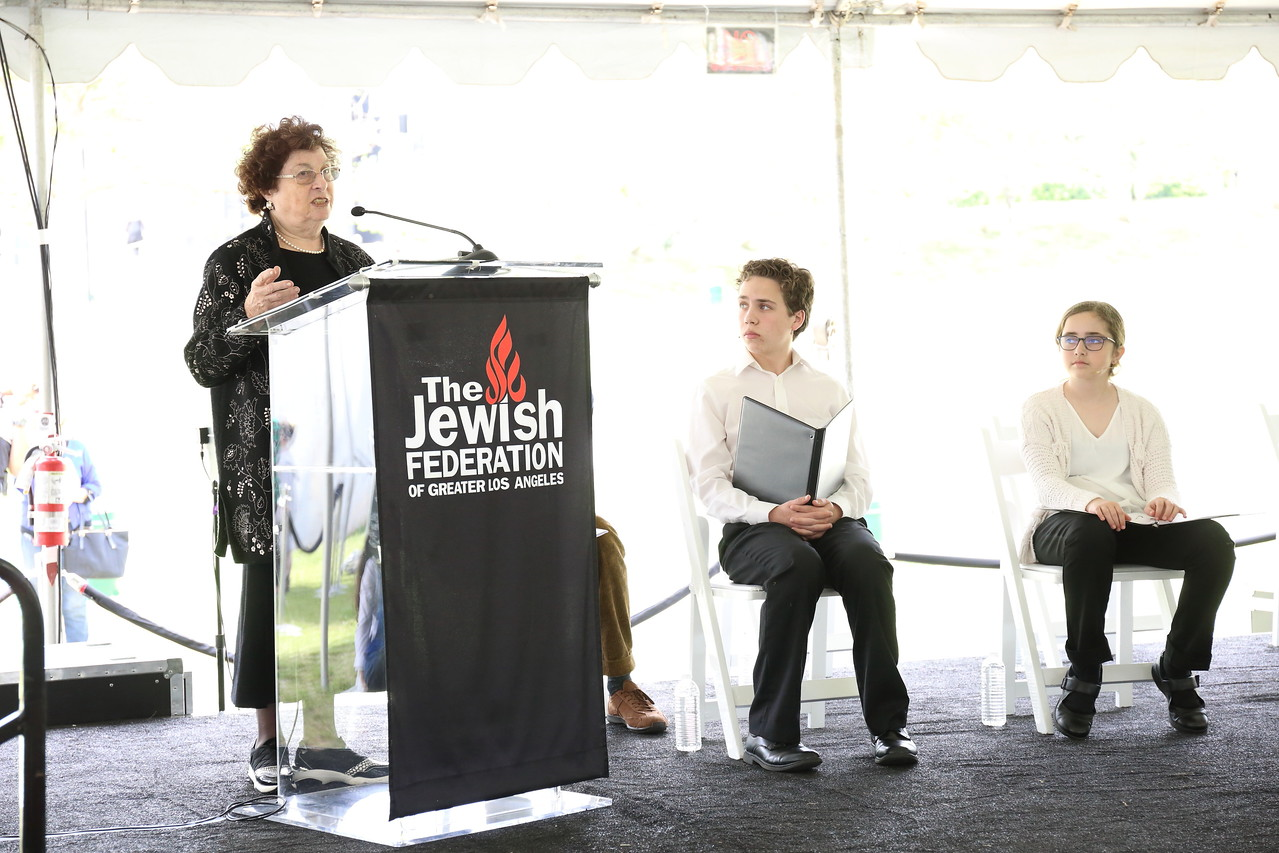
Holocaust survivor Eva Brettler shares her story at the Jewish Federation of Greater Los Angeles’ 2019 Yom HaShoah ceremony. Courtesy of the Jewish Federation of Greater Los Angeles
Not even insiders know how Jewish groups made out in the frenzy to take advantage of the funds, which covered two months of salary for applicants to keep employees on the payroll through the end of June. Jewish Federations sent out a survey on Friday afternoon to assess results.
But Doron Krakow, CEO of the JCC Association of North America, said that from what he has heard anecdotally, more Jewish community centers were turned away than received loans.
Krakow said 12 to 15 Jewish community centers have reported getting the money, and he expected that number to rise to 20 to 25 next week. But that’s out of about 150 JCCs in the country. Krakow said he did not know how many had applied for the loans, but said the number of recipients “represents a small fraction of the field.”
The stimulus bill’s drafters said they expected banks to act impartially and treat applicants on a first-come, first-serve basis.
That appears to have happened in some cases, such as for Ramah of the Rockies, a Colorado-based Jewish camp that found out its loan had been approved just days after working with the Bank of Colorado to submit its application.
But Mark Gurvis, Jewish Federations’ executive vice president, said a number of obstacles stood in the way of successful applications for some groups, even as he said he was already getting thank-you notes from groups that logged into the umbrella’s webinars and subsequently got grants.
Chief among the hitches, he said, was that groups were better positioned if they had a longstanding relationship with a lending institution.
“It wasn’t enough to have a checking account,” he said. “If the bank didn’t have experience with you as a borrower, the banks needed a way of filtering.”
“It wasn’t enough to have a checking account. If the bank didn’t have experience with you as a borrower, the banks needed a way of filtering.”
Yet another factor was that smaller banks in smaller communities were more agile and able to process the loans quicker than large institutions that were overwhelmed with applications.
“Whereas regional banks were able to move their customers much more quickly, for a Jewish community heavily concentrated in urban areas, that was more of a problem for us,” Gurvis said.
Another difficulty, he said, was that the haste of putting the program in place inhibited clarity. The Small Business Administration, working with the U.S. Treasury, issued changes in guidance on April 2, the night before applications opened, and twice afterward.
“As Treasury tried to clarify the loans, they created new ambiguities,” Gurvis said. It was never exactly clear how much a business could apply for and what should be included in the calculations, he said.
Absent that clarity, banks established their own guidelines. Some balked at lending to religious institutions until the Trump administration clarified that those institutions could receive the funds.
“In the early days, banks said ‘We don’t think you’re eligible,’” Gurvis said.
What’s more, some in the Jewish world and beyond have raised questions about whether nonprofit applicants were shortchanged in favor of for-profit businesses applying for the funds.
What’s more, some in the Jewish world and beyond have raised questions about whether nonprofit applicants were shortchanged in favor of for-profit businesses applying for the funds.
“We competed with the private sector,” Krakow said.
An April 8 letter from the National Council of Nonprofits signed by Krakow and Fingerhut’s groups suggested that nonprofits believe private sector businesses and their allies in the Trump administration hindered the fair disbursement of the funds.
Nathan Diament, the Orthodox Union’s Washington director, said that a number of his group’s affiliates were forced to turn to larger banks for assistance — and then did not necessarily have their applications moved ahead quickly.
“What we’ve heard anecdotally, many banks were putting nonprofits to the back of the line,” Diament said.
Congress is now considering a sequel to the $2 trillion Coronavirus Aid, Relief, and Economic Security Act passed last month, and a key element will be more cash for more small business loans. Fingerhut said in his message Friday that he anticipates another $250 billion being made available for small businesses.
Nonprofits again are pressing for $60 billion in dedicated funding that they asked for the first time around and did not get — and they want assurances that groups providing relief during the pandemic will be pushed to the front of the line.
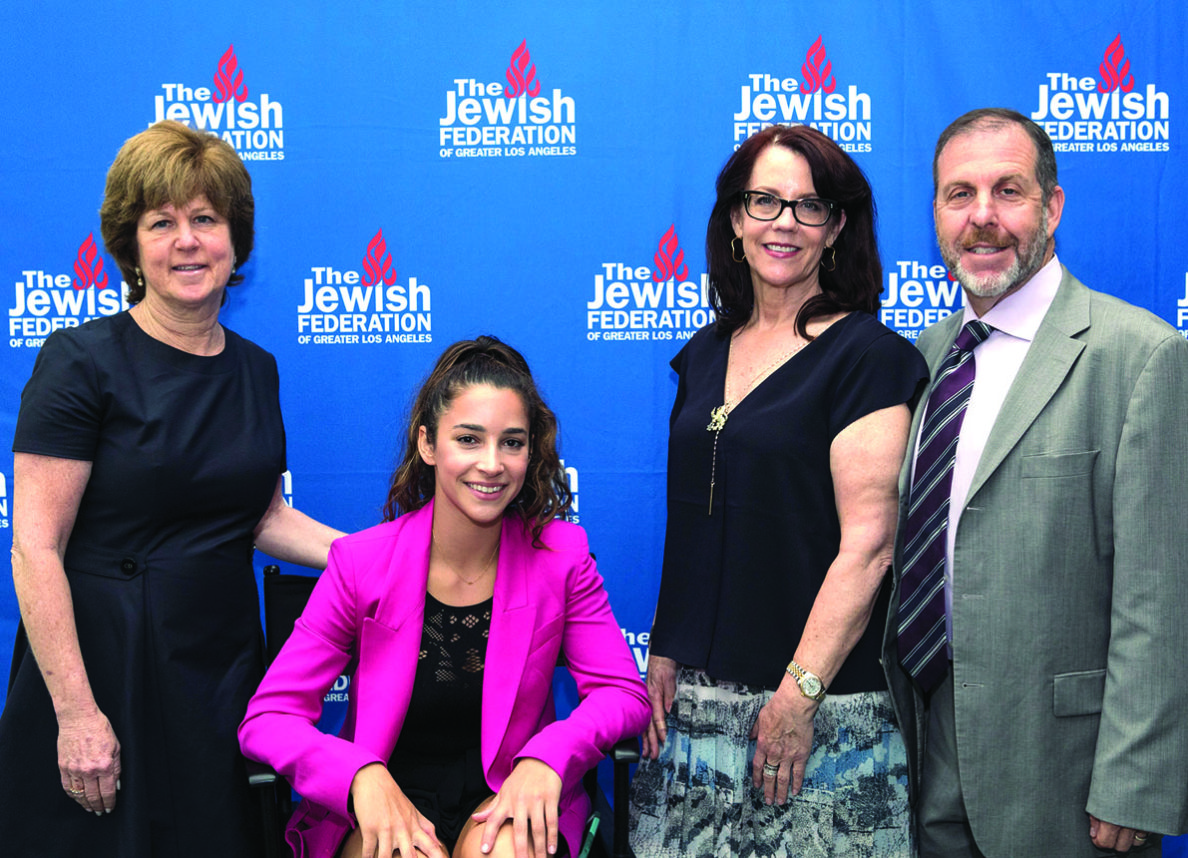
From left: The Jewish Federation of Greater Los Angeles Board Chair Julie Platt; Olympic gold medalist Aly Raisman; Jewish Federation Valley Alliance Chair Jill Namm; and Federation CEO and President Jay Sanderson come together at “It Takes a Woman,” an event for Federation supporters.
“We continue to believe that Congress is likely to pass supplemental appropriations,” Jewish Federations of North America said in an email Thursday to constituents. “However, let’s not take this for granted. Please contact your Members of Congress now.”
Abba Cohen, who directs the Washington office of the haredi Orthodox Agudath Israel of America, said his group also would lobby for a clearer dedication of funds to nonprofits.
“These steps will hopefully address the main impediments that have been experienced: slow bank response, preference of larger organizations over smaller ones, and loans being restricted to already existing customers,” he said in an email.
Gurvis had some advice for groups with loan applications already in if they are considering a change in tactics.
“If you are already in a process, you really want to understand where you’re at with the bank, and will they move your application along if there’s more money,” he said.
(JTA) — Poland’s parliament sent draft legislation aimed at blocking restitution of property lost or stolen during the Holocaust to a committee, even as the country’s ruling party voiced opposition to it.
The draft resolution, which was voted on Thursday at the Sejm, the lower house of Polish parliament, was referred for “further work” by the Justice and Human Rights Commission.
Out of the Sejm’s 460 members, 259 voted against scrapping the draft outright, Salon24 reported. But in a subsequent vote, 420 lawmakers objected to it moving to a second reading. This led Sejm Speaker Elżbieta Witek to refer the draft to committee.
The draft states: “It is forbidden to take any actions aimed at satisfying claims regarding heirless property, including negotiations, entering into settlements, recognizing claims and actions relating to heirless property, consenting to mediation, directing parties to mediation or payment of cash benefits.”
It also states that Nazi Germany, not Poland, is responsible for what happened in Poland when it was occupied by Germany.
The ruling right-wing Law and Justice party said on Wednesday that it does not support the draft because it is “unnecessary,” but it was introduced to parliament because it garnered 200,000 signatures — well above the 100,000 needed to do so.
Poland is according to the World Jewish Restitution Organization the only major European nation without laws regulating the restitution of heirless private property — or possessions that belonged to individuals but ended up in the hands of the Polish state or other parties after the Holocaust.
The Israeli government started to ease its strict coronavirus quarantine restrictions on Sunday, permitting some regulated outdoor prayer and allowing some retail stores to reopen.
Stores that sell electronics, home appliances and office equipment are back in business, but they must follow specific rules: take the temperature of employees and customers; limit the number of customers in a store at one time; implement spacing and a physical barrier between customers and cashiers at the cash register; and frequently disinfect their spaces.
People may now also participate in outdoor prayer groups of up to 19, standing six feet apart. That can take place no more than 550 yards from people’s places of residence or work, and only in open areas.
In addition to prayers, circumcisions and weddings can be held in open areas, with no more than ten people, distanced six feet apart.
Everyone in Israel is still required to wear a face mask outside, and not wearing one carries a fine.
Some technology and other kinds of businesses will be permitted to operate with up to 30 percent of its staff present at a time. Special education programs will also reopen, for up to three children per group.
In a nationally televised address on Saturday night, Prime Minister Benjamin Netanyahu said the new regulations will remain in place for two weeks and more restriction could then be relaxed if the coronavirus situation continues to improve.
Netanyahu called on Israel’s Muslim citizens to avoid family gatherings during Ramadan, which starts on Thursday, just as Jewish Israelis did during Passover.