Los Angeles County announced 40 people died from COVID-19 on April 14, the highest number the county has recorded in a single day since the pandemic began. The county also announced 670 new cases on April 14, bringing the total number of cases to 10,047 and 367 deaths. The COVID-19 death rate in the county is now 3.6%.
“I know that this represents lives that have been lived, with close families and friends who are now mourning this terrible loss,” Los Angeles County Public Health Director Dr. Barbara Ferrer said.
On April 13, there were 239 new cases in the county, which was the lowest number since March 26. However, Ferrer cautioned at the time this likely was due to less testing over the weekend.
On April 13, Los Angeles Mayor Eric Garcetti said California’s peak in new cases and deaths could occur on April 17 and 19, respectively.
California Gov. Gavin Newsom (D), outlined a series of criteria for him to start lifting the state’s shelter-in-place order on April 14, including more widespread testing, tracing, and isolation of new case;, making sure the healthcare sector has enough resources to handle a surge in new cases; and ensuring businesses and schools can implement social-distancing measures.
“There’s no light switch here,” Newsom said. “I would argue it’s more like a dimmer.”
The UC Irvine (UCI) Student Senate on March 31 repealed a 2012 resolution calling for the university to divest from companies that conduct business with Israel.
Associated Students of UC Irvine (ASUCI) Senator Marshall H. Roe introduced a resolution to repeal R48-15 — the divestment resolution — on March 12. The resolution stated that R48-15 had created a hostile campus climate against Jewish students and that its labeling of Israel as an apartheid state was a Blood Libel. The resolution also denounces the boycott, divestment and sanctions (BDS) movement as being “contrary to the foundational ideals of Higher Education and thus the values of the UC.”
The final vote tally at the March 31 meeting was 15 in favor, six against and two abstentions.
In a vote of 15-6-2, the Associated Students of UC Irvine repealed a 2012 BDS measure and condemned antisemitism. pic.twitter.com/jLgalM2QEV
Roe, a Jewish student and Navy veteran, said during the meeting that the BDS movement “created a noxious atmosphere [against Jewish students on campus].”
“I believe that embracing neutrality on this matter and thus repealing R48-15 would dispel the noxious atmosphere and create neutrality on campus, a neutrality that would foster an environment of reconciliation rather than rancor,” he added.
Roe elaborated on his noxious atmosphere remark in an April 14 phone interview with the Journal, explaining that during the fall quarter, members of Students for Justice in Palestine (SJP) screamed at members of UC Irvine’s Hillel outside a Starbucks and then just watched them for a while.
“It’s clear the point was intimidation,” he said.
Roe also said that he reached out to SJP to have a dialogue with its members, and then a few days later he received a threat on Twitter.
“I would like to have dialogue on campus,” Roe said. “For those of us who support Israel, we want to actually talk to the other side.”
He said that his argument of neutrality was what won over the majority of the ASUCI Senate to repeal R48-15.
“The Senate felt it was impossible to have a constructive campus conversation about the conflict without embracing neutrality…I think, in many ways BDS legislation, helped to create a noxious environment that has allowed years of harassment,” Roe said.
Jewish groups applauded the move.
“UC Irvine divestment originally passed at a time when major BDS initiatives on campus were relatively few and far between,” StandWithUs CEO and Co-Founder Roz Rothstein said in an April 14 statement to the Journal. “These campaigns became much more frequent after that, subjecting Jewish and pro-Israel students across the U.S. to hatred, intimidation, and harassment. We’re proud of all the student activists who have fought against these hateful campaigns over the years, and congratulate the UC Irvine student government for finally rescinding this destructive resolution.”
AMCHA Initiative director Tammi Rossman-Benjamin similarly said in a statement to the Journal, “We heartily commend the UCI student government for acknowledging how the 2012 anti-Israel divestment resolution, although ostensibly directed at Israel, has actually harmed students on UCI’s campus and created a noxious campus climate for all. While masquerading as a human rights campaign, these divestment resolutions are, in truth, a PR device meant to divide the campus, shut down discourse and debate, and marginalize and incite hate against those students who support Israel, as we have seen at UCI with numerous incidents of harassment toward Jewish and pro-Israel students as a direct result of BDS activities.”
She added that AMCHA’s research has shown that a strong correlation between BDS and anti-Semitism toward Jewish students on campuses across the country, including attempts to exclude Jewish and pro-Israel from campus activities. AMCHA, which means “your people” or “your nation” in Hebrew, is a nonprofit based in Santa Cruz.
“Kudos to the UCI student leaders for joining the growing number of students who are no longer falling into this hate-filled trap,” Rossman-Benjamin said. “We hope their actions in repealing the 2012 divestment vote will serve as a model of courageous student leadership for all campuses.”
Students Supporting Israel at UCI also said in a statement that its members were elated at the repeal of the divestment resolution.
“Pro-Israel advocates for years have worked to stop and repeal BDS,” the group said. “No longer will the blatant anti-Semitism that has pervaded the UCI campus be sanctioned or tacitly consented to. It’s just amazing to hear such good news even in these uncertain times.”
UCI’s SJP chapter did not respond to the Journal’s response for comment.
Like so many millennials, I bear my student debt like an albatross, branded with the lifetime shackles of an Ivy pedigree. Time has not shrunken my debt; rather, it has quadrupled what my initial principal once was. Homeownership is no sooner in my future than my two-decades-long dream of one day trekking across the vast landscape of Iran wearing my American-Jewish identity with pride.
A few weeks ago, the United States came to a grinding halt. A seemingly secure workforce found itself homebound, along with all of America’s youth under the age of 18, with school closures. Never in our history has the U.S. seen this level of national peril − and unlikely opportunity. While the nation struggles to flatten the coronavirus curve, I offer the following proposal:
The six-month deferment of student-loan interest outlined in the CARES act may provide immediate relief to millions, such as myself, whose monthly disposable income post-loan payment is meager at best. However, we are experiencing a unique time in our history, which might allow for a much more impactful program to benefit numerous sectors of our society now, and for the long term once we return to the workforce.
With a large portion of America’s workforce now working from home and almost all of America’s school-age children attempting to learn remotely, imagine an initiative that matches adults with student debt with children from elementary to high school in an online tutorial program. This program would be designed to augment the virtual learning experience and reinforce essential skills such as reading, mathematics, social studies and science. Homebound lawyers could become civics teachers; engineers become math and science tutors; writers become English teachers; athletes become health coaches; graphic designers become art teachers; musicians and composers become music teachers etc.
Never have we faced such a pandemic in modern times. However, we are presented with a unique chance to transform the shelter-in-place mandate into an opportunity not just to maintain, but to augment the virtual educational experience of America’s youth − specifically high-risk students − while simultaneously helping college graduates who bear substantial and unsurmountable student debts as the results of their investments in their education.
How the initiative works
College graduates and K-12 students will both enroll in this program and be assigned an identification number issued through the Department of Social Services. For each verified hour an eligible college graduate provides pro bono assistance to a student, he or she would receive, for example, a $50 credit toward his or her student loan principle. Assuming a college graduate provides five virtual tutorial hours weekly, that is a monthly student loan credit of $1,000. With an average student loan debt of $37,000, a graduate would have the opportunity to “work off” his or her federal loan in a few short years, compared to the current 20-plus-year average − all while providing invaluable assistance to other American students both during this unprecedented time and after.
With one high-school student dropping out every 26 seconds, the effect of such a program could be profound − especially given that school closures risk resulting in tremendous declines in student learning and access to tutorial services. In short, as waves of graduates successfully absolve their debts and provide an invaluable public service, new waves likely would follow in their footsteps, creating a new public-service paradigm where giving back becomes part and parcel of becoming a wage-earning member of society.
The advent of the coronavirus has been devastating nationally and globally. However, it is indeed woven into the fabric of American identity to build bridges when roads are collapsing. The implementation of the TOUCH Act could be the solution to both the crisis of student-loan debt and the tremendous challenge to the preservation of quality education in a time of ubiquitous school closures and potentially beyond, as we create a new “normal” and collectively redefine personal investment in the education of America’s youth.
Lisa Ansell is the associate director of the USC Casden Institute
BOSTON (JTA) – Thirty-two residents at two Jewish senior living facilities that are part of the same nonprofit network have died from COVID-19, and scores of other residents and staff have tested positive for the virus.
Eleven residents of Chelsea Jewish Life Care, across its three Boston-area locations, and 21 residents at JGS Lifecare in Longmeadow, a suburb of Springfield in Western Massachusetts, died, according to letters to families posted earlier this week on the websites of both facilities.
“The loss of so many of our loved ones is reflective of the severity of some manifestations of this terrible disease,” wrote Adam Berman, president and Barry Berman, CEO. “We offer our sincere condolences to their families and share in their grief.”
The pandemic is hitting seniors living in residential facilities especially hard. One of the first documented outbreaks in the United States affected a nursing home, and the death toll at Amsterdam’s Jewish senior home stood at 15 last week. Jewish homes, like many others, have adjusted their practices to try to curb the disease’s spread, but outbreaks are continuing nonetheless.
At JGS Lifecare, 93 residents tested positive out of more than 180 tests conducted, and 43 staff members tested positive of 84 tested to date. Across its sites north of Boston, Chelsea Jewish reported that 117 residents tested positive, out of 251 tested, and of 103 staff tested, 40 tested positive.
JGS Lifecare became part of Chelsea Jewish Lifecare in 2018. Combined, the nonprofit employs over 2,000 people and takes care of over 1,000 individuals, according to a spokewoman.
Chelsea, a largely immigrant city once home to a sizable Jewish population, has been hard hit by COVID-19, with an infection rate that rivals New York City’s. Many of its low-income residents are employed in businesses deemed essential.
The 11 deaths at the two Chelsea Jewish facilities in the city account for nearly 60% of the city’s COVID-19 deaths so far. As of Monday, Massachusetts reported 844 deaths due to COVID-19, with nearly 27,000 positive tests.
“We cried out to Adonai, the God of our ancestors, and Adonai heard our plea and saw our affliction, our misery and our oppression.” — Deuteronomy 26:7
“So why isn’t our crying out working now?” my stepmother, Melissa, asked at our Passover seder after she read this verse. My brother Josh jokingly suggested putting blood on the doorposts of our houses like the Israelites did.
Upon reflection, I realized Melissa’s question contained a few logical premises. Her question assumed God sent the original plagues, we cried out to God and God stopped the plagues, as stated in the Bible. Therefore, crying out to God should work for this plague, too.
It’s simple geometry — the transitive property — so why isn’t it working? Beneath her question, Melissa raised deeper questions: Did God send the plague of the coronavirus? Can God stop it?
Did God send this plague? I spent some time entertaining the idea that God may have sent the coronavirus plague. After my Amazon Alexa told me the world’s air pollution had dropped because of people staying home, I went on a bike ride and wondered. I thought about how we’ve been in this state in recent years where the youth — headed by Greta Thunberg — understood the need to change our behavior to avert climate change, while older people in power have resisted.
Perhaps God would be tempted to send a plague that kills the older but not the young, prompting people to stay home, thereby reducing air and water pollution. This plague has spurred humanity to realize we can live more humbly to avert death — which is what we need to do to avert the destruction of the planet through climate change. Perhaps, I mused, God did send this plague.
But after I returned from my bike ride, I learned my cousin was in the hospital with COVID-19. He’s been on a ventilator for the past week. A few days later, my aunt in another part of the country was taken to the hospital with COVID-19 as well. She had collapsed in her home, broken her nose, and had pneumonia and COVID-19. In both cases, their spouses and children were not allowed to visit them in the hospital. Even now that my aunt has returned from the hospital, she has to stay isolated. Her husband stands outside the house and talks to her through the window.
God surely wants none of this.
“I don’t think God sent this plague, but I know we can learn from it.”
The God I believe in is a God of snuggles, hugs and kisses — a God who knows that Zooming is a second-rate substitute for sitting beside a loved one and holding his or her hand. I imagine that like me, God is grateful for the blessings of Zoom, Skype and FaceTime — which are infinitely better than no contact at all. Still, it’s not the same.
God surely didn’t send this plague.
And while I’m all for crying out, I’m not holding my breath that crying out will save us. As our sages said in the Talmud, “Where there is a possibility of danger, we should not depend upon a miracle.” Don’t get me wrong. I’d love a miracle — but I’m not expecting one.
The only way out is for our medical researchers to find a vaccine. In the meantime, our medical professionals need to keep caring for the sick; our social service agencies to offer support to the needy; our grocery workers and deliverers to keep us fed; the clergy to provide comfort; and the rest of us to hunker down and Zoom our friends and family through this catastrophe. God will provide us strength and inspiration in these endeavors.
To be honest, I don’t know if God even sent the first Ten Plagues in Egypt, but I do know the Israelites recognized that the time of the plagues was their shot to get out and create a different kind of society, which glorified life rather than death. So, too, this moment is our chance to transform how we live.
As Rabbi Sharon Brous said, after the plagues, the Israelites “rebuilt a society that was the counter-Egypt, that was the antithesis of what they had experienced in their suffering in Egypt, and we will rebuild a society that is counter to the injustices and oppressions and indignities of this world that we have lived in.”
Or as Rabbi Steven Leder wrote, “Do not come out of hell empty-handed.”
Indeed, let’s create a society based on the antithesis of isolation. Let’s create a society based on love, justice and togetherness.
So Josh, I don’t think blood on the doorposts is the answer this time. Melissa, I don’t think crying out is the solution either. I don’t think God sent this plague, but I know we can learn from it.
From the first Ten Plagues, our people learned to “be kind to the stranger for you were strangers in the land of Egypt.” From this plague, let’s learn that we have the power to radically change our lives quickly to avert our destruction. Let’s care for Earth and one another with renewed ferocity. That way, we won’t come out of this hell empty-handed.
Rabbi Ilana B. Grinblat is the vice president of Community Engagement for the Board of Rabbis.
California Gov. Gavin Newsom (D) laid out the criteria needed for him to lift California’s shelter-in-place order.
The criteria consists of six benchmarks: using testing, tracing and isolation to curb the spread of COVID-19; protecting those most at-risk of becoming severely ill from the virus; having the proper healthcare infrastructure in place to handle a potential surge in cases; having treatment for the virus; making sure businesses and schools can implement proper social-distancing measures; and the state government having the ability to re-institute certain measures to combat the coronavirus.
#COVID19’s impact on the economy, on poverty & on healthcare is hard to sustain. In the future, we will need to modify our Stay-at-Home order.
— Office of the Governor of California (@CAgovernor) April 14, 2020
“There’s no light switch here,” Newsom said. “I would argue it’s more like a dimmer.”
Newsom did not provide a timeframe on when the shelter-in-place order will be lifted; he said he needed to see hospitalization and intensive care unit (ICU) numbers decline.
“We will be driven by facts,” Newsom said. “We will be driven by evidence. We will be driven by science. We will be driven by our public health advisers, and we will be driven by the collaborative spirit that defines the best of us at this incredibly important moment.”
He added that he would re-evaluate the situation in two weeks.
Newsom suggested that when the state does begin to re-open, restaurants would have fewer tables available and people will be wearing face coverings when outside. He also said it would be a while before people could engage in large-scale events.
“We talk about what the new normal will look like,” Newsom said. “Normal, it will not be.”
Newsom told California residents the state will get through this. “This can’t be a permanent state, and it’s not,” he said.
Newsom implemented the indefinite shelter-in-place order on March 19.
As of this writing, the state has 22,341 confirmed cases and 724 deaths from the coronavirus. The number of daily COVID-19 fatalities in the state have steadily declined since April 8, according to CNN.
On Thursday night, as sundown falls on the holiday of Passover, Sephardic Jews everywhere will celebrate the centuries-old tradition of Mimouna.
This is the night when Jews open their doors to their neighbors, offering lavish sweet tables to bring in a year of sweetness and good fortune.
If there’s a Jewish ritual that calls for maximum social connection, Mimouna is it. As I wrote in a column years ago, “Mimouna represented the love and intimacy of a neighborhood. There’s nothing like popping in to see 10, 20, 30 different neighbors on the same night, most of whom you see all the time.”
This year, after centuries of continuity, Mimouna parties around the world will come to a stop, conquered by a tiny virus.
I know, there is still livestreaming, there is still Zoom, there is still Face Time and all those magical digital instruments that help us approximate reality.
But not for Mimouna.
Not for a ritual where the very essence is the physical gathering of people.
Not for a ritual that tingles with the excitement of real-time human connection.
Not for a ritual where the smell of moufletas, those mouth-watering Moroccan crepes gently caressed with butter and honey, are central to the experience. (Does Zoom have a new aroma feature?)
Mimouna is also about romance. As I wrote:
“According to folklore, Mimouna was known as the ideal night to meet your sweetheart. It was a night when doors and hearts were open, and young men and women, dressed in their finest, would move and mingle like butterflies from one party and sweet table to another.”
As my friend Rabbi Daniel Bouskila discussed on my podcast this morning, none of that human connection can be captured on a digital platform. This is hardly a criticism of technology, which has kept humanity connected during these pandemic times, when much of the world is under “social distancing” lockdown.
I bring up the “Mimouna exception” because sometimes it’s healthy to accept our limitations. We’re used to being able to do pretty much everything we want. Not having a Mimouna party? Unthinkable.
This year, COVID-19 has quarantined Mimouna parties. Sure, the sweet tables will be made, the blessings will be given (Rabbi Bouskila will be livestreaming Mimouna on the SEC Facebook page), the Zoom parties will do their best, but everyone knows it won’t be the same.
As with so many other areas of our lives, the pandemic times are forcing us to accept a new reality.
As we feast on our moufletas this year and show them off on Zoom, and as we wish one another blessings of sweetness and good fortune, we can hope that those blessings will come to fruition before Mimouna of 2021.
The Jewish community’s expression of solidarity with Chinese Americans during the coronavirus pandemic has yielded an unexpected return: scads of personal protective equipment for Jewish organizations.
David Bernstein, the president of the Jewish Council for Public Affairs, the Jewish public policy umbrella that initiated the solidarity letter toward the end of February, said Tuesday that Chinese-American groups have sent thousands of much-needed items to Jewish social service agencies in the Washington, D.C., Boston and New York areas, and more is expected.
“They have many more connections in China than we do and they have ways of procuring PPE that many Jewish organizations do not and can help on an ongoing basis,” Bernstein told the Jewish Telegraphic Agency.
Among the contributions Bernstein reported: United Chinese Americans contributed 6,000 surgical masks to the D.C.-area Jewish Social Services Agency; The Committee of 100, a Chinese-American leadership group, donated 100 isolation gowns to the Jewish Family and Children’s Service in the Boston area; and the Bank of China-America donated 12,000 surgical masks to Jewish senior homes in the New York area.
On Feb. 21, some 74 Jewish groups signed the letter at a time when anti-Asian attacks were spiking because the coronavirus had originated in Wuhan, a city in China. Dozens of local Jewish groups, as well as major national groups and the breadth of Jewish religious denominations, were signatories.
“We pledge to help ensure that Chinese people feel safe and supported, and to combat attacks and stereotyping on social media,” the letter said. “We know from history, ours and yours, that such fearmongering can be devastating.”
The letter pledged to encourage Jewish communities to frequent Chinese American-owned businesses, which had seen a decline.
There were outpourings of gratitude from Asian Americans. A headline in one Chinese language paper reporting the letter cited a Chinese proverb, “In a snowstorm, they gave us coal.”
Haipei Shue, the president of United Chinese Americans, told the Jewish Telegraphic Agency that Chinese-American communities across the United States were scrambling to find PPE to distribute within their towns and cities.
“They know where to get them, where a lot of American organizations don’t know,” Shue said. “We probably have better sources, better connections.”
Making sure that a portion of those went to Jewish groups was an easy call, Shue said. He likened the closeness of the two communities to finding out in wartime who one’s true friends are.
“There are so many times that the Jewish community has shown up for us, this is really nothing,” he said.
Her name was “Promise.” An unusual name to be sure, but not so unusual in Ethiopia for young girls hawking souvenirs and trinkets to tourists in small villages everywhere.
The group of girls excitedly approaching our car were competing for attention – “Hi, I’m Layla. Remember me!” – “Hello, I’m Mary. Where are you from? Buy from me!” – “I’m Sue. Only 300 Birr!”
But Promise stood out from the crowd. She was vivacious, ambitious, entertaining, full of life, and seemed to speak English better than the others. She was flirtatious – asking and answering questions – but always with the sale at the forefront. “My name is Promise – will you promise to buy something from me? Promise? Promise?” The bantering was lively and exciting. And I knew that she had “hooked me”.
Ethiopian children on rural roads approach our vehicle wherever we stop. Sometimes eager for gifts and candies, and most often just saying “money, money!”
Ethiopia was country number 98 of my world travels, and all this was happening in front of a Falasha Village tourist stop, in Gonder. The Ethiopian Jews used to live in the village before being airlifted out by Israel in 1991. These days, it’s a small handicrafts village, and features a small round decaying structure, which they say was the shul. Today, the remaining Jews live in various other scattered villages, and many congregate in a large, fenced off, community center where many future Olim are learning Hebrew and Tanach and Jewish History, in preparation for their hopeful emigration to Israel.
Young children aggressively harassing tourists for money or for buying trinkets is so common in third world countries that after a few days of touring it’s easy to become immune to the underlying poverty there. On top of that, we’re often specifically told not to give money or buy anything because it encourages kids not to attend school. The experience can be very perplexing.
Knowing that tourists stopping at this village are interested in its Jewish history, the crafts shops create Jewish-themed items. Small figurines of King Solomon and the Queen of Sheba inside a “tabot” (a small ark representing the Ark of the Covenant), clay Kiddush cups and candlesticks, African-style, but adorned with Magen Davids.
Promise was soliciting a small clay sculpture of Moses holding the Ten Commandments. I was intrigued, firstly because Judaism is so embedded in their history and legend, and I wanted a Jewish memento of my trip. And secondly, Ethiopia is mostly Christian Orthodox and tribal so most souvenirs are of that nature. The Moses figurine was very unique.
Negotiating in these countries is par for the course. No one ever pays the asking price. You start by offering 10% and hope for a successful “ending” around 35%.
Jewish-themed souvenirs for sale at the Falasha Village old shul site. The small clay boxes are “tabot” (like the Hebrew word “teivah”) and are representative of the Ark from the Beit Hamikdash. Inside the boxes are tiny figurines of King Solomon and The Queen of Sheba.
And so the negotiating game with Promise began. She asked for 300 Birr (about $9.50). I offered 100. She came down to 250, 220, 200. I inched up to 120, 140. We were both having fun – certainly, I was – and we settled on 150 Birr. Half of her asking price. Not bad, I thought. I handed her 200 Birr and asked for change. She didn’t have any. She exchanged some words, in rapid-fire Amharic, with my driver, tossed the souvenir into the car and darted off.
A moment later, we saw a tuk-tuk accident across the street. A tuk-tuk is a small three-wheeled vehicle, about the size of a small golf cart, but covered with canvas and plastic. Many of them are decorated with colorful decals of famous celebrities. Bob Marley, of Caribbean reggae music fame, seems to be popular. Tuk-tuks have tiny engines that putter – thus the name “tuk…tuk”. There are literally thousands of them zipping around everywhere.
There was a sudden frenzy, with hysterical villagers screaming and running out to the street. A tuk-tuk had veered off the road and into an embankment. Our driver dashed outside to see what was happening.
When he returned, he was visibly shaken and crestfallen. He said that a woman was hit and she was under the vehicle and that people were tipping the tuk-tuk to get her out. We asked if she was alive and he said, “I don’t know, but her body was limp.” He said they took the girl to the hospital in a car.
On the road to Gonder, with a tuk-tuk in the background.
Our driver was shaking and crying. Slowly, he said, “It was the girl that was selling you the souvenir! She got hit! She was running to get the change.”
Oh, my dear God. You cannot begin to imagine the thoughts racing through my mind. What if she’s dead? The silence in the car was palpable. We were all in shock. Processing. Thinking. What if she died for 50 Birr? Is a life not worth a dollar and a half? Could she have died over the sale of a Moses figurine? Was it wrong for considering to buy that? For negotiating? Was I in some way responsible? Was this really happening?
Boy, how fragile life is. How it can change in a fraction of a second.
We are currently experiencing an unprecedented pandemic. Never before has the entire world had an event so far-reaching.
The internet is awash with suggestions as to why this is happening, both from physical and spiritual perspectives. Why? And why now?
Jewish Ethiopian boys studying the parsha at the Hatikve Jewish Community Center in Gonder. After learning there was minyan for Mincha.
As no one knows the ways of God, it is certainly not for me to attempt to explain it. But as Jews, we have Torah perspectives and Jewish history to glean from.
Besides the panic buying, fear of death, loss of money, and the helplessness of not having a cure, the main consequence that we’re all experiencing is being alone. Humanity is being separated. Whether it’s self-imposed or a mandated quarantine, we are being separated in a way that has never been experienced before.
We can no longer congregate with our community, neighbors, family, even our own children, parents and grandparents. We can’t shake hands with anyone. We can’t even be within 6 feet.
Over the last few years we’ve seen acrimonious disharmony. Right-wingers. Left-wingers. Absolute disdain for people with different views. Countries threatening each other with war. Other countries split from within. Look no further than the United States, the European Union, England, and Israel. Political considerations take front row to the people’s needs. Corrupt leaders suppress and steal from their own citizens.
Where is the unity? Where is the concern for the “klal”, for the nation – and the world – as a whole?
With everyone in the world looking out for themselves, is it any wonder that the result is separation?
The quarantine seems to be a direct reflection of our disunity.
The sages explain that the destruction of the Second Temple was because of sinat chinam – baseless hatred. God was essentially saying, “Why have a Temple to have a relationship with Me, when you don’t even have a relationship with each other?”
We are also familiar with the Avinu Malkeinu prayer. We first say Avinu, our Father, before Malkeinu, our King, because we want to appeal to God as a father first since a father always has more mercy than a king.
The interior of the old Shul, built in 1942, at the Falasha Village in Gonder. The seating is around the circumference of the building (Sephardic style). The guardian said that the chopped out area on the wall is where the Sefer Torah was.
But a father can only act as a father when his children act as children. If they’re always fighting, the family bond is broken, and he won’t treat them as a father. That is why we ask for forgiveness from all our friends before heading into the heavenly court of Yom Kippur. We try to heal our interpersonal relationships before approaching our Father in heaven.
What we see today, with the unprecedented closing of all shuls (not to mention churches and mosques) is so strikingly similar. God is effectively saying, “I don’t want your communal prayers.” Our shuls are our mikdash me’at – replicas of the Temple. If He’s closing every single one of them, that’s extremely telling. It means we’re being shut out.
For me, the nail in the coffin was when the Chief Rabbi of Israel closed the Kotel to prayer. This was, after all, the outer wall of the Temple. It is a remnant of what was. And all we have left. And God seems to be saying, “Not only did I take the Temple away – now I will even take the minimal outer wall away! I don’t want you there. Until you show some love and unity with one another.”
Ironically, the quarantine and closure of places of worship is having precisely the effect that it appears intended to have. People, in desperate straits, are beginning to act as brothers and as a family, and helping each other in so many ways, even during social distancing. The entire world’s efforts have shifted away from sports, entertainment, business, and materialistic pleasures. Priorities are changing. Governments are being forced to spend all their resources on survival rather than illegitimate activities.
I am certainly not the only one who says that this appears to be a “reset” of the entire planet’s modus operandi, but we all need to do soul searching and see how we can be better, kinder, more sensitive people – to everyone – and what we can do for the common good. We need to see ALL people as “tzelem Elokim” – all made in the image of God, regardless of nationality, religion, race, ideology.
Sometimes it takes a total stoppage to the system for us to re-evaluate everything. And sometimes it has to be shocking for it to be REAL wakeup call. It can’t just be a 9-11, or a tsunami or local earthquake. It has to be on so grand a scale that theentire humanity realizes it. And it appears to be working. Divided governments are starting to unify. These are signs that unity is possible.
There is nothing as shocking as the fear of death. It is the ultimate wake-up call.
A young Ethiopian Jewish Oleh-to-be, at the Hatikve Jewish Community Center in Gonder.
Which brings me back to my humble little story about Promise.
After 20 minutes sitting alone in the car (a quarantine, of sorts) contemplating the possible ramifications of what happened, I asked our driver, Ahmed, to drive to one of the local hospitals to see if a young girl was recently admitted. He obliged and went inside as we nervously waited outside.
I can’t begin to tell you how relieved we were when he returned. Promise was alive, didn’t remember what happened, on an IV line, and even spoke a few words! It was miraculous. We couldn’t understand how she could possibly be alive and well after being run over by a tuk-tuk.
The next day we heard that Promise was released, with only minor scratches. As we ended our tour, I handed Ahmed an extra $100 and said, “Please buy the Moses figurine. Tell her we were negotiating too much, and that it’s really worth $100! And please, Ahmed, keep the Moses figurine in your house as a memory of the miracle that had happened.”
In the end, the girl was okay, the driver was okay, and all the fears of death, thank God, went unrealized.
Promise (at left) holding 3,300 Ethiopian Birr (about $100) we gave her, and Ahmed our driver (at right) holding the Moses souvenir. Ahmed sent us this photo a few weeks after the accident.
As we are enduring this frightening pandemic I realized that the fear of death propelled me to do something that I wouldn’t ordinarily have done. Of course, I wasn’t guilty for what happened – she ran across the street on her own volition – and was probably so excited in making a sale that she neglected to watch the road. But I was clearly and inexorably linked to that event. There I was, bargaining for a dollar – which is so minimal to me, but so critical for her. How shortsighted. God showed me, in an instant and via a life-threatening tragedy, the value of life, and what can potentially happen if we lose track of that value. That another person’s life is just as important and equal to ours.
As tourists we tend to view the world through our camera lenses. The challenge is to step out from behind that lens and to see the person in the viewfinder as another being created in the image of God, regardless of their age or gender or race or background. We are all the same human beings going through our individual struggles and challenges.
In the end, I didn’t get my “Moses” and his Ten Commandments. But what I got was so much more – a reminder of what Hillel says is the essence of the entire Torah – Love your neighbor like yourself.
We shouldn’t be waiting for a shocking and transformative event to change us. Tragedies are God’s last resort option. We need to work on unity and love of all humanity now, before a tragedy hits.
May God, who rules the entire world and can disrupt it literally in an instant with an invisible microscopic organism, heal us all, both physically and spiritually, and reconnect us to Him in the way it is meant to be – as Father and children, and may we no longer need frightening wake-up calls to remind us of what’s important.
Passover Sameach. May it be a month of miracles!
Tuvia Ganz is an advertising creative director, avid world traveler, student of hashkafa, and is a transplanted New Yorker currently living in Los Angeles.
This article originated from Aish and is republished with their permission.
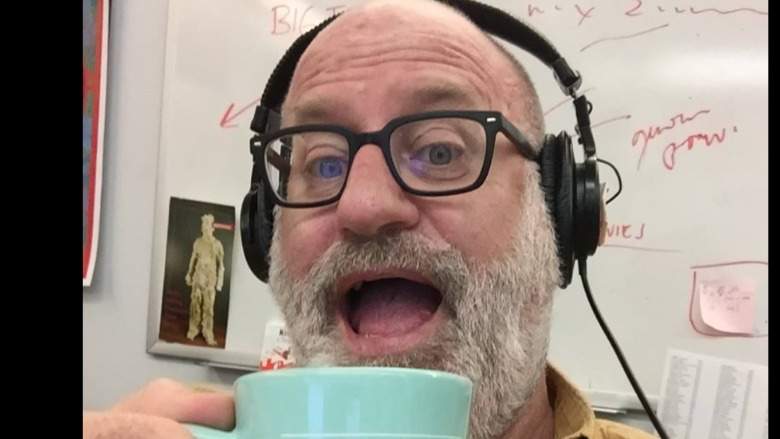
Matt Holzman died yesterday at the age of 56, after battling cancer.
You may not have known Matt personally, but if you ever listened to KCRW, you knew his voice. Whether it was his insightful show “The Business,” discussing all things Hollywood, or his film club “Matt’s Movies” or “that guy who gave away prizes” during KCRW’s fundraising drives, Matt was one of KCRW’s signature voices. He was a fantastic storyteller. And he was a mensch.
Matt was also my friend. I had the pleasure of being introduced to Matt several years ago, having him attend one of my birthday parties, and going sailing with him. Boy, did Matt love to sail. In fact, Matt loved any and all adventures. His love of said adventure, some might say, bordered on recklessness. Matt lived in the fast lane. And I understand why.
That’s because Matt and I were also bonded over the fact that we both suffer from the same illness: Polycystic Kidney Disease (PKD) — a progressive, genetic illness that produces thousands of cysts on your kidneys, to the point where they eventually shut down. To date, there is no cure for PKD and all patients will ultimately require dialysis and hopefully a transplant in order to survive. Matt received his new kidney from a cadaver donor in 1996.
As KCRW’s President Jennifer Ferro wrote in her tribute to him: “There were two eras of Matt: Dialysis Matt and donor-kidney Matt. The donor kidney gave Matt the vigor you always knew was in him. To see him not sick was truly joyful. He grabbed life and lived it — even traveling to Ghana and India soon after his transplant when many on immunosuppressant drugs wouldn’t dream of it.”
Matt’s rollicking story of that crazy day when he got the call that a donor kidney had come through for him is an epic piece and you should read it or listen to it here.
Despite the fact that it had been almost two decades since his transplant, when I was back in the hospital with my umpteenth kidney infection (a particular joy that goes with this disease), Matt sent me the following email:
Subject: Hey lady Heard you are laid up and you KNOW I feel your pain! Let me know if there’s anything I can do or if you just want to talk.
We had long chats about all kinds of things including my nephrologist, whom I adore and who has kept me alive and off dialysis so far, although a transplant will very much have to be part of my not-so-distant future. This is a disease that my father and his father had; and that both my siblings have (although they have received transplants now). So it was no surprise that Matt was deeply concerned about his own sister who had also inherited this disease. Which is why he sent me this email:
So I told my sister you had a doctor who was going to keep her off dialysis and she said she would pay you $1,000 for the name!
No matter what, Matt never lost his sense of humor. Or his humility, or his love of life and people. I believe that Matt’s joie de vivre shone through in his mellifluous voice on the radio. And I know he touched millions of people’s lives.
No matter what, Matt never lost his sense of humor. Or his humility, or his love of life and people.
I don’t know how I’m going to feel when KCRW’s next fundraising drive comes round and he isn’t there to demand that we all send in our money and send it in now.
I once said to Matt, “I don’t understand. I donate every year and you never choose me to win a car, or a new Macbook or a trip to Belize.” And he said, “That’s because you don’t send the money directly to me.”
Now, I’ll never have that opportunity.
I will miss you terribly, Matt. It seems so cruel that you beat PKD, only to be taken down by cancer while you were still in your prime. If there’s anything I’ve learned from you, it’s that you chose to grab life with both hands and live out loud with passion and love and intensity. It was an honor to have known you.








_htm_692d521f30ed5d87.jpg)