fbpx

April 8, 2020

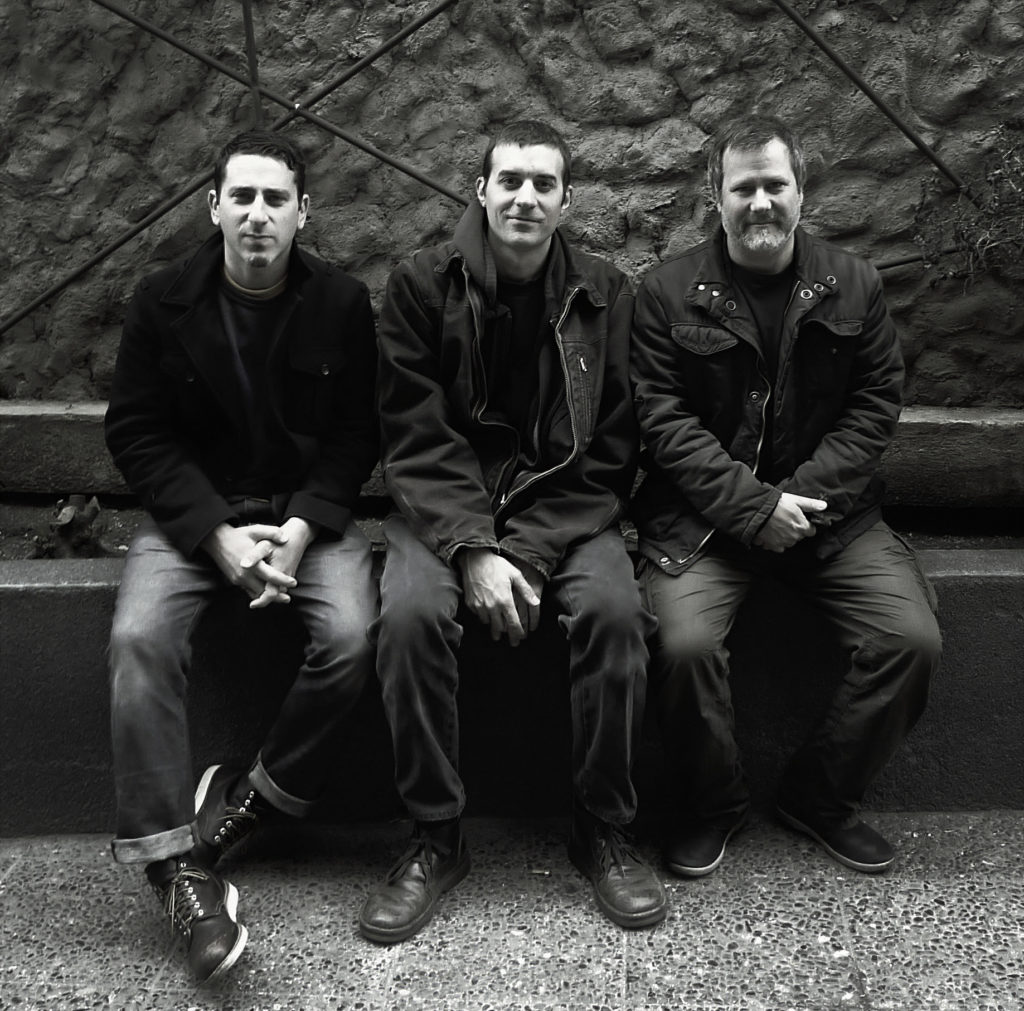
Bill Gould on Faith No More’s Jewish Roots and New ‘Talking Book II’ Album

As a co-founder of legendary band Faith No More, Bill Gould first found international success when the 1987 single “We Care A Lot” took off. Faith No More would go on to mainstream success just a few years later when 1989’s “The Real Thing” took off and the group became an MTV staple. Notably, Faith No More – which also includes singer Mike Patton, guitarist Jon Hudson, drummer Mike Bordin and keyboardist Roddy Bottum – was handpicked to open for Metallica and Guns N’ Roses on their co-headlining stadium tour in the early 1990s.

Faith No More would eventually go on hiatus in 1998, remaining broken up until 2009. Bill Gould never slowed down, even during Faith No More’s years off, not only playing with other artists (including Fear Factory and The Dead Kennedys’ Jello Biafra) but also starting the Koolarrow Records label.

While speaking with Gould on March 31 about the forthcoming Koolarrow release of “Talking Book II” – as also featuring Gigante Sound co-founders Jared Blum (Vulcanus 68, Vision Heat) and Dominic Cramp (Borful Tang, Lord Tang) – we were also discussing Yebiga, Gould’s own label of rakija. I had asked Gould whether he was of Serbian descent, since he was producing Yebiga through a Serbian family. This led to a brief and organic discussion of Faith No More’s connection to Judaism:

“I found out that my family roots go from that area, my father’s side. I have a Jewish background, but it got erased in World War II. We found out that some of the village where my family came from was sort of close to the Serbian border.”

I then asked if any other members of Faith No More had Jewish roots, and the answer was affirmative:

“Yeah, the drummer [Mike Bordin]. I believe he’s Russian and Ukranian.”

Jewish hard rock fans ought can further rejoice in the coolness that Mike Bordin was not only a key member of Faith No More, but also a long-time drummer for Ozzy Osbourne and prior contribution to recordings and/or live appearance for Korn, Primus and Alice In Chains’ Jerry Cantrell.

Any way you slice it, Bill Gould is still at it with a variety of great projects – including “Talking Book II” – and he and his Faith No More tour are slated to be out on the road on a co-headlining tour with Korn and special guests Helmet and Scars On Broadway this summer.


More on Bill Gould can be found here and here.

Bill Gould on Faith No More’s Jewish Roots and New ‘Talking Book II’ Album Read More »

Grandson of Yitzhak Rabin Wishes Coronavirus on Benjamin Netanyahu, Then Apologizes

JERUSALEM (JTA) — The grandson of assassinated prime minister Yitzhak Rabin wished in a tweet that Benjamin Netanyahu would contract the coronavirus before apologizing.

“I don’t wish for anyone to get sick with coronavirus, including Netanyahu. Apologies for that,” Yonatan Ben Artzi tweeted Tuesday night.

He deleted his original tweet, posted close to 5 p.m. Tuesday, though it was saved by his critics in screenshots.

“If Netanyahu lied to the Israeli nation and in fact only pulled a trick by saying ‘we need an emergency unity coronavirus government’ and actually meaning elections, then he deserves [to catch] coronavirus and live out the rest of his days sick in prison,” the tweet said. He also called it “karma.”

Ben Artzi frequently tweets criticism of Netanyahu, whose trial on corruption charges has been delayed due to the pandemic. He was referring to the stalled talks between Netanyahu and Benny Gantz to form an emergency unity government to deal with the coronavirus crisis.

The Likud party in a tweet slammed Ben Artzi.

“Even when the prime minister is saving the lives of Israeli citizens, the hate knows no limit,” Likud wrote. “Do you think anyone will open an investigation against him?”

The family of Yitzhak Rabin, and Israel’s left, have blamed Netanyahu for incitement that led to Rabin’s 1995 murder during a peace rally in Tel Aviv by a right-wing assassin.

Grandson of Yitzhak Rabin Wishes Coronavirus on Benjamin Netanyahu, Then Apologizes Read More »

The Bagel Report

Let My Bagels Go

The only bagel-related thing you should be consuming this Passover is…new and classic episodes of The Bagel Report! Erin and Esther reflect on the meaning of Passover and review essential Passover classics like “The Prince of Egypt,” “Rugrats,” “Ten Commandments” and “The Wizard of Oz” (Esther has her reasons). Plus, Esther’s bad impressions of a Family Feud buzzer, Jeff Goldblum and Yul Brenner; Angel of Death Dementors; and why all of us simultaneously are and are not Elijah the prophet this year. Wishing you all a meaningful Passover. 
let my babies go rugrats passover
Follow ErinEsther and The Bagel Report on Twitter! 

Let My Bagels Go Read More »

What I Learned After Unlocking My Papa’s History

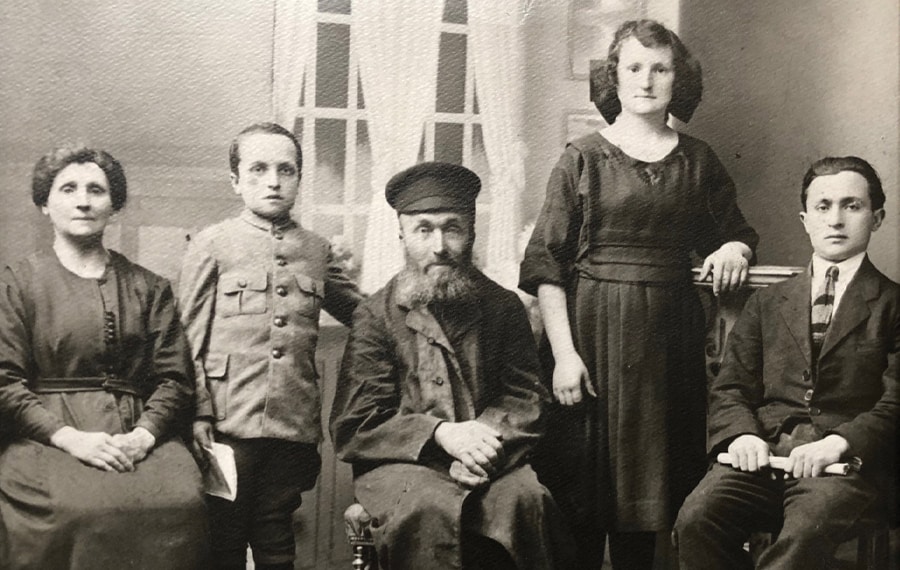
On Friday nights, I’d watch Papa Cohen stand at the head of the table in his finest suit, reciting the Kiddush in his Polish-accented Hebrew. I treasure this memory of his European refinement, his religious devotion, and the deep love he felt for his family, a love that was difficult for him to express in words.

Born Dov Ber Konopioty in Sokoly, Poland, in 1900, my maternal grandfather was renamed Bernard Cohen at Ellis Island in 1922. For the rest of his life, he had to explain he was not, in fact, a Kohen. Nor was he that other Rabbi Bernard Cohen in Los Angeles, the one with the middle initial “M,” a Reform rabbi who officiated at mixed marriages.

During a career that spanned 50 years, Papa served Conservative shuls from the East Coast to the West, including the first Conservative synagogue in Las Vegas in the mid-1950s. Worried about rampant assimilation, Papa tirelessly worked on behalf of afterschool Jewish education, and became the founding executive director of the L.A. Bureau of Jewish Education. He wrote prolifically for the Jewish press about Jewish history in the United States, the life and times of notable Jewish writers, issues in Jewish education and more.

Papa was always on the go, attending meetings, sitting as a judge in the Conservative beis din, teaching, speaking and writing. When he sat down for tea and cake Nana served him, he either was reading the Yiddish Forverts or a tome of Talmud.

Papa never told us stories about his life, but when I interviewed him for a high school biography project, he was thrilled to talk. I was fascinated to learn about his narrow escape from the Polish army, when he bartered his freedom for a book of Polish poetry a senior officer wanted. It was heartrending to hear him speak about his parents, who never left Poland and were killed by the Nazis, along with so many others in his family.

My guilt at letting Papa’s papers sit for so long was assuaged when I discovered that much of what remained had archival value, such as shul bulletins from 50 to 70 years ago that spoke to the history of those communities.

When Papa died at age 82, he left behind a legacy of professional achievement. He also left behind a huge and disorganized inventory of books, personal papers, mementos, cassette tapes of his sermons, shul bulletins from the congregations he served, and tiny date books going back decades.

The cache was so daunting that only last year did I finally, with great guilt, roll up my sleeves and sort through the dusty piles. I felt like an archeologist, sifting for the backstory of my grandfather’s life. He left pieces of his heart in surprising places, such as the tiny date books he used to jot down appointments.

In 1977, when my Nana, his wife of 50 years, was dying of cancer, he wrote, “My poor Ethel is suffering. It is terrible to see her in such pain.” On a separate slip of paper, he wrote Nana’s instructions to him about paying the mortgage and where she kept the bank statements.

I knew my grandparents had met at a Zionist convention in Pittsburgh in 1926, but not until I saw a sepia-toned group photo of the 150 well-dressed young Jews in attendance did I see Papa standing in the top row on the far right, while Nana sat several rows below and to the left, with another man’s arm around her shoulder. I cheered Papa’s triumph over the other suitor.

These puzzle pieces helped me see my grandfather as a man I never really knew, beyond the rabbi working so hard to build Jewish life in a secularized American culture. Reading through some of his articles, I appreciated so much more his skillful, sophisticated prose, especially since he didn’t learn English until early adulthood. I felt for him keenly as I read letters he sent, beseeching boards of directors to raise his inadequate shul or teaching salaries. How humiliating that must have been for such a dignified man.

My guilt at letting Papa’s papers sit for so long was assuaged when I discovered that much of what remained had archival value, such as shul bulletins from 50 to 70 years ago that spoke to the history of those communities. A librarian who curates materials on the history of Jewish Las Vegas at the University of Las Vegas was thrilled to receive my package of Papa’s papers, which also included conversion documents Papa had signed and the front-page newspaper story about Elizabeth Taylor’s marriage to Eddie Fisher that mentioned Papa’s name (spelled incorrectly) as the officiating rabbi. Nestled among one pile of papers was a slim, brochure-format text of a radio address by an American rabbi in 1933, warning of the coming Nazi menace, with Papa’s notes written in the back. This rare document soon will become part of the United States Holocaust Museum’s collection.

Five years after Nana died, Papa found love again. For three years, he carried on an intense, long-distance romance with Sarah, a Florida widow. Sarah’s letters to Papa, as well as her poems dedicated to him, filled an entire box. Like a nervous young suitor, Papa wrote notes to himself in preparation for an important phone call.

Discovering this youthful, romantic spirit in bloom in my 80-year-old Papa touched me more deeply than almost anything else. When he flew to Florida to propose, Sarah could not bring herself to leave her family. I cried when I saw a duplicate of a romantic greeting card he had sent to her, writing on it, “the last card I sent to Sarah.”

Nearly 40 years after he passed away, I got to know my grandfather more deeply, more holistically. His intellectual and professional achievements already were known, but the work behind it all and the deepest feelings that were in his heart were everywhere in those boxes.

Papa openly had fretted about the loss of Jewish continuity not only communally, but in his own family, where most of his grandchildren were indifferent to Judaism. But his efforts were rewarded. Papa and Nana have many descendants who are fully shomer Shabbat and who study Torah in a way that must give him nachas up in heaven. No sincere efforts on behalf of Judaism are ever wasted.

Last Yom Kippur, I felt Papa’s spirit with me in shul. It was a strong, palpable and energizing feeling, one I had never experienced before. My grown children had also begun to feel a kinship with Papa through the discoveries I shared with them. And last November, very close to Papa’s birthday, his fifth great-great-grandchild was born, a little boy who carries his name: Dov Ber.


Judy Gruen’s latest book is “The Skeptic and the Rabbi: Falling in Love With Faith.

What I Learned After Unlocking My Papa’s History Read More »

Bernie Sanders Suspends His Presidential Campaign

Bernie Sanders, the Vermont senator who became the first Jewish front-runner in a major party nomination race for president, is suspending his campaign.

The campaign told followers on Wednesday to tune in for a “special message” at 11:45 a.m. Eastern time. The media said Sanders was suspending his campaign, paving the way for Joe Biden, a former vice president and senator, to be the Democratic nominee.

For a period early in the primaries, Sanders led a field that had been whittled down to about half a dozen candidates. Biden overtook Sanders on Super Tuesday, March 3, when 14 states voted, and Sanders has not been able to make up the difference.

An early April departure is a marked change from 2016, when Sanders did not suspend until well into the summer, although Hillary Clinton was the clear front-runner. Sanders made history that election by becoming the first Jewish candidate to win major-party nominating contests.

Former Vice President Joe Biden (L) listens as Sen. Bernie Sanders (I-VT) speaks during the Democratic Presidential Debate at Tyler Perry Studios in Atlanta, Georgia on November 20 2019. (Alex Wong/Getty Images)

Sanders and Biden are closer than Sanders was with Clinton and have spoken often during the campaign. Additionally, Sanders in 2016, like many other Democrats, was operating under the assumption that Donald Trump, the Republican nominee, could not win. This time, however, there is greater pressure on Democrats to get their act together early to defeat Trump in November.

Sanders ran an aggressive Jewish campaign this time, blasting videos with Jewish messages over social media. Notably the messages were aimed not only at Jewish voters, but at others who might have been attracted to Sanders’ message of a more inclusive polity.

Sanders also likely wants to coordinate with Biden in advancing health care reform and greater economic parity at a time when the coronavirus is afflicting hundreds of thousands of Americans and has upended the economy.

Bernie Sanders Suspends His Presidential Campaign Read More »

Table for Five: Special Shabbat of Passover

One verse, five voices. Edited by Salvador Litvak, the Accidental Talmudist

And Moses hastened, bowed his head to the ground and prostrated himself, and said: “If I have now found favor in Your eyes, O Lord, let the Lord go now in our midst [even] if they are a stiff-necked people, and You shall forgive our iniquity and our sin and thus secure us as Your possession.” –Exodus. 34:8-9

Rabbi Elchanan Shoff
Beis Knesses of Los Angeles (BKLA)

“One may think that stiff-necked is a negative thing. Not at all. Stiff-necked is a great characteristic! Consider the Jewish attitude throughout history: ‘Either I will remain a Jew or I will be killed!’ ” So teaches the midrash (Shemos Rabbbah 42:9): Jews exist thanks to our stubbornness. The world is soaked in the blood of Jews who simply refused to let go of their Jewish identities. What holy stubbornness.

The saintly Rebbe of Kotzk was looking for a new city in which to settle. One town was friendlier than the next, inviting the holy man and his followers to settle there. Until he came to Kotzk. “No filthy Chassidim here,” they cried. He was pelted with stones. His followers were astonished when he announced immediately, “We will settle here!” He explained, “This is the first city we’ve visited where the people aren’t apathetic. If I can convince them to see things my way, these will be great people.” Apathy is the worst possible trait. Judaism cannot survive apathy. “Torah scholars who study together generally enter as enemies, because they do not accept one another’s positions, but they leave as beloved friends” (Rashi on Kiddushin 30b). Passion and stubborn commitment keep the Torah alive and bring peace to the world.

“Torah scholars increase peace in the world!” (Talmud, Brachos 64a) When we truly care and are fiercely stiff necked, then God sees us proudly as His stiff-necked people. We may be difficult at first, but may we never be apathetic.

Kylie Ora Lobell
Contributing writer, Jewish Journal

“A stiff-necked people.” It’s both a blessing and a curse. In parts of Exodus, it’s a curse: Some of the Jewish people collect more manna than they’re supposed to, while others complain that they want to go back to mitzrayim.

Worst of all, they create the Golden Calf. On the other hand, throughout our history, our stubbornness has been a blessing. In a Chabad.org story, Rabbi Jonathan Sacks quotes Rabbi Yitzchak Nissenbaum, who died in the Warsaw Ghetto and praised the Jewish people for being stiff-necked: “This is a people awesome in its obstinacy — and though now it is their failing, there will be times far into the future when it will be their noblest strength.” Nissenbaum was talking about the Jews in Exodus vs. his generation, who fought for their faith even in the darkest of times. Today, as we battle this terrifying pandemic, we again have to put our stubbornness to good use. We have to refuse to fall victim to scary headlines, and keep our unproductive anxiety in check with daily prayer. We must not worry about what our parnassah will be tomorrow, but instead give 10% of what we have to those in need now.

We need to continue celebrating Judaism, because our homes can be as holy as our synagogues. And we have to have an unwavering commitment to HaShem. We will get through this, no doubt, but the outcome depends on us. Keep your necks stiff; it’s the key to saving lives.

Rabbi Chaim Singer-Frankes,
Interfaith chaplain, Kaiser Panorama City

Chizkuni, a 13th-century Torah sage, observes that in the prior chapter of Exodus, God relents regarding honoring the sacred covenant despite Israel’s stiff-necked character. In our pasuk, he understands Moshe’s justification thusly: “Is there any better way to rein in the evil urge than the very presence of God?”

Moshe’s appeal acknowledges the ingrained flaws of the People and insinuates that this Holy relationship must be managed through God’s ever-steering presence, despite our rascal behaviors. In other words, Moshe is praying: “God, we need your constant presence, and for the long haul.”

Moshe himself was an earthly stand-in for God’s loving closeness among the people. In this long haul, the closeness of friends, sages, and family are highly prized and treasured. You don’t know what you’ve got until you lose it. So many from our circles are available only through virtual means, and those are paltry substitutions for human touch. We feel pangs of loneliness, missing the warmth of a hug, the holding of a hand. And yet curiously, such distancing consummates the ultimate decree: to preserve life. In a time when we all need constant reminders to perform the ultimate mitzvah of pikuach nefesh (saving a life), let us also remember that God has endowed us with outstanding faculties of knowledge and science to better fulfill this mitzvah.

And in so doing, God remains manifestly present among us, sanctifying our minds and hearts to enliven each generation … and may it be into the future.

Rabbi Rebecca Schatz
Assistant rabbi, Temple Beth Am

We often approach Passover questioning, “What enslaves me today?” The responses range from homework to unhealthy relationships. A common response is “my email” or “my phone.” This year, that which we were slaves to is making us free. In the recent past, our country has experienced life behind a screen —  distancing ourselves; rushing toward purposeful responses; adapting to new norms, devoting ourselves to protecting and healing one another. Following God’s exaltation of the most profound Divine attributes, Moshe hurries to bow down toward the ground and prostrate himself: va’maher Moshe va’yikod artza va’yishtahu.

Why “hurriedly,” maher? And why va’yikod and va’yishtahu, two expressions of obsequiousness — bow and prostrate? The Rashbam comments that as soon as Moshe feared God’s departure, he hurried to show reverence and supplication to the Divine partner. The shoresh (root) for va’yikod is to dubiously bow, to follow one’s leadership in hesitation and yet va’yishtahu, is to prostrate in worship. Read with trope, the verse might say: “And Moshe hurried. And he hesitated to follow bowing toward the ground. And he prostrated in worship.” Moshe was quick to assume what he needed, what the people wanted and the relationship with God. Pesach 2020 sees us forced toward rapid determination, and carefully considered resolute action.

Be careful and be quick, mindful and expansive. Join Zoom minyanim, virtual classes and make video calls to dear ones. May this be a Pesach when we rush to feel close to those we love, reevaluating that which we are enslaved to and finding new freedom!

Rabbi David Block
Associate Head of School, Shalhevet High School

With the fullest respect for the editors, I challenge the translation. The Hebrew does not quite say that God should forgive Israel “even though they are stiff-necked”; it says “ki” — because they are stiff-necked. But how can that be? Would not their stubbornness be reason not to forgive them? So I understand the translator’s choice, which is aligned with those of the Chizkuni and Ibn Ezra. And yet, like the Ramban, I believe we should read “ki” as “because.”

How? When Israel became God’s people, they were charged with the elusive mission to educate the world in God’s values. That task can be painfully difficult. People can be stubborn; they don’t want to hear their flaws and be told how they must improve. B’nei Yisrael needed to be taught how to be teachers. Moshe said to God: “You know why Israel needs Your forgiveness? Because they are stubborn. Stubbornness, unlike apathy, means they care deeply, but they don’t always see a fullness of perspective. They need You — the Master Educator — to guide them. To give them opportunities even after mistakes. God, you just charged them to become educators. Teach them how. Lead by example.”

Our new online learning environment is a blessing, but also comes with unique challenges for students. Perhaps we can learn a lesson about generosity and transition from God Godself. In the words of Rabbi Samson Raphael Hirsch, God teaches us to: “forgive them again and again … every pardon presupposes a step toward  betterment.” That’s education.

Table for Five: Special Shabbat of Passover Read More »

My Religion Pivoted To Zoom. Will My Faith, Too?

The coronavirus pandemic has been terrible — an overnight realization of the worst-case scenario, truly — for people who hate videoconferencing. People like me.

I’m no misanthrope. On the contrary: I love people. I love listening to people and I love talking to people, if not always in that order. I love seeing their faces. If that doesn’t come through twice a month in this column, I have failed.

But videoconferences always have been a bridge too far. You couldn’t pay me to FaceTime for longer than 10 minutes. Skyping with family has felt like an unbearable chore. Between flimsy reception, rampant distractions on both ends, background noise and the need to keep your eyes trained on a small screen the whole time, video chats are exhausting in a way no other communication format is. Give me texting, phone calls, even thank-you note writing, but don’t email me a 10-digit conference code. I won’t be drawn into your panopticon.

 Much to my chagrin, my religion — in addition to my peer group, my professional network and my podcast — has pivoted to Zoom.

Much to my chagrin, my religion — in addition to my peer group, my professional network and my podcast — has pivoted to Zoom. Three times a day, six times a week, my shul convenes on Zoom for minyan-less minyan. Our social hours and shiurim are on Zoom as well. I’m living by myself away from my apartment and away from my parents (quarantining as a precaution; I’m healthy, as far as I know). That means Shabbat meals, too, have been on Zoom.

Actually, just one Shabbat meal. The first Friday night after I started sheltering in place — three weeks ago? four weeks ago? I’ve lost track — I had my sister over for Shabbat dinner. We Zoomed my parents, who were hosting my other sister, but in the time it took for everyone to get set up, our food got cold. Instead of a pleasant conversation with my sister, the two of us were going back and forth with a screen, repeating ourselves when the connection wavered, letting the other side do the work. I checked out mentally and waited for it all to end. By the time we got to “A Song of Ascents,” I had descended into near-madness.

We didn’t reprise our experiment the following week. Instead, my sister and I walked over to my parents’ after dinner and stood on the sidewalk. We did our catching up in the dark.

I suspect many Jews have been feeling out the new normal, even as they fight it off. I’m now preparing myself mentally for a Zoom Four Cups, a Zoom afikomen hunt, a Zoom “Chad Gadya.” On seder night I’ll be sitting alone at my grandma’s table; it’s a small comfort that I won’t be by myself. Behold the Zoom dichotomy: On one hand, it’s a portal to family on a night when we are all but commanded to celebrate communally; on the other, its limitations as a medium partly reinforce our feeling of isolation.

On one hand, Zoom is a portal to family on a night when we are all but commanded to celebrate communally; on the other, its limitations as a medium partly reinforce our feeling of isolation.

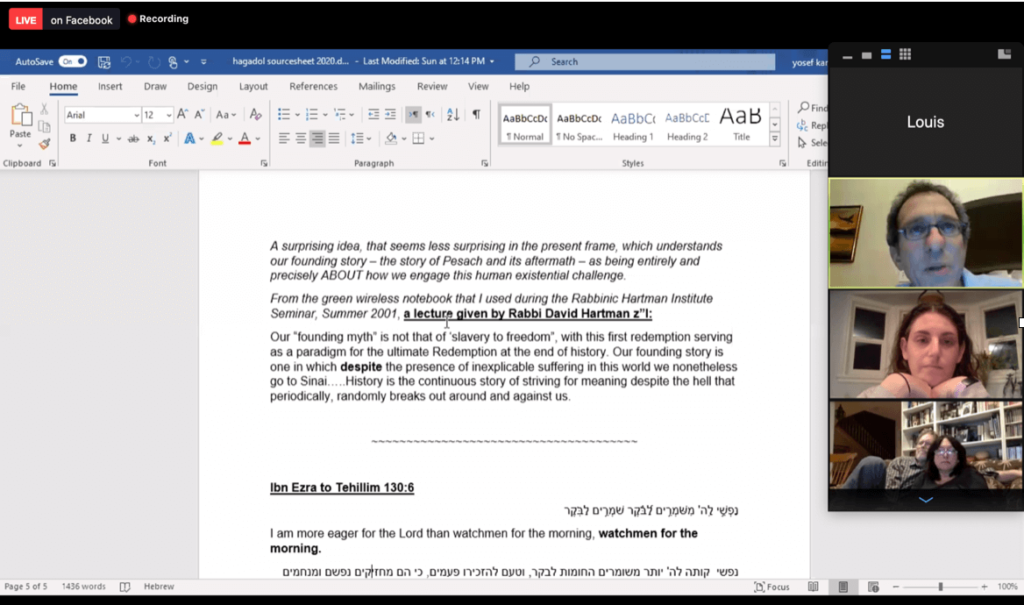
It took a Zoom Shabbat ha-Gadol drasha for me to begin warming to the upsides of the Zoom religious experience. The Shabbat ha-Gadol lecture is one of the highlights of the calendar in Orthodox communities, and at my shul it draws a greater turnout than any other Saturday afternoon event. This year, the talk couldn’t be on Shabbat for obvious reasons, so it was on Zoom on Sunday evening. Within a few minutes, the video conference had filled its 100-person capacity and everyone else spilled over to watch it on Facebook Live.

I have to admit, my attention span was no better for the Zoom drasha than it had been for the Zoom Shabbat dinner. I found myself looking at all the boxes closely to see all the fixtures and fringe-friends of the shul I had grown up in. I had not seen them for a while, and it was moving to reunite with them, even without a formal greeting. Old and young, male and female, seeing the breadth of the community intact was reassuring. But also, below each face was a name, and for the first time, Zoom enabled me to match them — people I never knew I never knew.

How does God want us to cope with COVID-19, to observe religion in the age of Zoom? Maybe God wants us to be struggling with this sudden tumult, wants us to be tortured with halachic issues that cut to our moral and spiritual core. This is how we communicate with God when the reception is fuzzy, when we are facing rampant distractions, when the background noise is deafening — when it feels like our Savior is on the other end of a Zoom. We keep our eyes trained on what matters most, for as long as we can.


Louis Keene is a writer living in Los Angeles. He’s on Twitter at @thislouis.

My Religion Pivoted To Zoom. Will My Faith, Too? Read More »

Viral Musings: Dealing with ‘Cabin Fever’ in the Days of COVID-19

Pretty much nothing really prepared us for the current statewide “Shelter-in-place” orders issued by Gov. Newsom in light the COVID-19 pandemic. Not to mention the complete shutdown of employment for those not deemed “essential “as outlined in the order.

Most of my work involves flying internationally – averaging 100,000 miles annually – with some domestic travel thrown in for good measure when the need arises and when I can’t bear the idea of back-to-back long-haul flights. With COVID-19 all of that and more abruptly changed.

Every project of mine was summarily halted and international flights have drastically diminished. It remains to be seen how the travel industry does or does not bounce back after COVID-19 finally becomes a distant memory. In the meantime, we need to deal with the present lockdown.

As empty-nesters, my now working-at-home husband and I at least don’t have to also learn how to homeschool our brood of four while trying to keep our sanity and our respective workloads afloat. For those of you that do have young kids at home, I wish you the patience of Job and a steady supply of good wine.

Here is a short list that may help in keeping cabin fever at bay while we endure these unusual times:

Keep a schedule

The answer to chaos is routine. So now perhaps more than ever, it is absolutely key to maintain a schedule. That includes wake-up times, bedtimes and mealtimes.

While it is enticing to stay in pajamas all day, don’t. There is no such thing as day pajamas and this is isn’t a long-term slumber party.

Get dressed and put on some lipstick. To the men out there, those sweatpants from Harvard with more holes than Swiss cheese are not actual clothes. Additionally, face shaving is important, not just because you look better but also if you need to venture out and don a face mask, experts report they are only effective on shaved faces.

Engage your inner Marie Kondo

This is perhaps the ultimate time to take Marie Kondo’s advice to heart. Kondo, the Japanese organizational Goddess, also known as Konmari, has sold millions of books in an effort to help the rest of us mere mortals declutter our lives.

The rules are pretty simple:

  • Commit to tidying up. Check.
  • Imagine your ideal lifestyle – which for me does not include a pandemic inducing lockdown.
  • Finish discarding first. Check.
  • Tidy up by category, not location – I found this the most difficult as I categorically don’t care about categories.
  • Follow the right order – this I disagree with; for me the right order is whatever works to get the unwanted, unneeded item out, period.
  • When determining if something should stay or go, ask if it sparks joy. This too I found difficult because having seven Phillips screwdrivers in various locations around the house might not spark joy say, on a daily basis, but when needed and I find one nearby it downright fills me with rapture!

Something else to keep in mind as you declutter since most charitable organizations that accept donations are closed, you will need to make some space in the corner of your garage or house. This may naturally set off another round of Kondo-ing.

Complete old projects or start new ones

Being cooped up is also the perfect time to organize photo albums or digital libraries. It’s also a good time to consider writing memoirs or old-fashioned letters to loved ones. I recently advised a frazzled mom to have her teenage kids write letters to their 40-year-old selves, then save them for later. That activity was a big hit.

Gardening is another good option which of course offers the added benefit of being outside. Or if apartment living, then spruce up your balcony, patio or windowsill.

Get some exercise 

Exercise is important always, but now perhaps more than ever. Even though gyms are closed, there is plenty you can still do.

If working from a stand-up desk, you can do deep-knee bends, pliés and side stretches. You’ll want to make sure your computer’s camera is blocked with a post-it in case a web conference call comes through and you unthinkingly click. From a regular desk, you can engage in the same kinds of seated exercises like those undertaken on long-haul flights, such as upper body twists, exaggerated neck rolls and calf stretches.

When you’re done working, many gyms and dance studios have started offering live stream classes that use the free Zoom video conferencing app. While not as motivating as being in a room full of kick boxers or ballet dancers, it is absolutely better than sitting around simultaneously eating extra crunchy Cheetos and peanut M&Ms. Trust me as I have vigorously done both.

The easiest of course is to simply take a walk or go for a run while of course maintaining requisite social distancing. Long walks naturally kill two birds with one stone if Fido or Fluffy are joiners.

Cook or bake something new

We all have to eat, so sheltering-in-place provides the opportunity to try new recipes that can often be accomplished with readily available pantry and freezer items.

If you are sheltering with others, this can be a way to try a new activity together. Spouses or roommates that possess consistent pyrotechnic kitchen skills – and you know you are – should be strongly advised to undertake dishwashing or clean-up duties.

This is also a good time to try your hand at baking Granny’s famous chocolate cake or making something delicious like scones requiring only a few ingredients.

Play board games, pick up a new hobby or take an online class

Old fashioned board games are good for an hour or two of entertainment in my house, but that may be because my husband has a tendency to play fast and loose with the rules. I’m a big fan of Scrabble, though yawn at most other board games that my husband can play for hours.

If you happen to have a guitar lying about and want to learn how to play it, Fender is offering three months of free online guitar classes for the first 100,000 subscribers.

If strings don’t float your boat, you can sign up for Yale University’s popular “Science of well-being” class available on Coursera. It is free to audit the class and $49 if want to take the exams and earn a completion certificate.

Do something for others

One neighbor started grocery shopping for elderly neighbors. This became especially important once the run commenced on everything from toilet paper to rice. Since I can only barely tolerate grocery stores in the non-pandemic era, this wasn’t going to be an option for me.

Instead I put an ad up on Nextdoor.com offering to walk or run with neighborhood dogs at no charge. This has been truly a win-win. I get more exercise and am able to help some lovely neighbors who really needed a hand.

Don’t forget down time

Even though you are sheltering-in-place and not dealing with rush hour traffic or a crowded commuter train, these are very stressful times. So finding ways to relax becomes very important.

Binge watching on Netflix is a good relaxation technique though you may wish to skip Steven Soderbergh’s “Contagion.” Better yet, reading a good old-fashioned book may provide an even greater escape.

Newport Beach’s Marjorie L. Rand, PhD, LFMT, suggests that this is a “perfect time to learn meditation” and there are apps for newbies such as Calm and Headspace.

In addition to engaging in something creative, like drawing, painting, singing or dancing, Dr. Rand also suggests keeping two journals, one to record how you think and feel during these unprecedented times and another for your dreams. These activities she believes “will yield information from your current experiences and unconscious fears from your dreams” that may allow you to ultimately integrate them.

One day at a time

While none of this will be easy or fun and life as we know it will certainly not be normal for quite some time, we must remain optimistic and hopeful.

Dr. Rand also recommends “staying present” as [g]oing into the future will make you anxious and thinking about the past will make you depressed.”

Dr. Angelo Pan, an infectious disease specialist at northern Italy’s hard-hit Cremona Hospital in Lombardy says, “If you are not involved in the hospital war that is healthcare now, stay home and think about life.”

It is probably also a good idea to keep in mind that like everything else in life, both the good and the bad, this too shall one day pass.


Julie L. Kessler is a journalist, attorney and legal columnist based in Los Angeles and the author of the award-winning travel memoir “Fifty-Fifty: The Clarity of Hindsight.” She can be reached at Julie@VagabondLawyer.com

Viral Musings: Dealing with ‘Cabin Fever’ in the Days of COVID-19 Read More »

Bowing of Daffodils Around the Bridal Path

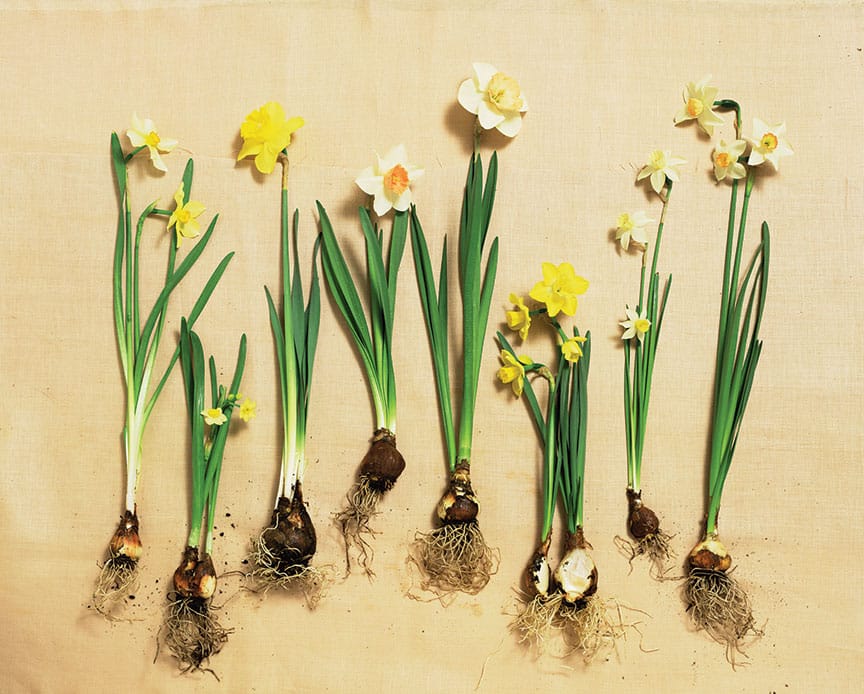
The daffodils are bowing their heads on this gray afternoon

In unison.

Perhaps they are ashamed
To be witness to a plague.

Corona may not be a direct threat to them
Yet they bear witness.

They are audience to ambulances singing their chorus in a minor key incessantly.

Perhaps the daffodils are lost in thought,
Heads bowed
Wondering why the hordes of bikers and runners
In Central Park have disappeared.

And why the birdsong is so shrill and audible.

All the people masked, social distancing.

Very few talking into the air
On cellphones in pockets, ear buds in place;
The cellphone litany was once offensive.

And yet now that it has been erased
I sorely miss that “noise.”

No doubt the daffodils by the reservoir
Feel the same.

Some silences are lovely.
Others deafening.

The yellow of the daffodils is fading fast.

Just yesterday they were upright and vivid in hue.

Today, their posture bowed. They appear pale.

It may be simply science unleashed.

Gravitropism overriding phototropism
On a day that the sun forgot to shine.

Or perhaps the daffodils bowed are a congregation praying.

Praying people will soon return to the lives they once knew
Before the pandemic.

Forever changed.
And yet return nonetheless.


Karin Charnoff-Katz is a physician at New York Presbyterian/Weill Cornell Medical Center in New York City.

Bowing of Daffodils Around the Bridal Path Read More »