(JTA) — Germany has seen an increase of anti-Semitism along with the rise in coronavirus cases, the country’s anti-Semitism commissioner said.
“There are direct links between the current spread of the coronavirus and that of anti-Semitism,” Felix Klein said Tuesday in Berlin, the AFP news agency reported. “In recent weeks, right-wing radicals have increasingly tried to leverage the coronavirus crisis for their own ends.”
Klein described one current pandemic conspiracy theory which states that the coronavirus is a failed bioweapon set loose by the Mossad, Israel’s secret service.
He was in the German capital for the launch of a government research project involving several German universities to better understand the causes and manifestations of anti-Semitism.
Mimouna is the joyous Moroccan celebration of springtime, friends, family and good fortune. Marking the end of Passover and the beginning of the agricultural season, the doors of people’s homes are thrown wide open and everyone is greeted with the Judeo-Arabic blessing “Tirbah u’tissad,” may you prosper and succeed.
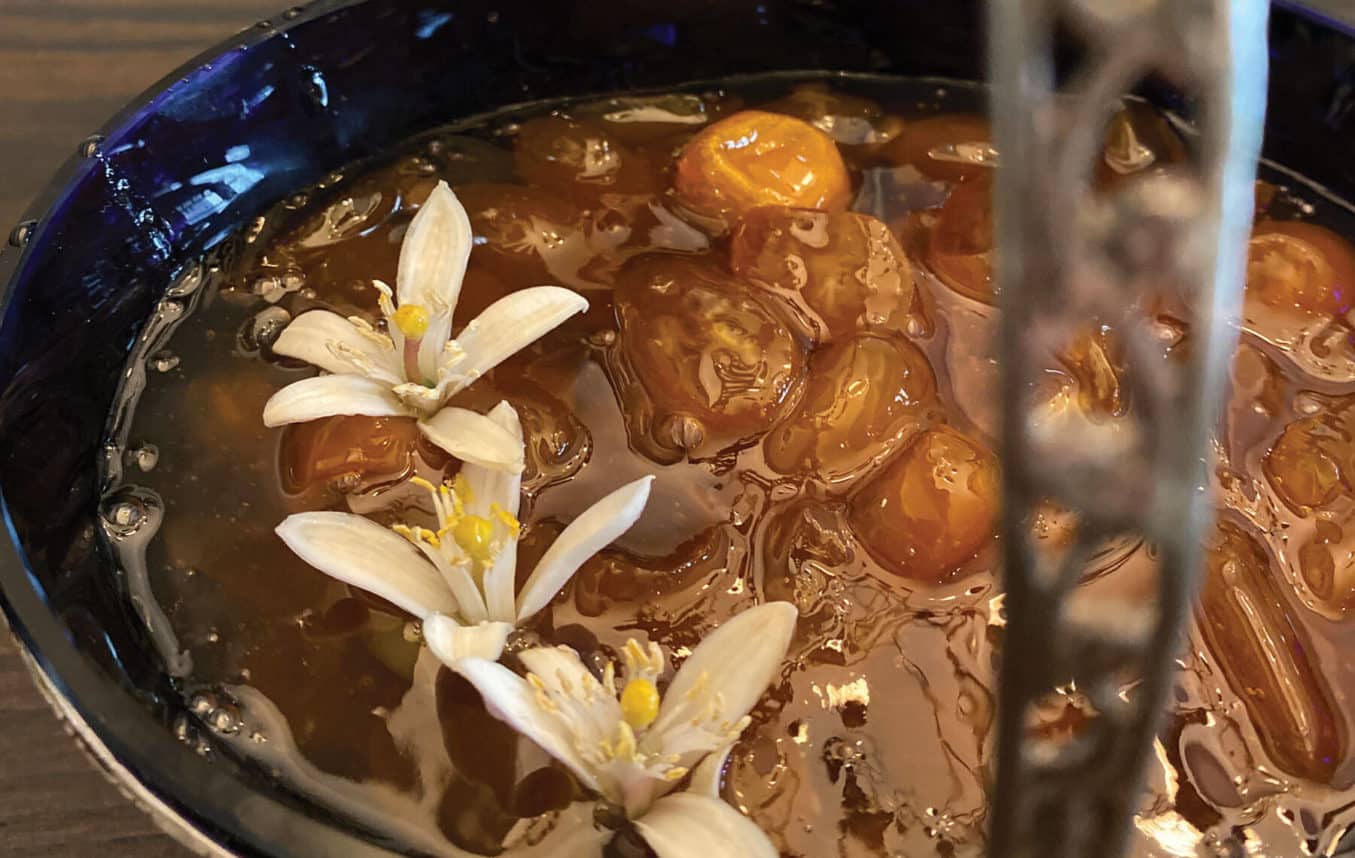
The mimouna table overflows with sweet treats like orange jam, eggplant jam, marzipan, meringues and, of course, the famous moufleta, crepes served with butter and honey. In Morocco, the flour used in moufletas was brought to Jewish homes by their Muslim neighbors after sundown, proof of the level of friendship and cooperation that existed between the two faiths.

Talismans of luck, fertility and prosperity also adorn the table. A live goldfish in a glass bowl. A green tree branch. Five gold coins in a bowl of flour, and five fava beans arranged on a pastry.
The exact origins of the name and holiday remain conjecture — does it mark the anniversary of the death of Maimon ben Yosef, the father of Maimonides; or does the name come from the Hebrew word “emunah” (faith); or is it derived from the Arabic word “ma’amoun” (wealth)? Regardless, mimouna has become a widely celebrated and wildly popular event on the Jewish calendar in Israel and all over the world.
In Morocco, the flour used in moufletas was brought to Jewish homes by their Muslim neighbors after sundown, proof of the level of friendship and cooperation that existed between the two faiths.
Rachel shares her delicately spiced and delicious recipe for Spiced Kumquat Jam. Feel free to substitute thinly sliced oranges if kumquats aren’t available. I share my recipe for Pavlova, a family favorite.
mufletas
Rachel’s Moufletas 3 cups flour
1 teaspoon salt
1 1/2 cups lukewarm water
2 tablespoons oil, plus 1/3 cup oil, separated, plus oil for frying
Butter, honey or Nutella, for serving
Sift flour and salt into large bowl. Make a well in the center and slowly add water.
Using hands, mix until dough is sticky but not smooth.
Pour 2 tablespoons of oil over dough, cover with towel and let rest for 15 minutes.
Line cookie sheet with parchment paper.
Divide dough into golf ball-sized balls and set on cookie sheet.
Pour 1/3 cup oil over balls and let dough rest an additional 15 minutes.
Lightly oil counter. Dip fingers in small bowl of oil, stretch each dough ball as thinly as possible.
Heat small amount of oil in a frying pan.
Place dough in hot oil. When dough is golden, flip and place another crepe on top.
Continue to flip every few minutes, adding an additional crepe each time.
Remove from pan when the stack has 3-4 crepes and start a new stack.
Traditionally served with sweet butter and honey but kids love it with Nutella.
Makes about 3 dozen.
Pavlova
Sharon’s Pavlova 8 egg whites
1 3/4 cups sugar
1 teaspoon vanilla
4 teaspoons cornstarch or potato starch
2 teaspoons white vinegar
Pinch of salt
2 cups heavy cream
Pint of strawberries, sliced
Preheat oven to 350 F.
Beat egg whites slowly and add sugar very gradually until egg whites are thick and glossy.
Gently fold in vanilla, cornstarch, vinegar and salt. Spoon mixture onto ovenproof dish.
Lower oven to 200 F and bake for 3 hours. Cool on wire rack.
In small bowl, beat cream until stiff peaks form.
Fill center of pavlova with whipped cream and top with sliced strawberries.
spiced kumquats
Rachel’s Spiced Kumquat Jam 2 cups kumquats
3 cups water
1 1 /2 teaspoons baking soda
2 cups fine granulated sugar
2 cups water
4 teaspoon cinnamon
2 teaspoon cardamom
2 teaspoon clove powder
Place whole kumquats in glass bowl and cover with the water. Sprinkle in baking soda and soak for 10 minutes. This will remove any mold and dirt. After soaking, rinse kumquats under clean, running water and dry with paper towels before proceeding.
Cut each kumquat in half and remove seeds.
In medium-sized pot, bring sugar, water and spices to a boil.
Add kumquats after syrup has thickened and has small bubbles.
Cook on medium heat for 30 minutes until excess liquid has evaporated and kumquat peels are soft.
Cool completely and store in sterilized, glass Mason jars.
Makes about 64 ounces.
Rachel Emquies Sheff’s family roots are Spanish Moroccan. Sharon Gomperts’ family hails from Baghdad and El Azair in Iraq. Known as the Sephardic Spice Girls, they have on the Sephardic Educational Center’s projects, SEC Food Group and community cooking classes. Join them on Facebook at SEC FOOD.
“If one tiny virus can stop the entire world, perhaps one mitzvah can save the world.”
— Dr. Benjamin Hulkower
“When we are no longer able to change a situation, we are challenged to change ourselves.” — neurologist Viktor E. Frankl
Viktor Frankl understood the necessity for individuals to change. One prayer that has helped me is the Serenity Prayer. “God grant me the serenity to accept the things I cannot change, the courage to change the things I can, and the wisdom to know the difference.” That’s where I believe we are right now. And may be for a while.
Husband: Hey honey, what do you want to do tonight? Wife: I’d like to go out to dinner and a movie. Husband: We can’t. What else? Wife: I’d like to be able to hug and kiss my children without thinking it might be the end of us. Husband: You can kiss me. Wife: Doctor said not till Tuesday.
For the past couple of years, I’ve been asked to change so many of my beliefs. I’m being told by scientists that we are facing an existential threat and that the world will be ending in 8 to 12 years. OK, I won’t buy beach property.
People are telling me we need to end fracking. I don’t even know what fracking is. It sounds like a dirty word.
I can’t handle being locked in for months but I can handle it for today.
I’m now finding out that many of my childhood heroes were nothing but scum-sucking slaveholders. I’m also told I’m a racist because I’m white, which I swear I had nothing to do with. And if that wasn’t enough, ladies and germs, please welcome the coronavirus.
Coronavirus: Thank you. Nice to be here infecting everyone. I’ll be here all …?
My governor has asked that I don’t go outside. Before the coronavirus, the last time I was told not to go out was by my mother in 1967. Now, only one family member is supposed to shop. The Centers for Disease Control and Prevention officially has classified my wife and me as old and weak. Supermarkets are now allowing people my age in early for first dibs on prune juice.
Every package or piece of mail could be as lethal as anthrax. When I get into my car, how do I know some infected 7-year-old didn’t touch my car door handle an hour before I got there? Every orange and lemon in the supermarket is a potential landmine.
My 401(k) is now a 104(k). People tell me it’s a great time to buy stock. I’m more worried about buying toilet paper — which my stock certificates are quickly turning into.
What should we do? Putting your face in your pillow then kicking and screaming with all you got might help. Prayer is always a good thing. Try to stay healthy: get rest, eat well, exercise and keep down the stress level. Also, don’t argue too much with your cellmates.
After all of that, the real battle is in your head. In my little world, the coronavirus is not a normal event. But in the real world, these things can happen. I don’t know about you, but my mind loves to take me on trips through very bad neighborhoods. I recently fantasized myself dead and felt bad because no one could attend my funeral or shivah. Like an ocean wave, I let these thoughts come and go. Almost everyone is scared. The entire world has been dragged into a Stephen King novel.
What I do to stay sane? I try to live just for today. Stay in the here and now. Remember that I have all I need for today. The future is not my friend. I can’t handle being locked in for months but I can handle it for today. So, I stay calm and carry on.
And one more thing that really helps is acceptance. The virus doesn’t have to change; it’s me that has to change and accept everything exactly as it is. We’ve all read about pandemics. Well, hello, it’s here. Good luck and God bless. I look forward to hugging you on the other side.
Let me start with the obvious: this is really hard. Like a reverse “Dayenu.” Even for those of us with roofs over our head, it is hard. (And, of course, how much more so for those who lack even that). Even for those of us with food in the pantry, it is hard. Even if we are not sick ourselves, or have a loved one who is, it is hard. Even if we still have all or some of our income, it is hard. Even if our children are essentially getting by with their school-work, it is hard. Even if, even if, even if…
This is an era whose magnitude and terror has not yet reached its apex, and it already is one that will be considered epic. There will be movies made about this moment in history. Books and scholarship written. Who knows? Depending on the total morbidity, perhaps even memorials in D.C. to the American victims of COVID-19, seeing as how the number of deaths may eclipse the total number of U.S. soldiers killed in Korea and Vietnam. Whereas much of the western world measures modern time as AD, suggesting that time and reality itself had a before-Jesus and after-Jesus meaning, there will be aspects of our lives, and of this society, that will have an AC (after-COVID) “date” to it, even if it is not referenced that way in our calendar. Much may be different when the crisis is over.
In the meantime, we are suffering. Again, you don’t need to be struggling to get air into your lungs or be on the verge of destitution to be suffering. If you are anything like me, you sometimes wake up with an anvil on your chest, as this reality is so heavy, so grievous. Sometimes the worry and the anxiety are palpable. Like a mass. Like you can touch it.
This notion makes me think of the midrashic take on the wording of the ninth plague. After the Torah explains that there was darkness over Egypt, we have the words: וימש חושך. Vayamesh hoshekh. There is no unanimity on how to translate the first word, which is the verb. The second word means darkness itself. Midrash Rabbah links the verb vaymesh to the word l’mashesh, used several times in the Torah. That verb means “to grope” or “to feel.” And so the midrash concludes that what made this darkness in Egypt different than all other darknesses (ma nishtana), and therefore not just the absence of light, was that this was a palpable darkness. A bleakness you could feel. A gloom that was tangible. You’ve heard of tension so thick you could cut it with a knife? In Egypt, there was darkness so real that even light couldn’t defeat it.
Does that seem familiar? Even more, the next verse explains that the impact of the darkness was that no one could see one another for three days. The Egyptians didn’t have Zoom. And to not see the people in your lives? Well, that’s a plague.
The Egyptians didn’t have Zoom. And to not see the people in your lives? Well, that’s a plague.
Commentaries wonder about the Israelites’ experience through this palpable darkness. The Torah says וּֽלְכָל־בְּנֵ֧י יִשְׂרָאֵ֛ל הָ֥יָה א֖וֹר בְּמוֹשְׁבֹתָֽם. All of the children of Israel had light in their dwellings. The language is interesting, because it does not say that they were spared the plague only in Goshen, which is the part of Egypt they inhabited, and which the Torah specifically mentions regarding the absence of many of the other plagues. But, literally, “wherever they sat” they were free from the impact of the darkness. Two medieval French commentators, Chizkuni and B’khor Shor, say that what protected the Israelites in this plague was not raw geography. Nor was it God’s supernatural interaction, as is the case with the 10th plague. No, here, when it came to physical, overwhelming, crushing darkness…there was something light in the Israelite spirit that kept the gloom at bay. Even when they visited Egyptian homes in neighborhoods suffused with ponderous darkness, the Israelites could see. One another. And even the Egyptians in their suffering.
I take two things from these interpretations. One is that we must find a way to see people in their suffering. Even when darkness utterly occludes their sense of light, we must open our eyes and be witness to their bleakness. For however terrible it is to suffer, it is more so to suffer alone. Two is that we must find within ourselves the same inner light that illuminated the Israelites’ world when everything was shrouded in darkness. That was not magic. Nor, I would posit, was it easy. But it was essential. For their ability to muster light when it seemed otherwise completely illusory kept them safe. It kept them together. It girded them for the travail and journey that was aborning. And it made ultimate liberation possible.
We remain in our Egypt, our מצרים/מיצרים mitzrayim/metzarim, in these dark, narrow straits. There is an end to this darkness that seems not to abate. We must not only imagine the light that will be waiting for us when it is over, but also find a way to shine our light through it.
Wishing everyone a joyful, sweet, kosher, family-centered, delicious, restful and memorable Pesach.
Rabbi Adam Kligfeld is the Senior Rabbi of Temple Beth Am in Los Angeles.
Israeli Science and Technology Minister Ofir Akunas announced on April 7 that Israeli scientists could have a coronavirus vaccine developed in a few weeks.
According to The Jerusalem Post, the Galilee Research Institute’s (MIGAL) oral vaccine will be ready in that time frame if everything goes right, and then would need approval in 90 days.
Akunas called it an “exciting breakthrough. I am confident there will be further rapid progress, enabling us to provide a needed response to the grave global COVID-19 threat.”
MIGAL’s oral vaccine would give patients antibodies to fight off the coronavirus, according to the Post.
The Post had previously reported on April 1 that MIGAL’s vaccine headed toward the final stages of development and that human testing could begin as early as June 1.
Additionally, the Israel Institute for Biological Research’s (IIBR) prototype COVID-19 vaccine is being tested on rodents, according to a March 31 Reuters report.
As of this writing, there are 9,006 confirmed cases in Israel and 61 deaths from the virus. Israeli Health Ministry Director-General Moshe Bar Siman-Tov said on April 7 that the Israeli government will start lifting social distancing restrictions after the number of daily cases declines from hundreds a day to dozens a day.
“Israel is in a much better place than more or less all advanced countries we compare ourselves to,” he said.
The United Kingdom last had a Jewish prime minister in 1880, the final year of Benjamin Disraeli‘s service.
Now, with the coronavirus sending Boris Johnson to the hospital, the country is again being run by a man with Jewish roots: Foreign Secretary Dominic Raab took over Monday after the prime minister was moved into intensive care.
At his first news conference in the role, Raab said that Johnson was “receiving standard oxygen treatment and breathing without any assistance.” He added that Johnson “will pull through because if there is one thing that I know about this prime minister, he is a fighter and he will be back leading us through this crisis in short order.”
Prime Minister Boris Johnson leaves 10 Downing Street for PMQ’s on March 25, 2020 in London, England. (Photo by Peter Summers/Getty Images)
His background: Raab’s father, Peter, was a Jewish refugee who immigrated to Britain at the age of 7 from what was then Czechoslovakia following the Nazi annexations there in 1938. Peter Raab died in 1986, when his son was 12, according to the Daily Mail.
Raab’s father, Peter, was a Jewish refugee who immigrated to Britain at the age of 7 from what was then Czechoslovakia following the Nazi annexations there in 1938.
Raab was raised in the Church of England before marrying a Brazilian Catholic woman, according to ITV. He studied to become a lawyer at Cambridge and joined the Foreign Secretary in 2000.
Raab, 46, does not identify himself as Jewish. Though multiple media outlets in the United Kingdom have noted that his father was Jewish, Raab rarely acknowledges this part of his background.
Raab, 46, does not identify himself as Jewish.
In a 2019 interview with ITV, pointing at family pictures, he said: “That’s my dad with his mum, and they were … Grew up and had their family in Carlsbad, lovely middle-class part of Czechoslovakia and then, of course, came over, fled when the Nazis took over in 1938.”
However, at multiple town hall meetings, Raab has referenced his father’s story to show he understands and supports immigration, as long as it is controlled and its effects are measured.
Raised by a single mother who later had cancer twice, he devoted much of his youth to training in karate and now is a black belt in the sport. He’s married to marketing executive Erika Rey, with whom he has two children.
His views: Seen as a tough negotiator and uncompromising supporter of Brexit, he held the Brexit portfolio under former prime minister Theresa May. But he resigned on Nov. 15, 2018, in opposition of the terms of a deal that May had tried to seal. Pro-Brexit critics, including Raab and Johnson, said the agreement was too soft.
Raab returned to the Cabinet under Johnson, becoming his second in command.
Raab has criticized Israeli settlement construction for undermining prospects for a contiguous Palestinian state. He also has rejected calls to recognize a Palestinian state before a peace deal is reached between the Israelis and Palestinians.
As families and friends celebrate the Passover Seder, the traditional question, “how is this night different from all others,” is sure to resonate deeply.
This Passover, we’re in the middle of the coronavirus pandemic that is claiming lives and turning our routines upside down. But while many families will observe this holiday of shared experiences from afar and possibly video chat, the rituals remain. We will retell the Exodus story, sing songs, and recount the 10 plagues while hoping for our own miracles.
The Parting of the Red Sea, (Painting: Lidia Kozenitzky)
Here are just 10 solutions that are making a difference.
Professor Hossam Haick, known for his acclaimed breathalyzer technology, is creating a breath test to diagnose asymptomatic coronavirus carriers, and developing an inexpensive patch for the arm or chest that will monitor the virus.
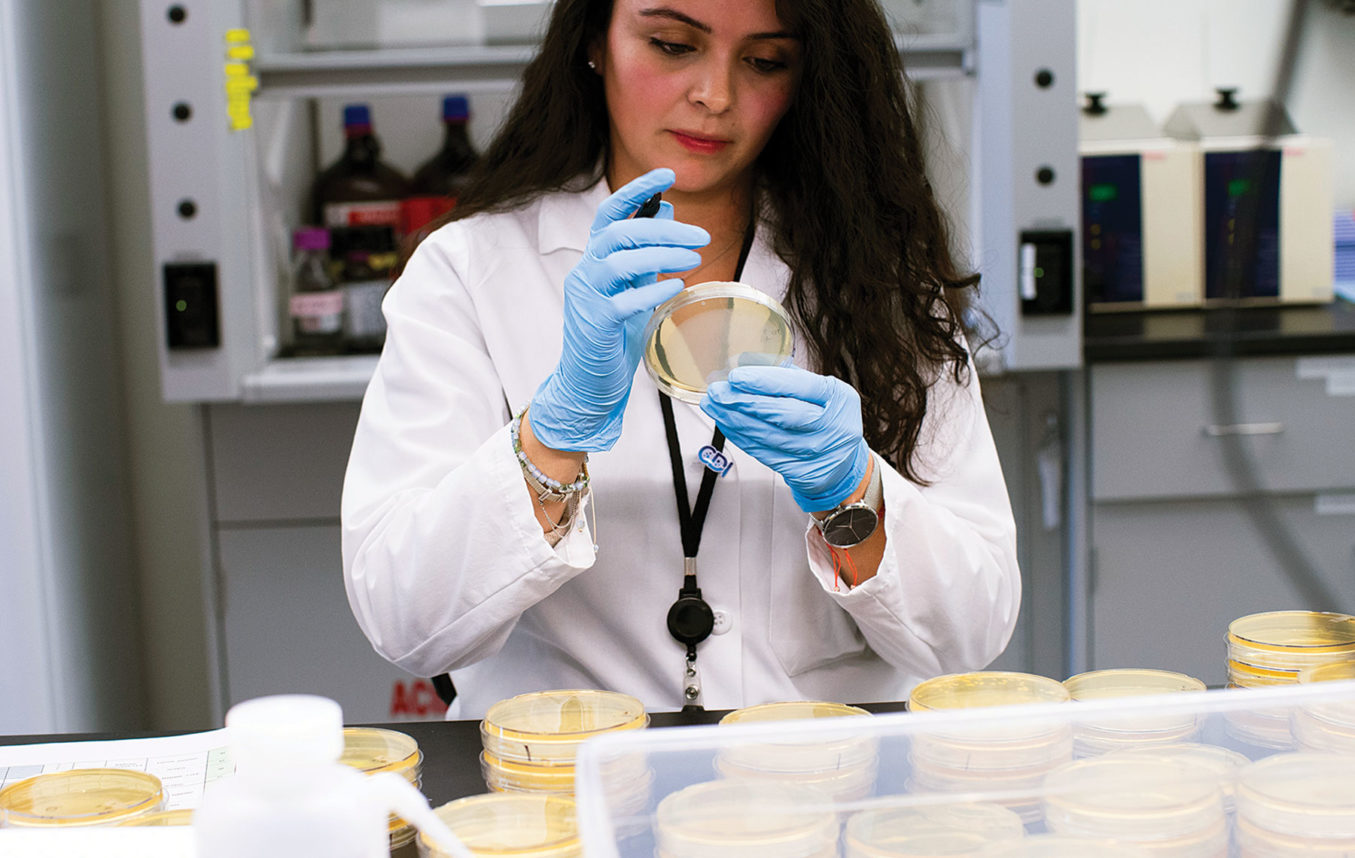
Working in her lab at the Technion, Professor Marcelle Machluf, Dean of the Faculty of Biotechnology and Food Engineering, is repurposing her “nanoghost” technology to trap the coronavirus.
Professor Eyal Zussman created protective stickers, made of a nanofiber that adheres to conventional medical masks to both block and kill the coronavirus. The stickers were created in under a week in Prof. Zussman’s lab and are already approved by Israel’s Ministry of Health for testing.
Professor Josué Sznitman is developing a liquid foam therapy that delivers drugs efficiently to treat acute respiratory distress syndrome, the principal cause of death in coronavirus patients.
Professor Roy Kishony and researchers from the Rambam Health Care Campus have successfully developed and tested a “pooling” method that dramatically increases the ability to test patients for COVID-19.
Diagnostic Robotics, co-founded by a Technon professor and alumni, parlayed its AI-powered predictive technology into a questionnaire that will be used by Israel’s Ministry of Health and HMOs to map the areas that are experiencing a spike in COVID-19 symptoms.
Professor Avi Schroeder is developing a coronavirus vaccine based on a food additive he developed to boost the immunity of shrimp against a deadly virus.
VocalisHealth, founded by three enterprising Technion grads, has joined with Israel’s Defense Ministry to collect voice samples from COVID-19 patients and the general public, hoping to home in on a unique vocal fingerprint of the coronavirus.
Researchers in Professor Alon Wolf’s Biorobotics and Biomechanics Lab built a robot in less than a week that skirts between patients’ beds to bring food and medicine and take simple tests without exposing medical workers to the coronavirus.
Organic chemist Professor Yoav Eichen is developing self-sterilizing coatings for gowns, tents, and face; while Professor Ezri Tarazi is protecting health care workers by producing a mask with a constant airflow that repels virus-laden aerosols from the face.
During this holiday when we celebrate the Jewish journey from slavery to freedom, the new sign at the entrance to the Technion says it all:
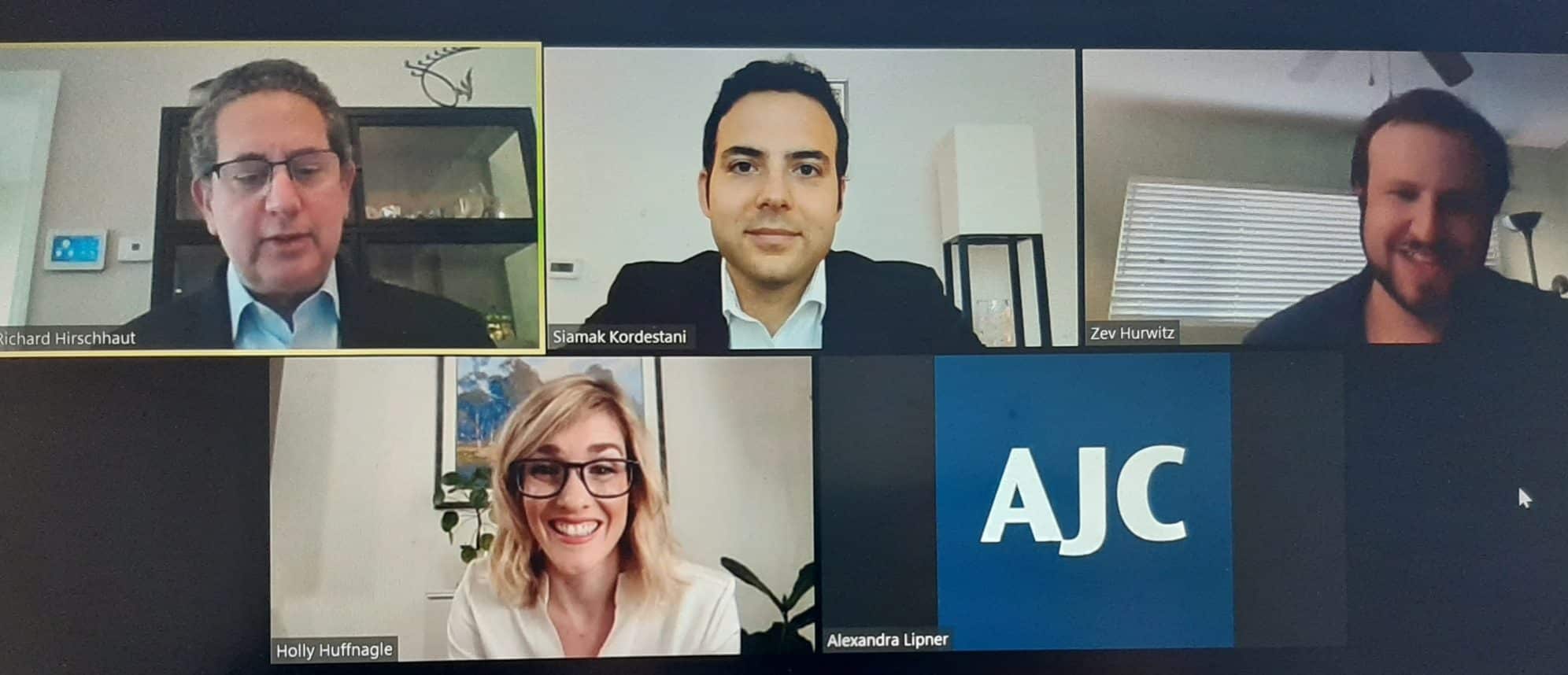
The American Jewish Committee (AJC) held a Zoom call on April 2 to discuss how to fight anti-Semitism.

AJC Los Angeles Assistant Director Holly Huffnagle spoke about the latest trend in online anti-Semitism known as Zoombombing, where people disrupt a Zoom call with anti-Semitic material. She cited a March 24 Conejo Valley Unified School District board meeting that was Zoombombed with swastikas and pornography.
“Online anti-Semitism is increasing because of the coronavirus,” Huffnagle said, adding that “really the whole world is moving online.” She said there is a correlation between social media and anti-Semitic hate crimes, pointing to the Tree of Life synagogue shooter’s use of the far-right social media platform Gab and the shooters in El Paso, Chabad of Poway and Christchurch, New Zealand, being radicalized by the online forum 8chan.
“Assailants are often radicalized in these online environments to begin with, but they also use their social media networks to amplify their reach,” Huffnagle said, adding that anti-Semites like to promulgate their rhetoric online through memes and coded references like the media, globalists, Hollywood and East Coast bankers.
“It’s more subtle,” Huffnagle said. “It’s winking. It’s nudging; dog whistling, if you will.”
She also spoke of anti-Semites targeting Jews online through doxxing (revealing addresses and phone numbers), and pretending to be Jews online and saying things like, ‘I want to control the world.’ “We’re seeing this line between what’s real and what’s fake blurring,” Huffnagle said.
“Online anti-Semitism is increasing because of the coronavirus. Assailants are often radicalized in these online environments to begin with, but they also use their social media networks to amplify their reach.” — Holly Huffnagle
She went on to speak about disinformation and how it tends to spread quickly on social media platforms. She cited Facebook’s policy of running political ads without fact-checking them, as long as it gets paid. She also said 15% of Twitter accounts are bots that popularize disinformation.
Huffnagle called for tech companies to police their platforms and for users to respond to and report hateful online speech. “It’s really the role of individuals and civil society and tech companies working together to push back against online anti-Semitism,” she said.
AJC Director of Campus Affairs Zev Hurwitz discussed the boycott, divestment and sanctions (BDS) movement, which he described as anti-Zionist. “Not every adherent to BDS is an anti-Semite, but the underlying ideology … is rooted in anti-Semitism,” Hurwitz said, arguing that the movement calls for the destruction of Israel.
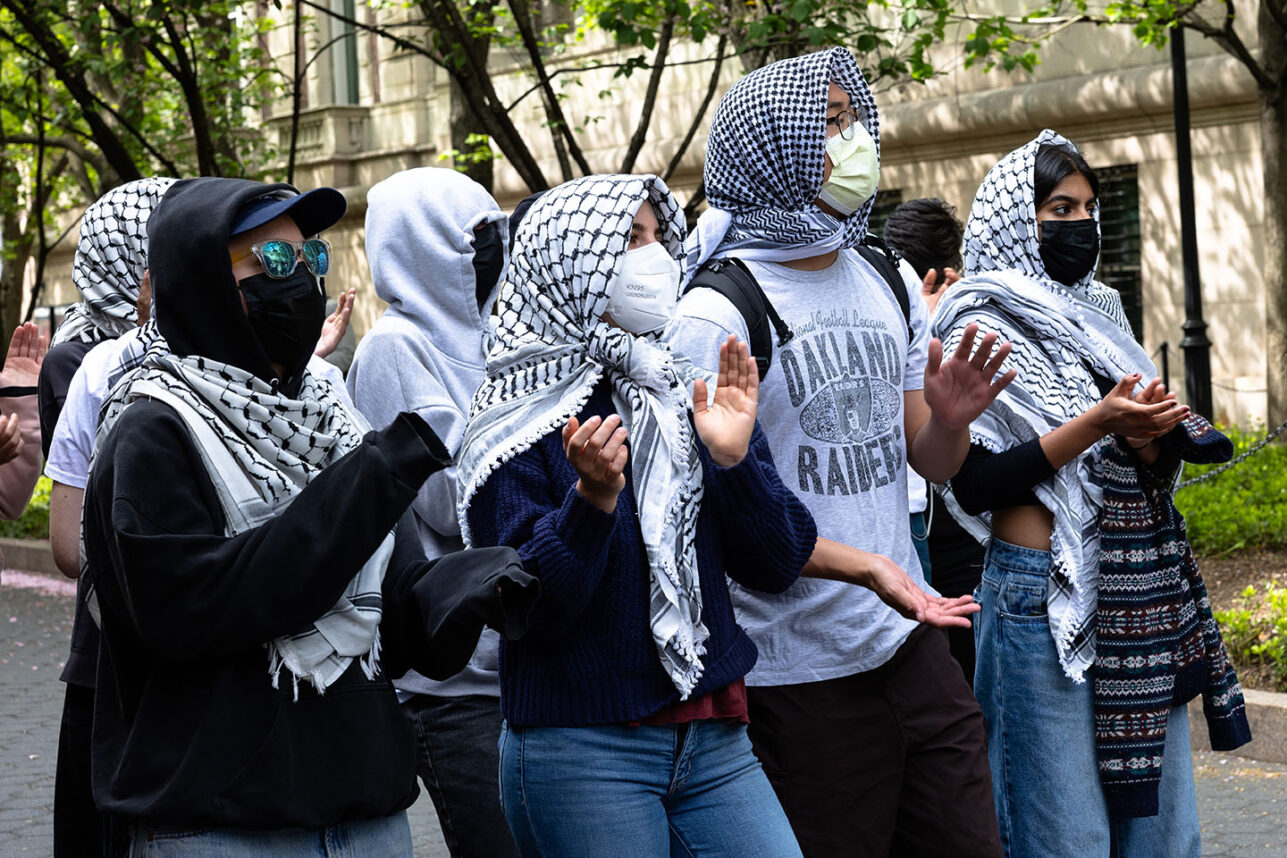
He spoke of how on college campuses, pro-BDS groups like Students for Justice in Palestine (SJP) launch campaigns pressuring the student government to pass resolutions calling on the school to divest from companies that conduct business with Israel. While BDS has been unsuccessful in getting universities to divest from such companies, the movement has created a hostile campus climate for Jewish students, Hurwitz said. “There is an attack on Jewish self-determination on campus,” he said, adding that “this is horrifically bigoted rhetoric that’s just allowed to exist on campus.”
Hurwitz also stated that 80% of students on college campuses are either uninterested in or don’t know much about the Israel-Palestinian conflict, meaning that the “80% stands to fall victim to misinformation and support for anti-Semitism.”
Jewish students also face anti-Semitism on college campuses in some progressive spaces that reject students because of their Zionist identity. These spaces view students who identify as Zionists as “white colonizers,” Hurwitz said, adding, “That’s a real problem that a lot of Jewish students are facing right now.”
Hurwitz acknowledged that the vast majority of Jewish students don’t feel unsafe on college campuses, and that positive stories on campus like Shabbat dinners and interfaith partnerships are overlooked because the BDS movement and swastika graffiti garner more headlines.
He encouraged Jewish students to form alliances with other minority groups on campus and to become acquainted with diversity and inclusion offices at their schools that can help when instances of anti-Semitism occur. “It just makes sense for the Jewish community to have the community support of other minority groups that are potentially subjected to discrimination of their own,” Hurwitz said.
AJC Los Angeles Assistant Director Siamak Kordestani said if anti-Semitism becomes a political cudgel, its meaning will be diluted and people will start tuning out the issue. “We run the risk that actual anti-Semitic rhetoric will be less noticeable,” he said. He added that anti-Semitism shouldn’t become a tool “to stifle criticism of a politician or a political party.”
Kordestani argued that social media has exacerbated a hyperpolarized political climate in America, since nuance is lost on social media and it’s easier to spread misinformation. “We have less of an attention span when it comes to conversations on the screen,” he said.
Therefore, he added, it’s imperative to maintain bipartisan support for Israel because anti-Zionism “has gained traction on the far left and that has contributed to the politicization about Israel.”
Kordestani encouraged people to urge their congressional representatives to join the Bipartisan Taskforce on Combating Anti-Semitism and to pass the National Opposition to Hate, Assault and Threats to Equality Act (NO HATE Act), which would provide grants to state and local governments to improve hate crime reporting as well as impose harsher penalties on those who commit these crimes.
“Those are two things that everyone on this call can be doing, to talk to their friends, their colleagues, their network all around the country,” Kordestani said, “and we can really get the needle moving on this issue through these two things.”
As the pandemic times intersect with Passover, a reflection on how we can use this time to practice the art of humility.
How do we manage our lives during the Coronavirus crisis? How do we keep our sanity? How do we use this quarantine to bring out the best in ourselves? Tune in every day and share your stories with podcast@jewishjournal.com.
Thanks to an initiative of ZAKA (an Israeli voluntary emergency organization) Bnei Brak commander Michael Gottwin, hundreds of boxes of shmura matzot were distributed by ZAKA volunteers to the police and Israel Defense Forces (IDF) soldiers working at the checkpoints and throughout Bnei Brak in a show of gratitude for their work in protecting public health.
ZAKA Bnei Brak commander Michael Gottwin said, “Thousands of police and IDF soldiers are in Bnei Brak around the clock, having left their homes to help protect public health. As a tribute and show of gratitude, we distributed special hand-baked shmura matzot for their use on seder nights. As they will not be at home for seder night, at least this will help them feel at home.”
Gottwin continued, “It was very moving to see their smile and joy when they received the special matzots for Seder. All the residents here are showing their gratitude to the soldiers and police for their dedication on behalf of the city’s residents by giving them food and sweets.”
Bnei Brak Mayor Rabbi Avraham Rubinstein, who met the ZAKA volunteers at one of the checkpoints thanked them and Gottwin for their work throughout the year for all Bnei Brak residents.