
Print Issue: April 10, 2020
Print Issue: April 10, 2020 Read More »

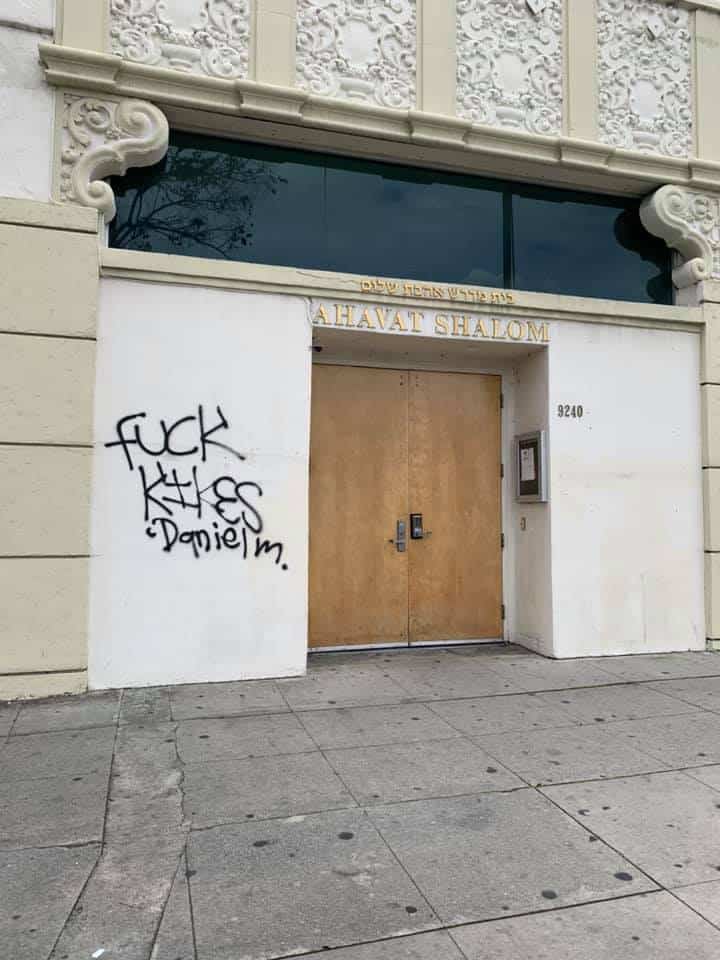
Anti-Semitic graffiti was found on a Persian synagogue in Los Angeles on April 7, according to a Facebook post.
The graffiti states, “F— k—s” and then the words “Daniel M” on the Orthodox synagogue Ahavat Shalom on West Pico Boulevard. Nathan Benyowitz, a University of Delaware student who is visiting family in the Pico-Robertson area because of the coronavirus pandemic, posted a photo of the graffiti to his Facebook page. He wrote that he saw the graffiti as he was taking a walk with his mother.
“ENOUGH IS ENOUGH,” he wrote. “There is no room for hatred in this world especially during these times. This is a time that we have to all come together as one. Am Yisrael Chai!”
https://www.facebook.com/photo.php?fbid=2899424546792403&set=a.361655893902627&type=3&theater
Jewish groups condemned the graffiti.
“We are outraged by reports of anti-Semitic graffiti outside a synagogue in LA,” Anti-Defamation League Los Angeles tweeted. “In the midst of a pandemic in which it is more important than ever for us to stand together and just before the start of Passover, it is shocking to see this hateful message on a house of worship.”
We are outraged by reports of antisemitic graffiti outside a synagogue in LA. In the midst of a pandemic in which it is more important than ever for us to stand together and just before the start of Passover, it is shocking to see this hateful message on a house of worship. pic.twitter.com/hfWyuD32K7
— ADL Southern California (@ADLSoCal) April 7, 2020
American Jewish Committee Los Angeles Regional Director Richard S. Hirschhaut similarly said in a statement to the Journal, “Amidst the COVID-19 pandemic, the vile anti-Semitic graffiti scrawled upon Ahavat Shalom Synagogue is a sobering reminder that it remains business as usual for anti-Semites. On the eve of the Jewish holiday of Passover, the defacing of this sacred house of worship, whose name literally means ‘Love of Peace,’ reminds us all to redouble our efforts to hold the haters accountable while never wavering from our pursuit of a more understanding and just world.”
Associate Dean and Director of Global Social Action Agenda at the Simon Wiesenthal Center Rabbi Abraham Cooper also said in a statement to the Journal, “Less than a mile from headquarters of SWC and [the] Museum of Tolerance, this Persian Synagogue [was] targeted by anti-Semites [on] Passover Eve. No cure yet for history’s oldest hate.”
The synagogue did not respond to the Journal’s request for comment.
‘F— K—s’ Graffiti Found on L.A. Persian Synagogue Read More »

Today, for only the second time in my life, I will have a small Seder. Just the four of us. Two children are away—one overseas, the other in uniform—two with us, at home. A table for four. About half of all Jewish Israelis (51%) will celebrate the Seder with a group of about this size, three to five people. Only the Charedim will have an average standard Seder of more people. A plurality of them (47%) will have six to nine members of the family sitting together. Larger nuclear families allow for a larger Seder.
Nuclear family is what the government expects Israelis to have at their table. Roads are closed to traffic from Tuesday afternoon. The closure will be even tighter tonight. Is the closure necessary? The Ministry of Health surveyed the public and reported that 98% intend to follow the government’s orders. So the closure is important to send a message of seriousness, and to try and stop the other 2%. All in all, Israelis tend to be obedient in recent weeks. There is some trouble in certain neighborhoods and with certain extreme elements. The rest of the public got the point: Coronavirus is dangerous. The officials are not faking the graveness of the situation.
My only other Seder of four was a long time ago. Twenty-four years ago, to be exact. And it was not a Seder for a nuclear family. Back then, my only nuclear family was my wife. And our two guests for the Seder were not family. In fact, they were people we barely knew then, and have lost contact with since. It’s been a long time, there’s a great distance, and we aren’t nearly the same age. And yet, I remember our Seder of four as one to cherish. My wife does too. So, this year we are using this memory as we try to convince our children that while a small Seder is, well, small – this doesn’t mean that it has to be sad.
It’s important to understand that in the case of a Seder, small also means different. It is not the same Seder but with fewer people. It’s a Seder night with fewer people and therefore a different Seder. The number of participants not only impacts the volume of singing, it also influences the design and content. Here is an example: the Seder is a ceremony designed in an educational format, and in many ways designed for children. They are the ones who ask the Kushiot (Ma Nishtana) and receive the answers from the text of the Haggadah. When the children lose patience, adults use material aids to draw their attention. They wrap Matza and Maror, they sprinkle wine into a saucer, they open a door for Elijah the Prophet.
A particularly popular practice is the one of the Afikoman. There are those who hide it – the girl or boy – and there are those who are required to promise to give them something in return when the Afikoman is given back. In normal years, most homes in Israel (76%) hide Afikoman. But naturally, the tendency to keep this practice is higher when there are children at home. The 35- to 44-year-olds (77%) and the 45- to 54-year-olds (81%) report hiding Afikoman more than people of younger or older ages, most of whom no longer or not yet have children of the appropriate age.
Twenty-four years ago, in my last Seder of four, we did not have children at the table. There was us, two twenty-something-year-old Israelis, and the couple who joined us, Bernie and Marcia Glick. The room was small, the table small, the kitchen small. We lived that year in a tiny apartment near Victoria Park in Kitchener, Ontario, Canada. We were young Shlichim, Jewish community workers for a year. The Glicks were adults, with real jobs and real achievements and experience in life. They were funny and gracious. I don’t recall how and why we decided to have a Seder together, but my assumption would be that they just wanted to be kind and not leave us all alone for Pesach.
What we did with the Afikoman, I do not remember. But I do know that Seder was one of the most interesting and memorable we had. Why? Because it was different. It was small – and hence intimate. It was surprising. For us, having a Seder with English speakers, who could not hold a conversation about the text of the Haggadah in Hebrew, was eye opening. It forced us to reengage with a familiar text. It forced us to engage with the tradition in a new way. The exact details are murky, but I know that they said things about the meaning of the night that were different than the meaning we used to ascribe to the Seder and to the holiday.
There is a lot I’ve learned about the Seder in the last quarter of century. And a few days ago, when I looked at a survey commissioned by Israel’s daily Maariv, I learned more. The Seder is one of the most commonly practiced Jewish customs, with about 97% of Israelis having one on a regular basis. But this year, being the year of Coronavirus, I wondered if people were going to take a break, to decide to make this a year off. The answer is no. Almost all Jewish Israelis (95%) told us that they were going to have a Seder, and this includes a fair share of people who will likely have it alone or as a couple (almost a quarter of the Israeli Jewish public). In fact, the decline among the general public this year is expected to be around 2%, and among the most secular group, around 3%. The Seder – so it appears – has true resiliency.
And yes, for most of us it will be different. We might miss the messiness of having all the branches of the family coming together. We might have to contend with a Seder of a different type. But something I learned many years ago, and I believe still stands, is that a Seder of a few people can still be a wonderful celebration of Jewish joy and meaning.
Glicks, wherever you are, this is for you. And have a happy Pesach.
*

The numbers in this post are taken from a survey by Maariv Daily, conducted by pollster Menachem Lazar (You can listen to a conversation with Lazar about Israel’s politics here); from my book with Prof. Camil Fuchs, #IsraeliJudaism, Portrait of a cultural Revolution (you can see some of our findings on Pesach here); from a short essay on a Coronavirus Pesach I wrote for The Jewish People Policy Institute (Hebrew, here).
An Important Lesson from my First Seder of Four Read More »

In these pandemic times, as we prepare for Passover seders that will be unlike any other, we can all use a special blessing.
Well, I have a suggestion. It’s a blessing Moroccan Jews, as well as some Tunisians, Algerians and Yemenites have been reciting for generations at the beginning of the Passover seder.
Ever since I was a toddler growing up in Morocco, I have never forgotten this moment. We were giddy with anticipation. Right before the beginning of the haggadah, my father would pick up the seder plate and wave it over the head of every person sitting at the table.
Meanwhile, everyone would sing the special blessing:
“Bibhilu yasanu mi-mitzrayim, ha lahma ‘anya, bené horin,”
(“With haste we left Egypt, this is poor bread, [now] we are free.”)
It’s a tradition that has never left me. Even if we have 30 people around the table—and we’ve had that amount—every person receives the blessing.
No one is left behind. It feels like that’s what we need this year more than ever: A statement that we’re all in this together. Even if we can’t see one another, even if we will have three people at our seders instead of 30, everyone receives the blessing.
Everyone is blessed to be liberated from this horrible disease and reach the ultimate destination: “We are free.”
There is a more mystical reason for this blessing—it’s connected to the Divine.
A few years ago, my friend Rabbi Daniel Bouskila explained the significance of the Sephardic seder plate, in kabbalistic terms:
“The three matzot correspond to keter (crown), chochmah (wisdom) and binah (understanding); the shank bone corresponds to chesed (kindness); the egg corresponds to gevurah (strength); the bitter herbs correspond to tiferet (beauty); the charoset corresponds to netzach (victory), the karpas corresponds to hod (splendor), the hazeret corresponds to yesod (foundation); and the seder plate itself represents malchut (kingship).”
The seder plate, he concluded, is no longer just a platter carrying a selection of ritual items. The special arrangement and designations, which he attributes to the great kabbalist from Tsfat known as the Ari (Rabbi Isaac Luria), transforms the seder plate into a “sacred representation of God.”
In other words, when the seder plate is waved above our heads during Bibhilu, we are being blessed by the spiritual strength of the Divine, as represented by the sefirot, or attributes of God. For the rest of the evening, the presence of the seder plate on the table represents the presence of the Divine in our midst.
Doesn’t that sound like something we can all use right about now?
Here is yours truly singing the melody.
You have time to practice before the seder.
May we all be blessed to see better days and say, “We are free.”
This Year, Let’s Sing the Sephardic Bibhilu at Every Seder Table Read More »

Rabbi Yaakov Perlow, a leading Orthodox rabbi also known as the Novominsker Rebbe, died Tuesday from the coronavirus.
Perlow, who hailed from a prominent line of rabbis, died at his home in the Borough Park neighborhood of Brooklyn. He was 89.
Since 1998, Perlow had served as the president of Agudath Israel of America, an umbrella organization for haredi Orthodox Jews that grew out of the Agudath Israel movement in Poland that his grandfather co-founded. Perlow also headed the Moetzes Gedolei HaTorah of America, the Agudah’s rabbinic ruling body.
Perlow succeeded his father to become the rabbinic leader of the Novominsker Hasidic dynasty and founded the Yeshivas Novominsk Kol Yehuda, a yeshiva in Borough Park.
“The loss to [the Jewish people], and Agudas Yisroel, is incalculable,” Agudath Israel said in a statement, using an alternate spelling of its name.
Last month, as the coronavirus started spreading rapidly through Orthodox communities across New York state and New Jersey, Perlow urged community members to take seriously the advice of medical experts.
“We must be informed about the facts of this disease and what the expert doctors, the infectious disease specialists, are telling us, in a unanimous way,” he said in a video message. “We cannot behave today like we did last week or two weeks ago. We are told that the Jewish law is that we must listen to doctors whether it’s about a sick person on Yom Kippur or a sick person that requires desecrating Shabbat and so on.”
Top Charedi Orthodox Rabbi Dies of COVID-19 Read More »

It would have been enough to vicariously see our favorite Broadway and Hollywood stars celebrating Passover on social media, but now fans will get to virtually gather with them on April 11 for a Passover seder.
Titled “Saturday Night Seder” and created by Broadway veteran Adam Kantor (“The Band’s Visit”) and culinary entrepreneur Brian Bordainick, the event will raise money for the Centers for Disease Control and Prevention Foundation’s Coronavirus Emergency Response Fund as guests encourage viewers to donate.

The star-studded cast virtually breaking the middle matzo includes Tony Award winners Idina Menzel, Ben Platt, Cynthia Erivo, Harvey Fierstein, Judith Light, Alan Menken, and Billy Porter.

Also participating are Pamela Adlon, Jason Alexander, Reza Aslan, Skylar Astin, Shoshana Bean, Mayim Bialik, Rachel Brosnahan, D’Arcy Carden, Andy Cohen, Darren Criss, Fran Drescher, Billy Eichner, Beanie Feldstein, Tan France, Eliot and Ilana Glazer, Josh Groban, Richard Kind, Julie Klausner, Nick Kroll, Rabbi Amichai Lau-Lavie, Dan Levy, Camryn Manheim, Milo Manheim, Debra Messing, Isaac Mizrahi, Busy Philipps, Stephen Schwartz, Michael Solomonov, Shaina Taub, Nina West, Henry Winkler and Finn Wolfhard.
Los Angeles Rabbis David Wolpe of Sinai Temple and Sharon Brous of IKAR are also slated to appear.
“In a time of confinement and uncertainty, a rag-tag team of Jews and non-Jewish Passover enthusiasts felt it was more important than ever to channel creative energies and gather community,” head writer Alex Edelman said in a statement. “We’re thrilled to be reinterpreting the timeless story of liberation and renewal while raising money for those on the front lines enduring—and fighting—an actual plague.”
The Passover seder will begin streaming at 8 p.m. ET/ 5 p.m. PT here.

Viktor Vekselberg, a Russian-Jewish businessman, is providing 3,000 free meals a day to Russians older than 65 in lockdown over the coronavirus.
Vekselberg’s free meals project, which began last week, is set to continue until the end of April, his office wrote in a statement. The initiative is a response to the Russian government’s decision to order all citizens older than 65 to go into lockdown.
The disease is “the worst challenge humankind has faced in the 21st century, and all must join forces to save human lives – governments, businesses, and public institutions,” the statement read.
The meals are prepared by the Airports of Regions firm, where Vekselberg’s firm Renova is a major shareholder, and delivered to the homes of seniors based on their level of need.
The meal sets are prepared daily by catering services based in the airports of the Russian cities of Yekaterinburg, Samara, Nizhny Novgorod and Rostov-on-Don.
Russian-Jewish Businessman Donates 3,000 Meals Daily to Senior Citizens Under Lockdown Read More »

Just hours after Israeli Health Minister Yaakov Litzman tested positive last week for the novel coronavirus, technicians arrived at his Jerusalem residence to deliver a smartphone and install computer equipment.
An adherent of the Ger Hasidic sect, the 71-year-old Litzman normally eschews the use of the internet at home, but special arrangements were required after his diagnosis sent him and his entire senior staff into self-isolation.
In different times, the special arrangements might be seen as underscoring Litzman’s role as a trailblazing haredi Orthodox politician — he was the first in his political faction to assume a full Cabinet position — and a testament to Israel’s complex societal makeup. But the current crisis has served to stoke haredi-secular tensions, with Litzman — fairly or not — serving as a flashpoint.
The news of Litzman’s diagnosis sent shockwaves across Israel because it meant that not only was the nation’s top health official running his department from home during a pandemic that has killed more than 54,000 globally (and at least 60 locally), but that the entire senior echelon of Israel’s government had to go home as well.
The news of Litzman’s diagnosis sent shockwaves across Israel because it meant that not only was the nation’s top health official running his department from home during a pandemic that has killed more than 54,000 globally (and at least 60 locally), but that the entire senior echelon of Israel’s government had to go home as well. Following Litzman’s diagnosis, Prime Minister Benjamin Netanyahu, Mossad Director Yossi Cohen, National Security Adviser Meir Ben-Shabbat and Hadassah Hospital CEO Zeev Rothstein all went into quarantine since they all had met with the health minister in recent days.

Litzman found himself the target of widespread anger following reports in the Hebrew press claiming that he had contracted the virus after attending an illicit prayer gathering of the sort that had been banned recently by his ministry, with one unidentified Cabinet member claiming that he had “put all of our lives in danger,” The Times of Israel reported.
ליצמן עכשיו עובד בביתו. אממה, בבית אין מחשב, אינטרנט או סמארטפון בשביל שיחות וידאו.
במהלך היום צפוי להגיע צוות של משרד הבריאות להתקין לו. pic.twitter.com/NYurjASsiy— יהודה שלזינגר (@judash0) April 2, 2020
Litzman denies the allegation, insisting he only attended such services when they were still permitted and was sure to keep his distance from other worshippers on those occasions.
His defense, however, speaks to a broader controversy: Litzman’s critics say he downplayed the situation initially and was slow to institute, and then enforce, social distancing measures in the haredi community, including refraining from closing synagogues and stopping prayer quorums, or minyans, in a timely fashion.
Litzman’s critics say he downplayed the situation initially and was slow to institute, and then enforce, social distancing measures in the haredi community.
Litzman “was strikingly reluctant to acknowledge and internalize the threat posed by the pandemic,”The Times of Israel’s editor in chief, David Horovitz, wrote Friday in a column.
“He resisted the stringent limitations on public movement his ministry’s senior officials sought to impose — stalling regulations that might otherwise have come into effect early last month just before Purim, and pleading in vain with Prime Minister Benjamin Netanyahu just 10 days ago to allow synagogues to stay open for at least small groups of worshipers standing two meters [about six feet] apart,” Horovitz wrote.

But Dr. Gilad Malach, director of the Ultra-Orthodox Society Program at the Israel Democracy Institute, told reporters on Monday that he believes Litzman truly did not understand the danger of the spreading virus.
Born in a Displaced Persons camp in Germany following World War II, Litzman was raised in Brooklyn’s heavily Jewish Borough Park neighborhood, moving to Israel as a teenager and eventually becoming a close confidant and adviser to the Gerrer rebbe. It was in this capacity that he entered politics in the late 1990s, heading the Agudat Israel faction of the United Torah Judaism party and rising to become one of Israel’s most prominent haredi politicians.
Litzman has been health minister since 2019, and previously led the ministry from 2015 to 2017. He served as deputy health minister from 2009 to 2013.
At times during his relatively long tenure in the Health Ministry, Litzman has been well received by the public. Back in 2016, a Channel 2 poll found him commanding the highest satisfaction ratings of any Cabinet minister. But his public standing has been significantly dented: According to a recent poll commissioned by Israel’s Channel 12 News (Hebrew), just 22% of Israelis are satisfied with Litzman’s performance (compared to 60% of Israelis who expressed satisfaction with the performance of Health Ministry Director-General Moshe Bar Siman Tov).
Even before the current crisis, Litzman’s tenure has been marked in recent years by multiple controversies.
Even before the current crisis, Litzman’s tenure has been marked in recent years by multiple controversies. In August, the Israel Police recommended that he be criminally indicted for bribery and aiding an alleged pedophile.
Litzman is accused of pressuring Jerusalem district psychiatrist Jacob Charnes to say that accused child molester Malka Leifer was mentally unfit to stand trial. She is accused of molesting several girls as the principal of a haredi girls’ school in Australia.
The extradition battle over Leifer, who fled Melbourne in 2008 with the assistance of haredim there after the allegations surfaced, has dragged on for several years, frustrating her accusers.
According to an investigation by Israel’s Channel 13 that aired last year, Litzman allegedly intervened improperly to aid at least 10 sex offenders from Israel’s ultra-Orthodox community.
“Yaakov Litzman is probably the most hated figure in Israel by those following the Malka Leifer case,” said Manny Waks, the CEO of Kol V’Oz, an organization that addresses child sex abuse in Jewish communities around the world.
Waks said that Litzman’s reappointment needlessly complicated otherwise friendly relations between Jerusalem and Canberra and caused a rift between the State of Israel and the Australian Jewish community, whose leaders had previously called for the minister’s ouster.
Litzman also faces bribery charges for allegedly helping to prevent the shutdown of a food business that the Health Ministry determined had serious sanitation violations. And he is accused of offering special benefits to Health Ministry employees in exchange for them preventing the Jerusalem-area restaurant and catering service from being closed.
Waks added that Litzman did deserve credit for helping to roll out the country’s medical marijuana system.

Under Litzman, who said in 2015 that he plans to make the ability to receive the medical marijuana “standard,” cannabis has become more widely available to those whose medical condition requires it.
Litzman has also worked to increase the “health basket,” the listing of the services and medications to which Israelis are entitled. In a joint statement with the Finance Ministry last December, his office announced that spending on such basic services would increase by half a billion shekels, or about $140 million, in 2020. Last year, Litzman passed a reform extending free dental care to children up to the age of 18 as part of the health basket, a boon to all Israeli families, but especially to the large families in the haredi community.
Asked by the Jewish Telegraphic Agency to comment on Litzman’s performance, several public health experts and epidemiologists declined to be interviewed.
A group of leading Israeli medical professionals demanded Litzman’s ouster, accusing him of allowing the country’s public health system to deteriorate under his watch.
In a letter addressed to Netanyahu last month, a group of leading Israeli medical professionals demanded Litzman’s ouster, accusing him of allowing the country’s public health system to deteriorate under his watch. A copy of the letter obtained by the local news website Ynet complained bitterly about numerous “deficiencies” brought about by the minister’s neglect.
“Despite efforts to deal with the needs, those have only increased with hospitals that are in the country’s periphery, offering inferior care while Israel itself was falling behind the rest of the world in the quality of care, while private medicine was allowed to thrive at the expense of public health services,” the doctors wrote, calling for someone with a medical background to take over.
In 2013, Bloomberg rated Israel’s health system the fourth most efficient worldwide, and it was still ranked sixth in 2018. But experts have been warning of mounting problems.

According to a 2019 report by the Taub Center for Social Policy Studies, “there are systemic failures in planning, budgeting, and regulation by the government especially in light of the increasing needs of Israel’s aging population.”
The center reported a 22% decline in the number of hospital beds over a 15-year period and asserted that Israel’s hospital system is “characterized by a diminished ability to handle emergencies” — an issue determined by the government’s approved budget.
Litzman’s spokesman, Yaakov Izak, defended the minister’s performance, insisting he had “changed” the ministry in an extremely positive way.
“Under him, Israel is one of the highest ranked countries in terms of public health,” Izak said, “but because he is haredi there is a lot of incitement against him.”
Israel has received praise for its overall handling of the current crisis, but Litzman has received little of the credit.
Israel has received praise for its overall handling of the current crisis, but Litzman has received little of the credit.
While he was reluctant at first to close down schools during the early days of the crisis, his ministry has imposed increasingly severe social distancing measures in recent weeks. They include prohibiting most Israelis from traveling more than 100 meters — that’s slightly longer than a football field — from their homes and banning public prayer.
On Monday, Litzman spoke out against the closure of the haredi city of Bnei Brak, one of Israel’s coronavirus hot spots, calling it “discriminatory and humiliating,” The Times of Israel reported. He also said the allegations that haredim were helping to spread the virus were “false and dangerous.”

President Reuven Rivlin then issued a statement calling on his countrymen to stop making “false accusations that one or another group is spreading the disease, and we must certainly not attack a whole community because of the bad deeds of individuals, which happens in every society.”
Regardless of the media furor, Litzman is still in fine shape politically to remain in his post once a new Israeli government forms, according to reports on how the coalition building involving Netanyahu and rival Benny Gantz is going. Litzman reportedly was offered the position of housing minister, which would increase his areas of influence.
He strongly refused.

My Passover plans rapidly changed on the evening of March 11, when the entire University of Illinois system made the sudden announcement to move classes online for the remainder of the school year.
Due to the pandemic, I was already planning on not attending any in-person Seders, but that email meant that suddenly I had to scramble to figure out how to hook up and pay for internet in my apartment.
As a graduate student in social work, I know well the many ways that poverty deepens difficult situations like the one we’re all in together — and the many ways that our society is not set up to mitigate this. And as an observant Jew, I know that preparing for Passover can come with a price tag that’s out of reach for many.
This year, the money I would have spent on Pesach groceries is now being spent on ensuring I have a stable internet connection to complete my remaining coursework for the semester.
This year, the money I would have spent on Pesach groceries is now being spent on ensuring I have a stable internet connection to complete my remaining coursework for the semester.
Students of all ages who don’t have internet access at home are struggling in the move to online learning. Some internet providers have offered free or affordable access for the moment, but those options either didn’t serve my area or required that I show proof of financial need via enrollment in a program such as SNAP, the program once known as food stamps.
When I reached out to several of my professors with concerns that my college wasn’t acknowledging barriers to access concerns in online learning, I was told that the school was looking into obtaining laptops and hot spots for students who needed them. But I did not receive an email about a program where students could rent hot spots from the library until the day classes resumed after a two-week spring break, several hours after my first online class was held.
So during the break, I reluctantly had a technician install internet in my apartment — the same day my partner was laid off from his restaurant job.
The layoff added to the financial pressure I already felt as a graduate student. So instead of spending spring break furiously cleaning my apartment for Passover, I picked up a variety of writing assignments and odd jobs, including several freelance writing gigs text banking for a local candidate during the Illinois primary election. Meanwhile, I also continued to teach synagogue religious school students remotely. By the time I get paid for all these jobs, Passover will have come and gone.
Chicago is home to many Jewish charitable organizations that provide all kinds of assistance and services, including emergency financial help and for food in the form of multiple pantries and hot meals programs. But navigating them can be complicated, and the onus for doing so always falls on the people least able to cope with challenges.
I have been very lucky to have a quiet network of friends and co-congregants who have pitched in to pay for my light bill, offer gift cards to local restaurants and even help me get a winter coat, scarf and boots when I was unprepared for this Midwest city’s cold weather in the fall and winter.
However, many of those friends are now struggling themselves. Thankfully, when I finally reached out to several local rabbis I know and work with, I was provided with boxes of matzah, financial assistance and a fully cooked Seder meal. I expressed my deep appreciation for the help I have received, but I still feel deeply conflicted about having received this kind of assistance.
Relying on personal ties to community leaders and individuals with an ability to help isn’t a sustainable solution.
Relying on personal ties to community leaders and individuals with an ability to help isn’t a sustainable solution. Not everyone has these connections or would feel comfortable reaching out and asking for help. I’ve taught Maimonides’ Ladder of Tzedakah multiple times, and students quickly pick up on why Maimonides valued anonymous giving and receiving of tzedakah: Your relationships with others, especially in smaller more insular communities, can change when you know who has given or received assistance.
While kosher food is frequently more expensive, it’s not a scarce resource in Chicago. And while faculty members at my college have said there is a limited number of laptops and hot spots available for students to rent, this scarcity is artificial. The university is sitting on an endowment of $2.81 billion, and the UIC chancellor makes $600,000 a year. The administrators at my own college of social work make the median salary for social workers ($49,000 a year) multiple times over.
If we wanted, we could reallocate resources and make it possible for every college student to have their internet access paid for, and for every person to receive enough food, without having to fill out pages of paperwork and disclose deeply personal information or have difficult conversations with friends or colleagues.
We need to move to systems of social welfare that provide goods and services universally and anonymously. Given our wealth of community organizations and deeply generous donors, all it would take to feed all Jews in need for Passover, no questions asked, is the communal will to do so.
We have a responsibility to create that future. After all, the Haggadah states, “let all who are hungry, come and eat,” not “let all who are hungry, come and eat — if you provide proof that you’re ‘hungry enough.’”
I Had to Choose Between Passover Food and Paying My Bills Read More »

The New York City Department of Education banned schools from using the video conferencing platform Zoom due to recent disruptions known as “Zoombombing.”
The New York Post reported that it had obtained an April 5 memo from New York City Department of Education (DOE) head Ursulina Ramirez ordering school district to use other video conferencing platforms like Google Hangouts or Microsoft Teams instead.
“We’ll share detailed how-to documents for your teachers and families to support the transition to Google Meet and/or Microsoft Teams,” she wrote.
The memo did keep the door open for schools to go back to using Zoom, stating the education department will “review and monitor developments with Zoom.”
New York Mayor Bill de Blasio said on April 6 that the city doesn’t think Zoom has been complying with efforts to address the matter.
“We’re not going to put our students’ privacy and our students’ data at risk,” he said.

Some anonymous principals in the city questioned the move to the nonprofit news site Chalkbeat. One of them argued that Microsoft Teams is too clunky; others said they have already figured out ways to stop Zoombombing.
“If the DOE follows through with this decision, I believe that the impact will be no more live teaching for many teachers,” one of the principals said. “I am not sure that the DOE and the mayor fully understand the impact of decisions like this.”
An anonymous school official and city Department of Education administrator similarly told the Post that it had taken weeks for schools to get accustomed to Zoom.
“It took countless phone calls and steps outlining how to access these virtual platforms for parents and families, and now we have to change it and start from scratch again,” the administrator said.
There have been several instances of Zoombombing occurring around the country since the coronavirus pandemic has forced schools to move their classes online. Some examples include Yeshiva University President Ari Berman’s March 31 speech being disrupted with anti-Semitic memes and messages in the group chat stating “the Holocaust never happened,” as well as a March 24 Conejo Valley Unified School District board meeting being disrupted with swastikas and pornography.
Nevada’s Clark County School District has also banned Zoom from being used for classes, and other school districts are reviewing the matter. The issues with Zoombombing have caused Zoom’s stock price to decline, according to Fortune.
Zoom said in a statement to the Post, “Zoom is committed to providing educators with the tools and resources they need on a safe and secure platform, and we are in continued dialogue with NYC’s Department of Education about how Zoom can be of service during this time.”
Eric Yuan, Zoom’s founder and CEO, told CBS on April 2 that the company has not done a good job of teaching first-time users how to protect their calls from Zoombombing.
“When we offer the free service, we should have a training session, we should enable a password,” he said. “Looking back, we should have done that. … This is our oversight.”
NYC Department of Education Bans Schools from Using Zoom Due to ‘Zoombombing’ Read More »