The Israel division of the medical device company Medtronic will provide the blueprints for its ventilators for free to companies seeking to manufacture them.
Yaron Yitzhari, the CEO of Medtronic’s Israel division, made the announcement to Israeli media network Arutz Sheva on April 1.
“Our goal is to prolong lives — to save lives, in fact,” Yitzhari said. “This is what’s needed right now, in the emergency situation we’re in, and this consideration comes before everything else.”
The COVID-19 pandemic has resulted in a global “demand for literally hundreds of thousands of machines, when global production usually runs to maybe a few thousand a month,” he said, adding that Medtronic already has doubled its ventilator production and is aiming to triple it in the coming weeks.
Yitzhari said that he didn’t think his decision would negatively impact the firm’s profit margin.
“Our company manufacturers thousands of products,” he said. “Ventilators are just one of those products, and this is an emergency situation. We have many other products that we sell for profit.”
The Simon Wiesenthal Center tweeted, “G-d bless Israel’s Medtronic and its CEO Yaron Yitzhari for releasing its patents and sharing the know-how for its ventilators to help save countless lives worldwide!”
G-d bless Israel’s Medtronic and its CEO Yaron Yitzhari for releasing its patents and sharing the know-how for its ventilators to help save countless lives worldwide! https://t.co/Aph2S4aseL
— SimonWiesenthalCntr (@simonwiesenthal) April 1, 2020
According to TechCrunch, Medtronic announced on March 30 it is releasing the design specifications of its Puritan Bennett (PB) 560 portable ventilator to help meet the global demand for ventilators.
Additionally on April 1, a team of more than 40 Israeli volunteers of various physicians, engineers and students released their blueprints for ventilators made from off-the-shelf components under the name AmboVent.
❝ The Open Source Ventilator Game Has Changed: @AmboVent and Medtronic COVID-19 Ventilators Open Sourced ❞ ー @RobertLeeRead, Head Coach of Public Invention Organization & Co-founder of @18Fhttps://t.co/sy6sLjljTj
Adam Schlesinger, one of the lead songwriters of Fountains of Wayne and the musical series “Crazy Ex-Girlfriend,” died April 1 due to complications from COVID-19. He was 52.
Variety reported that the Grammy and Emmy Award-winning musician was in a medically induced coma earlier this week in an upstate New York hospital and died the morning of April 1.
“He’s very sick and is heavily sedated, as are all people on ventilators, but no one has used the word ‘coma’ to me,” Josh Grier, his longtime attorney, told Variety March 31.
In 2003, Schlesinger, who grew up in a secular Jewish home, co-wrote Fountains of Wayne’s most famous song “Stacy’s Mom,” and was nominated for two Grammy Awards.
Schlesinger went on to receive many accolades for his work over the years including Oscar, Tony and Emmy nominations.
In 1997, he received an Oscar nod for writing mythical band The Wonders’ hit song in Tom Hanks’ “That Thing You Do.” He also collected two Tony nominations for the musical “Cry-Baby” in 2008, and Emmy nominations for songs on “Sesame Street.”
He also is credited for penning “Way Back Into Love” from the flim “Music and Lyrics,” starring Hugh Grant and Drew Barrymore, and most recently created many of the songs on Jewish musical TV series “Crazy Ex-Girlfriend,” which aired on the CW for four seasons. He won an Emmy for the song “Antidepressants Are So Not a Big Deal,” alongside the show’s creator and star, Rachel Bloom, and Jack Dolgen.
In January, Schlesinger and Bloom announced they were reuniting for a musical adaptation of Fran Drescher’s ’90s sitcom “The Nanny.”
According to the news service Jewish Telegraphic Agency, he also was adapting Sarah Silverman’s memoir, “The Bedwetter,” into a musical. Performances off-Broadway were scheduled for April 25 but have been delayed.
Schlesinger is survived by his wife, Katherine Michel, and two daughters.
An Israeli vaccine for the coronavirus is currently in the “final stages” of development, according to The Jerusalem Post.
Dr. Chen Katz, who heads the group of scientists at The Galilee Research Institute (MIGAL) developing the vaccine, told the Post on April 1 that “within a few days,” the institute will be obtaining the proteins for the vaccine that are the “active component of the vaccine.” Researchers already have started testing the vaccine on mice and could start human testing on June 1.
“The quality of this kind of vaccine should be closer to food regulations than pharma regulations or somewhere in between,” Katz said, pointing out that this is because it’s an oral vaccine. “We hope that we will not need to go through the complete purification process like in the drug industry, because that could delay us.”
It was reported in February that MIGAL’s vaccine could be ready in 8-10 weeks and then seek approval in 90 days; Katz told the Post that the vaccine suffered a mild setback “because it took longer than expected to receive the genetic construct that they ordered from China due to the airways being closed.”
On March 31, Reuters reported that the Israel Institute for Biological Research (IIBR) had started testing a prototype of its COVID-19 vaccine on rodents.
The Post also reported on April 1 that Magen David Adom (MDA), Israel’s emergency service, has started developing a passive vaccine — which consists of antibodies against the virus from recovered patients — to treat the virus. Israel’s first patient who recovered from the virus donated blood to MDA on April 1 to be used for the passive vaccine; the MDA expects more blood donations from recovered COVID-19 patients after Passover.
Four Israelis were arrested in April 1 riots in Jaffa over police fining a man suspected of violating the state-enforced quarantine.
According to The Times of Israel (TOI) and Jerusalem Post, the man refused to show the police his identification card when they said they suspected him of being more than 100 meters away from his home; the man’s family members and other bystanders started to circle the officers and throw objects at them, which included stones and burning tires. Dozens of Israelis took part in the unrest.
The Post and TOI highlighted videos on social media depicting the violence that took place between protesters and law enforcement.
אלימות המשטרה ביפו מוכיחה שוב את היחס הברוטלי שלה כלפי האזרחים בכלל והאזרחים הערבים בפרט. במשבר הקשה של כל העולם אל מול הקורונה, אין איך להבין את את ההתנהגות וההתנהלות של המשטרה. בדרך בה הם נהגו, המשטרה סיכנה את התושבים ביפו ואת כוחותיה בצורה מיותרת. pic.twitter.com/hUurm230dF
As of April 1, there are 6,092 cases of COVID-19 in Israel and 26 deaths. Israeli Prime Minister Benjamin Netanyahu announced that Israelis will have to wear masks when outside; those who don’t have masks can use homemade alternatives such as a scarf to cover his or her nose and mouth.
Netanyahu said that while there is some reason for optimism that the coronavirus situation is improving in Israel, certain parts of the country have seen the virus “spread at double the rate of the rest of the country and continues to double.” Israel is still in danger of “a slide toward those countries that already have thousands of dead,” he added.
STEPHEN WISE DAILY STREAMING After streaming Shabbat services for more than a decade, Stephen Wise Temple continues its virtual programming during the coronavirus pandemic. The congregation also streams a variety of events on weekdays.
Cantor Lizzie Weiss
BIM-BAM SHABBAT Temple Emanuel of Beverly Hills Rabbi Adam Lutz and Cantor Lizzie Weiss host a Bim-Bam Shabbat program for infants to 2-year-olds via Vimeo and Facebook. 10:30-11 a.m.
DAILY MEDITATION With master teachers leading, the Institute for Jewish Spirituality offers “Daily Jewish Meditation for Challenging Times.” No background needed. 9:30-10 a.m.
WILSHIRE BOULEVARD STREAMING Wilshire Boulevard Temple is livestreaming all Friday night and Shabbat morning services. Those saying Kaddish for a loved will have their name said as part of the service. 6 p.m. kabbalat Shabbat. 10 a.m. Saturday morning.
Rabbi Alyson Solomon
BCC SHABBAT LGBT synagogue Beth Chayim Chadashim is livestreaming erev Shabbat services with Rabbi Alyson Solomon and Cantor Juval Porat. The congregation has also been holding Tuesday Torah studies with Solomon via Zoom. Shabbat services from 8-9 p.m.
TEMPLE JUDEA EREV SHABBAT Rabbi Joshua Aaronson, Rabbi-Cantor Alison Wissot, Cantor Yonah Kliger and Rabbi Eric Rosenstein livestream erev Shabbat services. All Judea services are streamed from its Goor Sanctuary. 6:15-7:30 p.m.
SHABBAT SERVICES Three Reform temples that helped to launch jewitathome.com are streaming separate erev Shabbat services. Temple Emanuel of Beverly Hills and Temple Isaiah begin their services at 6:15 p.m. Congregation Kol Ami’s service is at 6:30 p.m.
LEO BAECK SHABBAT ONLINE Leo Baeck Temple is taking Shabbat services online for the third consecutive week. 6:15 p.m. Also, the Havdalah service will be held online on Saturday at 5:30 p.m.
VIRTUAL DAILY MINYAN
Temple Beth Am brings Judaism into your home every day through April 9. In addition to streaming Shabbat services via Zoom, the synagogue presents daily morning and evening minyans at 7:30 a.m. and 6:30 p.m.
SAT APRIL 4
SINAI STREAMED
Sinai Temple has assembled a large schedule of online events including daily minyans, a virtual Ma’ariv and virtual Havdalah. There is also a link to a prayer book. 8:30 p.m. Sinai Temple.
BOOK CLUB AND HAVDALAH
Congregation Kol Ami board member David Glickman convenes a virtual book club around author Rachel Kadish’s “The Weight of Ink.” A work of historical fiction, Kadish describes women who are separated by centuries, along with the choices and the sacrifices they must make. This event is for adults. 4 p.m.
SUN APRIL 5
WOMEN’S SEDER
Kol Tikvah’s long-planned Women’s Community Passover Seder will go forward in the digital space. 5-8 p.m.
MON APRIL 6
“FRESH LOOK” WITH RABBI TOPP Beth Jacob Congregation prepares members via Zoom for Passover and Shabbat. On Mondays at 11 a.m., Rabbi Kalman Topp takes a “Fresh Look” at the Torah portion of the week. On Tuesday evenings at 8 p.m., he discusses contemporary topics.
WED APRIL 8
VBS VIRTUAL SEDERS On the first night of Passover, Valley Beth Shalom turns to Facebook Live and other online platforms to stream three consecutive seders: Rabbis Noah Farkas and Avi Taff host a seder for young families from 5-5:35 p.m.; Rabbi Joshua Hoffman leads a seder for families with school-age children from 5:45-6:20 p.m.; and Senior Rabbi Ed Feinstein is joined by Cantors Phil Baron and Herschel Fox for a seder intended for adults and families with older children from 6:30-7:15 p.m.
THU APRIL 9
SECOND SEDER Mishkon Tephilo’s Rabbi Gabriel Botnick holds a traditional seder via Zoom. 8-9:30 p.m.
Have an event coming up? Send your information two weeks prior to the event to ryant@jewishjournal.com for consideration. For groups staging an event that requires an RSVP, please submit details about the event the week before the RSVP deadline.
Jewish National Fund (JNF) has launched a suite of live and on-demand videos to help older members of the community feel connected.
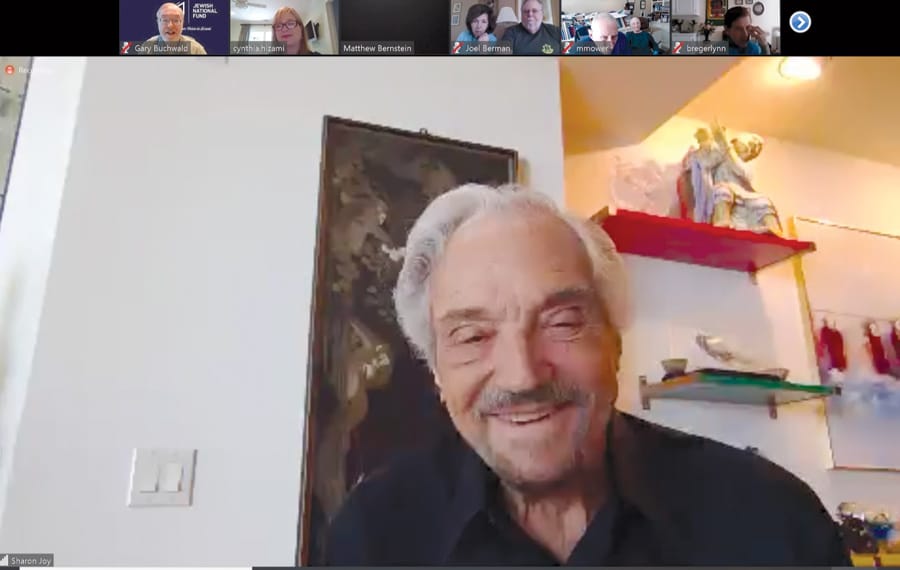
On March 24, the pro-Israel organization held a Zoom call with Emmy-winning actor Hal Linden, with the icon of the screen regaling viewers with tales from his storied past. The call also featured tax tips to consider during this turbulent time from JNF’s planned giving department.
“As senior members of our community stay indoors to protect their health, they may feel disconnected from the outside world,” Matt Bernstein, chief planned giving officer at JNF, said in a statement. “More than ever before, we want our partners to know that they’re part of the Jewish National Fund-USA Family, and families stick together when the going gets tough.”
“Our message to our Jewish National Fund-USA family is clear,” Bernstein continued. “If you are feeling lonely or isolated, call or email us, we’re always happy to speak.”
JNF describes itself as the leading philanthropic organization for Israel “that supports critical environmental and nation-building activities in Israel’s north and south.”
Israeli musical artist Idan Raichel performed a live-streamed concert from his living room, on March 22. Courtesy of Jewish Agency for Israel
Israeli musical artist Idan Raichel performed a live-streamed concert on March 22 from his living room.
Jewish Agency for Israel — which works to secure a vibrant Jewish future — teamed up with Raichel in organizing the concert.
“Idan Raichel has performed throughout the globe promoting his belief in the power of music to uplift and unite people. In these challenging times, The Jewish Agency is delighted to bring the music of Idan Raichel into homes around the world, enabling all to join together and share in a message of love and hope from Israel,” the organization said in a statement.
The event was promoted with the following message of social distancing; “Let’s stay home to save lives. We’re going to get through this.”
Isa Zweiback, daughter of Stephen Wise Temple Senior Rabbi Yoshi Zweiback, made a blood stem cell donation this week. Courtesy of Facebook
Isa Zweiback, the daughter of Stephen Wise Temple Senior Rabbi Yoshi Zweiback, spent this past week receiving daily injections in preparation for a peripheral blood stem cell donation.
Two years ago, when she was a senior in high school, Isa decided to do a cheek swab and put her name down on the national bone marrow registry through the organization Be The Match, a global leader in bone marrow transplantation.
Approximately one month ago, she got a call telling her she was a potential match for a patient who has leukemia.
Of the experience of donating her stem cells, “I have gained a lot of perspective through this relatively short, yet impactful month,” she said on Facebook. “I have learned not to take things for granted and to never underestimate the importance of feeling well, physically and mentally. In a time with so much fear and darkness we must forever count our blessings.”
In a message to the Journal, her father said he was proud of his daughter for finding a way to give back even at a time when people are under “safer-at-home” orders in an effort to curb the spread of the coronavirus.
He called himself a “proud abba,” using the Hebrew word for “father.”
Dr. David Pelcovitz. Courtesy of Yeshiva University
Dr. David Pelcovitz, who holds the Gwendolyn and Joseph Straus Chair in Psychology and Jewish Education of the Azrieli Graduate School of Jewish Education and Administration at Yeshiva University, led a March 24 teleconference, in which he discussed the emotional challenges of the coronavirus.
“Allow yourself to be anxious,” he said. “This is realistically a scary kind of time.”
Even as authorities are instructing people to remain indoors to the curb the spread of coronavirus, he spoke about the “Power and importance of exercise. The body is not set up for chronic exposure to stress. We do much better if we take some kind of a break to let our hearts and our neshamahs (souls) breathe a little bit.”
“We replenish ourselves, when we are able at times to shut off,” he continued.
The hourlong discussion focused on addressing the emotional concerns of ourselves and families during times of uncertainty.
Pelcovitz said the unpredictable nature of the coronavirus and what is in store for everyone is part of what it makes these times stressful. It is “hard to tolerate situations that are uncontrollable or uncertain,” he said.
By coming to terms with our stress, by acknowledging our anxiety, we will be better equipped to deal with the stressors, he said. He described this as “the power of naming the monster [or] labeling an emotion.”
Another challenge is social distancing, he said. People are “all wired for connection. Isolation from friends is particularly difficult or confusing.”
He advised parents who are at home with their children to speak to them about what is happening in the world. He said parents ought to explain to them that, “this is a process, not an event. You can’t mess it up as long as you let the child talk about what’s on their mind or heart.”
Be honest, he said. Tell your children, “It’s likely not to be getting better for a bit of time.”
One suggestion he gave for those finding it difficult to cope is to find ways of expressing gratitude.
“Those who keep a gratitude journal, the research shows that they are healthier and happier,” he said.
“It’s crucial at a time like this to allow ourselves to experience a full range of emotions,” he said. He quoted the late Israeli Prime Minister Golda Meir, who said, “Those who don’t know how to weep with their whole heart don’t know how to laugh either.”
There is “real wisdom in her words,” Pelcovitz said.
Shifting the conversation to the upcoming holiday of Passover, he said one of the most painful things is people who are preparing to be making a seder alone. However, there is a “big difference between being lonely and being alone,” and he encouraged those who can to find ways of connecting with loved ones at this time.
“Friendship doubles joy and cuts grief in half,” he said.
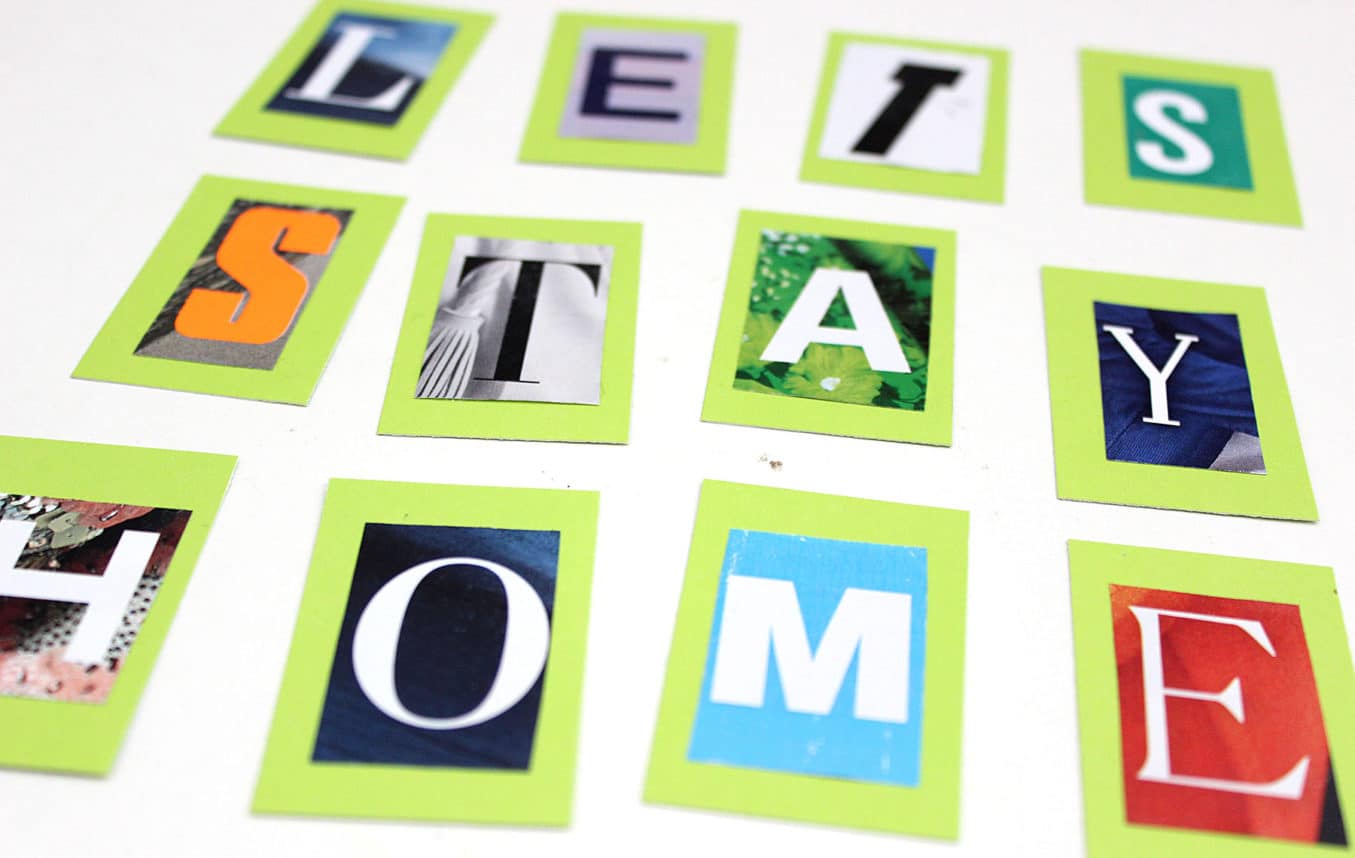
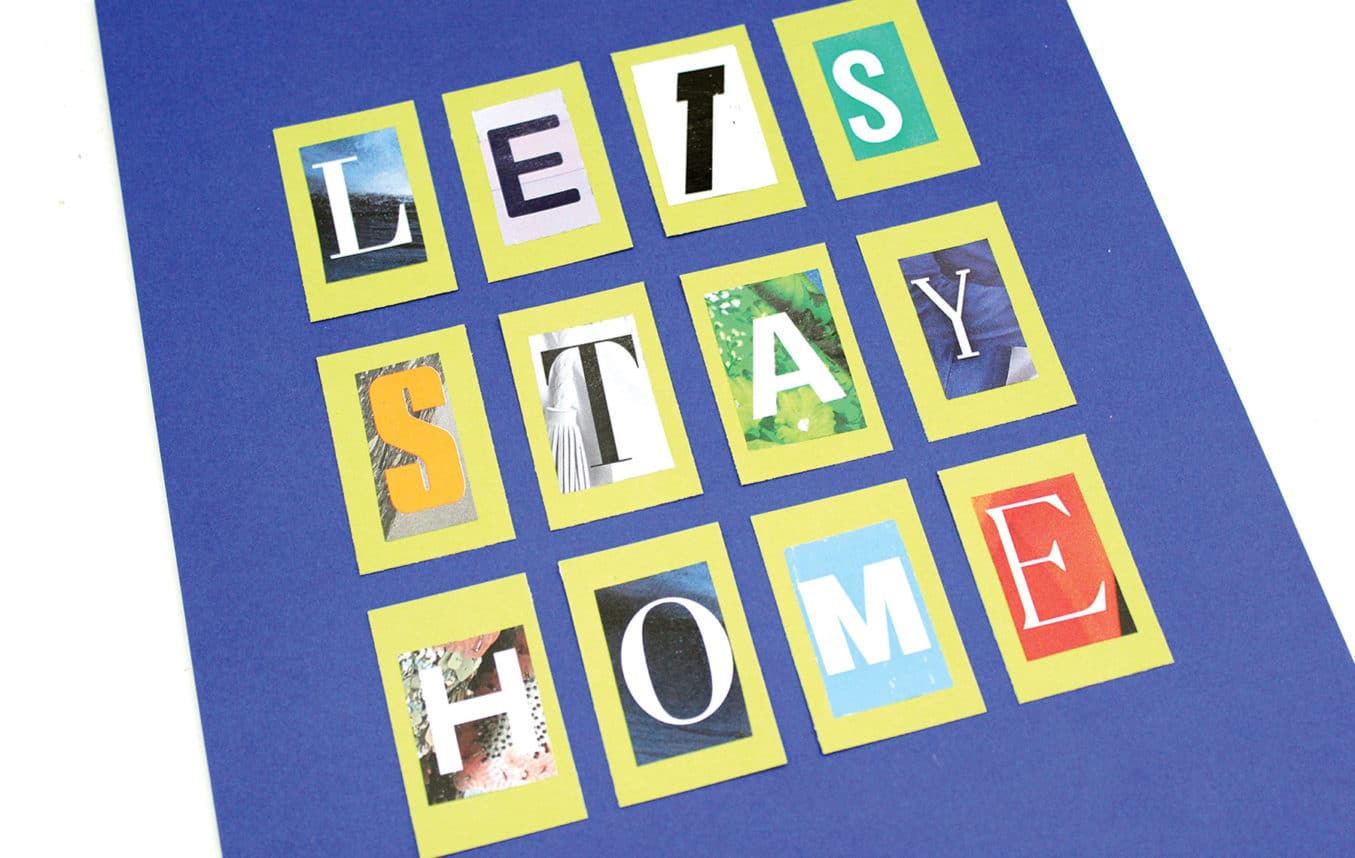
I’ve always been a homebody, so even before it was required for us to shelter in place during the pandemic, “Let’s Stay Home” was my weekend mantra. This sign made with letters cut out from old magazines is a good reminder of how to keep ourselves safe now. But it will also remind us of the importance of home and family when this crisis is over and we can all go out into the world again.
Like many of you I’m sure, my mental state in the past few weeks has ricocheted between panic, depression and hope. The times I’ve been happiest have been when I’ve been crafting. There is something therapeutic about the process of completing a creative project. I say again and again that creating is the opposite of destruction, and when we create something we’re counteracting the all the bad stuff going on. So I hope that in your free time at home, you’ll be able to flex your creativity.
Be safe. And “let’s stay home.”
What You’ll Need: Old magazines and newspapers
Scissors
Colored paper or cardstock
Glue stick
1. Go through magazines and newspapers to find the letters in “Let’s Stay Home.” Look for larger letters, which you will usually find in headlines and advertisements. This would be a good activity to involve the kids. Cut out the letters leaving a rectangular border around them.
2. Placing the letters on a grid of colored boxes will make the sign look more like art instead of a ransom note. Cut out rectangles from colored paper. These rectangles should be bigger than the letters. Adhere the letters to the colored rectangles with a glue stick.
3. Apply the mounted letters to another piece of colored paper. You can display the sign as is or place it in a frame.
Jonathan Fong is the author of “Flowers That Wow” and “Parties That Wow,” and host of “Style With a Smile” on YouTube. You can see more of his do-it-yourself projects here.
This year’s roundup of the latest Passover picture books includes a number of different takes on the holiday. They all emphasize the joyful spirit of the day and especially the love of family and tradition. Chag sameach to all!
It is a well-known fact that prolific children’s author Lesléa Newman likes cats. A previous cat story won the Sydney Taylor Book Award for best Jewish picture book in 2016, and she is also the upcoming recipient of the 2020 Sydney Taylor Body-of-Work Award. Her 2015 book, “Ketzel, the Cat Who Composed,” presented a true story about a musical cat and her owner. This newest book is simpler, more poetic and just lovely. The lush and large illustrations complement the simplicity of the text and bring family Passover traditions to life.
The pages depict the bustle of a Passover celebration inside a busy household, while outside, a lonely white kitten sits and waits in a tree. Each page shares a few words such as, “Inside, there was laughter. Outside, there was silence.” On the following page: “Inside, a boy hugged his family. Outside, a kitten sat alone.” The kitten and the boy have rituals that mirror each other. “Inside, the boy broke the middle matzo in half. Outside, the kitten split a twig in two.” However, the kitten goes hungry while the boy eats the festive meal. When it’s time for the boy to open the door for Elijah, the hungry kitten peeks inside, and the boy and his loving family welcome a sweet furry pet to a new home.
The illustrator has depicted the large family as multiracial and put kippot on the heads of all male guests. (The kitten is adorable.) The story of Passover and the ritual of opening the door for Elijah the prophet is explained in the author’s note at the end of the book.
“Miriam at the River,” by Jane Yolen.
Illustrated by Khoa Le. Kar-Ben Publishing, 2020.
Another famous children’s author has a Passover book for this spring, and this one is a fresh take on the story of Moses as seen through the eyes of his sister, Miriam. Jane Yolen, who has written over 300 books across all genres and age ranges, has retold Miriam’s story with a lyrical voice of great power.
Yolen imagines Miriam as a 7-year-old Egyptian slave who follows “God’s voice” to place her baby brother in a basket on the waters of the Nile. The blues, greens and browns of the color palette and the fluid strokes of watercolor truly enhance the story of this baby carried on his dangerous journey. The image of a sleeping infant in a reed basket with two youthful brown hands letting him go is quite moving. Miriam, future prophetess, reflects on the rippling waters of the river as she imagines a different parting of waters in God’s future plans for her.
This exquisite retelling of the poignant beginnings of Moses’ life is welcome particularly because it emphasizes the courage and selflessness of the female characters of the biblical story.
“The Passover Mouse,” by Joy Nelkin Wieder.
Illustrated by Shahar Kober. Doubleday, 2020.
It’s unclear why quite a number of children’s Passover books feature mice as main characters. Nevertheless, the thieving mouse in this story doesn’t steal any matzos, as is often the case, but runs off with bread pilfered from a pile of swept-up chametz.
It’s the morning before Pesach begins and the villagers in this brightly depicted shtetl town have all swept their homes clean of anything leavened. When the little mouse steals from Rivka’s house, her neighbors watch in alarm as he goes in and out of various homes, thereby nullifying their previous cleaning work and causing them to suspect one another’s diligence.
Any parent who has ever cleaned a floor and then watched the kids track in dirt two minutes later will feel their frustration. But as we well know, communities can come together when there is an outside menace that affects them all, and they turn to one another with kindness and forgiveness by the story’s end. Even the mouse gets to enjoy a bit of a matzo treat.
For those kids who are drawn to outer space stories, this over-the-top rhyming tall tale featuring a family of Jewish astronauts may fit the bill.
Young Asteroid Goldberg and her family are traveling home from Pluto just in time for Passover, but they are prevented from landing before the holiday begins. It is up to Asteroid to find matzo balls (from the moons of Jupiter) and matzo (broken off from Saturn’s rings) and gather the whole mishpachah from far-off planets to celebrate a gravity-defying seder on the spaceship. The lively illustrations are fun and goofy (especially the space dog) and so is the story.
“Who Will Ask the Four Questions?” by Naomi Ben-Gur.
Illustrated by Carmel Ben-Ami. Translated by Gilah Kahn-Hoffmann. Green Bean Books, 2019.
Passover is coming and it looks like big brother Eitan is going to have to reluctantly relinquish his role as the asker of the four questions — and he’s not happy about it. Little sister Evie is now old enough to sing the ritual song, but, even after numerous practices with helpful Grandma Naomi, she is still pronouncing “Ma Nishtana” incorrectly.
The story takes place in Israel, and the illustrations of a large, loving family celebrating together are vibrant and cheerful. It turns out that sometimes big brothers can be kind to their siblings, after all. This book was translated from the original Hebrew publication.
Lisa Silverman is the director of the Burton Sperber Jewish Community Library at American Jewish University.
Randi Alfasso died March 15 at 63. Survived by husband Albert; sons Adam, Mathew; sister Debbie Fell; brother Ron Ganzfried. Mount Sinai
Leonard Beezy died March 19 at 99. Survived by daughter Barbara; son Joel; 1 grandchild; 1 great-grandchild. Groman Eden
Judith Boksenbaum died March 19 at 82. Survived by husband Wolf; sons Peter (Ella), David (Wendy); 4 grandchildren. Mount Sinai
Marilyn Carnow died March 12 at 90. Survived by daughter Linda (Joe) Korosec; sons Abraham (Debra), Larry (Jasmine). Malinow and Silverman
Suzanne Cherry died March 12 at 93. Survived by husband Ivor; daughter Francoise (Jeffrey) Cohen; son Evan (Meri); 4 grandchildren; sisters Rita Puritsky, Rose (Mervin) Maier. Mount Sinai
Ann Dach died March 6 at 96. Survived by daughter Sue (Lyle); 4 grandchildren; 9 great-grandchildren. Hillside
Alfred Ertel died March 2 at 99. Survived by daughter Barbara (Walter) Zifkin; 2 grandchildren. Mount Sinai
Alona Gabbay died March 11 at 52. Survived by husband Sohail; daughter Tania; sons Alex, Tyler; 1 grandchild; sisters Rina, Doris, Carmela; brothers Raphy, Michael. Mount Sinai
Dianne Goldman died March 6 at 91. Survived by daughters Cindy (Michael) Brines, Lynne (Bruce) Pasternack, Joyce (Barnett Protas); 6 grandchildren; 4 great-grandchildren; sister Joan Cole. Mount Sinai
Sean Goodman died March 6 at 35. Survived by mother Abbe; father Stephen; brothers Aaron, Michael. Mount Sinai
Patricia Gumbiner died March 6 at 89. Survived by daughters Francine (Edward), Judy (Corey); son Barry; 4 grandchildren; 2 great-grandchildren. Hillside
Arlene Harris died March 11 at 93. Survived by sons James (Corinne), Richard (Sherry), Alan (Simone); 7 grandchildren; 3 great-grandchildren. Hillside
Myrtle Kramsky died March 10 at 95. Survived by daughter Barbara (Herb). Hillside
Nathan Krotinger died March 21 at 97. Survived by daughters Michelle (Aaron) Wolf, Eve (David) Panush; 4 grandchildren. Malinow and Silverman
Marcia Mathason died March 6 at 77. Survived by husband Bruce; daughter Karen (Ryan) Turner; sons Spencer (Letty) Siegel, Cris (Katie) Siegel, Jason (Sophie) Siegel; 5 grandchildren; brother Jack Gurian. Mount Sinai
Arthur Herbert Muller died March 10 at 92. Survived by sons Eric (Kathryn), Bill (Judy); 4 grandchildren. Mount Sinai
Jack Nierob died March 8 at 95. Survived by daughter Dores; son Alan (Tobi); 5 grandchildren; 5 great-grandchildren. Hillside
Michael Owens died March 12 at 78. Survived by sons Craig (Aracely), Keith (Djamilla); 4 grandchildren; brother Neil (David). Hillside
William Harold Podorzer died March 6 at 82. Survived by wife Madeline; daughters Yvette (Paul) Joffe, Sherry Hess; 3 grandchildren; brother Arthur. Mount Sinai
Dorothy Irene Rosengard died Feb. 28 at 96. Survived by son Phillip (Ellen); 2 grandchildren. Groman Eden
Matilda Schwartz died March 4 at 91. Survived by daughter Kathy (Raymond) Roundtree; son Robert (Debra); 2 grandchildren; sisters Rachel Berro, Sandra Feldman, Barbara Guss. Malinow and Silverman
Larry Fred Schwimmer died March 14 at 89. Survived by wife Tobie; daughters Maria (Jeffrey) Schechter, Marilyn (Thomas) Ezrin; son Howard (Linda); 10 grandchildren; 1 great-grandchild. Mount Sinai
Monique Senin died March 8 at 79. Survived by daughters Christine (Bob) Kuskin, Nathalie Ching; sons Christopher, Michel; 12 grandchildren. Mount Sinai
Irving Silver died Feb. 29 at 103. Survived by son Jack (Marilyn); 2 grandchildren; 3 great-grandchildren. Mount Sinai
Diane Solomon died March 19 at 71. Survived by husband Michael; daughter Lisa (Cesar) Mayorga; son Matthew; 5 grandchildren; brother Rubin (Theresa) Nicols. Mount Sinai
Regina Sperber died Feb. 8 at 81. Survived by husband Murray. Home of Peace
Sandra Diane Stein died Feb. 25 at 80. Survived by daughters Laura (Sam Goldfeder), Leigh (Joe McNamara); 4 grandchildren; brothers Robert, Jack. Montefiore Cemetery, Jenkintown, Pa.
Bonnie Sugar died March 7 at 74. Survived by sons Michael (Lauren),
Joshua “JB” (Alicia); 2 grandchildren; sister Roberta Sue Buckner. Mount Sinai
Dolores Warren died March 13 at 88. Survived by daughter Dessie (Gerald) Clark; 2 grandchildren; 3 great-grandchildren; sister Ruth Hirsch; brother Harold Cline. Mount Sinai
Jack Weiss died March 4 at 86. Survived by wife Susan; daughters Rosalyn Sokoler, Edie Schwartz; 4 grandchildren; brother Melvin. Mount Sinai
Byron Winner died Feb. 24 at 93. Survived by daughter Cori (Larry) Drasin; son Craig; 2 grandchildren. Chevra Kadisha
Boris Yaro died March 11 at 81. Survived by wife Jill; daughter Nicole Good; son Michael; brother Max. Mount Sinai
The National Gallery of Art in Washington, D.C., will return a drawing by Pablo Picasso to the heirs of a German-Jewish banker who sold the work at a loss because he feared the Nazis would confiscate his estate.
Paul von Mendelssohn-Bartholdy, a descendant of composer Felix Mendelssohn, sold the pastel work, titled “Head of a Woman,” in 1934, along with at least 15 other significant artworks. He died in 1935.
In 1938, Mendelssohn-Bartholdy’s family bank, Bank Mendelssohn & Co., founded in 1795, was seized by the Nazis and transferred to non-Jewish ownership.
“Head of a Woman” was sold to art dealer Justin Thannhauser in 1934. The National Gallery of Art acquired the work through a donation in 2001, according to The New York Times.
The museum said it decided to settle with Mendelssohn-Bartholdy’s heirs “to avoid the heavy toll of litigation,” not because it agreed that the heirs’ claims were valid, according to the report.
Heirs of Mendelssohn-Bartholdy, including his great-nephew, the German scholar Julius Schoeps, also reached settlements in 2009 with the Guggenheim Museum and the Museum of Modern Art in New York over two other Picassos that Mendelssohn-Bartholdy sold to Thannhauser. Those artworks remain in the museum’s collections.