fbpx

March 31, 2020

Israeli Research Institute Begins Testing Coronavirus Vaccine on Rodents, Report Says

The Israel Institute for Biological Research (IIBR) reportedly has started testing a prototype of a coronavirus vaccine on rodents.

Reuters reported on March 31 that this was according to a source in the IIBR; the source didn’t specify what type of rodent was being used in the trial. Israeli Prime Minister Benjamin Netanyahu’s office said in a statement that the IIBR is “preparing a model for commencing an animal trial.”

IIBR Chief Innovation Officer Eran Zahavy told reporters last week that the institute has a distinct, unspecified animal ready for testing, pointing out that animal testing is difficult when it comes to coronavirus medicinal trials.

“This disease is not affecting animals,” Zahavy said. “It’s not enough only to detect neutralizing antibodies in the animal. You really want to see them getting sick and getting better by this vaccine.”

Haaretz had reported on March 18 that the IIBR had developed a “significant breakthrough” in a coronavirus vaccine; the Israeli Defense Ministry denied that report. The IIBR is an Israeli government defense research institute.

In February, the Galilee Research Institute (MIGAL) announced that it could have a coronavirus vaccine developed in 8-10 weeks and then obtain approval for it in 90 days.

Israel currently has 5,358 cases of coronavirus and 20 deaths. National Security Adviser Meir Ben-Shabbat said on March 31 that Israel’s social distancing measures will start to be relaxed after Passover, although he cautioned that the country is “still in a dangerous area. All it takes is one day like Purim, or one local outbreak, in order to thwart all our efforts, and therefore we are obligated to continue with the existing limitations and follow all instructions.”

Israeli Research Institute Begins Testing Coronavirus Vaccine on Rodents, Report Says Read More »

Jewish High School Donates 2,000 N95 Masks to Medical Centers

Shortly after de Toledo High School closed on March 10 because of the COVID-19 pandemic and moved to virtual learning, Head of School Mark Shpall got a call from the school’s business manager, David Marcus, who said, “Just to remind you, we have all these N95 masks. What do you want to do?”

The school, which is located in West Hills, had almost 2,000 masks in its emergency storage after the 2019 fires that ravaged the San Fernando Valley. But with students off campus, there was no immediate need for them.

Shpall’s first call was to his brother Andy, a physician at Kaiser Permanente Woodland Hills Medical Center. Andrew Shpall connected his brother to the hospital’s medical director, Dr. Greg Kelman. And on March 20, Mark Shpall delivered 1,300 N95 masks to the hospital. Several hospital staff met him at the curb as he unloaded the boxes from his car. “One of the doctors in the picture, my brother said later, had tears in his eyes,” Mark Shpall said.

That same day, David Marcus delivered 700 masks to the nearby Los Angeles Police Department West Hills Police Stations Topanga location with which the school has a “deep relationship,” Mark Shpall said. “And then at the same time, I got contacted by one of our alumna, who graduated in [de Toledo’s] founding class of 2006.”

Tali Lee is an ICU nurse at Dignity Health Northridge Hospital Medical Center. The Toluca Lake resident is one of several nurses working in a COVID-19 positive unit. Shpall had been her basketball coach at de Toledo, then New Community Jewish High School, and Lee had seen a post on an alumni social media page about the school’s mask donations.

“I have been saying kindness is infectious. I have been saying that to everybody. Even though this virus is infectious, so is kindness. A mitzvah goes a long way.” — Tali Lee

“I was so happy,” she said. “We all need it. I have friends at Cedars, UCLA … we all went to nursing school together.” At the same time, she wondered if the school might have any more. So she reached out to Mark Shpall, who found 50 more masks, which he delivered to Lee. Another de Toledo staff member, Ellen Brown, who manages donor and alumni relations, found a package of 10 masks, which she also got to Lee. Lee delivered them to her hospital’s command center.

Mark Shpall also responded to a call from the addiction treatment center Beit T’Shuvah. “They put up on their Facebook page that they were in dire need of cleaning supplies, toilet paper, hand sanitizer, soap,” he said. “We had all this sitting around because we have no people here. My maintenance staff filled up a big van with 20 boxes of different supplies that I drove down there.”

“I’m not good at sitting around,” he added. “It gave me something to do that I felt was helpful to everyone else. I have to say in some ways it was a little selfish. It gave me a purpose.”

However, he added, “This isn’t about me. Our mission is to raise the next generation of Jewish leaders who go out and make a difference in the world. … We talk about all of our students graduating from our internal course of AP kindness. It’s a life course. It is the course they receive by being here for four years. And I thought this was just one more way for me and the school to model for our school community how we can be kind to others especially in difficult moments.”

Since Mark Shpall and Lee connected, both have been on a mission, independently, to reach out to other individuals and organizations that may have supplies sitting around that health care workers and first responders desperately need. Shpall sent an email to the head of every Jewish school in the country as well as the heads of many independent schools throughout the state, basically stating: “Hey, we realized we had these in our emergency supplies. Do the same thing,” he said. “And I heard back from a number of schools.”

Added Lee, “I have been saying kindness is infectious. I have been saying that to everybody. Even though this virus is infectious, so is kindness. A mitzvah goes a long way.”

Jewish High School Donates 2,000 N95 Masks to Medical Centers Read More »

L.A. Ambulance Gift to Israel Drives Mid-East Coexistence Meme

Los Angeles – A single act of charity can reverberate around the world. Such was the case with Myrtle Sitowitz and the donations of a few of her friends from Los Angeles to Magen David Adom (MDA) in 2016, which allowed Israel’s paramedic service to purchase a new ambulance. The two emergency medical technicians who drive that ambulance —  Avraham Mintz who is Jewish and Zoher Abu Jama who is Muslim — are now being feted as models of coexistence, after a picture of them in the middle of a prayer break made the social media rounds.

“I just can’t get over it,” Sitowitz said. It’s mind-boggling.” Sitowitz, who lives in Beverly Hills, has been long involved in pro-Israel charitable efforts, including a stint as the chair of the local women’s division of Israel Bonds.

Sitowitz and her friends made their donation to MDA through American Friends of Magen David Adom (AFMDA), whose name is emblazoned on the ambulance that Mintz and Abu Jama drive in the southern town of Beersheba. Aso written on the ambulance is “Given by the Women in Action in Los Angeles.”

“I saw what was going on in Israel,” Sitowitz said. “While the rockets were flying, too many of the women I know were sitting on their couches eating ice cream. So I wrote them all a letter asking them to help me donate an ambulance and I showed them each a copy of my own check. Then I followed up with phone calls. They needed to [step] up to the plate. I could not believe the response I got.”

“Only in Israel — a democracy animated by chesed — is an ambulance dedicated to the people of Israel by the women of Los Angeles, a project spearheaded by our very own Myrtle Sitowitz,” said Rabbi Kalman Topp, senior rabbi at Beth Jacob Congregation of Beverly Hills. “Am Yisrael Chai and kol hakavod, Myrtle,” he said.

Mintz and Abu Jama said their joint prayer break is standard practice during their shift. “We try to pray together, instead of each one of us taking the time for himself, because we have a lot of situations we’re dealing with right now,” Mintz told the New York Times. In the same interview, Abu Jama said now is the time for people from diverse backgrounds to come together (during COVID-19). “The whole world is battling this,” he said. “This is a disease that doesn’t tell the difference between anybody, any religion, any gender. But you put that aside. We work together. we live together. This is our life.”

Even celebrities took to their social media accounts to retweet and share the inspiring snap with their fans. Gene Simmons, the lead singer of rock band KISS, posted the photo on Twitter to his almost 1 million followers, and wrote that it showed “anything is possible.”

MDA, Israel’s emergency medical service and the Jewish state’s representative to the Red Cross, has been on the frontlines of the coronavirus epidemic. The disease has now claimed the lives of 17 people in Israel, with the number of positive cases north of 4,000.  MDA has seen its call volume grow exponentially, from a usual 6,000 calls daily to a day several weeks ago when it received more than 82,000. The paramedic service has used all of its 25,000 volunteers and 2,500 full-time staff to respond to the emergency.

“God said, ‘Myrtle, try and help us here. I am,’” Sitowitz said. “Now people can see what Magen David Adom is all about. Maybe this will help the peace effort. I’m crying here.”

L.A. Ambulance Gift to Israel Drives Mid-East Coexistence Meme Read More »

‘Zionists Not Welcome’ Graffiti Found on Israeli Coffee Bar in Toronto

Graffiti stating “Zionists not welcome” was found on an Aroma Espresso Bar in downtown Toronto on March 27.

B’nai Brith Canada posted a photo of the graffiti on Twitter after being alerted about it, writing: “This despicable hateful graffiti defacing an Aroma in #Toronto will not be accepted. @TorontoPolice have been notified. #Antisemitism.”

United Jewish Appeal (UJA) Federation of Greater Toronto wrote in a March 27 Facebook post that it was aware of the graffiti and it has been in contact with the Toronto police and Aroma Canada on the matter.

“We stand in solidarity with this wonderful community business,” the Toronto UJA organization wrote. “There must be no place for hate in our city. We urge anyone who may have information on this crime to contact Toronto Police Service immediately.”

Friends of the Simon Wiesenthal Center CEO and President Avi Benlolo similarly condemned the graffiti in a statement and called on the police to investigate it as a hate crime.

“It is absolutely disgusting that in this day and age, we are still seeing such vile and anti-Semitic attacks on Jewish-owned businesses,” Benlolo said. “This is reminiscent of the attacks endured by Jewish businesses in Europe leading up to the Holocaust and serves as a warning sign for all of us that we must be vigilant and stand united to resist anti-Semitism and hatred in all its forms.”

Aroma is an Israeli chain that has more than 100 locations worldwide. There have been several efforts to boycott Aroma due to its Israeli origins. For instance, in June 2018, there were flyers in downtown Toronto calling people to “boycott Aroma,” arguing that “every cup of coffee you buy at Aroma helps strengthen this illegal occupation and Israel’s campaign of violence against the Palestinians.”

Canadian government data released in July found that there was a 4% decline in anti-Semitic hate crimes from 2017 to 2018.

Centre for Israel and Jewish Affairs President Shimon Koffler Fogel said in a statement at the time, “It is deeply concerning that, despite a decline in hate crime generally, incidents targeting Jews remained relatively stable after a sharp spike in 2017. While most Canadians reject anti-Semitism, this data confirms the persistence of Jew-hatred — which is seeing an alarming global rise.”

‘Zionists Not Welcome’ Graffiti Found on Israeli Coffee Bar in Toronto Read More »

Social Distancing in France

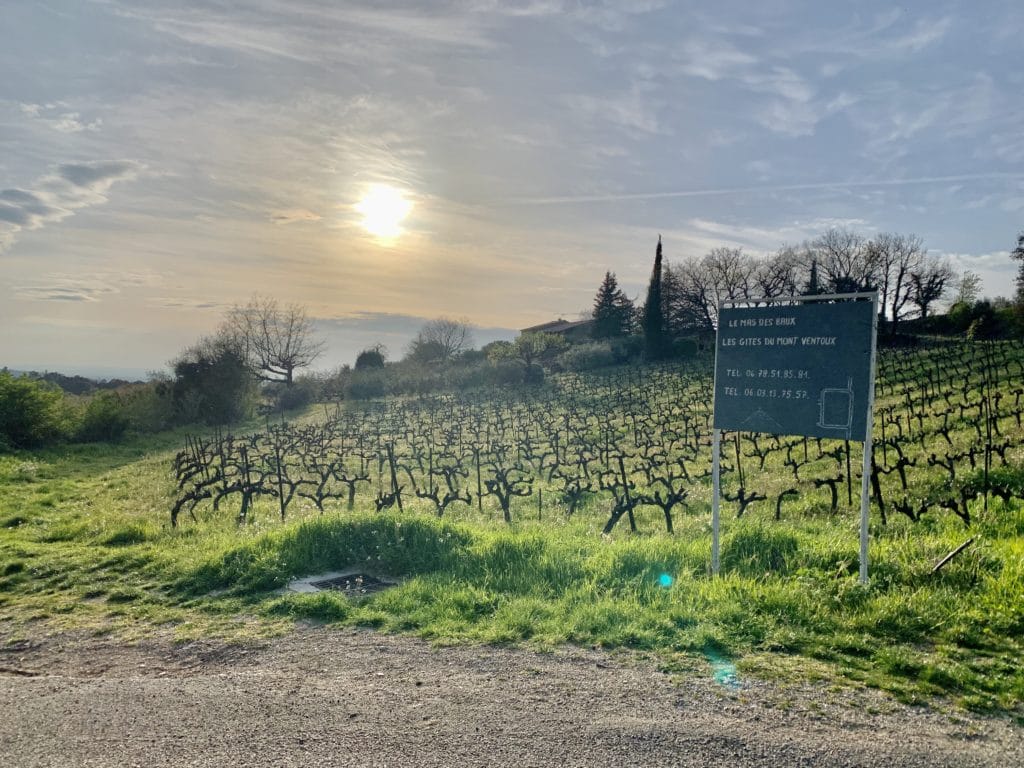
Greetings from Les Baux.

In my head right now, I am speaking that sentence in Garrison Keiler’s deep baritone voice ( “Greetings from Lake Woebegone…”).

That makes me smile because in just three days I have morphed into this wierd cross between a lumberjack, a hearth-witch (fine, I was always a hearth-witch) MacGuyver and a kind of Lady Garrison Keiler.

Here I am, world! As solitary and ensconced in the remote hills as can be except now I am speaking in this low, fine voice, reporting to my imagined listeners from the acres of farmland and vineyards of the mountains of Bedoin, France, to deliver the daily report.

And it’s a fine day here in Les Baux.

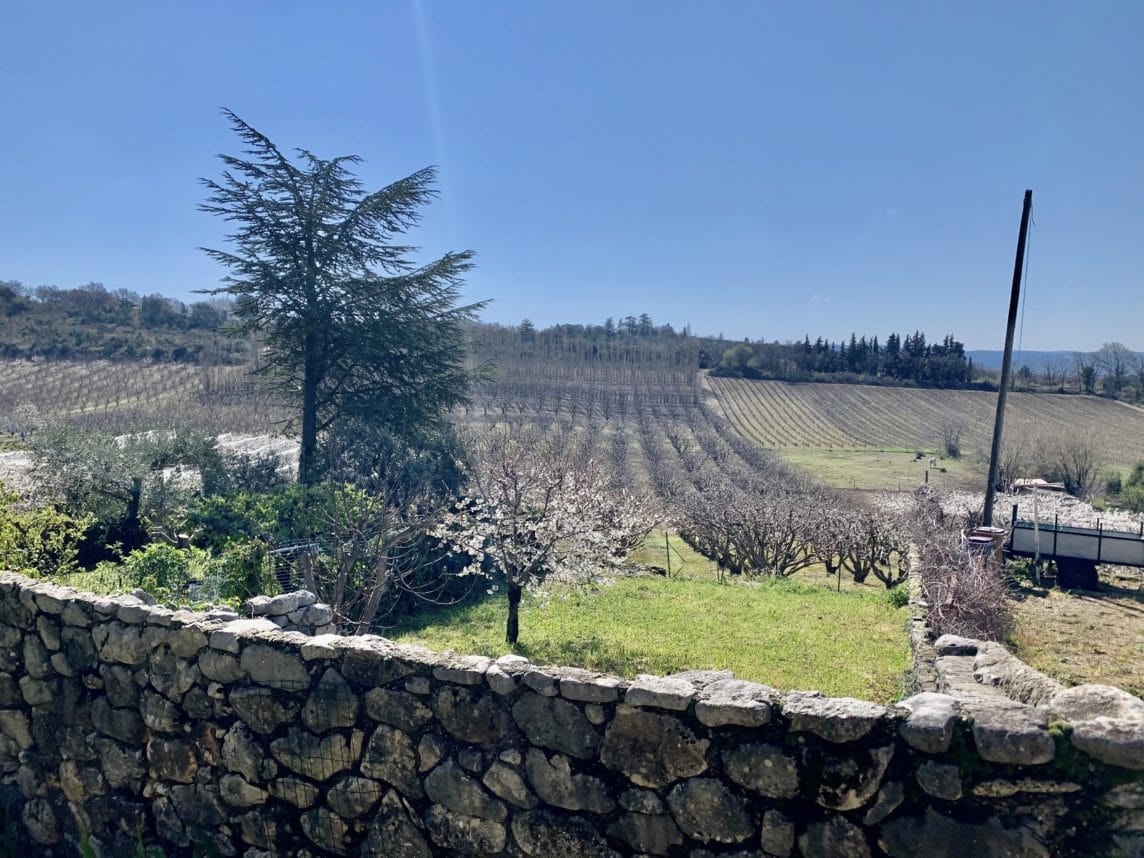
The sun is golden-warm and the breeze is nippy-cold. The morning air smells like wood burning from the neighbors fireplace. It is very rural here but my friend’s beautiful little Hamlet-house–which has become my new home– is in the tiny cluster of houses in this tiny village. The houses are ancient stone with the aforementioned wood burning ovens, or they are terra cotta colored with red tile roof, with magenta and green and blue and orange colored flowers in clay pots, and dusty cats posed next to them, lazily drumming their feathered tails in a slice of sunlight.

You may be thinking, what on earth is a nice Jewish girl from Los Angeles doing during the Covid-19 lockdown, all by herself, in the middle of a rural French village? Well, it all started because in early March I was in Tours for work. Tours is a beautiful little French city in the Loire Valley. I was there to perform the Thomas Ades opera “Powder Her Face”. Then Covid-19 came roaring in and everything was cancelled. My colleagues flew home but I felt raw terror of flying. I was terrified of exposing my father—who lives next door to me in LA and is older and vulnerable— to whatever I might have picked up in the airports. Sensing that it might be safer to stay put in France, I did exactly that. And, I reasoned, my Airbnb in Tours was paid up till April anyways. Or so I thought. One week after Macron announced the lockdown, my French Airbnb host demanded that I vacate her apt. Terrified of getting stuck in France with dwindling flights home and at a time when friends could not take a guest into their homes, and with Airbnbs being forbidden to operate, I was rescued by friends in Les Baux. Their guest cottage was free. “Come.” they said. Come here and be safe. So I did.

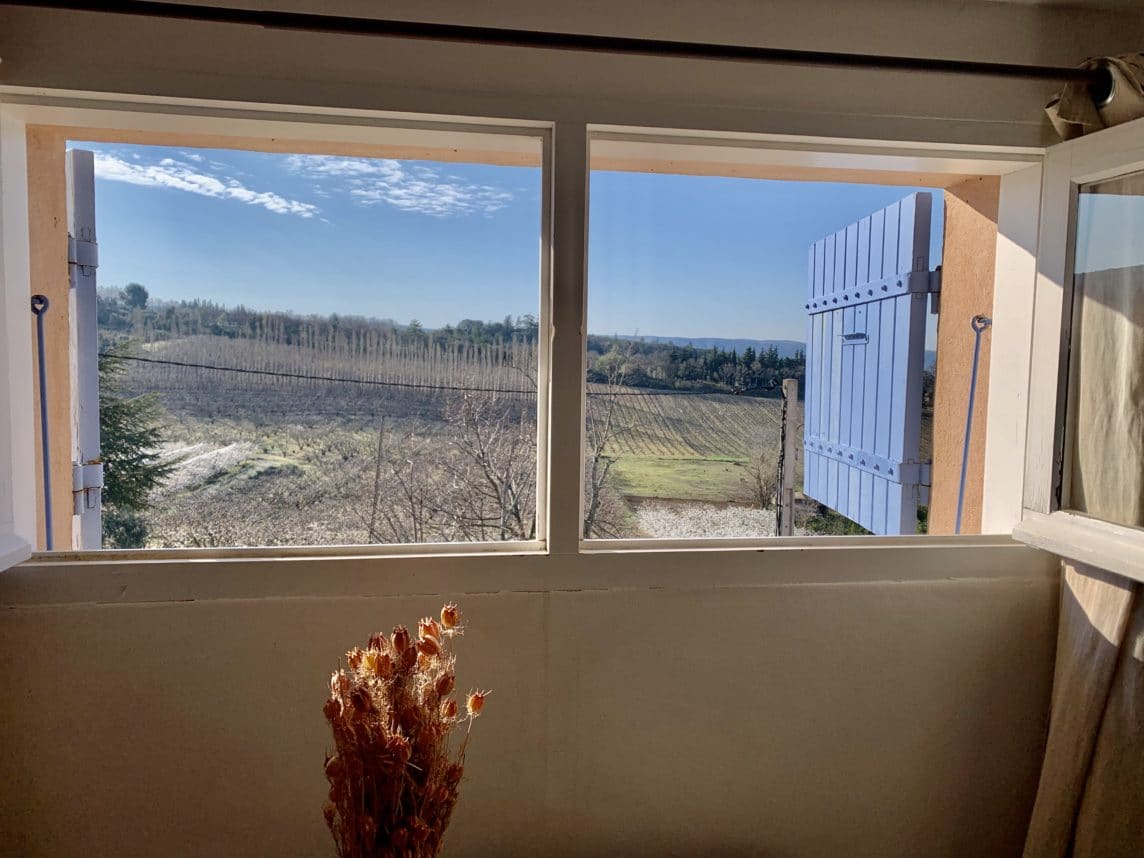
As I write this I have the terrace door open and I can hear the sound of someone’s tractor in the field, plus the lip-trembling fluttering sound of wings touching air, from a flock of tiny birds—are they humming birds?– swooping down, delicately, in my back deck.Right now as I type, I can hear the neighbors horses sneezing or whinnying or talking to each other in the field where they graze. I have a cup of hot Darjeeling with milk and Walkers Shortbread cookies on a plate next to me. I am writing and it is blissful.

Yesterday, my kind friend, who owns the house, and whose family lives a quarter mile away– delivered a cardboard box of groceries.  I had made a list. She left them on the doorstep and left quickly to keep safe distance.

The most exciting thing in the box were the carrots. They were covered in soil, blackened with earth. I washed them with hot water in the sink.

“Sorry I couldn’t find everything on your list.” she had texted me earlier. ” I should have just told you what was in season. Right now its asparagus and strawberries.”

I was slightly embarrassed; it’s a bit of a clueless city-slicker mistake, the things I requested (brussel sprouts!) are nowhere near in season.

Next time, I will do the shopping for her and her family. We have decided to trade off, to keep all of us out of the markets as much as possible.

And now I am sitting, with the terrace door open, listening to the breeze, and the sound of what I think is a bumblebee out back.

It is so beautiful here that it feels easy to forget that  that my 78 and 82 year old parents are far away from me in Los Angeles, and that I worry for their well being and safety and the safety of my older aunt and uncle and cousins, that I worry for my immuno-compromised older sister, that I am worried about my vulnerable friends, desperately miss the touch of my friends, and massage, and my Sansa and her sweet warm body on my lap, my beloved Sansa dog who is not with me.

It’s almost enough that if I squint I could forget the daily deaths popping up on my Faceboook.

It’s almost enough to forget that I am currently doing this whole self-isolation without any other mammal for company, in a country that is not my own, and with no idea how long any of this will last, and will I be able to sing in a theatre with humans again—its almost like if it weren’t for those things, I could just swoon about the fact that this countryside scenario here is my childhood dream come true.

So I try to focus on the beauty. Happily, I have an endless capacity for seeing beauty, and a matching capacity for solitude, one that would shock most people even in non-pandemic times, even if the latter is more complex.

I sleep very well here.

The house is cold—but somehow I like it. I put kindling on the wood burning stove at night, even though its more for the poetic value than actual warmth ( Look at me trying to stay warm!  I am Mimi in La Boheme; I will sing *che gelida manina*, yay, at long last I get to be in Puccini opera, even if there’s no one here to witness… )

In truth, I had to call a friend on FaceTime who kindly coached me through lighting the  wood-burning oven, my friend who used who lived in a log cabin in Maine ( “Now make sure the flue is open…now break off a littler piece of wood! That’s it! Now make a pyramid…now crumble paper at the bottom….now blow on it….good….No, don’t blow that hard—“ this, after I have indeed blown too hard and started coughing frantically due to the cloud of ash that has come up to my face.)

Still to my surprise, I did manage to make a very decent little fire, even if went out after 30 mins. Thankfully there is one radiator in the house that gives a glorious heat so I just pushed the wooden kitchen table up close to the wall.  Then I could sit right practically on top of that warmth.

Before bed last night, I heated up my red flannel hot water bottle, and got the three heavy blankets ready. I took a hot bath and then dried myself and got under the heavy down covers, running quickly into the warmth, snuggling deep down. I fell asleep fast and easy, the darkness and stillness of the countryside facilliating a whole different kind of rest. It may be true that for a time,  I will not be held by a human or snuggled up to by a child or an animal but somehow, something in the air here holds me, soothes me, rocks me to sleep.

I’ve already gone outside into this beautiful morning, in my pajamas, clutching my mug of Darjeeling.

I wanted to check whether my new Jack Russel Terrier friend, Jacque was there. I am currently trying to work up the courage to knock on his human’s door and ask if he can come walk with me again today. No touching or cuddling —just walking.


Two days ago, on my very first morning in Les Baux, little Jacques saw me across the way and bolted over to accompany me on my nature walk. This, without any invitation on my part, or any objection from his human, who was reading on a chair in her garden. I just started walking towards the crumbly stone path toward the olive groves and Jacques  ran to keep pace with his short little white legs. I kept thinking he would run home, but he did not; he stayed right by my side, growling at the neighboring dogs we passed in their big yards, looking up at me for approval and then scampering in the fields of wild flowers like a bunny rabbit.

When we came home an hour later, his human cried out to him “ Salut mon petit chou!” and he leapt into her arms and she kissed him about a thousand times.

“ Is it OK that he came with me?” I ask in French.

“Mais oui! He anyways goes wherever he wants, he always comes back.” she said.

I desperately wanted to say “Can he walk with me every single day? Can we have your blessing to be friends? ” but I thought it might be a bit much and also my French momentarily dissapeared.

So instead I smiled and pointed like a child to my front door and said “ I live here now. I am Sara.”

Read: I know we can’t hang out but I am the new kid on the block and just wanted to say hi.

And so now I am trying to drum up the courage to knock on Jacque the Terrier’s human’s door,  but I am afraid—first, who knocks on strangers doors during Covid-19 times, except if they need help or are offering help? And also what if they say no? I would not blame them. I would not want my Sansa going with anyone. But I am a city girl and here in the country it feels so remote, so far away—until you flip open Facebook, or check your WhatsApp and 6 different friends have sent you virus graphs.

Still I might dare to. Maybe after another cup of Darjeeling.

Social Distancing in France Read More »

Creating Resilience in the Age of COVID-19

“What is the secret sauce that holds a family together?” “What are the ingredients that make some families effective, resilient and happy?” In the age of COVID-19, this is something all of us need to be thinking through.

These are the questions Bruce Feiler asked in a March 15, 2013, story in The New York Times. This was seven years ago, and they are even more relevant now.

Feiler illustrated that one can develop a very strong family narrative. The way to do that is by asking questions such as “Do you know where your grandparents grew up? Do you know where your mom and dad went to high school? Do you know where your parents met? Do you know an illness or something really terrible that happened in your family? Do you know the story of your birth?”

Feiler asked these questions and what he found was that “The more children knew about their family’s history, the stronger their sense of control over their lives, the higher their self-esteem, and the more successfully they believed their families functioned.” They did better. According to the article, “The ‘Do You Know’ scale turned out to be the single predictor of children’s emotional health and happiness.”

One of the things we really need to think about is why knowing the story of your family helps develop resilience. Even more than that, what kind of narratives are the strongest kinds of narratives to help tell our stories and continue in an enduring way? What Feiler’s research wanted to figure out was what kind of storytelling led to a reality in which the person had the most resilience?

“One of the things we really need to think about is why knowing the story of your family helps develop resilience.”

There are three types of narratives: the ascending family narrative; the descending narrative; and the oscillating family narrative. The ascending family narrative goes from negative to positive. For example, the story is: “Son, we came to this country. In the past, everything was terrible. In the beginning, everything was awful. And at the end, now we’re strong, now we accomplished a lot. We started from the bottom; now we’re at the top.”

The descending narrative starts out positive and ends negative. “We had everything, then we lost everything.” The oscillating family narrative vacillates between the two previous narratives. That’s when we say, “Dear, let me tell you, we’ve had ups and downs in our family. We built a family business. Your grandfather was a pillar of the community. Your mother was on the board of the hospital. But we also had setbacks. You had an uncle who was once arrested. We had a house burn down. Your father lost a job. But no matter what happened, we always stuck together as a family.”

What those researchers found is that the group that coped best with the trauma of 9/11 was the group that had oscillating family narratives. What does this have to do with the haggadah? What does this have to do with the coronavirus?

Over the past 2,000 years, the architects of the haggadah constructed a learning experience that can help us think through questions of grit, resilience and overcoming challenges in a profound way, so I think the answer is: everything.

“Act based on hope. Have spiritual courage.”

On one hand, the story of the haggadah is a typical ascending narrative. The Talmud mentions “matchil biginut umisayem bishevach,” “We start with degradation and we end with prosperity, with praise.” There’s a talmudic dispute: What is this degradation of which we speak? One rabbi named Rav and one rabbi named Shmuel often had these debates. The debate here was: What was the original degradation? One perspective is that the original degradation was spiritual: “Mitchila Ovdei avoda zara hayu avoteinu,” “Our ancestors were idolaters.” The other degradation perspective is more physical, which is “Avadim Hayinu,” “We were slaves.” Both of these perspectives are included in the haggadah.

So it might seem the narrative the haggadah employs is an ascending narrative, but that’s not the case. The arc of the seder experience certainly projects forward, and throughout the seder, we recognize our lives are not perfect. We say “Hashta avdei,” “This year we are slaves,” but we look forward to success, saying “Lishana haba bnei chorin,” “Next year, we will be free.”

What we see throughout the haggadah are ups and downs. One famous narrative smack in the middle of the evening is: “Vehi She’amda, La’avotainu Velanu Shelo Echad Bilvad, Amad Aleinu Lechaloteinu Ela Sheb’chol Dor VaDor Omdim Aleinu Lechaloteinu V’HaKadosh Baruch Hu Matzilenu Miyadam”; “And this is what kept our fathers and what keeps us surviving. For, not only one arose and tried to destroy us, rather in every generation they try to destroy us, and HaShem saves us from their hands.”

What is the DNA of resilience? What can the haggadah have to teach us about the resilience we all need, specifically during the coronavirus pandemic? We may like to think our stories are linear. We start from the bottom, then reach the apex; or we were at the top, then hit rock bottom. But the truest story, the most authentic story, is the story with ups and downs, highlights and lowlights, successes and failures.

Consider every individual’s story. If we are honest about our stories, we all have oscillating narratives. For example, “Cynthia” had an incredibly successful career, then lost her job. She found a new job. “Jerry” worked hard to be a good father. Sometimes, he did not make it to his daughter’s baseball games and sometimes, he did not make it back for dinner. Other times, he was incredibly present.

When we tell these stories to ourselves and to our children, it breeds resilience and grit. When we tell that sort of story, it lets our young people know they’re going to have ups and they’re going to have downs. In his “21 Lessons for the 21st Century,” Yuval Noah Harari expands upon the virtue of resilience, saying, “Most important of all will be the ability to deal with change, learn new things, and preserve your mental balance in unfamiliar situations.” It is the ability to reinvent ourselves again and again that will prepare us for whatever life throws our way.

Recently, I had the opportunity to learn about resilience from human-rights activist Natan Sharansky. As Jewish day schools across the country shuttered their buildings and went online because of the coronavirus pandemic, OpenDor Media launched a weekly program called “Game Changers,” in which I interview leading Jewish minds of our day on a variety of topics. Sharansky, who spent nine years in the Soviet gulag, has spoken to thousands of students across the world about how he survived all those years of isolation. He was talking to us about resilience. “With so many things I couldn’t control, with so many things not in my hands, whether or not I will be a free person in prison depends on me,” he said.

How did Sharansky build his muscles of resilience? How do we build muscles of resilience? The basic elements of resilience can best be understood through an acronym my father taught me: SAFE. The first “S” is support. We see this throughout the haggadah. The Passover sacrifice required a sense of community. It had to be done in a haburah (i.e. with a group of others). We start off the seder by saying, “Kol dichfin yetei viyeichol, kol ditzrich yeiti viyifsach,” “Everyone should be a part of this” (to translate it pretty loosely). But the idea is there has to be support, and the haggadah teaches us how to have a narrative. A narrative should be oscillating, with ups and downs, and the way to have resilience throughout this narrative is with “S,” support.

This year, with many of us unable to feel that support from others, we can leverage Zoom, Skype and other technologies before the holiday or, according to a groundbreaking ruling from leading Sephardic rabbis in Israel, during the seder itself, in certain situations.

The next part of SAFE is “A,” action. Act based on hope. Have spiritual courage. Let’s remember the Korban Pesach, that sacrifice offering, was an offering that was quite unique because it took the gods of Egypt and publicly sacrificed them. Doing that took an act of spiritual courage. Action is prevalent throughout the seder. We have so many opportunities to be active during the seder. The Yemenites have a fascinating tradition where they walk around with the matzos on their back during “Avadim Hayinu” because it requires action, action, action. We can’t just sulk. We need to do something.

“F” stands for faith: faith in one another, faith in God, faith to have this relentless drive to overcome, the relentless ability to thrive as a people. We see faith through Hallel, the gratitude we show to God, which is a peak moment of the maggid section. Indeed, the whole storyline is about faith — that this lechem oni, this poor man’s bread, can be turned into a bread representing freedom and redemption.

“The story of Pesach, the story of the haggadah, is a story of resilience.”

“E” is express. Talk it out. Share things. What is the story we’re sharing? There is a reason the commandment on the evening of Passover is not “zechirat yetziat mitzrayim,” not remembering the Exodus, but “sippur,” telling the story of the Exodus. The reason for that is because we’re trying to express, express, express. The Talmud is so sensitive to the need to tell the story that in Tractate Pesachim 116, the Talmud teaches us the following law:

The Sages taught: If his son is wise and knows how to inquire, his son asks him. And if he is not wise, his wife asks him. And if even his wife is not capable of asking or if he has no wife, he asks himself. And even if two Torah scholars who know the halakhot of Passover are sitting together and there is no one else present to pose the questions, they ask each other.

If one is alone or in a big group, there is a demand to talk it out in the form of a story. This is no surprise given that human beings are story processors, not logic processors, to paraphrase Jonathan Haidt. When we have the letter “E,” are we thinking about ourselves? When we’re expressing our story, are we a persecuted person, or do we teach ourselves how to transcend persecution? The story of Pesach, the story of the haggadah, is a story of resilience.

The architects of the haggadah taught us how to cope with moments like this pandemic. They taught us you have to have Support, Action, Faith, Express, because now, when all of us are scared, we are wondering: Are we going to tell our story as one that was ascending — we were at the bottom, now we’re at the top —  or are we going to tell ourselves the story in which we were at the top and now we’re at the bottom?

The answer is neither. The best way to have resilience, the best way to inspire, the best way to teach our young people to have grit is through the oscillating narrative  because having ups and downs is the truest story of humanity and the most authentic story of every individual.

If we all tell that oscillating narrative, we’ll be able to look back at COVID-19 and say, “Here’s how we were able to cope with it. Here’s how we were able to deal with it.” Because after this, our descendants are going to ask us, “What did you do during COVID-19? How did you deal with it? What result did you have? Did you become stingier or did you become more generous? Did you become more isolated, or even in your isolation, did you reach out to others? Did you become more exclusive or more inclusive?”

These are the questions our children and grandchildren inevitably will ask. The responsibility falls on us to provide answers and, just as importantly, to provoke more questions. It’s our responsibility to pass on our stories that each and every one of us must continue to write.

May we all have a beautiful Passover!


Noam Weissman is the senior vice president of education for OpenDor Media.

Creating Resilience in the Age of COVID-19 Read More »

We Teens Are Combating The Pandemic By Befriending Our Elders

As teenagers, it is hard to comprehend the irreparable mark this coronavirus will have on our generation. We are in the middle of a tremendous shift away from our normal routine: online school, 17th and 18th birthday parties over Zoom. The city we’ve grown up in suddenly is a ghost town. These new realities will define this time period.

Yet, it is hard to deny the tremendous privilege we have to be able to quarantine with our families and have online access to our friends. In reality, these obstacles we face are insignificant compared to those faced by elderly people forced into isolation, often by themselves or with a single family member. This isolation can be lonely and alienating, especially for Holocaust survivors, who, to an extent, already are isolated from society due to their traumatic history.

The Righteous Conversations Project, a program of Remember Us, was founded in 2011 to connect Holocaust survivors and teens through filmmaking, writing and face-to-face meetings. Remember Us unites these two generations to carry on the stories of the Holocaust, knowing they are more than a series of events that can be printed in a textbook — they are lessons of strength and bravery that must be carried on. Now, more than ever, this mission is crucial, both to protect the legacies of the survivors and to provide comfort in a time of unimaginable loneliness.

As high schoolers, we are overwhelmed by the abundance of time suddenly presented to us. With the seemingly endless library of TV shows to binge-watch, it is easy to get sucked out of reality. But these enticing options are mind-numbing and pull us further and further away from reality. Instead of bingeing on a Netflix show, we could look at this excess of time as an opportunity to engage with those members of our community who are most isolated.

As members of the Remember Us Teen Board, we have learned firsthand how fulfilling and transformative a relationship with a Holocaust survivor can be.

As members of the Remember Us Teen Board, we have learned firsthand how fulfilling and transformative a relationship with a Holocaust survivor can be. Hearing their stories is life-changing, but perhaps what has surprised us even more are the small intersections we find between generations. We all have a song that transports us back to our childhood and the friend who showed compassion to us in a time of need. Personally, we know these unexpected connections can mean the world to both the teen and the survivor, serving as a reminder of the universality of the human experience.

That’s why Remember Us is creating a new initiative to pair teens and survivors for daily check-ins over the phone. We hope our generation will not let the physical limitations of quarantine impair our ability to reach out to this vulnerable generation of Holocaust survivors and make the life-changing connections with them that we know are possible.

[See Oseh Shalom from The Righteous Conversations Project on Vimeo.]

If you, too, feel the need to reach out and make a difference in these survivors’ lives, please contact Remember Us. Whether you are a rabbi, principal or parent and are in a position to extend this opportunity to someone in your life, or you are a high schooler and are curious to participate yourself, contact us so we can begin building a network of connections as soon as possible. We hope that with your help, we, together, can succeed in providing a source of light in a time of darkness for many survivors. ​If you are a Holocaust survivor or a Jewish elder looking to receive these calls​, we would love to connect you to our program. We also are developing a program to assist our community’s elders in sharing their memories and reflections for posterity.


Tess Levy​ ​is president of the Remember Us Teen Board 2019-20 and a senior at Windward School. Levy has been accepted to Yale University and is a member of the Kehillat Israel community. Charlie Nevins​ ​is a member of the Remember Us Teen Board and a Righteous Conversations Project intern and teacher. Nevins is a junior at Crossroads School in Santa Monica and a founding member of the UNICEF Young Ambassador Program, as well as a member of the IKAR community.

To contact Remember Us, email ​samara@remember-us.org​ or call (310) 463-8863.

We Teens Are Combating The Pandemic By Befriending Our Elders Read More »

Emergency Fund Launched to Help Israeli Nonprofits Amid Coronavirus

JERUSALEM (JTA) — An emergency fund has been launched to help Israeli nonprofit organizations slammed by the coronavirus crisis stay afloat.

The Emergency Fund for Nonprofits is a joint project of the Jewish Agency for Israel and the nonprofit lender Ogen, formerly known as the Israel Free Loan Association. The project will provide consulting services and low-interest loans with no requirement for guarantors.

The initiative aims to operate throughout the coronavirus crisis, offering loans of up to about $110,000 for a period of up to 60 months, with a six-month grace period and without guarantors.

The money for the fund includes about $1 million each from philanthropic sources of the Jewish Agency and donors to Ogen. Ogen has allocated about $10 million in capital for the loans.

There are about 16,000 nonprofit organizations in Israel with hundreds of thousands of employees. They account for 16 percent of Israel’s labor force, according to the Jewish Agency.

Emergency Fund Launched to Help Israeli Nonprofits Amid Coronavirus Read More »

david suissa podcast curious times

Pandemic Times Episode 12: Jay Sanderson on how the crisis is changing the Jewish world

New David Suissa Podcast Every Morning at 11am.

Jay Sanderson, the head of the Jewish Federation of Greater Los Angeles, talks about change, “three buckets” and crisis management.

How do we manage our lives during the Coronavirus crisis? How do we keep our sanity? How do we use this quarantine to bring out the best in ourselves? Tune in every day and share your stories with podcast@jewishjournal.com.

Pandemic Times Episode 12: Jay Sanderson on how the crisis is changing the Jewish world Read More »

We Must Unite In Israel’s New Coalition! (So We Can Separate)

The Hebrew word for coalition is “Ya’chdah” — from the word “Ya’chad.” Together. A coalition of parties is supposed to find a sense of togetherness in working toward agreed-upon goals.

What is the common goal of Israel’s new coalition? Let’s begin by looking at its main characteristics. It was born of necessity and hard labor after three rounds of elections — with  the possibility of a fourth in sight. It was born as one side — the outgoing coalition — remained unified amid the turmoil while the other, ultimately, caved and divided under the growing pressure. It was born after a long campaign in which both sides argued that their rival was not just unfit but rather illegitimate. It is a marriage of great inconvenience. The “Ya’chad,” the togetherness, was forced on the participants.

There is great irony in this situation. As Israelis are ordered to keep strict social distancing, their leaders are forced to perform a peculiar act of anxious togetherness. As I write this, talks to form the coalition are ongoing but it already is clear that the incoming coalition is going to be one of the largest in Israel’s history. Prime Minister Benjamin Netanyahu, a politician whose mere presence in politics is deemed criminal by almost half of the country because of the indictments hanging over his head, will lead a group of more than 70 Members of Knesset from 78 parties, ranging from Yamina on the right to Labor on the center-left.

Benny Gantz, the head of Blue and White, compared Netanyahu to Turkey’s autocrat Recep Tayyip Erdogan. Gantz will be “Erdogan’s” defense minister. Amir Peretz, the head of Labor, shaved his decades-old mustache  — his way of saying, “I will never sit with that man.” He is supposed to be a junior minister in Netanyahu’s government. Some of their supporters and partners cry foul. But these two leaders figure that the game is over, including overtime and penalty kicks. It’s time to declare the winner, and the winner is Netanyahu.

Some groups are furious but most are breathing a sigh of relief. Giving Israelis a little break from politics is the coalition’s main gift to the public. The other is the ability of the political system to focus on a deadly virus and an economy that has ground to a halt. A sense of togetherness could also be this coalition’s main challenge as it ponders the path forward for the country as a whole. How does a coalition that includes representatives of unruly groups — primarily in the ultra-Orthodox sector — make these groups join the battle against the virus? Can a coalition of leaders with competing socio-economic ideologies deal with the interests of poor and rich, owners and employees?

Benjamin Netanyahu, a politician whose mere presence in politics is deemed criminal by almost half of the country, will lead a group of more than 70 Members of Knesset.

Togetherness is what Israel needs. Togetherness is what the human race needs —  togetherness and pragmatism. The new and wide coalition is a clear manifestation of such need — a need that trumps all other considerations, at least for a while. Now, we need this new awareness to trickle down to all parts of Israel’s society. We need coalition and opposition leaders to accept a new political reality, to fold their campaigns and go back to being more civil rivals, to have constructive exchanges of contrasting views. We need ultra-Orthodox leaders to accept the need for a little less separateness (from the norms accepted by rest of society) and a little more pragmatism (in accepting the need for ideological flexibility to combat a virus). We need smart-ass youngsters to understand that this is not the time for naughty Israeli mischief. This is the time for obeying rigid rules and forgoing our usual corner-cutting habits.

Coalitions are built on compromise. Compromise is built on the understanding that living in a flourishing community cannot be advanced by playing a zero-sum game. In fact, sometimes it is best not to play any game. Just take a timeout.


Shmuel Rosner is the Journal’s senior political editor. 

We Must Unite In Israel’s New Coalition! (So We Can Separate) Read More »