fbpx

March 25, 2020

Palestinian Authority Announces First Coronavirus Death

On March 25, the Palestinian Authority (PA) announced a Palestinian died from the coronavirus, the first COVID-19 death in PA territory.

The Jerusalem Post reported the woman was in her 60s and lived in Biddo, which is south of Ramallah. A spokesperson for the PA said they are unsure how she contracted the virus, but speculated she may have gotten on it from her sons, who work in Israel. The woman’s daughter and son-in-law also are infected.

There are 64 Palestinian cases of COVID-19 in the West Bank. The PA is encouraging its citizens to not work in Israel and Israeli territory. There are 2,369 cases in Israel; 39 of whom are in critical condition. There have been five COVID-19 deaths in Israel.

The Coordinator of Government Activities in the Territories (COGAT) delivered 3,000 test kits and 50,000 masks to the PA; the World Health Organization (WHO) donated the kits and masks to COGAT, according to the Post.

“Once more, COGAT is cooperating closely with the World Health Organization to make assistance possible in the Palestinian Authority’s struggle against the coronavirus outbreak,” COGAT Major General Kamil Abu Rukun said in a statement. “I commend the teamwork of the international organizations in this important shared endeavor, I wish steady good health to all the residents of the region, and I hope that we will continue to work together in the fight to halt the spread of this dangerous virus.”

On March 18, the Israeli government and the PA established a joint operations room in working together to fight the coronavirus.

“We have been working with the Israeli authorities from day one to fight the virus,” a Palestinian health official told the Post. “Most of the measures we took in the Bethlehem area after the first cases were detected were done in full coordination with the Israeli authorities.”

Palestinian Authority Announces First Coronavirus Death Read More »

A Thought Experiment

The year is 1980. I’m a novice head of school at a pluralistic Jewish middle school-high school in suburban Philadelphia. I communicate with teachers by handwritten memos and in-person meetings, with students by assemblies or flyers taped to the walls (PA systems existed, but not in my school), with parents by letters or push-button phone calls, with the community by mimeographed flyers in schoolbags or town meetings.

What would we have done in 1980 if a pandemic like COVID-19 had struck?

    • We would not have emailed or WhatsApped our school plans and schedules and instructions. If it had been prior to the safer-at-home advisory, we would have sent a flyer home in schoolbags announcing an emergency town meeting. If it had been too late for that, we would have mobilized volunteers to call every family.
    • We would not have held Zoom meetings for each teaching period every day. We would have mailed daily instructions to each family and daily self-guided assignments to every student. And teachers would have given out their home phone numbers for students to call them with questions.
    • We would not have written to our listservs or joined webinars to pool our wisdom and resources with other schools. We would have picked up the phone and called one or two trusted colleagues.
    • We would not have convened advisory sessions with students in Google Hangouts. We would have called every student and parent to check in with them individually, and possibly have paid home visits – while maintaining social distancing, of course.

We would have lost the speed and the ease of instant, mass digital communication; we would have gained personal, one-to-one in-depth connection. We would have lost the instantaneous profusion of information; we would have gained time to think, to process, to feel, to share. We would have lost the ability to play and replay ubiquitous videos of overcrowded hospitals and anxious mothers ranting about the stressors of homeschooling four children; we would have gained time to play with and talk to family, to unwind.

But it’s 2020. We are experiencing this pandemic through a digital prism, and the clock can’t be turned back. Nevertheless, this predigital thought experiment is instructive in several ways:

    1. The pace of technological change is stunning. In barely half a lifetime, new communications technologies have expanded our access to knowledge and networks, extended our reach and our grasp, and supercharged our progress and prospects.
    1. At the same time, our underlying human needs – to belong, to contemplate, to breathe, to commune – have fundamentally not changed. Though the technologies we use shape our sense of self no less than they transform our perception of reality, we ignore our nature at our peril.
    1. Living a connected life is a choice, not a fate. We can be – we must be – intentional, deciding when to connect digitally and when to disconnect. We have a responsibility to model our intentionality so that our children and our students will learn from it.

I do not long for a simpler, quieter time, or lament its loss. I remember its inefficiencies all too well. But I embrace the lessons the past teaches us of a healthy balance, not only in times of heightened crisis but in more settled and secure times, as well.


Dr. Steven Lorch is the Head of School of Kadima Day School in West Hills. He has been a head of school since 1979, during which time he has headed five other schools, one of which, the Solomon Schechter School of Manhattan, he founded and led for 20 years. Formerly on the faculty of the Day School Leadership Training Institute and YU Lead, he has trained dozens of Jewish day school heads.  

A Thought Experiment Read More »

How Coronavirus is Changing Circumcision

While many synagogues have responded to the coronavirus shutdown by taking their services and rituals online, there’s one Jewish tradition that simply cannot be performed that way: the brit milah.

With the Los Angeles County Department of Health now banning all gatherings, Rabbi Shalom Denbo, a Los Angeles-based mohel, told the Journal that he’s gone from “ceremonies in a hotel ballroom with 500 people to a bris with just me, the father and the mother.” Some parents, he added, have just “outright canceled.”

But, he added, it’s only the tone of the ceremonies that have changed, given that there is no halachic requirement that a minyan be present for a brit milah. Now, he said, “it’s less of a public event and more the observance of the covenant and a celebration of that. You don’t have a large crowd to joyously welcome the baby, and chant ‘Barukh ha-ba!’”

“Parents should not take lightly that the bris should happen on the eighth day [but] in this situation, it’s a matter of health. We’re dealing with fear and anxiety and public concern.” — Rabbi Shalom Denbo

However, if the family decides to wait until after the eighth day to perform the brit milah, it is, Denbo said, still a “valid, kosher bris.” He explained that the Talmud deals with the possibility of the brit milah not happening on the eighth day.

“It says, ‘You have a child who grows up and never has a bris. It doesn’t speak about the reasons why, but just says he never had a bris. He has to take care of it; it’s now his responsibility,” Denbo said.

He added, “Parents should not take lightly that the bris should happen on the eighth day,” [but] in this situation it’s a matter of health. We’re dealing with fear and anxiety and public concern.”

However, Denbo did caution parents not to wait too long, because a few weeks after birth, the circumcision has to take place in a hospital.

How Coronavirus is Changing Circumcision Read More »

During COVID-19, Israeli Innovation Strikes Again

Since its inception, Israelis have embodied the concept that necessity is the mother of all invention. The entrepreneurial Israeli spirit has led to valuable contributions to address global challenges in science, technology and engineering. During this global crisis, the “Start-up Nation” continues to generate innovations that address the most pressing challenges.

COVID-19 has disrupted life around the globe and has uncovered many challenges in healthcare – including the need, here in the United States, for access to tests.  In the absence of those tests, and on a mission to gather more vital information about the virus, one Israeli company is utilizing its technology to help clinicians better understand the effects that the novel coronavirus is having on patients’ lungs.

Surgical Theater, co-founded by Israelis and based in Cleveland and Los Angeles, has harnessed expertise from the Israeli Air force to create a virtual flight simulator for brain surgeons.  The powerful technology allows doctors to practice their mission multiple times before ever touching their patients.  It has expanded to include multiple areas of the anatomy, including the thoracic region.

In the wake of the global pandemic, the team at Surgical Theater has been working with Dr. Keith Mortman, Director of Thoracic Surgery at George Washington University Hospital.  They have successfully rendered the first 360֯ Virtual Reality representation of COVID-19 infection from images of an actual patient’s lungs.

The virtual model, built from a patient’s CAT-scan, reveals a stark contrast to more common pneumonic infections, where the geography of inflammation is often restricted to individual lobes of lung tissue, and usually only one lung at a time.  Covid-19, however, appears to attack multiple lobes, often bilaterally, and simultaneously.   You can see the virtual model at COVID19Lungs.

“The information, rendered from an actual COVID-19 patient’s thoracic CAT-scan, provides specific data that can be vitally important for medical providers, as well as researchers, as we seek to achieve better comprehension of, and treatment modalities for this dangerous infection”, said Moty Avisar, CEO and Co-founder of Surgical Theater.  “Additionally, it can provide important visualization for patients and their families, allowing for greater understanding of the processes at play.”

“What you’re seeing in the video, essentially the blue part is the more normal lung, but anything you’re seeing that’s yellow is lung that’s being destroyed by the virus,” said Mortman. “One of the big problems is it’s really a one-two punch. So it starts with the initial insult from the virus, but then the body’s way of trying to contain it is by creating inflammation, by trying to surround it in a sense. So what you’re seeing in yellow is both viral infection as well as inflammation in the lungs. And it’s that one-two punch, that’s why far too many of these patients have trouble with their breathing or getting short of breath. And that’s a symptom that can come on quite rapidly to the point where some of these patients require hospital admission, being put on a breathing tube, or being put on a ventilator.”

Mortman feels the images hold a powerful message for members of the public.

“It’s really to educate them. So for those people out there who are still not heeding the warnings, not staying home, not taking precautions, not washing their hands – I really want them to be able to see this and understand the damage that’s being done to the lungs and the severity of the disease that this is causing. And why it’s so important that we all take these precautions,” he said. “This is really a community problem and it’s going to take a community effort to solve it.”

The immersive technology was recently featured during the Innovation Showcase at the AIPAC Policy Conference. Watch it here.

As the virus continues to disrupt daily life, we all need to find creative and innovative ways to deal with challenges old and new.  It is no surprise that a country with a reputation for being first responders for disaster relief, and whose national anthem “Hatikvah” literally to translates to the word “hope,” will continue to do what they do best.


Diana Judovits is the Chief Strategy Officer for EmergeCXO and Empower 360 Foundation.

During COVID-19, Israeli Innovation Strikes Again Read More »

Robert Levinson’s Family Says the Former FBI Agent Missing Since 2007 Died in Iranian Custody

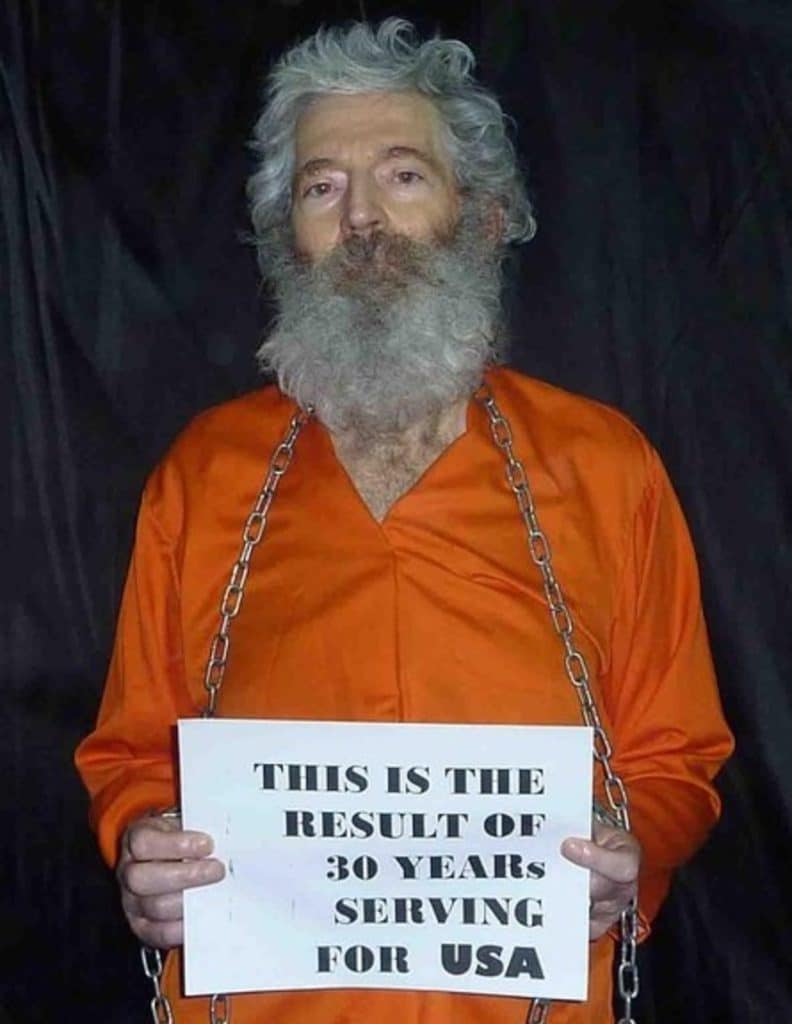
WASHINGTON (JTA) — Robert Levinson, the Jewish-American former FBI agent missing since 2007, has died in Iranian custody, his family said.

Iran has claimed over the years that the regime did not know his whereabouts.

On Wednesday, the family posted the “devastating” news “with aching hearts” on Twitter on the Help Bob Levinson account.

“We recently received information from U.S. officials that has led both them and us to conclude that our wonderful husband and father died while in Iranian custody,” the statement said. “We don’t know when or how he died, only that it was prior to the COVID-19 pandemic.”

Iran as recently as November had said that Levinson was officially a missing person case. The family denounced the regime for its cruelty in its treatment of Levinson and in withholding the information.

“How those responsible in Iran could do this to a human being, while repeatedly lying to the world all this time, is incomprehensible to us,” the statement said.

The family said it would continue to hold responsible the Iranian regime and “those in the U.S. government who for many years repeatedly left him behind.” The family is suing Iran in federal court. The statement did not name the U.S. officials it held responsible.

It thanked Trump administration officials, active and retired FBI agents, and past and current members of Florida’s congressional delegation for pushing the case.

Levinson, of Coral Springs, Florida, also was a private investigator and a part-time consultant for the CIA. He was 58 years old when he disappeared in 2007 on Iran’s Kish Island during what was first described as a work trip for private firms but later was revealed as a rogue CIA operation.

President Donald Trump would not confirm the death.

“I won’t accept that he’s dead,” he said in his daily briefing on the pandemic.

Last year, on the 12th anniversary of his disappearance, the Trump administration announced a $20 million reward from the State Department Rewards for Justice, in addition to the $5 million the FBI has offered for years for information leading to the rescue of its former agent.

Robert Levinson’s Family Says the Former FBI Agent Missing Since 2007 Died in Iranian Custody Read More »

Garcetti Says Shelter-in-Place Order Could Last Until May

Los Angeles Mayor Eric Garcetti told Business Insider on March 25 that the county’s shelter-in-place order to combat the coronavirus pandemic could last until at least May.

Garcetti said, “I think this is at least two months, and be prepared for longer.”

He added that he was concerned that Los Angeles is 6-12 days away from facing the shortages in hospital beds and ventilators that New York City is experiencing. Garcetti said that the county may have to use venues such as Staples Center to house hospital beds.

“Will we have hundreds of thousands of deaths or tens of thousands of deaths?” Garcetti asked. “That’s what keeps us up.”

On March 24, Garcetti said that non-essential businesses that remained open during the shelter-in-place order would have their water and power shut off.

As of March 25, the Los Angeles County Department of Health has recorded 799 confirmed cases of coronavirus and 13 deaths from the virus. The department’s director, Barbara Ferrer, said that authorities removed the March 24 death of a 17-year-old boy in Lancaster from the total because the boy may have had a different cause of death despite testing positive for coronavirus.

The department published a list of the number of cases per county:

Garcetti Says Shelter-in-Place Order Could Last Until May Read More »

Jews Are Disproportionately Being Infected with Coronavirus in the UK

Nearly 5% of all coronavirus-related deaths in the United Kingdom are of Jewish people, who make up just 0.3% of the country’s population, The Jewish News of London reported.

According to the paper’s report Thursday, at least 22 Jewish families have lost loved ones to the disease, which has killed 465 people in the United Kingdom. The U.K. has about 66 million residents and 250,000 Jews.

Jewish community leaders in Antwerp, Belgium, last week predicted a significantly higher infection rate of 85% in their congregation than the 50-70% rate that scientists expect to find in the general population. The leaders cited the large social circles and interaction of the Jewish community.

Among the hardest-hit congregations in the United Kingdom has been the Spanish and Portuguese Sephardi Community, which is based in northern London. It has lost four members in recent days, one of its rabbis told the Jewish Telegraphic Agency on Wednesday.

A man in his 70s who died was connected to the Edgware and Hendon Reform synagogue through his funeral, The Jewish Chronicle reported.

At least two rabbis of died of the disease: Yehuda Yaakov Refson, a senior rabbi in Leeds, was 73 when he died Sunday, and Zeev Willy Stern, a Holocaust survivor, was 86 when he died over the weekend.

Frieda Feldman, 97, died in London on Friday, the same day that she was diagnosed as having the virus, according to the Bhol news site.

Jews Are Disproportionately Being Infected with Coronavirus in the UK Read More »

N.Y. County DA Announces Inquiry Into Local Toyota Dealership That Refused Service to Chasidic Jew

A district attorney for a county in southern New York announced that he is launching an inquiry into a local Toyota dealership over a video showing them refusing service to a Chasidic Jewish man.

The March 23 video shows the Jewish man arguing with an employee at the Johnstons Toyota in New Hampton, N.Y., as to why his appointment was denied. “I just want to understand why all the other guys can have service and you won’t accept me,” the Jewish man said.

“Because you’re spreading the virus,” the employee responded.

Orange County District Attorney David Hoovler said in a statement that he is launching an inquiry into the matter. He added that he spoke to owner of the dealership and that the owner has taken action to remedy the situation.

“No business can withhold service from any person on account of their race, creed, color or national origin, even during this time of emergency,” Hoovler said. “While there may be an understandable fear of contracting the coronavirus, there is never an excuse to violate people’s civil rights due to their race, gender or religion.”

The Times Herald-Record of Middletown, N.Y., quoted the dealership’s attorney, Randy Perlmutter, as saying, “The dealership had closed, at that time of the video, for regular service, and was only taking emergencies and/or serving essential workers. There were signs posted to that effect. Multiple people with routine service appointments were turned away. Johnstons Toyota takes any customer complaint seriously and this one will be investigated.”

Anti-Defamation League New York/Jersey tweeted that it found the video to be “deeply troubling,” adding that “we cannot allow fears about #Covid19 to spark bigotry. This virus does not #discriminate & neither should we.”

StandWithUs called on New York Attorney General Letitia James to investigate the incident.

“We are seeing numerous instances of people wrongly blaming minorities — primarily Jews and Chinese people — for COVID-19,” the pro-Israel educational organization said in a statement. “StandWithUs is deeply troubled by one of the latest such reported instances, in which an Orthodox Jewish man in New York appears to have been turned away at a Toyota service station by an employee who claimed the man was responsible for spreading the virus. The StandWithUs Center for Combating Antisemitism and the Saidoff Legal Department are calling upon the New York Attorney General to investigate this matter as potential unlawful discrimination in violation of New York’s Human Rights law.”

James’ office is reportedly reviewing the matter.

Steve Jardine, who is part of the dealership’s management, told Mid Hudson News that the Jewish man was asked three times to leave before the employee told him to leave “because you’re spreading the virus.”

“The rabbi there has the virus and there has been many recorded cases there and my employees were scared for their safety as anyone would be,” Jardine said. “We are here for essential work, not for oil changes, no matter who you are.  Recalls, breakdowns and emergencies only. We spoke with the DA locally about this and everyone is concerned about the safety of the public.”

The rabbi he was referring to was Rabbi Aaron Teitelbaum, one of the grand rabbis of the Satmar Chasidic sect in Kiryas Joel.

Johnstons Toyota issued an apology over the incident in a March 24 statement to News 12 Hudson Valley reporter Blaise Gomez.

“We apologize for the misunderstanding and if this came across as insensitive,” the statement read. “The intent was to ensure the health and safety of the customer and dealership employees and in no way reflects our values or beliefs. We took immediate action to ensure our employees take a more sensitive approach moving forward.”

N.Y. County DA Announces Inquiry Into Local Toyota Dealership That Refused Service to Chasidic Jew Read More »

Uniting in the Coronavirus Fight: 8 Major Jewish Groups Team Up to Respond to Pandemic

(JTA) — Eight major Jewish organizations have formed an emergency coalition to respond jointly to the COVID-19 outbreak.

The Jewish Federations of North America, an umbrella group of communal fundraising and programming organizations, will lead a coalition that also includes umbrella groups for Jewish day schools, camps, community centers, campus Hillels and human service agencies.

The coalition will share resources, identify the scope of the disease’s impact on the Jewish community, lobby for private and public funding for struggling organizations, and help laid-off Jewish professionals.

Jewish organizational leaders have predicted that the economic downturn triggered by the coronavirus could lead to significant layoffs and fundraising challenges for Jewish nonprofits.

“Working together and collectively we can achieve more than any one of us can do alone,” Mark Wilf, JFNA’s chairman, said in a statement. Wilf is a former board member of 70 Faces Media, the Jewish Telegraphic Agency’s parent company.

Aside from JFNA, the coalition includes the Jewish youth group BBYO, the Foundation for Jewish Camp, Hillel International, the JCC Association of North America, the Network of Jewish Human Service Agencies, Prizmah: Center for Jewish Day Schools and Moishe House,  a network of homes that serve as community centers for Jewish young adults.

Uniting in the Coronavirus Fight: 8 Major Jewish Groups Team Up to Respond to Pandemic Read More »

Israeli Designer Competes for $1 Million on ‘Making the Cut’

Television fashion design competitions like “Project Runway” have launched careers and made household names of talented newcomers. Season 4 winner Christian Siriano now dresses top celebrities and became the show’s mentor, replacing Tim Gunn in Season 17. Gunn and former host Heidi Klum jumped ship to preside over Amazon Prime’s new series “Making the Cut,” which combines design and commerce, marshalling the resources of Amazon’s online marketplace to immediately sell the winning designs.

Premiering March 27, the competition comes with higher stakes: The winner receives $1 million. It also has a global focus, with locations in Paris, Tokyo and New York and an international cast of experienced designers. Among them is Rinat Brodach from Beersheva, Israel, whose eponymous, gender-neutral line has been worn by Billy Porter, Laverne Cox and Adam Lambert.

“It’s about finding the next global fashion brand, not someone who has a passion for sewing,” Brodach told the Journal. “These designers all have a foot in the door in the industry and have real stories about the struggles of making it, and they’re trying to put the second foot in.” Dressing a “very eclectic group” of clients ranging in age from early 20s to 65, she describes her clothing aesthetic as “very minimal, very bold. I drape a lot. I like to accentuate the person’s body. I consider my clothes more than just clothes. They’re tools for people to express who they are.”

Brodach said she was urged to apply by the same casting agent who had persuaded her to audition for “Project Runway” a few years ago. She hesitated. “I didn’t put much effort into the audition. I did it without expectations or thinking too much. But I guess the universe had a different plan, and I’m glad it happened that way,” she said.

“I like to accentuate the person’s body. I consider my clothes more than just clothes. They’re tools for people to express who they are.” — Rinat Brodach

Her approach going in was to “be real and raw and be myself; show my capabilities and my passion,” Brodach said. “I went into this to push myself out of my comfort zone. I embraced the discomfort. If I wanted to be comfortable, I would not have done it.”

She acknowledged the challenges she faced, “But I’m very adaptable. And like Tim Gunn says, I ‘make it work.’ I’ve run my own business alone and I’m involved in all areas. The hard times I’ve had really prepared me to perform to my best on the show.”

Brodach has been interested in art and fashion since she was young. “I was always drawing. Around the age of 12, I started designing clothes. My mom is a very stylish woman and I’d go shopping with her. She would always let me express myself, choose my outfits and wear whatever I wanted,” she said.

Her great-grandfather was a tailor in Czechoslovakia before he was killed at Auschwitz. “I think I’m here to finish what he was not able to,” she said. His daughter — her grandmother — made it to Brooklyn, N.Y., after the war. “She went through horrible stuff but it made her stronger. She’s my inspiration,” Brodach said. Her Polish grandfather escaped to Shanghai, where he spent five years before relatives brought him to the United States.

Brodach’s Zionist father volunteered for the Israeli army, where he met her Moroccan Israeli mother, and the family returned to the States a few months after her birth. They moved back to Israel when she was 8. “I think growing up in Israel makes you a stronger person, less naïve, and makes you think outside the box,” she said. After her own service in the Israel Defense Forces, she returned to New York at 21 to pursue her dream of being a designer.

Brodach considers herself “more spiritual than religious. I do my morning prayers. I light Shabbat candles. I do all the Jewish holidays. I talk to God. I know what I want out of this religion and make it my own in a way,” she said. Currently single, she’d like to change that “if any nice Jewish men want to come by. I think I’m at the point where I’m ready to be in a relationship, but I think it takes a certain type of man to be with me. He has to be strong enough to catch me when I fall.”

She hopes to keep growing her fashion brand, but has no current plans to expand it to Israel. “Israel is the place where I go to recharge my batteries and see my family and friends. I don’t have the energy to start a business there,” Brodach said. “New York is my home now. If you can make there, you can make it anywhere.”

She’d love to have the opportunity to dress Gal Gadot, Lady Gaga, Rihanna, Angelina Jolie and P.J. Harvey, “people who are very ballsy and out there and have a voice. I think my clothes have a voice too, and that they would go very well together.”

Reflecting on her “Making the Cut” experience, Brodach is glad she participated, noting that she came away with “some really strong bonds; friendships that continue today. “It’s really rare to meet designers that are genuine and don’t have an agenda,” she said. Taking part taught her to be herself and get out of her comfort zone.

“Anything big you want to accomplish in life is not going to happen while you stay comfortable,” she said. “You need to feel the discomfort and push yourself to the limit to get results. I had a once-in-a-lifetime experience and I don’t regret anything.”

“Making the Cut” premieres March 27 on Amazon Prime. 

Israeli Designer Competes for $1 Million on ‘Making the Cut’ Read More »