Rabbi Taub is a prominent Chabad rabbi and an expert in Jewish spirituality and recovery from addiction. With a down-to-earth manner and talent for storytelling, he makes Jewish mysticism accessible and relevant to everybody.
I am a proud Jew. I am also a 38-year-old quadriplegic with asthma. Millions of Americans – myself included – are at high risk from the virus and from medical rationing. Sadly, the de facto devaluation of disabled lives in healthcare is nothing new, but there is a current push to make it policy. It is always hard to determine the best way to allocate scarce resources, but Jewish tradition teaches that every life is of incalculable worth. Doctors will have to make enough tough choices, about who is likely to survive, and already will have to make the terrible judgment about who can survive without say, a ventilator, and who will die even if they have one.
Let us not compound this challenge by asking our doctors to place subjective value on individual lives, both because it is unfair to them and because any such subjectivity would necessarily disadvantage those whose life experience is very different from that of the doctor, including people with disabilities. After accounting for the likelihood of survival, first-come first-served is the only rational way to decide between two lives of incalculable value.
So, the question becomes, how can we as Jews ensure that this injustice and others do not become reality in this crisis. There is a major place for individual efforts and philanthropy on this issue, and yet all of the resources that we can muster pale before the nearly $2 trillion that our elected officials are soon to vote on, in order to allocate resources to deal with this crisis.
Our greatest effort, therefore, is to help those in power understand what is right. There are three important steps that our government leaders can take right now to ensure people with chronic health conditions and disabilities – who make up nearly 20 percent of the population in the United States, including millions who are immunocompromised – are not left behind. Please consider raising your voices in the pursuit of justice to share them:
Ensure Equal Healthcare Priority for People with Disabilities – As the crisis intensified in Italy, the government response to the strain on the healthcare system was to systematically ration healthcare away from people with disabilities. This approach is already illegal under American law, but it still happens nonetheless. We should send a clear message that we do not support this devaluation of disability lives
Ensure That Short-Term Help Doesn’t Do Long Term Harm – Salutatory efforts already are underway to provide financial assistance to the people hardest hit by the impact of this crisis, as well as other payments to stimulate the economy. To ensure this extra income not interrupt access to lifesaving services for people with disabilities, it should be excluded from the $2000 asset cap Which applies to disability benefits.
Ensure People with Disabilities Have the Supplies They Need in This Time of Quarantine – The realities of quarantine efforts to keep the community safe have fundamentally changed access to food and necessities. We need to make programmatic modifications to make sure that people with disabilities have the food and medicine that they need in this time of crisis.
For more detail on these steps, and others that you can take, please visit our website.
Our organization is one of many on the front lines and we need allies. And let us be a strong ally to you. For example, as you make your meetings virtual, RespectAbility is available to help you make those convenings accessible to people with disabilities who are deaf and/or blind. Please email me if you need support in this way, or if you have support to offer.
Matan Koch is Director of RespectAbility’s California operation and Jewish leadership work. He can be reached at MatanK@RespectAbility.org
Two more Israelis died from coronavirus on March 24, bringing the total current death toll to three in the country.
The Times of Israel reported that the two dead were an 87-year-old man who suffered from dementia and diabetes, and a 67-year-old woman identified as Malka Keva, who had been battling cancer. The 87-year-old man was hospitalized in Jerusalem; Keva was hospitalized in Bat Yam, just south of Tel Aviv.
Keva’s daughter, Dorit, told the Israeli news site N12 that people need to stay inside.
“Don’t go out,” Dorit said. “You risk yourself, your children, your relatives and people you don’t know. My mother gave her life, gave her soul to the Creator because of this illness. We are hurting, we are sad.”
Israel’s first coronavirus death occurred on March 20, identified as 88-year-old Holocaust survivor Arie Even. His funeral took place on March 22; only 20 people were allowed to attend and they had to be socially distanced from each other.
According to the Israeli Health Ministry, there are around 1,930 total coronavirus cases in Israel. An estimated six percent of those tested have the virus. The Jerusalem Post reported that nearly 25% of the cases originated in synagogues.
Israeli Prime Minister Benjamin Netanyahu warned on March 23 that up to 1 million Israelis could be infected and 10,000 could die from the virus in a month. The Israeli government is expected to approve new social distancing rules on March 24 restricting how far Israelis can stray from their homes.
This guide will constantly be updated. Keep checking back for additional information and email ryant@jewishjournal.com if you’d like your organization, event or resource to be added to this guide.
WHERE YOU CAN GO FOR HELP
ALZHEIMER’S ASSOCIATION
The Alzheimer’s Association offers support groups for caregivers as well as a 24-7, around-the-clock hotline at (800) 272-3900. The California Southland chapter is reachable during normal working hours at (323) 309-8821. alz.org.
AMUDIM ANONYMOUS SUPPORT LINE For those experiencing stress and anxiety, crisis response organization Amudim is partnering with multiple organizations and private practice clinicians including L.A.-based therapists via an anonymous support line available to the public at (888) 726-8346. 5 a.m.-8 p.m. Those who prefer to communicate in writing can do so via email at support@amudim.org. amudim.org.
BACK ENGAGED NOW
Back Engaged Now, a Jewish suicide prevention program, is providing support by offering people access to the following resources: Secular psychotherapy at the Southern California Counseling Center at (323) 937-1344; low-cost and free Jewish counseling at the Valley Beth Shalom Counseling Center at (818) 784-1414; and the JQ Helpline for the LGBTQ community at (855) 574-4577. For more information, email Jonah Sanderson at jonahsanderson2@aol.com.
BET TZEDEK
Pro bono legal aid agency Bet Tzedek has published a number of COVID-19 resources on its website, including an outline of employees’ rights during the crisis. bettzedek.org/our-services/resources.
I CAN HELP Focused on but not exclusively serving the modern Orthodox Pico-Robertson community, the I Can Help task force matches those in need with those able to volunteer. The website includes a donation link to an emergency Passover and Pandemic Crisis Tzedakah Fund, which distributes funds under the direction of Rabbi Yonah Bookstein. To request assistance or for additional information, email kavodforeldersla@gmail.com or visit icanhelp.site.
JEWISH FEDERATION OF LOS ANGELES WARM-LINE The Jewish Federation of Greater Los Angeles has launched a community warm-line, referring people in need of social services to the appropriate agencies. Call (323) 761-8305 from 8:30 a.m.-5 p.m. Monday-Thursday and 8:30 a.m.-3:30 p.m. on Fridays. For more information, visit jewishla.org.
JEWISH FREE LOAN ASSOCIATION For those who have lost wages because they cannot go to work, have accumulated childcare costs because of the schools being closed or have lost funds due to canceled travel plans, the Jewish Free Loan Association is offering emergency loans up to $3,000 to residents of L.A. and Ventura Counties who are U.S. citizens. Must have at least one person who can sign on your loan and guarantee repayment. Must be 18-or-over to apply. People of any faith are eligible. For more information, visit jfla.org.
JEWISH FAMILY SERVICE LA Jewish Family Service Los Angeles is delivering meals to homebound seniors and people with disabilities and maintaining and stocking its SOVA pantries, which are distributing pre-packed bags of groceries. Phone the JFSLA Community Response Line at (877) 275-4537. For more information, visit jfsla.org.
JEWISH NONPROFIT LOAN OPPORTUNITIES
The Coronavirus Aid Relief and Economic Security (CARES) Act, a $2.2 trillion stimulus package intended to combat the economic consequences of the coronavirus outbreak, includes an allocation of $350 billion for small businesses and nonprofit institutions.
Jewish organizations with fewer than 500 employees – including federations, JCCs, JFS agencies, nursing homes, day schools, camps, Hillels and synagogues – are eligible to apply for a loan, which will be forgiven if the organization keeps its employees on the payroll.
For more information about the unprecedented stimulus package and how it’s relevant for Jewish nonprofits, read Jewish Federations of North America’s (JFNA) simple and full analyses of the CARES Act at jewishtogether.org.
RENTAL EVICTION INFO
While Los Angeles tenants are still obligated to pay lawfully charged rent, landlords are prohibited from evicting their tenants for non-payment of rent if their inability to pay is due to circumstances related to the COVID-19 epidemic. The current emergency declaration protections, which were issued in March, continue through the expiration of the emergency. Tenants who are unable to pay their rent will have to work out a repayment plan with their landlord once the emergency expires. Protections apply to all residential and commercial rentals in Los Angeles. Read more here. Eviction complaints can be made at (866) 557-7368 or hcidla.lacity.org/File-a-Complaint.
SHOPPING HELPERS L.A. Sisters Kayla Newman, 19, and Leeat Hatzav, 20 have created WhatsApp groups to connect elderly people and the immune compromised with young and healthy people who can provide them with shopping assistance. Serving Pico, La Brea and the Valley. For more information, call (323) 628-7017, email shoppinghelpersla@gmail.com or visit myshla.com.
SINGLE JEWISH MOMS CONNECT
Single Jewish Moms Connect, a project of Chabad’s Bais Chana Women International, serves women who are divorced, widowed and single-by-choice. Because of the coronavirus, the New York-based organization is hosting twice-weekly Zoom meetings, connecting women to community resources and launching a volunteer program to provide homework help and other support to children of single mothers via video conferencing. For more information, visit singlejewishmoms.org.
PASSOVER RESOURCES
Social distancing seders, selling your chametz online – congregations are getting creative as they prepare to celebrate Passover this year. The following list of resources has been compiled to help you honor the holiday of Pesach while adhering to ‘safer at home’ orders.
CONSERVATIVE MOVEMENT PESACH GUIDE
The Rabbinical Assembly of the Conservative movement details the dietary restrictions for the holiday. Rabbi Elliot Dorff authors the introduction.
DIGITAL CONTENT FOR THE VIRTUAL SEDER
The Union for Reform Judaism has compiled digital resources to enliven this year’s unusual seders, including discounted Haggadot in print and as e-books; song playlists for your Passover seder; and thought-provoking questions to ask one another.
HAGGADOT.COM
Make your own haggadah. Choose from thousands of options of blessings, artwork, translations, songs, activities and more, and mix and match to create a unique hagaddah experience for your seder. Also, join Haggadot.com for its inaugural virtual seder on April 12 at 11 a.m. PST, 2 p.m. EST, featuring Haggadot.com Founder Eileen Levinson and Journal contributor Esther Kustanowitz.
IKAR VIRTUAL SEDERS
IKAR members host small seders from their homes on the first night of Passover and invite other members of IKAR to join them virtually. On the second night, everyone is invited to join the progressive congregation on Zoom for a community seder. Sign up on the website.
NUROOTS: COLLECTIVE ESCAPE
NuRoots, the young adults home of the L.A. Federation, curates virtual Passover experiences through its annual Collective Escape initiative.
PASSOVER LISTINGS
For those who have booked Passover retreat programs, have experienced cancellations and are looking for resources to guide them through this unpredictable time, Passoverlistings.com, a Yelp-like resource for Pesach retreats, has a blog on the topic as well as a Facebook group for people to share information.
PASSOVER PREP PODCAST
Sinai Temple Rabbi Erez Sherman appears on Up to the Minute Podcast COVID-19 and discusses how he and his wife, Sinai Rabbi Nicole Guzik, will use Zoom to hold a social distancing seder this year. Sherman recorded the approximately 13-minute conversation on March 31.
PREPARING FOR PESACH TOOLKIT
The Orthodox Union offers daily videos to help you prepare for Passover during these turbulent times. Kasher your kitchen, unpack the Hagaddah and get answers to your most pressing holiday questions.
VBS PASSOVER 2020
Valley Beth Shalom’s Passover 2020 hub’s features live-streamed Passover prep events, virtual seders, a portal for selling your chametz online and an array of resources to ready you for the holiday.
PASSOVER RECIPES
SEPHARDIC PASSOVER
In their Jewish Journal article, “A Sephardic Passover,” “Sephardic Spice Girls” Rachel Emquies Sheff and Sharon Gomperts publish recipes on lamb shanks, ratatouille, fava bean soup and chocolate bark.
VIRTUAL JERUSALEM RECIPES
If you are unsure what foods to prepare for these unusual Passover seders, Virtual Jerusalem has suggestions. Make dishes including chocolate macaroon tarts, sweet and sour French roast and potato crust meat pizza. Times range from 30-minutes to four hours.
YEMENITE DISHES
Cookbook author Judy Zeidler explains how to make Yemenite charoset and Yemenite fish and tomato sauce.
KOSHER FOOD
BIBI’S BAKERY AND CAFÉ Bibi’s Bakery and Café is open for pickup and delivery only. Customers can order through the website or on the phone. Owner Dan Messinger is updating the menu with traditional walk-in items. Normal operating hours may change but are: Monday-Thursday 7 a.m.-9 p.m., Friday 7 a.m.-1:30 p.m., Sunday 8 a.m.-9 p.m. 8928 W. Pico Blvd., Los Angeles. (310) 246-1788.
KOSHER BAKERY FOR PASSOVER
Eilat Bakery, a kosher fixture in the Pico community, produces 100-percent gluten-free, dairy free goods for Passover. Cholov Israel used for dairy products. Opens at 6 a.m. Sunday-Friday. 9060 W. Pico Blvd., Los Angeles. (310) 205-8700, (424) 243-6030.
PAT’S RESTAURANT AND CATERING Pat’s is offering Passover take-out as well as take-out and delivery through Pesach. Items include gefilte fish with carrots; matzah balls; roast brisket and braised short ribs. Orders need to be received by April 3 at noon. Call (310) 205-8705 or email patsrestaurantla@gmail.com. Update, March 31: Due to high demand, Pat’s is no longer accepting Passover orders.
PICO KOSHER DELI For the first time ever, Pico Kosher Deli and MGM Caterers are merging to offer a take-out Pesach menu. Servicing the entire state of California and under the supervision of the RCC, the order cutoff date is March 31. Come visit the new store at 8947 W. Pico Blvd., which will be open from 2-6 p.m. April 6 and 7 for order pickup. (424) 309-7676.
WAYS YOU CAN VOLUNTEER
AMERICAN RED CROSS There is an ongoing critical need for blood donations due to the coronavirus pandemic. To schedule an appointment to donate, visit redcrossblood.org.
L.A. EMERGENCY COVID-19 CRISIS FUND Help support families, healthcare workers, un-housed neighbors and others with a contribution to the Mayor’s Fund for Los Angeles, a nonprofit dedicated to improving the life of Angelenos. mayorsfundla.org/covid19.
ONGOING ONLINE ACTIVITIES
Minyans, Shabbat services, book clubs, topical discussions, mediation and yoga are just a few of the virtual Jewish programs offered at the following places.
AJC ADVOCACY ANYWHERE
Stay informed on global political issues during this challenging period. American Jewish Committee delivers online content and programs on Israel, campus advocacy and more.
BETH JACOB VIRTUAL UNIVERSITY
The modern Orthodox synagogue holds diverse online programming, including shiurim (lessons) and Torah-related discussions, and is running a buddy system to connect those in need of help with those who can volunteer their time.
FIDF ENGAGE
Friends of Israel Defense Forces (FIDF) has launched FIDF Engage in response to COVID-19. The hub of digital events includes falafel cooking classes, Krav Maga self-defense workouts and other ways to virtually connect with IDF soldiers, many of whom are on the frontline of Israel’s response to the coronavirus.
JEW IT AT HOME More than a dozen synagogues and Jewish organizations are curating online events and resources, including Shabbat services, daily meditation and yoga and book clubs, appropriate for kids, adults and families. jewitathome.com.
LOS ANGELES MUSEUM OF THE HOLOCAUST
The Los Angeles Museum of the Holocaust is offering a number of virtual educational resources, including live-streamed events, recorded survivor testimonies and a digital archive. lamoth.org.
SINAI STREAMED Sinai Temple has shifted its programming to an online platform dubbed “Sinai Streamed.” Visit the website. sinaitemple.org.
STEPHEN WISE TEMPLE Stephen Wise Temple provides live-streamed services and events online.
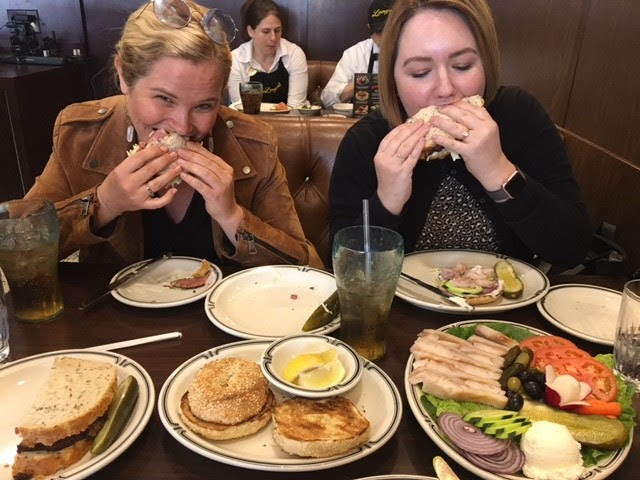
SKIRBALL AT HOME Laura Mart and Cate Thurston, co-curators of Skirball Cultural Center’s “I’ll Have What She’s Having: The Jewish Deli,” lead a virtual tour of the celebrated Jewish delicatessen as part of the #SkirballAtHome series.
Skirball co-curators Laura Mart and Cate Thurston enjoy a pastrami sandwich, the Original #19, at Langer’s Deli. Courtesy of Skirball Cultural Center
VALLEY BETH SHALOM AT HOME Valley Beth Shalom is offering a variety of online programs, from morning minyans to Torah study online.
VIRTUAL SHABBAT COMMUNITY
Hollywood Temple Beth El celebrates Shabbat in song and study, every Saturday morning, from 10:30 a.m.-noon, through April. Click on the Zoom link to join in.
WILSHIRE BOULEVARD TEMPLE @ HOME The Wilshire Boulevard Temple community is now an online community where people can pray, play, learn and connect with one another. Visit the website.
ONLINE SHABBAT MATERIAL Builders of Jewish Education is curating digital content to help celebrate Shabbat at home. Reform, Conservative, Orthodox, Reconstructionist, Humanistic and interfaith families can view the wealth of material online.
FACEBOOK GROUPS Several Facebook groups are responding to the outbreak of COVID-19. In the Jewish community, these groups include Parnassah Task Force L.A. and Jewish Crisis Response Task Force, which are providing advice, networking, temporary job or business referrals and information on volunteer opportunities. Learn more about these groups from their public pages on Facebook. Hat tip to Marcus Freed, who has also been compiling Jewish emergency resources in Los Angeles and alerted us to these Facebook groups.
TED CONNECTS A free, live daily conversation series features experts whose ideas can help us reflect and work through this uncertain time. Each day means a new live-stream at noon ET. Recent speakers include Rabbi Lord Jonathan Sacks.
MEDITATION
Mindfulness Rabbi Jill Zimmerman leads “Your Spiritual Toolkit in this Time of Crisis,” a three-session guided meditation course, on March 30 and April 6 and 13. $45 per person. Details provided upon payment. Classes live and recorded.
(JTA) — Why will this Passover be different from all others?
This year, the London Beth Din, or religious court, has created a list of permissible products not made under special supervision for Passover due to difficulties caused by the coronavirus crisis.
The Kashrut Division of the court developed the list, titled “Product guidelines in extremis,” from an array of basic goods to help quarantined families and those who are struggling financially due to the virus, the UK Jewish News reported.
“We are acutely aware of the pressures at this unprecedented time,” the Kashrut Division director, Rabbi Jeremy Conway, said in a statement. “We already know why this Seder night will be different to all other nights and this Pesach will be one unlike any other.”
He added: “This list should be used when regular supervised products are not available, or for people who are older or in isolation and so are unable to go shopping themselves or have Pesach products delivered to their home.
The greatest gathering of the Jewish year is nearly upon us and this year, the Passover seder will be celebrated like no other. Mah nishtanah ha-leila ha-zeh, indeed.
Most translations of this famous line portray it as a question: “Why is this night different from all other nights?” In my reading, this is incorrect. The Hebrew word “mah” doesn’t mean “why.” The proper meaning is “how” or “what.” The phrase is not a question at all: it’s a declarative statement: “How different is this night from all other nights?” Then, we get the questions designed to stimulate the engagement of the young and old: why matzo, why maror, why dipping twice, and why reclining? In this year of the coronavirus crisis, there is no question our seder experiences will be different. The question is how to make the evening engaging, educating, exciting, and memorable?
So, here are 10 tips to “zoom” in on crafting a great virtual seder:
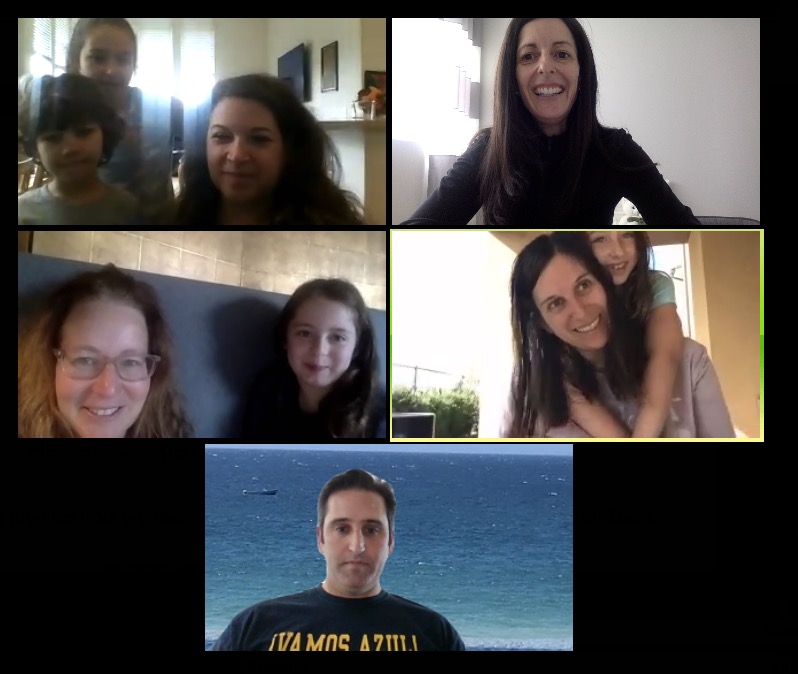
Prepare. Even when we gather together in person, a great seder is well-prepared in advance. A virtual seder requires even more advance work. Many people already have experienced a virtual Jewish ritual, celebrating Shabbat online these past few weeks. My wife, Susie, and I have done just that from our shelter-in-place location at Mayo Clinic in Rochester, Minn., where Susie recently received a life-saving kidney transplant. These virtual Shabbat experiences with our children and grandchildren have lifted our spirits beyond measure. So, imagine how thrilled we were to receive a photo from our daughter Havi picturing “the Paperny next generation cousins” (“Paperny” was my maternal grandfather’s name) — young people in their 30s and 40s and their kids — on a Zoom call discussing preparations for our virtual seder. To see Kate and Emma from Seattle, David and Miriam from San Diego, Lisa and Hannah from Irvine, and Havi, Ellie and Gabe from San Jose all together on that Zoom conference brought tears to my eyes. So, get your seder leaders together online now to think through how and what and why you will do what you’ll do on seder eve.
Give homework. I have been advocating this since the publication of my book (with Joel Lurie Grishaver) “Passover: The Family Guide to Spiritual Celebration” (Jewish Lights Publishing) in 1988. Consider asking each group calling in to take responsibility for leading one of the ritual practices, or explaining a section of the haggadah, or reading the text aloud. Especially the kids — so many of them are already reading stories to their grandparents (and vice versa) online. Get a PJ Library book about Passover and have the kids (or grandparents) read it aloud.
Tell the story. Keep your eye on the actual purpose of the seder — to tell the story of the Exodus from Egypt, our story that begins with our people in slavery and ends in our redemption. We ought to start the experience feeling constricted in a “narrow” (the literal meaning of “mitzrayim”) place (like being stuck at home) and freedom (if the weather is nice, consider walking outside after your seder). If there is one overarching theme of the evening, it is to feel as if you have experienced this “exodus:” “b’chol dor va dor chayav adam lirot et atzmo k’ilu hu yatza mi’Mitzrayim — in every generation, it is your responsibility to think of yourself as if you actually had been present at the Exodus from Egypt.” So, how do we achieve this feeling? We use every storytelling technique in our tool-box. Take turns reading sections of the haggadah. But also take time to tell the story by acting it out, singing parody songs (there are hundreds on the internet), doing magic tricks, making a video, writing your own haggadah.
Ask questions. Begin with the Famous Four, but spice up your evening with a few provocative and well-placed queries. An obvious one this year: “The seder recalls the Ten Plagues — what’s something that plagues us today?” Or, “The seder begins by inviting anyone to join in — Ha lachma anya. How do we sustain our relationships in a time of social distancing?”
Innovate. I cannot wait to see what folks will do by adding a symbolic food to the seder plate to mark this time in our lives. Too bad beer isn’t kosher for Pesach: a Corona would do the trick.
Have fun. Find ways to infuse some humor. There are the old standbys: beating each other with green onions during “Dayenu” to recall the experience of slavery, searching for the afikomen, singing those parody songs at key moments in the storytelling.
Afikomen gifts. At our face-to-face seder, Susie and I give a gift to each of the kids wholook for theafikomen. This year, we’ll be sending them via one of the online platforms. Just be sure you send them early to arrive in time — even Amazon is behind in deliveries.
Be inclusive. It can be challenging to keep the attention of everybody on a Zoom call. So, if one person is “leading” the seder, be sure to ask questions, call on people. There is a challenging short delay on Zoom to sing together, but do the best you can. You may want to mute when one party is giving a presentation.
Make changes: It’s your story. There is a reason there are thousands of editions of the Passover haggadah. We have embraced the permission to make the experience meaningful for us in our generation. So be creative — especially this year.
Wash your hands. Isn’t it a bit ironic or even prophetic that the seder calls for us to wash our hands not once, but twice? The first hand washing — urchatz – is often done by the leader on behalf of everyone. This year, I recommend everyone wash hands at the beginning of the seder and at rochtza before the meal. I suggest we add a blessing when we all wash for Urchatz — a version of birkat ha-gomel, a blessing of gratitude usually recited by someone who has escaped injury or successfully completed a perilous journey: Baruch ata Adonai, Eloheinu melech ha-olam, ha-gomel l’chayavim tovot she-g’malani kol tov.
Blessed are You, Adonai our God, Sovereign of the universe, who has bestowed every goodness upon us.
Instead of washing hands for 20 seconds to the tune of “Happy Birthday,” sing a chorus of “Dayenu” It’s enough already with this virus.
You might also consider adding a misheberach, a prayer for healing, at this or some point during the ceremony.
Wishing you a safe and wonderful Pesach.
Ron Wolfson is Fingerhut Professor of Education at American Jewish University and co-author of “The Relational Judaism Handbook: Second Edition” (Kripke Institute).
While mandatory coronavirus closures forced the cancellation of the Jewish Women’s Theatre’s March production “Sex, Addiction and Love,” JWT has now gone digital with a collection of daily stories called under the banner “Inside Our Time” on their YouTube channel, providing food for thought in isolating and scary times.
“The idea was to provide comfort, to say ‘You’re not alone, here’s what other people are feeling,’ and connect,” said JWT artistic director Ronda Spinak. “You’ve always come to us for contemporary stories that make you laugh, that make you cry. We’re offering those stories online for free as a way to say ‘We’re here, we’re part of your community, you’re not alone. Others are feeling and experiencing exactly what you’re feeling and experiencing.’ The stories are little slices of life, what life is like today and what we’re feeling.”
JWT invited patrons to share their feelings and experiences and received great responses. “Instead of just posting them, we asked our list of amazing actors if they would be willing to read one from their home, using their smartphone,” Spinak said. “From idea to inception it was four days.”
New stories will post daily Monday-Friday, and the Friday stories will be “a little more prayerful or have a spiritual edge to them,” in honor of Shabbat, Spinak said. Additionally, she’s curating stories from the archive of past JWT performances with a Passover theme that will run daily for the eight days of Passover. They will be available here.
AMSTERDAM (JTA) — Our Sunday in the park with the kids felt so normal that it was eerie.
My wife, children and I were among hundreds of people enjoying the first sunny day of spring at the Amsterdam Woods, a large patch of man-made forest in the Dutch capital’s south. There were new daffodils, the forest’s cherished picnic clearings and even a queue of visitors waiting to see its famous cherry orchard, which last week burst into spectacular blossom.
After a couple of hours, we nearly forgot that most of our friends and family across Europe, in Israel and beyond are under varying degrees of house arrest due to emergency government measures against the coronavirus.
That’s because Holland has taken a different approach.
Prime Minister Mark Rutte has essentially argued that social distancing will only prolong the disastrous effects of the virus. He believes — supposedly based on the knowledge of medical professionals — that the Dutch population should be somewhat exposed to the virus so that immunity can be formed and society can return to a sense of normalcy as quickly as possible.
The Dutch government did shut down schools, cafes, movie theaters, houses of worship and many offices, but we are still free here to move around, shop, pick up takeout and receive packages in the mail. Our extensive public transportation network hasn’t skipped a beat.
Sweden has a similarly lax policy. The United Kingdom, whose prime minister, Boris Johnson, had adhered to the same “herd immunity” policy as Rutte, introduced stricter measures on Monday, telling residents to stay home and ordering shops selling non-essential goods to shutter. Johnson on Monday finally ordered a full lockdown.
That makes Sweden and Holland the exceptions in Western Europe. Belgium, France, Italy, Spain, Denmark, Austria and Switzerland have all gone into total lockdown, along with parts of Germany.
Our relative freedom is of course a huge privilege and a convenience that at times feels reassuring. But as bodies pile up across the continent — the Netherlands has had over 200 deaths — our reality is also a growing source of fear that not enough is being done to prevent the rampant outbreak that is ravaging Europe and the rest of the world.
I have lived through four or five major missile attacks, two intifadas and combat army service in my native Israel, as well as reporting assignments in several war zones. But the footage taken at Italian hospitals has me fearing for my life for the very first time.
I can see the logic of the Dutch approach, even if I’m not fully convinced by the immunity plan and the murky science behind it. After all, there’s a limit to how long a lockdown can be imposed. The virus will still be around when it’s lifted, and an outbreak will occur later on, after several weeks of lockdown will have ravaged our national resources.
But pandemics are so unpredictable, and letting one spread on the basis of a bunch of assumptions feels like playing Russian roulette because the odds are in one’s favor.
I’m not the only one questioning the wisdom of allowing the population to spread the virus. On Sunday, Belgian Health Minister Maggie de Block for the first time openly criticized the Dutch policy.
“They’re letting the virus run loose,” she told the De Morgen daily about the Netherlands, with which Belgium shares a porous border.
Marino Keulen, mayor of the Belgian border town of Lanaken, called the Netherlands “the weakest link in the European chain.”
I already see the virus’ effects around me. My rabbi from when I lived in the Hague until 2015 is in intensive care. On Thursday, I learned that two friends of mine, one in the Hague and another in Antwerp, had caught COVID-19.
Over the weekend, an acquaintance of mine, Rabbi Andre Touboul, a founder of the Beth Hanna Jewish high school in Paris, suddenly passed away at the age of 64. A short and energetic guy with an informal and chummy demeanor, which he brought with him to Paris from his native Marseille, Touboul was healthy with no underlying medical conditions.
In London, the disease claimed the lives of at least six Jewish people, including Zeev Stern, an 86-year-old rabbi and philanthropist who survived the Holocaust, and a 97-year-old woman, Frieda Feldman. Italy has had about 5,500 deaths, including a former leader of Milan’s Jewish community, Michele Sciama.
And as most of us know, it’s going to get worse, not better. German Chancellor Angela Merkel shocked the continent when she said on March 13 that about 70% of her country’s population will catch the disease.
Some Jewish communities here are bracing for a much higher infection rate because of what is normally their biggest strength: a sense of cohesion. That will now become their biggest weakness, and policies like the Dutch response don’t protect them.
“The local Belgian person has a circle of about 15 friends and family. In Antwerp’s Jewish community, that figure is 150,” Michael Freilich, a Jewish lawmaker in the Belgian parliament, told me. “Antwerp Jews all know each other, each synagogue is an extended family.”
Citing this reality, leaders of the predominantly haredi Jewish community of Antwerp expect an infection rate of 85 % — well above projections for the general population, which range from 50 to 70%. According to this model, some 17,000 people from the community will catch the virus, resulting in more than 550 deaths.
My family is not religious, but we’re feeling very vulnerable all the same. We’re using the freedom we enjoy right now to tie up loose ends.On Sunday, my father came to see us in the park. He is 73 and prone to coughing colds, but he’s refusing to stay indoors.
As we walked to the car, he walked me through the whereabouts of his will and other information I need to know in case he dies.“We could be locked down tomorrow, who knows. This disease moves very quickly,” he explained to me in a rational tone.
We said goodbye without hugging or kissing. My children, engrossed in their own little worlds, waved goodbye to him indifferently as they climbed into the car. We pulled away and I watched in the mirror as his slender silhouette became a blue speck against the gorgeous spring bloom.
Europeans are bracing for even more restrictions amid the rising number of coronavirus fatalities.
Italy
Calling the pandemic the country’s gravest post-World War II crisis, Italian Prime Minister Giuseppe Conte has ordered all nonessential production to shut down. The death toll has surpassed 6,000 out of over 63,000 people infected and all citizens are homebound. An Israeli doctor in Italy told Israeli television that his hospital in Parma has stopped offering ventilators to patients older than 60.
Genoa resident Eyal Lerner is an Israeli who has been living in Italy for the past 25 years. He believes Italy serves as a warning to other countries. Among the dead is his friend’s 78-year-old father, who couldn’t properly say goodbye to his loved ones.
Lerner, a freelance musician and theater director who has postponed or canceled upcoming projects, said, “It’s very similar to people who go to war to another country and they come back in a coffin. The system is collapsing so what happens is that other people who have so-to-speak normal urgent problems like heart attacks … cannot get hold of the emergency line, and they die.”
Lerner lives in isolation in his apartment. Italians must acquire a special permit to justify leaving the house. He blames the Italians’ carefree and cavalier attitude to the rapid spread of the disease. “If you have a Mediterranean atmosphere, people are not disciplined enough to stay at home.”
He also believes the government’s measures are justified, despite the looming economic recession. “I believe it is an occasion for positive changes in our global social, economical and political system,” he said.
Germany
Germany has amped up legally enforceable restrictions effective for the next two weeks. Even Chancellor Angela Merkel was placed under quarantine after being treated by an infected physician. She ultimately tested negative for the virus. Public meetings are limited to up to two people while others must maintain a six-foot distance between them. Only core family members are allowed in the same house.
With communal Passover seders canceled, Morasha Germany-Olami, a Jewish educational institute, has altered its operations to hand out (via gloves) Passover essentials like matzo and haggadot to the several thousand students it serves. All Torah-study classes are taking place online. Germany’s Jewish population is estimated to be 200,000.
“Most people will do the seder alone with their really close circle of people, so we’re really trying to help the people,” said Morasha Director Eliezer Noy (an associate of the reporter). He said enough matzo has arrived safely from the United Kingdom but other kosher-for-Passover foods are stuck at the Austrian-Italian border. As a result, his team is providing recipe ideas using locally sourced ingredients.
Even as the holiday of liberation will be spent in a homemade captivity, Noy has faith. “If God decided that we’re living here for this period, then we’re here for thriving and not for surviving.”
Poland and Eastern Europe
Poland was one of the first European countries to close its borders, causing a bottleneck of trucks along the German-Polish border. Other Eastern European countries have followed suit.
In Poland, 774 cases have been reported with nine deaths, but Guy Sadaka, an Israeli tourism operator living in Warsaw for the past 17 years, believes the number is much higher because of the lack of testing. “There is no lockdown like in Israel,” Sadaka said. “People are going to work but less. If they can work from home, they work at home.”
Poland’s lockdown is not as strict as in other countries. No one is required by law to stay at home but only essential shops remain open and eateries offer delivery or takeout.
“There’s movement in the streets,” Sadaka said, “but it’s down by 60-70%.”
Sadaka’s tourism business catering to Israelis and accounting for 65% of his income is on indefinite hold.
“Cancellations already took place in February,” he said. “If it takes two to three months to finish with this coronavirus, I don’t think the tourism industry will see fruitful results, and it will take at least until holidays in Israel for something to flourish again, because only then will they have some kind of income.”
He said the Polish government has offered citizens no relief package for small and medium-sized businesses. “You’re starting generally to burn your savings. Savings can last three to four months,” he said. “After that I don’t know what will be.”
United Kingdom
Late in the game to shut down schools and public gatherings, U.K. Prime Minister Boris Johnson joined other major European countries in enacting severe social distancing measures as the number of cases surged to 6,650. As in France, no one can leave their home beyond a certain distance except for work, limited outdoor exercise and essential shopping.
“There is an overwhelming sense of relief that the prime minister is finally going to enforce a lockdown, as too many people were not keeping to social distancing rules voluntarily, endangering everyone’s lives,” said Miriam Shaviv, a London-based business owner, via Facebook messenger (she is a Facebook friend of the reporter). “It is clear that countries that enforced these rules early have saved lives. I’m willing to stay under lockdown with my family for as long as it takes, in order to save lives.”
Shaviv said she personally knows one person who died from the virus and at least two friends and acquaintances who have been ventilated. She works from home but, with children at home, finds it more difficult. “We have instituted a fairly rigid timetable for them including homework, chores, exercise, TV time and a ‘personal project,’ which seems to keep them occupied,” she said.
Shaviv attributes Johnson’s delay in ordering a lockdown to his reluctance to impose on people’s civil liberties, and she hopes that the health services will be able to handle the surge in cases.
Other European countries
Spain has extended its state of emergency, banning everyone from all but essential movement. In Austria, Chancellor Sebastian Kurz praised Israeli Prime Minister Benjamin Netanyahu for his recommendation that Spain implement Israel’s strict lockdown rules. As of press time, the number of cases in Austria was around 5,000 with 25 deaths.
The Netherlands has extended its social distancing measures through June 1. In France, Prime Minister Édouard Philippe told citizens to brace for lockdown for weeks to come.
Orit Arfa is a journalist and author based in Berlin. Her second novel is titled “Underskin.”
The Los Angeles County Department of Public Health announced four new coronavirus deaths on March 24, including a minor.
The Los Angeles Times reported that the minor was under the age of 18; he reportedly lived in Lancaster. One of the other deaths was a Long Beach woman in her 50s who reportedly had underlying health conditions.
The current coronavirus death total in Los Angeles County is 11 and there are 662 confirmed cases in the county. Eighty percent of the cases are between the ages of 18 and 65 and 42% are between the ages of 18 and 40.
The public health department tweeted, “COVID-19 can infect people of all ages. Everyone, no matter their age, is #saferathome.”
Under the county’s shelter-in-place order, which lasts through April 19, residents are not allowed to engage in gatherings of any kind and all nonessential businesses are closed. Restaurants are allowed to provide takeout orders. People are also allowed to do outdoor exercise, so long as they stay at least 6 feet apart from one another.
However, L.A. City Councilman David Ryu called for the Runyon Canyon and Lake Hollywood parks to be closed on weekends.
“Closing Runyon Canyon Park on weekends, when we have seen the highest volume of visitors, should follow to keep everyone safe,” Ryu said.
Los Angeles City Council meetings throughout the rest of March have been canceled and schools in the Los Angeles Unified School District (LAUSD) are closed until May 1.