Super Tuesday! The Voters Speak.
Super Tuesday! The Voters Speak.
Super Tuesday! The Voters Speak. Read More »

Super Tuesday! The Voters Speak.
Super Tuesday! The Voters Speak. Read More »

Millennials aren’t the only ones with little connection to history. The esteemed humanities department of the respected Scripps College failed to consult a little relevant history before inviting to their campus a hate merchant.
Rutgers University’s Jasbir Puar peddles a thousand-year-old, still-toxic anti-Semitic fantasy: The blood libel accusation against Jews updated in the 21st century and applied to Israelis.
Puar, associate professor of women’s and gender studies at Rutgers, entered the hall of fame of vicious academic hucksterism in 2016 when she delivered a lecture as Vassar College, titled, “Inhumanist Biopolitics: How Palestine Matters,” elaborated in her book “The Right to Maim: Debility, Capacity, Disability.”
Puar’s convoluted, implausible “thesis” will be that “the use of technologies of measure to manufacture a ‘remote control’ occupation, [is] one that produces a different version of Israeli ‘home invasions’ through the maiming and stunting of population. If Gaza, for example, is indeed the world’s largest ‘open air prison’ and an experimental lab for Israeli military apparatuses … what kinds of fantasies (about power, about bodies, about resistance, about politics) are driving this project?”
Puar doesn’t accuse Israelis of genocide. She accuses them of something worse. To the Israelis, “the Palestinians are not even human enough for death.”
Worse than Nazis, they don’t kill them en masse because that would win Palestinians sympathy as victims of “a new Holocaust.” Instead, the Israel Defense Forces selectively “maims” them, which not only demoralizes the victimized population but provides Israel with half-dead Palestinians to use for laboratory experiments and, ultimately, with Palestinian corpses to sell their body parts.
Dressed up in post-modernist theory about “fantasies about bodies,” Puar, in fact, is updating a very old, still potent anti-Semitic myth. In 1132 in Norwich, England, a 12-year-old named William was an apprentice who tanned and sold hides to the local population, including Jews. He disappeared in Thorpe Wood. The Christian villagers quickly blamed Jews, but Sheriff John de Chesney dismissed the accusation and put Norwich’s Jews under his protection.
The local anti-Semites returned home murmuring, and nothing much happened — for years. After all, this was the Middle Ages, with no internet. But then, a hate monger, Thomas of Monmouth, compiled a chronicle, “The Life and Miracles of St William of Norwich,” based primarily on the testimony of Jews who had converted to Christianity, like the monk Theobald of Cambridge, who claimed he was exposing the crimes of Norwich’s Jews.
Will Scripps be shamed into canceling the channeling the deadly virus of Jew-hatred into the mainstream of academia? Don’t hold your breath.
Theobald told Thomas that there was a prophecy that the Jews would regain control of Israel if they sacrificed a Christian child each year. Allegedly, Jewish leaders met in Narbonne in France to decide who would be asked to perform the sacrifice. In 1144, the Jews of Norwich were selected. Thomas the chronicler added the sensational details that the Jews shaved the head of little William (soon credited with miracles and made a saint), “stabbed it with countless thornpoints, and made the blood come horribly from the wounds,” and then “fixed [him] to a cross in mockery of the Lord’s Passion.”
This was the beginning of a devastating blood libel/ritual murder accusation — which has been deployed by Jew haters through the centuries from England to Syria. For hundreds of years, Jewish communities were fearful when Passover and Easter converged, lest they become victims of a murderous pogrom.
In our time, the internet provides new, powerful marketing platforms for the thousand-year blood libel virus. Mass killer Robert Bowers, who murdered 11 at Pittsburgh Tree of Life Synagogue in November, 2018, mocked his victims by alluding to his crimes as payback for “jewish [sic] Ritual Murder … also known as Blood Libel.”
John T. Earnest, who murdered one and maimed others at San Diego County’s Chabad of Poway synagogue on Passover 2019, wrote in his online manifesto: “You are not forgotten Simon of Trent, the horror that you and countless children have endured at the hands of the Jews will never be forgiven.”
On March 12, Puar will appear at Scripps College as part of the Claremont Consortium and for the Humanities Institute, to give a lecture: “(Re)Centering Wounds.” The event — which Scripps’ administration defends on “free speech” grounds — is sponsored by the notorious Students for Justice in Palestine. Not an aberration, this is only the latest time that Scripps College has sponsored events weaponizing anti-Semitism-tinged Israel bashing.
Will Scripps be shamed into canceling the channeling the deadly virus of Jew-hatred into the mainstream of academia? Don’t hold your breath. Will Scripps at least live up to its basic academic responsibility to invite a real scholar to debunk the pernicious blood libel in all its metastasized forms, to purge the lies and the cancerous hate, or will it breathe further life and legitimacy into history’s longest and deadly screed about the Jewish people?
Rabbi Abraham Cooper is Associate Dean and Director of Global Social Action for the Simon Wiesenthal Center. Dr. Harold Brackman, a historian is a consultant to the Simon Wiesenthal Center
Scripps College Helping Spread a Deadly 1,000 Year-Old Virus Read More »

It was one of those weeks where every day brought another great idea for a column. First, I attended an insightful lecture by Rabbi Dr. Meir Soloveichik at Beth Jacob Congregation that connected the festival of Purim with Abraham Lincoln and slavery.
Then it was “Comeback Joe” Biden’s resounding primary victory in South Carolina that reset the Democratic primary race.
Then it was the AIPAC Policy Conference I attended in Washington, D.C., where the drama and anxiety were at a peak.
And, of course, there was how Prime Minister Benjamin “Bibi” Netanyahu pulled off his magic act in the latest Israeli “do-over” election. All great column ideas!
Oh, and did I mention the coronavirus that has dominated the airwaves and alarmed much of the planet? I was thinking of writing about the paradox of viruses, which can both unite and divide. They unite us because they don’t discriminate — a virus doesn’t care whether you’re a Republican or a Democrat, Jewish, Muslim, white, black, left, right, etc. These shared threats remind us of our shared humanity.
But because they’re so contagious, viruses also keep us apart. We’re more reluctant to get close to one another — literally. I saw a sign of that at the AIPAC conference, where many attendees were replacing handshakes and hearty hugs with delicate elbow bumps.
But no virus can slow a political news cycle, and this past week that cycle was more like a tornado. Especially among traditional Democrats, there is growing anxiety, if not panic, that an unrepentant socialist like front-runner Bernie Sanders will spell disaster for the party.
No virus can slow a political news cycle, and this past week that cycle was more like a tornado.
No wonder, then, that Biden’s victory the day before the AIPAC conference generated so much buzz. Could an establishment old-timer rescue the party? Will the support of former rivals Pete Buttigieg and Amy Klobuchar help his chances? Will Mike Bloomberg’s billions make a dent or hurt Biden? (I’m writing this before Super Tuesday, so by the time you read this we may already have some answers.)
And let’s not forget the Israel factor, which further complicates the picture. If you love Israel, hate Trump and always vote Democratic, a candidate like Sanders who associates with anti-Semites can give you serious migraines. You end up asking: Who do I dislike less?
Beyond Israel, the real threat many Democrats see in a Sanders candidacy is that his radical leftist views will lead to a blowout in November, keeping Trump in power and undermining congressional races. But it’s not clear that a moderate candidate would fare any better, given the enraged Bernie followers who would take revenge on the Democratic establishment for sabotaging their candidate, as they believe happened in 2016.
What’s good for the Jews, what’s good for America and what’s good for my political party have become tension-filled questions that are becoming more and more difficult for American Jews to answer. That tension hovered among the 18,000 Israel supporters at AIPAC.
In the middle of this political anxiety, on the second day of the conference the buzz shifted temporarily to Israel’s third election in a little over a year. Will a third time be the charm or is Israel doomed to yet another election? As I write this, Bibi is still one or two seats short of a majority. Oh, and he’s about to start a criminal trial on March 17.
What’s good for the Jews, what’s good for America and what’s good for my political party have become tension-filled questions that are becoming more and more difficult for American Jews to answer.
It all sounds like a John Grisham novel.
Maybe that’s why I was looking forward to writing a Purim column — to give us a break from all this political craziness.
If there’s one Jewish holiday that’s good at giving us a break, it’s certainly Purim, when we’re supposed to be silly and wear costumes. For that one day at least, we can pretend to be someone else.
This notion of being someone else, though, is not so simple. For one thing, it assumes we already know who that “someone” is. Who am I? Am I the news junkie who couldn’t stop schmoozing with the crowds at AIPAC, or the reflective Torah student who savored a brilliant Purim lecture by Rabbi Soloveichik?
And how should I pick my Purim costume this year? By running far away from who I think I am, or by getting closer to who I’d like to be?
Well, since I only have one choice, I think I’ll pick the latter: I’ll pretend to be who I’d like to be. I’ll dress up as a reflective Torah student.
I know, it’s not as cool as dressing up as Bernie or Bibi — but it’s a lot better for my migraines.
Purim, AIPAC, Bernie, Biden, Bibi Read More »

“Esther, a woman, is the first statesman in Jewish history.”
This is how Rabbi Dr. Meir Soloveichik introduced the Jewish heroine of the Purim story at Beth Jacob Congregation on Feb. 26.
The Wednesday night lecture was the first in a three-part series titled, “American Jewish Experience Through the Prism of the Holidays.”
The remaining two lectures are “Three Civil War Seders: A Story of North, South and Jewish Identity” on March 31 and “From Cyrus to Truman: A Biblical History of Gentile Zionism” on May 18.
Discussing the history of President Abraham Lincoln’s Emancipation Proclamation through the lens of Megillat Esther, the rabbi from New York’s Congregation Shearith Israel said Lincoln and Queen Esther shared leadership qualities that enabled them to navigate political obstacles to achieve their respective goals.
He said both were great leaders because of their “balance of the real and
the ideal in order to achieve what can be accomplished.”
Speaking on “Lincoln’s Megilla: An Amazing Tale of Esther and the Emancipation Proclamation,” Soloveichik discussed how Esther was told by her Uncle Mordecai about the genocide awaiting the Jews. She had the choice to confront her husband, King Ahasuerus, but instead opted for a politically savvy route to thwart Haman’s plans.
Mordecai, Soloveichik said, was a prophet in the sense that the “job of the prophet is to proclaim true north and do it without compromise.” Once she knew what was the right thing to do, “Esther surveys the political scene to get where she needs to go,” Soloveichik explained.
“The Book of Esther is one of politics and statecraft. The Megillah, like American history, contains lessons for leaders today.”
—Rabbi Dr. Meir Soloveichik
He then went on to say Lincoln faced a comparable situation when assessing when and how to issue the Emancipation Proclamation. While he knew what was morally right, as Esther knew what was right, Lincoln was pragmatic enough to know that the proclamation would face political pitfalls.
Lincoln, Soloveichik said, subsequently employed a mix of idealism and realism. Just as Esther had to determine without God’s help how to prevent the genocide
of the Jews, “Lincoln had only himself when determining what the right course
of action was to abolish slavery,” Soloveichik said. “This is Lincoln’s greatness,” he added. “Lincoln pondering the inscrutability of the divine will.”
Ultimately, Esther and Lincoln “possessed greatness combined with goodness,” Soloveichik said. “Of true north with statesmanship.”
He added that Lincoln was well versed in the story of Esther. He read from an 1848 letter that Lincoln — then a member of the U.S. House of Representatives — wrote referencing, “the gallows of Haman,” in regard to the Mexican War.
Soloveichik said modern-day political leaders could learn from the Purim heroine. “The Book of Esther is one of politics and statecraft,” he said. “The Megillah, like American history, contains lessons for leaders today.”
Lincoln, Soloveichik argued, is “deserving of reverence of Jews.” He said an improved understanding of Lincoln’s greatness could be achieved by delving deeper into the story of the Megillah.
Soloveichik then recounted an obscure moment in U.S. history, when abolitionist Rev. William Weston Patton visited the White House to urge Lincoln to free slaves in the South. Patton, he said, drew on the text of the Megillah and told Lincoln he was in the role that Esther was in upon learning about Haman’s plans for the Jews.
Summing up the legends of Esther and Lincoln, Soloveichik said with people holding Lincoln in such high regard he is often considered without fault. However, he added, “had Lincoln been a saint he would not have been a great president.”
Similarly, Soloveichik argued, Esther is unique among protagonists in Jewish literature, because the Megillah came at a time when the age of prophecy or divine intervention was no longer common. Therefore, he said, it fell to human beings to make the miraculous happen.
Soloveichik drew in the audience with his detailed analysis of the queen and the president. A self-described Civil War aficionado, Soloveichik offered his best impression of Daniel Day-Lewis portraying Lincoln in Steven Spielberg’s 2012 film of the same name.
He then recounted a trip he took with his son to Gettysburg, during which he took a Segway tour around the grounds and fell off his vehicle. He then quipped he could say with honesty that he was injured at Gettysburg.
The Shared Leadership Qualities of Purim’s Queen Esther and Abraham Lincoln Read More »
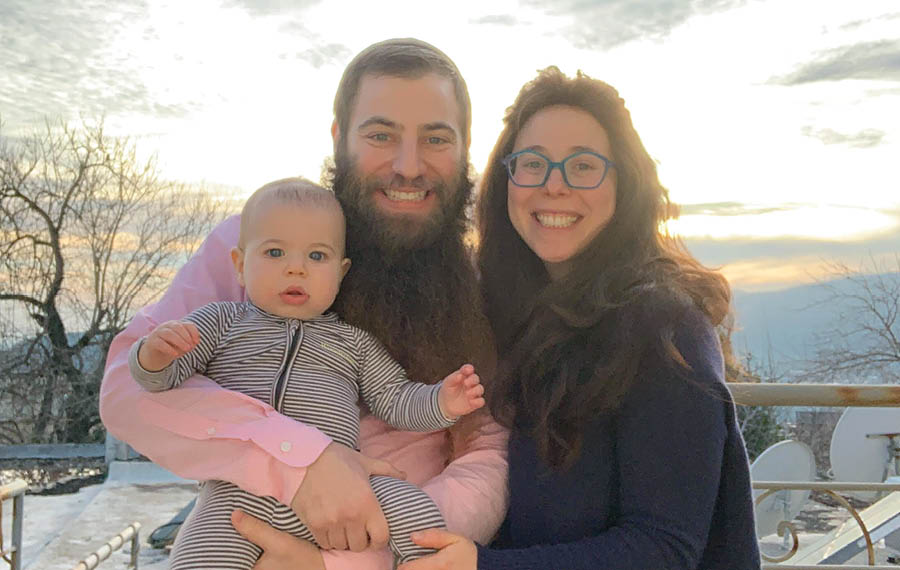
Nathan Hoffman has been tapped to build and launch the Galiliee Culinary Institute. “To me, food is fuel,” Hoffman said. “You can literally give me a food drip with all my nutrients and I’d be happy.”
An ambitious project initiated and funded by the American Jewish National Fund, Hoffman said, “It will be a center for immersive culinary experiences, innovation and excellence; a global beacon of culinary innovation and experiences.”
The Institute also will be the hub of an emerging ecosystem linking foodtech, agritech, chefs, restaurateurs and other industry professionals and with celebrity Israeli chefs such as Lior Lev Sercarz and Michael Solomonov lending support to the project.
As part of the JNF’s “Go North” strategic vision to strengthen and grow the Galilee region, the Institute will be situated in one grand complex on Kibbutz Gonen.
“[We’re] utilizing the assets of the region — the food, the culture, over 70 ethnicities in a very small area in the Galilee,” Hoffman said. “And also so much of the produce in Israel is coming from the north. [We] have wineries up the wazoo, honey, organic farms, goat farms. All this stuff in such close proximity makes it a very unique environment.”
Hoffman sees himself as part of the new wave of Zionist pioneers. “This is really the new pioneering,” he said. “The old [pioneers] were building with shovels, but the new ones are changing the world.”
“[We’re] utilizing the assets of the region — the food, the culture, over 70 ethnicities in a very small area in the Galilee.”
Originally from Silver Spring, Md., Hoffman and his wife made aliyah 2 1/2 years ago and settled in Safed in the north of the country. “My wife and I came to Israel four years ago for her brother’s wedding in Jerusalem,” Hoffman recalled. “We spent a weekend in Safed, and in the car my wife said ‘OK, we have to make aliyah.’ ”
For Hoffman, the Institute is as much about the students as it is about the tourists.
“People are going to come from all over the world to work with our talent here,” he said. He also believes the Institute will have a ripple effect in spurring job creation in a variety of sectors and throughout the region, from science and technology to food service and hospitality. “The ability to bring jobs to the north through [cuisine] is amazing,” he said. “Our goal is for people to come and stay a few nights [and] enjoy the region.”
Hoffman also is excited about the physical building. “The views are amazing. Beautiful landscape. The restaurant used to be the cheder ochel (dining hall), with an amazing 180-degree view, like Tuscany.”
Hoffman hopes the Institute will be ready for the first class of students and the opening of the restaurant in early 2022, but they’re still waiting on some permits for the extensive renovations. But Hoffman takes it all in his stride.
“In order to become comfortable,” he said, “you have to first become uncomfortable.”
The Man Building the Galilee Culinary Institute Read More »

He stood at the press conference on Feb. 24 and spoke about the coronavirus outbreak, visibly uncomfortable and sweating profusely. As he reassured the public about imminent containment, he removed his glasses and wiped his face with a handkerchief, and then began to cough.
Shortly thereafter, Iraj Harirchi, Iran’s deputy minister of health — the man who’s been tasked with leading the country’s anti-coronavirus task force — announced he had tested positive for coronavirus.
Iran is now second only to China in coronavirus-related deaths. As of press time, authorities are reporting 77 people have died in Iran, although hospital sources have told the BBC that figure is closer to 210. More than 1,500 cases of infection have been confirmed in the country.
Neither ordinary citizens nor Iranian leaders have been immune to the virus, including Masoumeh Ebtekar, Iran’s vice president for women and family affairs. Ebtekar was seen sitting next to President Hassan Rouhani at a cabinet meeting days before she announced she was infected.
A member of parliament, Mahmoud Sadeghi, also tested positive for COVID-19. On March 2, Mohammad Mirmohammadi, a senior adviser to Supreme Leader Ayatollah Ali Khamenei, died after falling sick from the virus. Reportedly, roughly 10% of the nation’s lawmakers are infected.
And because it’s Iran, even a deadly virus is getting entangled with politics and, of course, the Almighty.
Ground zero in Iran is suspected of being the holy city of Qom. An annual destination for 20 million Shiite pilgrims, it’s home to more than 50 seminaries, a shrine and a theological center. With ritual piety taking precedence over hygiene, thousands of pilgrims kiss holy spaces. This custom is suspected of being a factor in the virus’ spread.
Those pilgrims then returned home to places such as Iraq, Turkey, Kuwait, Oman and Bahrain. Iran hadn’t informed neighboring states of the danger in time, and people still are entering and leaving Qom.
The regime announced it has no intention of quarantining cities, least of all Qom, because it’s such a powerful symbol, not only of Shiite Islam, but of a certain fatalistic resignation that argues that everything, including an epidemic, is in the hands of a higher power, and if you’re destined to be infected, it is the will of God. To prove this, some defiant Iranians have shared videos on social media in which they’ve actually licked shrines throughout the country.
In addressing the virus, Ayatollah Abbas Tabrizian (from Qom) took to his 120,000 followers on social messaging service Telegram to denounce Western medicine as “un-Islamic.” He then offered alternatives to fighting COVID-19, including burning wild rue and eating massive amounts of brown sugar. His final tip? “Before bedtime, drench some cotton in violet oil and apply onto your anus.”
If the scourge of disease wasn’t enough, the regime is facing another major issue with the outbreak: It’s engaged in a dangerous campaign of lies and inaction in the face of an epidemic. This lack of leadership won’t be soon forgotten by opposition groups and the public.
My heart aches for the people of Iran. In the past year, more than 1,500 citizens were killed in anti-government protests, and in January, the Islamic Revolutionary Guard downed a Ukrainian jetliner, killing all 176 passengers and crew, including many Iranians.
Despite surviving the turbulence of the past year, the regime might face an insurmountable challenge in the form of the latest threat to strike the country of 81 million people.
And if the horror of a viral epidemic that was both covered up and improperly contained costs the clerics the power they attained 41 years ago, they may have to rest assured that the end of their reign was … the will of God.
Although something tells me there’s not enough violet oil in the world to address this new, deadly challenge.
Tabby Refael is a Los Angeles-based writer and speaker.
In Iran, Will God Stop Coronavirus? Read More »

A visit to her grandparents’ hometown set Zane Buzby on a new path.
In 2001, the actress and director decided to take a “roots trip” and visit the shtetl in Belarus where her grandparents had lived. What she found had a profound effect on her. “There was no family to greet me,” she told the Journal in a phone interview. “There were no traces of Jewish life. Just ruined, desecrated cemeteries and burnt buildings.” Even more disturbing was the poverty she encountered. Elderly Jews living alone in small, dilapidated huts, unable to afford even the barest necessities. They had lived through World War II in the Baltics, Soviet Union or Asia. Their villages had been pillaged, their families and friends marched into the forest, shot and dumped into mass graves, ignored by the Claims Commission and other Holocaust charities. Their stories had gone unrecorded.
Returning to Los Angeles, Buzby was determined to do something about this. She teamed up with philanthropist Chic Wolk and Yiddish scholar Professor Dovid Katz to form the nonprofit Survivor Mitzvah Project (SMP). The SMP set out to not only provide financial aid to these survivors, but to record and archive their testimonies of what Buzby called “The Other Holocaust.”
When we think of the Holocaust, she said, “we think of concentration camps, ghettos, and cattle cars. But 2.7 million Jewish men, women, children and infants were not murdered in concentration camps. They were burned alive, buried alive, killed in gas vans, starved, drowned, hung, massacred … and this is not taught in the schools, is not part of the organized commemoration days, is not featured in most museums and is not at all in our collective memory.”
To date, SMP has aided and recorded the testimonies of more than 2,400 survivors. Buzby tries to get to Eastern Europe at least once a year, visiting survivors to distribute money, medicines and other aid, and expand the archive. Many of them live in towns so far off the beaten track, Buzby said they look like the 20th century has not arrived, much less the 21st. Cars are unheard of and horse-drawn vehicles navigate the rough, unpaved roads.
“Every generation has their moment when they’re asked what do they stand for, and who do they stand with? Lives hang in the balance and we can change these lives with a simple act of kindness.” — Zane Buzby
“Every town has its painful stories of endless courage, monumental suffering and acts of resistance and the fight for survival,” Buzby said. Their stories have never been told, Buzby said, because nobody asked them. “They’re so appreciative that we’ve found them; appreciative that these strangers a world away have sent money. It’s just such a pleasure to be the ambassador of goodwill.”
Describing the work as “a call to action,” Buzby said, “We get thousands of letters every year, and so many read, ‘When I found your money, I thought things like this only happened in fairy tales.’ ‘Thank you for your help. Before you, we couldn’t even buy an apple.’”
Buzby estimates it takes about $150 a month to provide each survivor food, medicine, heat and shelter. “The price of a Starbucks coffee will change someone’s life forever,” she said.
It’s work that’s become the center of her life. “I can’t take my foot off the accelerator,” she said. The SMP now has volunteers on the ground in Eastern Europe who help with distributing the aid, and ferreting out other survivors. Buzby is developing a feature-length documentary of the 500 hours of interviews she’s accumulated.
“Every generation has their moment when they’re asked what do they stand for, and who do they stand with?” she said. “Lives hang in the balance and we can change these lives with a simple act of kindness. These are the last survivors of the Holocaust, and they’re counting on us. There’s no magic pill, no big Jewish organization is going to read this and go, ‘Oh, let us help.’ This is done person-to-person. You want to save a life? You can do it. It’s really easy.”
More information on the Survivor Mitzvah Project can be found at the website.
Update: A previous version of this article incorrectly identified the Yiddish scholar as Richard Katz; gas vans were incorrectly identified as gas vents; and a statement about a possible project with the Discovery Channel was incorrect.
Zane Buzby and ‘The Other Holocaust’ Read More »

Israeli Ambassador to the United States Ron Dermer told the American Israel Public Affairs Committee (AIPAC) Policy Conference in Washington, D.C., on March 3 that Israel is going to be “America’s most important ally in the 21st century.”
Dermer said that this is because the two most important aspects the United States needs in an ally are “security and technology.” When it comes to security, both Israel and Britain are America’s most reliable allies, Dermer said, but on technology Britain is “not in the same time zone as Israel.”
The future of technology will involve artificial intelligence, and the four countries that have made the most progress in that field are the U.S., Israel, China and Russia, Dermer said.
“China and Russia are not allies of the United States,” Dermer said. “Israel is.”
He added: “Ten years from now, when an Israeli ambassador is going to sit here, people are going to say, ‘Of course Israel is America’s most important ally in the 21st century.’”
Additionally, Dermer recalled how in 2018, while he was touring the crematorium inside Majdanek, a Nazi concentration camp in Poland, he was discussing with U.S. national security advisers how to deal with Syrian President Bashar Assad.
“If you ever needed to encapsulate the great transformation that has happened in the life of the Jewish people from a stateless and powerless people to a sovereign people that is capable of defending itself, it was right there,” Dermer said. “And that’s why it was a remarkable moment.”
Dermer also said that the Israeli government is thankful for President Donald Trump’s policies on Iran, arguing that Trump’s exit from the Iran nuclear deal in May 2018 and sanctions on the Iranian regime have starved the “regime of the fuel, the money it needs to fuel its war machine in the region.”
The Israeli ambassador said that the decision to kill Iranian Maj. Gen. Qassem Soleimani “has helped restore American power and deterrence in the Middle East,” arguing that Iran and its proxies now know that the U.S. will take action to protect itself.

(JTA) — James Lipton, who hosted the “Inside the Actors Studio” on the Bravo channel for 23 seasons, has died. He was 93.
Lipton interviewed about 275 actors, writers and directors. In the first season alone his guests included Paul Newman, Alec Baldwin, Neil Simon, Sally Field, Dennis Hopper and Sidney Lumet. His later years included one-on-ones with Robert Downey Jr., Viola Davis, Jessica Chastain, Amy Adams and Bradley Cooper.
The show was nominated for 21 Primetime Emmys during Lipton’s years as host — he left before the show moved to Ovation TV in 2019 — and he received a Lifetime Achievement award from the Daytime Emmys in 2007.
On the 200th episode of the show, this son of Jewish parents professed to be an atheist.
Lipton died Monday at his home in Manhattan of bladder cancer, The New York Times reported, citing his wife, Kedakai Mercedes Lipton.
He became associated with the Actors Studio, a membership organization in New York City for professional actors, theater directors and playwrights best known for its work refining and teaching method acting, in 1992 when he was invited to observe a session. He came up with the idea of taping the sessions as seminars for the New School’s drama students. But he also recognized the potential for marketing and made the connection with Bravo, according to The Times.
Lipton was a professional actor, including a decade on the soap opera “Guiding Light” as Dr. Dick Grant. He has written scripts for soap operas, a novel and a made-for-television movie.
He was frequently mocked by Will Ferrell on “Saturday Night Live,” and a cartoon version of Lipton was murdered on “The Simpsons.” He voiced himself on the episode.
James Lipton, Longtime Host of ‘Inside the Actor’s Studio,’ Dies at 93 Read More »

Chief Rabbi of the United Kingdom Ephraim Mirvis called for American Jews to unite against anti-Semitism during his March 3 speech at the American Israel Public Affairs Committee (AIPAC) Policy Conference in Washington, D.C.
Mirvis said that he had written an op-ed for the Times of London in November criticizing then-Labour Party leader Jeremy Corbyn with other Jewish leaders organizations because Britain’s Jewry has typically been unified against anti-Semitism.
“Please take a leaf out of our book and please speak with one voice,” Mirvis said, adding that “we cannot afford to be divided.”
Mirvis urged those on the political left and right to confront anti-Semitism within their ideological movements.
“There is only one path for us and that is the bipartisan route,” he said.
Mirvis touted the British government’s adoption of the International Holocaust Remembrance Alliance definition of anti-Semitism, which states that the demonization and delegitimization of Israel is a form of anti-Semitism. Mirvis said that while it’s perfectly valid to criticize individual Israeli government policies, “if somebody denies the right of the Jewish people to have their state, that is a different matter.”
He added that such criticism of Israel is intended to demonize Jews. “We must confront it and we must defeat it,” Mirvis said.
At the end of his speech, the rabbi told the AIPAC audience that they are in a position to influence the national discourse.
“Let us act with one voice,” Mirvis said. “Let us do so with a clear vision.”
At AIPAC, UK Chief Rabbi Urges American Jews to Unite Against Anti-Semitism Read More »
