fbpx

February 2, 2020

I Have Cerebral Palsy. Here’s Why I Went to Speak to the Candidates in Des Moines.

I have cerebral palsy. I also am a managing director at a large asset manager in New York and a Jewish mother. Part of my Jewish values of tikkun olam is to try to use the skills and success I have achieved to help the other 60 million Americans who live with a physical, sensory, cognitive, mental or other disability.

As someone with cerebral palsy, I walk with a cane for balance support. I try to avoid venturing out in the snow as I don’t want to make any “unscheduled landings.” But I went to Iowa in the snow because I wanted to speak with political candidates — and I did. Maybe it’s part of my own natural chutzpah.

I recently returned from Des Moines, where I went with a team from the nonprofit group RespectAbility — started by three Jews. I’m on its board, and we fight stigmas against and advance opportunities for people with disabilities. We do a lot on inclusion of Jews with disabilities in the Jewish community, but we also reach out to advance social justice. Our online publication, The RespectAbility Report, is at the intersection of politics and disability. Twenty percent of the U.S. population has a disability, and 22 million of those individuals are of working age (18-64). Seventy percent of those with a disability who are of working age are underemployed or unemployed. However, 70% want to work.
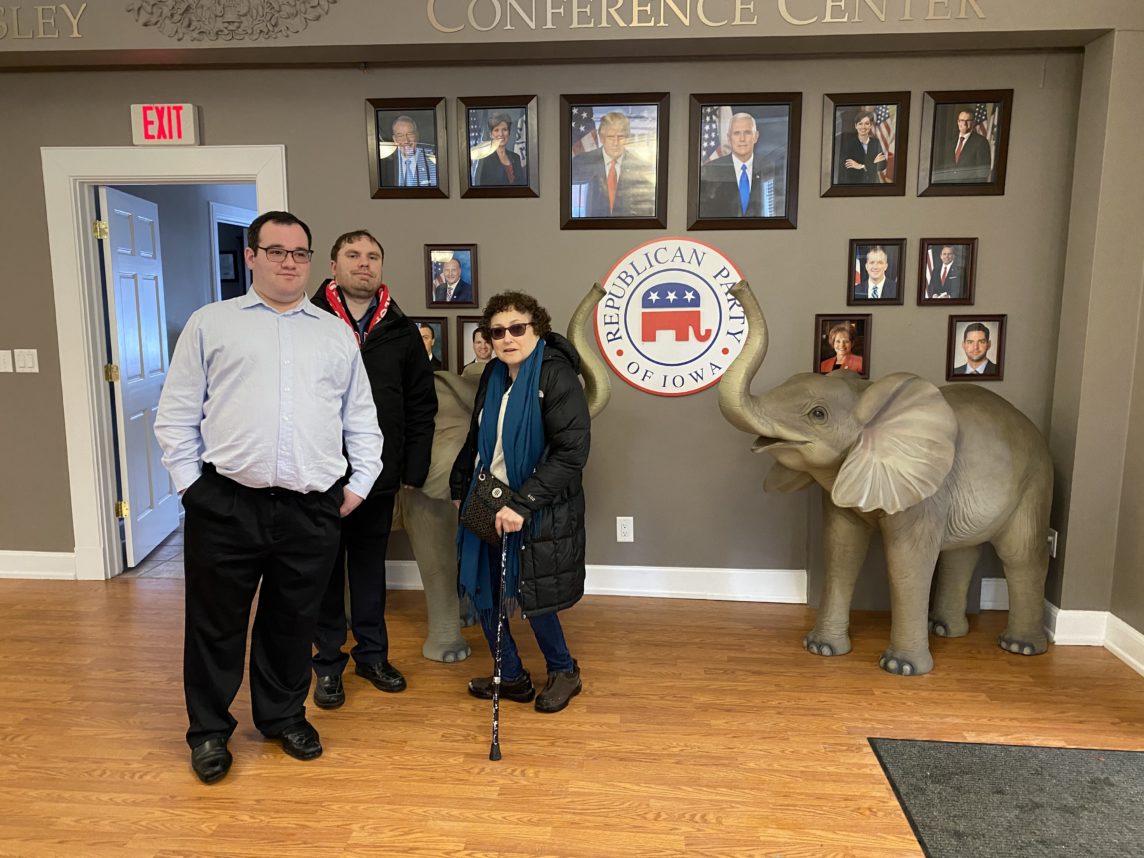
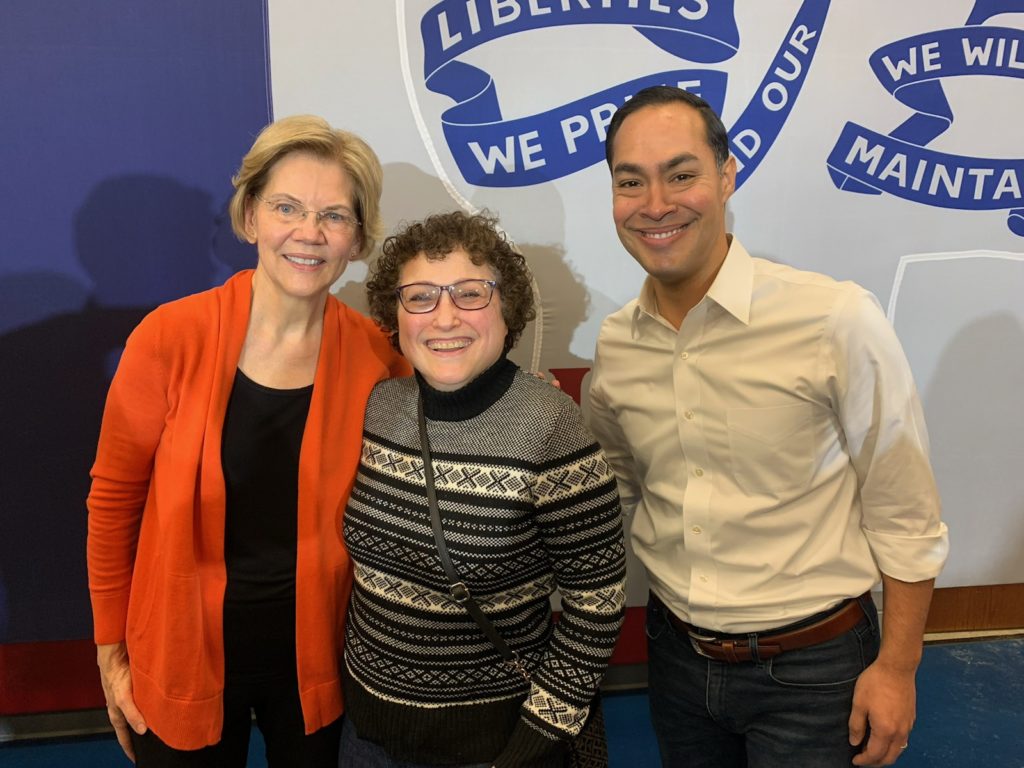
Over the course of four days, we attended events for presidential candidates Bernie Sanders, Elizabeth Warren, Amy Klobuchar, Pete Buttigieg, Joe Biden and Andrew Yang. Where possible, we asked questions and met with the candidates, staff and policy advisers.

Prior to our arrival in Iowa, we sent a nonpartisan questionnaire to all candidates to collect their views. We just released our disability voter guide. We went to each candidate’s field office to deliver the questionnaire in person, meet staff members and answer any questions. As of this writing, we have received complete written responses from Buttigieg, Klobuchar, Sanders, Warren and Yang.

We focused our engagement on “employment first,” asking each candidate to recognize that disability impacts 6 million schoolchildren and 22 million working-age adults. Not only are we the largest minority in the United States, we are the group most people eventually will join if they live long enough. We need to elevate the discussion to show the value people with disabilities bring to the workforce and the community. We asked the candidates to be more vocal on the campaign trail discussing disability issues and ensuring that if elected, his or her administration will include those with disabilities, to actively create change and increase employment opportunities.
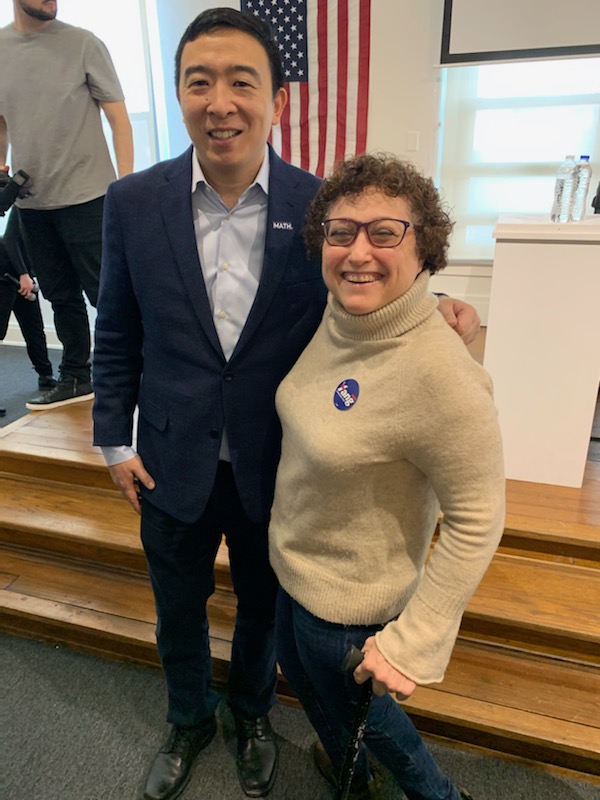
With Andrew Yang

True, the social safety net and health care are very important. However, most people with disabilities don’t just want to cash a government check. Millions want to work and be independent. Yet, the current system discourages employment. For example, for those who receive disability benefits to be able to attend school, those benefits end when they get a job. That sounds good in theory, but if someone is quadriplegic and needs someone to dress and feed them, they can’t afford to give up government benefits for school or a low-paying job. It is that same assistance — hand up, not handout — that would enable them to work and choose for themselves. It is better for the individual and society at large if those who are able to work pay taxes, raise families and have the choice to live independently and fulfill their dreams.

There is significant evidence that diverse teams, including those with disabled individuals, make better decisions and create better economic outcomes for the companies that employ them. This is true in synagogues, corporations, nonprofits and beyond. The discussion needs to be about what we can do. Everyone deserves the right to have a job, be independent and choose their purpose.

Four years ago, most candidates did not have accessible websites or events. That was also true at the start of this campaign. However, because of the advocacy of our group and others, people like me can go to an event and know there will be a place where we can sit and participate, just like anyone else.

Civic engagement is a core Jewish value, and it is a part of how we have survived for centuries as a people. It’s how we protect ourselves and everyone around us. It is vital for Jews — with and without disabilities — to engage in 2020 and beyond.
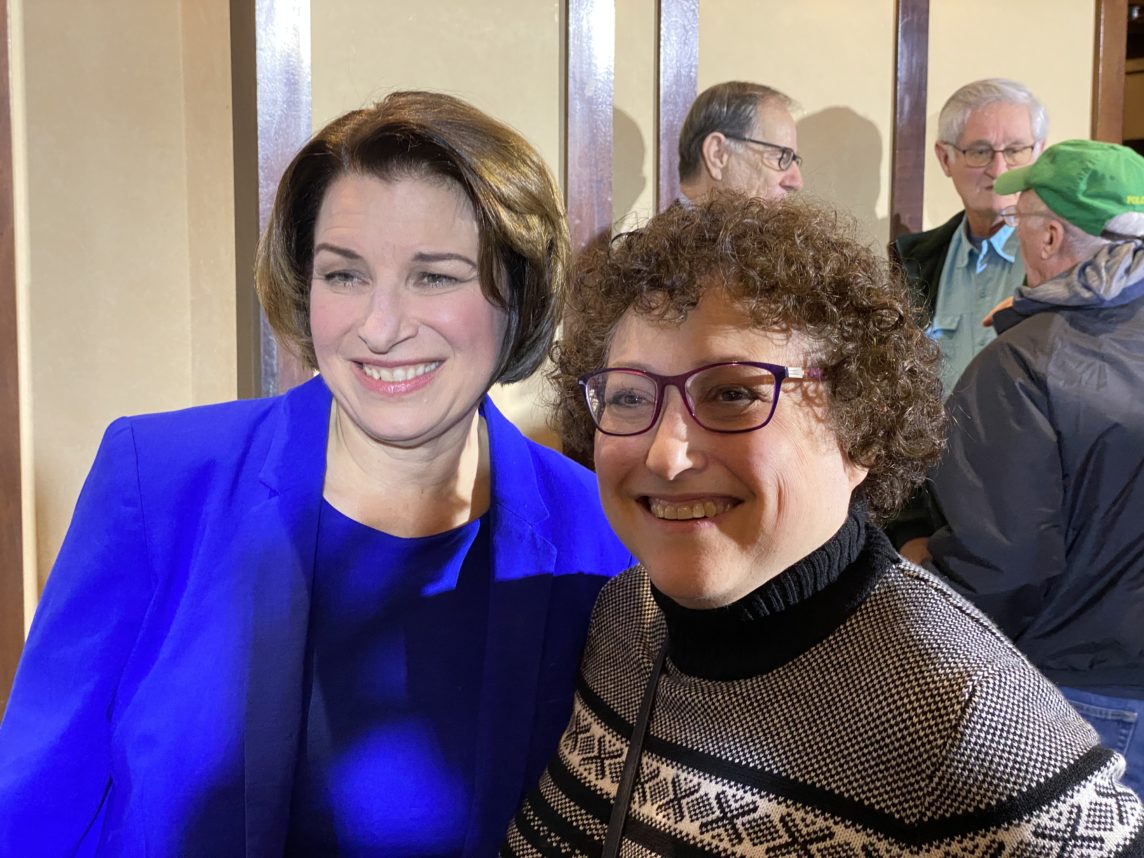
With Amy Klobuchar

Ila Eckhoff is a Jewish lay leader for RespectAbility.

I Have Cerebral Palsy. Here’s Why I Went to Speak to the Candidates in Des Moines. Read More »

Palestinians Fire Rocket from Gaza at Southern Israel for Fourth Day in a Row

JERUSALEM (JTA) — At least one rocket was fired by Palestinians in Gaza at communities in southern Israel for the fourth day in a row.

The rocket landed in an open area in the Gaza border community of Nahal Oz on Saturday evening. No damage or injuries were reported.

Blue and White coalition head Benny Gantz, a former Israel Defense Forces chief of staff, was visiting Nahal Oz at the time of the attack. It is not known if the Palestinians who fired the rocket knew that Gantz and other members of his party were in the area.

Earlier in the day, at least four clusters of balloons carrying homemade explosives floated from Gaza and landed in southern Israeli communities, including Sderot. Police sappers were called to disarm the bombs and dispose of them.

In response, Israel’s Air Force late on Saturday night launched air strikes on what it called “a number of Hamas targets in Gaza.”

At least three rockets and several mortar shells were fired on Friday at southern Israeli communities. Two were intercepted by the Iron Dome missile defense system. Several homes were damaged by shrapnel from the interceptions, according to Hebrew media reports.

The uptick in rocket fire from Gaza began a day after the Trump administration’s Israeli-Palestinian peace plan was unveiled at the White House in Washington D.C.

Palestinians Fire Rocket from Gaza at Southern Israel for Fourth Day in a Row Read More »

The Naama Issachar Affair

When Prime Minister Benjamin Netanyahu returned from his trip to Washington and Moscow, Israelis gave him a standing ovation: Not so much for the “Deal of the Century” cooked by President Trump, of which Israelis have mixed feelings, but for bringing with him Naama Issachar.

Issachar, a dual American-Israeli citizen, has been in prison in Russia since April when she was stopped at the airport for having 9.5 grams of marijuana in her luggage. Prime Minister Benjamin Netanyahu has been repeatedly pleading with his friend Vladimir Putin to release her, and finally succeeded.

At the same time, another Israeli, Nati Hadad, served his 18 months in jail in Thailand, for operating an illegal clinic. But then, much to the shock of everybody, a judge arbitrarily sentenced him to another four years. His mother Nurit was raising hell but unlike in the case of Yaffa Issachar, Naama’s mother, Netanyahu never approached the King of Thailand asking for the release of her son.

You don’t need to be an “anti-Bibi” fanatic to understand that Naama and Yaffa were lucky, because they presented Netanyahu with a dreamlike opportunity to show the Israelis, who are going to the ballots soon for the third time in a year, how great and irreplaceable he is. Instead of heading straight back home from Washington, then, he made a detour to Moscow, allegedly to brief Putin on Trump’s “Deal of the Century,” but actually for the invaluable photo-op with him bringing Naama home.

In the midst of the celebration here, I hate to spoil the party, but with all due respect, Naama Issachar is not Ida Nudel, the “guardian angel” of the refusenik movement, who had been freed from Soviet jail in 1987 after a struggle of sixteen years. Yet what worries me more is the question of the price we will pay for Naama’s release, because I don’t believe there is a free lunch when it comes to Putin. Perhaps relinquishing recently the ownership of the Alexander Courtyard in the Old City of Jerusalem after decades of dispute with the Russian Orthodox Church, is an advance payment.

“There is no greater commandment than the redemption of captives,” said the Rambam (Maimonides), and the Shulhan Arukh (Code of Jewish Law) states categorically: “Every moment that one delays in redeeming captives, where it is possible to be speedy, is like shedding blood.”

However, our sages were aware of the price Jews might be forced to pay for this Mitzva. The Mishna warns that “captives should not be redeemed for more than their value, to prevent abuses.” Indeed, in 1286, Rabbi Meir Ben Baruch, known as the MaHaRam of Rothenburg, was arrested by the German King Rudolph, imprisoned in the fortress of Ensisheim and held for ransom. A huge sum of 20,000 Marks was raised for his release, but Rabbi Meir forbade his followers to pay any ransom for him, in order not to create a precedent. He remained in prison until his death in 1293.

Unfortunately, when the Jews finally had a state of their own, they didn’t develop the kind of resilience the MaHaRam had commanded. Israeli soldier Gilad Shalit was released in 2011 from the hands of Hamas in exchange for more than 1000 Palestinian prisoners, some of them with Israeli blood on their hands. And who waited for the helicopter carrying Shalit back to Israel, with dozens of television crews around him? No other than Benjamin Netanyahu, who, in his book “Terrorism: How the West can Win” (1987) had emphatically opposed such move.

To Netanyahu’s credit, it was Yitzhak Rabin who had created the dangerous precedent, when in 1985, as Defense Minister, authorized the notorious “Jibril Deal” by which 1,150 security prisoners were released in return for three soldiers who had been taken captive in the First Lebanon War.

Having said all that, I’d rather have Bibi Netanyahu pay whatever price to Putin for the release of Naama, than having him pull a trick Frank Underwood had done in the fifth season of “House of Cards,” when he declared war on a terror organization to rig the coming elections.

Welcome home, Naama.


Uri Dromi was the spokesman of the Rabin and Peres governments, 1992-96.

The Naama Issachar Affair Read More »

Boston Smoked Fish Company’s Chris Avery Whole Foods Expansion, Becoming Kosher-Certified

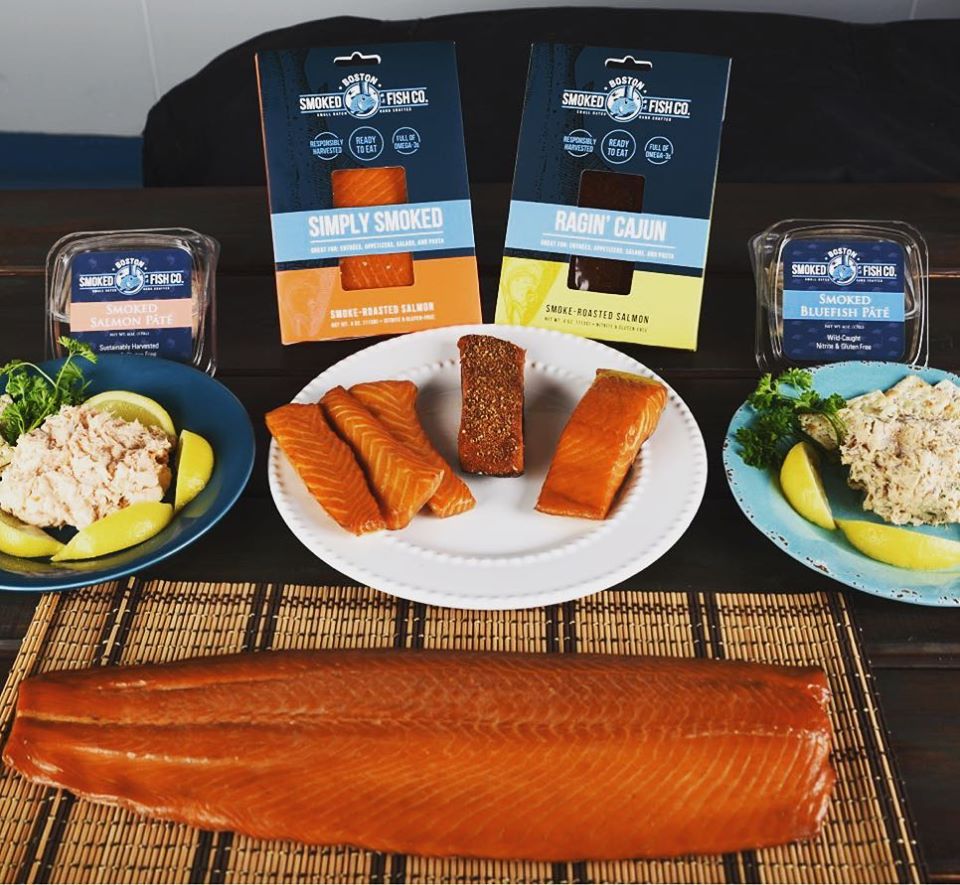
As the premier smoked fish company in Massachusetts, the Boston Smoked Fish Company has pioneered its own niche within Boston’s thriving seafood culture by focusing exclusively on the art of hot-smoking. This process imparts a “cooked texture” to the fish and gives it a distinctive bacon-like “umami” quality that appeals to traditional meat eaters and seafood lovers alike. Once in the smoker, there is no firm rule for determining how long the fish should cook; only experience and careful attention to each batch ensures the perfect result.

The Boston Smoked Fish Company emerged in 2013 when Matt Baumann and Chris Avery — law school classmates, attorneys and seafood lovers — set out to create a smoked fish that stands apart from the more traditional brands on the market. They renovated a 500-square-foot shed and experimented with 72 different brine recipes and multiple varieties of fresh fish and North American hardwoods, finally arriving at the perfect combination of flavor and all-natural processing. Baumann and Avery ultimately traded in their day jobs and dedicated themselves full-time to sharing their results with the communities around them. 

I had the pleasure of doing Q&A with Chris Avery about the past, present and future of the Boston Smoked Fish Company, including its recent expansion via Whole Foods.

Darren Paltrowitz: Word is that both of you are lawyers by trade. Are there any similarities between your two careers? 

Chris Avery: Matt and I attended Suffolk University Law School in Boston at the same time, graduating in 2007. Coincidentally we worked at the same law firm after graduation before going off in different directions. It was in January 2013 that Matt and I met up over a beer in a South Boston and he told me of his plans to start a smoked fish business.

DP: How long was it from conceptualizing the Boston Smoked Fish Company to having your first finished product for sale? 

CA: It was exactly 6 months. Matt hatched the idea while visiting his family in Michigan at the start of 2013, and the first product was sold at the Lexington (Massachusetts) Farmers’ Market in June of that year.

DP: To you, what makes the Boston Smoked Fish Company products better than other smoked fishes and pates on the market?

CA: We focus exclusively on the art of hot-smoking. This process imparts a cooked texture to the fish and gives it a distinctive “umami” quality that appeals to traditional meat-eaters and seafood lovers alike. But the real key to our bold flavor profile is our brine ingredients, and the critical dry time that allows each filet to develop the perfect pellicle, or smoke-catching surface. Once in the smoker, there is no firm rule for determining how long the fish should cook; only experience and careful attention to each batch ensures the perfect result.

DP: Was it difficult to become a kosher-certified company? 

CA: It was fascinating to work with the Rabbis as they explained the Biblical origins of the law and the rationale for why certain products and procedures met its requirements. Our hot-smoked process initially presented some novel questions to the Rabbis, but after careful analysis and some minor adjustments to our operation, we were able to become fully compliant with Kashrut.

DP: Did having Boston in your company name pose any challenges with expanding into other cities like Los Angeles and New York? 

CA: We have yet to really find out because so far we’ve primarily focused on growing our brand in New England. But we’re very excited about our recent arrival in all Whole Foods locations throughout the New York Tristate region. Boston is internationally-renowned for the superb quality of its seafood, so we’re hopeful that our name will carry a certain amount of cachet and customer appeal in other parts of the country. California is the next great frontier!

DP: Do you have a favorite of the Boston Smoked Fish Company products available?   

CA: To this day I think our Simply Smoked Salmon Filet embodies the purest representation of what we do. The brine flavors, balanced smokiness, and perfect moisture content all combine for an unforgettable experience. I believe all of our products stand out, but for my money, the Simply Smoked is the best place to start for the uninitiated.

DP: What is coming up for the company in 2020?

CA: We’re currently building a salmon burger business in our adjoining space on the Fish Pier. We plan on manufacturing and selling the burgers by March.

DP: Finally, any last words for the kids? 

CA: Keep eating fish! We made it extra tasty for you. Actually, my nieces and nephews love the smoked quality and love telling me that there’s nothing “fishy” about it.

More on the Boston Smoked Fish Company can be found here.

Boston Smoked Fish Company’s Chris Avery Whole Foods Expansion, Becoming Kosher-Certified Read More »