fbpx

December 26, 2019

The Four Messages of Netanyahu’s Primary Victory

This is exactly how you take a lemon and make a lemonade out of it. Prime Minister Netanyahu was challenged from within his own party. This could have been the beginning of the end. But he made it into something else. Maybe a beginning of a new beginning. He won decisively against rival Gideon Saar (with more than seventy percent of the vote) and achieved four things.

One – Sending a clear message that he is not yet dead, and that betting against him is still politically dangerous. His Likud colleagues watched and learned.

Two – Reminding everybody that he is still the best politician in town and that losing twice in the general election, as painful as it is, does not necessitate a third defeat. He might be able to pull it off.

Three – Warning the legal system that a decision to send him home could lead to chaos. Likud voters want him as their leader, and no court could change that.

Four – Rediscovering the power of the rally. For too long Netanyahu relied on social media and videos, but working against Saar was different. He had to go out and meet the voters. And suddenly he seemed to enjoy doing it. It reinvigorated a party and a leader. No doubt, in this election he is going to do it much more.

The Four Messages of Netanyahu’s Primary Victory Read More »

Sweet Dreams – A poem for Parsha Miketz

I have dreamed a dream, and
there is no interpreter for it

The one where you show up to work
naked

The one when you realize you’re at school
in your underwear

The one where you’re falling and you
wake up before you hit the ground

The one where you’re traveling the
perimeter of the country by covered wagon

The one where you can fly
The one where he really is the president

The one where you have all the money
but wake up before you can spend it

The one where you can’t pick things up
and objects keep falling over

The one where the ears of corn are healthy
but your son still won’t eat them

The one where the cows put up signs
that say chicken is healthier

The one where the king of all the land
puts you in charge of feeding everyone

The one where the doorbell rings while
you’re writing a poem and you forget

where you were going when you come back
The one where you come back

The one where you never left


God Wrestler: a poem for every Torah Portion by Rick LupertLos Angeles poet Rick Lupert created the Poetry Super Highway (an online publication and resource for poets), and hosted the Cobalt Cafe weekly poetry reading for almost 21 years. He’s authored 23 collections of poetry, including “God Wrestler: A Poem for Every Torah Portion“, “I’m a Jew, Are You” (Jewish themed poems) and “Feeding Holy Cats” (Poetry written while a staff member on the first Birthright Israel trip), and most recently “Hunka Hunka Howdee!” (Poems written in Memphis, Nashville, and Louisville – Ain’t Got No Press, May 2019) and edited the anthologies “Ekphrastia Gone Wild”, “A Poet’s Haggadah”, and “The Night Goes on All Night.” He writes the daily web comic “Cat and Banana” with fellow Los Angeles poet Brendan Constantine. He’s widely published and reads his poetry wherever they let him.

Sweet Dreams – A poem for Parsha Miketz Read More »

The Baker: Chapter Thirteen

PREVIOUSLY: Daughter-in-law Marianne is the only person who stands up to Ernie and get away with it. How?

Marianne remembers the first time she ever met the irascible Ernie. 

The year was 1984. Marianne was nearing the end of a year-long visa to the U.S. She’d come from her childhood home in Casablanca, where her father was a criminal lawyer.

She knew all about strong men.

Marianne went to a party Ernie threw at his house in Oakland. But the host was too busy to talk. He was in the kitchen making donuts.

So she was introduced to his son, Morde.

“He looked good,” she said. “He was sharp, very strict in his talk.”

If this was a match-making effort, Marianne wasn’t interested. Morde, the son, was cute, she thought, but as a petite 103-pound firecracker who’d only just arrived in America, Marianne was interested in having fun, not settling down.

Also, Morde was there with his soon-to-be ex-wife. Not terribly romantic.

That day, she was more transfixed by Morde’s father, a master pastry chef who commanded his kitchen like a field general. “Not only was he making these amazing cream puffs, he was doing everything so fast it made you dizzy.”

Sitting in the kitchen was a woman Marianne later learned was Ernie’s latest girlfriend, who clearly adored her baker boyfriend.

“Yes, sweetheart,” she told him.

When Morde’s wife left the party, the soon-to-be bachelor approached Marianne.

“Aren’t you eating my father’s donuts?” he asked.

“Not right now,” she said. “We’re having dinner soon.”

“Well, you could certainly eat them if you wanted to,” he said. “You look really good.”

He handed her his business card. He was a limo driver.

“I’d love to give you a tour of the city.”

Marianne rolled her eyes. 

Later, after dinner, the father held center court: Ernie led the table conversations that ranged from religion to politics; you name it. Marianne saw a man who could discourse on most any subject. 

But food, it was clear, was his passion.

Marianne also got a bird’s eye view of Ernie’s approach to women. 

It wasn’t pretty.

“The soon-to-be ex-girlfriend’s name was Vicki, and she doted on him,” Marianne recalled. “The problem was that she had three kids. Ernie wanted all of her attention. He wasn’t there to be the father of anyone’s kids.”

That day at the party, Marianne decided she wasn’t going to pursue a married man. 

What she didn’t know was that Morde’s mother, Helen, who had been divorced from Ernie for years, had other ideas.

Helen, who was remarried but also lived in the Bay Area, had seen Marianne at the local synagogue and had quickly decided that she was perfect for her son.

Then, as fate commands, Marianne ran into Helen at a wedding.

“I’d like you to call my son and take him out,” Helen said. 

At this point, Marianne had no idea that she’d already met Morde at Ernie’s party.

But Helen was persistent. 

After weeks of calls from the older woman, Marianne relented. She called the number Helen had given her and left a number with the answering service.

Morde called right back.

“I spoke with your Mom,” Marianne began.

“My Mom?”

“Yeah. She gave me $500 to take you out.”

They both laughed. Then they set a date.

When Morde arrived at her apartment for their date, Marianne gasped.

“I thought ‘Oh my God — I get it now. This is the same guy.’ But he looked great. This time, the connection was immediate.”

The couple dated six months before they got engaged. During that time, Marianne got to know Helen. She had so many questions about the mysterious baker.

It quickly became clear that Helen was the love of Ernie’s life — the one one who got away. He was obsessed with her, even after she remarried.

The feelings ran both ways.

Helen described how she and Ernie had started their life together in Israel after their release from the British camps in Cyprus. 

At one point, Ernie opened a bakery, and the couple lived in a unit right upstairs. Helen rarely saw her husband, because Ernie would not let her help in the kitchen.

Then she got pregnant with Morde. 

What happened next was a precursor of what was to come.

When she was in labor upstairs, Ernie was so busy with the bakery that he couldn’t take time to be by his wife’s side. All day, he ran back and forth up the stairs, from the bakery to the bedroom and back.

When Morde was finally born, Ernie was downstairs in the bakery.

For the young couple, there were other misfires.

Helen loathed Ernie’s rudeness. She hated how he talked to her, in the kitchen especially, in front of employees or even when the two were alone. 

He made her feel stupid. 

When Morde was still young, Helen’s older brother Max approached her about emigrating to the U.S. He’d never liked Ernie in the first place — said he was too tall for Helen — and he knew his sister was unhappy.

And so, on a lark, she accepted his offer, leaving Morde behind with his father because visas were so hard to come by. 

Once in the Bay Area, Helen got a factory job. She learned English. At the synagogue, she stood out. Men competed for her attentions. They took her dancing and to the movies. 

For the first time in years, Helen felt attractive again.

“I realized that I wasn’t that stupid after all,” she told Marianne. “Men wanted me.”

Helen soon bought her own car, got an apartment and became even more independent. 

By the time Ernie arrived in the U.S. a few years later, sponsored by Helen’s older brother Max, who apparently relented in his dislike for his brother-in-law, their relationship had irreparably changed. 

Ernie took her to dinner, tried to win her back. But Helen loved her new life. She slowly broke the news that things were different between them.

As Morde got older, Helen playfully criticized him: “Don’t be like your father. Treat women like they’re a queen.” Or she’d say, “Look at that. You’re just like your father.”

Then Helen met Maurice, a 48-year-old Polish immigrant who had survived a hard-labor camp during the war. He was Ernie’s opposite: Very religious; a smooth talker. And he didn’t like the way Ernie treated people, especially Helen. 

They dated eight years. Finally Helen’s brother told her: He’s not going to wait forever. Ernie was crushed when Helen announced her wedding plans. All these years, he’d secretly hoped that Helen would return to him.

Still, even after Maurice and Helen were married, Ernie stayed in the picture. 

He was invited to all the couple’s social functions. He and Helen spoke by phone most every day. She even offered advice on women Ernie should pursue. 

Helen told the stories, how Ernie was always considered part of the family.

“My God!” Marianne told her one day. “You’re still in love with him!”

“I love him very much because he was my first,” Helen told her. “But am I still in love with him? No.”

Ernie was a hard man, she’d repeat. But he was a good man. 

NEXT: Ernie returns home long after the war to find wounds that haven’t healed

The Baker: Chapter Thirteen Read More »

Rapper Kodak Black Donates $1,000 to Orthodox Synagogue from Prison

(JTA) — Rapper Kodak Black donated $1,000 to a south Florida Chabad synagogue while serving a four-year prison sentence.

The donation, made last week, was his second gift in as many years to the Downtown Jewish Center Chabad of Fort Lauderdale, according to Rabbi Schneur Kaplan. The rapper, known for the hit singles “Zeze”and “Roll in Peace,” is connected to the synagogue through his lawyer, Brad Cohen, who is a member there.

“I understand that he is a philanthropic individual, and his attorney shared with him things that we are doing, so he wanted to contribute to it,” Kaplan told the Jewish Telegraphic Agency. “It’s a beautiful thing to see that we received support from people even outside of the Jewish community who appreciate the work that we’re doing.”

Kodak Black was sentenced to nearly four years in prison last month for lying on background check forms for two gun purchases. The contribution to Chabad was part of $8,000 in total donations made by the rapper, who also donated to a south Florida preschool and to a child who is blind, according to the celebrity gossip site TMZ.

Kaplan said the donation to Chabad will go toward the construction of its new building. Kaplan says he hopes to be in touch with Kodak Black in the future.

Rapper Kodak Black Donates $1,000 to Orthodox Synagogue from Prison Read More »

Flood Damages Beirut’s Only Jewish Cemetery

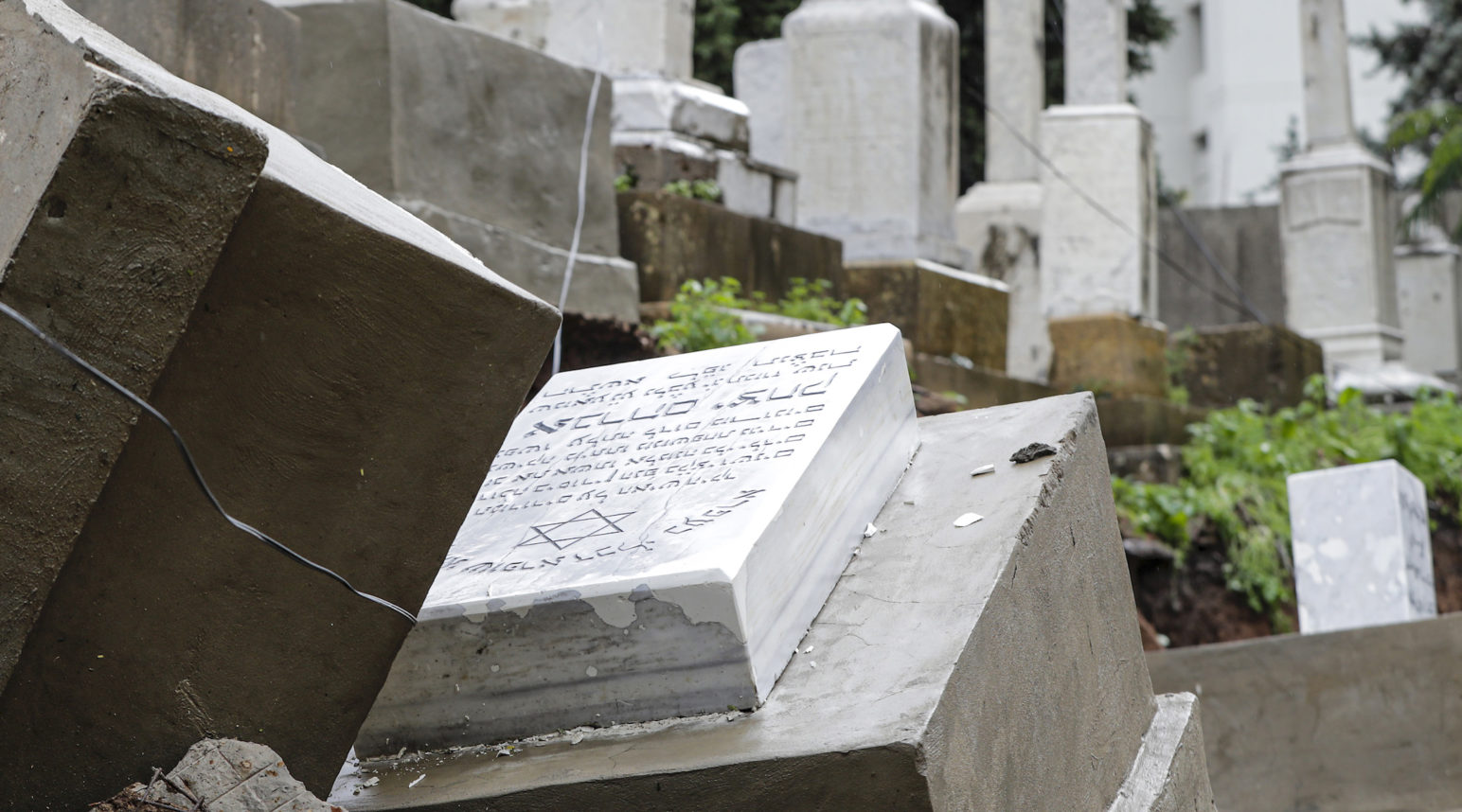
(JTA) — Four graves were destroyed and others covered by rubble as a flood swept through Beirut’s only Jewish cemetery.

The flood in the Lebanese capital on Thursday destroyed a retaining wall in the city’s only Jewish cemetery, whose graves date back to the 1820s, according to Agence France-Presse. Most of the cemetery’s 3,407 graves remain intact, according to Nagi Georges Zeidan, an expert on Lebanese Jewry.

Some sarcophagi and headstones were displaced, and rubble covered over other remains. The graves that were destroyed date to the 1940s, according to Zeidan, who volunteers at the cemetery.

Once home to thousands of Jews, Lebanon’s remaining Jewish community numbers only 29 today, Zeidan says.

Flood Damages Beirut’s Only Jewish Cemetery Read More »

Headstones Discovered Vandalized at Second Jewish Cemetery in Slovakia

(JTA) — More than 20 headstones were vandalized at a Jewish cemetery in northern Slovakia in the second such incident in the country in a week.

The 22 gravestones vandalized at a Jewish cemetery in the country’s northern town of Rajec appear to have been damaged in mid-December, according to the World Jewish Congress. The vandalism is currently under investigation by police.

The 60 gravestones knocked down and set on fire in the Jewish cemetery of Námestovo, a town in northern Slovakia near the Polish border, were discovered on December 16.

It is not known yet whether the two incidents are connected.

Anti-Semitic incidents of this nature are extremely rare in Slovakia, according to the World Jewish Congress.

In Central and Eastern Europe, inactive Jewish cemeteries often attract vagrants because they are often located outside urban centers and out of sight of law enforcement. Some incidents of vandalism have been attributed to drunks and drug users and are not always deemed hate crimes.

Headstones Discovered Vandalized at Second Jewish Cemetery in Slovakia Read More »

Israel will Seize ‘Pay for Slay’ Salaries Paid to Arab-Israeli Prisoners

JERUSALEM (JTA) — Arab Israelis convicted on terrorism charges will no longer receive payments from Palestinian authorities.

Defense Minister Naftali Bennett on Wednesday signed an order that will allow Israel to seize the payments.

The Palestinian Authority has long made monthly payments to individuals under arrest in Israel for terrorism-related offenses. The payments range from about $400 to $3,400 month, Ynet reported. The salaries are informally known as “pay for slay” payments.

“We are taking action, this is a further step in the fight against terrorism,” Bennett said in a statement. “We are working to make the spilling of Jewish blood no longer economically profitable.”

Among those covered under the order are five Arab Israelis serving life sentences. One participated in a 2003 double suicide bombing in Tel Aviv, which killed 23. Two others assisted the suicide bomber who attacked a bus at the Meron Junction in August 2002, killing nine people and injuring 38.

Israel will Seize ‘Pay for Slay’ Salaries Paid to Arab-Israeli Prisoners Read More »

A Moment in Time: Hanukkah – Miracles Don’t Happen on Their Own

Dear all,
Miracles don’t happen on their own.
Even the big episodes of the Bible … (the Burning Bush, the Parting of the Sea, and the Walls of Jericho) or the post-Biblical events (the story of Hanukkah) … all of these took lots of moving parts. Visionaries had to convince others. Participants had to organize. Movers had to schlep.
It was more than one cataclysmic event in a vacuum!
The birth of our twins was certainly a miracle, and Ron and I celebrate their life and their light each day, especially during this Hanukkah season. But we also recognize that it took lots of perseverance to get here, and it will take incredible stamina moving forward.
No, miracles don’t happen on their own. They are about time, place, people, and spirit. So if you experience a miracle this week consider:
What brought my soul to this place so I could recognize it?
Who helped me get here?
How will I adjust my life moving forward?
When you take a moment in time to reflect on these – perhaps THAT is the true miracle!
With love and shalom,
Rabbi Zach Shapiro

A Moment in Time: Hanukkah – Miracles Don’t Happen on Their Own Read More »

Episode 174: Is Israel a Socialist or Capitalist Country?

Israel was founded largely by a group of Russian Jews. Ben Gurion, Moshe Sharet, David Remez, the list goes on and on. They came to Israel In the end of the 1800’s and early 1900’s, and were extremely influenced by Karl Marx and socialist ideas.
The entire culture of Jewish Society in mandatory Palestine was socialist. If you wanted to be someone, you had to be a part Mapai, Ben Gurion’s Workers’ Party, and if you wanted a job, you had to bare the party’s famous “Red Notebook.”

When Israel was founded, the socialist ideas of the founding fathers were the foundations for the country’s entire infrastructure. Every 1st of May, the entire country celebrated International Workers’ Day, and when Stalin passed in 1953 the newspapers mourned.

Flash forward, 75 years later. Israel in 2020 is a thriving country, where innovation and merit are important values. But the country is more divided than ever when it comes to economic ideology, as most of the population thinks the country isn’t “social” enough, while others call for the end of what remains of the socialist system.
So is Israel a social country, or a capitalist country?

To clarify this daunting question, we brought Dr. Eli Cook straight from Haifa Uni. Eli is an expert for the History of Capitalism, and we’re super happy to have him here today.

Dr. Cook’s book on Amazon

RSS Subscribe


Episode 174: Is Israel a Socialist or Capitalist Country? Read More »

Gal Gadot to Produce Movie from Book Banned in Israel

Gal Gadot will produce a movie based on “Borderlife,” a 2014 novel about an Israeli-Palestinian romance that was removed from school reading lists in Israel the following year. Sales of the book increased after Israel’s conservative Education Minister Naftali Bennett banned the novel, which has been published in English under the title “All the Rivers.”

Gadot and her husband and producing partner Yaron Versano are teaming up with Keshet International for the project, about an Israeli woman and Palestinian man who meet in New York, fall in love, and keep their relationship a secret from friends and family.

It’s uncertain whether Gadot will star in the film, but she will appear in several upcoming projects. “Wonder Woman 1984” is set for release in June and “Death on the Nile” with Kenneth Branagh is due in October.

She next shoots “Red Notice” with Dwayne Johnson, and she’s set to play two famous women in projects she and Versano will produce. She’ll star in biographies of Irena Sendler, a Polish nurse and social worker who saved thousands of Jewish children during the Holocaust, and play actress and inventor Hedy Lamarr in a miniseries for Showtime.

Gal Gadot to Produce Movie from Book Banned in Israel Read More »