fbpx

November 21, 2019

Fight Breaks Out During Protest of Reservists on Duty Event at Canadian University

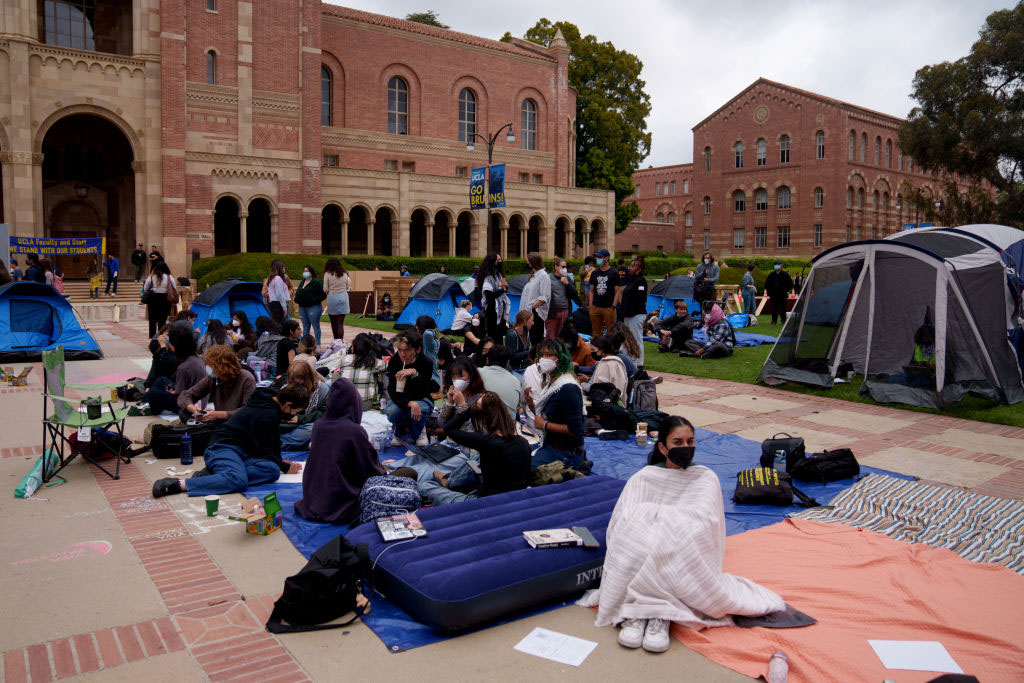
A fight broke out Nov. 20 during protests of a Reservists on Duty event at York University in Toronto, injuring at least one person.

The Toronto Sun reports that York University’s Students Against Israeli Apartheid (SAIA) led the protests, highlighting videos showing the protesters chanting of “Viva viva Intifada!” and “Free Palestine!” Reservists on Duty, an organization featuring Israel Defense Force reservists discussing their time in the army, posted a video to their Facebook page showing the protesters banging on the doors of the event and interrupting it. The video also shows punches being thrown at a stairwell before police intervene; Reservists on Duty claimed in their Facebook post the protesters had “assaulted a few Jewish students.”

According to the Sun, one person that was injured filed a police report but there aren’t currently any charges.

Reservists on Duty CEO Amit Deri told the Jerusalem Post, “We will continue to speak. We will never be afraid to do so.”

York University President Rhonda Lenton denounced the protests in a Nov. 21 statement, saying “that acts of violence are not tolerated on our campuses and York University has zero-tolerance for hate.”

She later added: “In democratic societies, universities play a central role in facilitating debate on difficult issues. Shouting, threats of violence and attempts to intimidate community members are not consistent with the responsibilities we all share.”

B’nai Brith Canada CEO Michael Mostyn said in a statement, “The Toronto Police Service and York University should be commended for ensuring that this event could be safely held. Enraged mobs cannot be allowed to prevent lawful and peaceful gatherings from taking place on campus. Further investigation is required into how a registered student group was permitted to glorify terrorism and attempt to intimidate those peacefully assembling on campus. There must be consequences for violent behavior.”

Associate Dean and Director of Global Social Action Agenda at the Simon Wiesenthal Center Rabbi Abraham Cooper said in a statement to the Journal, “Will York University ever hold pro-Palestinian extremists accountable for their violent Jew-hatred? What about rights of Jewish students, the speaker and other students? Won’t stop until University holds these bigots accountable.”

StandWithUs Canada Executive Director Meryle Kates similarly said in a statement to the Journal, “We are deeply dismayed at the shameful demonstrations of hate at York University. Anti-Israel protesters once again attempted to deny pro-Israel speakers the freedom of speech we have the right to expect at any university campus in Canada. We must stand together as a community to condemn this bigotry.”

SAIA at York University celebrated the protests in a Facebook post.

“The students’ message to York University was loud and clear yesterday: war criminals actively participating in the ethnic cleansing of Palestine and in violations of Palestinian human rights are not welcome on our campus!” they wrote. “Thanks to everyone who showed up!”

SAIA at York University did not respond to the Journal’s request for comment.

Fight Breaks Out During Protest of Reservists on Duty Event at Canadian University Read More »

Doing Jewish – A poem for Parsha Chayei Sarah

…you will not take a wife for my son from
the daughters of the Canaanites…

When I worked for Hillel, the organization’s motto
was a memorable maximizing the number of Jews

doing Jewish with other Jews. All the kids and
much of the staff had a good laugh at the

implications of the word doing. It didn’t take a
cabal of Yentas to know Hillel was simply following

the directions of Abraham…making sure his son
kept doing Jewish. Abraham’s words were the

Genesis (Get it? That’s the name of the book they
come from) of the You should marry a nice Jewish

[insert pronoun of choice] concept. I think of them
when my son, the Isaac in training, tells about

all the people he has crushes on at his school.
Usually it’s only one at a time. He has no concern

about whether they come from the same tent.
In his view, the world is one large open tent

where everyone belongs and can do each other.
He has no idea yet what the word do means.

(At least I’d like to think so.) I like the world
he lives in, where our traditions can thrive

holding hands with even a Canaanite neighbor.
If you go back far enough, and at this point

that’s only four chapters, we all come from
the same garden. The taste of the apple

is still in our mouths.


God Wrestler: a poem for every Torah Portion by Rick LupertLos Angeles poet Rick Lupert created the Poetry Super Highway (an online publication and resource for poets), and hosted the Cobalt Cafe weekly poetry reading for almost 21 years. He’s authored 23 collections of poetry, including “God Wrestler: A Poem for Every Torah Portion“, “I’m a Jew, Are You” (Jewish themed poems) and “Feeding Holy Cats” (Poetry written while a staff member on the first Birthright Israel trip), and most recently “Hunka Hunka Howdee!” (Poems written in Memphis, Nashville, and Louisville – Ain’t Got No Press, May 2019) and edited the anthologies “Ekphrastia Gone Wild”, “A Poet’s Haggadah”, and “The Night Goes on All Night.” He writes the daily web comic “Cat and Banana” with fellow Los Angeles poet Brendan Constantine. He’s widely published and reads his poetry wherever they let him.

Doing Jewish – A poem for Parsha Chayei Sarah Read More »

ADL Survey: 25% of Europeans Have Anti-Semitic Attitudes

The Anti-Defamation League (ADL) released a new poll regarding anti-Semitism throughout various parts of the world as part of its ADL Global 100: An Index of Anti-Semitism. Among the findings highlighted in the survey is that one out of four European said they believed in most of the anti-Semitic beliefs mentioned in the poll.

According to a press release from the ADL, the poll surveyed 9,056 people in 18 countries, including 14 European countries, Argentina, Brazil, Canada and South Africa from April to June. Respondents were asked if they subscribed to 11 anti-Semitic beliefs and attitudes.

The survey found that the most common anti-Semitic stereotype in Western Europe is the belief that Jews have dual loyalty to Israel, while in Central and Eastern Europe was the notion that Jews have an inordinate amount of economic power. About a third of Austrians and Germans believe that hatred of Jews stems from their behavior, not anti-Semitism.

Additionally, anti-Semitic attitudes among Muslims in Belgium, France, Germany, Italy, Spain, and the United Kingdom were three times higher than the average population in those countries, but lower than attitudes among Muslims in the Middle East and North Africa. Thirty-seven percent of Muslims surveyed said that “people hate Jews because of the way Jews behave.”

Support for the boycott, divestment and sanctions (BDS) movement were all 18 percent or lower except for South Africa, where 38 percent of respondents expressed support for BDS. The survey noted that South Africa has “troubling levels of anti-Semitism and support for BDS.”

Since the ADL conducted its 2015 survey, there were significant increases in anti-Semitism in Argentina, Brazil, Poland, South Africa and Ukraine, marked decreases in Austria, Canada and Italy, and little to no change in Belgium, Denmark, France, Germany, Hungary, Netherlands, Spain, Sweden and the United Kingdom. However, the survey pointed out that the decreases were largely due to “people saying they ‘don’t know’ whether stereotypes are true, not the result of people saying they’re false.”

The ADL tweeted that the survey showed that “hate is on the rise.”

ADL Survey: 25% of Europeans Have Anti-Semitic Attitudes Read More »

The Baker: Chapter Eight

One day a few years ago, Ernie called his son Morde, who works as a self-employed limousine driver in the Bay Area.

The brief discussion said much about their rough-edged relationship.

How maddening it was to have Ernie for a father.

“Why don’t you come up to Lake Tahoe?” Ernie asked. “It’s your birthday.”

“Yeah, it’s my birthday,” Morde responded. “Why don’t you come down here? You always come down to play poker with your friends. Come see your son.”

“I have a few hundred dollars for you.”

“I don’t need your money. If you won’t come down, put it into my account.”

“Oh, forget it,” Ernie said. “I don’t have time.”

And he hung up.

Morde understands his father. He isn’t rattled by Ernie’s brusque exterior.

“I don’t listen,” he says. “When he screams, it goes in one ear and out the other.”

Once, Morde recalls, Ernie was eating burgers at a restaurant with one of his Morde’s daughters, who was trying to explain a story to her grandfather. 

Ernie turned to her. 

“Listen,” he said. “When I’m eating, you’re dead.”

Morde laughs at the episode. 

“People get all upset and offended at the things he says, but that’s just him.”

Morde is sarcastic as well. 

He’s his father’s son, after all.

He’d tell Ernie on the phone: “Can’t you hear me? Get a hearing aid.” 

Or “Stop mumbling. You need a new set of teeth.”

And Ernie would laugh.

For a moment, defanged.

Morde understood his father. He knows he was a self-made businessman who worked long hours to carve out his own success. He knows how just one slip up in the kitchen can cost time and money. 

Ernie taught him: Do your job. If you can’t, step aside. Don’t waste his time. 

And Morde has always respected that.

Sure, Ernie yells, he says, but he’s never profane.

“And once you were out of his kitchen” Morde recalled, “everything was cool.”

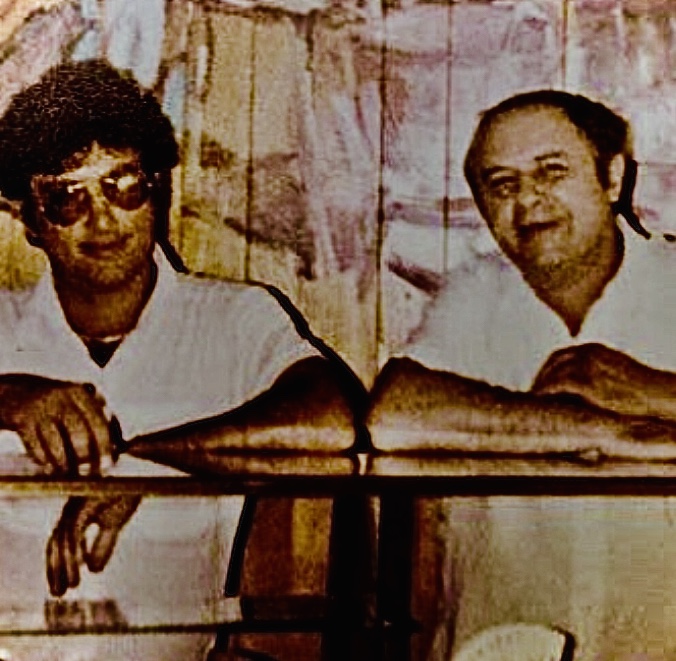
For years, Ernie ran the Bay Area’s only kosher bakery. People came for his strudel.

Every Rosh Hashanah, his challah was in high demand. Customers needed him; not the other way around. 

And he knew that.

But here’s where the perfectionist part comes in, the character flaw that drove people from Ernie in droves. 

“In the beginning, Ernie did the baking, the marketing, the financial stuff. He bought all the raw materials for his products,” Morde said. 

“There was a lot of pressure. He did everything. He worked six days a week. He couldn’t delegate to anyone. He didn’t trust them. He thought he was the only one who could do things the right way.” 

Once, Ernie’s cashier took a day off. Ernie noticed the replacement girl clumsily putting a customer’s order into a small box, one pastry on top of the other.

He’d spent hours making his creations. Unlike the competition, which used machines to work their dough, Ernie did things the old fashioned way.

He stood at a table, 5-feet-by-2-feet, covered with a cloth. He set the oil-covered dough out the night before and then used his hands and muscle to stretch it out, firmly but cautiously, so there were no holes. 

Then he’d roll the dough and bake the results, covering the finished product with powdered sugar.

That day, Ernie knew the pastries would be crushed in the small box and called for a bigger one. He stepped up to scold the worker.

The female customer stopped him.

It was fine, she insisted.

Not for Ernie it wasn’t.

“No,” he said, “they have to be packed the right way.”

“Leave her alone,” the woman said. “She’s doing it right.”

Well, you can guess what happened.

Ernie told the woman to get out of his store. He didn’t need her business. These were his pastries; he knew how to handle them.

Morde says it’s been this way from the beginning. He’d seen how Ernie treated his second wife Shoshana in the kitchen.

“Nobody wanted to work there. It was like working alongside some crazy whirling dervish,” Morde recalled. ‘If she screwed up, even in the slightest way, there would be hell to pay.”

Once. Morde said, his father yelled at Shoshana for 20 minutes. 

“When he was done, he yelled for another ten minutes, saying she’d wasted his time by invoking the first tirade.”

As a boy, Morde was scared to even visit his father at work.

“I don’t want to hear all the yelling,” he’d tell his mother.

“Go, go,” Helen would say. “It’s OK.”

It wasn’t until he became a teenager that Morde tried sarcasm with his father. 

It worked.

When Ernie asked him to taste a new creation, he’d say, “It tastes like shit.”

“Good,” Ernie would fire back. “This one’s going to be a good seller.”

His father might have yelled and threw tantrums, Morde says, but he was also quick to stand up for his son.

Morde struggled in the first grade and teachers wanted to hold him back. 

But Ernie would have none of it. 

“He came to class every day and sat right behind me – like Gulliver among the Lilliputians. I had a gorilla behind me. Man, he was tough.”

Despite Ernie’s deep flaws, Morde still cared about his father. 

“It’s like having a little brother who you love and care for, but you really just can’t stand.”

Still, he knows he paid a high price for having a kitchen tyrant for a father.

“The thing I missed the most is that I never had a Dad to go do things with,” he said. 

“Mine was always working too hard.”

The Baker: Chapter Eight Read More »

Hakhel Grows Jewish Intentional Community Program with 7 CA Locations

Hakhel, the Jewish Intentional Communities Incubator which engages millennial Jews with their heritage, has added 27 new communities around the world and in the United States including seven new communities in California.

New communities have also been added in Massachusetts, Colorado, Nevada, New York and Georgia.

The Jewish Intentional Communities were created for those who live in proximity to each other. These groups also have a long-term vision for the community they seek to create; are rooted in Jewish life, to whatever extent they are comfortable; and meet together on a regular basis with the intention of reaching a wider group of people and having on impact in the world at large.

According to a recent survey commissioned by Hakhel and conducted by the Do-Et Institute in Israel, young people are disengaged with traditional Jewish communal organizations like synagogue and community centers.
Hakhel hopes that the spaces they are creating by the organization can meet the needs of Jewish millennials for years to come.

“The plethora of these new communities joining the Hakhel network shows that our formula for engaging millennials is working and taking root for Jews throughout the world,” Hakhel Founder and General Director Aharon Ariel Lavi said in a statement provided to the Journal. “This is another sign that millennials are looking for a different solution when it comes to their religious experience. If we are innovative in our approach it can have a meaningful impact for generations.”

These communities have been established with Aishlit Los Angeles; Career Up Now Community; Career Up Now Los Angeles; Mamash in San Diego; Career Up Now Palo Alto; Career Up Now San Francisco and East Bay – Hakehila in Berkley.

These communities will receive professional support from Hakhel over the next three years to develop their community by increasing participation, fundraising, branding, programming, education or any other aspect of their Jewish growth.

Founded in 2014, Hakhel is the first and largest global incubator for Jewish intentional communities. Hakhel operates in partnership with Israel’s Ministry of Diaspora Affairs

“The State of Israel understands its obligation to help diaspora communities grow in their connection to Judaism and our homeland,” said Dvir Kahana, Director General of the Ministry of Diaspora Affairs. “We support the work of Hakhel and its programming with intentional communities around the world because we have seen the wonderful results of more engaged Jews, particularly millennials, as a result of that great work.”

Hakhel Grows Jewish Intentional Community Program with 7 CA Locations Read More »

Netanyahu Calls Indictment a ‘Coup,’ Says ‘Investigators Should Be Investigated’

Israeli Prime Minister Benjamin Netanyahu called Attorney General Avichai Mandelblit’s decision to indict him on Nov. 21 “an attempted coup,” urging the investigators to be investigated.

Speaking at a press conference, Netanyahu criticized Mandelblit for making his decision during the “most sensitive time politically since the establishment of the state.” 

Currently, Israel is on the brink of its third round of elections if the Knesset doesn’t form a coalition in 21 days.

“This is an attempted overthrow of a prime minister [with a] biased investigation,” Netanyahu said. “Indictment publicized faster than ever at the most sensitive timing. The recommendation was also published a few weeks before the last election.”

He accused the investigators of “inventing new crimes” and “selective enforcement on steroids. It’s enforcement just for me.” He advocated for an independent commission to investigate the investigators.

“I cannot believe that the country I fought for and was wounded for, that I’ve brought to such achievements, that in this country, in its democracy, there will be this kind of tainted justice, of selective enforcement,” Netanyahu said. “I won’t let the lie win. I will continue to lead this country with devotion. For this country, for the rule of law, for justice, we have to do one thing: to finally investigate the investigators.”

Netanyahu faces charges of bribery, fraud and breach of trust in three cases. Case 1000 involves Netanyahu allegedly providing favor to wealthy supporters in return for gifts. Cases 2000 and 4000 involve Netanyahu allegedly using regulations to empower specific news outlets in exchange for more favorable coverage.

Mandelblit said in his announcement of the indictment that his decision wasn’t political. “We’re not infallible or above criticism,” he said. “But we acted without fear or prejudice, for the rule of law.”

Daily Wire Editor-In-Chief and Journal columnist Ben Shapiro explained in a Twitter thread that Netanyahu’s indictment opens up a whole new set of possibilities for Israel’s political future.

Journal Senior Political Editor Shmuel Rosner wrote, “For the first time in Israel’s history a sitting Prime Minister will be indicted for charges as serious as bribery. No matter the final outcome of this sorry affair, today is a sad day.”

Netanyahu Calls Indictment a ‘Coup,’ Says ‘Investigators Should Be Investigated’ Read More »

Our Community Relies on Affordable Prescription Care- Let’s Make Sure California Keeps It That Way

I am a Rabbi, community leader, and parent to young children; the health of my family and community is extremely important to me. The rising cost of medicine and access to healthcare are concerns we face. I constantly worry about the cost associated with maintaining a healthy life and saving money when I visit the pharmacy is meaningful to my annual budget. I worry about the impact of politics and state interference, and how that would worsen the challenges we already face in obtaining affordable medication. Access to affordable medicine is something we cannot take for granted, and it is vital that our community is aware that special interest groups would like to significantly alter the way in which pharmacy benefit managers, also known as PBMs, are allowed to operate in the state.  I know that I am not alone with these concerns; that so many in our community face the same struggles and worse- that some among us cannot afford the cost of medicine as it is. It is crucial that we are aware and informed about any potential changes to our options. 

PBMs are an important part of what we all know to be a highly complex healthcare system. Their primary function is to partner with health plans, unions, or companies that are self-insured to negotiate lower drug prices for those who are insured through those organizations. 

Whether a person is analyzing the issue from the perspective of directly benefiting at the pharmacy counter or through the savings that come with taxpayer-funded programs like Medi-Cal, it is easy to see how vital these savings for all communities that rely on prescription drugs, and can’t afford to see prices soar. 

When it comes to PBMs in California, the legislature and the governor need to consider the concerns of individuals who are members of PBMs when making decisions about these programs. These patients rely on the work of PBMs, whose advocacy work pushes back against the tactics of Big Pharma to gouge up the price of drugs. 

As a faith leader, I want to get involved in this conversation. It is my hope that the governor will look to groups like my own and listen to a myriad of voices before coming to any decision on the work of PBMs in the state.

Faith leaders have an obligation to advocate for the people in their community. Someone like me, a faith leader who has directly benefited from a PBM and seen the price difference, should be allowed to advocate for my community and family–those who rely on these patient advocates for affordable medicine.

We are a diverse community made up of all ages and across all socioeconomic lines. We are the elderly, families with many children, Holocaust survivors, and like so many others, we face many bumps in the road to good health. Many in our community, especially the elderly or those dealing with complex medical issues, take multiple medications and see many doctors. PBMs play a key role in keeping those medications affordable and accessible for those who need it most.

It’s not a secret that when it comes to Big Pharma, they are working for whatever benefits their coffers—not the patients. Ultimately, drug manufacturers alone set the price of medication; they can and do raise the price of a given drug at any time by any amount, often multiple times per year, regardless of whether its been on the market already for decades. PBMs work to end Big Pharma’s games and work on behalf of consumers to guarantee access to affordable prescription. If PBMs don’t have the flexibility to negotiate lower prices, patients will see their premiums or out of pocket costs – or both – go up. If California were to restrict the tools that PBMs have at their disposal to negotiate better deals for consumers, I worry about the impact on our community. The last thing I want to see is prices of medications to rise; God forbid it mean the difference between picking up the prescription or going without. This worries me most, that members of our community will resort to medication rationing should their prescriptions go up in cost. Such behaviors could lead to future expensive health care, like emergency room visits. 

I welcome a well-balanced debate on the issue of PBMs; which makes it imperative that both the governor and legislature consider all voices on this issue making any long-lasting decisions or laws about these programs. The Jewish community needs to remain vigilant about these current debates in the state—if we don’t advocate and speak up for continued access to affordable medication, the effects might be devastating to our community. When it comes to matters as essential as our ability to afford medication, and to provide adequate care to our families, we cannot afford to look away. 

Our Community Relies on Affordable Prescription Care- Let’s Make Sure California Keeps It That Way Read More »

Bernie Sanders Gets Applause at Debate for Call for Treating Palestinians with Dignity

ATLANTA (JTA) — Bernie Sanders got applause at a Democratic presidential debate when he said it is not good enough to be pro-Israel, and called for treating Palestinians with dignity.

Sanders, a Vermont senator and among the front-runners in the race to garner the Democratic nomination, was one of several candidates asked Wednesday by MSNBC/Washington Post moderators whether they would take a tougher stance on Saudi Arabia, considering its human rights abuses and its regional adventurism.

All the candidates said they would be less conciliatory to Saudi Arabia, and Sanders, who is Jewish, volunteered that he would also be tougher on Israel.

“The same thing goes for Israel and the Palestinians,” Sanders said. “It is no longer good enough for us to be pro-Israel, I am pro-Israel, but we must treat the Palestinians with the dignity they deserve.”

The audience in Atlanta applauded. Sanders called the situation in the Gaza Strip, where a majority of the working population is unemployed, “unsustainable.”

The debate, the fifth since June, brought together ten candidates in a state that Democrats hope to flip to their party next year. Moderated by four women journalists — a historic first in political debates — it was the most substantive foreign policy debate so far.

Candidates largely agreed on what they said were Trump’s failures in diminishing American influence in the Koreas and in the Middle East. Sen. Kamala Harris, D-Calif., faulted Trump for pulling out of the 2015 Iran nuclear deal.

Former Vice President Joe Biden noted that North Korean leader Kim Jong Un, who gets along with Trump, has said Biden should be “beaten to death with a stick.” “Other than that you like him,” Sanders interjected. “Other than that I like him,’ Biden said, to laughter.

Bernie Sanders Gets Applause at Debate for Call for Treating Palestinians with Dignity Read More »

Marvel Asks NYC Councilman to Stop Dressing as Captain America in Political Campaign

JTA) — Marvel Comics has a message for a New York City candidate: The day has come for you to stop using Captain America in your campaign.

Ben Kallos, a New York City councilman who is running for Manhattan Borough president in 2021, wears a Captain America costume on the stump and uses the images in his literature, as well the character’s trademark phrase, which says that “he can do this all day.”

The 38-year-old candidate, who is Jewish and has served on the City Council since 2014, sent out a solicitation letter that said: “In all seriousness, while Captain America was pretty busy fighting Hydra, sleeper agents, Loki, Ultron, and Thanos, Ben’s been fighting for everyday New Yorkers.”

In response, Marvel’s deputy chief counsel, Eli Bard, sent a letter to Kallos requesting that he stop the Captain America shtick.

“I write to request that your campaign refrain from using Marvel’s characters in its advertisements for your quest for the Borough Presidency or otherwise,” Bard wrote. “While Marvel appreciates your obvious affection for our properties and welcomes your support as a fan, we ask that our characters not be used for political purposes or to support political campaigns.”

Kallos shared the letter in a tweet.

He has been dressing up as Captain America since at least 2016, according to images seen on his Facebook page, and has been in office since 2014.

Marvel Asks NYC Councilman to Stop Dressing as Captain America in Political Campaign Read More »

Netanyahu Indicted: The Short Version of What You Need to Know

What happened?

Israeli Attorney General Avichai Mandelblit indicted Prime Minister Benjamin Netanyahu. This marks the first time a sitting Israeli prime minister has been indicted. The charges: Bribery, fraud and breach of trust. If you wish to better understand cases 1000, 2000, and 4000 (the most serious of the three), I’d recommend the Rosner’s Podcast episode with legal expert Ido Baum. The basic charges are simple: Netanyahu was receiving gifts and favors in exchange for influence and favors.

Are we surprised?

Not at all. If the AG would have changed his mind and decided against indictment, or, decided to reduce the level of charges – there would have been surprise. What he decided to do is what everyone expected him to do.

Is the decision justified?

The answer to this question depends on two main things:

1. How do you feel about the PM?

2. How do you feel about the legal system?

Israelis who have a great dislike of the PM would generally say that the indictment is too little too soon. Those who do like him believe that this is a case of political vendetta. 

Israelis who believe that the legal system is impartial and professional would generally say that the indictment was unavoidable. Those who believe that Israel’s State Attorneys have no sense of proportion and common sense would assume that they misfired.

Can Bibi stay as PM?

Again, in many cases one’s answer depends on one’s politics. The law is clear: He can stay. Previous Supreme Court decisions that forced out ministers when they were indicted murky the legal waters. The Supreme Court will surely look at the case. If it lets Netanyahu stay as PM, life will be simpler (if disappointing for the PM’s rivals). If the court forces him to leave, a legal-political crisis might ensue. 

What does this mean for politics?

We ought to make a few assumptions:

1. Likud voters factored in the possibility of indictment when they voted for Bibi, so for most of them, the decision will not change much.

2. Most of Bibi’s allies (and some rivals) dislike the legal system as much as he. Some of them were indicted in similar manner and are still bitter because of it.

3. If Bibi’s right-wing bloc of 55 holds (that’s the bloc that prevented Blue and White’s Benny Gantz from forming a coalition) nothing changes in the near future. 

4. There are 21 days for any MK to save Israel from a third election. The indictment made any coalition headed by Netanyahu an impossibility. No opposition party will agree to sit under him.

5. The next election will be all about the indictment. Is this good or bad for Netanyahu? It might be better than a round of election focused on religion-state issues. 

6. Still, some members of Likud might decide that this is a good time to send Netanyahu home as soon as possible. In such case, they will quickly form a unity government under someone other than Netanyahu and thus release Israel from this election headache.

7. Still, the voters might decide that this is a good time to send Netanyahu home (in a March election) and thus release Israel from this PM headache. 

So, nothing really happened?

Well – something happened. For the first time in Israel’s history a sitting Prime Minister will be indicted for charges as serious as bribery. No matter the final outcome of this sorry affair, today is a sad day. 

Netanyahu Indicted: The Short Version of What You Need to Know Read More »