fbpx

November 6, 2019

‘Very Ralph’ Reveals Fashion Icon’s Origins

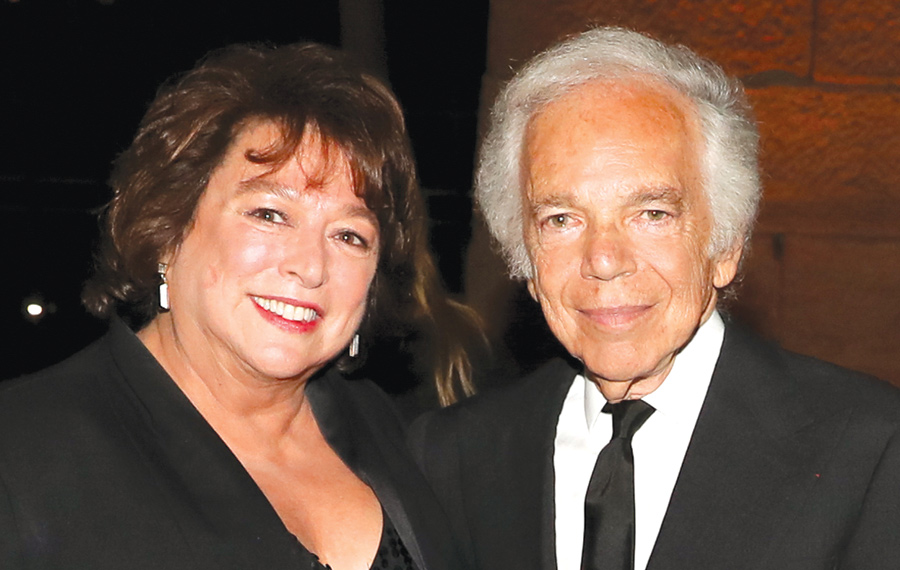
How did Ralph Lifshitz, the son of Jewish immigrants with no fashion training or connections, become Ralph Lauren, a classic American designer with a multibillion-dollar global lifestyle brand? Interviewing friends, family, colleagues, fashion insiders and Lauren himself, filmmaker Susan Lacy tells the design icon’s origin story in “Very Ralph,” premiering Nov. 12 on HBO.

“Everybody knows the name Ralph Lauren but you don’t know him. He comes from a very modest background, he believed in himself and he built one of the biggest fashion empires that ever existed. That’s an amazing story,” Lacy told the Journal. 

Lacy had always wanted to make a film about a top fashion figure during her three decades as the creator, executive producer and sometimes director (encompassing 250 portraits) at PBS’ “American Masters,” and her choice of Lauren made perfect sense. “But I knew it would be a tough sell,” she said. “He’s a very shy man. He’s never done anything like this. It took him a moment [to say yes].”

Although Lauren was wary of ceding control and concerned about how he’d look, he imposed no conditions or restrictions on Lacy, who assured him that she wasn’t digging for dirt. “I’m more interested in why a person is important and how his work relates to, influences and represents our culture than I am in the gory details of their life,” she said. 

Lacy interviewed Lauren eight times at several of his homes, including his Montauk, N.Y., estate and his Colorado ranch. “I’m careful when I’m making a film about someone with great wealth,” she said. “Where do you draw the line between the work and what the work made possible? I don’t ever want to step into ‘Lifestyles of the Rich and Famous’ territory.”

It was a challenge, she said, to figure out how to depict a designer who doesn’t drape, sketch or sew and explain the story behind his success. “He’s not cutting-edge. He’s not interested in that. He’s interested in maintaining quality and timelessness. Where does that vision come from in a kid from the Bronx? A lot of it came from movies and I wanted to portray that,” Lacy said. “I found it fascinating that he had no plan. He didn’t know where any of this was going to go. When he pulled his ties from Bloomingdale’s because they wanted to use their labels instead of his, he didn’t have a penny in the bank. It took a lot of guts and belief in himself and his vision. I think that’s the key to Ralph Lauren. He had a vision and he stuck with it.”

The director also wanted to show that Lauren is still working every day at 80 and has a playful side, seen in home movies with his wife, Ricky, and children Andrew, David and Dylan, famous in her own right for the Dylan’s Candy Bar sweet shops. Lacy also includes his Jewish upbringing and why he changed his last name at his brother’s suggestion. “He had enough of being made fun of,” Lacy said. “He’s not Orthodox but I think he’s very conscious of his Judaism. He went to yeshiva. He goes to synagogue. His wife comes from a family that escaped the Holocaust. That’s in the film. [Judaism] has an impact on his life, for sure.” 

“Everybody knows the name Ralph Lauren but you don’t know him. He comes from a very modest background, he believed in himself and he built one of the biggest fashion empires that ever existed. That’s an amazing story.” 

— Susan Lacy

Born and based in New York, Lacy discovered she had much in common with Lauren. While some of her subjects have had very difficult childhoods, “that’s not true of Ralph and not true of me,” she said. “Ralph had a very happy middle-class background. He was a modest guy who achieved incredible things. We both had a vision and believed in ourselves and didn’t take no for an answer. I think that’s true of many artists.”

Lacy, whose German Jewish father lost many family members in the Holocaust, “grew up with a real consciousness of what happened from a grandmother who talked about it all the time. On rainy days in the summer, the pictures would come out and she’d tell me about the family I would never get to know.” 

Lacy added that she feels a strong connection to her (half) Jewishness, but it isn’t the reason she has made documentaries about Steven Spielberg, Leonard Bernstein, David Geffen and Annie Leibovitz. “Let’s face it, the smartest, most talented people in the world are Jewish,” she said. “It’s natural I’d be drawn to that.” 

The editor of her high school and college newspapers, Lacy wanted to be a journalist but had always been a film buff. After getting her master’s degree in American Studies from George Washington University, she went to work at WNET-TV, the New York PBS station. There, she became involved in arts and performance programming, and sought to expand the parameters beyond plays, ballets, dance and music. “I was always interested in the social, political and cultural context of the work and the people who create it. I wanted to make real films that stood the test of time and were as excellent as the subjects. That’s where ‘American Masters’ came from,” Lacy said. “It wasn’t easy to keep the funding going, but it’s one the most decorated series in the history of public television and it’s still going. I’m so proud of it.”

Now making films for HBO, Lacy would like to add narrative features to her repertoire. “I’m quite interested in the hybrid between documentary and narrative and I think my next project will be along those lines,” she said. As for the subject of her latest endeavor, Ralph Lauren “is very touched by the film,” she said. “He said to me, ‘I never could have made this good a film about myself.’ I think his only criticism is he wishes he didn’t look old. But I think he likes it very much.”

“Very Ralph” premieres Nov. 12 on HBO.

‘Very Ralph’ Reveals Fashion Icon’s Origins Read More »

Rabin Assassination ‘Incitement’ Premieres at Israel Film Festival

When Israeli Prime Minister Yitzhak Rabin was assassinated in November 1995, his hope of a lasting peace between the Jewish state and the Palestinians died with him. The events leading up to his murder unfold in “Incitement,” told from the point of view of assassin Yigal Amir, an Orthodox Jewish law student who believed in a nationalist divine right. 

The winner of the Ophir Award for Israel’s best feature film of 2019 and Israel’s entry for the 92nd Academy Awards next February for best international feature film, “Incitement” will have its U.S. premiere on the opening night of the 33rd Israel Film Festival on Nov. 12.

“I wanted to make the film because it’s a very important topic in Israeli history and because of the trauma that’s involved, both on a national level and a personal level,” filmmaker Yaron Zilberman (“A Late Quartet”) told the Journal. “Experiencing this assassination was shocking because it was the prime minister and also because the assassin was an Orthodox Jew. I wanted to understand in a more profound way why it happened and what we can learn from it. It’s relevant more than ever today because incitement is ongoing and violence and the potential for violence to erupt because of irresponsible statements by leaders.”

Zilberman chose to tell the story from Amir’s point of view to explore the factors that drove him to kill and give it a fresh perspective. “When you tell a story from an angle that has not been told before, it’s unexpected and you have new insights, and it makes it a story that people want to watch,” he said. “There is the danger of somebody watching it and feeling empathy for the murderer but we decided that the big picture was more important: to tell society the inner workings of incitement, how a relatively moderate activist turns into an assassin using religious and political justification.”

To achieve tonal balance and ensure accuracy, Zilberman and co-writer Ron Leshem spent six years working on the film, interviewing interrogators, lawyers, judges, journalists, Amir’s family and friends and the killer himself. Two researchers from the Orthodox community also provided valuable insights. 

Zilberman said he expected divided reaction in Israel, but was thrilled when a leading right-wing journalist tweeted that “Incitement” was a must-see movie. He’s also encouraged that young Israelis have been buying tickets, and is looking forward to coming to Los Angeles for the premiere. “It’s an honor for us to be the opening movie at the Israel Film Festival and get an opportunity to have a conversation with the community in L.A.,” he said.

“If [Yitzhak] Rabin had been alive, in my opinion there would be a better relationship with the Palestinians, perhaps even an everlasting peace. I cannot prove that but that’s what I believe.”

 — Yaron Zilberman

Born in Haifa, Zilberman is the son of Israeli parents of Polish heritage, with a rabbi great-grandfather and roots in Jerusalem dating back to the Ottoman era on his mother’s side. “I was raised completely secular,” he said, “but I’m proud to be an Israeli and I’m proud of my Jewish heritage.” 

He studied physics at MIT and crunched numbers on Wall Street. “But art was what I always loved most growing up, from painting to music to poetry,” Zilberman said. When a friend asked him to help out on his movie, he learned the ropes and changed course. “I made my first movie, ‘Watermarks,’ a documentary about female swimmers in the 1930s who escaped from Vienna. From the first interview, I knew that it was what I wanted to do for the rest of my life.”

While gearing up for the theatrical release of “Incitement” on Jan. 24, Zilberman, who is currently based in New York City, is working on the TV miniseries “Valley of Tears,” about the Yom Kippur War, and has several projects in the pipeline. One is a World War II-set story about a young Jewish girl and her mother’s escape to the Carpathian Mountains. The other is about public relations pioneer Edward Bernays, whose “wild and crazy campaigns shaped America,” Zilberman said.

In a hypothetical Israel in which Rabin had lived, Zilberman imagines that “things would be radically different. Some say peace would not have been achieved no matter what. For me that’s the wrong conclusion,” he said. “If Rabin had been alive, in my opinion there would be a better relationship with the Palestinians, perhaps even an everlasting peace. I cannot prove that but that’s what I believe.” 

He also believes there’s takeaway value from the tragedy. “It’s a great story of how someone goes from being a relatively moderate political activist to becoming an assassin in a year and a half,” Zilberman said. “For me, the most important lesson is understanding that incitement, the use of inflammatory words by the gatekeepers of society — religious leaders, politicians, university professors — eventually causes violence to show its face, and it can lead to chaos and a danger to democracy. I want people to see the inner workings of this process, and by connecting the dots, not to allow it to happen again.”

“Incitement” premieres at the IFF Nov. 12 at the Saban Theatre (opening night gala), with additional screenings at Laemmle’s Ahrya Fine Arts on Nov. 16 and at Laemmle’s Town Center 5 on Nov. 20. For more information, visit the website. 

Rabin Assassination ‘Incitement’ Premieres at Israel Film Festival Read More »

Cathy Heller on Not Keeping Your Day Job

Cathy Heller knows what it’s like to build a career from the ground up. She arrived in Los Angeles 16 years ago at the age of 24 with big aspirations and a little bit of money. Within a year, she had a six-figure income while working for a commercial real estate firm.

But she was miserable, so she quit her job and pursued her dream of being a musician. She wrote songs for commercials and TV series, and ended up selling them to McDonald’s, MTV, Walmart, “Pretty Little Liars” and “One Tree Hill.” 

Today, the Pico-Robertson resident is a business coach, host of the popular podcast “Don’t Keep Your Day Job” and author of a book by the same name being released on Nov. 12. 

Heller said she decided to start the podcast and write the book because, “I have always wanted to help people feel seen. I know what it’s like to feel invisible and I think everyone is seeking a deeper sense of purpose. I wanted to do my part to show people that there is room for them to share their gifts with the world.”

The twice-weekly podcast has featured interviews with former Starbucks CEO Howard Schultz, fitness guru Jillian Michaels, YouTube personality Hannah Hart, author Martha Beck and musician Lisa Loeb. During each episode, Heller talks to the business pros about how they built their empires and offers encouraging words to listeners. 

“We reach for the highest branches we see, and I want to show people a model of what could happen if they build their own dreams.” 

— Cathy Heller

“I try to show examples of people who have made a living doing what they love,” she said. “From podcasting to baking to dancing, [from] pottery to calligraphy, there is proof everywhere you look that you can make a living doing what you love.”

The “Don’t Keep Your Day Job” book is part memoir and part motivational tome. It incorporates snippets from Heller’s podcasts and has writing prompts at the end of each chapter. There are also sections on finding your unique angle, the importance of imagination and creativity, and why you need to let go of your fears. 

In addition to the book and the podcast, Heller coaches hopeful entrepreneurs and holds classes on how to make it in the music business. She said she has helped close to 30,000 students with her courses over the years. 

Although Heller has a lot going on, she said she is able to center herself with Judaism. After college, she went to Jerusalem and intended to stay for three weeks. She ended up living in the Holy Land for three years and immersing herself in Jewish texts. While there, she said she “learned that we are each truly significant. God doesn’t create extras and everyone has different DNA, which means that we each make a different imprint. We are needed to make this world whole.”

On the podcast, she related to Schultz through their mutual love of Jewish study. He told Heller he used to learn with the late head of the Mir Yeshiva in Jerusalem, Rabbi Nosson Tzvi Finkel, who wouldn’t touch the Western Wall because he said he didn’t feel worthy of it. “Instead, he asked Howard to pray for him on his behalf and to go touch the Kotel,” Heller said. “I was amazed that someone who makes $3.5 billion was talking to me about this holy rabbi and how he impacted him in such a significant way.”

Along with Judaism, Heller said she also stays grounded thanks to her family. She picks up her three young daughters from school every day and does bath time and bedtime with them. She doesn’t think too far into the future — she has no five- or 10-year goals — but instead focuses on how she can improve day to day. “I wake up every day in search of expanding more of my potential, helping more people, [and] being a better mom, wife and person,” she said. 

With “Don’t Keep Your Day Job,” Heller said she hopes her readers and listeners “come home to themselves. I hope they start to listen to that whisper within that has always wanted to paint more or write or open a bakery. I hope they see how doable it really is to get paid to give to others in the ways they feel most alive. We reach for the highest branches we see, and I want to show people a model of what could happen if they build their own dreams.”

“Don’t Keep Your Day Job” is available on Amazon. 

Cathy Heller on Not Keeping Your Day Job Read More »

AJC Teaches Jewish Teens Advocacy Skills

What is the difference between Jewish advocacy and advocacy by Jewish advocates?

Why is it called “anti-Semitism”?

What is a Jewish issue? 

Is climate change a Jewish issue?

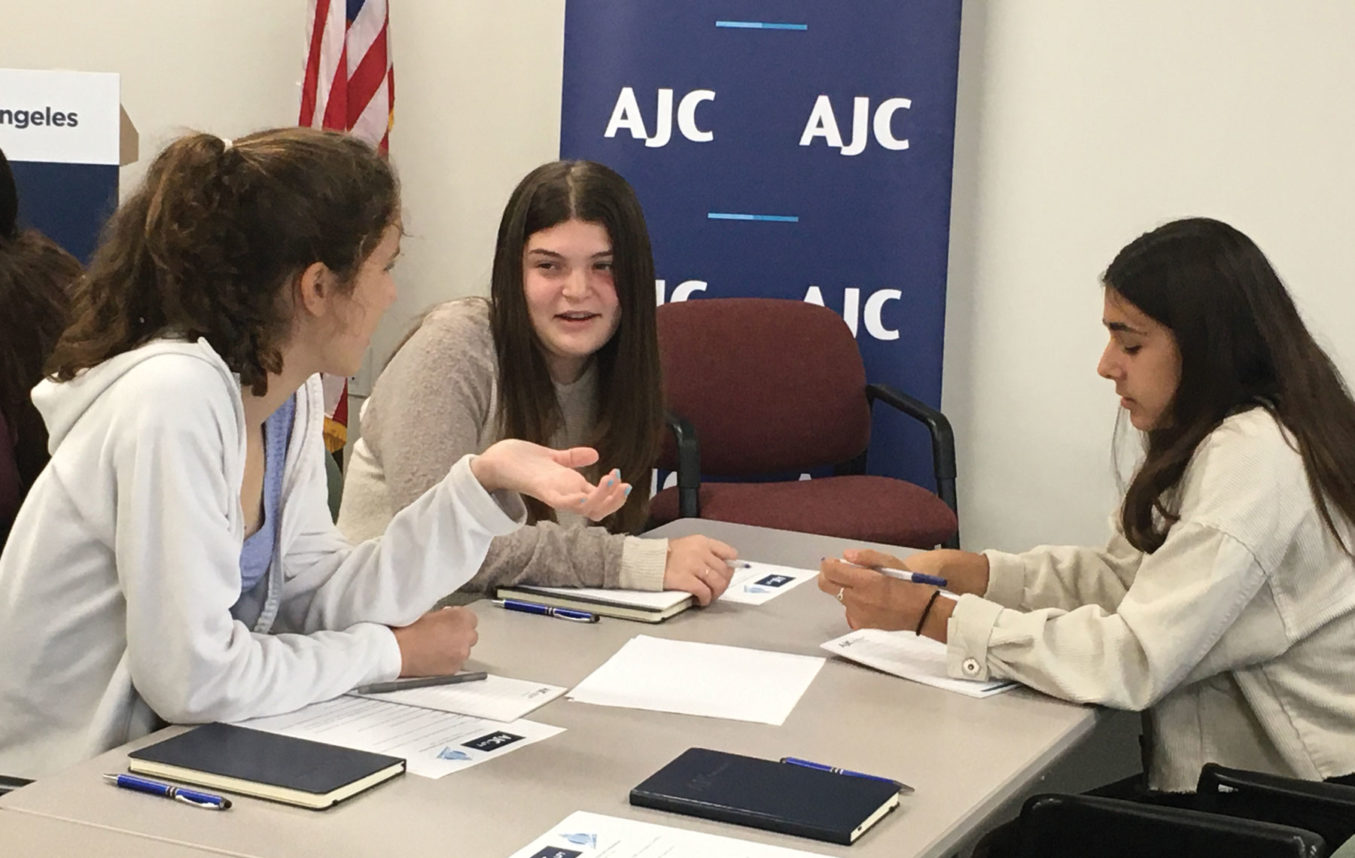
These are just some of the questions that were asked during a recent gathering of two dozen high school students in West Los Angeles. The students, who represent a variety of area public and private schools, both Jewish and nondenominational, are participants in Leaders for Tomorrow (LFT), a program of the American Jewish Committee (AJC) designed to empower the next generation of Jewish leaders to advocate for Jews, Jewish causes and Israel.

Joanna Lieberman Snir, AJC’s deputy director for leadership development and board engagement, told the Journal the program got its start in New York five years ago after an area student approached AJC CEO David Harris. The student said one of his teachers had repeatedly expressed anti-Israel sentiment and he wasn’t sure how to respond. The student’s mother was active with AJC. 

They asked AJC “to put together a program to help students like him to respond,” Lieberman Snir said. “AJC’s leadership was really inspired by this notion.” 

Shortly thereafter, the first cohort of LFT students began meeting. A facilitator steers the discussions. The next year, the program kicked off in Chicago. Currently, there are 12 groups across the country, including the one in Los Angeles, which started last year. Each group of teens, primarily high school sophomores and juniors, meets approximately seven times over the course of the school year. The students also gather in Washington, D.C., in the spring. Other than that trip, there is no cost to participate, but students do go through an application process that includes both a written portion and an interview. Prior Jewish advocacy work is not required. 

“One of the great things about the LFT program is we have students coming at it with varying perspectives, varying backgrounds,” Lieberman Snir said. “We also have many students who haven’t really been previously engaged in the Jewish community at all.”

“It’s really preparing me for the future and the reality of being Jewish.”
— Sydney Luchs

At each meeting, there is a general session topic, which can include “Israeli Society Today,” “Being Jewish on the College Campus,” and “AJC’s Global Approach to Advocacy.”

“The idea at the end of the day is students are having a comparable experience with comparable takeaways,” said Zev Hurwitz, the Los Angeles facilitator and AJC’s director of campus affairs. 

At the first session, which took place in September and focused on Jewish identity, there was a combination of group discussion, small group and partner activities, and, finally, circling back and sharing. The students also created maps of their own Jewish identities. For the second meeting in late October, participants were joined by representatives from Los Angeles Mayor Eric Garcetti’s Youth Council and heard from Sgt. Mike Abdeen of the L.A. County Sheriff’s Department, who spoke about the rise in hate crimes and how to help, as well as Tim Zaal, a former white supremacist who now is a regular presenter at the Museum of Tolerance.

Hurwitz likes to give the teens plenty of room to go where discussions take them or pivot if current events dictate a response. “If students have siblings who have experienced troubling activity in college, we will definitely make time to have those conversations,” he said.

Participant Sydney Luchs, 15, a sophomore at Taft Charter High School in Woodland Hills, told the Journal she applied because “I’ve noticed that anti-Semitism has become almost normalized in the political environment right now. As a person who wants to work in politics in the future, I wanted to figure out how to be an advocate for Israel but didn’t have the tool set to do it.”

She added that the program does a good job in teaching people how to be advocates. “So far, I’ve learned a lot of facts on how you deal with things. It’s really preparing me for the future and the reality of being Jewish.”

AJC Teaches Jewish Teens Advocacy Skills Read More »

Kehillah Chen v’Chesed Welcomes All People

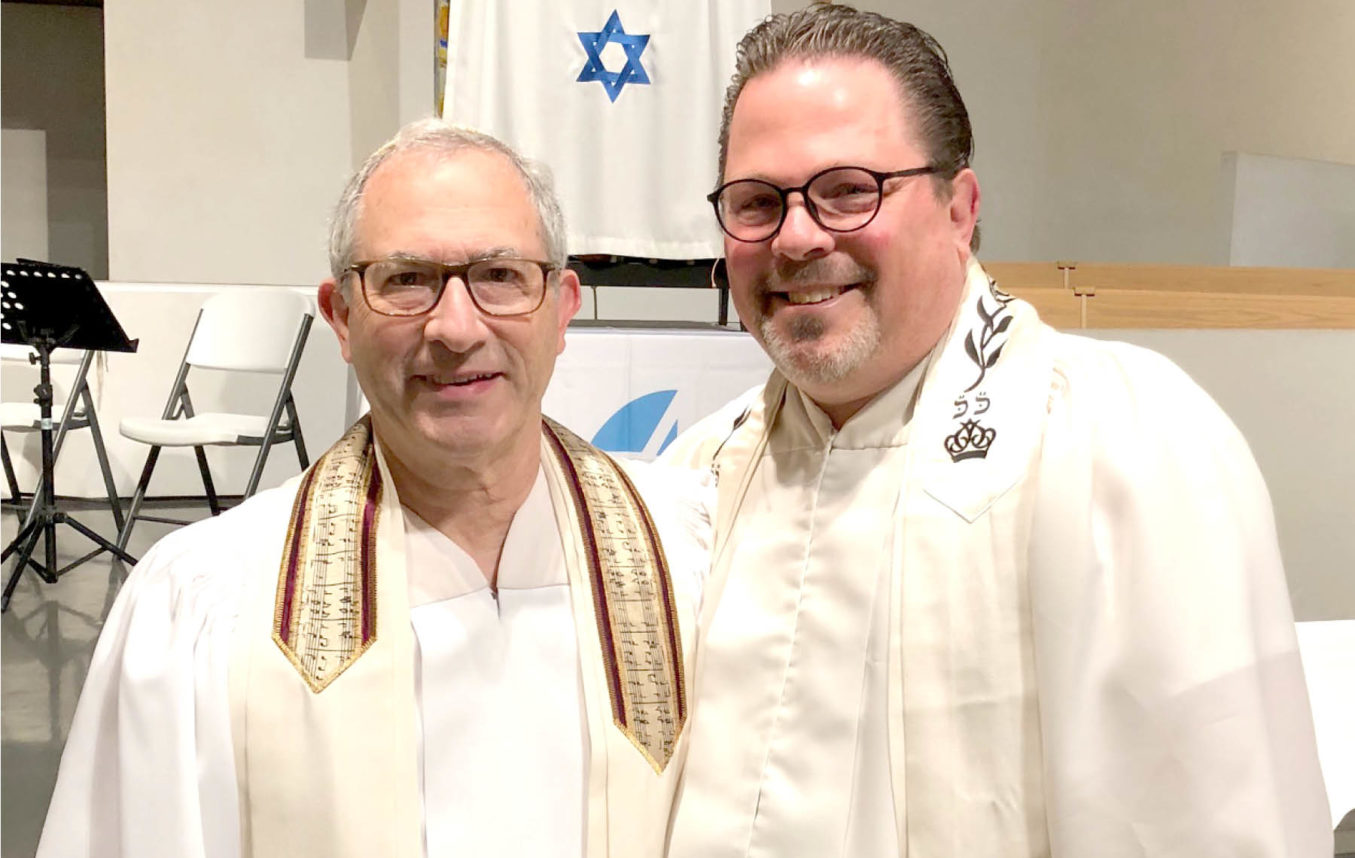
In describing Kehillah Chen v’Chesed synagogue in Encino, spiritual leader Rabbi Eric Morgenstern explains, “We don’t affiliate with any of the traditional movements. We are a community that believes in the idea that all human beings are created in the image of God and that everyone has the duty to treat each other with love and integrity and compassion, and we believe that there are many pathways to the divine.”

Kehillah Chen v’Chesed (KCVC) was established in 2011 by people who wanted to be a part of a Reform congregation that supported families without many of the constraints of a traditional synagogue. Morgenstern, 55, said of KCVC, “Most of the families that joined were born [into] Judaism or a combination of Judaism and Christianity and they were disillusioned by traditional synagogues. They were looking for someplace to have a sense of community and a sense of tradition, and even more so a place for the life cycle. It was important to me that the families were not affiliated because I was very set on not poaching from other synagogues.”

He added that many people come to KCVC because it’s warm and inviting. “We respect everybody for what they believe in and where they come from,” Morgenstern said. “We don’t diminish any one person’s path. Everybody is entitled to make their own decisions. We just try to teach peaceful doctrines. We really push tikkun olam — our goal is just to make the world a better place in our own way.”

Since its inception, KCVC has shared space with the First Presbyterian Church of Encino, a place where Morgenstern frequented many times as a Boy Scout in the late 1970s. 

Decades later, Morgenstern said, “When the families all got together and were looking for a place to have High Holy Days, we approached Dave Jung, who was the senior pastor at FBC Encino, and he welcomed us and we had a beautiful High Holy Days there. One afternoon after Yom Kippur, the pastor came into our sanctuary and told me, ‘You can’t be staying here. We need to find you some space.’ So he took me around and found space for us and ever since then, we have had a permanent home there.”

Since then, both congregations have shared numerous holidays, community celebrations and philanthropic goals. “We’ve done MEND (Meeting Each Need with Dignity) trips together. We organized a missionary trip to Trona, which is a [California] mining town that was really devastated by the earthquake in July.”

He added that Pastor Ruth Mandernach has spoken at High Holy Day services and has been a pivotal person in both communities coming together. 

“Our community is unique where if you want to come to a Jewish service, you can do that. If you want to go to a Christian service, you can do that,” Morgenstern said. “Families have come to us for some of the Jewish events and gone to the church for some of the non-Jewish events, and the events we do together are all the better because everybody enjoys it.”  

Born in New Jersey, Morgenstern moved to Encino in 1977 and was a Jewish educator for 25 years, specializing in both the Conservative and Reform platforms. “I didn’t get into being a rabbi until I was 40,” he said. “I have always been involved with religious institutions. It was the families who encouraged me to be ordained and it’s worked for me.” 

“We respect everybody for what they believe in and where they come from. We don’t diminish any one person’s path. Everybody is entitled to make their own decisions. We just try to teach peaceful doctrines.” 

— Rabbi Eric Morgenstern 

Cantor Kenny Ellis, who joined KCVC in 2018, told the Journal that Morgenstern is the big draw for attendees. “People flock to our synagogue not necessarily to hear my music but to hear Rabbi Eric,” he said. “He is very inspirational. He doesn’t talk down to people but talks to them.”

Ellis, who previously worked at Temple Beth Ami in Santa Clarita for eight years and at Temple Beth Haverim in Agoura Hills for 15 years, added, “I try to bring traditional music, new music and contemporary [music] to the service. I try to do things that the people can sing along with me, so that people feel part of the service and not alienated.” 

Ellis also is involved in TV and film, having appeared in shows such as “NCIS: Los Angeles” as well as an episode of “Curb Your Enthusiasm” in which he played the officiant of a fictional Jewish funeral opposite Larry David.

“For the families that come for services and the High Holy Days, they get that sense of cantillation when it’s appropriate in addition to contemporary and modern music,” Morgenstern said. “It was really transformative to have Kenny join us.” 

Morgenstern believes it is important to make sure that KCVC has programming events and education for congregants of all ages. “We are really hooked on experiencing Judaism,” he said. “Our philosophy is we really want to engage the young people in Jewish life. We want to make them part of our future and educate them and give them the opportunity to think.”

Moving forward, Morgenstern plans to build on KCVC’s community. “We are not competing with other synagogues,” he said. “Traditional synagogues have their role in society, and we appreciate and respect them, but we are trying to at least get a community that is Jewish by nature to be part of the Jewish community and grow within it in some way, because we truly believe that something is better than nothing. We are providing people somewhere to go to be together with a bunch of other people and just have an experience.”

Kehillah Chen v’Chesed Welcomes All People Read More »

German Cardinal Calls for Christians and Jews to Unite Against Anti-Semitism

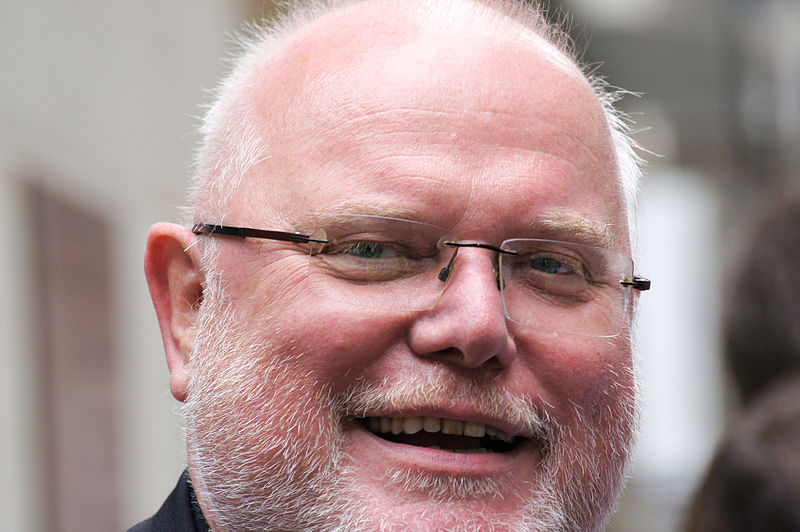
German Cardinal Reinhard Marx condemned anti-Semitism and called for Christians and Jews to unite against it during a Nov. 3 panel, the Jerusalem Post reports.

The German Bishops Conference and Orthodox Rabbinical Conference of Germany panel, which featured Central Council of Jews in Germany head Josef Schuster, European Commission Coordinator on Combating Anti-Semitism Katharina von Schnurbein, Orthodox Rabbi Conference’s Rabbi Julian Chaim Soussan and North Rhine-Westphalia Chief Minister Armin Laschet in addition to Marx – centered on rising anti-Semitism in Germany and Europe in light of the shooting at a synagogue in Halle during Yom Kippur. Marx, who is the head of the German Bishops Conference, said that he was concerned about more people delving into “conspiracy theories” from various “blogs” that radicalize them into becoming anti-Semites. He called for Christians and Jews to become allies.

“Anti-Semitism is an attack on us all,” Marx said. “Christians and Jews will never separate again. That, too, must be clear in our training centers. We need experience and sensitivity in this field.”

He also pointed out that “Jesus was a Jew, until the end. He never became a Catholic,” according to the Berlin Spectator.

Marx’s remarks echoed Christians United for Israel founder Pastor John Hagee’s comments during a panel at the 2018 Israel-American Council (IAC) conference. Hagee said that an anti-Semitic Christian is a “hypocrite,” arguing that anti-Semitism doesn’t comport with Christian values.

“A Christian is someone who’s driven by the love of God, and anti-Semitism is driven by hate,” Hagee said. “Love and hate do not come from the same blood.” He later added, “Judaism does not need Christianity to explain its existence. But Christianity cannot explain its existence without Judaism.”

StandWithUs CEO and Co-Founder Roz Rothstein tweeted, “Thank you, Cardinal Reinhard Marx (of Germany) for saying ‘Anti-Semitism is an attack on us all! Christians and Jews will never separate again,’ – wish there were more people like you.”

German Cardinal Calls for Christians and Jews to Unite Against Anti-Semitism Read More »

Nov. 8, 2019

View the full screen here.


Nov. 8, 2019 Read More »

Cystic Fibrosis and the Ashkenazi Jewish Connection

When California native Stacy Carmona was 10 years old, her 12-year-old best friend died from cystic fibrosis (CF). CF is a rare, life-threatening genetic disease that affects the lungs and pancreas. Carmona also suffers from the disease and her friend’s death awakened her to the horror that her parents had tried to hide from her: the brutal reality of the disease. 

CF is a recessive disease that’s acquired from both parents having a copy of a defective gene that causes CFTR protein to become dysfunctional. Approximately 1 in 25 Ashkenazi Jews are carriers. If both parents are carriers, there is a 1 in 4 chance that each child will inherit the disease.

Carmona inherited the disease from her parents and, at the age of 10, was faced with the question: Would she let CF define the rest of her life or would she live it to the fullest despite an uncertain future?

Today, Carmona is 33, married and expecting her first child. She’s given motivational speeches, defying all expectations people had for her when she was a child. When she was born, the average lifespan of someone with CF was 18. Today people with CF can live to be 34 to 40. Some even live beyond 50.

Stacy Carmona and her husband.

Carmona has managed to live a meaningful life full of purpose and urgency, but it’s a daily struggle because CF causes the body to harbor bacteria because of a genetic mutation that produces a thick, sticky mucus. Over time, the buildup of bacteria causes chronic lung and sinus infections that make breathing difficult and ultimately leads to lung failure. The mucus also causes inflammation in the pancreas, preventing food from being absorbed. It’s estimated that 30,000 people in the U.S. have CF, and although treatments are rapidly improving, there’s still no cure.

There are some promising new advances in CF research, but there’s a catch. 

Approximately 1 in 25 Ashkenazi Jews are carriers. If both parents are carriers, there is a 1 in 4 chance that each child will inherit the disease.

By 2020, medications that correct the basic defect are expected to benefit 90% of the CF population (using modulator drugs that target the defective CFTR protein caused by the most common CF mutation, Delta F508). However, the remaining 10% will be left behind, because they have different mutations not targeted by the treatment. One of these mutations belongs to a class called nonsense mutations, which disproportionately affects Ashkenazi Jews.

Carmona told the Journal the improvement in drug treatments is bittersweet. “The time that it takes to get a medication from test tube to patient can be 10 to 15 years and [cost] a billion dollars. It’s a scary place to be.”

These obstacles are what propelled Emily Kramer-Golinkoff — who has CF — to take the fight for her life into her own hands. In 2011, while working at Penn Medicine and pursuing a graduate degree at the University of Pennsylvania in bioethics, she launched Emily’s Entourage, an organization with a singular focus on nonsense mutations.

Photos courtesy of Emily Kramer-Golinkoff

“I had no grand vision of starting an organization but we felt there was no hope,” she told the Journal. “It was up to us to do something.”

Since its inception, Emily’s Entourage has raised nearly $6 million to fund 17 research projects around the world, accelerating drug research for those with CF nonsense mutations. 

For her work, Emily was named a White House Champion of Change for Precision Medicine in 2015 and was invited to speak at the White House. “We realized there was a whole infrastructure that was broken to even develop future hope for us,” she said.
The work funded by Emily’s Entourage has further significance because nonsense mutations are found in roughly 12% of all genetic diseases, meaning up to 30 million people worldwide could benefit from these drug discoveries. Advancements in treating nonsense mutations in CF can extend to treating certain types of muscular dystrophy, inherited blood disorders, as well as some cancers.

Emily Kramer-Golinkoff; Photos courtesy of Emily Kramer-Golinkoff

With CF becoming a predominantly fatal Jewish disease, much of the advancements are happening in Israel. Dr. Eitan Kerem, head of Hadassah Medical Center’s Pediatric Division in Jerusalem, is regarded as one of the leading doctors in the world specializing in CF, authoring more than 170 papers in the field of pulmonology. “If the gene is defective and the protein which is called CFTR is defective, then there is less hydration and dryness of secretion in these airways in the lungs,” Kerem said in a Hadassah podcast earlier this year.

Today, Carmona is 33, married and expecting her first child. She’s given motivational speeches, defying all expectations people had for her when
she was a child. 

The CF Foundation also has set up a Nonsense and Rare Mutation Initiative (NRMI) to fund research for the 10% left behind. Since 2015, it has funded more than 60 NRMI projects, raising nearly $63 million.

Some of the top research also is coming from a person living with CF. Los Angeles native Jacob Witten is a 26 year-old post-doc at M.I.T. He earned his doctorate in computational biology and now is studying how to use gene editing to cure CF. “If you fix the basic genetic defect then you stop the progression of CF in its tracks,” Witten said of his research.

Jacob Witten; Photo courtesy of Jacob Witten

“He declared from the time he was a little kid that if CF wasn’t cured by the time he was old enough he would cure it himself,” Witten’s mother, Nancy Seid, told the Journal.

Witten works out five to six days a week (five days of running with two days of weight lifting mixed in) and has a high caloric, high-fat diet, which is needed because people with CF have a hard time maintaining weight. He wakes up every day around 6 a.m. and goes for a run. When he comes home he does his vest breathing treatment for half an hour, then showers and arrives at work by 9:30.

Mornings typically require an hourlong breathing treatment in which a vest is worn that inflates and vibrates at high frequencies, breaking up the mucus in the lungs. This routine is then repeated at night. Throughout the day, a person with CF takes roughly 40 to 50 pills, including digestive enzymes with every meal. Everyone presents symptoms differently. For instance, Carmona said she feels like she has a cold every day, and that’s when she’s healthy. Witten, on the other hand, said he has never felt sick. His mother said she believes growing up near the Pacific Ocean may have strengthened his lungs, because the saline in the air provides a protective coating.

Another Jewish CF patient — Jessica Franklin — is also very athletic. She tries to get up at 5:30 a.m. every day and go for a run or take a yoga class, before returning home to shower and take her vest treatment, before arriving at work by 8:30.

Raised in Philadelphia, Franklin graduated from Philadelphia’s Drexel University in 2017 before moving to Tampa Bay, Fla., where she works as a brand ambassador for the Collective Genius company. She has been a public advocate for CF since she was 5 and did her first speaking gig at 10 and on her college graduation cap wrote the words: ‘Your problems are never bigger than your purpose.’

Jessica Franklin. Photo courtesy of Jessica Franklin

“I haven’t had a choice but to be an advocate,” she said. “My parents felt if you’re an advocate then CF will be cured.” 

In 2015, she raised $1 million at a CF fundraising event in Philadelphia.

Carmona also has made advocacy a central part of her life. She is the director of CF patient advocacy at Kroger Specialty Pharmacy, serves on the CF Foundation’s Adult Advisory Counsel, and is a patient representative for the Food and Drug Administration.

Unlike most life-threatening conditions, CF is one of a few diseases where forming community with other sufferers is kept at a distance. Exactly 6 feet apart, to be exact. Any closer and it could potentially be fatal for sufferers.

Witten, however, said, “I don’t really pay attention to the CF community in any way. I’m kind of an outlier in that sense. Especially for having nonsense mutations.” That may be because unlike many CF sufferers Witten is considered high functioning with no history of hospitalizations or ever presenting major symptoms. 

However, “With respect to infection, I’m extra paranoid,” he said, because a person with CF who is as healthy as Witten can still be vulnerable to the more pronounced symptoms if he comes in contact with someone who is sick. It requires him to take meticulous care of himself and be aware of his surroundings always. Though, generally, he said being outside is not a major concern, which explains how he’s run numerous half-marathons and played competitive sports his whole life.

Franklin also said she is currently in good health. She has 90% lung function, which is considered excellent, but added, “I’ve had now six sinus surgeries,” including a recent surgery that required her to take two months off work. Doctors had to make incisions into four bones behind her eyes to drain the mucus. “My face was basically turning into Medusa,” she said. 

Despite this ordeal, she said her condition is considered mild, which has enabled her to remain physically active.

Carmona, though has had to be much more cautious with her physical activity. “My best day is like my husband’s worst day,” she said. “Now that I’m pregnant I’m being very cautious. If I could bubble wrap myself and not leave the house for all of flu season, I would.” She has the benefit of working from home, but acknowledges that as a student, she was always conscious of who had a bad cough.

By the time Carmona was 18, she already had endured 12 sinus surgeries, two stomach surgeries and more hospitalizations than she can count. She knows to take every threat seriously. For instance, she explained that when her husband is sick, he has to sleep in the guest room, and when she travels she has to wear a mask. Catching a simple cold can mean weeks in the hospital and rounds of IV antibiotics. Franklin and Witten don’t have to wear masks outside because of their strong lung function, although Franklin said she always wears one on airplanes.

“I had no grand vision of starting an organization but we felt there was no hope. It was up to us to do something.”
— Emily Kramer-Golinkoff

Carmona recently was diagnosed with CF-related diabetes and said that monitoring her blood sugar levels and administering insulin has been a unique challenge. She’s spent her entire life perfecting her CF routine, but with a child on the way, she knows she must plan meticulously in advance to navigate her approach to parenthood, as people with CF require a lot of rest.

Fortunately, she has a supportive family 15 minutes away in Orange County, while Witten’s and Franklin’s jobs required them to move thousands of miles away from their families. 

In 2014, Carmona accomplished one of her dreams of giving a TEDx Talk about living with CF. What starts as a bleak tale evolves into an inspiring and captivating speech, evoking laughter from a responsive audience.

Carmona, Witten and Franklin spoke to the Journal separately about their experiences living with CF. And that “separateness” is no coincidence. In fact, it’s a defining feature of the disease. People with CF live in a unique oasis. Unlike most life-threatening conditions, it is one of a few diseases where forming community with other sufferers is kept at a distance. Exactly 6 feet apart, to be exact. Any closer and it could potentially be fatal for sufferers. That’s because CF sufferers can pass dangerous bacteria between them. It makes the CF experience a mostly solitary one, relying on the grace of allies to provide support. With the emergence of social media, however, people with CF are rallying together as digital families, but meeting in person remains rare.

And because sufferers are aware that their life spans are likely to be shorter than most, even if they can’t meet in groups, they pursue their personal passions with a sense of urgency. 

Carmona said that her illness has given her a greater appreciation of life, and that her story has made those around her find gratitude in every breath. “Accomplishing milestones is so much more meaningful because I have to work so much harder to get there,” she said.

Her father, Paul Motenko, has become a committed advocate for CF research, making his daughter’s illness his life’s mission. “I believe that, if the philanthropic Jewish community becomes aware of this situation, we can generate significant support for this area of research,” he said. Motenko helped organize a cultivation event to support CF research that took place on Nov. 5 in Los Angeles. 

“The purpose of the event is to create awareness in the Jewish community about this very important situation,” Motenko said. “CF is more prevalent [among Ashkenazi Jews] than many of the more commonly-known Jewish genetic diseases, like Tay-Sachs.” 

“It’s given me a very different perspective on life because I’ve been faced with my own mortality my entire life,” Carmona said. “The big takeaway with CF is how we make our time valuable.”

For Kramer-Golinkoff, it’s also about spreading a message of hope. “Our dream,” she said, “is that we will find a cure for CF and then be able to move on to another rare disease and then apply all of our learning to another.” 

With continued research, CF will hopefully one day stand for “Cure Found.”

For more information about cystic fibrosis and Emily’s Entourage, click here. More on the CF Foundation’s can be found on their website. 


Peter Fox is a New York-based writer. His work has appeared in The Jerusalem Post, Tablet Magazine and The Forward. Follow him on Twitter @thatpeterfox. 

Cystic Fibrosis and the Ashkenazi Jewish Connection Read More »

Make Your Own Sophisticated Tuna Spread, Italian Style

Jews have a long history in Italy. In fact, Rome has Europe’s oldest Jewish community. When the Roman Empire conquered Jerusalem 2,000 years ago, it sent the Jewish people from their holy land into the Diaspora, with different tribes settling in different regions. Jews who settled in Spain are called Sephardic, while those who ended up in Eastern Europe are known as Ashkenazi. Others went straight to Rome because, during that millennium, Rome was like New York — a big city with lots of jobs and great orgies. Most Jews went to Rome as indentured servants, working toward their freedom as they became integrated, upstanding citizens.

At various points in history, Jews from Spain came to live in Northern Italy via France, while other Spanish Jews made their way into southern Italy as merchants. The Jews contributed most notably to Italian culture in the mark they left on Italian cuisine. (You can learn more in my spiels for Chicken Crack and Sfratti.)

All this is to say that wherever you go in the entire world, Jews love a tuna sandwich.

This recipe is a lighter version of Joyce Goldstein’s recipe for Crostini di Spuma di Tonno from her book “Cucina Ebraica.” Its roots originate from the Jewish community in Padova.

Unlike American tuna salad, this is a whipped, fluffy tuna spread with butter and lemon. I know the concept of tuna whipped with butter is foreign to many of us, but spalmata di tonno is a delicacy in Italy. It’s not that different from tuna salad with mayonnaise, only much more sophisticated. (If you want to make it even more sophisticated, you can throw some anchovies into your food processor when you whip the tuna — but even I’m not that sophisticated myself.)

Delicious on a summer day by the pool or as an outdoor lunch, these tuna crostini pair well with an Aperol spritz and are ideally served before a meal that features seafood or as an afternoon snack.

Jewish Italian Tuna Toasts
From “Meal and a Spiel: How to Be a Badass in the Kitchen” 

1 (7-ounce) can Italian tuna in olive oil
3 tablespoons unsalted butter, room temperature
Zest of 1 lemon
Juice of 1 lemon
10 to 20 grinds of pepper mill, to taste
10 to 12 (1/2-inch thick) slices baguette
Olive oil for drizzling
2 tablespoons salted capers, chopped
12 pitted green olives, roughly chopped
Small handful flat-leaf parsley, chopped

Place oven rack on the second rung from the top and turn on broiler.

Combine tuna (along with the oil in the can), butter, lemon zest and juice, and pepper and zip in a food processor until it becomes a smooth paste.

Place bread slices on baking sheet and set under the broiler until golden, about a minute. Flip slices and toast the other sides. Be careful not to burn.

Drizzle oil lightly onto the bread and slather on tuna spread, as you would peanut butter. Top with the capers, olives, parsley, and extra pepper if desired.

Makes 10-12 toasts.

Make-ahead prep: Although it might lose some fluffiness, the tuna spread tastes better the next day, so don’t hesitate to make it in advance. Be sure to bring it to room temperature for a couple of hours before eating. Toast and assemble the crostini as close to eating as possible.

Gluten-free variation: Replace the baguette with a gluten-free pizza crust. 

Note on using multigrain bread

Italians would never make crostini or bruschetta on whole-grain bread. But no matter how good a fresh, crusty country loaf of ciabatta might be, white flour is not that healthful. The point is to eat like Italians, not look like a fat, old one. If you choose good bread, you might find that bruschetta made with multigrain bread won’t feel like a runner-up to the original but a winner all its own. I find that quality whole-grain tomato bruschetta pairs well as a side dish to frittatas.


Elana Horwich is the author of “Meal and a Spiel: How to Be a Badass in the Kitchen” and the founder of the Meal and a Spiel cooking school.

Make Your Own Sophisticated Tuna Spread, Italian Style Read More »

Weekly Parsha: Lech Lecha

One verse, five voices. Edited by Salvador Litvak, Accidental Talmudist

“And I will bless those who bless you, [Abram], and the one who curses you I will curse, and all the families of the earth shall be blessed in you.” –Genesis 12:3


Rabbi Jason Rosner
Temple Beth Israel, Highland Park 

Rabbeinu Bachya, writing around 1300 C.E., suggests we should understand our verse as an explanation of Genesis 12:1: “leave your parents’ house.” He states that Abram felt cursed when he lived with his parents in Ur Casdim. The townspeople criticized his emerging belief system. In order to be his full self, he needed his own residence. Sarai and Abram grew into fully adult characters when they established their own home. The important developmental step of establishing a home can be difficult in today’s housing crisis. Despite leaving the spacious R1 homes of Ur Casdim, Abram and Sarai felt quite blessed to live in their own tents. 

The feeling of security associated with buying a home seems increasingly out of reach. In the Journal’s Oct. 18 edition, it was reported that only 16% of millennials and Generation Z-ers surveyed in Los Angeles County own their residences. Those without the means to buy struggle to afford high rents and can feel cursed by an inability to overcome their financial challenges. Property values are high and zoning regulations are strict. Sarai and Abram changed their concept of housing from metropolitan Ur Casdim to pastoralist’s tents; perhaps we can rethink housing, too. We could consider changing zoning regulations, exploring co-housing or encouraging tiny homes. How would the Torah have unfolded if Abram lived in fear of rent hikes or dwelt indefinitely with his parents in Ur Casdim? Let us work together toward every person feeling blessed with adequate and stable housing. I have always fancied living in a yurt.

Rabbi Tal Sessler
Sephardic Temple Tifereth Israel 

Our verse states that God will bless those who bless us, and undermine those who wish us harm. A quick glance at our tumultuous history factually confirms the veracity of this dynamic. For example, when medieval Spain was hospitable to us, it flourished. After it became oppressive, the countdown for its hegemonic demise began. The same holds with regard to countless other global historical powers. 

Even to this day, the one country that genuinely affords its Jews true equality and dignity, the United States, is indeed blessed by God as a supreme hegemonic superpower. Why is humanity blessed through us? According to Catholic historian Paul Johnson, it’s because we remind humanity that “history has meaning, and that humanity has a destiny.” Because, according to the late British Prime Minister Winston Churchill, we are “the most remarkable race” that ever walked the earth. Because, according to Thomas Jefferson, we “have done more to civilize mankind” than any other group in history. Because we are indefatigable agents of change for the betterment of the overall human landscape. Because Jewish teachers and scholars facilitated the emergence of our fellow monotheistic religions of Christianity and Islam. Because we engineered much of the ideational infrastructure of Western and human civilization as we know it, including socialism, capitalism, psychoanalysis, modern nuclear physics, postmodern thought and much more. Having survived genocide, we exemplify the human spirit’s capacity to achieve “the victory of possibility over probability,” with the State of Israel epitomizing the modern virtues of resilience, adaptability, ingenuity, innovation and proactivity. 

Miriam Yerushalmi
CEO SANE, counselor, author of “Reaching New Heights”

HaShem expands on His promise to Avraham in the preceding verse that he “will be a blessing.” How will Avraham be a blessing? Because he will lead others to be blessed, if they follow his example. Avraham realized that God, the Creator who controls everything, is entirely good; therefore, everything that comes from God is good. 

Avraham’s strong connection to God enabled him to always recognize his blessings, even when they were disguised as what others might see as a curse. When thrown into the fire by Nimrod, Avraham was unaffected by the flames, for to him they were the same as water. Those who appreciate this quality of living life as a blessing have further blessed Avraham for his demonstration of it, and they themselves have been blessed to be a part of “the families of the Earth [that] shall be blessed” in Avraham’s merit. 

Life’s blessings, hidden within seemingly harsh realities, challenge each of us to reach deep within ourselves to recognize them. Those who fail to see the blessings in every aspect of their lives, whether they are apparent or appear as the most difficult challenges — physical or emotional — will be inclined to grant those challenges an undeserved power over themselves. As children of Avraham, each of us has inherited his gift of seeing and being a blessing. Chassidus can guide us to the discovery and development of that gift. May each of us be blessed to access, apply and transmit to future generations that precious gift. 

Rabbi Aryeh Markman
Executive director, Aish LA

The Torah means what it says.

In the biblical year 1948 (there are no coincidences) Abraham, the original, prototypical Jew, was born. Seventy-five years later, he is self-actualized to the point that God deems him and his Jewish descendants to be the First Family of humanity.

The Jews will now forever be the vehicles upon which God’s blessings flow into this world. We are part of God’s distribution system. The boycott, divestment and sanctions movement against Israel, driven by jealousy, knows this to be true.

To the extent that Jews manifest Torah in the world, we are increasing God’s presence and hence His capacity to send His blessings to all of humankind. The rest of the world benefits from the overflow of what we are generating. Those who aid and abet the Jews will thrive and those who do the opposite will evidentially be destroyed. Biblical Math 101.

For example, you would rather help one of your beloved’s friends than one of his or her enemies, even if the enemies have just cause. So, too, is it with God. He would rather assist those who try to help the Jewish people rather than those who try to thwart us.

Which brings us to ourselves. Are we Jews blessing one another or the opposite? Maybe all this political and personal infighting is bringing troubles upon us. All it takes is a new attitude. The Torah means what it says.

Deborah Engel Kollin
Organizational consultant, LGBTQ+ advocate

I know if I were Avram, I’d be thinking: “How can all the families on Earth be blessed in me? How can I, a 70-year-old nobody from Ur, possibly be a source of blessing to everyone on Earth?” 

The answers to those hypothetical questions, it turns out, are revealed in the Torah. In the next pasuk we’re told, “Avram went forth,” following God’s command to do so. Avram took not only his wife, Sarai, and cousin Lot, but a caravan of people as well. He and his wife, Sarai, were subsequently blessed and God’s name was added to each of theirs. They became Avraham Avinu and Sarah Imeinu — the Jewish nation’s father and mother, respectively. 

Just as they took a huge leap of faith, went forth, and trusted in God’s guidance, we, too, must go forth using the Torah as our spiritual guidebook and engaging in mitzvot. By showing loving kindness to all who we meet — just as Avraham and Sarah did — we not only end up being a blessing to all but also, hopefully, being blessed by all. 

Weekly Parsha: Lech Lecha Read More »