fbpx

September 13, 2019

Rosner's Domain Podcast

Yaron Dekel: Understanding the upcoming elections results

Yaron Dekel and Shmuel Rosner discuss the possible scenarios that will take place after the election results are announced.
Yaron Dekel is a political commentator and cohost of the popular radio show “Dekel Segel” on Galei Tzahal, the Israeli radio network operated by the Israel Defense Forces. Yaron served as a commander at Galei Tzahal in the years 2012-2017. He has won many awards for his journalistic achievements, including the Sokolov Award.

Follow Shmuel Rosner on Twitter.

Shmuel’s book, #IsraeliJudaism, Portrait of a Cultural Revolution, is now available in English. The Jewish Review of Books called it “important, accessible new study”. Haaretz called it “impressively broad survey”. Order it here: amzn.to/2lDntvh

Yaron Dekel: Understanding the upcoming elections results Read More »

Letters to the Editor: Jews and Democrats, Fighting Anti-Semitism, Seder Table Guests

Jews and Democrats
A Sept. 6 letter under the headline “Jews Who Vote for Democrats” condemns President Donald Trump for saying that Democrats are anti-Jewish, but Trump is right: For the first time in decades, some elected and other influential Democrats are blatantly anti-Semitic, and party leaders are afraid to condemn them. Blaming Trump is a distraction because anti-Semitism became acceptable on the left a decade ago, when radical Muslim student groups began poisoning the minds of young people against Israel.

If Democrats want Jewish funding and votes in 2020, they must strip Reps. Ilhan Omar (D-Minn.) and Rashida Tlaib (D-Mich.) of their committee assignments and reject K-12 curricula that maligns Israel and Judaism.
Rueben Gordon, via email

Fighting Anti-Semitism
Gil Troy omitted an obvious way to combat anti-Semitism (“The Rise of Anti-Semitism, and What to Do About It,” Aug. 30). Pay to publish the “Famous Jews” column in widely circulated newspapers and magazines. It might do well to run those columns in newspapers in Idaho and Montana, centers of white supremacist organizations. 

The column should have a header that Jews were important in making America
great and continue to do so.
Myron Kayton, via email

Lessons From a Case in Which Wife Not Granted a Get
Here are three lessons that can be learned from Meir Kin (“Protesters Descend on Local Shivah Home of Man Who Refuses to Issue Wife a Get,” Aug. 30):

First, in extreme cases of get-refusal, beit din should seek venerable halachic solutions such as voiding a marriage. This is crucial, especially in the Diaspora, where there are no state law enforcement powers to coerce get refusers to give the get.

Lonna Kin received a p’tur (halachic ruling that the marriage was void) from the International Beit Din (IBD) in 2017. 

Second, family members who aid and abet a get refuser should be denied any amenities from the Jewish community, even the rites of burial, in accordance with the sanctions of Rabbeinu Tam.

Third, a Jewish prenuptial agreement should be required at every wedding. Chazal understood that only if every wedding were preceded by a ketubah, even weddings of wealthy women, no stigma would be attached.
Esther Macner, via email 

Seder Table Guests
I had never heard of excluding non-Jews from the seder table, so I was surprised to read that for some people, this is a “thing.” (“OK to Invite Non-Jew to Passover Seder?”  Aug. 23).

Throughout my childhood, we routinely invited to our seder one or more of the Catholic children who lived next door. Among other things, the mystery that was the Jewish neighbor was lifted, at least somewhat. Later, we hosted a group of our daughter’s non-Jewish college friends for a seder. Maybe they understood us a little better.
Nothing helps us understand “the other” more than the opportunity to be witness to our traditions and rituals. When I was invited to decorate a Christmas tree, it was nice to be included but it didn’t change who I was.
We have nothing to hide and everything to share. Our dining tables make good classrooms.
Sandi Gilbert, Calabasas

Synagogue Membership Is Worth It to Her
With my children and grandchildren grown, I find it’s important to be a member of Valley Outreach Synagogue (VOS) for over 30 years (“As a Mom, Synagogue Dues Are Worth the Cost,” Sept. 6).

This is the longest relationship in my life and I will continue to sacrifice certain things to gratefully pay my dues.

VOS has been the one constant “family” through the years for me.
Jacqueline Callan, Tarzana

Resurgence of Judaism
Yasher koach to Chabad for leading the way for Jewish resurgence: from Hawaii to New York and around the world (“Optimistic Signs About Future of Jews in the U.S.,” Sept. 6). Who says that traditional Judaism is dying? Reminds me of that “ancient” Time magazine cover headline: “Is God Dead?” I don’t think so.
Enriqué Gascon, Westside Village

The Mass Shooting in Texas
The high-profile, major advertisers who have so greatly benefited by shaping the values of our society through the choices we make can help lessen the horrors guns visit upon us by listing, in all media, the names of senators and House members who are financially supported by the NRA. Shaming these so-called representatives (85% of Americans say they want gun control yet those in a position to change this do nothing about it) will loosen this lobby’s stranglehold on common sense and help bring about a healthier nation. President Donald Trump should lead this fight.
Hal Rothberg, via email

Valerie Harper: Trailblazer for Jewish Characters on TV
Valerie Harper, who died Aug. 30 at age 80, wasn’t Jewish. However, she was a trailblazer for the portrayal of Jewish characters on television.

On “The Mary Tyler Moore Show,” Harper originated a television archetype in Rhoda Morgenstern as the lead character’s friend who is expressly identified as Jewish. This dynamic was followed to varying degrees in “The Wonder Years,” “Weeds” and “The Big Bang Theory.”

When Harper’s Morgenstern became the lead character in “Rhoda” beginning in 1974 — television’s first female lead who was identified as Jewish since “The Goldbergs” (1949-57) and first Jewish lead of either gender since “Bridget Loves Bernie” — her success opened the door for “Barney Miller,” “Taxi,” “Northern Exposure” and “Seinfeld.”

Harper also portrayed Israeli prime minister Golda Meir in the film “Golda’s Balcony” (2006).
Stephen A. Silver, San Francisco 

Calling Out BDS
A letter in the Aug. 30 edition said, “… Rabbi Shmuley Boteach, who shouted out his hate for the boycott, divestment and sanctions (BDS) movement …”

What’s wrong with shouting out hatred for those who support BDS? If the pro-BDS movement gets its way, Israel will no longer exist. I would hope that all Jews would shout out their hatred for these people.
Paul Jeser, via email

CORRECTIONS

In a story about the dedication of a renovated sanctuary (“New Space, New Light, New Sanctuary at Temple Beth Am,” Sept. 6), the amount of the Ganzberg lead gift was incorrect. It was $2 million. Also, the ark was dedicated by the late Lou Colen. The space was renovated by San Francisco-based architecture firm Herman Coliver Locus.

To clarify, in “RBO: The Rabbi Who Eschews Conventional Gender Pronouns” (Sept. 6), Rabbi RBO Bat-Or was a butcher, not a kosher butcher, in New Haven, Conn. RBO entered rabbinical school at the age of 55. The rabbi, who keeps kosher, no longer uses Rachel in per name.


Now it’s your turn. Letters should be no more than 200 words and must include a valid name and city. The Journal reserves the right to edit all letters.
letters@jewishjournal.com.

Letters to the Editor: Jews and Democrats, Fighting Anti-Semitism, Seder Table Guests Read More »

Artworks by Children Around the World Installed at Pittsburgh’s Tree of Life Synagogue

PITTSBURGH (JTA) — An art installation consisting of works submitted by children from around the world was unveiled at the Tree of Life synagogue in Pittsburgh.

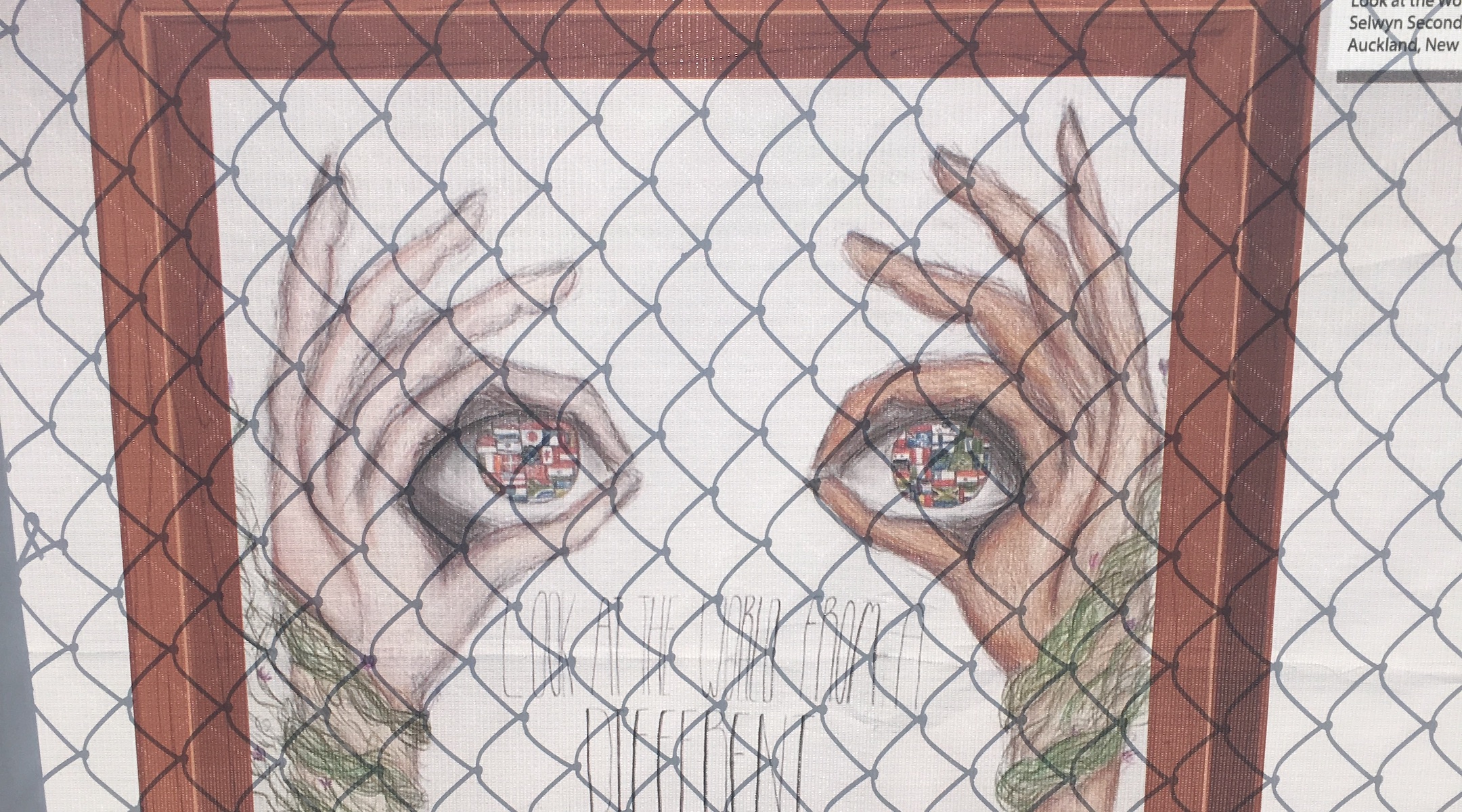
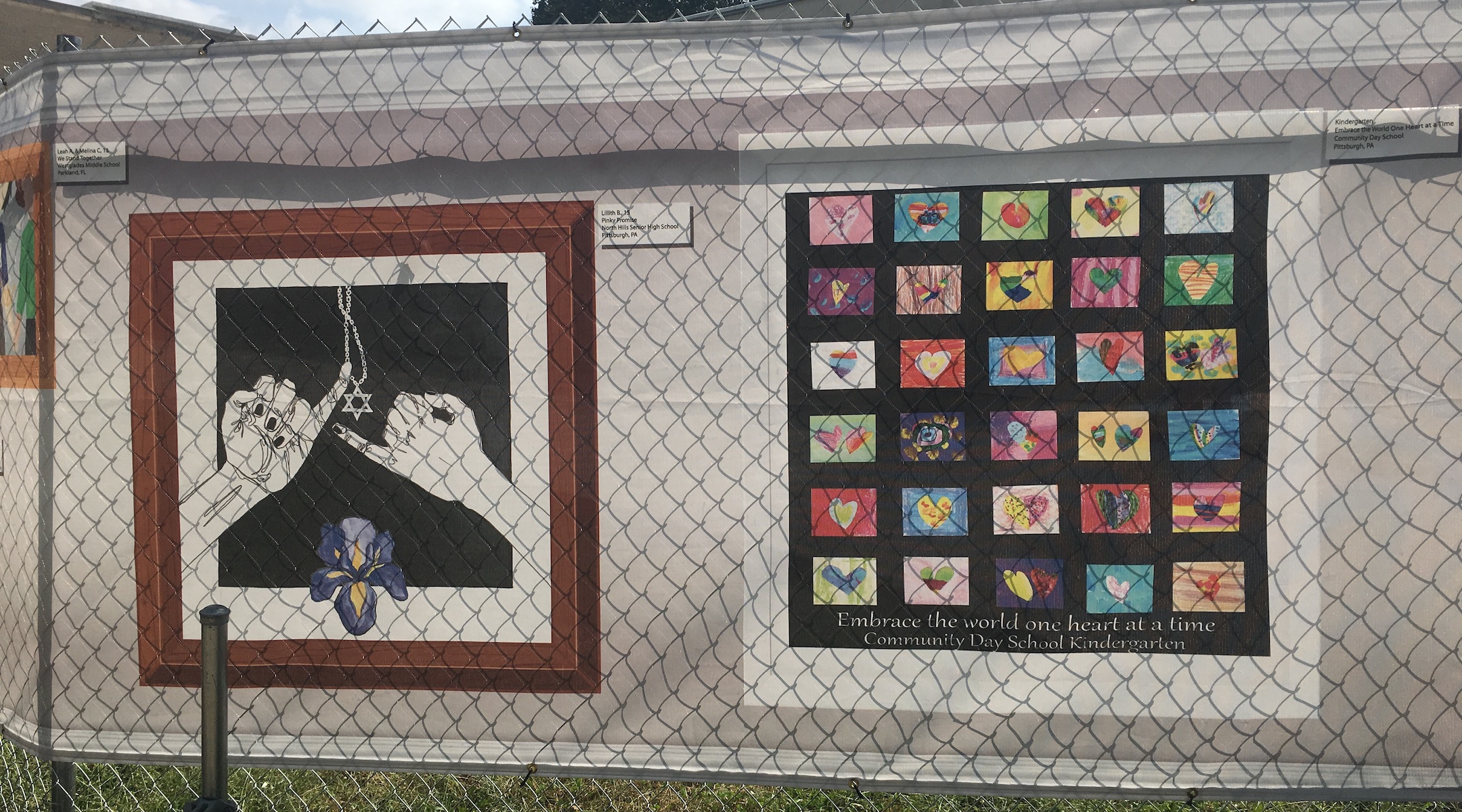
“#Hearts Together: The Art of Rebuilding” features 101 works of art printed on canvas that are wrapped around the synagogue building in the Squirrel Hill neighborhood.

Among those who submitted the art were children from Columbine, Colorado; Newtown, Connecticut; and Parkland, Florida — all sites of mass shootings. The works were selected by members of the three congregations that were meeting at Tree of Life when a gunman killed 11 worshippers there last October.

The artworks were submitted by children from around the world, including from Columbine, Colorado; Newtown, Connecticut; and Parkland, Florida — all sites of mass shootings. (Beth Kissileff)

Since the shooting, the synagogue building has been surrounded by blue tarp. The scene was depressing to synagogue members and neighbors, who wanted something more uplifting and cheerful.

“The dismal scene at the corner here did not reflect who we are and did not project the message that we wanted to project back to the community,” Laurie Zittrain Eisenberg, a longtime member of Tree of Life who had the idea for the art project, told those gathered for the unveiling Thursday. “We tried to think about what we could do and realized the tarps were a blank canvas. What do you do with a blank canvas? You paint a picture on it.”

(Beth Kissileff)

In April, the three congregations began soliciting artistic contributions online. In all, 224 submissions were received from 11 states and New Zealand. All the submissions can be seen online.

The October shooting was the deadliest act of violence against American Jews. Last month, federal prosecutors said they will seek the death penalty for the alleged gunman.

(Beth Kissileff)

Artworks by Children Around the World Installed at Pittsburgh’s Tree of Life Synagogue Read More »

Man Arrested for Allegedly Assaulting NY Chasidic Rabbi

A 26-year-old man was arrested on Sept. 12 for allegedly assaulting Chasidic Rabbi Avraham Gopin, 63, on Aug. 27.

The man, identified as Oniel G. Gilbourne,  faces hate crime charges as well charges of assault and possession of a deadly weapon. He was reportedly hospitalized after his arrest, for reasons that have not been publicly stated.

Gopin told CBS New York on Aug. 28 that the assault occurred while he was walking through Lincoln Terrace Park in the Crown Heights area of Brooklyn areas. Gopin said the assailant punched him multiple times and struck him with a rock. A struggle ensued, and the assailant fled.

It was hate,” Gopin said. “He said, ‘Jew, Jew.’ He said something in that direction… he was for certain looking to kill. No doubt about [that].”

The American Jewish Committee published a video on Sept. 3 highlighting the rise of anti-Semitism in New York City, pointing out that such hate crimes have increased by 81 percent from 2018-19.

“What would you say if you learned there were over 100 anti-Semitic assaults in a European city?” the video asks. “If Jews were being ambushed, attacked, stabbed, kicked, choked, bludgeoned?”

Man Arrested for Allegedly Assaulting NY Chasidic Rabbi Read More »

Saudi Activist Says She Was Raised to Hate Jews. Now She Aims to ‘Eliminate’ Anti-Semitism

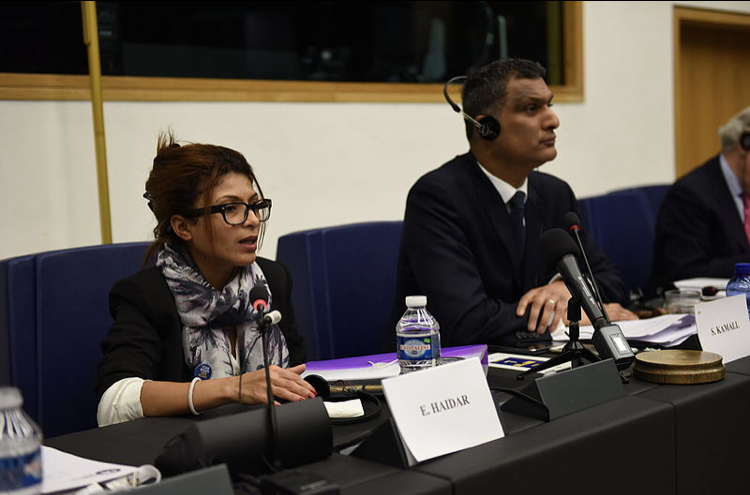
Saudi human rights activist Ensaf Haidar wrote in a Sept. 13 Jerusalem Post column that she was raised to hate Jews, but now she hopes to expunge anti-Semitism from the world.

Haidar stated in her column, We were taught in the Arab world that the Holocaust was just a big lie. It was only when we grew up and opened ourselves to the world of ideas and humanity that we discovered Jews are in fact human beings, and good people, too.”

She then explained that the Saudi government arrested her husband, Raif Badawi, in 2012 after he was critical of the regime, sentencing him the following year to 10 years in prison and 1,000 lashes.

“His indictment says he was guilty of ‘insulting Islam’ and ‘producing what would disturb public order, religious values and morals,’” Haidar wrote. “His real crime, in fact, can be summarized in one sentence: He believed in his fundamental right to express his opinion.”

She added that Badawi believes that Saudi Arabia and the Middle East as a whole should embrace a society “based on acceptance, respect and mutual understanding,” putting him at odds with the Saudi monarchy.

“Central to this vision is the recognition that Jews are not our enemies,” Haidar wrote, adding that “our enemy is the tyranny of religious extremism that insists on hating Jews, and deems them our eternal enemies. Our enemies are the political systems that discriminate against their citizens or violate their human rights.”

Haidar concluded her column with optimism that the world can be changed so long as human rights everywhere are upheld, which involves going after the global rise in anti-Semitism.

“We all have a responsibility to stand firmly against anti-Semitism and denial of the Holocaust,” Haidar wrote. “Since childhood, we grew up on hatred of Jews and taught to curse them. We have to insist on repudiating this message and work actively to eliminate them.”

Badawi ran a website called Saudi Arabia Liberals, where he wrote myriad critiques of the Saudi government, including denouncing the Saudis’ treatment of women in public and that the regime is “backward thinking.” He also condemned Hamas for promoting a “culture of ignorance and death.”

After Badawi was imprisoned, Haidar and her three children sought refuge in Canada, where they have resided since October 2013. 

Saudi Activist Says She Was Raised to Hate Jews. Now She Aims to ‘Eliminate’ Anti-Semitism Read More »

Report: Iran Sanctions Has Country’s Pensions on ‘Brink of Collapse’

A Sept. 13 Fox News report states that the Trump administration’s sanctions against the Iranian regime have put the country’s pension funds on the “brink of collapse.”

The report states that, according to National Security Council documents, 17 out of the 18 retirement funds in Iran are “in the red,” including “pension funds for all of Iran’s armed forces.” The report also notes that 80 percent of the pensions’ funding comes from the Iranian government.

The sanctions appear to have crippled Iran’s economy, as the country’s GDP growth went from being more than 12 percent in 2016 and more than 3 percent in 2017 to a negative growth rate of more than 3 percent in 2018 and a forecasted negative growth rate of 6 percent in 2019, according to the BBC

The Trump administration exited from the Iran nuclear deal and began reinstating sanctions on Iran in 2018.

The Sept. 13 report comes as President Donald Trump reportedly considering lifting sanctions on Iran in order to get a meeting with Iranian President Hassan Rouhani; the Daily Beast reported on Sept. 11 that Trump might agree the French government’s proposal to provide a $15 billion bailout to Tehran as incentive for them to comply with the Iran deal.

A possibility of a Trump-Rouhani meeting has the Israeli government reportedly concerned, as their policy toward Tehran is to target the regime through isolation and economic warfare, according to Bloomberg. Such concerns have been amplified with National Security Adviser John Bolton’s departure from the administration on Sept. 9.

Report: Iran Sanctions Has Country’s Pensions on ‘Brink of Collapse’ Read More »

Left and Right: Not as Far Apart as They Seem

The irony of “left and right” in Israel is that while in speech they are far apart, in deed they are very similar. In fact, while the left speaks of making peace, it’s right-wing governments that have implemented the agreements that tried to trade land for peace.

Late Prime Minister Menachem Begin relinquished the Sinai to Egypt, late Prime Minister Ariel Sharon deported all Jews from Gaza, and current Prime Minister Benjamin Netanyahu gave 80% of Hebron to the Palestinian Authority and dismantled outposts, evacuating Jews.

He also has promised many things before each election in order to garner votes, most of which haven’t happened.

Perhaps that’s why, despite his “dramatic announcement” on Sept. 10 that he will annex the Jordan Valley (a strip of land nearly all Israelis believe is vital for security) and impose sovereignty over Jewish communities, the only people who believe him are left-wing American Jews, certain U.S. congresswomen and the Arab press.

Netanyahu’s announcement was made a week before elections in a clear bid for votes.

“As much as it is possible, I want to apply sovereignty in the communities and other areas with maximum coordination with the U.S. … there is one place where it is possible to apply Israeli sovereignty immediately after the election. If I receive a clear mandate to do so from you, the citizens of Israel.

… Today I am announcing my intention to apply, with the formation of the next government, Israeli sovereignty on the Jordan Valley and northern Dead Sea.”

This seems like a gift for right-wingers. What could be more wonderful than annexing land and applying Israeli sovereignty?

But a closer, more realistic look at his words shows that there is more to the story than Jewish sovereignty.

President Donald Trump has a plan, and although he has taken a lot of confidence-building measures that are pro-Israel, starting with moving the U.S. Embassy to Jerusalem, the recognition of Israeli sovereignty on the Golan Heights and the adoption of new definitions for anti-Semitism, it is completely unclear what Trump’s plans are for Israel.

After the euphoria of the word “annexation” dims to an echo, one realizes that Netanyahu promised only the annexation of Jewish communities. Left unspoken is that sovereignty over non-Jewish communities would be given to the Palestinian Authority, i.e., a Palestinian sovereignty and perhaps a state.

In February, more than a month before the April 2019 Israeli elections, Fox News reported that the U.S. peace plan team had completed its work on the the “deal of the century.”

Channel 13 in Israel aired the main points of the plan: between Israelis and Palestinians, territories will be exchanged; a Palestinian state will be established in 90 percent of the Palestinian territory; illegal outposts will be evacuated; isolated settlements will not be expanded; Jerusalem will be divided into two capitals; Israeli sovereignty applies in the west of the city, and Palestinian sovereignty applies in East Jerusalem.

A Lebanese newspaper then reported that the “deal of the century” was presented to Saudi Arabia for Palestinians. According  to the report, the plan marks the boundaries of the future Palestinian state in the West Bank. It was also said that the discussion on the status of East Jerusalem would be postponed for a later date.

In a few days, Israeli voters will go to the polls, the second round of elections within a year — third if you include municipal elections in October 2018.

The distribution of right-to-left blocs in polls looks very similar to the April 2019 elections, and some voters wonder if there is any point to casting a ballot.

Despite the fact that there are many problems in Israel — cost of living, bureaucracy, traffic jams, health and transportation systems that need serious work — it always seems to be the security and policy issues and the existential threat that divides right and left, between supporters of two countries or annexation.

The right fearmongers about the possibility of a left-wing government; Netanyahu says he is the best person for the job of negotiating the deal with Trump; and the left staggers on its feet with “anything but Bibi.”

How ironic would it be that those who think they are voting for a right-wing government that will apply sovereignty over the West Bank end up with a prime minister who ushers in a Palestinian state?

If it is again the right that signs peace agreements, relinquishes territories, expels Jews and divides the land, then again it will be proof that in Israel, left-right discourse is false. Israelis must adopt a less dichotomous discourse that recognizes their complex realities and produces creative solutions based on the people of the region and not  extremist rhetoric.


Miri Shalem is the CEO of the Institute for Zionist Strategies in Israel and a writer whose work appears in Yedioth Achronot newspaper.

Left and Right: Not as Far Apart as They Seem Read More »

Yale Launches Holocaust Survivors Podcast

(JTA) — Yale University’s Fortunoff Video Archive for Holocaust Testimonies launched a podcast series featuring the remembrances of survivors.

The series launched this week with the testimony of Martin Schiller, a Jewish man from Poland who described his experiences in the concentration and slave labor camps of Plaszow, Skarzysko-Kamienna, Buchenwald and Theresienstadt. Plaszow serves as the setting for the film “Schindler’s List,”

Titled “Those Who Were There,” the podcast has narration by Eleanor Reissa, an actress and Yiddish theater director, and historical oversight by Professor Samuel Kassow. It features testimonies collected from 1979 onward.

Yale Launches Holocaust Survivors Podcast Read More »

Third Democratic Debate Round Again Links Trump to White Supremacy

WASHINGTON (JTA) — Democratic candidates for the party’s presidential nomination linked President Donald Trump’s rhetoric to white supremacist violence, as they have in previous debates.

“He didn’t pull the trigger, but he’s certainly been tweeting out the ammunition,” Sen. Kamala Harris, D-Calif., said of Trump at the debate Wednesday evening in Houston, referring to the Aug. 3 massacre in El Paso, Texas.

The alleged gunman, who targeted mostly Latinos, believed in theories that migrants were seeking to replace whites. The gunman who last year murdered 11 Jewish worshippers at a Pittsburgh synagogue also referred to “replacement” theories.

Other candidates linking Trump’s rhetoric to the attacks were Beto O’Rourke, the former Texas congressman who is from El Paso, and Julian Castro, the former Housing secretary also from Texas.

Trump has spoken of migrant “invasions” of the United States, but also has repudiated the racism behind the El Paso killing and other massacres.

Blaming Trump for an increase in white supremacist violence has been a feature of virtually every Democratic debate.

Although some 20 or so candidates remain in the race, 10 made the cut for the Houston debate based on their fundraising and polling. The others were former Vice President Joe Biden, Sens. Amy Klobuchar of Minnesota, Bernie Sanders of Vermont, Cory Booker of New Jersey and Elizabeth Warren of Massachusetts, businessman Andrew Yang and South Bend, Indiana, Mayor Pete Buttigieg.

Much of the debate, which was broadcast on ABC, focused on health care and trade policy. Foreign policy barely came up, although Booker faulted Trump for abandoning the 2015 Iran nuclear deal in depicting Trump as mercurial. (Booker, speaking on ABC following the debate, took issue with critics who faulted candidates for occasionally speaking Spanish. “Thank God, Baruch Hashem, that we’re doing multilingual tonight,” said Booker, who is familiar with Jewish texts.)

In their summaries, the candidates were asked to describe overcoming moments of resilience. Sanders, who is Jewish, recalled “growing up in a rent-controlled apartment in Brooklyn, New York, the son of an immigrant who came to this country without a nickel in his pocket.”

The debate’s most dramatic moment was when Castro, 44, mocked Biden, 76, for what Castro said was a memory lapse. Other candidates on the stage rebuked Castro.

Third Democratic Debate Round Again Links Trump to White Supremacy Read More »