fbpx

September 9, 2019

Election Handbook: The Threat of the Threshold

A Timesaver Guide to Israel’s Elections on  Rosner’s Domain, until Election Day, September 17. We hope to make it short, factual, devoid of election hype, and of he-said-she-said no news, unimportant inside baseball gossip.


Bottom Line

The last week.


Main News

Iran is making headlines. Netanyahu revealed new information about its military activities.

Likud failed to install video cameras in polling stations.

Oztma, the radical rightist party, crosses the electoral threshold in several recent polls.


Developments to Watch

Coalition: Gantz might get the mandate to form a coalition, if (and that’s a big if) the United Arab Party decides to tell the President that he is their preferred candidate.

Likud: The party is trailing Blue and White in several recent polls by a seat. This could be important when the president makes a decision as to whom gets a first shot at forming a coalition.  

Right: Otzma is close or above water. This is tricky for the Netanyahu bloc, as the party could get in – and color the whole bloc as radical – or stay out – and waste almost four seats for the right.

Left: Labor is still the party to watch. If it sinks bellow water – something many pollsters think is a real possibility – the blocs picture could change.  

Audio: Turn to Rosner’s Podcast for a fascinating conversation with veteran political analyst Dana Weiss about Israel’s coming elections. It is here.


The Blocs and Their Meaning

The blocs: Netanyahu’s bloc does not have the 61-seat majority it needs – for now. Not even in polls that show Otzma above the threshold. At this point this leaves us with four options: 1. The polls are all wrong (and all polls are wrong). 2. A week is enough time to alter the political map. 3. Netanyahu will be forced to pay a high price to a party that isn’t part of his bloc. 4. Netanyahu will not be Prime Minister.
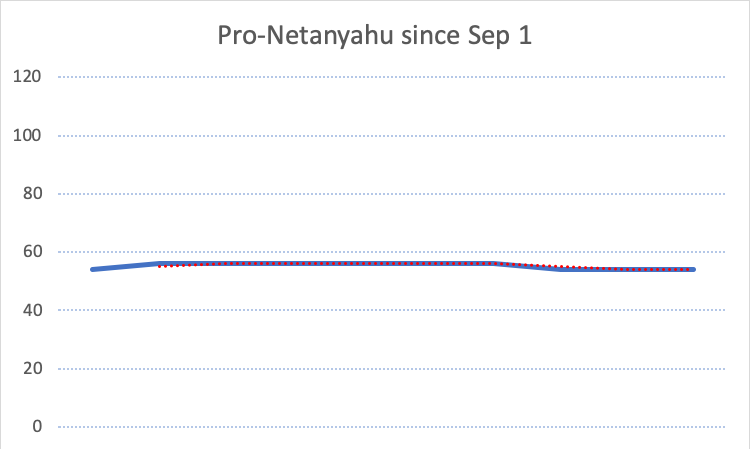


A look at the parties, a week before Election Day – with some comments following the graph:


Note these things:


1.

In most elections, small parties get smaller on election day and main parties grow – as voters wish to play it safe. This puts Labor (and Otzma, that we don’t yet include in the graph, but crosses the threshold in the last three polls) in danger.

2.

It’s hard to see in the graph, but Israel Beiteinu and Yamina also witness a downward trend.

3.

Likud and Blue and White are tied on average, but the last two polls show Blue and White one seat ahead.

4.

For Gantz, there is a lot of good news in recent polls. But forming a coalition will be tricky for him – unless Likud decides to dump Netanyahu.

—–

Shmuel Rosner’s book#IsraeliJudaism, Portrait of a Cultural Revolution, is now available in English. The Jewish Review of Books called it “important, accessible new study”. Haaretz called it “impressively broad survey”. Order it here: amzn.to/2lDntvh


Election Handbook: The Threat of the Threshold Read More »

Accidental Talmudist Podcast

Rabbi Tzvi Freeman: What is Chassidus?


Rabbi Freeman, a self-described “un-Orthodox rabbi,” shares unexpectedChassidic teachings that help us come closer to God, each other and our own true selves.

Rabbi Freeman, senior editor of Chabad.org, brings down deep teachings from the Baal Shem Tov, founder of Chassidism, and the great Lubavitcher Rebbe. What does it mean that we all carry a spark of the Divine?

Follow the Accidental Talmudist on FacebookInstagram and Twitter

Rabbi Tzvi Freeman: What is Chassidus? Read More »

Report Details Proxy War Between Israel, North Korea

A lengthy Sept. 9 report in Tablet details the ongoing “shadow war” between Israel and North Korea that receives little media coverage.

The report notes that both the United States and Israel intelligence discovered in 2007 that North Korea was involved in the construction of Syria’s Al Kibar nuclear reactor; the reactor even resembled North Korea’s Yongbyon reactor. Intelligence also uncovered the head of Syria’s Atomic Energy Organization photographed with North Korean scientist Chon Chibu at the Yongbyon reactor.

Israel destroyed the Al Kibar reactor that year, a move that North Korea condemned. The episode was illustrative of the proxy war between Israel-North Korea that has occurred since the 1960s. The Tablet report goes on to note various instances in which North Korea has provided aid to Israel’s enemies, including to Egypt and Syria during the Six Day War in 1967 and Egypt again in the 1973 Yom Kippur War. During the latter, “Israeli military personnel described clashes with North Korean fighters over the Sinai,” according to the report. North Korea has also helped keep Syrian President Bashar al-Assad’s grip on power amidst the civil war that has engulfed Syria since 2011.

Additionally, North Korea first allied with Iran during the Iran-Iraq War in the 1980s, providing Tehran with military assistance during the war. The two have since engaged in “close cooperation in developing strategic missile systems,” as both U.S. and Israeli intelligence officials have noted striking similarities in Iran and North Korea’s missile programs. Whether or not the two countries are also working together on developing nuclear weapons remains “an open question,” according to the report. 

The report notes that North Korea is moving closer toward its goal of reaching “hydrogen bomb capability” with its nuclear program, sparking Israeli concerns that Pyongyang could funnel its weaponry “to Israel’s Mideast enemies, particularly for the right price.”

A 2017 report from the Tokyo-based Diplomat Magazine seemingly buttresses Tablet’s report, noting that North Korea provided weaponry to the Palestinian Liberation Organization (PLO) in the late 1980s and has sided with Hamas over Israel in the myriad conflicts between the two. 

The Diplomat report also highlights a 2010 Congressional Research Service report stating “that North Koreans have helped Hezbollah build underground tunnels in Lebanon.”

North Korea’s antagonism toward Israel stems from Pyongyang’s belief that Israel is hypocritical to be stridently against nations like Iran from obtaining nuclear weapons despite having such weaponry of their own; Pyongyang also views Israel as an “imperial satellite” of the U.S., according to The Diplomat.

Report Details Proxy War Between Israel, North Korea Read More »

Netanyahu Exposes Another Secret Iran Nuclear Site

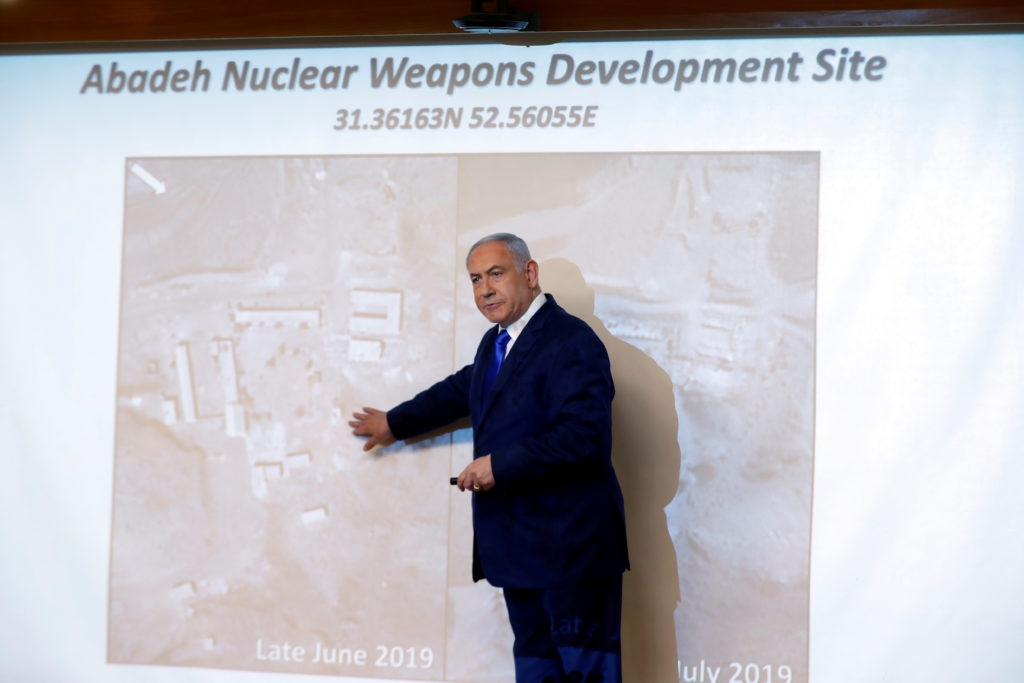
Israeli Prime Minister Benjamin Netanyahu has exposed another secret Iranian nuclear site in a  Sept. 9 press conference.

While speaking at the Israeli Foreign Ministry in Jerusalem, Netanyahu said that the site, located in southern-central Iran city of Abadeh, was where “Iran conducted experiments to develop nuclear weapons.” He added that Iran attempted “to destroy the evidence” after Israeli intelligence discovered the site.

Netanyahu also pointed out that the International Atomic Energy Agency announced earlier in the day that they discovered uranium traces at an Iranian site in Turquzabad – which is located in Tehran – that Iran said was for cleaning carpets. Iran hasn’t provided the agency with any answers as to why uranium was found at the site.

Israel knows what you are doing,” Netanyahu said. “Israel knows when you are doing it, Israel knows where you are doing it. We will continue to expose your lies.”

He urged for international cooperation in adding onto President Donald Trump’s sanctions against Iran.

Iranian Foreign Minister Javad Zarif responded on Twitter that Netanyahu is “the possessor of REAL nukes” and accused Netanyahu of being hungry for “war.” 

The Jerusalem Post’s Yaakov Katz posited that Netanyahu’s Sept. 9 announcement was aimed at deterring Trump from meeting with Iranian President Hassan Rouhani during the United Nations General Assembly from Sept. 23-27.

“Netanyahu is hoping that by going public, conservative pundits in the US will use the revelation to call on Trump not to meet with Rouhani,” Katz wrote. “Considering how sensitive Trump is to media coverage, a few negative reports on Fox News might be all it takes.”

In April 2018, Netanyahu revealed that Iran had been hiding nuclear sites from the IAEA and urged Trump to exit from the Iran nuclear deal at the time. Iranian Atomic Energy Organization head Ali Akbar Salehi said in January that the regime hid their operational Arak reactor from the IAEA, telling the agency they had shut it down.

Netanyahu Exposes Another Secret Iran Nuclear Site Read More »

Jewish Bucket List No 7: Krav Maga

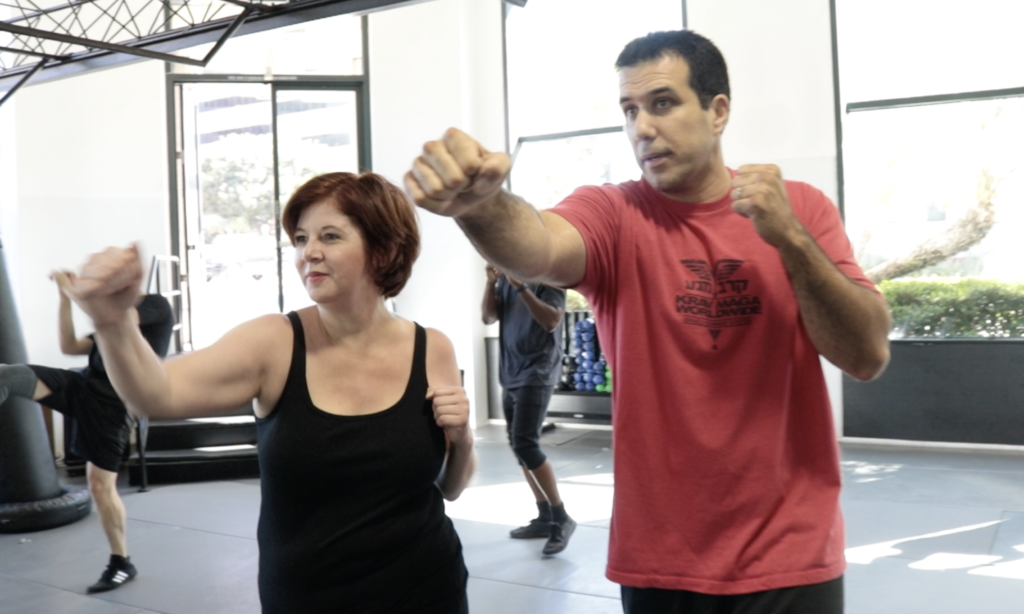
Krav Maga is the first thing the Israel Defense Forces (IDF) uses to train new soldiers to get up to speed and ready for combat. But it’s also as much about a mindset as it is about fighting.

I first learned about Krav Maga when I interviewed Amir Perets for the Journal last year. He’s the Israeli who popularized the discipline in Los Angeles. I decided to add taking a class to my Jewish bucket list. 

Krav Maga, which means “contact combat,” was adapted for the nascent Israeli state by Hungarian-born Imi Lichtenfeld. However, it originated in the mid-1930s in Bratislava, Czechoslovakia, where Lichtenfeld grew up and led a group of Jewish boxers and wrestlers who defended Jewish neighborhoods against anti-Semites. He quickly discovered that actual fighting was very different from competition fighting. So Lichtenfeld started to develop the techniques — sourced from boxing, wrestling, aikido, judo, karate and street fighting — to create Krav Maga.

“There’s an Israeli-Jewish history link, [and] there’s a real element of pride in being part of that,” instructor Gabriel Khorramian told me. “Krav Maga is not just for Jewish people.”

A third-degree black belt in Krav Maga, Israeli-born Khorramian has lived in Los Angeles for more than 20 years and has been teaching at Krav Maga Worldwide in West Los Angeles since 2001. 

“I love doing Krav Maga,” he said. “You build the self-confidence to defend yourself in kind of a crazy world. You’re getting in great shape.”

Maybe. But after 10 minutes in Khorramian’s class, I realized how tough it was. What had I been thinking? We started with a warm-up. My partner and I took turns pushing each other and getting out of the way. I worked with Alexis, a strong and talented teen headed to Harvard this fall. After a few minutes of “attacks,” we were instructed to do jumping jacks then one burpee. And repeat.

This mix of fighting and cardio exercise seemed to be way beyond my natural abilities. However, I trained in aikido (self-defense) for nine years and my current exercise of choice is dance (movement and cardio). After I made it through the warm-up, I found my comfort level. Phew. I knew I could survive the rest of the class.

Next, we practiced strikes. Then kicks. Then a combination of both. From there we practiced defense for close attacks. Strikes with elbows. Then knees. Then another combination. 

“We worked on punching and kicking techniques, as well as some conditioning drills,” Khorramian explained. “The goal of these was to teach proper technique, help to develop power in these strikes and use them in some drills that push students out of their comfort zone and make them keep going.”

The final exercise — drills — was designed to mirror a tactical simulation. First, we were told to do a series of fast punches and then go into a plank position while our partner moved to another part of the room. We got up, found our partners and did a series of kicks. Then it was time to plank again. Then another partner search and more fast strikes.

The goal was disorientation and endurance. I experienced both. The training was tough, but it did its job of getting me to tap into my mental, physical and emotional strength.

I’m still seeking items for my 2019 Jewish bucket list. Please send your ideas to deckerling@gmail.com.


Debra Eckerling is a Journal contributing writer.

Jewish Bucket List No 7: Krav Maga Read More »

Israeli Assaulted in Germany While Speaking Hebrew

An Israeli tourist was assaulted in Berlin on Sept. 9 as he was speaking to three other men in Hebrew, the Jerusalem Post reports.

The tourist was conversing with the three men outside of a nightclub when the assailant punched the tourist in the face and then fled. The tourist told police that the assailant was “Arab-looking,” according to the Post. The Post also noted that the police report on the matter described the assault as having an “anti-Semitic background.”

Israeli diplomat Dan Poraz tweeted out a link to the story, writing that “its 2019 not 1939.” He added in a follow-up tweet, “To almost every trip abroad, to almost any destination – Jews will usually be cautious/uncomfortable about speaking Hebrew. In fact, there’s only one place in the world in which Jews speak Hebrew freely.”

A German intelligence agency released a report in June stating that there was a 71.4 percent increase in anti-Semitic violence from 2017 to 2018 and 20 percent in anti-Semitic hate crimes overall in the same timeframe. In May, German Commissioner Felix Klein warned Jews against publicly wearing kippahs in the country, a statement he later backed down from after facing criticism over it.

“Germany’s domestic intelligence agency notes #antiSemitism is a core element of both right & left-wing extremism, and also essential to Islamist extremist ideology,” Anti-Defamation League CEO Jonathan Greenblatt tweeted in June. “We must tackle this rise in anti-Semitism and extremism, no matter the source.”

Israeli Assaulted in Germany While Speaking Hebrew Read More »

Joe Biden Fundraising Letter Features Rabbi’s Story About the Presidential Candidate

WASHINGTON (JTA) — A Delaware rabbi wrote a fundraising endorsement for Joe Biden’s presidential campaign citing Biden’s appearance at the shiva for a constituent of modest means.

Rabbi Michael Beals was leading a minyan in 2006 for Sylvia Greenhouse, who lived in a senior living facility in Claymont, a town at the northern tip of Delaware. The minyan was taking place in the laundry room because Greenhouse’s apartment was too small to accommodate the 10 supplicants required for prayers during the period of mourning, or shiva.

Beals was surprised to see Biden, then the state’s senior senator, entering the laundry room. Afterward Beals, of Congregation Beth Shalom in Wilmington, asked Biden why he had come.

Biden explained that Greenhouse had sent his campaign $18 every Senate election since his first in 1972. Eighteen is the numerical equivalent of the Hebrew word for “life,” “chai.”

“There were no news outlets at our service that day — no Jewish reporters or important dignitaries,” Beals wrote in the appeal distributed by the campaign of the former vice president. “Just a few elderly mourners in a basement laundry room.”

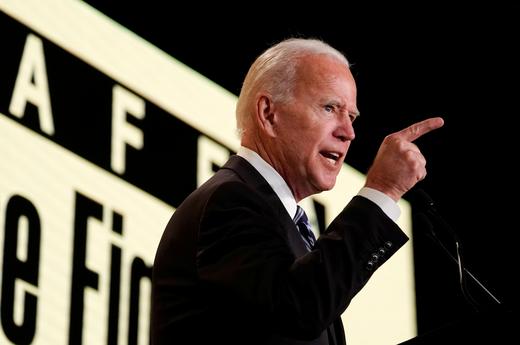
A photo of Biden posing with Beals is attached to the appeal.

Joe Biden Fundraising Letter Features Rabbi’s Story About the Presidential Candidate Read More »

Swastikas Found on Several Homes in San Pedro

A slew of swastikas were found on around a dozen homes and buildings in San Pedro on Sept. 2.

Siamak Kordestani, American Jewish Committee Los Angeles Regional Office Assistant Director, tweeted out photos of some of the swastikas:

Police Office Paul Winter told the Daily Breeze newspaper that the vandalism spanned from “Grand Avenue to Pacific Avenue, and from 12th Street to 19th Street.” He also said that the police are looking for a 6’2” white male as a suspect and that they are investigating the matter as a hate crime.

Coastal San Pedro Neighborhood Council President Doug Epperhart told the Daily Breeze that he had never seen such graffiti before in his 27 years living in San Pedro, pointing out that most graffiti in the area is “gang-related.” 

Temple Beth El Rabbi Cassi Kail told the Daily Breeze, “The man who did this chose to invoke something, provoking fear and from a place of hatred. Even if it wasn’t specifically against the Jewish community, it’s against all people who value diversity and respect for another.”

Community activist Lion Lyons told Spectrum News that he is going to organize a community meeting to address the matter.

This community, as you can tell, we’re very diverse and we don’t have time for that,” Lyons told CBS Los Angeles. “First off, we want to educate our youth and seeing that this doesn’t happen and at the same time, let them know that everyone’s welcoming here.”

Anti-Defamation League CEO Jonathan Greenblatt tweeted, “Sickening display of #antiSemitism in California where swastikas were found painted onto over a dozen houses. Glad to see the community has already come together to take action and seek justice. @LA_ADL is working with law enforcement to assist in any way.”

Swastikas Found on Several Homes in San Pedro Read More »

Learning Never Stops

For many years, my grandfather had a secret. He was a devoted husband, father, and grandfather. He worked unusual hours, so it was easy for him to keep this secret. It was unique, to be sure. But unlike any other type of family secret, this one is amazingly special.

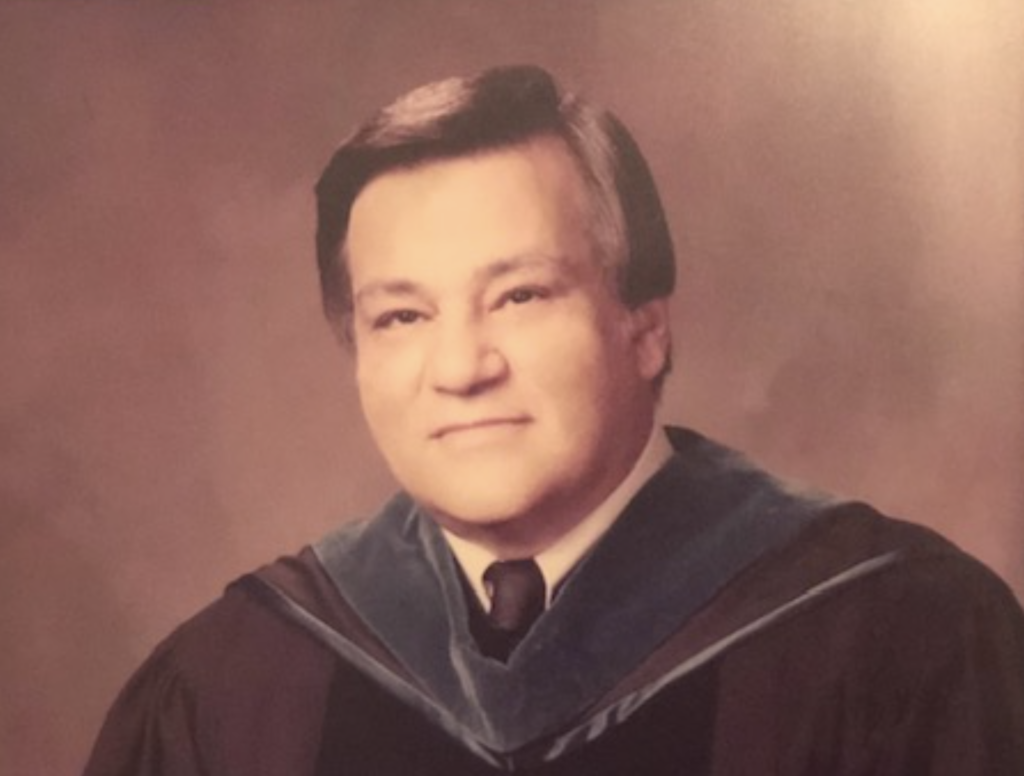
I always knew my grandfather’s name was Dr. Sidney D. Rothstein. I saw it written on his stationery, bookplates, etc. He had a PhD in marketing from University of Maryland and it was displayed proudly on the wall in his home office. He lived his entire life in Philadelphia, so I am not really sure why I never thought to ask about when or how he obtained that degree. It was way before the day of online learning. It never came up until a conversation with my dad a few years ago.   

In his early 50s, with a wife, two grown children—one of whom was finishing up law school—without telling anyone, my grandfather, “Poppy” enrolled in and completed his PhD. Before the days of online learning platforms, there were “correspondence courses.” Mail from the University was sent to his office, so my grandmother never saw it. “Nanny” confirmed to me that she never knew he was doing this until it was a done deal. My dad thinks he did it this way because like just about every other PhD student, he wanted to avoid the endless questions about his progress in the program. 

While getting a PhD in secret is impressive in itself, what makes it even more special was that he did not need to do it. He had a successful career as an advertising executive and it was for one reason alone–the love of the learning. He later shared that love with hundreds of students, as an adjunct professor of marketing at the Wharton School of the University of Pennsylvania, the Fox School of Business at Temple University, and several other colleges in the Philadelphia area.

Mishna says “Do not say, ‘When I have leisure, I will study.’ Perhaps you never will have that leisure.” Poppy was an empty nester. He lived in a major urban area with a lot to do. He could have done any number of “leisure” activities with this time, but he did not. He set a goal and finished it. 

It is no accident that Jews are known as the “People of the Book.” We love to read. There are thousands of pages of Jewish texts. Bible stories, commentaries, codes, stories, modern day interpretations, the list goes on and on. Jewish parents have an obligation to educate their children (Talmud Kiddushin 29a). Throughout the history of the Jewish people, as we were exiled from place to place, the one constant was our knowledge. It was portable and permanent. Rabbi Meir tells us that one who engages in (Torah) study for its own sake becomes “great and exalted above all of creation” (Pirkei Avot 6). 

I write this as so many head back to school. After fifteen years, I am doing the same. Although not following the secretive legacy of my grandfather, I am inspired by the notion that you can go back at any age. I will soon be taking a class (via Zoom—Poppy would have done the same if he could have!) in Jewish leadership. Although I am admittedly nervous about this new endeavor, I will think about Poppy and the incredible legacy he left me. Learning is ageless and timeless.

Poppy would have been 98 this year. In his memory, I gave my daughter the middle name Shoshana. And at her naming, my father shared some memories of him. Jewish tradition teaches us that when we name our children in loving memory of someone, we are hoping to pass down the characteristics of that person. In addition to his sense of humor and love of travel, I hope my daughter will inherit his love of lifelong learning. I do not expect her to secretly complete a PhD (!!!), but I hope she will continue her love of books, her curiosity about the world, and the smiles and love she shows everyone. All things that Poppy had. Zichrono livracha. May his memory be forever a blessing.


Lisa Rothstein Goldberg is a social worker and Jewish educator. She lives in Louisville, Kentucky with her husband and their two young daughters. 

Learning Never Stops Read More »