fbpx

July 6, 2019

Election Handbook: Leading Parties Decline

We call this format a Timesaver Guide to Israel’s Coming Elections. This will be a usual feature on Rosner’s Domain until next Election Day, September 17. We hope to make it short, factual, devoid of election hype, and of he-said-she-said no news, unimportant inside baseball gossip.


Bottom Line

Stalemate.


Main News

Peretz elected as Labor leader.

Ethiopian demonstrations capture the headlines.

Polls: Clear advantage for Netanyahu over his rivals as “most fit to be PM”.

Barak proposes to drop the issue of Haredi draft. Names his party Democratic Israel.

Talks about mergers of right parties and left parties continue without result.


Developments to Watch

Barak: His new party was launched with media fanfare, but the polls do not give it much beyond the electoral threshold (and in one case, below). If the party does not gain momentum, it might fail to convince Labor and Meretz to form a bloc under its wings.

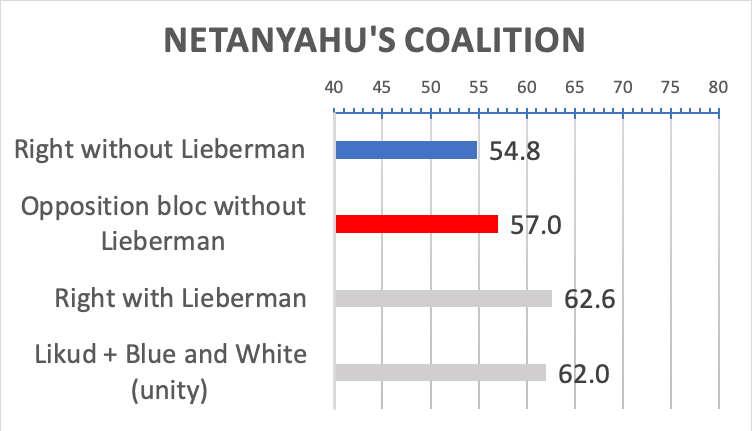
Lieberman: His party gained a few seats, but not many, since his decision not to join a Netanyahu coalition. But for now, he has all the seats he needs to serve as the ultimate king maker of the next election. Without him, no bloc has a majority.

Likud, Blue and White: Both leading parties are losing votes, according to the polls.


The Blocs and Their Meaning

As you can see in the graph, the two blocs, one of parties for Netanyahu and one of parties against him, are both stuck bellow the 60-seat line. Lieberman will make or break the next coalition. That is, unless Likud and Blue and White decide to form a unity government without him.


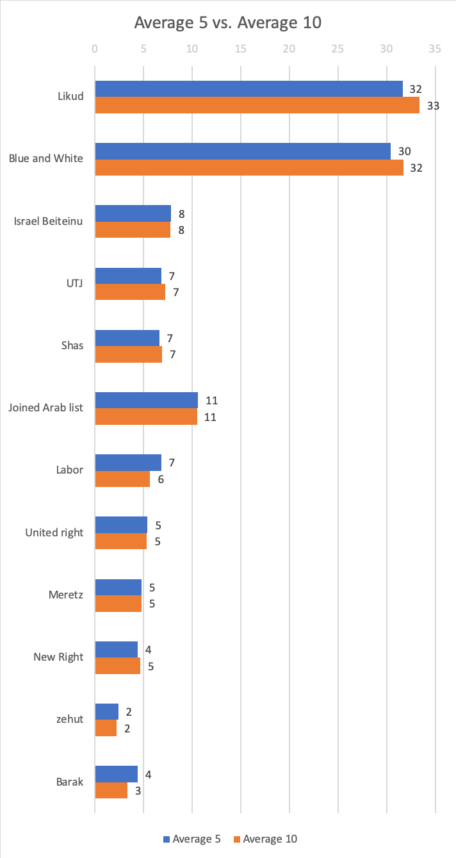
And here is a graph of two averages. One is the average, for each party, of the 5 latest polls, and one is a graph of the 10 latest polls. Why such graph is helpful? Because it gives us a way to look at trends. Take a look and note the following things:

The leading parties are in gradual decline.

Labor still has a pulse.

There are still many parties in the 2-5 seat zone – namely, unsecured.


A Party to Watch

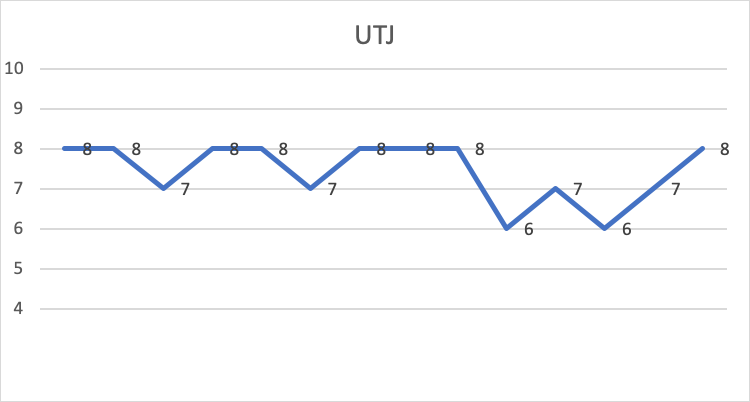
For United Torah Judaism, the voters are not the issue. The voters are loyal. This party suffers only is circumstances change, and coalitions are formed without it, or without it having a power to dictate its terms. The polls show that a repetition of its current eight seats is a likely scenario for the September election.


Election Handbook: Leading Parties Decline Read More »

California Assemblyman Apologizes for Depicting His Jewish Opponent Clutching Dollar Bills

(JTA) — California State Assemblyman Tyler Diep is sorry for a campaign ad depicting his Jewish opponent holding a wad of money.

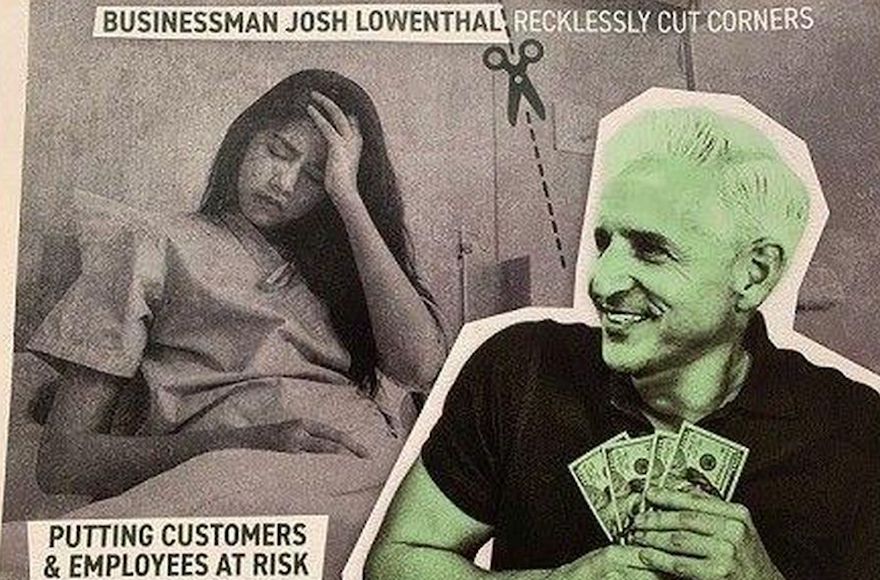
Diep, a Republican, beat Democrat Josh Lowenthal in the November 2018 election. Ahead of the vote, Diep distributed campaign literature showing Lowenthal clutching dollar bills and accused him of putting customers and employees at risk “[j]ust so he could make a quick buck.”

Lowenthal is the president of FreeConferenceCall.com.

Diep, who is Vietnamese, had defended the ad at the time, citing his personal history of fleeing communist persecution. But after meeting with local Jewish leaders this week, Diep, who hails from Orange County, apologized for the mailer.

“I want to take this opportunity to publicly share my sincere apology to anyone in the Jewish community who was offended by my campaign during the 2018 election,” Diep said in an emailed statement Tuesday, according to the Los Angeles Times. “There is no place for anti-Semitism in our society, and while my campaign had no intention of doing so, we failed to recognize the sensitivity of the problem. I now have a greater understanding for the seriousness of anti-Semitic sentiments.”

California Assemblyman Apologizes for Depicting His Jewish Opponent Clutching Dollar Bills Read More »

Selma’s Only Synagogue has 4 Members and is Fighting for its Life

(JTA) — Whenever the lone synagogue in Selma, Alabama, needs dusting, new lighting or vacuuming, Ronnie Leet is the one who does it.

It’s tiring work — especially since the 120-year-old Temple Mishkan Israel hasn’t held regular services in years, hasn’t had a rabbi in nearly half a century and isn’t even close to having enough Jews for a minyan, a prayer quorum of 10 people.

In fact, the temple has only four members. At 68, Leet is the youngest. There are two or three other Jews in the city of 20,000 known for its role in the civil rights movement, but they’re not involved with the synagogue.

“The congregation gets smaller and smaller, and we’re getting older,” Leet said. “With a 120-year-old roof, we see issues every day with it. As every year goes by, and as it gets older and older, something is going to happen.”

Other small towns in America with dying synagogues have simply pulled the plug. Buildings are vacated, prayer books and Torah scrolls are sent elsewhere, and the dwindling membership finds other places to go or just stops going to synagogue.

It would probably be easier for Selma’s temple to follow suit. But it’s doubling down on the continued life of the synagogue.

Mishkan Israel wants to raise $800,000 through GoFundMe for renovations. A Virginia professor is trying to turn the synagogue into a cause celebre. And last year it got an email address.

“Temple Mishkan Israel is one of those stories that’s so easy for people in the United States to overlook,” said Amy Milligan, a Jewish studies professor at Old Dominion University in Norfolk who is writing a book about Selma’s Jewish life and has taken an active role in helping the congregation with fundraising and publicity. “It’s a story about an early community of Jews that continues to survive in 2019.”

There are no illusions of becoming a regularly functioning synagogue in the near future. But Mishkan Israel members and Milligan believe it still has something to say to the 81,000 tourists who filter through Selma every year visiting places like the National Museum of Voting Rights, which is just across the Edmund Pettus Bridge from the synagogue.

They plan for the synagogue to become a museum, one more dot in the city’s constellation of spaces commemorating a formative era in the Deep South. The synagogue would host exhibits on Southern Jewish history and the Jews’ role in the civil rights movement, as well as events.

In 2017, some 125 people prayed at the synagogue during a Jewish mission to Selma over Martin Luther King Day weekend. Two years earlier, 205 attended a commemoration at the synagogue of the 50th anniversary of Bloody Sunday, when Alabama state troopers beat nonviolent civil rights marchers on the bridge and shot tear gas at them.

“We want it there for people to tour the building and hear our story of the past,” Leet said. “It’s more than just fixing the building and letting it sit there.”

Decades ago, Selma had a thriving Jewish community of as many as 500 members. Leet said that as recently as the early 1950s, half of the businesses in the city’s downtown were owned by Jews. In the 1920s and ’30s, Milligan said, Jewish businesses used to take out ads in the local paper notifying their customers that they would be closed for the High Holidays. Stores owned by non-Jews would likewise buy ads wishing Jews a happy holiday and reminding them to come by after it ended.

Jews came to Selma around the early 1830s, and the first organized services took place in 1867. Mishkan Israel moved into its current building in 1899, and it still has the original electricity system. Leet said the building is still in remarkably good condition for its age.

But as Jews became more successful, Milligan said, younger generations moved away.

“It very much is a fulfillment of the American dream,” she said. “People came into Selma, they had their businesses, and they built that as a community for their children. And then they sent their kids away to college. The parents said, ‘Go have a career. I want you to prosper.’”

Despite the famous image of Rabbi Abraham Joshua Heschel marching with the Rev. Martin Luther King Jr. in Selma, Leet said the local Jewish community was not active in the civil rights movement. Other Southern synagogues were attacked, and Mishkan Israel received a bomb threat.

While Jews were comfortable in the community, Leet said they still felt uneasy about their relations with elements of the white Christian majority and did not speak out publicly for racial equality.

Milligan said a museum exhibit could provide an unvarnished portrayal of that attitude and era.

“We knew that where everybody was on Sunday morning was where we were not,” Leet said. “I think the congregation as a whole really didn’t play a part in the national movement of civil rights here in Selma. They didn’t know where it was going to fall on them.”

So far, the synagogue has raised only $6,500 online. But Leet hopes the synagogue’s diaspora will come through. In 1997, some 220 relatives of current and former synagogue members came back for a reunion.

“There’s a love across this country from people raised in Selma,” he said. “We want the country and world to know there was a wonderful congregation here in Selma, Alabama.”


Selma’s Only Synagogue has 4 Members and is Fighting for its Life Read More »

Ukraine Synagogue Where Menachem Begin was Married Gets Torah Scroll

(JTA) — The Ukraine synagogue where the late Israeli prime minister Menachem Begin was married received its first Torah scroll since World War II.

Leaders of Ukrainian Jewry gathered Wednesday at the Choral Synagogue in the western city of Drohobych to celebrate the introduction of the scroll in a ceremony featuring songs, dances and speeches.

Completed in 1865, the synagogue inspired by the Rundbogenstil school was among the region’s most impressive. It became abandoned in the Holocaust, when most of the region’s Jews were murdered by the Nazis. It was a furniture warehouse during communist times.

In 2013, philanthropist Viktor Vekselberg funded a $1 million restoration of the synagogue. The project — led by Vekselberg’s father, Felix, who was born in that city — was completed last year. Viktor Vekselberg, who was born in Drohobych as well, also donated the scroll.

Begin, and his wife, Aliza, were married at the synagogue in 1936. Among the guests was Ze’ev Jabotinsky, the leader of Revisionist Zionists and mentor to Begin, who would go on to become Israel’s sixth president.

The synagogue is depicted in the famous painting by Maurycy Gottlieb, “Jews Praying in the Synagogue on Yom Kippur,” which is now at the Tel Aviv Museum of Art. Gottlieb was born in 1856 in Drohobych, then part of the Austrian Empire.

It later became part of Poland, was occupied by the Germans, incorporated into the Soviet Union before becoming part of Ukraine.

Ukraine Synagogue Where Menachem Begin was Married Gets Torah Scroll Read More »

50,000 Flock to Lubavitcher Rebbe’s Grave in New York to Mark 25th Anniversary of His Death

(JTA) — An estimated 50,000 people have visited the resting place of the Lubavitcher Rebbe, Rabbi Menachem Schneerson, ahead of the 25th anniversary of his passing.

The pilgrimage to the burial site in Queens, New York, known as the Ohel has taken place over the past week ahead of the anniversary Saturday, the 3rd of Tamuz on the Hebrew calendar, according to a spokesman for the late rabbi’s Chabad-Lubavitch Hasidic movement. Schneerson headed the movement from 1950 until his passing in 1994 — a movement he had helped revive following its post-Holocaust re-establishment in New York.

Throughout the year, approximately 400,000 people visit the Cambria Heights site, many of them not Hasidim or even Jewish, the spokesman said.

In Britain, Chief Rabbi Ephraim Mirvis eulogized Schneerson as “one of the great rebuilders of Jewish life after the tragedy of the Shoah,” whose “teachings and insights remain as fresh and relevant today as they have ever been.”

Numerous political leaders in Israel took to social media to share tributes to Schneerson.

Prime Minister Benjamin Netanyahu of Israel wrote on Twitter that Schneerson “changed the world and influenced me a lot. I’ll always remember him.”

Moshe Yaalon of Israel’s Blue and White opposition party in a tweet called the Rebbe “one of the greatest leaders of the Jewish people in our generation. He also said Schneerson’s “directive of ‘Ahavat Yisroel’ [love for fellow Jews] is more important today than ever.”

50,000 Flock to Lubavitcher Rebbe’s Grave in New York to Mark 25th Anniversary of His Death Read More »

Dutch Christians Rebuff Officials Seeking Labeling of Israeli Settlement Goods

AMSTERDAM (JTA) — Christian Zionist importers of Israeli goods declined to comply with a government directive to apply special labeling for settlement products.

The exchange occurred last month between the van Oordt family, which runs the Israel Products Center and the Christians for Israel group in Nijkerk, near Amsterdam, and representatives of the Ministry of Economic Affairs and Climate Policy, Roger van Oordt, director of the Christians for Israel group, wrote Wednesday in a statement.

The officials requested to visit the store and urge van Oordt to apply the labels, as per regulations adopted in 2015 by the European Commission, which described the regulations as designed to give shoppers accurate information about product provenance.

Israel and Jewish groups protested the regulations as an attempt to isolate and financially hurt the Israeli settlements. The regulations also applied to the Golan Heights and eastern Jerusalem, which Israel captured in the 1967 Six-Day War. The Palestinian Authority said the labeling regulations were a welcome buffer against what it considers Israeli land theft.

“Labeling was created to ensure food safety but has become a political tool to pressure the Jewish state,” said van Oordt, whose outfit helps bring in 120,000 bottles of Israeli wine each year, as well as many tons of Dead Sea cosmetics and other merchandise.

“These are anti-Jewish regulations to me. They mean separating products made by Jews and Arabs,” he wrote.

The regulations are binding, but the European Commission and Dutch government have limited recourse against countries and businesses that don’t implement them.

Dutch Christians Rebuff Officials Seeking Labeling of Israeli Settlement Goods Read More »