Los Angeles life coach Sherri Ziff never imagined she would spend her time advocating for road and pedestrian safety, but after living through a hit-and-run accident in March of 2018, it’s all she wants to do.
“I feel strongly about this. I lived. Not many people survive what happened to me,” Ziff told the Journal. “HaShem gave me a second chance and I need to make my life worthy of the second chance.”
Now she is trying to save the lives of others in her community through her advocacy group “You’ve Been Hit and Run” and eBook, “You’ve Been Hit and Run: What You Must Do Now.” Ziff is working closely with the Los Angeles Police Department (LAPD) and Department of Motor Vehicles (DMV) to help them get the search software they need to solve hit and run cases as well as provide support to the victims of hit and runs.
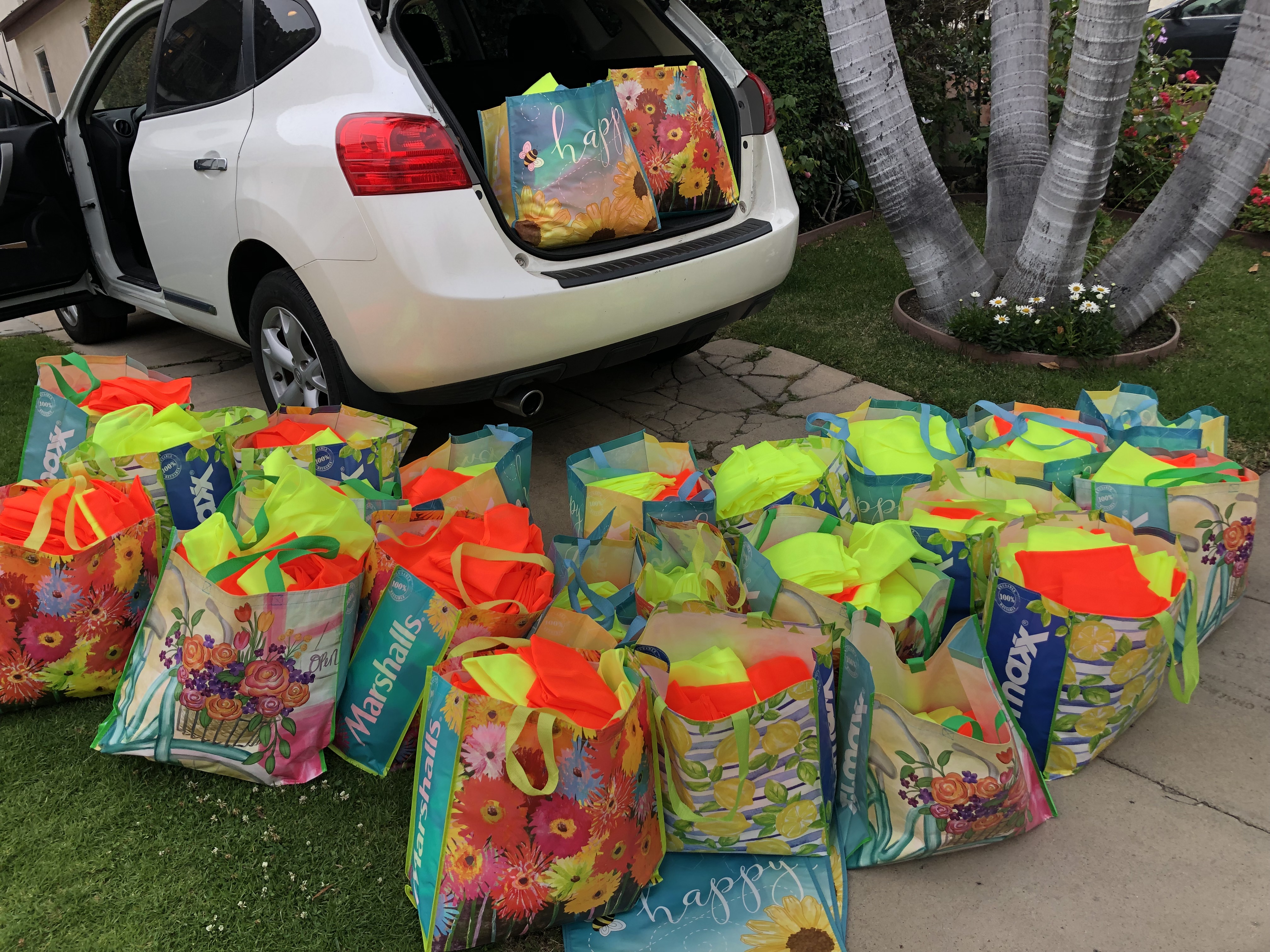
She also just completed handing out 3,000 safety vests for people to wear out of synagogue in time for Shavuot.
Ziff said the idea came to her on Tuesday when she figured many around the community would be walking home late at night, even walking in the streets, following Shavuot learning sessions. She called a few friends and her rabbi to see if she could collect donations to buy enough vests and in a matter of hours she had the money and was running to every 99 cent store in the area.
3,000 yellow and orange safety vests making their way into Ziff’s car. Courtesy of Sherri Ziff.
“Following the accident I had been going to 99 Cent stores to buy vests for people so I knew where to get them,” Ziff said. “It happened really fast… I haven’t even gotten ready for Shabbat yet. I just got done passing them out.”
Ziff and a few people in the L.A. Jewish community gathered to organize and sort them into bags to be distributed to various synagogues around the Pico-Robertson area. She will also be walking around during Shavuot delivering vests to smaller shuls as well.
Ziff hopes people wear them home and continue to wear them as long as they are easily available. Her main goal is to prevent future hit and run accidents from happening.
“I’m alive on the wings of the prayers I received from hundreds of people in the Jewish community,” Ziff said. “This is really nothing compared to what this community has done for me.”
(JTA) — A Russian court handed handed a 2-and-a-half year prison sentence to a young man for writing anti-Semitic graffiti on a residential building.
A district court in the city of Kurgan near Russia’s border with Kazakhstan earlier this week upheld the unusually lengthy sentence, which the 23-year-old man received from a lower court last year, Kommersant reported Wednesday.
The man, who was not named in the report, was drunk when he broke the law against inciting racial hatred by calling for extremist activity, the court said. The sentence also takes into account the perpetrator’s previous convictions for carjacking and theft, the report also said. It did not say what the man wrote or drew.
Leaders of Russian Jewry have often expressed gratitude to the judiciary for a strict approach to anti-Semitism.
Russian President Vladimir Putin, whose government is widely seen as controlling the judiciary, has often spoken out against anti-Semitism.
Watchdog groups, including ones critical to Putin, say that Russia has only a few dozen cases annually involving anti-Semitic violence or intimidation — a fraction of the tally in many European countries with sizable Jewish populations.
WASHINGTON (JTA) — A Maryland suburb of Washington D.C. is screening an anti-Israel film narrated by Roger Waters as part of a free documentary series.
“Occupation of the American Mind” is being shown by the municipality of Takoma Park on June 13 as part of the town’s “We Are Takoma” free cultural event series, taking place in its community center.
“‘Occupation of the American Mind is a captivating documentary that reveals how the Israeli government, U.S. government, and pro-Israel lobbying groups have engaged in a decades-long propaganda campaign to shape American media coverage of Israel and its occupation of Palestinian lands,” says a blurb on Culture SpotMD, a culture website paid for in large part by Montgomery County, where Takoma Park is situated.
Waters, the Pink Floyd member, has become a leading advocate of boycotting Israel.
The Jewish Community Relations Council of Greater Washington asked the municipality, a famously liberal enclave that includes a thriving Jewish community, to reconsider showing the film.
“Regardless of the fact that there is a disclosure saying that ‘the views expressed in the film are those of the filmmakers and don’t necessarily represent the views of officials or staff in the City of Takoma Park government,’ for a government to use taxpayer funds to present a one-sided, highly contentious, and highly biased film as part of a ‘cultural series’ of presentations is short-sighted, highly problematic, and frankly discriminatory against the mainstream Jewish community,” said the letter sent Friday to Takoma Park’s mayor and council.
The Jewish Telegraphic Agency has requested comment from the municipality.
The German parliament shot down a bill on June 6 that would have fully barred Hezbollah from the country, the Jerusalem Post reports.
Currently, the German government has banned Hezbollah’s military wing, not its political wing. The German government also doesn’t designate Hezbollah as a terrorist organization.
Members of the German parliament voicing opposition to the bill claimed that dialogue was needed with the terror group rather than a full ban; some even claimed that Hezbollah was “legitimate resistance” to Israel, per the Post. German Chancellor Angela Merkel is also opposed to a full Hezbollah ban.
The Germany Jewish community had been lobbying for the ban following Dr. Felix Klein, the German Commissioner to Combat Anti-Semitism, stating that German Jews shouldn’t wear kippot publicly.
“Hezbollah is heavily financed by Iran, and Hezbollah poses, in its entirety, a threat to the entire world,” Central Council of Jews in Germany head Dr. Joseph Schuster said in May, adding that “a continuation of the distinction between their individual wings would be negligent and should therefore be corrected as soon as possible.”
The Simon Wiesenthal Center tweeted on June 6, “World Jewry rejects any #German who depicts #terrorist group bent on murdering #Jews as ‘legitimate resistance.’ #Hezbollah schemes to invade #Israel-kill Jews. Today’s Germany, has moral obligation to do no harm to Jews.”
— SimonWiesenthalCntr (@simonwiesenthal) June 6, 2019
The United Kingdom fully banned Hezbollah in February. British Foreign Secretary Jeremy Hunt said at the time, “It is clear the distinction between Hezbollah’s military and political wings does not exist. By proscribing Hezbollah in all its forms, the government is sending a clear signal that its destabilizing activities in the region are totally unacceptable and detrimental to the UK’s national security.”
The Israel Defense Forces have destroyed six Hezbollah tunnels since December; they believe the Shia terror group was going to use the tunnels terrorize northern Israelis. The United Nations Interim Force in Lebanon determined that at least three of these tunnels violated the 2006 ceasefire between Hezbollah and Israel.
American Jewish Committee Transatlantic Institute Director Daniel Schwammenthal said at a May 28 panel at Wilshire Boulevard Temple School that Hezbollah uses their political wing in Lebanon to buy off public support through “welfare organizations,” which he compared to how “the mafia in Sicily provides similar services.”
According to the Post, there are around 150 Hezbollah operatives stationed in Lower Saxony, a northwestern German state.
When the cast of the Israeli television series “Shtisel” began shooting interiors in Tel Aviv and exteriors in the ultra-Orthodox neighborhood of Mea Shearim in Jerusalem back in 2013, they never thought it would become a hit. But the Charedi family drama resonated widely in Israel and beyond.
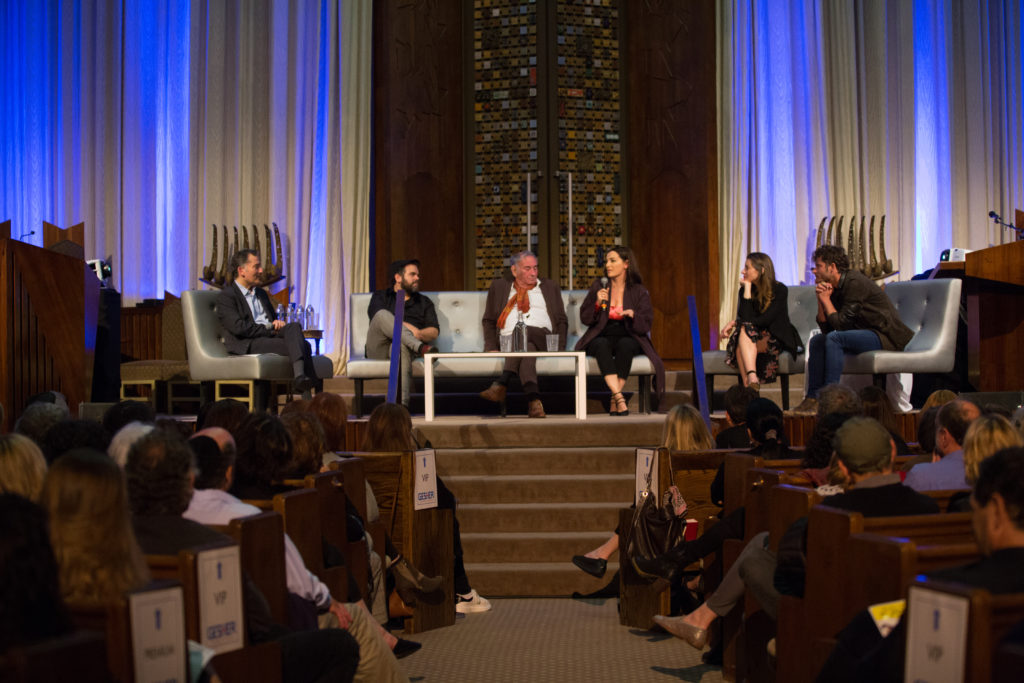
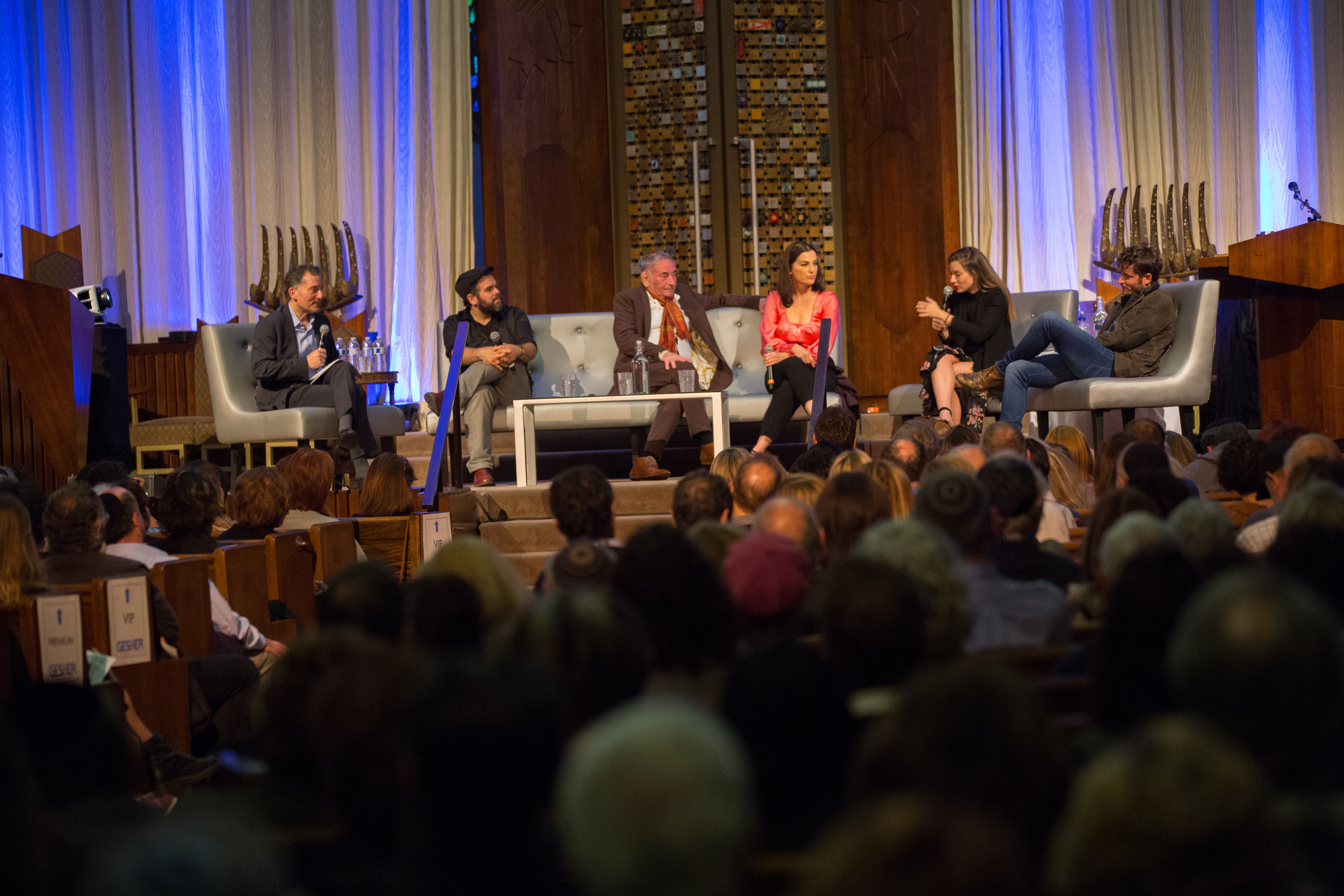
With two seasons under its belt and the show streaming on Netflix, there were suddenly “Shtisel”-hungry fans everywhere. Two Los Angeles events, organized by cross-communal connections organization Gesher and produced by Teev Entertainment Group, drew more than 1,500 fans to “behind-the-scenes” events panels with the cast on June 4 and 5, at the Saban Theatre and Sinai Temple respectively.
At the June 4 event, moderator Larry Tanz, vice president of International Original Series for Netflix, writer/creator Ori Elon and actors Dov (Dov’ale) Glickman (Shulem), Michael Aloni (Kive), Ayelet Zurer (Elisheva) and Neta Riskin (Giti) took the stage to wild applause.
“It was the best script I read in my entire life,” said Glickman, who plays Shtisel family patriarch Shulem. “[It was] so deep and so complicated in psychology and the language and what happens there, I couldn’t believe it. It seemed to me like something between ‘The Sopranos’ and (Swedish director Ingmar) Bergman …”
Riskin said when she heard that “Shtisel” was about an ultra-Orthodox family and would be shooting in summer in Jerusalem, she said, “Never mind, no thanks.” But then she read the script.
“It was so perfect,” Riskin said. “I don’t know why we have to shoot it; they should just print it as a book. I still think we should. It’s much better written.”
For Riskin, understanding her character, Giti — a mother of five whose husband abandons her for an extended period of time — presented a challenge.
“Sometimes you’re like Peter Pan with his shadow and you need to find out how to sew the shadow to your legs and let it become a part of you,” she said. But after studying what other characters say about Giti in the script, she began to understand.
“I don’t know why you chose this series for Netflix. It doesn’t have any sex scenes, no action, no nothing. But [the heater scene is] like the sex scene of ‘Shtisel.’” — Michael Aloni
“When you have this huge gap between what other people think about you and what you think about yourself, you get the character and her persona, and you know what she wants to fight for,” Riskin said, adding that Giti is seen as the “spine of her family,” but that she’s “working hard to be ordinary.”
More from night 2 at Sinai Temple. Photo by Shlomit Levy Bard.
Glickman also spoke about establishing a kinship with his character. “We got so friendly, me and Shulem Shtisel, you cannot imagine,” Glickman said. “Shulem Shtisel told me, ‘Dov, you are a Jew.’ And I really accepted it. All [Shulem’s] relationships are broken. The only relationship he has is with the dead — with his wife. It is something that doesn’t leave him.”
Playing Elisheva Rotstein — the twice widowed woman raising a young son — Zurer noted it’s why her character is called “a schnitzel warmed twice in an oven. Elisheva has one foot in the community and one foot outside, one foot in life, one foot outside of life,” she said. “It’s really tragic … it’s about someone who is in love with death more than life.”
When it came to casting the role of Elisheva, Zurer was already a Hollywood star, starring in “Munich,” “Angels & Demons” and “Man of Steel.” The producers weren’t sure her schedule would permit her to play Elisheva, Aloni said. So they shot Aloni’s side of one scene — the moment where Elisheva comes to pick up an electric heater from Kive — using a line producer as a stand-in, hoping that they could shoot Zurer later.
“I don’t know why you chose this series for Netflix,” Aloni said to Tanz. “It doesn’t have any sex scenes, no action, no nothing. But [the heater scene is] like the sex scene of ‘Shtisel.’ ”
Glickman, improvising in character, then expressed regret that Shulem came between Kive and Elisheva. “It was a big mistake with Elisheva,” Glickman-as-Shulem said. “I thought, she’s just a widow, I didn’t know she was a star in Hollywood. You never told me. I’m really sorry. I would tell you, ‘Go with her.’ ”
“ ‘Shtisel’ is all about the experience of not what these people are … it’s about who they are,” said creator Elon, a sentiment echoed by Aloni. Elon said walking in the streets of Jerusalem, he’s now able to see himself in an ultra-Orthodox man or a Muslim woman, as “someone who has a home and a haimish belonging.”
After the discussion, Adynna Swarz, who attended the event at the Saban, told the Journal it felt like being with family. “I just loved how they brought that presence on stage,” she said. “They were warm, engaging, funny and just made you feel like you were stepping into their world again, but in real life.”
“ ‘Shtisel’s’ appeal lies in its deep focus on the human condition and the relatability of the characters,” Cantor Yonah Kliger, of Temple Judea in Tarzana told the Journal. “Certainly, the Charedi world is a unique setting that many of us have never seen before, but what really makes this show work is that these characters could be any of us or our family members. It’s similar to why ‘Fiddler on the Roof’ plays so well in Japan. These are all of our stories.”
After the event, Gesher CEO JJ Sussman told the Journal, “Gesher’s goals are to create a cohesive society and bring us closer to one people, to Jewish unity. If the right people write and act convincingly, we can break down barriers and stereotypes. We were overjoyed and overwhelmed in a positive way by the excitement that ‘Shtisel’ generated, both from an entertainment value perspective and as a peek into a society that other people don’t get a chance to see. While we’re all different, we can all be together.”
I was recently in an underground hot spring with tunnels leading in various directions. It was pretty dark, and it wasn’t always intuitive which way to go. But one passageway led to an opening bathed in light. I was drawn to it, and soon I found myself embraced by the sun.
There are times in life when we just don’t know which way to turn, and it’s easy to become disoriented.
What do we do? We find the small rays of light and head toward them.
The light could be a friend.
The light could be music.
The light could be a smile.
The light could be a cherished memory.
The light could be our community.
The light could be a prayer.
And keep in mind: the light will come – and it will go. So we seek it out again, even for just a moment in time, because that light at the end of the tunnel becomes the beginning of tomorrow.
Our practice of Judaism is not derived from biblical religion. All Judaism today is founded on the Bible, but developed by the understandings of the Bible shaped by the Sages of the Second Temple and Talmudic period, who used the Bible as their raw material. You can even say that ancient sages taught the generations after them the skill of using the Bible as come kind of volatile plastic, dynamic energy.
The same tradition that produced Maimonides, who tried to square the Bible with Aristotle, produced the Kabbalah, a disturbing and brilliant interpretation of the Bible that takes the Bible into unknown universes.
Our tradition is volatile and shape shifting – held together by some set of practices and beliefs that cover over a turbulence of religious texts. Asking “what Jewish belief is” is almost always the wrong question. The term “Jewish Belief” is like a signpost at the entrance to a vast cave system.
Think of the upcoming holidays of Shavu’ot, the holiday of the giving of the Torah, which begins Saturday night. From a biblical perspective, God spoke the 10 Commandments on that day. From an very traditional Orthodox perspective, one is required to believe, generally speaking, that the entire five books of Moses were given to Moses at Mt. Sinai, or to Moses at other places before his death.
The rabbinic tradition, however, reflects deeply on this idea of “Torah from Heaven” much more than it tries to supply any creed. That tradition of reflection shapes our religious lives up until today.
Instead of asking what exactly did God say, we might ask ‘what does it mean to be addressed by the Soul of Universe.’ We might ask, ‘how does a human being absorb the speech of the divine?’ ‘And once the divine word enters us, how do we translate the experience of having been addressed by the Soul of the Universe into words that can communicate this experience to another human being?’
The rabbis of the Talmud encountered a mystery. They understood the Five Books of Moses as a poor reflection of the Upper Torah, the divine wisdom. They understood our written Torah as a doorway into the Divine Mind. They uttered poetic images – the Torah in the Divine Mind is “black fire written upon white fire.” They saw the event at Sinai as God revealing something of the essence of the divine existence, carried in the vehicle of Divine speech.
Maimonides, the great medieval philosopher, teaches us how to read a metaphor. The speech of God does not imply vocal chords. Hearing God does not happen with our human ears. We use these words all the time metaphorically; “that painting really speaks to me” we say. When we inally understand what someone is trying to tell us, we say “I hear you”. Speaking and hearing do not always mean what they seem to mean. The Kabbalists, who flourished a bit later than Maimonides, create an entire belief system from symbols and metaphors. This is crucial: we are not just the people of the book; we are the people who know how to read books.
Problem is, when moderns come to the Bible we turn into shallow literalists. We forget what speaking and hearing can mean.
Most of us modern Jews don’t have the benefit of having been immersed in the Talmud and Midrash, of having studied the brilliance of Maimonides, of having gazed into the enchanted orchard of the Kabbalah. That is understandable.
What is harder for me to accept is that when many modern people today approach our religion, we tend to forget our capacity for poetry and metaphor. If anything, the Talmudic rabbis and those who came after them taught that one cannot understand the Torah if one reads it literally. The Zohar teaches that if you confuse the real Torah-as-mind-of-God with the literal meaning of words written in the Five Books of Moses, that your bones should burst and you will have no portion in the world to come. “Literalists Don’t Go to Heaven”. It would be like thinking that music is dots and squiggles on a lined page.
Shavu’out, therefore, cannot be understood literally as the holiday of the “giving of the Torah”, as if you can just be given white fire on black fire, the structure of the universe in the divine mind, the substance of the existence of God.
A non-literal meaning of Shavu’ot, and therefore a truer meaning, might be, ‘the holiday when the portal into the divine mind was opened, a portal that can re-opened to those willing to encounter a mystery.’
The United States is putting further sanctions on the Iranian regime, with the latest round targeting Iran’s largest petrochemicals company on Friday.
The Associated Press reports that the Persian Gulf Petrochemical Industries Company has been conducting business with Iran’s Islamic Revolutionary Guard Corps (IRGC), which the Trump administration designated as a Foreign Terror Organization in April.
“We intend to deny funding to key elements of Iran’s petrochemical sector that provide support to the IRGC,” Treasury Department Secretary Steven Mnuchin said in a statement. “This action is a warning that we will continue to target holding groups and companies in the petrochemical sector and elsewhere that provide financial lifelines to the IRGC.”
According to the Treasury Department, the aforementioned petrochemical company accounts for around half of Iran’s petrochemical exports and 40 percent of the country’s petrochemical production. Petrochemicals are chemicals extracted from petroleum and other fossil fuels that are used in making products like soap and fertilizer.
The latest round of sanctions comes after a former deputy for the International Atomic Energy Agency said that Iran could get nuclear weapons as soon as six-to-eight months. Marine Gen. Frank McKenzie, a top commander of American forces in the Middle East, told NBC News on June 6 that Iran poses an “imminent” threat to the United States.
“I would say the threat has probably evolved in certain ways even as our defensive posture has changed and become more aggressive, and we certainly thank our Iraqi partners for many of the things they’ve done,” McKenzie said.
In May, the United States sent Air Force bombers and a carrier strike group to the Middle East to counteract potential unspecified threats from Iran. President Donald Trump said earlier this week that war with Iran could break out at any time, but he prefers to hold a dialogue with the regime in Tehran.
The National LGBTQ Task Force announced on June 6 that they are withdrawing their support from the D.C. Dyke March in light of their decision to ban Israeli paraphernalia.
As the Journal previously reported, the D.C. Dyke March has made clear that any “nationalist symbols” are barred at their Friday event, including the multicolored Jewish Pride Flag featuring a Star of David in the center, which the march says resembles the Israeli flag.
National LGBTQ Task Force Executive Director Rea Carey said in a statement that the task force “signed onto the stated focus area that is the crisis of housing displacement and gentrification in the District of Columbia” to support the march. However, the task force cannot support the march’s decision to ban Israeli symbols, Carey said.
“After recently learning of the decision by DC Dyke March organizers to discourage attendees from carrying the Jewish pride flag, the National LGBTQ Task Force withdrew our support for the DC Dyke March,” Carey said. “The Jewish Pride Flag is a symbol that represents the greater LGBTQ Jewish community – around the world and of many perspectives.”
Carey added, “We are disappointed that this action distracts from the appropriate and needed focus on DC residents and housing policies that favor gentrification.”
Myriad Jewish organizations, including the Anti-Defamation League and Simon Wiesenthal Center, have condemned the march’s decision as anti-Semitic. The D.C. Dyke March defended their decision in a statement to the Journal on June 6, saying, “Our mission says that we are enacting a vision of queer liberation for all. That vision does not include nationalist symbols, including symbols of the state of Israel, which are different from symbols of Judaism. Flags that resemble Israeli flags are not welcome.”
The march is taking place at McPherson Square in Washington, D.C.
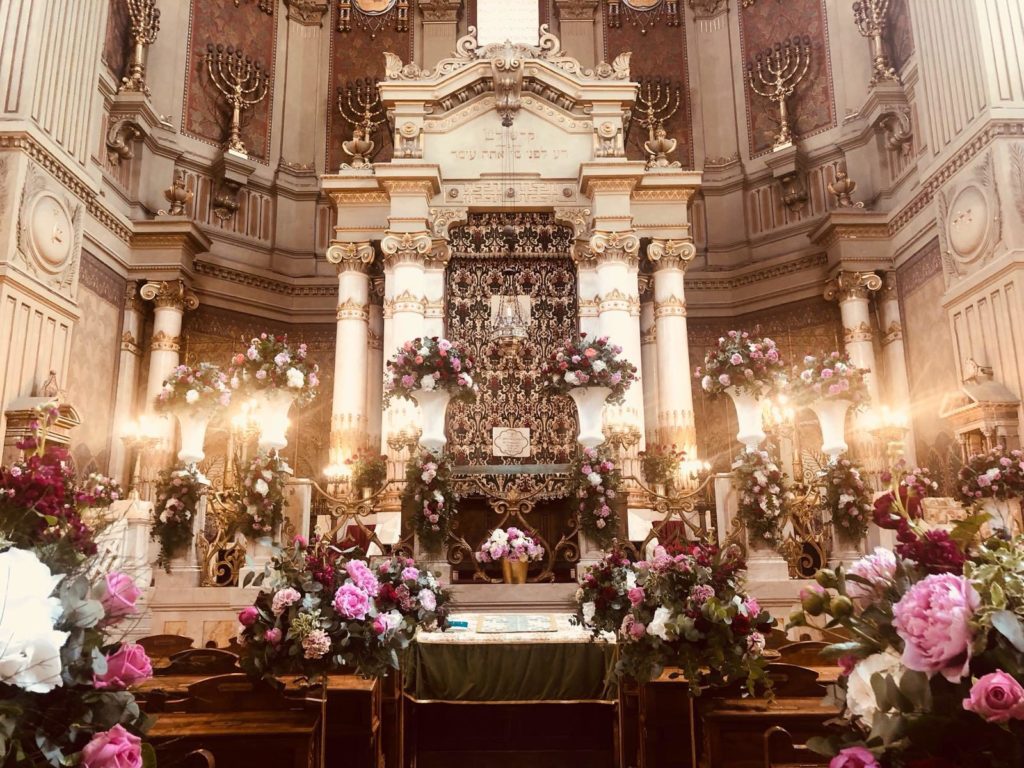
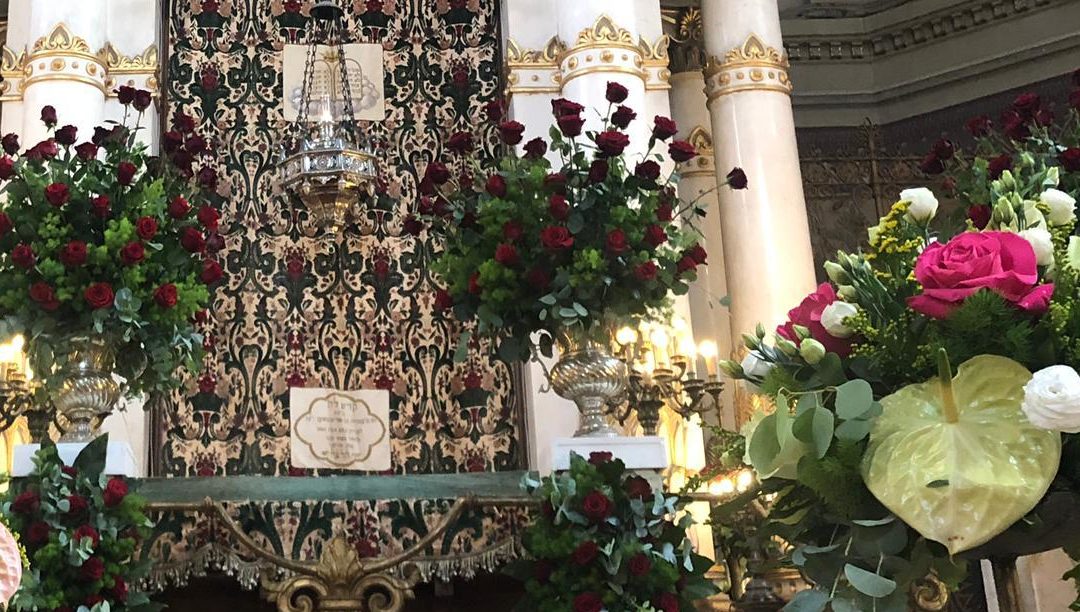
Rome’s largest synagogue was decorated with thousands of flowers as part of the community’s tradition ahead of the holiday of Shavuot.
The flowers — arrangements of roses of various colors and pink calla lilies, among others — were placed along the aisle of the Great Synagogue of Rome, on its bimah, on the Torah ark and between the pews.
Flowers are placed each year during the holiday in the synagogue, a square-domed building with river views that is considered one of Europe’s most spectacular and ornate Jewish houses of worship. This year the display promises to be particularly spectacular thanks to the recent installment of lighting on the building’s exterior, Riccardo Di Segni, the chief rabbi of Rome, said in a statement.
Flowers decorating the Great Synagogue of Rome, Italy in June 2019. (Courtesy of JTA and the Conference of European Rabbis)
“Our prayer is: ‘Make a sanctuary for me, and I will dwell among them’,” Di Segni, vice presidnet of the Conference of European Rabbis, wrote in the statement, quoting Exodus.
Shavuot, occurring seven weeks after Passover, celebrates the giving of the Torah by God to the Jews. It begins Saturday night. Also known as the Holiday of Harvest, it recalls when Jews were commanded to bring the first yields as an offering to God.
Besides Shavuot, the 149-year-old Great Synagogue of Rome is also decorated with flowers during weddings.