fbpx

May 2, 2019

Elizabeth Banks to Host ‘Press Your Luck’ on ABC

Actress, producer, director Elizabeth Banks is adding a new hat to the many she wears: game show host. She will be the emcee of ABC’s revival of the classic game show “Press Your Luck,” premiering June 12. Banks will also serve as executive producer of the show with her husband Max Handelman, Jennifer Mullin and John Quinn.

“Elizabeth Banks is exactly the type of woman we want on ABC. She’s a big star who’s smart, strong and funny,” ABC Entertainment president Karey Burke said in a statement. “She has everything we need as the host of ‘Press Your Luck,’ one of our signature summer game shows. If anyone can ride herd on the Whammy, it’s Elizabeth!”

Banks is also busy on the big screen. She stars in the sci-fi horror drama “Brightburn” about the arrival of a sinister alien child on earth, opening May 24 and as Bosley in the rebooted “Charlie’s Angels,” due out Nov. 15. After that, she stars opposite Jamie Foxx and Anthony Mackie in “Signal Hill,” based on a police brutality case that lawyer Johnnie Cochran litigated in 1981.

Elizabeth Banks to Host ‘Press Your Luck’ on ABC Read More »

NYU Department Passes Resolution Against Tel Aviv Study Abroad Program

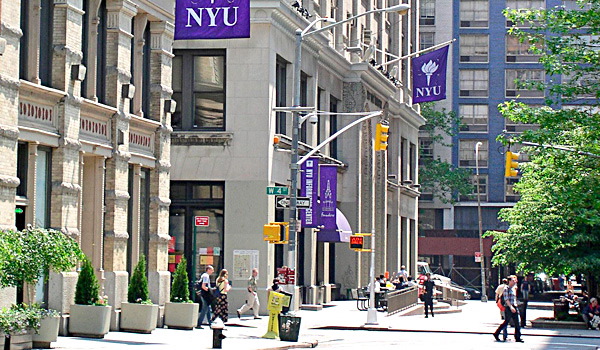
New York University’s (NYU) Department of Social and Cultural Analysis (SCA) announced Thursday it had passed a resolution to boycott the university’s study abroad program in Tel Aviv.

The SCA stated on its website it passed the resolution because of Israel’s “longstanding practice of barring entry to persons of Palestinian descent” as well as the Israeli government’s policy barring boycott, divestment and sanctions (BDS) movement  supporters from entering the country.

According to  SCA’s statement, “Many members of the NYU community (including members of the department) are affected by these policies and are effectively unable to access NYU’s program in Tel Aviv. The resolution seeks to protect the department from complicity with these forms of racial, religious, and political profiling.”

The SCA’s statement also disputes university spokesman John Beckman’s October statement that Israel hasn’t barred any NYU students from entering the country, noting: “The administration fails to take into account the Palestinian members of the NYU community from the West Bank and [the Gaza Strip] who are unable to enter Israel, in addition to those with American citizenship who have been banned based on their Palestinian heritage and political activity. Participating in the program while members of our own department are barred entry to their homeland and sites of research serves to reproduce the racial inequalities of Israel’s policies in our own workplace.”

In its statement, the SCA acknowledged it can’t prevent NYU students and faculty from taking part in the program, but it encourages “faculty and student members to act in the spirit of noncooperation.”

Adela Cojab, the NYU student who has filed a legal complaint against the university after it gave an award to NYU Students for Justice in Palestine, told the Journal in a Facebook message, “The fact that SCA pledged non-compliance with Tel Aviv when no student or faculty has ever been denied entry, while continuing partnership with NYU-Abu Dhabi after two professors have already been turned away because of their Shiite heritage is hypocritical as it is absurd. SCA does not care about equal opportunity or ethical conduct, they only care about demonizing the Jewish state.”

Cojab added that the resolution’s passage on Yom HaShoah “makes its effect all the more painful.”

Realize Israel, an NYU pro-Israel student group, wrote in a Facebook post, “We, and many Jewish students, feel not only baffled, but affronted by this decision. NYU students should be free to experience other countries and cultures firsthand to form their own opinions without the close-minded prejudices of some members of the NYU faculty. We believe this to be the foundation of higher education learning and growth.”

The statement continued: “It is deeply disappointing that NYU continues to foster an environment that singles out and targets Jewish students based on their support for the State of Israel. Today is Yom HaShoah, a day when Jewish communities around the world remember the lives lost in the Holocaust and say, ‘never again.’ Never again will the Jewish community remain silent in the face of discrimination.”

Rena Nasar, StandWithUs’ Tri-State campus director and managing director of Campus Affairs, condemned the resolution in a statement to the Journal as “hypocritical and discriminatory. The resolution misrepresents Israeli law, as evidenced by the Israeli High Court’s decision in the case of Lara Alqasem,” Nasar said. “Furthermore, it conveniently ignores NYU’s program in the United Arab Emirates, where Israelis are prohibited from entering solely based on their national origin. We call on NYU to condemn this hateful resolution and demand that the department reverse it.”

Rabbi Abraham Cooper, Simon Wiesenthal Center associate dean and director of the Simon Wiesenthal Center’s Global Action Agenda, said in a statement to the Journal, “NYU President Andrew Hamilton has called academic boycotts of Israel “contrary to our core principles of academic freedom, antithetical to the free exchange of ideas, and at odds with NYU’s position. Really? Now is the time for him and NYU to put up or shut up as [the SCA] ends all ties with Israel.”

Judea Pearl, chancellor professor of computer science at UCLA and Daniel Pearl Foundation president who asked NYU to rescind his 2013 Distinguished Alumnus Award, told the Journal in an email, “This is perfect time for president Hamilton to defend the study abroad program on moral grounds and expose the hypocrisy of the Department of Social and Cultural Analysis by saying: ‘A country whose existence is under daily threats  cannot be expected to allow in people who openly seek its destruction. I [Hamilton] challenge any member of the SCA department to stand up and recognize Israel’s right to exist before criticizing her protective laws or policies.’”

Beckman told the Journal in an email, “The university’s position on the issue of academic boycotts of Israel is clear: they are at odds with university policy, and they are at odds with the tenets of academic freedom. With respect to this departmental vote: it’s a little puzzling as to what form it would take, as our Tel Aviv campus does not draw on the Department of Social and Cultural Analysis for its academic program,” Beckman wrote. He also reiterated that “NYU has not had a student denied entry to Israel to study at our Tel Aviv campus.”

NYU Social and Cultural Analysis Professor Andrew Ross, who is also director of American Studies at the university, told the Journal in an email, “University policy on ethical conduct prohibits discrimination of all kinds and promotes equal opportunity. It should be clear that the resolution appeals directly to that policy.”

Ross also wrote that the resolution vote took place on Yom HaShoah because it was “the last department meeting of the academic year. There are many Jewish students in our department who introduced this initiative and supported it.”

UPDATE: Stephanie Merkrebs, the Anti-Defamation League’s New York and New Jersey director of Campus Affairs, said in a statement to the Journal, “We are concerned to see this kind of resolution pass within a New York University academic department. Discouraging students and faculty from studying in Israel and engaging with Israeli colleagues creates barriers to the free exchange of research and ideas, and to experiencing the complexities first hand. It also contradicts NYU’s statements against BDS. “

NYU Department Passes Resolution Against Tel Aviv Study Abroad Program Read More »

ADL Praises Facebook’s Decision to Ban Louis Farrakhan, Others

Anti-Defamation League (ADL) CEO Jonathan Greenblatt praised Facebook’s decision to ban Nation of Islam leader Louis Farrakhan and other individuals from its platform.

A Facebook spokesperson told CNN Business Thursday that the social media giant will be banning individuals it deems “dangerous.”

“We’ve always banned individuals or organizations that promote or engage in violence and hate, regardless of ideology,” Facebook said in a statement. “The process for evaluating potential violators is extensive and it is what led us to our decision to remove these accounts today.”

Facebook also banned David Duke, Paul Nehlen, Alex Jones, Laura Loomer and Milo Yiannopoulos.

Greenblatt said in a statement that Facebook’s move was “long overdue. Still, it’s not enough for tech companies to make fighting hate part of their press strategy,” Greenblatt said. “When Facebook made a similar decision last year, extremists and their supporters were able to circumvent those measures. We will wait and see how Facebook responds to that challenge.”

He added: “Facebook and other platforms need to apply the same degree of energy and intensity to tackling this problem that drives other aspects of their business. We strongly encourage Facebook to share measurable information about the success or failure of this initiative with ADL or other organizations. Whether through external audits or some other verifiable reporting mechanism, we need transparency in order to gauge its performance.”

Similarly, the American Jewish Committee tweeted, “We welcome @facebook’s decision to ban a number of extremists including Louis Farrakhan and Alex Jones. They may have the right to spread vile hatred but Facebook has the right (and responsibility) to say ‘not on our platform.’”

The Simon Wiesenthal Center also tweeted that they commend Facebook “for finally barring America’s hater-in-chief #LouisFarrakhan who for decades has been demonizing #Jews, #Judaism, and America. We hope other leaders in media and public life will follow Facebook’s move.”

ADL Praises Facebook’s Decision to Ban Louis Farrakhan, Others Read More »

University of California, Berkeley, Establishes First Israel Studies Chair

(JTA) — The University of California, Berkeley, has created an endowed faculty chair in Israel studies.

The chair is the university’s first in the field and will endow courses, research and programs of the Berkeley Institute for Jewish Law and Israel Studies, the university said in a statement.

The chair is endowed with a $5 million grant from the Helen Diller Family Foundation. It will be held by Ron Hassner, the Berkeley institute’s faculty co-director and an international relations expert on the relationship between religion and conflict.

Hassner, a recipient of the university’s Distinguished Teaching Award, is an associate professor of political science. In fall 2018, Hassner pioneered UC Berkeley’s first regular course on conflict in the Middle East.

Helen and Sanford Diller met in the early 1950s at Berkeley while they were undergraduates. In 2002, the Diller family made endowment gifts of $5 million to Berkeley, which currently provide funding for the campus’s Center for Jewish Studies and support its director, faculty research funds, and graduate student fellowship and research funds.

The grant “signals great faith in the work we have done to build Jewish and Israel Studies at Berkeley, and helps launch, in a very robust way, a campaign to ensure that our ‘startup’ efforts will be institutionalized for generations of students to come,” UC Berkeley Chancellor Carol Christ said in a statement.

University of California, Berkeley, Establishes First Israel Studies Chair Read More »

In 2019, More Than Half of Reported Hate Crimes Were Anti-Jewish, Says NYPD

(JTA) — In New York City, more than half of all hate crimes reported in 2018 and so far in 2019 were anti-Jewish.

According to Police Department figures released Thursday, of the 145 hate crimes reported in January through April 2019, 82 incidents –  nearly 57 percent – were anti-Jewish.

In 2018, there were 353 total hate crime complaints, up from 325 in 2017, and the NYPD made 149 arrests. Of these hate crimes, 186 – or nearly 53 percent – had anti-Jewish bias, up from 151 in 2017.

The NYPD tally is of reported complaints and arrests, not convictions.

Three precincts with large Hasidic populations, all in Brooklyn, reported the most anti-Jewish hate crimes in 2018. The 71st Precinct, which encompasses part of Crown Heights, reported nine anti-Jewish hate crimes, the most of any precinct. Precincts including Williamsburg and Borough Park each had seven.

Sixty-nine – or 37 percent – of 2018’s anti-Jewish hate crime reports resulted in an arrest. Forty of the alleged perpetrators were white, 25 were black, two were Hispanic and two were Asian.

“The data released by NYPD today is deeply disturbing and should serve as an important reminder to all of us that we must continue to be vigilant in the face of hate,” said Evan Bernstein, the New York-New Jersey regional director of the Anti-Defamation League. “On this Holocaust Remembrance Day, it remains imperative that New Yorkers continue to stand up to condemn these hateful and anti-Semitic acts. No one should ever have to live in fear that they will be attacked, harassed or targeted because of their faith. New York is no place for hate.”

In 2019, More Than Half of Reported Hate Crimes Were Anti-Jewish, Says NYPD Read More »

Paper Butterflies for Yom HaShoah

Butterflies have become a poignant symbol of the Holocaust, particularly of the 1.5 million children who perished. One reason the insects have assumed such a role in Yom HaShoah remembrances is Pavel Friedmann’s poem “The Butterfly,” which he wrote in 1942 at Terezin concentration camp, a couple of years before he died at Auschwitz. The butterfly represents freedom, and the young Friedmann lamented in the final words of the poem:

That butterfly was the last one.

Butterflies don’t live in here,

In the ghetto.

In the spirit of the Butterfly Project of the Holocaust Museum Houston, in which kids from all over the world handmade butterflies to memorialize the children who died, here’s a project to make your own butterflies.

What you’ll need:
Colored paper
Scissors
String or yarn

1.

1. Cut two triangles out of colored paper, with one triangle a little shorter than the other. The triangles should be isosceles, meaning two of the sides are equal in length. Try to make the shapes narrower, which will allow for more folds and a fuller butterfly.

2.

2. Accordion fold both triangles, folding the paper at half-inch intervals. They don’t have to be exact, so just eyeball them.

3.

3. Bend the accordion-folded triangles in half, toward the longer ends of the triangle. Now they look like wings.

4.

4. Line up the two wing pieces, positioning the bends in the center. Place the larger piece on top and the smaller one below it. Tie a piece of string or yarn around the middle to secure the two pieces together. Cut off excess string, and you’re left with the butterfly’s antenna. Spread the folds out to expand the butterfly wings.


Jonathan Fong is the author of “Flowers That Wow” and “Parties That Wow,” and host of “Style With a Smile” on YouTube. You can see more of his do-it-yourself projects at jonathanfongstyle.com.

Paper Butterflies for Yom HaShoah Read More »

Obituaries: May 3, 2019

Gary Bock died March 26 at 85. Survived by daughter Nancy (David) Olson; son Dale (Lejing Han); 2 grandchildren. Mount Sinai 

Elaine Burakoff died March 29 at 90. Survived by daughter Jeri (Barry); son Glen (Debbie); 4 grandchildren; 2 great-grandchildren; sister Barbara (Ray). Hillside

Dorothy H. Cohen died March 6 at 94. Survived by daughters Nan (Paul) Feldon, Andrea (Michael Bracha), Jan (Mario) Cohen-Iscovich; son Keith; 8 grandchildren; 7 great-grandchildren; sister Shirley Steppler. Eden Memorial

Sandra Joy Dick died March 21 at 87. Survived by daughters Ellen (Steve) Milner, Kristin (John) Press, Cheri (Dominic) Lombardi; 7 grandchildren; 5 great-grandchildren; brother Norman Mandel. Mount Sinai 

Ben Heirshberg died March 28 at 98. Survived by daughter Gayle (Richard) Heirshberg-Mah; sons Stan (Diane), Art; 6 grandchildren; 1 great-grandchild. Mount Sinai 

Joan Laine died March 29 at 79. Survived brother, Gerald (Millicent Reynolds) Fishbein. Mount Sinai 

Louise Lelah died March 26 at 94. Survived by son Abraham. Hillside

Janet Mann died March 24 at 90. Survived by daughters Robyn Seymour, Deborah Diamond, Lisa Diamond; 3 grandchildren. Mount Sinai 

Robert D. Mayer died March 26 at 79. Survived by wife Beverly; daughter Melissa (Gerald Sacks); son Steven (Michelle); 2 grandchildren. Mount Sinai

Eugene “Gene” Marks died March 26 at 94. Survived by daughter Robyn (Fred) Farley; 2 grandchildren; 2 great-grandchildren. Mount Sinai 

Marvin A. Marks died March 28 at 93. Survived by brother Jules (Betty). Mount Sinai 

Harold Rouse died March 28 at 96. Survived by daughter Susan; son Scott; 2 grandchildren; 3 great-grandchildren. Hillside

Herschel Silverstone died March 26 at 81. Survived by sons Jeffrey (Annette), Doug (Mark Gamez), Dan (Jesse); 1 grandchild. Mount Sinai 

Edith M. Singer died March 27 at 93. Survived by sons Bruce (Mary), Robin; 4 grandchildren. Mount Sinai 

Frieda Wald died March 27 at 94. Survived by daughter Edda (Daniel Adams) Malone; son Fred; 2 grandchildren; 1 great- grandchild. Mount Sinai 

Wynn Warner died March 29 at 88. Survived by wife Joy. Hillside

Marlene Weinberg died March 7 at 83. Survived by daughters Robbin, Barbara; sister Lila (Steve) Klausner.

Obituaries: May 3, 2019 Read More »

David Picker, Former Studio Chief, 87

As an independent producer and executive at United Artists, Paramount Pictures and Columbia Pictures, David Picker left his mark on American culture. Picker, who died of colon cancer on April 20 at age 87, greenlit the Beatles’ first movie, “A Hard Day’s Night,” (1964) and recommended Richard Lester direct it. He also helped shepherd Ian Fleming’s British superspy James Bond onto the screen. Ingmar Bergman, Bob Fosse, Billy Wilder, Paddy Chayefsky, Bernardo Bertolucci, Woody Allen and Steve Martin are among the filmmakers Picker worked with throughout his 60-year career.

Picker was born into filmmaking. His grandfather David War-field was a partner with Marcus Loew in Loew’s theater chain; his father, Eugene, was president of Loew’s and introduced the wide release of movies. His uncle Arnold was an executive at United Artists and Picker’s sister, Jean Picker Firstenberg, was the president and CEO of the American Film Institute for years.

Picker joined the marketing depart-ment at United Artists in 1953. In less than a decade, he was president of the studio. He oversaw the production of two best picture winners: 1963’s “Tom Jones” and 1969’s “Midnight Cowboy,” which is the first and to date, only, X-rated film to be so honored.

Picker moved to Paramount in the late ’70s. Among the pictures under his watch were “Saturday Night Fever” (1977) and 1980 best picture-winner “Ordinary People.” At Columbia, he oversaw best picture-winner “The Last Emperor” (1988) and legendary flop “Ishtar” (1987). Known for modesty and sly humor, in his 2013 memoir “Musts, Maybes and Nevers: A Book About the Movies,” he wrote, “If I had turned down every picture I greenlit, and greenlit every picture I turned down, I’d have the same number of hits and flops.”

Picker is survived by his wife, Sandra Jetton Picker, sister Jean, daughters Caryn and Pam, and a grandson.

David Picker, Former Studio Chief, 87 Read More »

Charlotte Stern Friedman, Frank Family Friend, 98

Longtime Temple Beth Solomon of the Deaf board member Charlotte “Lotte” Stern Friedman, a friend and schoolmate of Anne Frank, died April 13 at 98.

She was born on July 20, 1920, in Aachen, Germany, to Max and Anna Stern. Her deafness went unnoticed until she was 2 years old and contracted  typhoid fever. While recovering, Stern got too close to a hot stove. Her mother yelled a warning, then realized her daughter couldn’t hear her.

As a child, Stern’s family knew the family of Anne Frank, whose grandmother lived down the street from the Sterns. The Sterns and Franks often socialized, and their children went to school together. Both families eventually escaped to Holland at the same time.

After her mother’s death, Stern’s father married a woman named Minna in 1929. Minna helped Stern perfect lip-reading skills, involved Stern in sports and taught her to be independent. Stern was slated to graduate from school at age 13, but an edict declared Jewish children couldn’t attain higher public education. So Stern’s parents hired private tutors and sent her to a private art school.

Stern left home at age 17 to study at the Private Art School in Berlin. She thought she would stay in Berlin, but in November 1938, Stern witnessed Kristallnacht violence. She immediately left Berlin.

In November 1938, Stern witnessed Kristallnacht violence, and immediately left Berlin.

Charlotte Stern had been born in a Catholic hospital, and her birth certificate registered her as Catholic. She went to a police station to get an ID allowing her to travel. Jews were allowed to purchase only third-class train tickets. To try to ensure her safety, Stern bought a second-class ticket and saluted soldiers.

Using his connections, Max obtained passports for the family. Two weeks later, they boarded a train to Rotterdam, Netherlands. The soldier checking the passports failed to notice the page identifying them as Jews.

When the Sterns arrived, authorities confiscated their passports and held the family in a guarded detention facility. After a few weeks, the Sterns transferred to an Amsterdam hotel under guard. Max and Minna eventually moved to an apartment, but Charlotte stayed in detention. During this time, Stern worked with nurses taking care of detainees’ medical needs.

At age 19, she was released. The law forbade her to live with her parents, so she initially lived alone, then later, with her aunt. Working as a maid during this time, Stern had a strict curfew and had to report monthly to the police.

In 1940, Max secured passports and visas, and the Sterns left for New York. Charlotte was the only passenger not released when they arrived. The U.S. government wouldn’t admit anyone with a disability or mental illness, but she had a letter of sponsorship from a family member in San Francisco. The doctors and staff did the required interview and tested her. They returned her passport. Stern spent several months working temporary jobs, including making leather gloves and sketching for a wallpaper factory.

In 1940, Stern attended the Central Institute for the Deaf in St. Louis with a scholarship from the Jewish Federation. In exchange for room and board, she cared for a deaf child with cerebral palsy. She learned English, then moved to Los Angeles, taking a job as a technical designer at an automotive school.

In 1945, The Volta Review published an article about and photo of Stern. Irvin Friedman, president and co-founder of the Hebrew Association of the Deaf in Chicago, kept the article. When Friedman attended a convention of the Jewish deaf in Los Angeles, he showed the picture and obtained Stern’s address. They married in a small Jewish chapel on Nov. 7, 1948. Stern and Friedman had two sons, Joey and Myron.

Stern and Friedman moved to Los Angeles and in 1970. Stern returned to school at age 57, graduating in 1977 as a licensed vocational nurse from Los Angeles Trade Technical College. She and four deaf classmates had proven their nursing abilities by state standards but California denied their licenses because they were deaf. St. John of God Catholic Church in Norwalk later hired her to care for a woman with Alzheimer’s disease.

They became involved with Temple Beth Solomon (TBS) of the Deaf. They received numerous awards for their work, years on the board of directors and involvement with the sisterhood. Friedman died in 1996, but Stern remained an active member of the TBS board until 2010. 

Charlotte Stern Friedman, Frank Family Friend, 98 Read More »

Long Lives of Male Holocaust Survivors Remain a Mystery

A study appeared in PLoS ONE, the peer-reviewed journal published by the Public Library of Science, that drew attention in Israel but made barely a ripple in the United States: That men who’d survived the Holocaust lived longer — significantly longer — than their peers who’d never been under Nazi oppression.

What made the study especially intriguing was its large scale and conscientious design: The authors looked at more than 55,000 Polish immigrants, roughly three quarters of whom came to Israel between 1945 and 1950, directly after the Holocaust, and about one quarter of whom had come to Israel before 1939.

Researchers found that men who had experienced the Holocaust from 10 to 15 years old lived, on average, 10 months longer than their brethren who were already in Israel, and that those who were from 16 to 20 years old lived an extra 18 months.

No one, needless to say, was expecting this outcome. Studies of Holocaust survivors have repeatedly shown that their mental health remained — and remains, in the instances of those who are still alive — more fragile throughout their lives: They reported more anxiety, more depression, and more all-around symptoms of post-traumatic stress disorder than the general population. State-of-the-art genetic research also suggests that early trauma can severely damage our telomeres, the protective tips of our chromosomes that defend us against cancer and premature aging.

And so the obvious question arises: Why has one of the most traumatized populations in the world led longer lives?

The authors offer two theories. The first is the phenomenon of “post-traumatic growth.” It’s an intriguing idea, first developed by a pair of psychologists at the University of North Carolina, which stipulates that many survivors of horrific events emerge with a renewed sense of purpose and meaning, a reorientation toward life.

Some of the earliest studies of this phenomenon looked at POWs from Vietnam, many of whom have shown remarkable resilience and productivity (like the late Sen. John McCain). It has since been documented in scores of other contexts — in survivors of terrorism and natural disasters, in those who’ve lived through mortal illnesses and the deaths of loved ones.

“We certainly see it here a lot,” said Asher Aladjem, the chief psychiatrist at the New York University Bellevue program for survivors of torture. He cited one of his patients, who lost a child in the conflict in the Ivory Coast. “He believes God guided him here to make a better life for the rest of his family and himself.”

It is one thing, however, to posit that trauma gives some people a renewed appreciation for life. It is something else entirely to declare that it adds years to one.

Why has one of the most traumatized populations in the world led longer lives?

Whether there’s a correlation between happiness and life expectancy is in fact very much open to debate.

“It’s all speculative,” said Abraham Sagi-Schwartz, a professor of psychology at the University of Haifa in Israel and one of the Holocaust study’s co-authors. “I have trouble, too, litigating these conflicting data.”

But as someone who’s interviewed Holocaust survivors and not simply amassed data about them, Sagi-Schwartz, a fellow at the United States Holocaust Memorial Museum, also had a different perspective. “Forget, for a moment, these dry statistics,” he said. “Many survivors will tell you: ‘We won the war. It’s our victory. We have children, grandchildren, great-grandchildren, successful ones.’ ” He said it would be hard to measure how emboldening that is. “Maybe the survivors,” he said, “developed a strong desire to celebrate their victory.”

Perhaps. There’s another possibility, however, that those

strong enough to survive the concentration camps were bound to live longer. And the authors do float this idea:

An alternative interpretation would be differential mortality, meaning that those vulnerable to life-threatening conditions had an increased risk to die during the Holocaust. Holocaust survivors by definition survived severe trauma, and this may be related to their specific genetic, temperamental, physical, or psychological makeup that enabled them to survive during the Holocaust and predisposed them to reach a relatively old age.

A version of this story originally appeared on the New York Intelligencer website in 2013.

Long Lives of Male Holocaust Survivors Remain a Mystery Read More »