fbpx

March 27, 2019

Judaism in Action in Bangladesh: A Field Log From the Rohingya Refugee Camps

The Rohingya Muslim minority in Myanmar is one of the most persecuted populations in the world.

After enduring decades of rights deprivations and abuses, more than 700,000 Rohingya in August 2017 fled full-blown genocide at the hands of the Tatmadaw, Myanmar’s military and security apparatus. This mass exodus joined previous waves of Rohingya refugees already living in neighboring Bangladesh, and together nearly 1 million remain today in sprawling, squalid camps.

In my position at Jewish World Watch (JWW), one of my first priorities was to classify the Tatmadaw’s persistent persecution of the Rohingya as an ongoing genocide, and to push elected officials and the U.S. State Department to do the same. 

Last August, I wrote an essay posted on the JWW website that explained why the attacks on the Rohingya by the Tatmadaw should by called a “genocide,” a term used sparingly by governments and legal entities. Multiple other entities have since followed suit in labeling this a genocide — and not just a mass atrocity — including the U.S. Holocaust Memorial Museum, the United Nations’ fact-finding mission tasked with assessing the atrocities, and the Public International Law & Policy Group, contracted by the State Department to do the same. In December, the House of Representatives overwhelmingly passed a resolution designating the situation as genocide.

JWW was founded in 2004 on the belief that Jews cannot stand idly by in the face of genocides worldwide. Just as righteous gentiles saved Jews during the Holocaust, we stand united with people of all faiths to speak out on behalf of the world’s most vulnerable people — the survivors of today’s genocides and mass atrocities.

In early March, I traveled on behalf of JWW to the Rohingya refugee camps in Bangladesh to learn how we, the Jewish community and beyond, can make a difference.

At JWW, we encourage our community to advocate, but beyond the loftier goals of international recognition of the Rohingya’s plight, we recognize that they need increased aid and — perhaps most importantly — accountability for what has happened. JWW has a history of supporting survivors of the Darfuri genocide and mass atrocities in the Democratic Republic of the Congo, among others, with educational and vocational programming — particularly for women, and it was our belief that those avenues, along with community-building initiatives, could emerge as the most necessary and strategic means for us to engage with the Rohingya.

“For cultural and religious reasons, Rohingya women primarily are confined to their homes. Their children, by virtue of their statelessness, are barred from attending host community schools.”

What follows is a collection of my observations from a weeklong journey into the camps of Cox’s Bazar in Bangladesh — a journey that recalibrated my perspective, exposed me to bottomless need, and reminded me why all of us at JWW — including our many supporters in schools, synagogues and beyond — do this work: because we believe in the awe-inspiring resilience of the human spirit. 

Day 1: A prison with no walls

“The host community is on the left, the camps on the right,” my guide, Haythem, said after an hour of traveling bumpy roads, taking in the tableau of everyday Bangladesh. The activity of the host community’s bustling marketplace slowly dwindled as we approached the refugee camps that, although huge, appeared surprisingly still.

In Camp 6 we crossed paths with very few adult women. The most noise came from babies sitting in the dirt, calling out until older siblings scooped them up. I kept hungering to see programmed activities for the refugees, especially the children, who followed us with curiosity. It wasn’t just the conditions of the camp, with its fragile structures extending seemingly forever into the distance, that left me concerned. It was the lack of anything for the people to do.

For cultural and religious reasons, Rohingya women primarily are confined to their homes. Their children, by virtue of their statelessness, are barred from attending host community schools. An “informal” curriculum developed for use inside the camps may be taught only in English or Burmese, not Bangla — the language most similar to the one the Rohingya speak and the official language of Bangladesh.

Because Rohingya have no legal status, they cannot legally work for aid organizations or outside the camps. These limitations create an invisible barrier between them and the host community, preventing assimilation and diminishing the option to stay.

In this newer section of the camps I saw just one informal learning center, where a teacher led a class in English — a language she herself did not understand.

On this first day in the camps — despite seeing the 50 impressive monsoon-resistant dwellings JWW had commissioned last year as part of a pilot program to provide shelter for families — I felt flattened by the scene before me: All those listless eyes of children with untapped potential; the women confined to their homes with nothing to do and no way to heal from their trauma.

I witnessed the survivors’ need for purpose, to truly make lives for themselves and their families, even in the camps. 
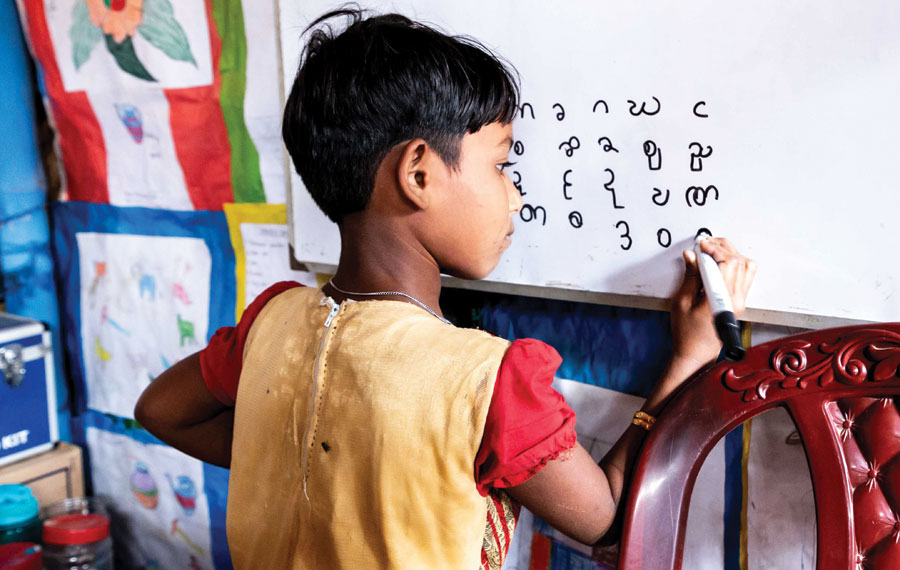
A student writes on the white board in a school in a camp.

Day 2: Little things, big differences

I had hoped my second day would offer me opportunities to explore how JWW’s support of locally run programs might be of help, but I woke to learn that the government had shut down the roads to the camps because of street protests by the local residents. 

With the camps closed off, I pivoted to visit schools in the slums of Cox’s Bazar that educate many Rohingya from previous waves of persecution-triggered flight. The conditions in the slums were even worse than what I had seen in Camp 6.

John Littleton, regional director of an organization operating the slum schools in partnership with a Bangladeshi nongovernmental organization (NGO), announced our arrival at the first school. As I entered through a gate, I was spellbound by a lush garden with tidy bushes, blooming flowers, planters fashioned from repurposed plastic water bottles, and a set of swings! Old and rusty as those swings were, seeing them in this tiny, verdant oasis — such a stark contrast to the bleakness outside — filled my soul with hope.

We visited four schools across three slum areas. All had uplifting gardens and classrooms decorated with the children’s vibrant artwork — brightly colored paper streamers crisscrossing the ceilings, and mobiles made of shells, pompoms, straws and bottle caps. 

The benefits of these decorative touches could be seen in the smiling faces of the kids, who seemed genuinely engaged and grateful to be there. They got me thinking about how we might go about replicating such healthy learning environments within the Rohingya refugee camps.

There is a palpable difference in the response of beneficiaries whose unique circumstances are considered in the crafting of a project. Such recognition gives the refugees a sense of agency and joy, offering the message: “I believe in you, and you matter.”
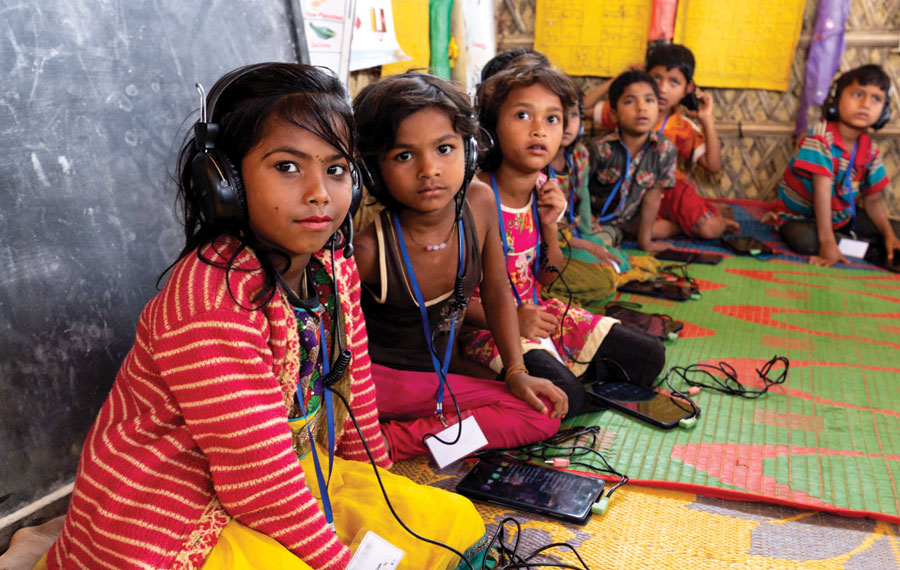
Rohingya children in a learning center in a camp in Cox’s Bazar.

Day 3: True leaders rise

Today, with the camps reopened,  I was lucky enough to befriend several young people who, against all odds, have managed to pierce the malaise of being marooned indefinitely in a country that doesn’t want them.

I met a young Rohingya woman who worked with a communications organization that produced radio programs for the camps. Groups of refugees would huddle in listening groups around the few people with phones that picked up the programs.

The woman, who would not give her name out of concern for her safety, interviewed Rohingya on topics ranging from early marriage and sex trafficking to water sanitation and chickenpox. She also helped dispel rumors, like the one about vaccinations being a tool for religious conversion.

“We hear the words ‘human rights,’ and we are human, but where are our rights?” she asked me. “I would rather die in Myanmar than waste away my days here.”

If just one remark could capture the Rohingya predicament, that would be it.

She continued, talking about the desperate need to combat boredom.

“The men, they sit idle because there is nothing for them to do. It’s dangerous. They’re like in prison.”

The women, she said, also need help. “Many women here were raped or had their husbands killed in front of them. But because they have nothing else to do, they sit around reliving the horrors that happened to them. Their minds get stuck. …  There should be sewing centers for women everywhere!”

I then met a remarkable young man (who also would not give his name). He was born in one of the camps that the United Nations High Commissioner for Refugees established to deal with a large influx of fleeing Rohingya in 1992. When the mass influx from the Myanmar genocide began in August 2017, he started to work as a day laborer for an NGO to assist the refugees. Under the mentorship of the NGO’s director, he has risen to become a program coordinator, managing multiple projects across several camps.

“I’m not educated at all, but I’m resourceful and work hard,” he told me. “I don’t know where I’d be if [my boss] hadn’t taken me under his wing.”

These two brilliant young people both dream of one day earning a college degree. They demonstrate that incomprehensible resilience that pushes even survivors of atrocities to rise. They are the future leaders of their people, the sort JWW strives to seek out and help to empower.

“We hear the words ‘human rights,’ and we are human, but where are our rights?” — a Rohingya woman 

Day 4: Community is power

I sat upon many floors during my days in the camps, mostly in dark huts, surrounded by women. On this day I sat with one such group, huddled together to listen to a radio program much like the one produced by the young woman I met the day before. With them, I felt as though I was among girlfriends, sharing concerns and talking lovingly about our children.

Many Rohingya women have formed informal support groups in their communities. Among us was a young woman whose husband was beheaded before her eyes, and whose daughter bears deep white scars on her chest and neck. These women rely on one another. Any opportunity to bring them together, particularly to learn, has a multiplier effect. They hold each other up so that they may hold up their respective families in the wake of the unfathomable loss and unconscionable violations. 

In these sprawling camps of nearly 1 million people, I saw the power of human connection in teaching, learning, healing and rebuilding. The women,


in particular, have charted a way forward by building communities, such as a democratically elected women’s association that oversees operations in a school-uniform sewing center, as well as that radio-listening group and a communal garden.

The power of such groups is what helps the Rohingya to persevere.

They gave me hope and confidence that our interventions to help bring together and organize these survivors are crucial to making life in the camps sustainable for whatever time they remain there.

What’s next?

I am now compelled to share these and more stories with anyone who will listen to how we can support the Rohingya. I and others from JWW will be making ourselves available to speak at synagogues and events throughout Los Angeles to increase awareness and to ask you to join us in this fight. Over the next two weeks, I will also be at JWW’s annual Walks to End Genocide, where you also can learn how to get involved.

Please come walk with us and stop by to talk. With your help, we can provide hope and healing.

For more information on how you can advocate for the Rohingya, visit jww.org/actions.

On March 31, the Walk to End Genocide will be held at Pan Pacific Park, 7600 Beverly Blvd., Los Angeles, from 10 a.m. to 1 p.m. On April 7, a Conejo Valley walk will be held at Temple Etz Chaim, 1080 E. Janss Road, Thousand Oaks, from 12:30 p.m. to 2:30 p.m.

Sign up to participate online.


Ann Strimov Durbin is a human rights attorney and Jewish World Watch’s director of advocacy and grantmaking.

Judaism in Action in Bangladesh: A Field Log From the Rohingya Refugee Camps Read More »

Politics Claims Another Friendship

My friendship with “Caroline” had been fading for years when, on a whim, I clicked on her Facebook page. When I landed there, I had a shock. She had replaced her previous personal photo — where she stands next to her husband, both of them smiling — with an illustration aiming daggers at political conservatives. It depicted a woman, seemingly Lady Justice, forcibly held down on a table. A man stands above her menacingly, his white hands projecting out of the sleeves of an expensive-looking suit. He gags the blindfolded woman with one hand as the other clamps down on her wrist, forcing her scales of justice to lay in disarray. 

The pièce de résistance? The bold red-white-and-blue Republican elephant logos burnishing the man’s shirt cuffs.

I gaped at the image, feeling a true sense of loss. Caroline and I had been close for more than 20 years, beginning in junior high school. In high school and college, we were both left of center. Wasn’t everybody? I loved and admired Caroline. She was delightful, adventurous, smart, warm and on a path to success despite a difficult family background. During college, I introduced her to a friend of mine, thinking they would make a great couple. I was honored to be a witness at their wedding more than 30 years ago.  

When I met my husband, I was introduced for the first time to conservative political and traditional Jewish teachings. I didn’t want them to make sense because, like so many Jews, I wore my liberal identity as a badge of honor. I resisted any paradigm shift in my self-perception or in how I perceived the world. But after long and careful consideration, I saw the value and wisdom in many conservative positions, both political and religious. My practices and beliefs drifted rightward, toward what I had previously considered “the dark side.” Caroline and I never talked politics after that shift but still found plenty of common ground in talking about our families, our jobs, books, music and more. 

Living on opposite sides of the country, we connected less and less often. In our politically polarized culture, I felt increasingly cut off from Caroline, and she stopped taking the initiative to call or email. This also was true of other old left-leaning friends. Several years ago, one of them unfriended me on Facebook after I posted a link to an article with evidence that tighter gun control laws do not necessarily correlate with lower rates of gun violence.

“The Judy I knew used to be more nuanced,” she typed, severing all ties. 

“It’s not healthy to live in a purist ideological bubble.”

Caroline’s choice to fuse her social media persona with her politics also felt like a final severing of our friendship. It demonized the left’s favorite target: white Republican men, and with its suggestion of sexual violence, it cheapened the experience of women who had endured such trauma. 

Ironies abounded: Haven’t the majority of men accused of such crimes in recent years been famous Democrats? And, far from conservatives stifling dissent or even the right to speak, aren’t conservatives the ones who are frequently banned from speaking at universities, and threatened with violence if they do? Don’t leftists dominate college campuses, the vast majority of news outlets and social media? Google and YouTube censor and restrict access to more than 80 videos produced by the conservative Prager University. Spotify and Twitter also refuse advertising from certain conservative organizations.  

Who exactly is gagging whom?

I have never regretted my decision to rethink my views, one that was scary at the time but one I know has provided a life of deeper meaning and joy. But I still miss the friendships with good, well-meaning people that had nourished me for so long, and which I knew would pay the price of my evolving viewpoints. I am blessed to have many longstanding, treasured friendships with like-minded individuals, but it’s not healthy to live in a purist ideological bubble. I would welcome respectful debate and discussion, but as many of my conservative friends have also found, liberal friends are usually unwilling to engage. 

 If meaningful engagement is too high a bar, maybe we can start by not demonizing those whose politics have strayed from our own.


Judy Gruen is the author of “The Skeptic and the Rabbi: Falling in Love with Faith.”

Politics Claims Another Friendship Read More »

love marriage wedding meant2be

The Eventual Honeymoon

Being an observant Jew in Los Angeles is great, if you can afford it. So after my wife, Chanie, and I were married, the starting gun went off and the race was on. We had a future to prepare for, and that future included children, tuition, a house — there was no time for a honeymoon. The idea of a “newlywed” vacation was tabled for another day.
Sixteen years and six kids later, and I am now the director of Jews for Judaism, a job that requires me to visit Jewish communities worldwide. Chanie is a full-time teacher. So between my busy itinerary and my wife’s demanding schedule, our dream getaway was going nowhere.

But then I received a call from Rabbi Shneur Hecht, inviting Chanie and me to their upcoming Shabbat 180, a program intended to deepen community ties, where I would have the honor of visiting as their guest speaker.

Hecht and his wife, Mushkie, are emissaries of Chabad of Puerto Vallarta in Mexico, where they oversee a successful Jewish community center, featuring a synagogue and religious day school. They also run Vallarta Kosher, a full-service restaurant that offers kosher food to Jewish locals and tourists. As their guest, I would have the opportunity to spend the weekend speaking to fellow Jews in one of the most beautiful locations in all of  Mexico  and my wife would be joining me. The offer was irresistible.

We landed safely in Puerto Vallarta, and as any red-blooded Orthodox Jew will tell you, there’s nothing like a hot, kosher meal after a long flight, which is exactly what was waiting for us at the hotel, compliments of the Hechts. Chanie and I enjoyed a relaxing lunch together — just the two of us.

That evening, we walked the boardwalk and joined Shneur Hecht at the local farmers market. Each week, Mushkie Hecht bakes hundreds of challahs in preparation for Shabbat, and sets aside a large number of them for her and her husband to sell at the busy outdoor mall. I was amazed at how many Jewish community members came out to buy the homemade loaves.

The rabbi explained that aside from its many tourists, Puerto Vallarta has about 250 Jewish residents and snowbirds, and most of them grew up with almost no connection to Judaism. That being said, they were inspired to move to Mexico by the Lubavitcher Rebbe, who always stressed that the act of inspiring one person is akin to saving the entire world. The Hechts believe and live by the rebbe’s words.

“Before the Hechts arrived, there was practically no organized Jewish life in the entire area.”

Friday came, and Chanie and I spent most of the day preparing for my presentation. Shneur Hecht had rented space at a hotel, anticipating a bigger crowd than usual. Meanwhile, I was wondering how many people would even attend. Sure, many people turn out for challah but will they show up for my lecture on “Cults and the Power of Persuasion”? 

Thankfully, I was pleasantly surprised.

We arrived to find the hotel lobby packed with Jewish locals. Women lit candles, Shabbat services followed, and dinner was served. I shared my presentation, and a large portion of the audience remained for an impassioned discussion. The atmosphere was harmonious and lively, and Saturday was equally as meaningful. 

One community member told me that before the Hechts arrived, there was practically no organized Jewish life in the entire area. Synagogues were nonexistent, and only a few Jewish residents would gather on Passover to perform a seder. 

The Hechts changed everything, and they did it together. 

On Sunday, Chanie and I toured the area as a couple. We agreed that it was our time to focus on each other, and the busy world would just have to wait. The rabbi and rebbitzen reminded us that success within the home is vital to success outside the home.

This was the honeymoon we should’ve taken long ago, and we look forward to our next one.


Rabbi Zalman Kravitz is the director of Jews for Judaism and host of #SMARTalks, a weekly webcast that strives to develop young leaders.

The Eventual Honeymoon Read More »

Omar’s Hatred Has No Place in Congress

Congresswoman Ilhan Omar didn’t attend the AIPAC Policy Conference in Washington, D.C., this week, but her presence was impossible to escape. Democratic and Republican politicians alike pushed back at her — either by name or implication — and especially her contention that U.S. Middle Eastern policy is the result of large sums of money spent by Israel’s supporters. 

Omar’s “dual loyalty” slurs clearly energized Israel’s strongest supporters in both parties. But in addition to her obliteration of the line between anti-Zionism and anti-Semitism, the Minnesota Democrat made a broader point about the role of money in American politics that is worth further examination.

“I reaffirm the problematic role of lobbyists in our politics, whether it be AIPAC [the American Israel Political Affairs Committee], the NRA [National Rifle Association] or the fossil-fuel industry,” she said in a combination of self-righteousness and ideological selectivity. “It’s gone on too long and we must be willing to address it.”

OK. Let’s address it.

Money spent by foreign governments on lobbying and other types of advocacy is legal (although foreign spending on our political campaigns is not.) So, perhaps Omar thinks that is a problem. If so, the targets of her first complaints might be the nations of South Korea and Japan, which have spent $58 million and $53 million on lobbying, respectively, since the beginning of 2017 — far more than Israel’s $34 million, according to OpenSecrets.org. (Keep an eye on those nefarious Bermudans, too; their government spent $52 million lobbying the U.S. over that same time.) Other countries that spend at approximately the same level as Israel are Ireland, the Bahamas and the Marshall Islands.

If Omar’s motivation was the need for stricter campaign finance reform, we could assume she would be just as outraged by the money these other countries spend to lobby our government. Yet, only Israel’s advocacy has inspired her to such anger.

“Our problem with Ilhan Omar is not a lack of respect for her religion but rather a recognition of her intolerance for ours.”

These numbers get even more interesting when you break them down per capita — the amount of money spent per resident of the country in question. Israel spends $3.43 per resident on lobbying the U.S. government. Qatar, one of Iran’s most reliable allies in the region and one of the world’s most notorious supporters of terrorism, spends just over $5 for each of its 2.6 million residents. Not surprisingly, Omar is not on record criticizing the Qataris’ considerable investment in lobbying American politicians. Maybe it’s not “all about the Benjamins” after all.

There are many strident critics of Israel’s government who don’t resort to personal vitriol and vindictiveness when mounting a policy-based attack. I obviously don’t agree with the goals of anti-Zionists, but I recognize that those who oppose the policies I believe will ensure the safety and security of the Jewish state are entitled to their opinions too.

But that’s not who Omar is. In her diatribes, she has only occasionally and belatedly bothered to mention the settlements, the Iran nuclear agreement or any other aspect of Middle Eastern geo-politics. For Omar, it’s not about Israel. It’s about the Jews. It’s anti-Semitism, pure and simple, and it has no place in the halls of Congress.

Omar frequently suggests that much of the anger directed toward her is rooted in prejudice toward Muslims. But when Jewish religious and community leaders joined memorial services across the world to grieve the unspeakable tragedy in New Zealand recently, it didn’t matter that the victims were praying to Allah or that they lived in a city named after Jesus.

Just as Muslim leaders across the country stood with us after the heartbreak of Pittsburgh, we stand with them after the tragedy of Christchurch. That same shared commitment to our common humanity enables people of goodwill to disagree on matters of politics and geopolitics without resorting to bias and bigotry.

Our problem with Ilhan Omar is not a lack of respect for her religion but rather a recognition of her intolerance for ours. That’s why pro-Israel Democrats and Republicans put aside their other differences this past week to make it clear that they reject the hatred masquerading as public policy that she continues to promote.


Dan Schnur is a professor at USC’s Annenberg School of Communication and Journalism, UC Berkeley’s Institute of Governmental Studies and Pepperdine University.

Omar’s Hatred Has No Place in Congress Read More »

The Pleasures of Commitment

Ever since I moved to Los Angeles seven years ago, I’ve noticed something: People here are flakes. 

Often I make plans to get together with people but they flake out. I invite them for coffee or to come to my house for Shabbat but they will cancel, reschedule or just not show up. It’s especially bad on Shabbat; I wonder if the person is OK but I have no way to reach them because I’m not using my phone.

The flakiness extends beyond social gatherings. My husband Daniel and I have tried to hire many gardeners to cut our lawn and repairmen to help around the house but they just don’t show. I’ve had job interviews rescheduled and appointments moved without reason. I’ve been ghosted countless times. 

People blame traffic, the rain, their exhaustion or their “incredibly busy” schedules for flaking out. Sometimes they don’t even offer an excuse. 

I’m not alone in being the victim of people’s flakiness. Many people I know have moved from the East Coast, like I did, and comment on how flaky people here are. Once, an acting agent gave Daniel some clarity on the situation. She said, “Nobody is anybody in this town unless they’ve canceled on you at least twice.”

Maybe that flies in show business but in the real world, I can’t accept flakiness.

People of my generation are especially guilty of being flakes. It’s true that most of us are busy because we’re working to pay the bills. We don’t have the time and money to socialize and spend our paychecks on entertainment. 

 “I’m not alone in being the victim of people’s flakiness. Many people I know have moved from the East Coast, like I did, and comment on how flaky people here are.”

However, if you’re going to make plans with someone, it’s hurtful and rude to cancel, even if you don’t have much money. Go to Coffee Bean and get a small drink, which is $2. Or offer to cook dinner or watch a movie on Netflix. There’s no excuse not to show up.

And what about the benefits we get from socializing, like validation, relaxation and connection with another human being? Do we think we can survive without it?

I used to be flaky when it came to shul attendance. Sometimes I would go, sometimes I’d sleep in and miss it. I never felt good about not going, but I thought it was a habit I could never break. 

I decided at a certain point last year not to give myself that leniency anymore. I was going to go to shul on Friday night and Saturday morning, every week. Although I still have to work on being on time for davening, I am always there. 

I used to be a flake when it came to my weight as well. I was pre-diabetic, getting heavier and feeling awful physically and emotionally. I would flake out on diets and exercise and revert to my old ways. One day last October, my husband and I decided to commit to something. We switched to a mostly vegan, plant-based diet and have lost a combined 70 pounds since then (thanks to the help of fellow Journal writer Mark Schiff).

Even though other people in Southern California are flaky, I don’t have to be, and you don’t, either. Good things happen when you don’t flake. When you commit to something, whether it’s a dinner date or a diet, you have to give it 100 percent, even if you don’t feel like it. The payoff is incredible. 

When I go to shul, I get to connect with HaShem and my community. When I eat healthfully and exercise, I look and feel better. When I spend time with friends, I feel great. All these things help me achieve inner peace and feel centered in this crazy town. And achieving that feeling? That’s something worth not flaking out on.


Kylie Ora Lobell is a Journal contributing writer.

The Pleasures of Commitment Read More »

March 29, 2019

March 29, 2019 Read More »

Facebook Announces Ban of White Nationalist Posts

Facebook announced in their newsroom on Wednesday, March 27, that, starting next week, they will be banning “praise, support and representation of white nationalism and separatism on Facebook and Instagram.”

The newsroom announcement states that, until now, Facebook didn’t ban white nationalist and separatist posts because “ because we were thinking about broader concepts of nationalism and separatism – things like American pride and Basque separatism, which are an important part of people’s identity.”

“Over the past three months our conversations with members of civil society and academics who are experts in race relations around the world have confirmed that white nationalism and separatism cannot be meaningfully separated from white supremacy and organized hate groups,” the announcement says. “Our own review of hate figures and organizations – as defined by our Dangerous Individuals & Organizations policy – further revealed the overlap between white nationalism and separatism and white supremacy.”

Additionally, Facebook will start re-directing people who search for white supremacist terms on the social media platform to an organization called Life After Hate that focuses on driving people away from violent extremism.

Kristen Clarke, president and executive director of the Lawyers’ Committee for Civil Rights Under Law, told the Associated Press, “This is long overdue as the country continues to deal with the grip of hate and the increase in violent white supremacy. We need the tech sector to do its part to combat these efforts.”

On March 15, a white supremacist murdered 50 people at two New Zealand mosques. The video of the shootings could be seen on Facebook Live.

Anti-Defamation League CEO Jonathan Greenblatt tweeted:

Facebook Announces Ban of White Nationalist Posts Read More »

Carr and Hier Discuss Anti-Zionism, the ‘New Anti-Semitism’

Elan Carr believes the definition of anti-Semitism has evolved in today’s world. 

“In the new anti-Semitism of today, anti-Zionism — whether it’s hatred of the State of Israel by Hamas or Hezbollah, Iran, or it’s hatred of the State of Israel by intellectual elites in Europe or on college campuses in the United States — anti-Zionism today is the fig leaf that justifies the most appalling and unvarnished anti-Semitism,” Carr said.

Carr, the recently appointed U.S. special envoy to monitor and combat anti-Semitism, spoke on March 14 at the Museum of Tolerance in Los Angeles, along with Rabbi Marvin Hier, founder and dean of the Simon Wiesenthal Center (SWC).

The event, a 75-minute discussion that included a Q-and-A with the crowd of about 300 people, featured David Suissa, publisher and editor-in-chief of the Jewish Journal, as its moderator, and focused on the rise of anti-Semitism around the world today. American Committee for Shaare Zedek Medical Center in Jerusalem organized the event with the U.S. Department of State, SWC and the Journal.

Examining the many forms of anti-Semitism, the three speakers discussed how the vilification on college campuses of people with privilege creates an anti-Semitic environment toward young Jewish people today.

“There is the view, and this is prevalent now on the left and certainly on college campuses, that privilege and power is the cause of social ills today,” Carr said.

Hier voiced his concerns about freshman Rep. Ilhan Omar (D-Minn.), one of two Muslim women elected to Congress last year. In tweets and in other public settings, Omar has said support for Israel is due to “the Benjamins,” referring to Founding Father Ben Franklin’s image on $100 bills, and that some American lawmakers’ support of Israel represents a “dual loyalty,” an assertion her critics have called anti-Semitic. 

A resolution in the House of Representatives denouncing anti-Semitism and other forms of bigotry omitted Omar’s name, despite agreement among some of her colleagues that her remarks were anti-Semitic.

“What Congresswoman Omar is doing is very, very dangerous,” Hier said. “The fact that she was not condemned by name is an embarrassment.”

Suissa refuted the claim by Omar’s defenders that her statements were legitimate criticisms of the Israeli government. If they were not actually about ending the Jewish state altogether, they would lead to a debate about Israel’s policies, he said.

“Whenever I hear the anti-Semitism that’s hiding behind anti-Zionism, one of the things that frustrates me to no end, there’s never a debate on Israel,” Suissa said. “The comments from Ilhan Omar, the representative, has nothing to do with criticizing Israeli policies.”

“How do we combat anti-Semitism in a society where hate speech is not illegal?” Suissa asked.

Carr said the answer was Jewish unity. There is power when Jewish people stand together to denounce anti-Semitism, he said.

“Right-wing anti-Semitism, left-wing anti-Semitism, it doesn’t matter to me. Jew hatred is Jew hatred.” — Elan Carr

“We have a First Amendment but we have to meet hate speech with resounding, unequivocal condemnation,” Carr said. “When the Jewish community comes up and stands together, it changes the world.”

Hier spoke about his conversation with the king of Bahrain, “a chassid of Frank Sinatra,” he said. The Bahraini king ordered Sinatra recordings that had not arrived two months after he ordered them. The king learned that there had been an Arab boycott against Israel and that CBS, which then housed the recordings, was on the list.

“So he orders immediately that they should give him the records, and he says to these fellows, ‘I don’t believe in the boycott against Israel,” Hier said. “I intend to see we’re not boycotting Israelis.’ And right now, the king of Bahrain — you saw in the news the last three months — they want to make peace with Israel.” 

Carr said his job in the State Department underscored that America cares about its Jews.

“Jews aren’t tolerated in the United States — we are loved in the United States,” Carr said. “We are, and it’s not perfect and, of course, there are people on the fringes and we have challenges and we’ve seen things in the last couple of weeks that are disturbing, but by and large, we are absolutely blessed.” 

Whether fighting anti-Semitism on the left, where it often takes the form of bias against the Israeli government, or on the right, as was seen in 2017 in Charlottesville, Va., where neo-Nazis chanted against Jews during a rally, the Jewish people need to call out anti-Semitism, Hier said.

“We need to be fair on both sides,” Hier said. “I’m also a big critic on the right-wing, KKK, right-wingers that are sometimes accepted by the Republican Party or elements of the Republican Party. We should criticize them with straight talk in the same way that we should criticize any president of the United States that was going to Aretha Franklin’s funeral and is seated near Louis Farrakhan, the biggest anti-Semite in the United States of America.”

Hier was referring to former President Bill Clinton, who sat near the Nation of Islam leader at Franklin’s 2018 funeral. 

“Right-wing anti-Semitism, left-wing anti-Semitism, it doesn’t matter to me. Jew hatred is Jew hatred,” Carr agreed. “We’re going to fight it no matter what ideological clothing it dresses itself in.”

Carr and Hier Discuss Anti-Zionism, the ‘New Anti-Semitism’ Read More »

Hakeem Jeffries: Majority of House Caucus Democrats Are Pro-Israel

WASHINGTON D.C.: “I represent the ninth most African American district in the country [Brooklyn and Queens] and the 14th most Jewish.”

This was just one of the statements made by House Democratic Caucus Chair Hakeem Jeffries at the American Israel Public Affairs Committee Conference (AIPAC), that received raucous cheers and applause during a packed to the gills breakout session, filled with diverse attendees.

Indeed, moderator Labriah Lee, AIPAC’s director of outreach and engagement, made a point of stating, “I think it’s incredible to see diversity here across racial lines, political lines, across gender lines.”

In the conversation with Jeffries, which covered everything from his rising star in the Democratic party, to his work on criminal justice reform and his support for Israel, Hakeem said he believed that electorally, “the heart and soul of the Democratic base are middle-aged African American, largely church-going women who have powered elections all across the country including the election twice of President Barack Obama.”

Hakeem said this was important to note because, “I believe that we are the most authentic representatives of the American people and the House of course is the institution that was designed to represent the current people and the current mood and current passion.”

Of his unwavering support for Israel he said having been to Israel three times now (the first in 2008, then again as freshman congress person and finally last year with House Speaker Nancy Pelosi and House Intelligence Chair Adam Schiff), on his first two visits he went to Yad Vashem.

“Just in terms of the historic tragedy that the Holocaust represented, just to be able to experience it with both Jewish and non-Jewish colleagues in a meaningful way,” helped him put into context the district he represents, he said.

“I represent people who were directly victimized and their families adversely impacted by the Holocaust. I talk often about the fact that I serve more Russian speaking Jewish immigrants from the Former Soviet Union than any other congressman in the country. I mean, Hakeem Jeffries, who knew?”

Understanding what happened in the Holocaust, he said, “when you anchor that against that outrageous crime against humanity in the annals of human history, you understand the importance to strongly stand by Israel and its right to exist as a homeland for the Jewish people as a Jewish and a democratic state.”

Jeffries also showed off his understanding of the geopolitical situation on the ground in the Middle East and the threats Israel faces. “Being physically on the ground and having the opportunity to interact with a wide variety of stakeholders [from] defense, the IDF, the intelligence community professors and others had a meaningful impact on me,” he said. He added that it’s why he is urging all the new congress members to take the congressional trip to Israel this August.

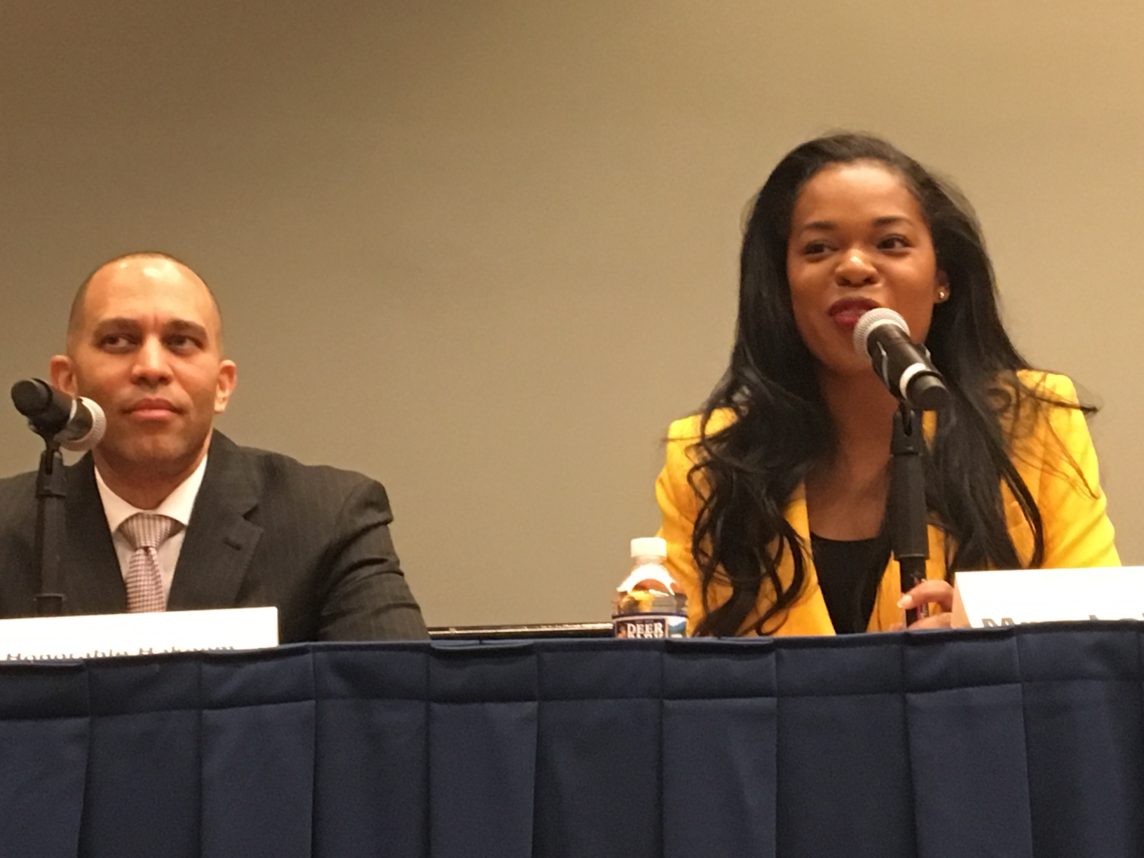
Congressman Hakeem Jeffries in conversation with AIPAC Outreach Director Labriah Lee

“I say often, when you step back and see Hamas in Gaza and the dangerous situation including elements of Al Qaeda in the south, in the Sinai, Hezbollah in the North, the chaos in Syria including Russia and other [adversarial] entities including ISIS as well as Iran with nuclear aspirations in that region — it’s clear Israel lives in a tough neighborhood.”

Drawing on his own roots, Jeffries said, “As someone who came of age in central Brooklyn in the late 80s and early 90s, I know from tough neighborhoods. I’ve learned from my own experiences that when you live in a tough neighborhood, at the end of the day the only thing that you can guarantee people respect is strength, which is why I’m committed to [Israel].”

Asked about the “current debate” around Democrats in the House — a veiled reference to the controversy surrounding Ilhan Omar’s (D-Minn) comments about Israel, Jews and AIPAC, Jeffries said, “The overwhelming majority of the House Democratic Caucus is strongly pro Israel, has been strongly been pro-Israel and will remain strongly pro-Israel.”

He added, “I’m committed as are many of my colleagues to [Israel] because of the shared democratic values of our two countries and the shared strategic interests of our two countries in an important region of the world.”


Hakeem Jeffries: Majority of House Caucus Democrats Are Pro-Israel Read More »