fbpx

March 27, 2019

Inspiring All Ages With Design

When Joanne Fink started her art career, she was designing intricate designs for ketubah documents. Now, more than 35 years later, her love for art and Judaism has developed in ways she never imagined by creating coloring books, journals, poetry, music and collaborative art projects that all incorporate her designs. 

Fink’s mantra is, “Live by inspiring others to fly,” and that’s exactly what she does with her faith-based collections. As a lover of Jewish music and art, her artistic passion led her to be the founding president of the International Association for the Calligraphic Arts and founding board member of the New York-based American Guild of Judaic Art. 

The Journal video chatted with Fink from her art studio in Florida to get a sense of her mind at work. This interview has been edited and condensed for clarity. 

Jewish Journal: How did you first get established as an artist and how did that lead you to coloring books?

Joanne Fink: I started doing what I call Zenspirations 10 years ago this fall, and that is the combination of personal spiritual philosophy that is heavily overlayed with tikkun olam, which is “repair the world.” I use it to help people create their own inner talents and hone them to make a difference in the world. I process things Judaically, which is faith-based.

I cannot take credit for doing coloring books. I’ve done many books in my life and I have a couple of different publishers and what’s called a crafts book publisher, who did my first Zenspirations book. I think he is a visionary and he asked me if I wanted to do them. They came out in 2013 and were abstracts, flowers and Zenspiration. Together, they have sold half a million copies. It’s insane. My coloring books are different because I allow a lot of open space and I want people to use my art as a springboard for their own art, and I teach people how to add color and texture and text and their own personal style. The fronts of the book are basic patterning techniques, and they get this simple line and they can add extra details and make it their own. 

JJ: So it’s for all ages?

JF: Yes. They are designed for adults and I know that kids use them, but it’s for everybody. I would post on here [Facebook page “Zenspirations Create, Color, Pattern, Play”] and people would submit their versions of them. My editors and I would then go through and pick the ones we really liked. I think I’ve had dozens of artists contribute. 

Coloring Book page from Joanne Fink.

JJ: When did you learn how to use Lightroom or Bridge or Photoshop? How did you learn to incorporate that into your artwork and go digital?

JF: I spent many years standing behind my staff. I had four graphic designers on staff and I spent many years standing behind them pointing, saying, “Make that bluer, move that over there, make that bigger,” and in the end, when the economy crashed, I had a choice of learning Photoshop or closing my business. Now, 10 years later, I cannot imagine not working on Photoshop. Now I have such creative freedom, depending on what people want.

JJ: What is the reaction when people see your work in front of them?

JF: When I was a young designer, I started doing greeting cards, and I saw somebody looking at my card and I yelled, “That’s my card!” and she looked at me like I was totally nuts, so I never did that again. But I love when people get to use or when they appreciate my work on a level that they emulated in some way. 

I also do a lot of grief support work and have done pieces on [the shootings in] Parkland and Pittsburgh, and I also do designs with Jewish Songleader Boot Camp. One of the initiatives I did was Jewish Art Week, and I went into the synagogues and worked on the art projects. I had several hundred kids making a quilt, and another year we did a piece for the Holocaust museum where kids made hundreds of little butterflies. 

Design by Joanne Fink

JJ: What do you want to do next? 

JF: I would like to illustrate a siddur that has just my art and words. I guess what I do is bring the text to life with my art. But I did not want to take away the text that they are familiar with. But one of the things I really want to do is help people find connection. I don’t think I’ve ever made the connection before but I want to be the spiritual artist that [world-renowned Jewish song leader] Debbie Friedman is with music. If I am able to connect people spiritually with my designs like she does, because she is so powerful with her music, I think that would be so special. n

Follow Joanne Fink online at zenspirations.com. 

Inspiring All Ages With Design Read More »

Obituaries March 29, 2019

Hanna Arfa died Feb. 17 at 103. Survived by daughter Fay (Charles); son Allan (Carmelith); 4 grandchildren; 11 great-grandchildren. Mount Sinai

Victor Aseraf died Feb. 14 at 62. Survived by wife Ruth; sons David, Adam (Solange); 4 sisters. Mount Sinai

Greta Rabinowitz Bayer died Jan. 23 at 95. Survived by 13 stepgrandchildren. Mount Sinai 

Cindy E. Berglund died Feb. 14 at 63. Survived by son Josh; sister Amy Norris. Mount Sinai  

Oren H. Bornstein died Feb. 23 at 90. Survived by wife Jill; sons Jeffrey, Richard, 3 grandchildren. Mount Sinai

Saul Brown died Feb. 23 at 96. Survived by wife Helen; daughters Janine, Emily; sons Gordon, Jonathan; stepson Mark; 9 grandchildren; 3 great-grandchildren; brothers Daniel, Seyom. Hillside

Lazer Cohen died Feb. 21 at 82. Survived by wife Joan; sons Larry (Laura), David (Chris), Steven (Leslie); 6 grandchildren. Mount Sinai

Ilana d’Ancona died Feb. 14 at 80. Survived by daughter Susanna Porte; sisters Erela Peled, Hava d’Ancona-Dvir; brother Menashe Dvir-d’Ancona.

Ilya Drabkin died Feb. 22 at 85. Survived by daughter Marina (Anatoli Kouzine); son Vladimir; 5 grandchildren. Mount Sinai

Bennie Engle died Feb. 23 at 94. Survived by daughter Laura; son Stephen (Saul Varela). Mount Sinai

Penny Haptor died Feb. 25 at 74. Survived by husband Stanley; son Gregory (Gretchen); 1 grandchild; sister-in-law Gloria (Bernie) Matusow. Mount Sinai

Malka Kelmahter died Feb. 17 at 95. Survived by daughters Luba (Ben) Sobol, Anna Zislis; 4 grandchildren; 4 great-grandchildren; brother Gregoriy Goyhman. Mount Sinai

Oleg Kolesnikov died Feb. 16 at 79. Survived by sons Kirill (Kate Lebedeva), Konstantin (Irina); 3 grandchildren. Mount Sinai

Thea Krauthammer died Feb. 14 at 97. Survived by daughters-in-law Joy, Robyn; 2 grandchildren; 2 great-grandchildren. Torchinsky Hebrew Funeral Home, Washington, D.C.

Annie Lampl died Feb. 24 at 101. Survived by sons Lanny (Sharon Hunter), John (Maria Dominguez); 4 grandchildren; 2 great-grandchildren. Mount Sinai 

Gerald Laxer died Feb. 24 at 72. Survived by wife Leslie; son Kevin (Kathy); 4 grandchildren; sister Carol Rosenbaum. Mount Sinai

Rena Leifeste died Feb. 17 at 82. Survived by daughter Romy Beattie; 2 grandchildren. Mount Sinai

Ruth Lishan died Feb. 3 at 99. Survived by daughter Ellie (Marty) Podway. Mount Sinai 

Claire Marlow died Feb. 15 at 95. Survived by daughter Barbara Thomas; son Neal; son-in-law Jay Thomas; 2 grandchildren; 4 great-grandchildren; sister June Meyerson. Mount Sinai

Michael Marton died Feb. 17 at 72. Survived by wife Peggy; daughter Erica (Cass) Fuller; son David (Rosie); 4 grandchildren; sister Susie (Fred) Granich; brother Ken (Mary).

Gregory Meltzer died Feb. 20 at 52. Survived by mother Rose; father James. Hillside

Ignac Mermelstein died Aug. 8, 2018, at 91. Survived by sons David, Evan (Michal); 9 grandchildren. Mount Sinai 

Richard Miller died Jan. 30 at 90. Survived by wife Sheila; daughter Barbara Levandoski; 1 grandchild. Mount Sinai 

Louis Milner died Feb. 1 at 94. Survived by sons Herve, Marco; 3 grandchildren. Chevra Kadisha

Belle Lorand died Nov. 26, 2017, at 96. Survived by sons Andrew (Shron), Steve; 5 grandchildren. Mount Sinai

Harold H. Nebenzal died Feb. 14 at 96. Survived by wife Dorothy; daughter Deborah Corday. Mount Sinai

Lillian Nusbaum died Feb. 14 at 100. Survived by daughter, Joann (Bob) Levine; 2 grandchildren; 1 great-grandchild. Mount Sinai

Gerald Okonowsky died Feb. 17 at 88. Survived by wife Mildred; daughters Stacy, Wendy Corell; son Gary (Susan); 5 grandchildren; 1 great-grandchild. Mount Sinai

James Orecklin died Feb. 26 at 78. Survived by wife Phillipa; daughter Michele (Lance); sons Larry, David; 3 grandchildren. Hillside

Barbara Pilson died Feb. 26 at 90. Survived by daughter Cathy (Michael); son Barry (Barbara); 3 grandchildren. Hillside

Paulette Rapp died Feb. 22 at 76. Survived by cousins Lisa, Joel. Hillside

Samuel Rifkin died Feb. 17 at 100. Survived by son Edward; 1 grandchild. Mount Sinai 

David Rosenfeld died Feb. 23 at 96. Survived by son Michael (Elizabeth).
Hillside

Elizabeth Rosenfeld died Feb. 10 at 98. Survived by daughter Tina (Ira) Artz; son George (Donna); 5 grandchildren; 8 great-grandchildren. Mount Sinai

Sheldon Saltman died Feb. 16 at 87. Survived by daughter Lisa (Daniel) Medford; son Steven (Betsy); 4 grandchildren; sister Barbara Marder; half-brother Jack. Mount Sinai 

Jack J. Schmider died Feb. 20 at 89. Survived by son Ernest (Omar Rodriguez); 2 grandchildren; brother Walter (Barbara). Mount Sinai 

Joseph C. Steinfeld died Feb. 24 at 90. Survived by wife Joan; sons Reid (Rhona), Henry; stepson Ron (Sue) Grossblat; 7 grandchildren. Mount Sinai

Estelle Lee Smalley died Feb. 17 at 89. Survived by husband Alan; daughters Sheryl, Pam (Brian) Adams; 2 grandchildren; 4 great-grandchildren. Mount Sinai

Melvin Mayer Stowsky died Feb. 20 at 87. Survived by sons Jay (David Kerr), Robert; 2 grandchildren. Mount Sinai n

Obituaries March 29, 2019 Read More »

JWW Walk, Israel Election Preview, Shesh Besh

FRI MARCH 29

Rabbi Sandy Eisenberg Sasso
Rabbi Sandy Eisenberg Sasso, the first woman ordained by the Reconstructionist Rabbinical College and the first woman rabbi to serve a Conservative congregation, is the scholar-in-residence at Temple Isaiah on Shabbat. On Friday night, she discusses “I Am Not Religious; I’m Spiritual,” a lecture about God for those who can’t believe. On Shabbat morning, she discusses “Jewish Stories of Love and Marriage.” On Sunday, at a private home, she speaks on “Women and Spirituality — A Personal Journey.” Friday: services 6:15 p.m.; dinner and program 8-10 p.m. March 30: services, 9:30-11:30 a.m. March 31: home event, 10 a.m.-noon. Free. Temple Isaiah, 10345 W. Pico Blvd., Los Angeles. (310) 277-2772.

SAT MARCH 30

“Combatting Efforts to Delegitimize Israel”
On Shabbat morning at the Beverly Hills Jewish Community, Stuart Sloame, vice chairman of the board of the American Jewish International Relations Institute, which seeks to reverse anti-Israel votes at the United Nations, discusses “Combatting Efforts to Delegitimize Israel.” Sloame spent 35 years in Washington politics and is a former executive of The Israel Project. 9:30 a.m. services. 11:30 a.m. lecture. The Beverly Hills Hotel, 9641 Sunset Blvd., Beverly Hills. Limited seating. RSVP at info@beverlyhillsjc.org. (310) 276-4246.

SUN MARCH 31 

“An Outstretched Arm”
After Jewish World Watch’s Walk to End Genocide, stop by Temple Beth Am for “An Outstretched Arm: Experiencing the Stages of a Refugee’s Journey.” The afternoon opens with an interactive exhibit that connects the Jewish Exodus from Egypt with contemporary flights from violence. Special guests include former refugees and asylum seekers. A caterer who fled Venezuela for asylum in California prepares a meal for attendees. 12:30-3 p.m. Donations encouraged, $10 per adult, $5 per child. Temple Beth Am, 1039 S. La Cienega Blvd. (310) 652-7353.

Spring Day of Service
Families and volunteers of all ages participate in the Builders of Jewish Education’s (BJE) Spring Day of Service Learning, at the Jewish Home for the Aging in Reseda. Adults and children make challahs, paint, plant potted plants, enjoy arts and crafts, and sing to the home’s residents. 9:45-11:45 a.m. Jewish Home for the Aging, 18855 Victory Blvd., Reseda. Sign up with Millie Wexler at mwexler@bjela.org or call (323) 761-8631.

“Istoria Judia”
A concert, “Istoria Judia: Sephardic and Mizrahi History, Music and Dance,” commemorates the 527th anniversary of the 1492 expulsion of Jews from Spain. Noreen Green and the Keshet Chaim Dance Ensemble perform with the American Jewish University choir, mezzo-soprano Diana Tash, Oud player, guitarist Asher Levy and ethnic percussionist Jamie Papish perform “A Letter Fell From the Sky,” an original composition by Michelle Green Willner. 4 p.m. $25. American Jewish University, Gindi Auditorium, 15600 Mulholland Drive, Bel Air. (310) 440-1572.

Walk to End Genocide
Join Jewish World Watch for its 13th annual Walk to End Genocide, which raises awareness for the 68.5 million global refugees fleeing atrocities. The 5K walk and rally includes a hate-speech workshop, a jump-a-thon for kids, arts and crafts, and an opportunity to talk with genocide survivors. Based in Encino, the organization urges the American government to take action against mass atrocities and raises funds to educate, advocate and provide on-the-ground relief for survivors. 10 a.m.-1 p.m. $30 for ages 23 and above; $18 for ages 5-22; free for ages 4 and under. Pan Pacific Park, 7600 Beverly Blvd., Los Angeles. (818) 501-1836.

Gustavo Bulgach

Learning Klezmer
Klezmer Juice bandleader Gustavo Bulgach, a.k.a. “the Prince of West Coast Klezmer,” and his band mates draw on the Eastern European musical tradition of klezmer rhythms, scales and modes, and teach their skills to the Jewish community. This inaugural meeting of the Klezmer Arts Institute of Los Angeles will be followed by workshops. Bring your instrument. 11 a.m.-1 p.m.  Free. Westside Jewish Community Center, 5870 W. Olympic Blvd. (323) 938-2531.

MON APRIL 1

“In the Age of Trump”
Veteran political personality David Axelrod, who was the campaign strategist and White House adviser to former President Obama, and Adam Nagourney, the Los Angeles bureau chief for The New York Times examine “American Politics in the Age of Trump: Looking to 2020.” Axelrod is also the founding director of the University of Chicago’s Institute of Politics and hosts CNN’s The Axe Files. 7 p.m. Free. Temple Israel of Hollywood, 7300 Hollywood Blvd. (323) 876-8330.

Nikki Haley

Honoring Nikki Haley
Former United Nations Ambassador Nikki Haley receives Friends of Magen David Adom’s Humanitarian of the Year award. Haley discusses her two years as ambassador with Friends of Magen David Adom leader Dina Leeds. 6 p.m., cocktails. 7 p.m., dinner. 9 p.m., dessert mixer. $500 general admission. $1,000 preferred seating. Beverly Wilshire Hotel, 9500 Wilshire Blvd., Beverly Hills. (323) 655-4655.

TUE APRIL 2

“We Are All Responsible”
The Talmud teaches that all of us are responsible for each other, but how far do our responsibilities go? What are the parameters? Exactly who are we obligated to aid? Rabbi Jonathan Aaron leads a three-class series on the subject at Temple Emanuel of Beverly Hills. 7 p.m. Free. Temple Emanuel, Davidson-Sheffer Hall, 8844 Burton Way, Beverly Hills. (310) 288-3737.

WED APRIL 3

Women’s Passover Celebration
Adat Ari El Cantor Judy Dubin Aranoff and Rabbi Jessica Yarkin lead “Circle ‘Round for Freedom: A Women’s Passover Celebration.” Attendees explore their heritage, find their feet and celebrate their journey to freedom. 7 p.m. $36. Adat Ari El, Jacoby Social Hall, 12020 Burbank Blvd., Valley Village. (818) 766-9426.

Israeli Election Preview
Less than a week before the April 9 Israeli elections, three experts debate whether Prime Minister Netanyahu can retain his office. David A. Halperin, executive director of the Israel Policy Forum; Ilan Goldenberg, director of the Middle East Security Program at the Center for a New American Security; and Hady Amr, a visiting fellow at the Brookings Institution, appear in conversation with Valley Beth Shalom Rabbi Ed Feinstein and discuss potential election outcomes and the impact on U.S.-Israel relations, President Trump’s pursuit of an “ultimate deal” and regional security. 7-9 p.m. Free. Valley Beth Shalom, 15739 Ventura Blvd., Encino. (818) 788-6000.

Shesh Besh

Shesh Besh Concert
Beth Jacob Congregation’s annual cantor’s concert, “Coexistence Through Music,” features Shesh Besh, an Arab-Jewish ensemble of the Israeli Philharmonic Orchestra that seeks to strike an elusive balance of East and West in music while embodying two cultures living together in harmony. The group performs traditional Eastern material alongside Israeli melodies and works by Bach, Mozart and Haydn. 7:30-9 p.m. $20-$100.  Beth Jacob Congregation, 9030 W. Olympic Blvd., Beverly Hills. (310) 278-1911.

THU APRIL 4

“Finding Something New to Say”
Rabbi David Lazar leads “Finding Something New to Say,” a discussion of the Torah portion of the week. Lazar’s “Lunch ‘N Learn” continues on the following three Thursdays,  as he focuses on “Getting the Story Right,” “Custom and Culture” and “So How Does One Depict God?” The well-traveled rabbi has taught in Sweden and Israel and leads Or Hamidbar (Light in the Desert), a Jewish engagement organization in Palm Springs. Noon-1:15 p.m. Free. Kehillat Ma’arav, Library, 1715 21st St., Santa Monica. (310) 829-0566.

“Not That Jewish”
Emmy-winning comedy writer and comedian Monica Piper performs “Not that Jewish.” Her hit autobiographical one-woman show is a story of life, love, pain, and Mickey Mantle. Audience members will laugh, cry and leave happy to be Jewish. Presented by Jewish Women’s Theatre. Directed by Eve Brandstein. Thursdays at 8 p.m. Through April 11. $40 presale, $45 door. The Braid, 2912 Colorado Ave., Suite 102. Santa Monica. (310) 315-1400.


Have an event coming up? Send your information two weeks prior to the event to ryant@jewishjournal.com for consideration. For groups staging an event that requires an RSVP, please submit details about the event the week before the RSVP deadline.

JWW Walk, Israel Election Preview, Shesh Besh Read More »

North Africa and the Holocaust

As I was working with the team creating the Dallas Holocaust Museum and Human Rights Center, we decided to tell the story of the Holocaust geographically rather than thematically and chronologically. After all, the fate of Jews varied country by country. German policy differed in various countries, in part depending on German attitudes toward the local population, German plans for the geographical area after their assumed conquest, and the attitudes of the local population toward their own Jews, whether they be citizens or not. 

Furthermore, the Holocaust happened at different times in different countries. For the Jews of Germany, Nazi policy evolved over six years (1933-1939) before World War II even began, and eight years before the Final Solution – the systematic annihilation of the Jews — became German state policy. In occupied Poland, ghettos preceded the murder of Jews and lasted for between two and four years. Elsewhere in Eastern Europe, ghettoization followed the massive massacre of Jews in what has become known as the Holocaust by bullets. There could be no doubt in these regions that the intent of the German occupation was the annihilation of the Jews — in Nazi-speak: extermination.

 In Macedonia, ghettoization was a matter of weeks, deportation a matter of days. Hungarian Jews were persecuted by the German-allied Hungarian government and were taken for slave labor but not murder until after the German invasion of March 1944. Ghettoization followed swiftly in April and early May and deportation began on May 15. By the first week of July 1944 the countryside was Judenrein, without Jews, and all that remained were the Jews of Budapest.

As we explored the Holocaust geographically, one of the problems we faced was how to describe the fate of the Jews of North Africa, who lived under French or Italian or even, during World War II, German occupation. Should we treat those countries independently of their European colonial rulers, or treat them as an offshoot of France and Italy, the dominant colonial rulers?

I wish I could say that we debated the issue philosophically. In the end it was merely determined by spatial considerations, and I shall leave it to future museum visitors to consider the wisdom of our choice. 

I read Aomar Boum’s and Sarah Abrevaya Stein’s book, “The  Holocaust and North Africa” — the result of a 2015 conference sponsored by UCLA and the United States Holocaust Memorial Museum —with great interest and considerable gratitude, for it explores the fate of Jews in North Africa during World War II, when colonialism and the Holocaust met.

In each North African country, the fate of the Jews differed by the nature of colonial rule, the colonial power’s attitude toward collaborating with the Nazis on implementing the Final Solution, and the duration of German or allied and collaborationist colonial powers’ control in these lands. As Christians persecuted Jews in countries with an overwhelmingly Muslim-majority population, the attitude of the Muslim population, and most especially its leaders, impacted the fate of the Jews. What also determined Jews’ fate was how swiftly liberating Western allied powers came to control these countries, replaced colonial leadership and reversed anti-Jewish policies imposed by the colonial powers allied with or occupied by Germany.

“Any consideration of the Holocaust in North Africa operates under a handicap… The accepted narrative is that the Holocaust was only a European event.

Any consideration of the Holocaust in North Africa operates under a handicap, as many of the authors remind us repeatedly. The accepted narrative is that the Holocaust was only a European event. North Africa is regarded as a peripheral issue at best, a footnote if considered at all. And while a variety of camps were in North Africa, there were no death camps. Furthermore, with the post-colonial collapse of these Jewish communities by migration to Israel, France or North America, their experience during World War II often takes a back seat toward their more recent trauma, and their sense of loss is the loss of their homes and the demise of their communities that took place in the 1950s and ’60s. The events of the 1940s fade into oblivion. 

There was never any doubt that Sephardim were also victims of the Holocaust. All scholars must consider the European dimensions of the fate of Sephardic Jews in Greece — the great Jewish community of Salonika was deported in 1943 — and in the Balkans, where the Jews expelled from Spain found a haven, but most have avoided North Africa as it does not fit into the Europe-centered narrative. This book is an overdue and most necessary offering that should force a reconsideration of the issue. 

The role of the Holocaust in Israeli national identity further complicates the matter, as the greater the concern with the Holocaust, the more Mizrahim in Israel feel neglected and disregarded. There may also be a sense of “Holocaust envy.” How can their experience during the Holocaust or in exile from their homeland compare as a catastrophe? And there certainly were significant omissions in terms of compensation, reparations and the recovery of property.

“The Holocaust and North Africa” is a carefully chosen title. Notice that it is not entitled “The Holocaust in North Africa.” The term Holocaust evokes ghettos and death camps and more recently murder by bullets, and little of this occurred in North Africa. The book could have also been titled “Where Colonialism and Holocaust Meet” or “Where Colonialism and Fascism Come Together.”

The book is divided into four parts. The first considers the meeting together of colonialism and fascism in consideration of the French colonies of Morocco, Tunisia and Algeria, and the Italian colony of Libya, which for a time was occupied by Germany. Ironically, Jews fared better under French colonial rule than they did in Vichy France and quasi-independent but strongly collaborationist France; and certainly far better than they did in German-occupied France, where Jews had greater rights before the German invasion. Colonialist Italian rulers were more lax in enforcing anti-Jewish legislation than their counterparts in Italy, and in both Italy and Libya conditions deteriorated dramatically after the Germans invaded Northern Italy and reinstated Mussolini. 

The second part of the book deals with diverse experiences of different North African Jewish populations. Occupation, internment and race laws differed country by country, often year by year, and even within some countries by regions, whether rural or urban.

The third part considers the narratives of this period of time, the joining of memory of the past with contemporary efforts to find a useful history; and the final part deals with the efforts, mostly by Holocaust historians, to find a place with the greater narrative for the experience of North African Jews.

One wonders how many more narratives remain to be discovered and how deeply historians of this generation and the next will probe this region. One also wonders whether fictional accounts of the time will be written, and whether this material, mostly in French, will be translated into English or Hebrew. The admirable work of the Yitzhak Ben Zvi Institute, dedicated to the history of Sephardic Jewry, simply cannot compete with the intellectual and economic powerhouse of Yad Vashem.

Conferences vary in the quality of presentations and their written record is usually uneven. Most often, their impact is ephemeral. Not so the conference that resulted in this book. The chapters offer a consistency of quality and perspective, and the whole is greater than the sum of its parts.

Future historians will have to consider the fate of North African Jewry, country by country, region by region. This reviewer hopes that future historians do not end their research and their writings at the borders of Europe. “The Holocaust and North Africa” proves that there is much to be learned.


Michael Berenbaum is director of the Sigi Ziering Institute and a professor of Jewish Studies at American Jewish University.

North Africa and the Holocaust Read More »

NYC Councilmember: ‘Palestine Does Not Exist’

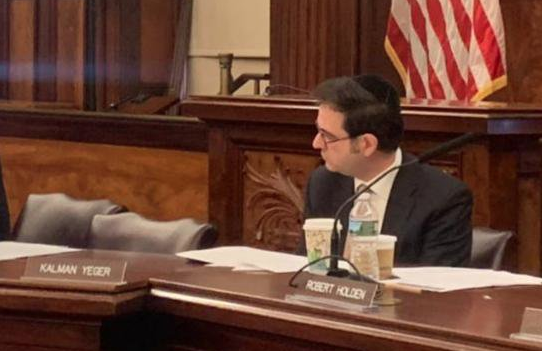
New York City (NYC) Councilman Kalman Yeger created some controversy on March 27 when he tweeted that “Palestine does not exist.”

It started when Yeger, a Jewish Democrat, tweeted in response: to Rep. Ilhan Omar’s (D-Minn.) Twitter thread criticizing Israeli Prime Minister Benjamin Netanyahy for singling her out in his AIPAC (American Israel Public Affairs Committee) Policy Conference speech.

A Twitter user responded to Yeger by pointing out that the councilman has previously said that “Palestine does not exist” and has used the term “so-called Palestinians.” Yeger tweeted in response, “Palestine does not exist. There, I said it again. Also, Congresswoman Omar is an anti-Semite. Said that too. Thanks for following me.”

Yeger’s tweet drew rebukes from Women’s March, Inc. co-leader Linda Sarsour and NYC Mayor Bill de Blasio.

Former Democratic New York State Assemblyman Dov Hikind defended Yeger:

According to Jewish Virtual Library, the term “Palestine” originated from the Philistines, who were ancestors of the Greeks. Palestine was loosely used to refer to southern Syria under the Ottoman Empire; after the empire fell, the word “Palestine” was used to refer to the land that eventually became Israel and Jordan. Today, Judea and Samaria and Gaza are referred to as the Palestinian territories, however an official state called “Palestine” has never been established.

NYC Councilmember: ‘Palestine Does Not Exist’ Read More »

Harrowing ‘Sobibor’ Dramatizes Death Camp Escape

On Oct.14, 1943, 300 prisoners escaped from the Sobibor death camp in Poland, killing a dozen Nazi SS officers in the process. The Russian-made Holocaust drama “Sobibor” dramatizes the desperate escape plot while depicting the hellish existence those not immediately sent to the gas chambers endured.

Often difficult to watch, the film unflinchingly shows Nazi acts of sadism-for-sport. But its message about hope and humanity amid the darkness is clear.

In an e-mail interview, director Konstantin Khabenskiy, who also stars as Russian-Jewish revolt leader Alexander ‘Sasha’ Pechersky, said of his directorial debut, “It was important for me to understand and show how a person is changing in these circumstances, in a death camp. How do they try to remain themselves, not lose their reason, the ability to resist?” 

He added that this applied to the Nazis, too. “I tried to understand them as much as possible. Not to justify, of course, but to understand. I wanted to make a film where the death camp would be the main character, [where] people exist as if in its shadow. The legendary uprising and its preparation are not so important. It’s more important to show the camp and the people in it.”

Although Pechersky was a real person, little is known about some of the other men behind the uprising. “For example, Boris Tsibulsky, Pechersky’s closest ally,” Khabenskiy said. “How to accurately reproduce his image on the screen, if there are no documents about him, only two paragraphs in Pechersky’s memoirs?” For Khabenskiy, it was more important to get the historical details right and “show how people live and act in such circumstances.” 

Khabenskiy had advisers from the Alexander Pechersky Foundation vetting everything about Sobibor, the uprising and prisoners’ fates, and he aimed for accuracy in the scenery, weapons, transportation and uniforms, down to the buttons. 

Khabenskiy initially turned down the offer to become involved in the film, but reading Pechersky’s memoirs and other research materials changed his mind. “It took probably about two years before I realized that this story could be interesting for me as an actor and even some more time until I agreed to become a director,” he said.

“It was important for me to understand and show how a person is changing in these circumstances, in a death camp. How do they try to remain themselves, not lose their reason, the ability to resist?” 

— Konstantin Khabenskiy

But wearing both hats proved to be a physical and logistical challenge. “You have to run all the time from the shooting area to the camera and back,” he said. “It is not easy not to be able to look at yourself from the outside, to appreciate the scene in which you participate.” 

“[Directing] is a completely different profession,” he said. “I talked to many outstanding directors and I know that they look at everything that happens on the set with different eyes. The main challenge was to understand for myself if I could embody what I had learned from them in my own film.”

Although “Sobibor” graphically depicts Nazi brutality, the director “tried to remove excess cruelty from the screen. We have not shown one-fifth of what the prisoners of Sobibor write about in their memoirs.” 

Although the Sobibor escape story has been the subject of books, documentaries and the 1987 TV movie “Escape From Sobibor,” it is not widely known. 

“It seems to me that this is how human consciousness works,” Khabenskiy said. “It is convenient for people to imagine one thing instead of a multitude: Anne Frank as a representative of the victims of the Holocaust, Elie Wiesel as a representative of the survivors, Raoul Wallenberg and Oskar Schindler as representatives of the Righteous Among the Nations. The same thing happened with the camps. Everyone heard about Auschwitz and Dachau and much less is known about the rest, although many of those camps are much higher than Dachau in the number of victims.”

An estimated 250,000 Jews were murdered at Sobibor. Of the prisoners involved in the revolt, most were captured or killed. Only 53 survived the war, including Pechersky.

Khabenskiy admitted that his apprehensions about making the film lingered after he finished it, despite the fact that it was a hit in Russia and was its Oscar entry this year. 

“But I know one thing. I did my best,” he said. “If something did not work out, it is not because I didn’t try. We had dozens of options for editing the film, and until the last moment we continued to work on it. If the premiere were a little later, perhaps the final version of the film would have been a little different.”

He’s not eager to try directing again any time soon. “My main profession is [as a] theater and film actor,” Khabenskiy, who is a major star in Russia, said. “I learned that this is what I can do best. I do not think that I will soon try to repeat the experience of filmmaking.”

On the eve of “Sobibor’s” release in the U.S., “I would like the audience to leave the cinema hall emotionally enriched,” he said. “This is not about any particular knowledge or message, but about a certain change in the emotional structure.”


“Sobibor” opens March 29 at Laemmle’s Music Hall and is available via Video on Demand.

Harrowing ‘Sobibor’ Dramatizes Death Camp Escape Read More »

‘Crazy Ex-Girlfriend’ Cast Looks Back With Laughter, Affection

Author’s note: Videos embedded within the story contain adult themes and may include explicit language. Viewer’s discretion is advised.

Hundreds of devoted fans gathered on March 20 inside the Dolby Theatre to honor and kvell over CW cult favorite “Crazy Ex-Girlfriend.” 

The raunchy and comedic cast got together for a panel discussion at PaleyFest LA — most of which was “not safe for parents” — where the show was referred to in the past tense because it’s fourth and final season has wrapped. 

“This is all making my heart kind of hurt,” actress Rachel Bloom, who plays ex-girlfriend Rebecca Bunch and executive produces, said after moderator Stacey Wilson Hunt asked cast members to name their favorite songs from the series from a lengthy list. “It’s the first time we’re saying it in the past tense. … It’s really interesting … we’ve now finished the concert, the show actually really is in this past tense. It’s really weird.”

Bloom was referring to the “Yes, It’s Really Us Singing: The Crazy Ex-Girlfriend Concert Special!” show that will follow the series finale, in addition to the concert tour that the cast did in several cities around the country.

The number of F-bombs dropped during the event was in the spirit of the TV series, which addresses mature themes (sex, drugs, mental health, coming out, LGBTQ rights, sex again), but the amount of self-deprecation dispersed from the talented ensemble made the night of laughs heartfelt. 

For a TV show that tosses social tropes into the garbage (its song “Let’s Generalize About Men,” for example) and also plays like a musical fully recognizing it’s a musical, almost every actor needs to bring their comedic chops, dancing abilities and vocal performances to the forefront on top of acting. This cast and show’s cameo actors are quadruple threats.

Bloom kicked off the night with the show’s origin story, sharing her fears. Pitching “C.E.G.” in her mind wasn’t easy because “literally no one wanted” her other two shelved musical television shows. 

“Hot tip,” she told the crowd. “If you’re pitching a musical television show, don’t sing in the pitch.” 

Bloom was seated next to her show runner and “work wife,” Aline Brosh McKenna (“The Devil Wears Prada,” “27 Dresses”), each of whom wore matching prescription-pill-bottle dresses. 

“She’s a fellow writer girl and I liked that,” McKenna said, remembering their first meeting almost six years ago.

The Jewish-female dynamic duo, along with their team of writers, created more than 150 original songs during four seasons. Their Jewish roots came into play on a handful of occasions including, “The J.A.P. Rap Battle,” and its reprise during Season 4, “Remember That We Suffered” and “The Math of Love Triangles,” which also is reprised in Season 4 — to name a few. 

Bloom said her favorite song, which she admitted changes frequently, is “The Villain of My Own Story” from Season 1. 

“That’s an emotional tentpole song for the character,” Bloom said. “It’s this f—ed-up Disney song, which is my jam. I have a weird fondness for that song because I won the Golden Globe [in 2016 for best actress in a comedy or musical TV series] and came back to set and I shot that song. So it was this weird thing of, like, being in a gown, and then you go to set and you get the prosthetic nose put on and you try to eat chili fries with the nose. And that’s what the job is.” 

One of the main musical writers on the show is Jack Dolgen, who has written songs with Bloom for almost a decade. 

As moderator Hunt put it, “He’s a man of many hats but only one outfit,” because Dolgen frequently appears in real life in his denim-on-denim look. 

He became a key player, who also ended up writing, directing, producing and performing throughout the series. 

“I think just bridging the gap between what we were doing in the writers room and story-wise and song-wise to make sure they work together and fed off each other properly, that was the main trick of the show,” he said. “I think that was a skill we all learned together.”

Dolgen also gave musical props to music producer Adam Schlesinger (“Music and Lyrics,” “That Thing You Do”), who played a big part in every song throughout the series. Although Schlesinger wasn’t at the panel, Dolgen stressed how crucial he was to the process. 

“We couldn’t have done the show without him, [without] Adam’s ability to produce in any genre and to write incredible songs in his own right, simply the quantity that we did,” Dolgen said. “We did over 150 comedy songs.”

McKenna added how nice it was to see the cast members show up on set to cheer on one another during the songs they might not be in. The show isn’t just musically hilarious; the panel revealed they were like a family. Their dynamic allowed for a great space for making the scripts come to life. 

Donna Lynne Champlin, who plays lawyer and Rebecca’s best friend, Paula, admitted her steepest learning curve was adjusting from live theater to single-camera television. She joked she didn’t fully feel comfortable until Season 3.

“I didn’t know how anything on a TV show came together,” Champlin said, holding for laughs. “My nickname, lovingly, was ‘Sabotage.’ … It was so overwhelming … for me. The weirdest [part] was coming from a live theatrical background, I didn’t realize how much I relied on the audience, most particularly, the laughter.” 

Vella Lovell, who plays the sarcastic and apathetic Heather, and studied acting at Juilliard, also weighed in on the TV-production process.

“I feel like you can train forever and not be prepared to be on set of a television show,” Lovell said. “I don’t think anything could have prepared us for this experience. Yeah, I mean, we were all saying it was kind of our senior year, like we all got into college. Now we are saying goodbye.” 

Although the show’s final episode will air soon, Bloom and McKenna aren’t done with Rebecca’s story. Bloom and McKenna hope they can continue to perform the series’ songs in concert and potentially condense the 60 hours of the show into a musical. 

“We are only starting to talk about that [stage musical],” Bloom said, “but for now, we have these live performances with the cast, and the coolest part for me is that we have begun to create a hybrid of a comedy show to a full-fledged musical revue, and the fun thing about it is that we are playing ourselves. … It allows for the freedom that we have when we are on set. … I am probably going to be bothering them to do these shows for the next 50 years.”


The final episode of “Crazy Ex-Girlfriend” airs April 5 on the CW. 

‘Crazy Ex-Girlfriend’ Cast Looks Back With Laughter, Affection Read More »

Schiff at TEBH, Carr at IAC, Dayan at JNF

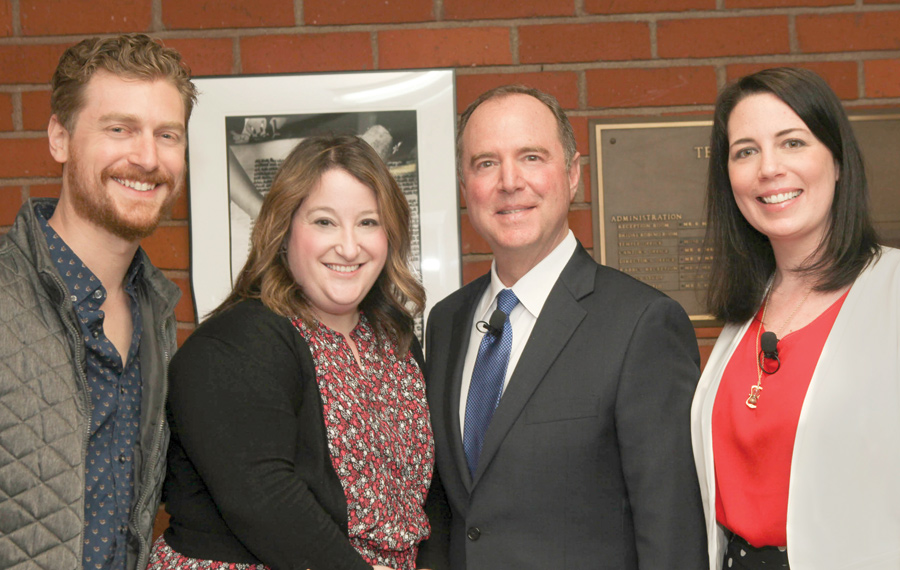
Addressing more than 1,100 people on March 19 at Temple Emanuel of Beverly Hills (TEBH), Rep. Adam Schiff (D-Burbank) expressed support for Israel.

“The Jewish state is held to a completely different standard than any of its neighbors,” Schiff said from the bimah of the synagogue, which organized the evening with nonprofit Writers Bloc Presents.

Schiff appeared in a town hall-style conversation with TEBH Associate Rabbi Sarah Bassin. The two spoke about the temple’s gun violence initiative, with Schiff saying the nation had reached a tipping point in how it approaches gun policy, but more work was needed.

“I refuse to accept this is the best we can do,” said Schiff, who chairs the House Intelligence Committee and whose district includes West Hollywood, Burbank and parts of Glendale and Pasadena.

Attendees included TEBH President Barry Brucker and his wife Sue; Karl Thurmond, vice chair of the Milken Community Schools board of officers and Schiff’s former Harvard Law
School classmate; TEBH Rabbi Educator Adam Lutz and Cantor Lizzie Weiss; Andrea Grossman, founder of Writers Bloc Presents; and Rabbi Joel Simonds, the West Coast legislative director for the Religious Action Center of Reform Judaism.


Jewish National Fund’s (JNF) Green Horizons liaison Ido Reichman-Eisikovits, JNF breakfast event chair Judy Levin, JNF Greater Los Angeles Board President Alyse Golden Berkley and Israel Defense Forces Major General (Res.) Uzi Dayan. Photo by Henry Porter

The Jewish National Fund (JNF) held its third annual Breakfast for Israel on March 13 at the Warner Center Marriott, which featured Israel Defense Forces Major General (Res.) Uzi Dayan as the keynote speaker.

“Being strong in the Middle East is the 11th commandment,” said Dayan, the national chair of JNF’s Green Horizons and nephew of Israeli military statesman Moshe Dayan. “What brought me to Green Horizons is that we are dealing with the future and the horizon of Israel. We must work together toward cohesion between Israeli society and the unity of the Jewish people, and I believe Green Horizons and Jewish National Fund contribute to this cause.”

JNF’s Green Horizons Liaison Ido Reichman-Eisikovits spoke about the impact of JNF in Israel. 

“JNF today is the real game changer in the Negev and Galilee,” he said. “It went from an organization that plants trees to one that plants seeds of leadership in Israeli youth. That work is invaluable for the future of our country.” 

As a part of its mission, JNF works with Israeli youth in grades 5-12 to create meaningful connections with the land while building interpersonal and leadership skills. Through a program organized by Green Horizons, JNF leads hiking and camping trips throughout Israel. Activities are designed to promote self-confidence, independence, social responsibility and an appreciation for Israel’s history and natural beauty.

JNF Greater Los Angeles Executive Director Lou Rosenberg discussed the daily on-the-ground work in Israel and the vision of JNF’s “One Billion Dollar Roadmap for the Next Decade” campaign.

The breakfast event was chaired by JNF Board Member Judy Levin.


Beverly Hills honorees Lori and Robert Goodman (third from left and second from right) with Israel’s Ambassador to the United States Ron Dermer (fourth from left) and Israel Bonds President and CEO Israel Maimon (far right) at the annual Israel Bonds International Prime Minister’s Club Dinner. Also pictured is Stuart Garawitz, vice president of national sales at Israel Bonds and Howard Goldstein, chairman of the board of development corporation for Israel Bonds (first and second from left). Photo by Peter Halmagyi

Beverly Hills residents Lori and Robert Goodman were among nine honorees presented with the inaugural Shimon Peres Leadership Award, in recognition of their exceptional dedication to Israel and Jewish causes. 

They were honored at the annual Israel Bonds International Prime Minister’s Club Dinner on March 3 in Hollywood, Fla.

At the dinner, Israel Ambassador to the U.S. Ron Dermer, referencing Israel’s recent lunar landing craft launch, said, “Israel Bonds has been our booster rocket, helping to fuel Israel’s remarkable rise among the nations.” 

Mika Almog, granddaughter of Shimon Peres, cited the late president’s forward-looking vision in telling the honorees, “You, too, are made of the future.”


The Israeli-American Council (IAC) welcomed over 800 guests to the 11th Annual IAC Gala at the Beverly Hilton on the evening of March 17.
Photo by Linda Kasian Photography

The Israeli-American Council welcomed over 800 guests to its 11th Annual IAC Gala at the Beverly Hilton on the evening of March 17. Titled “My Story, Our Story,” the event celebrated the individual stories that are interwoven in the collective narrative of the IAC’s coast-to-coast community.

Special guest Elan Carr, the U.S. State Department’s recently appointed Special Envoy to Monitor and Combat Anti-Semitism, was recognized for his work to develop and implement U.S. foreign policies on combating discrimination against Jews around the world. Carr called on the IAC and other Jewish community groups to stand with him in fighting anti-Semitism. 

“IAC, more than any other organization, exudes Jewish unity,” Carr said. 

The evening also featured a presentation on the story of Nir Caspi, a former member of the elite Israeli Naval Commando. Today, Caspi, co-founder and CEO of Café Landwer restaurants, lives in Boston and serves as a local IAC council member. 

The presentation included the screening of a clip from “One Night in Anzeria,” a documentary on Caspi’s survival of one of the most fatal operations in the history of Israel’s Navy and his subsequent journey of overcoming the odds to become a successful entrepreneur. 

Following the screening, Israeli television journalist Alon Ben-David interviewed Caspi about his journey and how it led him to become a leader within the IAC. 

“The IAC and I personally have a mission to show other aspects of Israel,” Caspi said. “We always talk about Israel in terms of politics. We need to present other aspects, like food, music and culture.”

The event also featured entertainment from popular Israeli singer Ehud Banai. 

Additional guests included Congressman Brad Sherman (D-Northridge), California State Assembly members Jesse Gabriel and Richard Bloom, and Los Angeles City Controller Ron Galperin.

“Israeli-Americans share a unique and powerful story, which is reflected in the perspective and work of the IAC,” said IAC Los Angeles Regional Director Nadav Banai. “Our 11th Annual Gala celebrated the stories that inspire our commitment to ensuring a strong Jewish and Israeli identity today and for future generations to come.”


Want to be in Movers & Shakers? Send us your highlights, events, honors and simchas. Email ryant@jewishjournal.com.

Schiff at TEBH, Carr at IAC, Dayan at JNF Read More »

Two Civic Engagement Initiatives Awarded Lippman Kanfer Prize

Two Los Angeles-based initiatives, The Jewish Federation of Greater Los Angeles’ CIVruta program and IKAR’s Minyan Tzedek, were among seven winners of the Lippman Kanfer Prize for Applied Jewish Wisdom, awarded at the Jewish Funders Network Conference in San Francisco on March 18. 

The prize, funded by the Lippman Kanfer Foundation for Living Torah with support from the Democracy Fund, celebrates applications of Jewish wisdom that help people live better lives and shape a better world. This year, the prize focused on democracy and civic engagement. 

CIVruta, which was recognized as a “new idea” received a $15,000 prize. It convenes community leaders from different backgrounds in a day-long “civic beit midrash” (“house of learning”) that encourages and equips them to bring Jewishly-informed democratic values to their service on local boards and commissions, said Mary Kohav, the Federation’s vice president of community engagement.

“The program will empower emerging civic leaders to take on roles in their communities, build and strengthen bridges in and outside of the Jewish communities, and engage Jewish and non-Jewish participants in Jewish wisdom,” Kohav said. “[This kind of] inclusion is core to a healthy democracy.”

CIVruta aims for diversity among participants, in terms of level of experience, religion, race and ethnicity, with 25 to 40 percent Jewish and the remainder non-Jewish, Kohav said. 

Several alumni of the Federation’s Rautenberg New Leaders Project (NLP) are involved in the program, including Kohav and Shawn Landres, who serves on L.A. County and City of Santa Monica commissions. 

“This isn’t Civics 101,” Landres said. “It’s for people who understand they want to be on a board or commission and want some tools to bring Jewish values to the work of local government.”

He named Barbara Yaroslavsky, who died last December, as the kind of leader the program will serve, calling her “a connector and a bridge-builder.”

Kohav said the CIVruta team felt “validated and honored” to receive the prize, calling the program “repeatable and adaptable.”

 “There’s a lot of momentum and excitement about this program at the Federation and in our city’s civic world as a whole,” she said. 

IKAR’s Minyan Tzedek: Organizing for Social Change, received the $30,000 prize for an established program, is working to actively engage and cultivate a culture of social justice from a distinctly Jewish perspective rooted in Torah and the principles of community organizing. The goal is to become a 100 percent voting community.

“This is all replicable in other communities,” said IKAR Executive Director Melissa Balaban. “Our text, tradition and Jewish wisdom need to be involved in the work of government in thoughtful ways.” 

IKAR convenes “Know Your Representatives” conversations, distributes “know your reps” cards to members and asks people to contact their government representatives regarding specific campaign issues. 

“People are very confused [by the voting process] and are grateful to come to synagogue and learn about the issues — even if we’re not advocating a position — just to get informed,” said Brooke Wirtschafter, director of community organizing at IKAR. “We need to do more work to make sure people vote but also engage with elected officials.” 

IKAR runs its membership database against public voting records and works with local organization L.A. Voice to determine what percentage of its community gets to the polls. 

“No Jewish congregation in America has 100 percent voting,” Wirtschafter said. “It’s a misconception that we all vote. Running these numbers is a good eye-opener that people don’t vote in midterm and smaller municipal elections. … Being civically engaged means that people vote every time. We do need to ask our own community
to vote.”  

Two Civic Engagement Initiatives Awarded Lippman Kanfer Prize Read More »

Purim, IKAR-Style

Parodying “Ferris Bueller’s Day Off,” in a video segment, IKAR’s Rabbi Sharon Brous pretends she is too sick to work. After her husband and children wish her well and head out, she wanders around her blissfully empty home in her bathrobe before calling L.A. Mayor Eric Garcetti, who actually is sick at home.

“Life moves pretty fast. If you don’t stop and look around once in a while, you could miss it,” Brous says into the camera. 

A couple of scenes later, Brous and Garcetti are dancing to the Beatles’ “Twist and Shout” on location at the Los Angeles County Museum of Art (LACMA), Garcetti in Wayfarer sunglasses and a hockey jersey — a ringer for Ferris’ BFF Cameron — partying like it’s, well, 1986.

Welcome to the spirited “IKAR Noir: Purim Justice Carnival,” where people drank, danced, listened to the Megillah and enjoyed a humorous Purim spiel.

The Mid-City-based IKAR held its Purim party at Candela La Brea on March 20, one of several Purim events happening around the city, from Pico-Robertson to Pico-Union, that evening.

This being IKAR, an egalitarian, social justice-oriented spiritual community, many wore politically left-leaning costumes. Brous was dressed as Ruth Bader Ginsburg. IKAR Founder and CEO Melissa Balaban wore an all-white ensemble, an homage to the Democratic women in the 116th Congress. And a 20-something wore a sign around his neck that read, “Bro, do you even know who my father is?” Asked what he was supposed to be, he said, “A culturally appropriating frat boy.”

Some left politics behind, if only for one night. IKAR Cantor Hillel Tigay was dressed as “The Dude,” Jeff Bridges’ character from “The Big Lebowski,” shaggy hair, bushy beard, robe, flannel pants and all. 

Partygoers at the bar attempted to fulfill the Purim tradition of getting drunk enough to not know the difference between the cursed Haman and the blessed Mordecai. Stacked in a pile on a nearby table were nonperishable food items, noisy enough to be used as groggers during the Megillah reading and to be donated to SOVA food pantry after the party.

The reading of the Megillah was interwoven with a video spoof of the documentaries about the botched Fyre Festival, the “luxury music festival” that never was. In IKAR’s video, people were planning Trybe Fest, where the challah was a couple of lousy pieces of matzo, there was not enough tefillin to go around and organizers faced more problems than the folks behind the latest Women’s March.

“So You Think Shushan Dance,” a live parody of the televised competition show, “So You Think You Can Dance,” followed. Stage right, a row of judges, including Brous, critiqued dance moves by actress Ayla Barreau, who portrayed Vashti.

After the spiel, volunteers cleared chairs for a dance floor. Attendee Jeremy Yanofsky, a congregant of Adat Ari El in Valley Village, wandered around the room, looking lost.

Yanofsky, one of the few to follow the noir theme, was dressed as a gumshoe detective, complete with overcoat and fedora. He literally followed the commandment of Purim and made an effort to turn his own world upside down. 

The 35-year-old drove all the way from the Valley to experience Purim in a new environment. “I just wanted to try something different,” he said.

Purim, IKAR-Style Read More »