
fbpx

March 9, 2019

Israel’s Election Handbook: Kahol Lavan weakens

We call this format a Timesaver Guide to Israel’s Coming Elections. This will be a usual feature on Rosner’s Domain until April 9. We hope to make it short, factual, devoid of election hype, and of he-said-she-said no news, unimportant inside baseball gossip.


Bottom Line

For now, it seems like a draw.


Main News

In the polls, Kahol Lavan declines.

The Supreme Court will convene to discuss which parties are eligible to run for the Knesset.

The central elections committee disqualified Arab Party Balad.

The committee rejected the Attorney General’s position and did not disqualify Michael Ben Ari from the far-right party Otzma Yehudit.

In recent polls, the Zehut party of religious-rightist-libertarian Moshe Feiglin crosses the electoral threshold.


Developments to Watch

Material: The tension around Gaza is growing. An eruption of violence could impact the last weeks of the campaign.

Political: The loyalty of Kahol Lavan voters is weak. It remains to be seen if more of them abandon the party. If the party does not get significantly more votes than Likud, it might not get a chance to form a coalition.

Political: At least two parties on the right – Kulanu and Zehut – are not committed to support Netanyahu as the next Prime Minister.

Personal: Among the veteran leaders that Israel lost in this election cycle, Avigdor Lieberman could be next. In most recent polls his party does not cross the electoral threshold.


The Blocs and Their Meaning

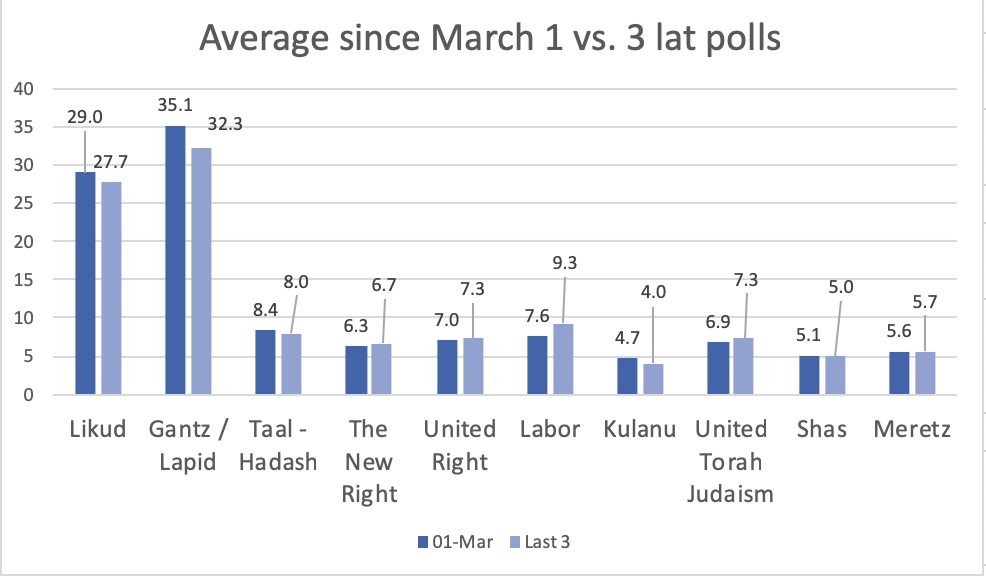
Here is a graph that includes all the parties who (on average) cross the electoral threshold in recent polls. In this graph we compare the averages of these parties for two periods. One – from March 1st. Two – last 3 polls. What do we see in these polls? That Kahol Lavan is losing seats. Some of their voters move back to supporting Labor. We also see that Likud lost some voters following the decision to indict PM Netanyahu. Zehut might be the beneficiary of that. In two of the last three polls Zehut got 4 seats (in the third polls it was pretty close to getting 4). Zehut, along with Kulanu, Meretz and Shas are close to the electoral threshold, and hence their fate is still in doubt.


What about the next coalition? It is complicated. In the second graph you can see the average of the Netanyahu base coalition. That is, all the parties that were part of the 2015 Netanyahu coalition. It is close to having a majority, but not quite there yet.


Now consider the last graph. What you see here (based on the last three polls) is what happens if we count Kulanu and Zehut in or out. Kulanu was part of the Netanyahu coalition but is not committed to continue with it. Zehut was not part of the coalition, but is considered by many to be a natural member of a right-religious coalition. What is clear from this graph is simple: in a base coalition, every member is king because without him there is no coalition. This means that the price Netanyahu will have to pay as he forms his coalition is going to be high. That is, unless there is another option – the option of unity with Kahol Lavan.


Israel’s Election Handbook: Kahol Lavan weakens Read More »
David Suissa Andrew Sullivan

What America Gets From Israel

The brouhaha over anti-Semitic tropes connected to Jewish “lobby power” in D.C. has brought to the surface an important issue: Is the U.S.-Israel relationship a one-way street? In return for the incredible support Israel gets from America, does it give anything back?

Among those who think America is getting a raw deal is prominent New York magazine writer Andrew Sullivan, who wrote last week that what the U.S. gets from Israel is “worse than nothing” because “The U.S. suffers internationally from this alliance.” 

Behind this American support, he says, is “a very powerful lobby that deploys the money and passion of its members to ensure that a foreign country gets very, very special treatment from the U.S.”

To show he’s not using any anti-Semitic tropes, Sullivan does what looks like a plain accounting of the relationship, which, according to him, boils down to this: America gives, Israel takes.

Unfortunately, by being so dismissive of Israel’s value to America, Sullivan ends up grossly distorting a special relationship.

A more honest accounting would have recognized the depth, strength and unique quality of the U.S.–Israel relationship, as laid out by historian and former Israeli Ambassador to the U.S. Michael Oren in a 2011 Foreign Policy essay.

“What is the definition of an American ally?” Oren asked.

“On an ideological level, an ally is a country that shares America’s values, reflects its founding spirit, and resonates with its people’s beliefs. Tactically, an ally stands with the United States through multiple conflicts and promotes its global vision.

“The brouhaha over anti-Semitic tropes connected to Jewish ‘lobby power’ in D.C. has brought to the surface an important issue: Is the U.S.-Israel relationship a one-way street?”

“From its location at one strategic crossroads, an ally enhances American intelligence and defense capabilities, and provides ports and training for U.S. forces. Its army is formidable and unequivocally loyal to its democratic government. An ally helps secure America’s borders and assists in saving American lives on and off the battlefield. And an ally stimulates the U.S. economy through trade, technological innovation and job creation.

“Few countries fit this description, but Israel is certainly one of them. As U.S. President Barack Obama told a White House gathering, ‘The United States has no better friend in the world than Israel,’ a statement reflecting the positions of Democrats and Republicans alike. The importance of the U.S.–Israel alliance has been upheld by successive American administrations and consistently endorsed by lawmakers and military leaders.”

Sullivan includes none of those benefits to the U.S. in his appraisal, presumably because it would undermine his one-sided take of “a very powerful lobby” ensuring that “a foreign country gets very, very special treatment from the U.S.”

In fact, had he done his homework about the American Israel Public Affairs Committee (AIPAC), he would have learned that its mission is “to strengthen, protect, and promote the U.S.–Israel relationship in ways that enhance the security of the United States and Israel.”

In return for its aid to Israel, Oren writes, “The United States receives not only an armed but an innovative ally, enhancing America’s military edge. That contribution is real and requires no lobbyists to fabricate it. While organizations such as AIPAC press Israel’s case in government and in popular forums, they represent American citizens who view the alliance with Israel as a national American interest.”

“Israel’s fundamental interests, like its values, are America’s,” he writes. “For the price of annual military aid equaling roughly half the cost of one Zumwalt-class destroyer, the United States helps maintain the military might of one of the few nations actively contributing to America’s defense.”

“Maybe you don’t have to be anti-Semitic to believe that the U.S-Israel relationship is a one-way street, but it certainly feeds the beast.” 

As Michael Eisenstadt and David Pollock wrote in 2012 for the Washington Institute, “The benefits to the United States of its relationship with Israel belie the argument that the alliance is based solely on the two countries’ shared democratic values, on the popularity of Israel in American politics, or on the elusive pursuit of progress in the peace process. It is a relationship based on tangible interests — and will remain so for the foreseeable future.”

Oren quotes former Secretary of State Alexander M. Haig, who once observed: “Israel is the largest American aircraft carrier in the world that cannot be sunk, does not carry even one American soldier, and is located in a critical region for American national security.”

The benefits of the U.S.–Israel relationship, Oren concludes, “are of incalculable value to the United States, far outweighing any price.”

One can acknowledge the many moments of tension and friction that have dotted the U.S.–Israel relationship and still agree that Sullivan’s take was hollow and blatantly one-sided. It’s as if Sullivan set a personal challenge for himself: Let’s see if I can go over-the-top on the “Israel lobby power” without being accused of anti-Semitic tropes.

Maybe you don’t have to be anti-Semitic to believe that the U.S-Israel relationship is a one-way street, but it certainly feeds the beast.

What America Gets From Israel Read More »
