fbpx

December 19, 2018

Temple Judea Students Enjoy ‘Respecting Elders’

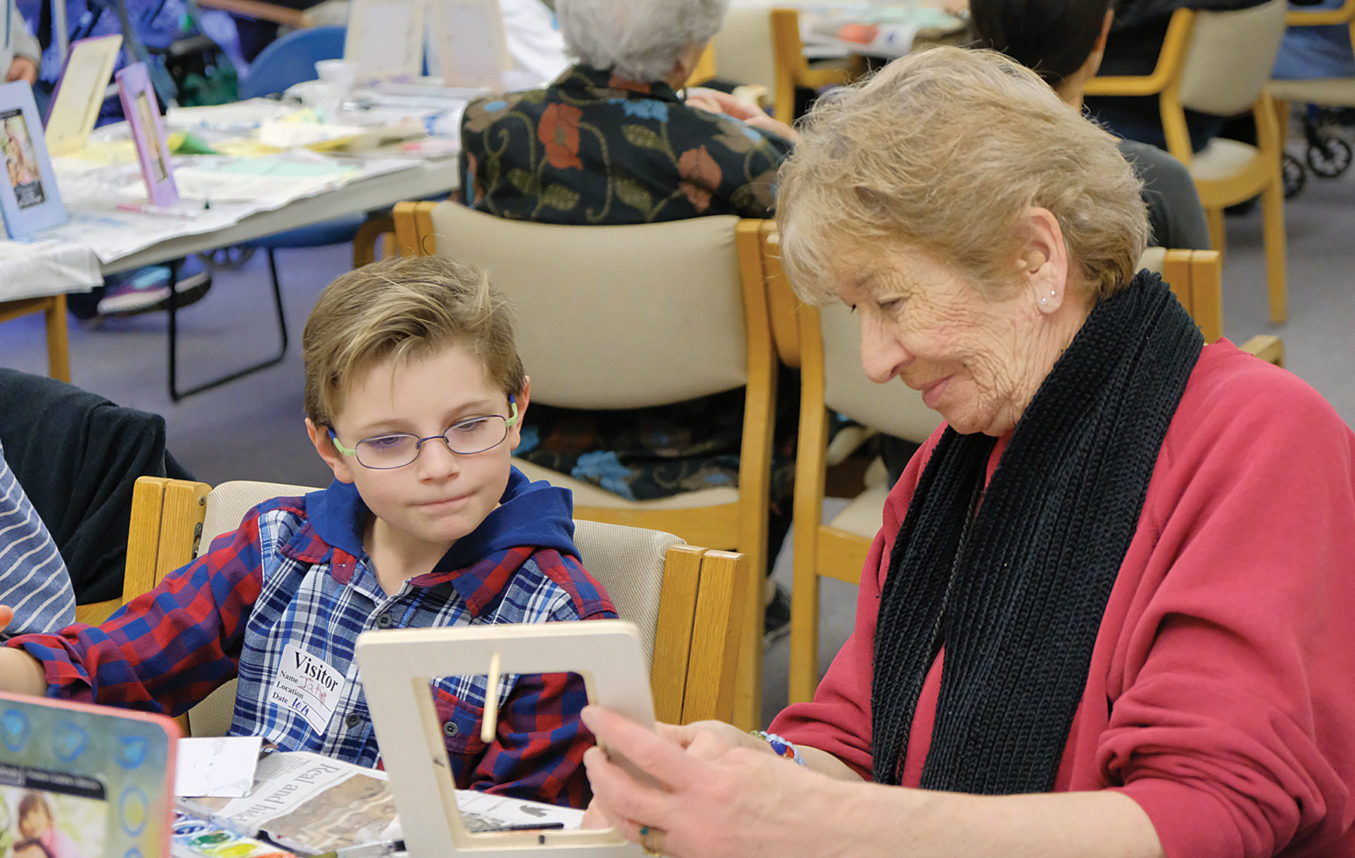
A group of 10-year-olds are busy decorating wooden picture frames with markers and watercolor paints. Alongside them, men and women old enough to be their grandparents are helping them. Once the frames are completed, their photos are taken and placed in the frames as a memento of the day.

The children are fifth-graders from Temple Judea in Tarzana and the adults are residents of the Los Angeles Jewish Home (LAJH) Eisenberg Village campus in Reseda. The event is part of the students’ mitzvah project, “respecting elders,” through a program with LAJH. 

“There’s a great deal of happiness derived from these programs,” said Caryl Geiger, activities director for Eisenberg Village, LAJH. She has been coordinating these types of programs for 33 years.

“At first, I thought I could understand how our residents would be very happy to see children, but I didn’t understand that the children [also] would be eager and happy to see our residents,” she said.

Resident Myra Blain said of the children’s visit, “It was wonderful to see [them]. They make me feel so good.”

Audrey Berger, another resident, added, “I miss my grandchildren and love being with the youngsters. This is fantastic.”

And student Sadie Leavens said, “I really enjoyed talking to my buddy about what we like to do in our free time and what we are good at.” 

The relationship began when Temple Judea fifth-grade teachers Lauren Elan Helsper and Ravit Sebbah started a pen pal program. The students wrote notes that were taken to the home and each child was then matched with a senior. 

During the students’ Dec. 9 visit, along with decorating the picture frames, they also brought socks for the residents (part of their mitzvah project sock drive) and pompom bookmarks they had made. 

Led by music teacher Elizabeth Woolf, the students sang for – and then with – the LAJH residents.

Accompanied by music teacher Elizabeth Woolf, the students sang “Oseh Shalom” and “Od Yavo Shalom” for the residents before celebrating the last day of Hanukkah with sufganiyot.  

“Part of respecting elders is going to visit them and interact with them, so I wanted to make sure we did something to incorporate that,” Elan Helsper said. 

“This shows the students how to practice the values they learn inside the classroom. L’dor v’dor — from generation to generation. They are really enjoying it,” Sebbah added.

“I hope this is the beginning of fostering a relationship between the residents and my students,” Elan Helsper said. “Our older generations have a lot of insight. They’ve accomplished a lot of things and we need to show them the respect that they deserve, and we can learn a lot from them.”

The teachers plan to maintain the relationship between their students and the residents with more letters throughout the year. They also hope to have another get-together by Passover.

Elan Helsper said doing a mitzvah is more than just opening your wallet or donating a can of tuna to a food drive. It’s about giving of yourself and it’s important to teach that to children.  

“I am hoping that is a lesson they will take from this and carry on into other aspects of their lives and teach that to their children,” she said. “I remember my mom used to take us to visit our great-grandmother once a month. I know it really meant a lot to her.” n

Temple Judea Students Enjoy ‘Respecting Elders’ Read More »

YULA’s Innovative New Nagel Family Campus

On a recent afternoon, in a special classroom on the Nagel Family Campus at Yeshiva University Boys High School in Los Angeles (YULA), loud machines whirred as students produced 3-D printed and laser-cut objects. YULA Boys’ Director of Innovation Rabbi Michael Cohen explained that the students were creating three-dimensional etchings of some of the monsters depicted in Homer’s epic poem “The Odyssey.” 

The classroom is one of three in YULA’s new Gelman Hall devoted to STEAM (science, technology, engineering, arts and mathematics), where students focus on state-of-the-art subjects including innovation, 3-D design, coding and robotics. 

“These are the rooms where you get prepared for jobs that don’t yet exist,” said Rabbi Arye Sufrin, a 10-year faculty member who became Head of School two years ago. “We have been around since 1979 with the mission to be consistent with the Torah values and hashkafah (religious perspective) of Yeshiva University, valuing and prioritizing Torah growth but also a synthesis of academic, general studies, co-curriculars and of course, character development. Our new facility takes our program to the next level.”

“High school years are very formative years in your life,” said David Nagel, president and chairman of the YULA Boys board for the past 11 years. “It’s a really important time to receive an impactful education. I am most proud of the fact that we built a campus that feels collegiate,” he added. “It’s hard to motivate high school kids in general. This gives them a jump. It’s an energizer.”

Touring the renovated campus, Sufrin pointed out three new buildings. Gelman Hall is a wing of experiential learning spaces, including the Schlesinger STEM and Entrepreneurship Center. The Samson Center, donated by Lee Samson in memory of his late wife, Anne, and including the Yoni and Lisa Wintner Family Court, is a multifunctional gym that can hold up to 700 people. It will also be used for theatrical productions, graduation and other special programs. And the Kestenbaum Commons is a collaborative learning center and student support center, which includes the Mintz Family Resource Center, where walls are transparent on both sides because, as Sufrin says, “there’s no stigma to student support.” He also noted that in the outdoor Robin Family Plaza, students get together between classes, right near the two batei midrash (centers of study), one of which houses a Sephardic minyan.

The $17 million project — a decade in the making, and under construction for the past two years — was spearheaded by the Nagel family, especially philanthropist Jack Nagel, who died in October at 96, and his wife, Gitta. (David is one of their four children.) Around 450 people attended the campus’s rededication on Dec. 9.

“This will be a type of educational center that will spearhead so many things beyond what normally would have been thought by YULA faculty.”  — David Nagel

The renovations were designed to encourage the school’s 178 students to learn and achieve, Sufrin said. Modular furniture and walls enable faculty members to expand their classrooms and students to gather in whatever study configuration is needed. “We don’t want to give you the idea, we want you to come up with the idea,” Sufrin explained. “We set up the infrastructure [so] that you’re able to use your creativity and your passion.” 

“Have you ever seen a school like this?” Gitta Nagel asked. “You can look far and near and you won’t find one. It’s very important for other schools and other cities to emulate this state-of-the-art high school.”

YULA is built on three pillars, Sufrin said: the primacy and relevancy of Torah, uncompromising general studies and character development. Students know these goals because a framed mission statement hangs in every room, and because Sufrin can pop-quiz them in the halls, as he did to one student during the tour. 

While about 40 percent of graduates feed into Yeshiva University in New York,  and 90 percent of graduates do a gap year in an Israeli yeshiva, Sufrin said that the school wants students to go to the college where they can grow the most. 

“We want to create mature thinkers who respect what others have to say even though you don’t agree, and who live a life of Torah values. Part of that is prioritizing and loving Torah as something that’s a part of who you are but also being a mensch,” he said.

“This was my husband’s and my dream for the last 19 years,” Gitta Nagel said. “We worked every day [on it].”

“The Nagels’ response to the Holocaust was to build Torah institutions, and they are role models for all of us,” Sufrin said. 

David’s parents gave the lead gift in 2003, enabling students to move from trailers into a real building. Once the Nagel name was on the campus, David became the lightning rod for complaints. The only way to get things fixed for good, he realized, would be to become board president. More than 60 donors contributed to the construction project, David said. Additional funds will be raised to modernize the existing building.

“This will be a type of educational center that will spearhead so many things beyond what normally would have been thought by YULA faculty,” David said. “It’s a tremendous opportunity for the school for generations to come.”  

“Of all the charities I am involved with, No. 1 every year is education,” Gitta Nagel said. “I always say, Jewish education is the spine. If we didn’t have a spine, we would crawl like animals on the floor.”

At the dedication, emotions ran high for the Nagels, particularly David, feeling the loss of his father. 

“He had the real vision,” David said. “He was the one who pushed me initially to get the campus finished. Seeing it completed but him not being at the dedication ceremony made it a very emotional day for me but, at the same time, it was a celebration. The last and most important thing that my father wanted to accomplish in his life for the L.A. Jewish community was done.”

YULA’s Innovative New Nagel Family Campus Read More »

Tel Aviv University Honors the Samuelis

Cocktail in hand, Gail Reiss, President and CEO of American Friends of Tel Aviv University (TAU), the stateside fundraising arm of Israel’s largest public university, summed up her elevator pitch to donors:

“I ask them, are you interested in Israel? Are you interested in education? Are you interested in investing in the next generation of thought leaders, not only for Israel, but for the world? If you are, Tel Aviv University is the place to be.”

More than 300 people convened at the Skirball Cultural Center on Dec. 12 for the TAU International Gala. The event honored renowned philanthropists Henry and Susan Samueli and highlighted the world-class research and innovation coming out of TAU. 

Guests schmoozed and flipped through pamphlets touting TAU achievements, including its history of producing founders of billion-dollar startup companies, where it is ranked ninth worldwide among universities. To date, TAU has been granted patents for more than 2,500 inventions. TAU also has a research partnership with cancer scientists at City of Hope in Duarte, Calif. 

“Living in Tel Aviv, you understand the university’s importance to the city, the community, to Israel and to the world,” Israeli actress and producer Noa Tishby, who emceed, the event told attendees. “Nothing embodies the spirit of Israeli resourcefulness, creativity and ingenuity, especially in the STEM fields, like Tel Aviv University.” 

As part of the evening, Tishby interviewed “Fauda” creators Lior Raz and Avi Issacharoff about their hit Netflix show. Issacharoff has a master’s degree from TAU. Another TAU alum, Gideon Raff, the creator of “Hatufim,” the Israeli show that was adapted into “Homeland” for American audiences, also attended the event. 

But the big stars of the evening were Orange County residents Henry and Susan Samueli, who were recognized for their philanthropic work with TAU. Henry is the co-founder of Broadcom Inc., and Susan heads up the Samueli Foundation, which backs nonprofits in education, integrative health, youth services and Jewish culture. 

The Samuelis, who own the Anaheim Ducks National Hockey League franchise, recently donated a $20 million gift to establish the Susan and Henry Samueli Engineering and Health Research Fund at the University. They’ll also name a new building currently under construction on the TAU campus, funded by Broadcom, which will house both Broadcom’s R&D Center in Israel as well as its Faculty of Engineering.

“It’s a pleasure for Susan and I to be here to show our support for Tel Aviv University,” Henry told attendees. 

Robin Schoenfeld, who lives in Tarzana and is a Valley Beth Shalom member, has been a longtime friend of the Samuelis since meeting Susan in a “Mommy and Me” class years ago. She told the Journal that their giving nature comes as no surprise to those who know them.  “They’re always looking outside of their own welfare and into benefiting the larger community,” she said.

Amiel Farnam, 33, a TAU alum, graduated last year with a master’s degree in Emergency and Disaster Management. He now works for the city of El Segundo as its Emergency and Disaster Manager, providing training and strategizing on everything from earthquake preparedness to domestic terrorism. 

“Being here gives me a feeling of pride,” he said. “It’s amazing to see that here, in Los Angeles, people are lined up to not only support, but also pay respect to Tel Aviv University for what it does for the community, Israel, the world and all the students that go there.” 

Orian Raviv, 21, is a student at the University of Southern California (USC). She attended the gala to represent USC’s Hillel and to learn more about TAU, since she hopes to attend its Sackler School of Medicine someday. 

“I tell all my friends I want to go to Tel Aviv University,” she said. “But it’s also really cool the ‘Fauda’ guys are here.” n

Tel Aviv University Honors the Samuelis Read More »

Heaven-Scented Hamin: Slow Food for Warm Souls

There are some dishes that require a few chefy techniques to come out well, although I maintain those are few and far between. Then there are classics, like chicken soup, that once you know the tricks, they require no more measuring or tinkering to be consistently pleasing.

Then there is a hamin or a cholent, depending on where in the world your people came from, which like all good peasant food requires very little in terms of technique, rather some tips passed down through the generations. 

A cholent, a uniquely Jewish food, is a Shabbat dish that was born out of its observance. It is prepared on Friday afternoon before sundown and cooked overnight at a very low oven temperature, then eaten Saturday for lunch after returning from services. This provides a hot, hearty meal without violating the commandment against cooking on the Sabbath. In Israel, there are still whole communities in Jerusalem that cook their cholent communally, usually in a town baker’s wood-fired oven; a revival of dish’s popularity in Tel Aviv has many restaurants selling it made to order by the pot.

Food historians attribute the word cholent to the French chaud lent, meaning “to warm slowly.” Food journalist and cookbook author Joan Nathan theorizes the dish likely originated in ancient Israel and migrated to France and then to the rest of Europe. Apparently, when the Spanish Inquisition forced the Jews out of Spain and into Eastern Europe the dish’s ingredients changed from lamb and chickpeas to beef, beans, barley and potatoes. 

For the Jews who escaped Spain and fled to northwestern Africa across the Strait of Gibraltar, the ingredients of the hamin evolved according to what was available locally, and called a dafina, which means “covered” in Arabic. The dish traditionally was buried in a pit and covered with hot ashes on the eve of Shabbat, with household residents picking up their cooked treasure on their way home from synagogue. Although the recipe for a Moroccan dafina varies from city to city and from family to family, every Jewish house was distinguished by its dafina, and legend has it that the noble rabbis could sense the peace and holiness of the house from the smell of the Shabbat stew. While the spices of an Eastern European cholent usually are restricted to salt, pepper and paprika, a Moroccan dafina usually includes sweet potatoes, honey, cinnamon, cumin and dates. 

Sephardic Jews tend to include packages of rice and brown eggs called haminados in their hamin but Ashkenazi Jews tend to use root vegetables and kishke, a sausage made of shmaltz, flour and vegetables. The Jews of France adopted a version of this stew and called it schalet. Jewish food historian Gil Marks said all three versions — hamin, schalet and cholent — consisting of beans and meat, seasoned with onions and slow-cooked overnight, were the basis for the iconic southern French cassoulet, and that there is a good chance the medieval dish had its roots in Judaism.

Because Jews have been scattered all over the world for centuries, there are as many recipes for a hamin as there are cooks. In Israel, I once sampled an exquisite hamin prepared by an Argentine cook who slow cooked duck breasts stuffed with pasta and stewed with prunes. The long tradition of hamin, distinguished by region and imbued with the flavors of many cultures, is also one of extended family and even neighbors. After all, one cannot make a cholent for two; by definition, it is an experience of communal eating. And although you must plan ahead to make it, soaking the beans and grains overnight is hardly cause for concern. From there, it is a straightforward and meditative one-pot wonder that hardly involves the interference of the cook except for the very beginning of the process. 

While I prefer to cook my cholent in the oven, I know there are many who use a countertop slow cooker, a tool that can be turned on and forgotten about until the next day. I also don’t, as many do, add ketchup, cola or honey to my cholent; rather I employ some techniques using caramelized sugar, onion skins and a tea bag to deepen the signature brown color of the dish.

Cholent enthusiasts are divided over whether to pre-sear the meat but I am adamant in searing it although it’s an extra step.

In addition, I also always include chicken thighs and homemade chicken stock in my cholent. The reasons for this are obvious: Shmaltz imbues the flavor of beans and everything it touches with a savory quality that cannot be replaced, and the gelatin produced by the chicken bones in the stock creates a “protein crust” and a viscosity that is otherwise impossible to achieve without it.

Even though I tend to identify with my Sephardic side, certainly when it comes to my food tastes, this is one case where I move more toward my Ashkenazic side. I prefer kishke over rice and white beans over chickpeas. I don’t use any Middle Eastern spices, opting for the more traditional paprika, salt and pepper only. The nod to my Sephardic side ends with the insistence on adding haminados in the pot. I tend to serve my cholent with a variety of fresh salads and pickles. I find the acidity in the dressing necessary to cut the richness of the stew.

As for leftovers, this is one stew that guests are happy to take home but if not, it makes a wonderful soup the next day, thinned with some extra broth and served with toasted bread. It’s almost like another dish entirely.

As we enter the darkness and chill of winter, it doesn’t matter what you call it — cholent or hamin, dafina or schalet — as it always has been, this is one dish that will perfume the houses of Jews on Shabbat until the end of time. 

YAMIT’S CHOLENT
2 tablespoons oil or chicken fat
4 large kosher chicken thighs (skin on)
2 pounds fatty, kosher beef-brisket, flanken or short rib, chopped into 2-inch pieces
2 large yellow onions, cleaned and chopped (reserve skins)
5 cloves garlic, peeled and left whole
1 pound russet potatoes, peeled and quartered
1 pound sweet potatoes, peeled and quartered
2 large marrow bones, soaked in salted water until very white
1/2 pound dried white beans or cannellini beans, soaked overnight
1/2 cup pearl barley (or wheat berries or freekeh), soaked overnight
2 teaspoons salt
1 teaspoon black pepper
1 tablespoon sweet paprika
1 tablespoon sugar, caramelized in a pan until brown
1 quart (or to cover) strong chicken stock
1/2 pound kishke, plastic casing removed
6 large eggs, boiled for 3 minutes and drained
1 black tea bag

In a large, 10-quart, heavy-bottomed pot with a tightly fitting lid, brown the chicken thighs and beef in oil. Remove the meat, set aside and fry the onions until soft. Add the garlic and fry until the aroma rises.

Add half the potatoes and sweet potatoes to the pot, add the marrow bones and arrange the beef, chicken, drained beans and barley on top, and then the other half of the potatoes sprinkling each layer with salt, pepper and paprika as you go. Add the caramelized sugar.

Cover with stock. Steep teabag in a cup of boiling water or stock and add the liquid to the pot. Add onion skins. Bring pot to a boil. Remove any scum that rises. Arrange kishke on top and then the eggs. Make sure all items are submerged at least 3/4 of the way in liquid and then put the lid on and transfer to the lowest-temperature oven (200 degrees F.) overnight.

Check on it in the morning and add boiling water should the stew look dry. Cook for at least 14 hours and up to 18 hours before serving.

Serves 12.


Yamit Behar Wood, an Israeli-American food and travel writer, is the executive chef at
the U.S. Embassy in Kampala, Uganda, and founder of the New York Kitchen Catering Co. 

Heaven-Scented Hamin: Slow Food for Warm Souls Read More »

Speech Pathologist Challenges Texas Anti-BDS Law

A speech pathologist is challenging Texas’ law cracking down on the Boycott, Divestment and Sanctions (BDS), arguing that it’s a violation of her First Amendment rights.

The pathologist, Bahia Amawi, refused to sign a pledge from her employer, Pfugerville Independent School District in Austin, that she said would have required her to “not boycott Israel during the term of the contract.”

“I was shocked because I didn’t know what my position as a speech therapist helping kids improve their language in an elementary school had to do with economic harm to Israel and why the government was trying to be involved in restricting me in boycotting a certain entity,” Amawi told the Dallas Observer. “I felt like my rights were taken away and that I had no choice in what products I could purchase.”

Amawi also told The Intercept that she couldn’t sign the pledge because she would “be betraying Palestinians suffering under an occupation that I believe is unjust.”

The school district requires all employees to sign the contract under Texas’ anti-BDS law, which bars the state from contracting with entities that engage in boycotts of Israel. It was signed into law in May 2017.

Amawi has called the law “a violation of my civil liberties and really everyone’s who is an American citizen.”

However, George Mason University School of Law Professor David Bernstein has argued in Reason that the law does not violate the First Amendment.

The school district certification applies to the business, ‘it,’ not the individual ‘she,’” Bernstein wrote. “Contrary to what I’ve been reading all over the internet, Ms. Amawi is not being asked to pledge that she, in her personal capacity, will not privately boycott Israel, much less that, e.g., she will not advocate for boycotting Israel or otherwise refrain from criticizing Israel.”

Bernstein explained that this means that Amawi simply can’t take any action in a business capacity that would result in a boycott of Israel as an employee of the district, but she is free to engage in such boycotts on her own time.

“Supreme Court precedent, mostly to my chagrin, seems rather clear that this is constitutional, and that the protected class in question need not be an individual or minority group — in Rumsfeld v. FAIR, the Court held that the law school plaintiffs had no First Amendment right to boycott military recruiters in the face of a federal statute barring recipients of federal funds from discriminating against those recruiters,” Bernstein wrote.

Bernstein added that because of this, the lawsuit “will almost certainly lose.”

“It’s nearly impossible to think of a way in which Ms. Amawi’s speech pathology business would ever have an opportunity to in any way boycott or otherwise economically harm Israel, rendering this pure political theater,” Bernstein wrote.

Speech Pathologist Challenges Texas Anti-BDS Law Read More »

Weekly Parsha: Vayechi

One verse, five voices. Edited by Salvador Litvak, Accidental Talmudist

[Israel] instructed them, saying to them, “I am about to be gathered unto my kin. Bury me with my fathers in the cave that is in the field of Ephron the Hittite.” Genesis 49:29


Miriam Yerushalmi
Author, CEO of SANE

This week’s parsha is called Vayechi, “And he lived.” Yakov spent the final 17 years of his life in Mitzrayim, Egypt. There, he “lived” quietly, peacefully, with no external threats and no internal drama, free to learn Torah in comfort, surrounded by his entire intact family. Yet he requested that in the end, he “be gathered unto my people” and buried “with my fathers” — back home in Canaan!

This is an eternal message to us. You may be living in a foreign land, comfortably ensconced in mitzroyim, the “narrow straits” of physicality and worldly temptations. Yakov’s message is that, yes, in that foreign land he lived what seemed to be the good life, but it was not the place where he belonged. It was, however, necessary, and allowed him to return whole to his true home, to our father in heaven.

It is through this world, this foreign land, that we can reach the higher heights of our true home. 

My children once rescued a bird that had been hit by a car. We kept it in a cage to recuperate until its wings healed, to protect it from predatory creatures. The bird, though, did not appreciate the protection; it felt trapped, and continually tried to break free. We are like the bird, in the cage of this world. If we recognize this world is a protective cage for us, we can utilize our time here to grow stronger in holiness, and make ourselves worthy to be “with our fathers.”

Rabbi Aryeh Cohen
American Jewish University

Two separate speech acts, signaled by two verbs (“and he instructed,” “and he said”) begin this short but complicated verse. Jacob’s command (“bury me with my ancestors”) encloses his statement (“I am about to be gathered unto my kin”). Jacob announces his death and, at the same time, commands his sons to bury him. This story (Genesis 49:29-33) rehearses almost exactly the short opening tale of this series when Joseph is summoned to his father’s bedside as he lays dying (47:28-31). There is, however, one significant difference. In our story, Jacob recounts the history of Abraham’s real estate deal with Ephron the Hittite. The deal is introduced in our verse, expanded upon in the next verse and then the second verse after that. 

Why?

Jacob presents himself as a Diasporic Jew. There is no mention of the promise of the whole Land, there is no mention of the return. Jacob is connected to the land, not by force of capture, nor by Divine intervention, but, rather, through family and a piece of real estate bought at a fair price from its original owner. Jacob’s return, in death, to Canaan was brokered with Pharaoh, and conditioned upon a return to Egypt.

This minimalist story of Jewish existence has always existed in tension with the maximalist version in which there are no others with whom we need negotiate. Nowadays, it seems that the maximalist version is leading us down the primrose path to perdition. 

Ilana Wilner
Shalhevet High School/Judaic Studies Teacher and Director of Student Activities

In our verse, Yakov turns to all of his sons on his deathbed, commanding them to bury him in Israel. This request is familiar: Yakov earlier implored his son Yosef to bury him in Israel. However, now when turning to all his sons, he asks to be buried in Maarat HaMachpella alongside Avraham, Sarah, Yitzhak, Rivka and his wife, Leah. What has happened in the interim that he makes this specific request of his sons? 

After Yakov instructs Yosef on his burial, he blesses Yosef’s children, Ephraim and Menashe, yet switches his hands and gives the blessing of the bechor, the oldest child, to Ephraim, who is the younger one. Yosef is shocked by his father’s overt favoritism and tries to correct Yakov. Seeing Yosef’s reaction, Yakov learns from his own favored son the importance of treating all his sons equally. He now gathers all his sons as one, “all of these are the tribes of Israel,” while also giving them each a bracha, a blessing, “appropriate for them.” 

Here, Yakov is making amends. Not only does he now turn to all his children but he makes clear — and perhaps understands himself for the first time — that he needs to be buried alongside Leah, the less favored wife and the mother of the less favored children. Yakov , in this final request, is repairing his relationships and teaching us a valuable lesson that no one person can carry the legacy. It must be the collective group, and in doing so, he creates Bnei Yisrael, the nation known as the Children of Israel. 

Rabbi Tal Sessler
Sephardic Temple

The name of our parsha is a veritable oxymoron. Vayechi means “And he lived,” and yet —everybody — dies in this parsha. Jacob dies, Joseph dies, and in the associated haftarah from Scripture, King David dies. The Talmud suggests that “Jacob never died” because we — his spiritual descendants — are still alive. In other words, because Jacob left a lasting legacy for perpetuity. 

In Amos Oz’s novel “My Michael,” the heroine asks her husband what does he live for. His answer? Most people don’t live for something, they simply live by way of sheer physical inertia. To live spiritually, like Jacob, Joseph and King David did, is about so much more than mere biological facticity. It is about living up to the four L’s of spiritual real estate, as articulated by Steven Covey, namely to “live,” “love,” “learn” and “leave a legacy.” “To live” entails enjoyment, “to love” is about cultivating relationships, “to learn” is about constant growth, and “to leave a legacy” is about leading an impactful existence whose effects continue to reverberate and loom large long after we are physically gone. 

Lamentably, observes Rabbi Jonathan Sacks, some people live without a compass or a sense of purpose. Such people “can spend months planning a lavish party or a vacation, but not a single day to plan a lifetime.”

Nietzsche famously preached “to live dangerously.” The Torah invites us to live forcefully, with passion and vigor, with intensity and with boundless joy, with the dignity of a purpose, and with the loftiness of a vocation.

Rabbi Aryeh Markman
Executive Director, Aish LA

What will be your very last words?

Jacob leaves a cryptic message that there is a next world and to bury him in Israel, and then expires immediately afterward. 

Jacob was sending a missive to the Egyptians that we Jews are never going to be naturalized. He knew the Egyptians were planning to enslave the Jews. He had to orient his descendants’ hearts and minds toward their true inheritance: the Promised Land. And yet only 20 percent of the Hebrews left Egypt when the choice was before them on Passover night.

Jacob knew he was establishing sentimental, indestructible ties linking Israel to wherever his descendants would find themselves throughout history. Even in death we can influence our family for centuries to come. 

By linking the children of Jacob to his burial site, they would be connected forever to the Patriarchs and Matriarchs, and to their message: Your life will create your afterlife. Furthermore, Jacob incentivized the Jews to never give up the land that possessed the burial Vault of their Forebears. He knew the Jews would need a place to supplicate to the Almighty, as we do today, when bereft of the Temple. 

Inspired by Jacob, my wife and I hope to be buried in Israel. We think about what we will write on our tombstones as an eternal communique to our great-great grandchildren. 

What would you like to say and where would you leave it? Send a message for the ages to ensure the continuity of our future generations.

Weekly Parsha: Vayechi Read More »

Poem: Adonai Echad

Shema yisrael, adonai elohenu, adonai echad — 

watchword of the Jewish faith, declaring the oneness of God 

Listen Israel —

The lord is one.

The world is one.

Everything one. 

Created by the same creator

with the same atomic particles

in the same black bang.

Are you listening? 

No one is. 

We’re terrorized by terrorists,

suffocated by the smell of strangers 

who don’t know the lyrics to our song,

crawling back from AI truth

to 3-D myths of yesteryear

waiting for the savior 

who’ll convert our H2O to wine.

Ritalin’d and Klonopin’d, 

all we really want is peace

and a smaller piece of humble pie

in universe of blackened holes 

unmoved by what we’re praying for —

like prisoners trapped in Plato’s cave

unsure of the source of light.


Paula Rudnick is a former television writer and producer who has spent the past 30 years as a volunteer for nonprofit organizations. In the past several years, she has begun to write poetry — another nonprofit endeavor.

Poem: Adonai Echad Read More »

Jewsraelis: A Cultural Revolution

A vast array of data proves that Israel’s Jews reinterpret Judaism by mixing tradition and nationalism, making questions of continuity obsolete. 

After King Cyrus allowed the Jews in Babylonia to return to the Land of Israel in 538 BCE, most of them chose to remain in exile. They may have missed their country but their longings didn’t include a strong desire to settle there again. Such attitudes persisted into the 20th century when Jewish-American rabbi and thinker Arthur Hertzberg decreed that “The character of the Jews is of sophisticated nomads.” They love their homeland passionately, but at the same time are also “the most cosmopolitan people.”

Not anymore.

Zionist thinkers, from their early days, believed that the role of a national homeland was to rescue the Jews and Judaism from their cosmopolitan state. Historian Ben-Zion Dinur expressed that view without mincing words: “There’s one problem with Judaism, and it is called exile.” Thus, political Zionism stressed the need to offer the Jews a physical refuge from anti-Semitism. Its adherents had woken up from the dream of integrating among other nations and believed that only a defined and secure geographic territory could sustain the Jews. Spiritual Zionism emphasized the need to offer the Jews a cultural refuge from assimilation. Its adherents realized that the prospect of preserving Judaism when among other nations wasn’t viable. They believed that only a defined geographic territory could supply Judaism with the spiritual energy for its continued existence. In other words, political Zionism wanted to rescue the Jews from the dangers threatening them from the outside, whereas spiritual Zionism wanted to rescue the Jews from the dangers threatening them from the inside. 

“Israel, we strongly believe, is indeed a hub of a revolutionized Judaism. It is the hub of a new Jew.”

Both of them, and all other sub-streams of Zionism, developed the concept of the “new” Jew and its multiple meanings. The idea of the “new” Jew, like the principle of Diaspora negation, explained Prof. Yitzhak Conforti of Bar Ilan University, “provided a middle ground for all forms of Zionism.” All Zionists rejected the Diaspora, “and all saw a need to create and educate a new Jew. However, each of the various forms created a type of new Jew that reflected its particular ideology.”

So, Zionists expected a new Jew to emerge. They were correct in their assessment — a new Jew was born. It was born and had grown and is now standing on both feet. A book penned by me and my co-author, professor Camil Fuchs, “#IsraeliJudaism,” presents this new Jew in detail. Israeli Judaism, we argue, is Judaism like none other today or throughout history. It is a new type, a new branch of Judaism. As the subtitle for our book states — “A Portrait of a Cultural Revolution” — Israel, we strongly believe, is indeed a hub of a revolutionized Judaism. It is the hub of a new Jew.

We base our conclusions on a vast amount of data. Fuchs, a mathematician at Tel Aviv University, is Israel’s leading statistician and pollster. And so, I asked him to join me in running a comprehensive study about Israeli Judaism for The Jewish People Policy Institute (JPPI), where I am a senior fellow. Our task was simple: 70 years after Israel was born, identify the main characteristics of its Jewish culture. We did not want to make guesses or come up with intellectual theories that look good on paper — we wanted hard evidence. We wanted to know what the Jews of Israel are doing culturally in their everyday life. 

To achieve this, we ran surveys with more than 3,000 respondents — that’s a very big sample for a society of 6 million. (The average Israeli survey you read about in the newspaper includes 500 participants.) We asked each of these Israeli Jews close to 400 questions. To supplement our findings, we dug out many hundreds of other data sets, studies and books about Israel. As a motto for our research we chose a quote from the Talmud: “Pook hazi mai amma davar” — Go out and observe what the people are doing.

We now know what they are doing. We know Israelis practice a new brand of Judaism born from mixing traditional sentiment and national sentiment in a way that makes the two indistinguishable. In many cases it is very hard — maybe impossible — to determine where the Jew ends and the Israeli begins, or where the Israeli ends and the Jew begins. Most of us — 55 percent, to be exact — are Jewsraelis.

To reach this conclusion, we scanned many thousands of data points and used several methodologies of statistical analysis (that is to say, Fuchs ran statistical analyses while I was waiting impatiently for the results). Our most telling model was locating the Jews of Israel on a graph with two dimensions — one for tradition, one for nationality. We used 32 questions from the survey to create a map. If a Jew lights candles on Friday night, they get a point for tradition. If they shop on Shabbat, they get a point for nontradition. 

And of course, this exercise was not meant to make a point about the appropriateness or inappropriateness of doing this or that on Shabbat. As we were writing this book, we agreed to be as nonjudgmental as possible when we looked at what the Jews of Israel do. In fact, it was impossible for us to be judgmental, because we are two authors who often disagree on the appropriateness of this or that. I am much more traditional and conservative than Fuchs. Do we approve of shopping on Shabbat? It does not matter, because all we do is measure it. And then we apply numbers to it, to differentiate between a person who does the traditional thing (no shopping) and a person who does the less traditional thing (shopping).  

We measure points of Jewish tradition, such as keeping Shabbat laws, and we measure behaviors of Israeli nationalism, such as raising the Israeli flag on Independence Day. Those who raise it get a point for nationalism. Those who say that Israel should not be a Jewish but rather a neutral civil state (about 9 percent of the Jewish population), get a point for non-nationalism.

Our map shows a Jewish population divided into four unequal groups. The majority is the group of Jewsraelis — that is, the Jews who score high on keeping Jewish traditions and on keeping national practices. Here is one example of what such Jews look like: 38 percent of Jewish Israelis raise the flag on Independence Day (nationalism) and make Kiddush on Friday night (tradition) and say that it is important for them to be Jewish (level of intensity). The percentage of Jewish Israelis who don’t make Kiddush and don’t raise the flag and say it’s not important for them to be Jewish is much smaller — 8 percent. 

So, we have four groups: Those practicing tradition and nationality (“Jewsraelis,” the 55 percent majority); those who mostly practice nationality (15 percent we call “Israelis” in the book, who tend to come from secular quarters of the old-fashioned Labor Party Zionists and whose culture is relatively devoid of keeping Jewish traditions); those who practice mostly Jewish traditions and many fewer Israeli customs (17 percent we call “Jews,” who are mostly Haredi Israelis); and those who, relatively speaking, practice neither (13 percent we call “Universalists” — urban, liberal, left leaning and often alienated from other Israelis.).

A few myths are refuted in our book that American Jews should know about.

One myth — that Israel is becoming more religious — is not true. The secular group is growing rapidly. In the book we include a story about a huge battle in the city of Petach Tikvah in the 1980s over the opening of a movie theater on Shabbat. (I remember it as a young soldier at the time.) That was a big deal. Policemen on horses were called in to calm violent demonstrations. The government was shaking. It seemed like a serious cultural crisis. Now, 30 years later, 98 percent of all movie theaters in Israel are open on Shabbat. 

“If you consider tradition rather than religion — and in the book we make an effort not to confuse them — Israel’s Shabbat is still strong.”

Another example that we already touched upon: the issue of shopping on Shabbat. Not long ago, suggestions for a possible grand bargain between secular and religious Israelis in regard to Shabbat included the idea of having cultural institutions open and commercial enterprises closed. One such suggestion was authored by two renowned Israeli intellectuals — Rabbi Yaakov Medan and law professor Ruth Gavison. They thought they were both compromising — he, by accepting a reality of opened cultural institutions such as movie theaters; and she, by agreeing to keep shopping malls closed. 

Our book questions whether such a proposal would be practical today. That’s because, according to our numbers, a clear majority of secular Israelis (about half of all Jews) shop on Shabbat. Shopping on the day of rest has become a habit for them, a part of their weekend culture. Rolling it back would be difficult, if not impossible. Rolling it back would also ignite the kind of political battle that politicians tend to avoid. So again, when it comes to halachic Shabbat observance, Israel is secularizing.

Does this mean Shabbat as a cultural Jewish phenomenon is also weakening? That depends on your viewpoint. If you only consider an Orthodox religious version of Shabbat to be a worthy exercise, then the answer is yes. There is less religiosity and less religious coercion of rules in the public sphere. However, if you consider tradition rather than religion — and in the book we make an effort not to confuse them — Israel’s Shabbat is still strong.

In 65 percent of Israel’s Jewish homes, candles are lit on Friday night. In 68 percent of these homes, Israelis make a Kiddush. More than 80 percent of Jewish Israelis have a family meal on Friday night — that’s tradition. Jewish Israelis keep many of the Jewish traditions, but without the need to be religious or follow the script dictated by ancient religious texts. 

Take another example: A clear majority of Jews in Israel light Hanukkah candles for eight days. They light the candles more than American Jews, even though Americans attribute more importance to Hanukkah than do Israeli Jews do — for whom it’s not such a major holiday. Israelis light candles because this is what we do in Israel. It’s an integral part of life. We have a seder on Pesach, we raise the flag on Independence Day, we dip apples in honey on Rosh Hashanah. And by “we” I mean almost all of us. 

And yes, we also have this habit of confusing, or mixing, Jewishness and Israeliness. Thus, Independence Day becomes a Jewish holiday — not an Israeli holiday. Most people who celebrate it are Jews. The flag they raise is Jewishly themed. The ceremony on Mount Herzl includes 12 torches lit by 12 Israelis who represent 12 tribes. Why 12? Read the Torah and find out. Why torches? Go to the Mishna and find out. Independence Day is a civil celebration like all other Independence Days in all other countries. But it is also very much a part of a new Jewish calendar. The Jewish calendar of Jewish Israelis. The themes of the day make it Jewish, and also the views of the people celebrating it.

We asked the Jews of Israel many questions about their beliefs and values, and from their answers it is easy to extract a simple reality: many of them no longer see a difference between being a good, patriotic and contributing Israeli to being a good Jew. The lines blur. The culture is a melting pot of tradition and nationalism.  

For instance, there are non-Jews serving in Israel’s military, such as Druze and Bedouins. Nevertheless, more than 70 percent of Jewish Israelis believe that to be a “good Jew” one must serve in the Israeli army. There are many non-Jews living in Israel as good citizens — one-fifth of the population is not Jewish, most of it Muslim, a small minority Christian. Nevertheless, two-thirds of Jewish Israelis believe that to be a “good Jew” one must educate their children to live in Israel. 

Combining these many findings — just a tiny fraction of which we have in the book — you get a new picture of Israel’s Jewish society and of Israel’s Jewish culture. It is a society that moves away from religion and from religious coercion, but does not move away from Jewish traditions. It moves away from the control of rabbis and the mandatory observance of certain practices, but does not move away from voluntary, relaxed, widespread Jewish practice.

It is a society whose Jewish culture is no longer as mobile as Judaism used to be. This is Judaism connected to living in a certain place, surrounded by certain people, governed by certain rules. Israel is the only place such Judaism works — and it works without much need for worry about its long-term viability.

What about Jewish continuity? For many Israelis that’s a weird question — a question for the Diaspora. The continuity of Israel’s Jewish culture is very much ensured by the environment in which they live.  

We begin our book by explaining how Israel serves as the answer to three challenges of the modern world. “Since in the modern world nations exist in civil states — we will build for the Jews a civil state; since in the modern world religion no longer serves as a strong glue for Jews — we will gather them to a place in which their Judaism no longer depends on strict observance of halachah; since the modern world makes it easy for Jews to assimilate and disappear — we will offer a social framework in which there is not much opportunity for assimilation.”

“Two-thirds of Israelis say it is “very important” for them that their children will be Jewish. Nearly two-thirds of Jews have complete confidence that their children will indeed be Jewish.”

Israel is all this. And judging by the numbers, it is a great success. There is little to no assimilation in Israel. There is little, if any, erosion of the extent to which Jews feel Jewish. Hence, worry about “continuity” — a concept American Jews are highly familiar with — is practically nonexistent in Israel.

We asked the Jews of Israel: On a scale of 1 to 10 — 1 having no confidence and 10 having complete confidence — to what extent are you confident that your children will also be Jewish? (How can anyone have complete confidence in having a certain future for one’s children? Well, one can live in Israel and thus have it.) 

If you want to understand the stark difference between Israeli Jews and American Jews by looking at just one set of numbers, this is probably the one you ought to look at. A strong majority of Jewish Israelis, 61 percent, have complete confidence — that is, a 10! – that their children will also be Jewish. A vast majority, 86 percent, rank it from 8 to 10. And when we asked the same question about whether their grandchildren will be Jewish, the number of responses ranking confidence from 8 to 10 were only slightly lower — 79 percent.

So, either Israeli Jews are fools and don’t understand where they live, or they understand and internalize what it means to be Jewish in Israel. It means that if Israel survives (that’s for another article, about a different topic), Jewishness survives. Not just survives — it thrives.

Two-thirds of Israelis say it is “very important” for them that their children will be Jewish. Nearly two-thirds of Jews have complete confidence that their children will indeed be Jewish. Maybe that’s why the Jews of Israel are happy. 

That, and the wonderful December weather.


Shmuel Rosner is senior political editor. For more analysis of Israeli and international politics, visit Rosner’s Domain.

Jewsraelis: A Cultural Revolution Read More »

Wording of Survey’s Questions Matters

new survey by Shibley Telhami of the University of Maryland shows that an increasing number of Americans support a one-state solution for Israel and the Palestinian territories. “When one considers that many Israelis and Palestinians, as well as many Middle East experts, already believe that a two-state solution is no longer possible, especially given the large expansion of Israeli settlements in the West Bank,” Telhami writes, “it’s not hard to see why more people would be drawn to a one-state solution.”

Is this new finding important? It is and it isn’t.

It’s important because it shows that Israel fails to communicate its position to American audiences, especially Democratic voters and younger voters (of which 42 percent support a one-state solution).

It’s not important because the one-state solution is still not a viable option, and thus not an option.

Telhami conducts his poll every year, and almost every time, I write critically about it. This is because his polls, conducted under the pretense of being impartial, in fact raise the suspicion that they are an act of advocacy for certain positions.

Take the question of the one-state solution. What it offers is a mirage. “A one-state solution: A single democratic state in which both Jews and Arabs are full and equal citizens, covering all of what is now Israel and the Palestinian Territories.”

Sounds good? It does. In fact, I see no reason why Americans wouldn’t support such solution to a nagging problem. But what would happen if the survey question were reworded to reflect a more plausible outcome: “A one-state solution: An attempt to establish a single state that is likely to result in Jews and Arabs constantly fighting for control and spilling even more blood than today.” Would Americans still support it?

Another choice offered to Americans is this: “Do you favor the Jewishness of Israel more than its democracy” or “Israel’s democracy more than its Jewishness”?

Presented with this false dichotomy, most Americans give the answer you’d expect. They favor democracy (one wonders: should non-Jewish Americans even worry about Israel’s Jewishness?)

Telhami argues (in the publication Foreign Policy) that “What many read as a rising anti-Israeli sentiment among Democrats is mischaracterized; it reflects anger toward Israeli policies and … the values projected by the current Israeli government.”

The semantics Telhami uses here (and he is not alone) are simple: Place the bar for being anti-Israel so high that it becomes almost impossible to reach. That’s convenient, especially for anti-Israel activists.

I know that in left-wing circles it’s becoming popular to argue that being anti-Israel is not akin to being anti-Semitic. But read this question and see if it makes you feel somewhat uneasy: “How much influence do you believe the Israeli government has on American politics and policies?”

The answer, of course, is that the Jews (and by this, we mean the Jews of Israel — not the good Jews of America) might have too much influence. Fifty-five percent of Democrats think they do; 44 percent of young Americans think they do. Would they also say that the governments of Russia, Saudi Arabia, Great Britain or China have too much influence on American politics? I bet many of them would — but Telhami didn’t ask.

Americans want fairness, and hence many of them expect their government to “lean toward neither side” when “mediating the Israeli-Palestinian conflict.”

But how does one measure “leaning?” Here is an example: If the U.S. government says, “We would not tolerate Palestinian suicide bombers killing innocent people in Tel Aviv,” does this count as “leaning” toward Israel, because it’s critical of something that only Palestinians do? Another example: If the U.S. government says, “We believe that Palestinian insistence on a right of return imperils any prospect for a successful peace process,” does this count as “leaning” toward Israel, because an impartial position would be to say, “Let’s compromise on a right of return for half the people”?

In other words, what if the U.S. government doesn’t “lean” toward the Israeli position but rather toward a more reasonable position that tends to be the Israeli position? Would Americans want their government to lean toward an unreasonable position for the sake of being impartial?

Wording of Survey’s Questions Matters Read More »

Bat-el Borenstein: The Pint-Sized Star

Bat-el Borenstein was 4 years old when older girls in her neighborhood started to make fun of her. They pointed at her and called her a midget. She ran back home to her mother, a “Russian Jew who was not to be messed with,” who dismissed the girl’s tears and instructed her to go back outside and not return until she had made two friends.

“That was the foundation of who I am today,” Bat-el says in her TEDx talk, derived from her hilarious and poignant one-woman show called “I am Bat-El” that she performs around the world. 

Born in Romania, Bat-el, 30, has achondroplasia, a form of dwarfism that means she has disproportionately short limbs. At just 4 feet tall, what she lacks in height she makes up for with a joie de vivre that infects everyone she meets. 

The day her mother demanded she go back outside, Bat-el met two girls who remained her best friends through elementary school. That anecdote notwithstanding, Bat-el said she is barely aware of being different. Her mother always believed that “anything anyone else can do, you can, should and would do better.” 

“I saw supermodels on TV and thought, ‘Oh, I can do that,’” she said, dramatically flicking a strand of her long, curly hair over her shoulder and laughing. 

While the runway was not written in the stars for Bat-el, being a star of some kind was. “I always wanted to do something that involved me standing onstage and other people watching,” she said. At 11, she landed a minor role as a street urchin in a stage version of “Oliver Twist” at Israel’s famous Habima Theatre. 

Five years later, she presented herself at an Israel Defense Forces recruiting office and was shocked to hear that she wasn’t required to enlist. Nonetheless, she volunteered in the army for three years. Bat-el dreamed of being a radio DJ and did everything from sleeping on the floor of Army Radio to ambushing the head of the broadcasting department until finally she landed an on-air job.  

After completing drama school, she acted in fringe theater. But during Israel’s 2014 war with Hamas, all her shows were canceled. Bat-el called her mother, asking for money to pay the rent. Her mother said, “Honey, I am not going to fund your Tel Aviv life. You wanted to be an actress; you deal with this.”

“I saw supermodels on TV and thought,
‘Oh, I can do that.’ ” — Bat-el Borenstein

After wallowing in self-pity and tears, Bat-el picked up a pen and started writing her life story, carefully recording all the times she had been humiliated. “I was amazed by how funny it was,” she said. 

Four years later, her story has evolved into a one-tiny-woman show replete with song and dance. In 2017, she debuted an English-language version to critical acclaim at the prestigious Edinburgh Festival Fringe in Scotland. But her triumph is tinged with a pang of guilt over her decision to leave out her army experience. “I was scared of BDS,” she admitted, referring to the boycott, divestment and sanctions movement, and noting that an Israeli production had been shut down the year before after festival producers succumbed to protests calling for its boycott.  

At no other time had she ever been afraid to say she was an Israeli. “Yes, we have an army, and thank God for that,” she said, adding that while she loves performing overseas, “Israel is the core of my career. If anything, the [Edinburgh] experience made me more Zionist.” 

She draws a parallel between herself and her home country, but is quick to add, “Oh, it sounds so narcissistic, but I really relate to [Israel]. Israel is a tiny country and everyone looks at her and she’s like, ‘What do you want from me? I’m so tiny.’ But I’m still here. Flourishing.”

Her face splits into a thousand-watt grin. “Tiny and strong like me.”

Bat-el Borenstein: The Pint-Sized Star Read More »