A majority of the United Nations General Assembly voted in favor of a resolution that called out the Iranian regime for its various human rights abuses on Monday, by a vote of 84 in favor and 30 against.
The resolution denounces Iran’s “ongoing severe limitations and restrictions on the right to freedom of thought, conscience, religion or belief, restrictions on the establishment of places of worship, attacks against places of worship and burial and other human rights violations, including but not limited to harassment, intimidation, persecution, arbitrary arrests and detention, denial of access to education and incitement to hatred that leads to violence against persons belonging to recognized and unrecognized religious minorities.”
Iran was also condemned for its “alarmingly high” rate of executions – especially over “drug-related crimes – as well as its frequent use of “arbitrary detention.”
Hillel Neuer of U.N. Watch has the breakdown of countries that voted for and against the resolution:
Good news: #Iran just got condemned by the UN General Assembly by 84 to 30, an increase over last year of 3 more nations who see the fanatic, fundamentalist regime for the oppressive, misogynistic, homophobic and belligerent mullahs that they are. pic.twitter.com/84arZ0lstw
“The death in detention last week of Vahid Sayadi Nasiri, imprisoned for Facebook posts critical of Tehran’s rulers, only underscores the urgent need for the international community to hold Iran accountable for its human rights abuses,” Neuer said in a statement. “Today the world sent a strong message to the fanatical regime, and that must continue.”
Neuer added, “We call upon the international community to use the occasion of this resolution to redouble its condemnation of Iran’s escalating abuse of the human rights of all its citizens, and to demand a change.”
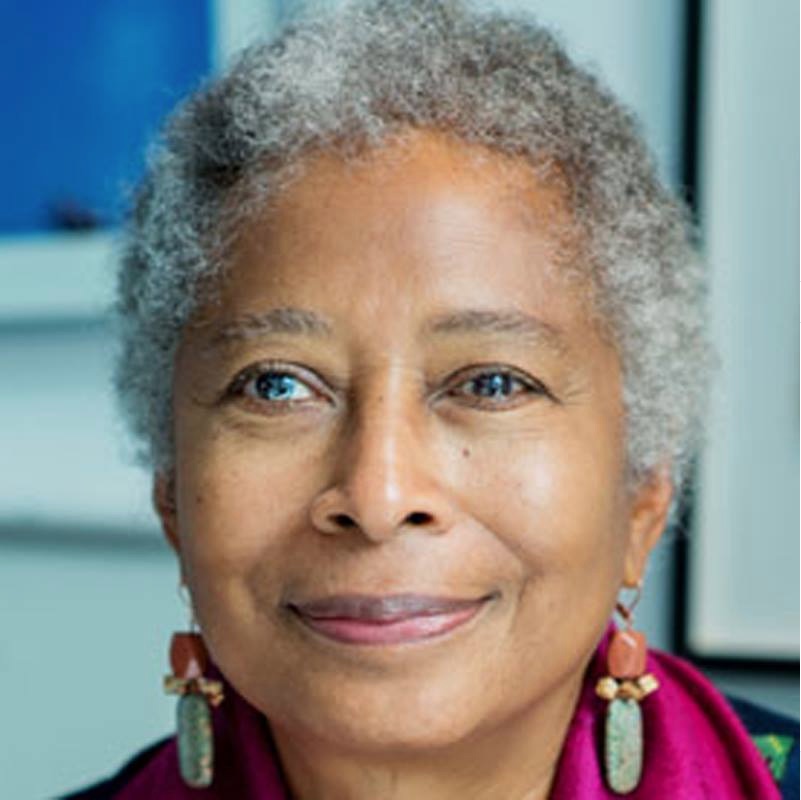
Pulitzer Prize-winning author Alice Walker praised an anti-Semitic book in a New York Times interview that was published on Sunday, which has resulted in a firestorm of criticism toward Walker and the Times.
Walker was asked what books she has on her nightstand, one of her answers was David Icke’s And the Truth Shall Set You Free.
“In Icke’s books there is the whole of existence, on this planet and several others, to think about,” Walker said. “A curious person’s dream come true.”
Tablet’s Yair Rosenberg noted that the aforementioned book is laced with anti-Semitism, highlighting how it praises the Protocols of the Elders of Zion, the infamous bible of anti-Semitism, as “authentic.” Icke also questions the veracity of the Holocaust while suggesting that Jews were behind the Holocaust, suggests that Jews were behind the slave trade and calls the Talmud one of “the most appallingly racist documents” that exists.
Rosenberg also pointed out that Walker has praised Icke several times in the past, which included sharing a YouTube video in 2015 of Icke being interviewed by far-right conspiracy theorist Alex Jones. Additionally, Walker shared a poem on her blog titled “It Is Our (Frightful) Duty To Study The Talmud,” that features a passage that reads, “Are Goyim (us) meant to be slaves of Jews, and not only that, but to enjoy it?”
Rosenberg criticized The New York Times and “elite cultural critics” for failing to challenge Walker on her praise of Icke, positing that she’s likely celebrated over her support for the Boycott, Divestment and Sanctions (BDS) movement.
“Walker—like Icke—is a strident critic of Israel, her defenders—like Icke’s—have dismissed allegations of anti-Semitism by claiming they are merely an attempt to quash her criticism of the Jewish state,” Rosenberg wrote. “But it should not surprise anyone that the world’s only Jewish state, home to half its Jews, would attract the attention of anti-Semites, who would use the legitimate debate over its conduct to smuggle in their anti-Jewish bile. Anti-Zionism may not be anti-Semitism, but plenty of self-described anti-Zionists are anti-Semites.”
The Anti-Defamation League (ADL) tweeted that they are “deeply disappointed that @nytimes would print Alice Walker’s unqualified endorsement of a book by notorious anti-Semitic conspiracy theorist David Icke.”
“We have asked editors to update the review w/ information about this author’s #antiSemitism,” they added.
We’re deeply disappointed that @nytimes would print Alice Walker’s unqualified endorsement of a book by notorious anti-Semitic conspiracy theorist David Icke. We have asked editors to update the review w/ information about this author's #antiSemitismhttps://t.co/C7cse1xxYt
A New York Times spokesperson addressed the controversy in a statement that read, in part: “Our editors do not offer background or weigh in on the books named in the By the Book column, whether the subject issues a positive or negative judgment on those books. Many people recommend books Times editors dislike, disdain or even abhor in the column.”
NYT responds to criticism from @tabletmag and @Yair_Rosenberg over their decision to publish Alice Walker's praise of the book "And the Truth Shall Set You Free" without noting that its author, David Icke, is a conspiracy theorist and antisemite pic.twitter.com/XejdGRqlrY
Looking for a unique Judaica gift for an upcoming wedding? Check
out these options.
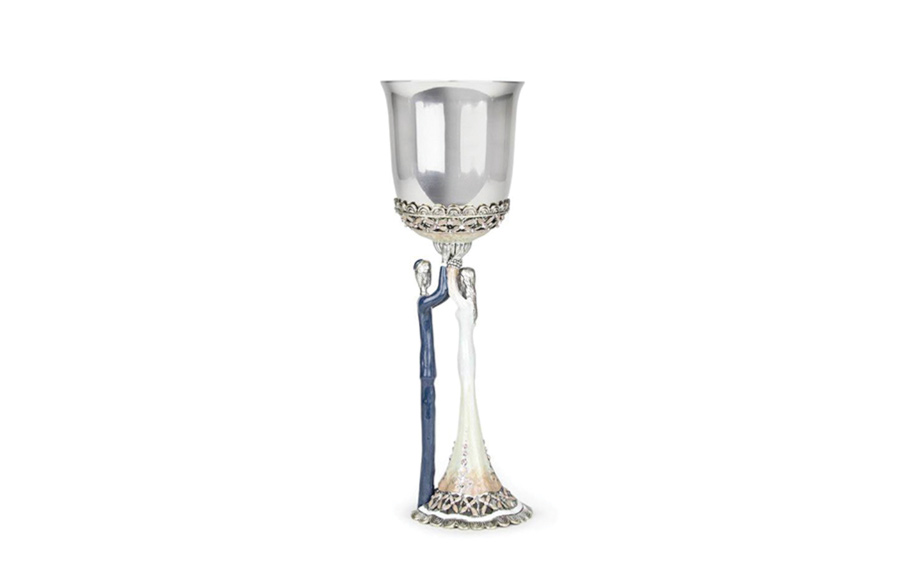
Wedding Kiddush Cup Every wedding is one of a kind. Present the bride and groom with a Kiddush cup to match. Quest Collection’s hand-painted and handcrafted pewter Kiddush cup with Swarovski crystal detailing is a piece of art. ($262.50) It’s also available in silver ($178.50) and gold ($262.50). Purchase here.
Shabbat Candlesticks This set of Shabbat candlesticks is carved from natural Jerusalem stone (a pale dolomite and dolomitic limestone in varying shades) and features a small replica of the Ten Commandments etched with glowing golden Hebrew letters set between two stone candle holders in the shape of an eagle’s wings. ($75).
Wedding Mezuzah Created by glass artist Tamara Baskin, this keepsake mezuzah has “I Am My Beloved’s and My Beloved Is Mine” from the Song of Solomon inscribed in Hebrew. It’s available in many colors, including sky blue, dark blue, black, crystal and ivory. ($34).
Glass Challah Plate This 17-by-11-inch challah tray is made with thick crystal glass adorned with silver embossed handles and comes with a matching knife. ($125)
Mizrahi Jews from the Middle East and North Africa have practiced pre-wedding henna ceremonies for generations. The tradition is a symbolic way to shower the bride and groom with what they hope will be many years of protection, health and fertility. Today, henna celebrations often are held a few days before the wedding, though some, like Esther and Daniel Bengio’s henna party, are held on their wedding day.
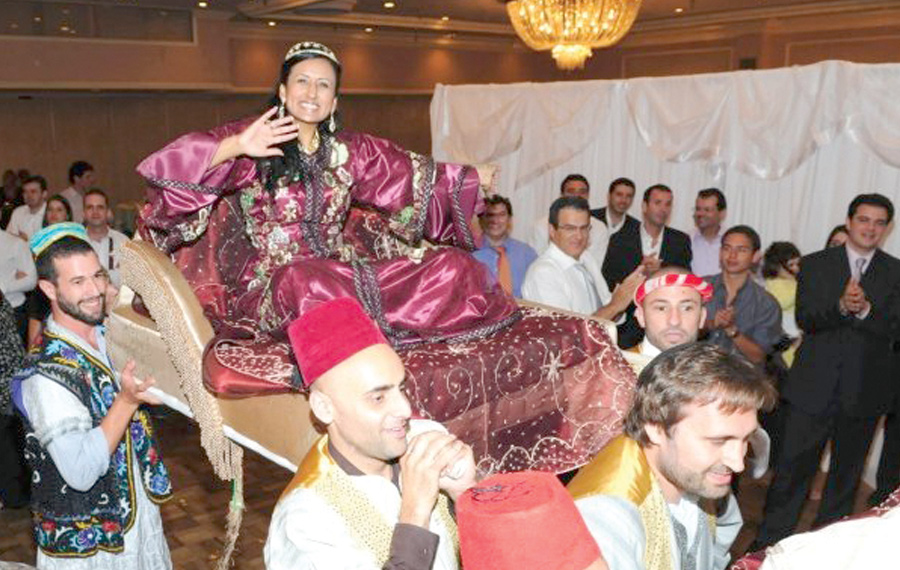
Dressed in traditional Moroccan attire, Esther and Daniel were lifted up on ottomans like a king and queen and carried into a ballroom by four men wearing red fez hats. They were treated to joyful music and dancing before being ushered into a small, embroidered red tent with Moroccan lamps. Female relatives smeared their palms with henna dye before wrapping their hands in cotton pads and red ribbon.
Their friends and family, many of whom also were dressed in long caftans, fez headdresses and colorful, gold-embroidered robes and headpieces clapped and yelled. The animated women shouted the “Lililili!” sound that is commonly associated with Sephardic and Mizrahi celebrations. In Persian, the sounds are called “kell,” and they’re reserved exclusively for milestone events like weddings and births.
Daniel was born to Moroccan Jewish parents in Spain, and U.S.-born Esther wanted to honor Daniel’s heritage. Esther’s family participated in the ceremony, wearing traditional Moroccan attire and carrying decorative plates filled with sweets.
“It was a magical evening for everyone who attended,” Esther said. Her non-Jewish relatives “thought they were in a re-enactment of [Disney]’s ‘Aladdin’ and still talk about the party to this day,” she added.
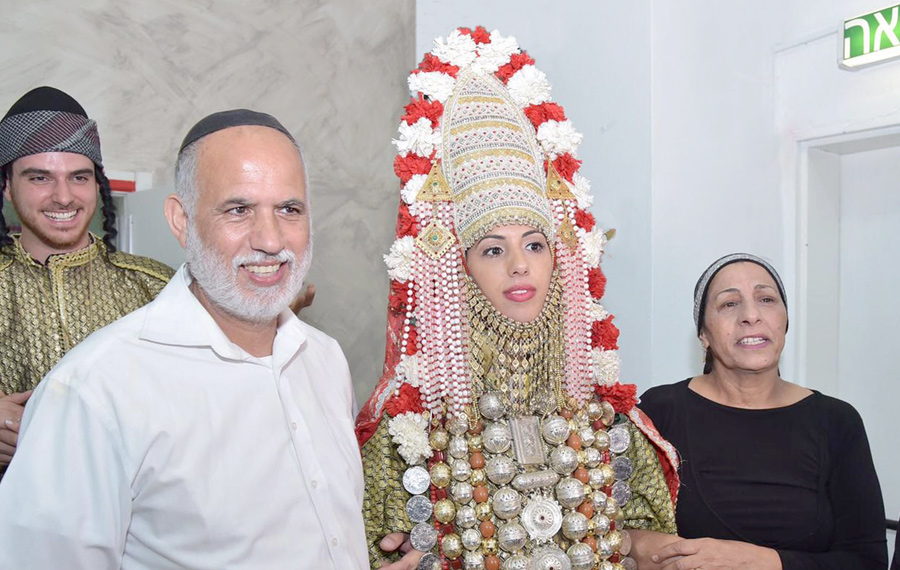
Yemenite brides borrow headdresses and gold jewelry from older women. Photo courtesy of Liat Nourafchan
Sephardic and Mizrahi communities around the world continue to keep this dynamic tradition alive to the delight of many of their Ashkenazi guests, some of whom have never attended a henna party and who continue to scrub the henna stain off their palms in frustrated wonder for days after the ceremony.
On the night of the henna party for my sister and her French-Tunisian husband, my mother complained loudly that the dye would never wash off before the wedding. She was right.
Some people are familiar with the concept of henna from the Indian body art known as mehndi, an ancient practice in the Indian subcontinent and the Middle East. One difference between mehndi, which is often done at Hindu weddings and festivals, and the Jewish henna ceremony is that the former involves intricate designs on the hands (and sometimes feet) while the latter consists less of artwork patterns. Instead, a small ball of solid henna dye is place on a cotton pad and wrapped around the palm with decorative ribbon. The bride and groom then raise their palms together in a show of joyful unity. It also makes for an excellent photo op.
Brooke Korda, a 31-year-old acupuncturist from Pico-Robertson, always knew that she wanted a henna party. Korda’s father is Persian and her mother is Ashkenazi, while her husband’s mother is Greek and his father is Hungarian. During their 2016 ceremony, her non-Persian in-laws were “totally out of their element but they really did enjoy themselves,” she said.
Couples who hold henna ceremonies see the event as a bridge between familial generations. Dallas-born Liat Nourafchan, 24, lives in Los Angeles but had her henna party in El’ad, Israel, in 2015. Nourafchan’s father is Persian and Russian and her mother is Yemenite, while her husband is Italian-Persian.
Yemenite henna celebrations are often “bigger than the wedding,” said Nourafchan, who donned a traditional Yemenite bridal headdress covered in red and white carnations and real gold.
In Israel, brides who wish to have Yemenite henna ceremonies often borrow headdresses and gold jewelry from older Yemenite women who lend such treasures, many of which are family heirlooms dating back several generations. These elderly women attend the events and ensure that every single one of their precious pieces is accounted for.
“It was important to me to be able to do the same thing my mother’s family was doing for many generations,” Nourafchan said. “The customary dress is a lot more than one would expect. Wearing around 50 pounds of gold all over your body [while] trying to dance is very difficult.”
A highlight of her henna ceremony was when her now late grandmother sang a traditional Yemenite song in Arabic. The lyrics offered comfort for a nervous bride and her grandmother’s presence meant that three generations of Yemenite Jewish women took part in the ceremony.
“I think on an emotional level, this was more meaningful than the actual wedding,” Nourafchan said. “Weddings happen all the time, but it is very rare for a full-bred American to be raised the way that I was and I want to continue the tradition. I only hope my daughters wish to do the same.”
In Los Angeles, there is no shortage of local vendors who offer everything from attire for the bride and groom (and their family and friends) to furniture, lighting and even Moroccan teacups for those who want to hold a traditional henna ceremony. They also provide the henna.
As Nourafchan’s Yemenite grandmother sang during her granddaughter’s henna party, “You get married and you will have everything you need.”
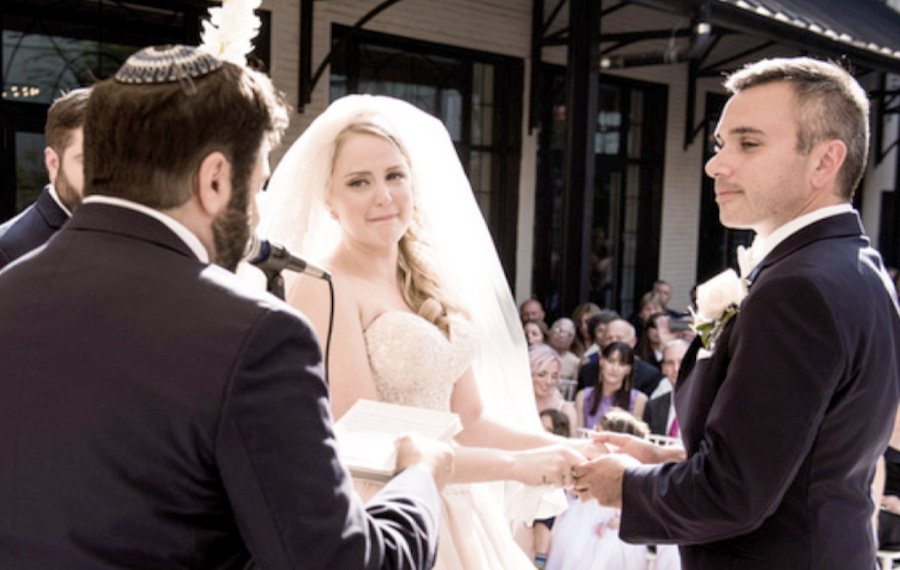
Wedding officiant Todd Shotz takes great pride in creating meaningful one-of-a-kind Jewish wedding experiences. Limiting himself to three to five weddings each year, he puts a great deal of time and energy into working with and getting to know the people he marries. Some of those weddings involve interfaith couples seeking a ceremony from a Jewish perspective.
Shotz is the founder of Hebrew Helpers, a nationwide Jewish studies program that provides personalized education to students of all backgrounds and affiliations. He also is a Jewish educator with more than 20 years’ experience. He has officiated weddings and other life-cycle events for almost 10 years in places as far-flung as Venice, Italy, and as close as Santa Monica.
The first step in creating a meaningful wedding ceremony, he said, is to find out how the couple wants their wedding to feel. “They usually will always say something about, ‘We want it to be moving, but we don’t want it to be too long.’ They also usually want to laugh and have it feel somewhat informal.”
“It’s so important to me to make sure we create a ceremony that’s authentic to that couple and their families, while at the same time paying tribute to tradition.”— Todd Shotz
Between his first and second meeting with each couple, Shotz encourages them to write a mission statement for their relationship. “It doesn’t have to be a formally written paragraph,” he said. “It can just be bullet points or words that they keep falling back on [about what makes] their relationship unique or how they feel about each other.”
He said for one couple the word “companionship” was significant, while another used the word “outdoorsy” to describe their bond. “What I hope is [the mission statement] will help them to make decisions as they go forward in the relationship. It also helps them to decide the rest of the ceremony.”
For the wedding itself, Shotz sticks with a template on how a Jewish ceremony works and then personalizes the running order. He works with the couple to determine how they want to interpret each moment, from the rings and the readings to how many cups of wine for the ceremony and whether the couple wants to be wrapped in tallit.
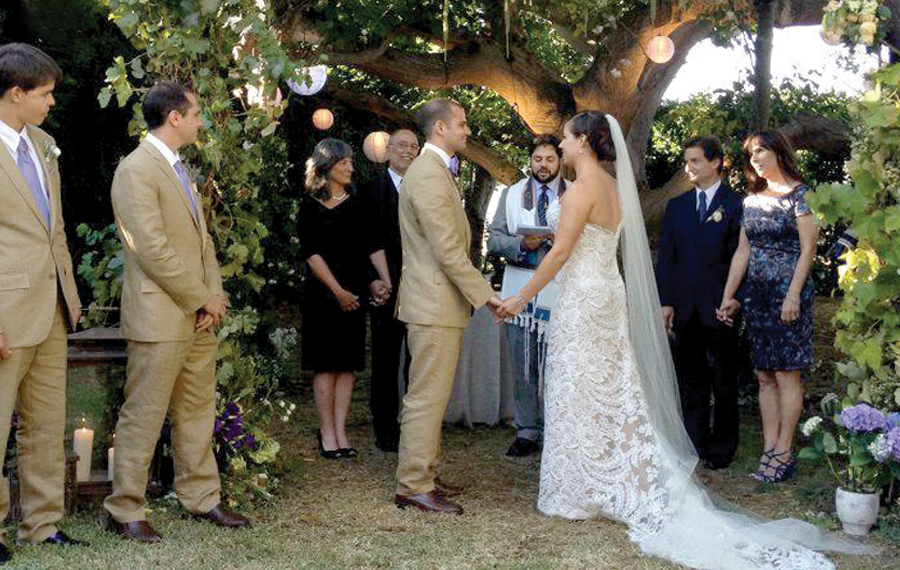
Lucy Jacobson and Nathaniel Meadow’s outdoor wedding.
“It’s me fostering a unique ceremony based on what they are looking for and within reason,” he said. “I want to make sure it still feels like a Jewish ceremony, because that’s why they came to me, rather than a secular justice of the peace.”
Another big part of the decision-making process that Shotz helps the couple with is deciding on how many of the seven traditional blessings that are recited under the chuppah to use. Most couples, he said, keep the opening blessing: “We commemorate this occasion with a glass of wine, fruit of the vine that is shared today between these two hands and these two lips, as the first of many celebrations a life shared will bring,” and the closing one: “And we celebrate together with the bride and groom the joy in song, pleasure, delight, love, sisterhood, peace and companionship. The sound of joy and the sound of gladness in the voice of the groom and the voice of the bride, the sound of the jubilance of couples from their wedding canopies and at their feasts of song. We sing of the happiness of the groom and the bride.”
However, at the request of one of his couples, Shotz began personalizing the other five blessings. “The other blessings are really somewhat vague,” he said. He has since written more than a dozen custom blessings that talk more about relationships.
Todd Shotz officiates at the wedding of his sister, Annette, to Anthony DelVecchio. Photo by Cliff Mautner
Whenever he creates a new version of the blessings, Shotz translates them into Modern Hebrew. He then sets them to a traditional tune that he sings a cappella during the ceremony. He said the best part about doing this is that the translations reflect the couple’s relationship and they can involve their friends and family in the ceremony.
After 20 years together, Lucinda Anguay and Moe Davidowitz finally tied the knot in October in Southern California. After Anguay saw Shotz perform at a bar mitzvah ceremony in Israel, she asked him to officiate at their Jewish wedding and incorporate her Hawaiian heritage.
Shotz recruited one of Anguay’s nieces, who had studied the traditional Hawaiian language in high school. She helped him come up with a Hawaiian prayer — a beautiful proclamation of love — to open the ceremony, which he did in Hawaiian and English.
“It immediately made the family and friends who traveled from Hawaii feel included,” Shotz said. “In our modern age, so many different types of couples are coming together, not just interfaith, but Jewish couples with different backgrounds. It’s so important to me to make sure we create a ceremony that’s authentic to that couple and their families, while at the same time paying tribute to tradition.”
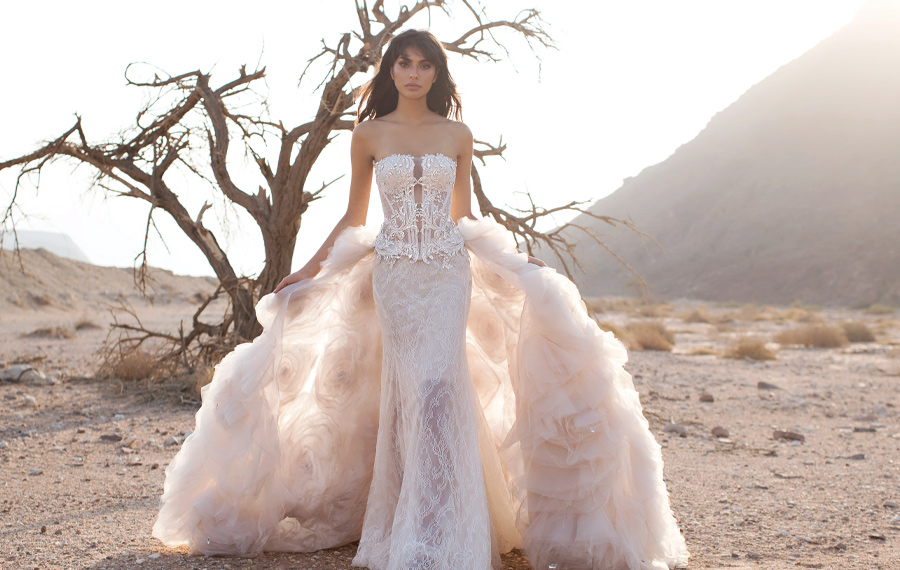
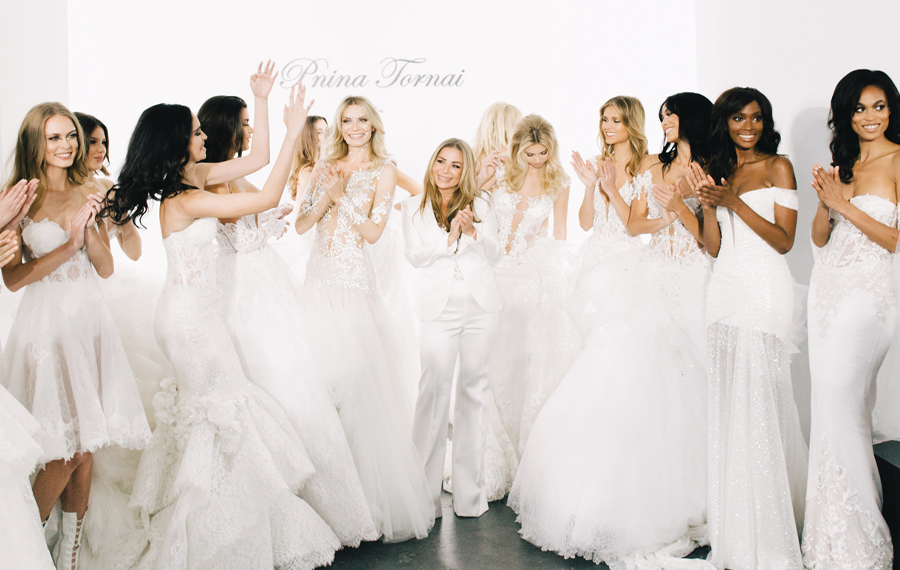
Brides who want to make a showstopping statement when walking down the aisle turn to Pnina Tornai, whose sexy, bejeweled wedding creations are not for the faint of heart. The Israeli-born designer, familiar to viewers of the TLC series “Say Yes to the Dress,” is known for gowns with corseted, Swarovski crystal-studded bodices, plunging backs and tattoo lace that combine traditional and modern elements.
“My design aesthetic is fashion-forward and sexy. My customer is confident and knows what she wants,” Tornai said. “She likes to step out of the box a little bit and wants something truly one of a kind. Often my brides are looking for unique laces, intricate details and the ‘wow effect.’ I have perfected my corset construction over the years, and it’s something that truly sets my gowns apart from the rest.”
For Jewish brides who want something more modest, “I make customizations to raise the neckline, back, or add sleeves onto the gown,” she said.
Tornai’s couture creations start at $6,000 and can soar to as much as $50,000, but her Love by Pnina Tornai gowns cost between $2,400 and $5,100. They’re all showcased in her boutique at Kleinfeld Bridal in New York, at her Tel Aviv flagship store and at shops around the world. Family members are part of her company: Her husband is her business manager; her son is her graphic designer; a sister is her makeup artist; and she hopes her granddaughters will take over the business one day.
Pnina Tornai backstage at her Fragile Collection show. Photo by Joseph Lin
The oldest of four daughters of an Egyptian-Jewish father and a mother born in Tangier, Morocco, Tornai grew up in Kfar Saba, northeast of Tel Aviv. “The big families in the Sephardic culture, along with the big celebrations, are so grand and inspiring,” she said. “Huge weddings come with the territory of being a Sephardic Jew, so of course that influenced me.”
Tornai considers herself “a very spiritual person. I am observant and I am, overall, very proud to be a Jewish woman from Israel,” she said. “My Jewish identity is extremely important to me and influences my work immensely.”
A self-taught seamstress and designer, “I learned by taking apart my own dresses and then learning the construction,” Tornai said. “I used to design outfits for myself and my friends and realized that people really loved what I was doing. I was sewing ready-to-wear, but after having a dream about wedding gowns falling from the sky, I knew that God was calling me to change directions. It’s considered the biggest mitzvah in Judaism to make a bride happy on her wedding day. I love designing bridal because I feel like being a part of a bride’s big day is sacred.”
When Tornai first approached Kleinfeld about carrying her line in 2005, the store’s executives didn’t understand her aesthetic.
“The American bride was much more traditional. Israel always had sexier, more daring designs. I modified my designs slightly while still keeping that sexy touch, and the brides went crazy for them,” she said. “A few years ago, I received an award from the Israeli ambassador in New York for helping pave the way for other Israeli designers entering the
U.S. market.
“Brides want to celebrate their shapes and be sexy, and I think that is why Israeli designers are so successful today,” she added. “Tel Aviv is an environment that breeds creativity and entrepreneurship, which is why I love it so. But Israel is not Paris or Milan, where fashion is encrusted in the DNA. This has always made it more challenging for me to bring it out to the world.”
Being a part of “Say Yes to the Dress” has certainly increased awareness of the Tornai brand. “I am so blessed to have so many fans who watch the show and know my dresses by heart,” she said. “For now, the show is taking a break from filming, but we are gearing up for more episodes soon.”
Wedding gown from the Pnina Tornai collection. Photo by Alexander Lipkin
Tornai attributes her success to “staying true to my vision and never taking no for an answer. If I had let Kleinfeld tell me ‘No’ and didn’t insist that my designs be in the store, who knows how my life would be different?” she said. “I truly believe that if you have faith in yourself, others will have faith in you.”
Reflecting on her accomplishments, Tornai said she is “most proud of making thousands upon thousands of brides’ dreams come true. To know that I contributed to one of the most important days in a woman’s life is a blessing.”
Pnina Tornai’sAdvice for WeddingDress Shopping Have a budget in mind and be honest with your consultant. You don’t want to fall in love with a gown and then not be able to purchase it.
Consider where and when the wedding is going to be. While I believe that you should wear whatever you desire on your wedding day, if traveling, you may want to choose a lighter gown.
While a bride should do her wedding gown research before her appointment, it is always a good idea to keep an open mind.
Once you find the gown, stop looking. You’ll only drive yourself crazy if you think there is something better out there.
Enjoy the process. This should be one of the best times of your life. Try not to stress about all the small details. At the end of the day, you are marrying the love of your life, and that is the most important part.
At a time when the most popular wedding dresses are sheer, strapless, body-baring showstoppers that leave little to the imagination, the modest bride has few options. Sarah Abesera faced that dilemma when trying to find a gown for her December 2016 wedding to Laurent Cohen.
“I’m Modern Orthodox and I didn’t want to be sleeveless,” she said. “I wanted something classy and modest that would look good with sleeves, and that was hard to find. I saw the same dress over and over at every single store, and it was not calling my name. The only things I liked were $10,000 and above.”
Abesera shopped for months to no avail, and then recalled having stopped by Jinza Couture Bridal a year earlier. Having joined forces with San Francisco-based Jinza Jin after Jin designed her wedding dress, owner and designer Grace Pei opened her West Hollywood store in 2015. Her Elvet collection, priced at $2,500-$8,000, is exclusive to the store.
The sample of a new gown Pei designed in French Alençon lace and silk satin organza had just arrived, and it was a perfect fit on Abesera. It did not have sleeves, but Pei made a long-sleeved silk jacket to go with it.
Rebecca Sarto married at Calamigos Ranch in Malibu on Oct. 15, 2017. Photos by Hello Blue Photos
“The jacket let the lacy detail show and gave me the modest look I wanted while keeping it modern,” said Abesera, who now goes by her married name of Cohen and lives in Pico-Robertson. She and her husband, both French-Moroccan Jews, met through a mutual friend with whom she went to college. Their wedding, at the Alexandria hotel in downtown Los Angeles, was “beautiful, magical,” she said. “Everyone said it was the best wedding they’d ever been to.”
“I wanted sleeves.I liked the ideaof having myshoulders covered, for traditionalreasons, too.”— Rebecca Rothman Sarto
Pei, who named the gown’s style “Sarah” after Cohen, can customize any gown, adding sleeves or raising necklines for the modest bride. “Clients love our line because it’s modern and timeless,” she said. “Instead of nude panels and deep V’s, it’s classic design with more coverage. It’s a timeless, elegant look.”
That was just what Rebecca Rothman Sarto of Studio City was looking for in a wedding gown. Like Cohen, she had been to many boutiques without finding a dress. “I wanted sleeves,” she said, adding that sexy dresses are “just not me. I liked the idea of having my shoulders covered, for traditional reasons, too.”
She found it at Jinza but had Pei make changes, fully closing the back, raising the front and changing an ivory bodice panel from ivory to nude. “I wanted lace, a lot of beadwork and flowers everywhere,” she said, the latter to reflect the “garden-y, romantic vibe” of Calamigos Ranch in Malibu, where she married Matthew Sarto in October 2017. “The skirt had layers and tiers of silk chiffon. The veil had the lace and flowers all around it,” she added.
Her wedding reflected the Conservative Jewish traditions with which she was raised and incorporated a few personal ones. The tallit used in the ceremony was her grandfather’s. Wrapped in extra fabric from her gown, her bouquet was encircled by a custom-made charm bracelet covered in Swarovski crystals, with three tiny frames holding photos of her grandparents and her dog.
For modest brides whose budgets are tight and can’t afford nuptial extravagances, there’s another option. Los Angeles Hachnassat Kallah (LAHK) is a service that lends brides wedding gowns for a fee of $250-$350, including the veil, tiara and shoes. Accessories alone can be borrowed for $18. But in the charitable lending tradition of gemilut chasadim, no one is ever refused.
Popular wedding gown styles featuring long sleeves, high necks, beaded bodices, layers of tulle and lace, and princess silhouettes are among the dresses LAHK stocks in a wide range of sizes. According to Devorie Krause, who took over running the service three years ago, “Brides love fit and flare, and ornate tops and full bottoms. White is more popular than ivory or cream.”
On my wedding day, I made sure I packed everything I needed before heading off to the venue. Wallet? Check. Veil? Yes. Toothbrush? Got it. Headscarf? Yup.
I’d be wearing the headscarf immediately following the wedding. I decided during my Orthodox conversion process that as a married woman I’d be covering my hair.
There are many reasons given for this custom. I’ve learned that holiness resonates from a woman’s hair and she should protect it for herself and her family. An Orthodox Jewish woman needs to keep a barrier between herself and the outside world, and covering her hair accomplishes that. It also communicates that she is married and unavailable.
At the time, the reason behind my decision was simply that everyone else was doing it. The women in my Pico-Robertson community wore scarves, tichls, hats, snoods and sheitels galore, and I wanted to join them.
When I was going through my conversion process, I had imposter syndrome. I have blond hair and blue eyes, so I don’t exactly look Jewish. I don’t speak Hebrew. I pray in English, I can’t recite all the bentsching by heart and I don’t understand inside jokes about Jewish day school or camp. So I was looking for a way to fit in, by trading pants for skirts and tank tops for shirts with sleeves. Covering my hair was the final piece that would help me look the part.
“When I go out into the world, hair covered, I amdemonstrating that I’m honored to uphold this custom.“
And so, the morning after my wedding, I put my hair into a bun and attempted to tie the scarf around my head. It slipped right off. I asked my husband for help, but it started to fall off after a few minutes. There was just too much material on my head and it was heavy.
Frustrated, and with nothing else to cover my hair, I took a bunch of bobby pins and awkwardly secured the scarf to my head. I walked downstairs, where our friends and family were hanging out beside the pool, and kept readjusting my scarf so that it wouldn’t slip. It was uncomfortable, but I was determined. It continued this way for the next few weeks, the constant messing with
the scarves.
Not long after that, I became fed up with the scarves and I was now self-conscious about appearing to be too religious in public. I was beginning to understand why women wore wigs, and I wanted one of my own.
Orthodox women can tell right away when another woman is wearing sheitel, but the outside world usually can’t. It was the perfect solution. Plus, I was going to my brother-in-law’s wedding and I didn’t want to wear a scarf with a fancy dress.
I went to a sheitelmacher in Brooklyn and tried on a bunch of blond wigs —an incredibly difficult hair color to shop for, because many Jewish women are brunettes.
The best wig didn’t look natural at all, but I thought, “Oh, well,” because I needed it. I financed it for $1,100.
The wig was heavy and made me feel self-conscious. In pictures, you could see the netting. I didn’t feel like myself. It was downright annoying and awkward. Every time I walked past the wig, I remembered how much I still owed on it, so I threw it to the back of my closet. I went out into the world, hair uncovered, for two months.
During that time, it was liberating to be able to show off my washed and styled hair, but much of the time, I felt naked. I realized that the head covering, be it a hat, a scarf or the wig, made me feel like I had a little tent over my head, protecting me at all times. I was reminded of HaShem when I wore one of them. I practiced more mitzvot. I liked that other Jews knew from seeing me that I was a married woman.
I learned from a few rebbetzins about hair covering and I liked their reasons for doing it. I slowly started covering my hair again. First, I just wore hats and showed my hair. Then, I got smaller scarves that were super cute and easy to tie. Eventually,
I ditched that first sheitel for a morenatural-looking one that I could wear with the front of my hair showing. It was a little trick I learned from my fellow Orthodox Jewesses.
Today, I cover at all times, with hats, scarves and sheitels. When I go out into the world, hair covered, I am showing that I’m happily married. I am demonstrating that I’m honored to uphold this custom. And I’m saying, above all else, that I am a proud Jew.
When Rachel Light and Jeremiah Levine were planning their wedding for March of this year, there was no question about where they would tie the knot: Camp Ramah in Ojai.
Light, 39, and Levine, 37, met at IKAR on Simchat Torah in 2015. However, it was Light’s parents who first met Levine, at an IKAR Shabbaton at Camp Ramah in 2014, and felt he was the perfect match for their daughter. So it was only fitting that their wedding took place at camp.
“We decided the greatest place we could imagine getting married would be at camp,” Light told the Journal. “Anyone who’s looking for an opportunity for their friends and family to come together and actually be together, camp takes the destination wedding to an extreme.”
Their celebratory weekend with 350 of their closest family and friends began with Shabbat services on Friday night. Following Shabbat morning services, the couple held a nonsense Olympics after lunch. “People competed to decide whether our last names would be Light-Levine or Levine-Light,” Light said. Light-Levine won.
“The nonsense Olympics people were dressed in crazy costumes,” she added. “A friend built a human foosball setup. There was a big kickball tournament. It was perfectly hilarious when one of my friends turned to me and said, ‘Is it OK if I show up to the wedding rehearsal dressed like a unicorn?’ Magic like that only happens at camp.”
“Anyone who’s looking for anopportunity for their friends andfamily to come together and actuallybe together, camp takes the destination wedding to an extreme.”
— Rachel Light
On Friday and Saturday night, guests slept in the camp’s bunks or at nearby hotels.
“Seeing my adult friends staying in a bunk together and loving it more than they ever could have imagined was a life-changing experience,” Light said. “I constantly feel like I have a competitive advantage in life because I went to summer camp. I feel like it taught me so much and it really helped me develop my identity. To be able to offer that experience to people, no matter what age they are is incredibly special.”
Camp also allowed the couple to navigate their families’ religious requirements, allowing everyone to be within walking distance on Shabbat. Light said it was amazing to see their friends put away their phones for the 24-hour Shabbat period. “I don’t think any of them had ever done that before,” she said.
On Saturday night, there was a talent show at the outdoor amphitheater. By the time the actual wedding took place on Sunday, everyone had developed an incredible bond.
“We renamed all of the buildings at camp so they all had meaning to us,” Light said. “The outdoor amphitheater where we got married we called Dodger Stadium. My husband had always dreamed of getting married at Dodger Stadium.”
Rachel Light at her Camp Ramah wedding. Photo by Ryan Jesena @ Lush Photography
For the wedding itself, the couple brought their own flowers. “We purchased these oversized gigantic roses that people came down the aisle with and later became the centerpieces on all of the tables,” Light said.
The camp catered all the food and was responsible for much of the support and organization. And guests also pitched in.
“We had friends who ran the nonsense Olympics and other friends who organized the talent show,” Light said. “I’m lucky to have multiple rabbis in my family (IKAR Rabbi Sharon Brous is Light’s sister-in-law) who helped out with the services. It basically became a really big group effort of love to help plan it.”
She added that since their wedding, “We’ve been hearing nonstop from people that it was one of the best weekends of their life, which you don’t expect other people to say about your wedding.”
If someone is thinking about a camp destination wedding, Light said they should consider what kind of experience they are looking to create. “And if they are kids at heart, it’s a no-brainer.”


 This set of Shabbat candlesticks is carved from natural Jerusalem stone (a pale dolomite and dolomitic limestone in varying shades) and features a small replica of the Ten Commandments etched with glowing golden Hebrew letters set between two stone candle holders in the shape of an eagle’s wings.
  Created by glass artist Tamara Baskin, this keepsake mezuzah has “I Am My Beloved’s and My Beloved Is Mine” from the Song of Solomon inscribed in Hebrew. It’s available in many colors, including sky blue, dark blue, black, crystal and ivory.
  This 17-by-11-inch challah tray is made with thick crystal glass adorned with silver embossed handles and comes with a matching knife.