fbpx

December 7, 2018

UN Fails to Pass Resolution Condemning Hamas

A resolution that would have condemned Hamas as a terror organization failed to pass in the United Nations, falling below the two-thirds threshold needed to pass.

The resolution, which was spearheaded by the United States, denounced Hamas for using rockets and tunnels to attack Israel and “inciting violence.” While the resolution received a plurality of the vote with 87 in favor, 57 against and 33 abstentions, a motion was passed prior to the vote that required a two-thirds threshold to pass a resolution.

Hillel Neuer of U.N. Watch has the breakdown:

U.S. Ambassador to the U.N. Nikki Haley excoriated the U.N. for failing to pass the resolution.

We can’t talk about peace in the Middle East until we can agree on a basic condemnation of Hamas and its terrorism,” Haley said. “The U.N. had a chance to do that today, and it failed.”

Similarly, Israeli Ambassador to the U.N. Danny Danon said, “Wait when you will have to deal with terrorism in your own countries. Your silence in the face of evil reveals your true colors.”

“It tells us what side you are really on: a side that does not care for the lives of innocent Israelis and innocent Palestinians who have fallen victim to the terrorists of Hamas,” Danon continued.

Hamas spokesman Sami Abu Zhari tweeted that the resolution’s failure “represents a slap to the U.S. administration and confirmation of the legitimacy of the resistance.”

However, Danon did note in a tweet that “a record 87 countries condemned Hamas for its rocket fire & use of civilian infrastructure for military purposes against Israel.”

“I thank @nikkihaley for her hard work in forming an unprecedented coalition. We will continue to fight for the truth!” Danon wrote.

UN Fails to Pass Resolution Condemning Hamas Read More »

Jewish Democratic Council of America Endorses Anti-BDS Congressional Bill

The Jewish Democratic Council of America (JDCA) endorsed the Israel Anti-Boycott Act in a press release on Thursday as a means to fight against the Boycott, Divestment and Sanctions (BDS) movement.

The Israel Anti-Boycott, which was sponsored Reps. Peter Roskam (R-Ill.) and Juan Vargas (D-Calif.) and Sens. Rob Portman (R-Ohio) and Ben Cardin (D-Md.), bars companies from engaging an international boycotts against Israel. Cardin is currently aiming to get the bill attached to a December spending package.

“The Jewish Democratic Council of America opposes efforts to delegitimize Israel through global boycott, divestment, and sanctions (BDS) efforts,” Halie Soifer, executive director of JDCA, said in a statement. “The Israel Anti-Boycott Act is consistent with the 2016 Democratic Party Platform that states Democrats ‘oppose any effort to delegitimize Israel, including at the United Nations or through the Boycott, Divestment, and Sanctions Movement’ and is also aligned with JDCA’s platform of opposition to global BDS.

“We support the Israel Anti-Boycott Act, as amended, and urge passage of this legislation during the 115th Congress,” the statement continued.

The Anti-Defamation League (ADL) has also expressed support for the Israel Anti-Boycott Act, as their website states that the legislation is “designed to update and extend existing law to include boycotts by international governmental organizations.”

“It is not intended to limit the First Amendment rights of U.S. individuals and companies who want to criticize Israel or penalize those who want to refuse to do business with Israel based on their own personal convictions,” the ADL’s website adds. “Ask your Members to support the Israel Anti-Boycott Act.”

J Street, on the other hand, is opposed to the bill.

The legislation draws no distinction between Israel and the West Bank, effectively extending U.S. legal protections to illegal settlements,” the organization said in a press release. “The ACLU [American Civil Liberties Union] has also flagged major free speech issues, noting cases where the bill would penalize individuals and companies for exercising their First Amendment right to participate in boycotts.”

“While J Street has always been clear about our opposition to the Global BDS Movement, this legislation is absolutely the wrong way to oppose BDS,” the statement added.

Jewish Democratic Council of America Endorses Anti-BDS Congressional Bill Read More »

Hanukkah Illumination Rocked by Darkness of Hate

Our age seems to be addicted to what Mark Twain called “lies, damned lies, and statistics.” But when it comes to the upsurge of anti-Semitism in the United States, especially on our campuses and on our streets since Pittsburgh’s Tree of Life synagogue slaughter of 11 innocents by a white supremacist Jew hater on Oct. 27, you don’t need statistics — just the litany of shameful specifics — to bring home the alarming truth.

Here are but a few recent campus “incidents” across the U.S. during Hanukkah:

Now, to top it off, at Harvard University — which rolled out the golden carpet in 1934 for high Nazi official Ernst Hanfstaengl (a Harvard alum) who used the occasion for anti-Semitic incitement — the Chabad House menorah was knocked over on the first night of Hanukkah, an incident being investigated as a hate crime.

Statistics released by the FBI confirm that the Hanukkah attacks were no aberration.  Hate crimes rose an astounding 17 percent last year, yet crimes targeting Jews, who represent only 2 percent of the population, soared 37 percent. 

Not all anti-Semitism emanates from neo-Nazis. Students for Justice in Palestine (SJP) raised a Palestinian flag above the University of Vermont’s Davis Center, surrounded by handmade signs (put up in violation of university policy) calling for an end to United Nations Resolution 181, which recognized Israel’s right to exist as a U.N. member state.

The SJP and at least initially, its ally, J Street University of Vermont, repudiated an earlier Israeli flag-raising as allegedly symbolizing “the moral  bankruptcy of Zionist ideology … [and the] ethnic cleansing of Palestinian civilians” as well as Israel’s “racist and oppressive … sexist, homophobic, and transphobic policies.”

Campus campaigns demonizing Jews and other Zionists as racists and supporting ethnic cleansing along with demands that the lone Jewish state, home to world’s largest Jewish population cease to exist, open the door wide for more attacks against American Jews.

And reaction by some university officials to anti-Semitism has been nothing short of outrageous.

For example, the initial statement issued the day after the Pittsburgh synagogue bloodbath from Columbia University’s Student Life Office, was mute about exactly who was slaughtered and why. Only after indignant protests, many from Jewish Columbia alumni, was a revised statement issued condemning “horrific anti-Semitic violence.” The hemming-and-hawing was similar at Dartmouth College.

Denial by euphemism is awful. But could anything be worse than the UCLA administration’s decision, a few weeks after the 80th anniversary of Nazi Germany’s Kristallnacht pogrom, to give its go-ahead on specious free speech grounds to the national conference of Students for Justice in Palestine, whose ranks include leaders who have tweeted: “LOL let’s stuff some Jews in the oven” and “We need to put Zionists in concentration camps. Now that would be a life experience for them” and “Every time I read about Hitler, I fall in love all over again.”

What is to be done?

American-Jewish students inclined to visit or study in Israel — or just speak up for the Jewish state — are often subject to intimidation and ridicule, sometimes by the professors who teach them. The Jewish community and national organizations must ensure that no Jewish student is left alone to fight back. Timidity in the face of anti-Semitic bullying must end. And fight back they must! When it came to mobilizing for Soviet Jewry in 1960s and ’70s, students led and adults followed. Now the legitimacy of the Jewish state, Jewish history and Jewish values are under assault. We need to nurture young Jews who want to fight back, not become invisible.

Beyond the campus, American Jews must recalibrate our interactions with neighbors, believers and nonbelievers, to forge new alliances to confront and defeat history’s oldest hatred, a hatred that seems to grow stronger every day.


Rabbi Abraham Cooper is the associate dean and director of global social action for the Simon Wiesenthal Center. Historian Harold Brackman is a long-time consultant for the Simon Wiesenthal Center and its Museum of Tolerance in Los Angeles.

Hanukkah Illumination Rocked by Darkness of Hate Read More »

Grammy Noms Include Perlman, Barbra, ‘Band’s Visit’

Rapper Drake, music legend Barbra Streisand and the late rapper Mac Miller are among the nominees for the 61st Annual Grammy Awards, which will be presented Feb. 10 and broadcast live from The Staples Center on CBS.

Drake received seven nominations, including best rap song, record and song of the year for “God’s Plan,” album of the year for “Scorpion,” and best rap performance for “Nice for What.”

Streisand was nominated for her album “The Music…The Mem’ries…The Magic!”; Miller was recognized in the best rap album category for “Swimming.”

Maroon 5, led by Adam Levine, was nominated for its collaboration with Cardi B “Girls Like You” in the best duo/group performance category.

The Itzhak Perlman documentary “Itzhak” from filmmaker Alison Chernick and “Quincy,” the Quincy Jones bio from his daughter Rashida Jones, will vie for best music film.

“The Band’s Visit,” the soundtrack from the Broadway musical about an Egyptian orchestra stranded in an Israeli desert town, is up for best musical theater album. It’s from producers/composers Dean Sharenow and David Yazbek.

Benj Pasek is nominated with his songwriting partner Justin Paul for “This is Me” from “The Greatest Showman” in the song for visual media category; and “Yiddish Glory: The Lost Songs of World War II” was nominated for best world music album.

Vying for producer of the year, Larry Klein is in the mix on the non-classical side and Judith Sherman and Elizabeth Ostrow were recognized for classical production.

Grammy Noms Include Perlman, Barbra, ‘Band’s Visit’ Read More »

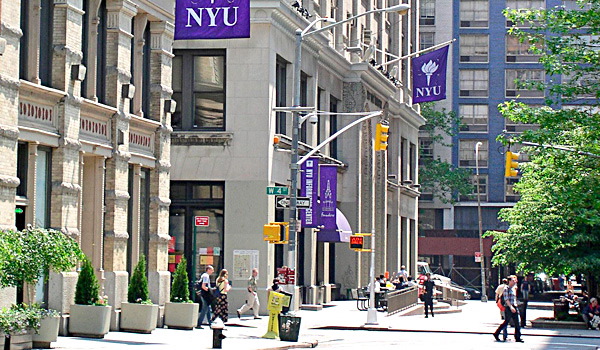
BDS Resolution Passes at NYU

A Boycott, Divestment and Sanctions (BDS) resolution passed the New York University (NYU) Student Government Assembly (SGA) on Thursday night by a margin of 35 in favor, 14 against and 14 abstaining.

The resolution, titled “Resolution on the Human Rights of Palestinians,” called on NYU to divest from Caterpillar, General Electric (GE) and Lockheed Martin unless “they have put in place policies designed to ensure that none of their products are used by the State of Israel in the violation of human rights.”

The resolution passed under a secret ballot, with 51 NYU student groups and 34 faculty members supporting it. The resolution got two more votes than the 33 required for it to pass.

“This resolution is for the human rights of all,” Alternate Senator-At-Large Leen Dweik said at the meeting. “We want to know that our tuition money is not being spent to kill brown people across the world.”

Following the passage of the resolution, NYU spokesman John Beckman said in a statement the university is against the resolution because the university thinks their “endowment should not be used for making political statements” and it would also be impractical to implement.

“Our endowment assets are invested through independent financial managers who operate funds in which our assets are co-mingled with others’,” Beckman said. “NYU cannot unilaterally direct those fund managers not to select certain companies’ stock. Our only choice – potentially a very costly one – would be to liquidate assets in a time of considerable market volatility, which would be incompatible with the endowment’s primary purpose: generating income to support NYU’s academic mission now and in the future.”

Myriad pro-Israel groups denounced the resolution.

“It is deeply disappointing that SGA passed a resolution that is so one-sided and discriminatory,” Ron Krudo, executive director of campus affairs at StandWithUs, said in a statement. “I’m proud of the students who worked so hard to stand up for themselves, in the face of a fundamentally undemocratic student government process.”

NYU pro-Israel group TorchPAC wrote on Facebook that the “process” in passing the resolution was “unfair and systematically silenced our community and our voices, which enabled the passage of this resolution.”

“At the meeting, falsehoods went unchecked, rules of order were not followed, and only seven members of our community were able to speak, for approximately two minutes each,” TorchPAC wrote.

The group added, “We will continue to show support for pro-Israel students on this campus and be a strong voice against hate. Our community is strong and united. This resolution will not change that.”

NYU student group Realize Israel echoed TorchPAC in a similar Facebook post, writing: “Our community has been silenced time and time again, and tonight was no different. While their side had over 48 minutes of allotted time to discuss the nine page bill, our side had 12, a mere fourth.”

“As we light the candles of the fifth night of Hanukkah, we remember that there will always be a glimmer of hope and light will always overcome darkness,” they added.

BDS Resolution Passes at NYU Read More »

Lighting the Chanukah Menorah in a Soviet GULAG

Note: The following story comes courtesy of from Ulpan Or, Jerusalem.

[GULAG – an acronym from Russian “Glavnoe Upravlenie ispravitel’no-trudovykh LAGerei  – “Chief Administration of Corrective Labor Camps”.]

Between the years 1935 and 1956, Mordechai Chanzin spent overall 21 years in Soviet prisons and camps. He selflessly devoted himself to preserving Judaism behind the Iron Curtain.

Among his many experiences in the Soviet GULAGs, there was one story that he would tell again and again:

As the Siberian winter deepened, Chanukah came, and a group of 18 Jewish prisoners of the Gulag, gathered for a short meeting.

The topic: how to obtain and secretly light a Chanukah menorah – חנוכיה (Khanukiyah).

One prisoner took upon himself to supply margarine to be used as fuel.

Some frayed threads from standard-issue camp garb would suffice as wicks.

Even small cups to hold the margarine were procured from somewhere.

All this was of course against camp regulations, and the Jewish prisoners understood the implication of their actions should they be caught.

Mordechai Chanzin was the eldest of the group of 18 men, and was therefore honored to usher in the holiday by lighting of the first candle.

In the dead of night, in a small garden shed, the hardy crew crowded around their makeshift menorah and listened to  Mordechai’s emotional voice as he recited the first blessings, tears trickling down his cheeks.

Mordechai and his comrades gazed silently at the small yellow light, each one recalling Chanukah in his parents’ home.

Suddenly a loud crash of the door opening shattered the men’s reverie. Camp guards rushed through the doorway and flooded the cramped space.

The Jewish prisoners were grabbed by the guards and shoved through the camp. When they reached a small dank cell, they were ordered to pile inside.

A trial was about to begin.

The first to be brought to trial was Mordechai. The small courtroom consisted of the judge’s desk and a bench for the defendant.

Mordechai solemnly awaited the verdict.

“This is an act of treason,” said the prosecutor. “By lighting the candles, you intended to signal to enemy forces. The penalty for this is death.”

The judge regarded the man standing in front of him.
“Do you have anything to say for yourself?”

Mordechai’s heart pounded in his chest as he approached the judge. “Is it just me, or is it the rest of the group too?”

All of you,” enunciated the judge dryly.

Mordechai was devastated.

Whatever indifference he was able to afford until then vanished in the terror-stricken realization that his fellow brothers would be led to their deaths. He blamed himself.

Reb Mordechai burst into bitter tears, and for a few minutes he stood in front of the judge, sobbing uncontrollably.

“Come close,” said the judge.

Mordechai took a step towards the judge’s desk. Softly, the judge asked about his relatives, their means of livelihood and other personal details. Mordechai answered the judge’s inquires.

“What do you have to say for yourself?” the judge pressed on.

Mordechai answered the judge, “We are Jews, and we lit the candles that night to observe the holiday of Chanukah.”

“You lit Chanukah candles? You lit Chanukah candles?” the judge repeated to himself, clearly unsettled.

Then the judge called to the two guards present in the courtroom and asked them to stand outside. When the door clicked closed, the judge turned his attention back to  Mordechai.

“If you lit Chanukah candles, let me demonstrate the right way to light them.”

Mordechai watched the judge light a small lamp.

Picking up the incriminating documents with trembling hands, the judge slid the first one off and held it to the flame.

The paper caught fire and disappeared quickly in an orange blaze and a few wisps of smoke.

As if he were afraid to delay lest he change his mind, the judge worked quickly through the pile, saying:

You see? This is how you light Chanukah candles.”

Soon there was nothing remaining of the pile.

Finished, the judge scooped up the scattered ashes, strode over to the window and tossed them into the Siberian wind.

Sitting down, the judge reached for the buzzer on his table and summoned the guards.

“Take this group of 18 men,” the judge barked, “and separate them, making sure that it would be impossible for them to see one another. There’s no point in killing them; they are not worth even one bullet.”

The guards marched out.

Mordechai was again left alone with the judge.

The latter faced Reb Mordechai and said in a trembling voice:

I too am a Jew, and I beg you to make sure that the future generations of our people will know to light the Chanukah candles.”

Indeed, the Temple Menorah was taken into exile by the Romans, but its eternal light has been kept by our people lighting the Chanukah Menorah everywhere in the world, even in the GULAGs.   


Lighting the Chanukah Menorah in a Soviet GULAG Read More »

Opening the Gates of Worship for Congregants with Special Needs

By Michelle K. Wolf

Last week I presented about government benefits to a diverse group of parents who had children with intellectual/developmental disabilities. One of parents, an African-American mother, said that she couldn’t take her teenage daughter with autism to her local church because the congregation wasn’t welcoming. There were many nods of agreement from the Jewish parents present. We were all too familiar with being on the receiving end of a “stink eye” in what should be a spiritual, warm environment.
It turns out that many churches, synagogues and other houses of worship may preach a good line about inclusion of congregants with special needs but the news from the pews shows otherwise. In a new study on Religion and Disability published in the Journal of the Scientific Study of Religion, sociologist Andew Whitehead, also the father of a son who is nonverbal and on the autism spectrum, found that across the board, “the odds of children on the autism spectrum never attending religious services are almost double what they are for children without a chronic health condition.”
Most religious congregations expect that older children (and adults with special needs) will be quiet, stay in their seats and will not engage in what some may consider odd or strange behavior, such as flapping their hands. For younger children, there are often nursery and child care programs, but the staff at these programs usually have little experience or understanding of how to work with children of special needs. As Whitehead writes in a Washington Post article, “Many parents report that their children with disabilities have been unable to participate because of lack of support and said their congregations had never asked how to best include their children. And like us, more than half reported that they were expected to stay with their children during worship services.”

Proactively reaching out and including children and adults with special needs should really be a no-brainer. Doesn’t every congregation worry about how to attract and keep new members? Don’t all the holy scriptures repeatedly instruct us to welcome the most vulnerable in our midst? Middle to larger size congregations are likely to have a special education teacher or psychologist as part of their congregation who can provide pro bono or discounted training to staff and volunteers. Parents can also provide training and tips, sharing their own experiences and knowledge.

In the aftermath of the horrific shooting at the Tree of Life synagogue in Pittsburgh, we learned that two of the victims were brothers with developmental disabilities. They were “regulars” who were often the first to show up for services. To honor the memory of Cecil and David Rosenthal, I propose that we dedicate ourselves to create a national “Rosenthal Brothers Inclusion Program” at every synagogue (and also at churches, mosques and other houses of worship) across the country. Although some synagogues have made great strides in reaching out to families who have children with special needs, there are very few that actively promote and market these services. There are far less that reach out to adults with special needs.

In partnership with local agencies that serve children adults with intellectual and developmental disabilities, our holy sanctuaries can proactively reach out and invite in those who may look and act differently on the outside, but who aren’t that different on the inside.In addition to inviting adults with special needs to attend services, they should also be given appropriate roles and honors, from greeting congregants to leading various parts of the services, commensurate with their abilities.

This inclusion program will allow us to honor the legacy of the Rosenthal brothers by focusing on how they lived, and not on how they died.

Opening the Gates of Worship for Congregants with Special Needs Read More »

Rosner’s Torah Talk: Parshat Miketz with Rabbi Dovid Bashevkin

Dovid Bashevkin, Director of Education for NCSY, studied in Ner Israel Rabbinical College and completed his rabbinic ordination at Yeshiva University’s Rabbi Isaac Elchanan Theological Seminary (RIETS).  While in Yeshiva University, he completed a Master’s degree in Polish Hassidut, focused on the thought of Rav Zadok of Lublin, under the guidance of Dr. Yaakov Elman.  He is currently pursuing a doctorate in Public Policy and Management at The New School’s Milano School of International Affairs, focusing on crisis management.  He also teaches a course a Yeshiva University about religious crisis.  Recently, he published a rabbinic work entitled B’Rogez Rachem Tizkor (trans. In Anger, Remember Mercy), which is a discussion of sin and failure in Jewish thought and law.  Dovid has been rejected from several prestigious fellowship and awards.

Parashat Miketz (Genesis 41:1-44:17) – features the second part of the story of Joseph and his brothers. The parasha begins with Joseph interpreting the Pharaoh’s dream and continues to tell us about Joseph’s rise to power, about the seven years of famine, and about Joseph’s first re-encounter with his brothers who come to Egypt to purchase grain. Our discussion focuses on family trauma and healing.


Previous Torah Talks on Miketz:

Rabbi Yehudah Mirsky

Rabbi Aaron Bergman

Rabbi Corey Helfand

Rabbi Jacob Staub

Rabbi Jeremy Weisblatt


Rosner’s Torah Talk: Parshat Miketz with Rabbi Dovid Bashevkin Read More »