Laws in Florida and Illinois cracking down on the Boycott, Divestment and Sanctions (BDS) movement might be used against Airbnb in light of the company’s recent decision to remove listings from Jewish communities in Judea and Samaria.
Florida Governor-Elect Ron DeSantis (R) told reporters on Monday that Airbnb’s decision “discriminates against Jews in the West Bank.”
“They do not treat anybody else in the entire world like this; it’s only targeted in these Jewish communities,” DeSantis said. “I think that that likely runs afoul of Florida’s BDS legislation; we’re reviewing that now.”
DeSantis added that unless Airbnb rescinds the policy, he will bar state workers from using Airbnb for travel purposes.
Additionally, the Jerusalem Post is reporting that the Illinois state legislature is going to determine in December if Airbnb’s policy violates their anti-BDS law. Outgoing Illinois Gov. Bruce Rauner (R) is also reportedly calling for action:
#BREAKING: @kann_news: Following @Airbnb decision to remove settelments from its site, @GovRauner is calling the Illinois Investment Policy Board to ensure enforcement of the state’s anti-BDS law at next month meeting; aide to Rauner: "Governer finds Airbnb decision disturbing" pic.twitter.com/wwhiUPtXCT
There are 26 states with anti-BDS laws; Congress is attempting to pass a law that would sanction United States entities that engage in boycotts of Israeli businesses in Judea and Samaria.
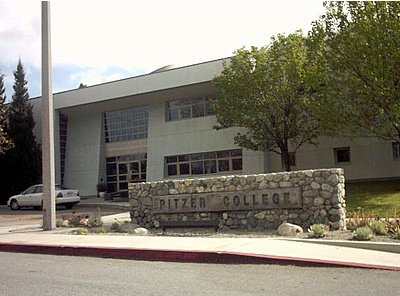
The faculty of Pitzer College, one of the Claremont Colleges, voted on a motion to end its study abroad program at the University of Haifa in Israel on Monday.
According to the Claremont Independent, Pitzer’s faculty voted to suspend the program until Israel ends its policy of preventing supporters of the Boycott, Divestment and Sanctions (BDS) movement from entering the country and begins to grant “visas for exchanges to Palestinian universities on a fully equal basis as it does to Israeli universities.”
The faculty also passed a motion expressing their dissatisfaction with Pitzer College President Melvin Oliver and the Board of Trustees’ decision to render invalid a student government resolution passed in 2017 calling the college to divest from companies that do business with Israel.
“We the Faculty object to the president and trustees singling out this one issue as a basis for not accepting the Senate’s longstanding autonomy in controlling its funds, in the context of Pitzer’s governance system,” the dissension read.
Ron Robin, president of the University of Haifa, said in a statement that the university is “highly disappointed” in the vote to suspend the study abroad program.
“As Pitzer’s Student Senate articulated in a powerful resolution, the faculty’s decision is ‘a flagrant advancement of a political agenda at the expense of students who seek opportunities in Middle East/North African Studies, Arabic, Hebrew, Christianity, Judaism, Islam and the intercultural relations of Israeli and Palestinian ethnicities,’” Robin said. “Indeed, Israel’s commitment to an open and inclusive society in which multiculturalism and interfaith tolerance thrive is no more evident than on the University of Haifa campus, where an approximately 25-percent-Arab student body exceeds the 20-percent-Arab population of the country as a whole.”
The resolution Robin referenced states, “The Pitzer College Student Senate denounces the Faculty’s desire to suspend the study abroad program at the University of Haifa and the Faculty’s decision to act unilaterally without regard to Student Voice, which constitutes an abuse of power and rebuke of Pitzer’s tradition of shared governance.”
There will be a campus-wide discussion held on Thursday to discuss the faculty’s motion to suspend the study abroad program.
Ron Krudo, executive director of campus affairs for StandWithUs, told the Journal in an email, “Faculty shouldn’t be trying to limit educational opportunities and undermine academic freedom on campus.”
“We are encouraged by the student government’s resolution criticizing the anti-study abroad vote and hope other Pitzer governing bodies will join them in standing up for the free exchange of ideas,” Krudo added.
Tammi Rossman-Benjamin, AMCHA Initiative Director, condemned the faculty’s votes as “absolutely reprehensible.”
“These Pitzer faculty members have abrogated their most basic professional responsibility – to promote the academic welfare of their students,” Rossman-Benjamin said. “President Oliver must immediately condemn this action and publicly commit to ensuring that no Pitzer student will be impeded from studying about or in Israel and that faculty will not be permitted to implement an academic boycott of Israel at Pitzer.”
A university spokesperson told the Journal that the university will refrain from commenting on the matter until the governing process on it is complete.
A poll released by CNN on Nov. 27 highlights the extent of current anti-Semitism in Europe, revealing a belief in anti-Semitic stereotypes and a lack of education about the Holocaust among the European population.
The poll, which surveyed more than 7,000 respondents in Austria, Britain, France, Germany, Hungary, Poland and Sweden from Sept. 7-20, found that 33 percent of respondents believe that Jews have too much power in global politics and 20 percent believe that Jews have an outsized influence in the media.
Additionally, 28 percent of respondents blamed Israel’s actions for anti-Semitism and 18 percent blamed the actions of Jews for anti-Semitism.
On the Holocaust, 5 percent of respondents said they had never heard of the Holocaust; that number increased to 20 percent among 18-34 year olds in France. While 33 percent of respondents said that the Holocaust is used as a tool to advance Jews’ political agenda, 33 percent of respondents also said that Israel politicizes the Holocaust to advance its policies.
Yad Vashem said in a statement that the CNN poll shows “the necessity to intensify broad-based efforts in the area of Holocaust education and awareness, which is essential to any effort to contend with anti-Semitism.”
Recent examples of anti-Semitism in Europe include a group of young men throwing a firecracker at an Israeli reporter in Germany and the vandalism of Jewish grave sites throughout Eastern Europe.
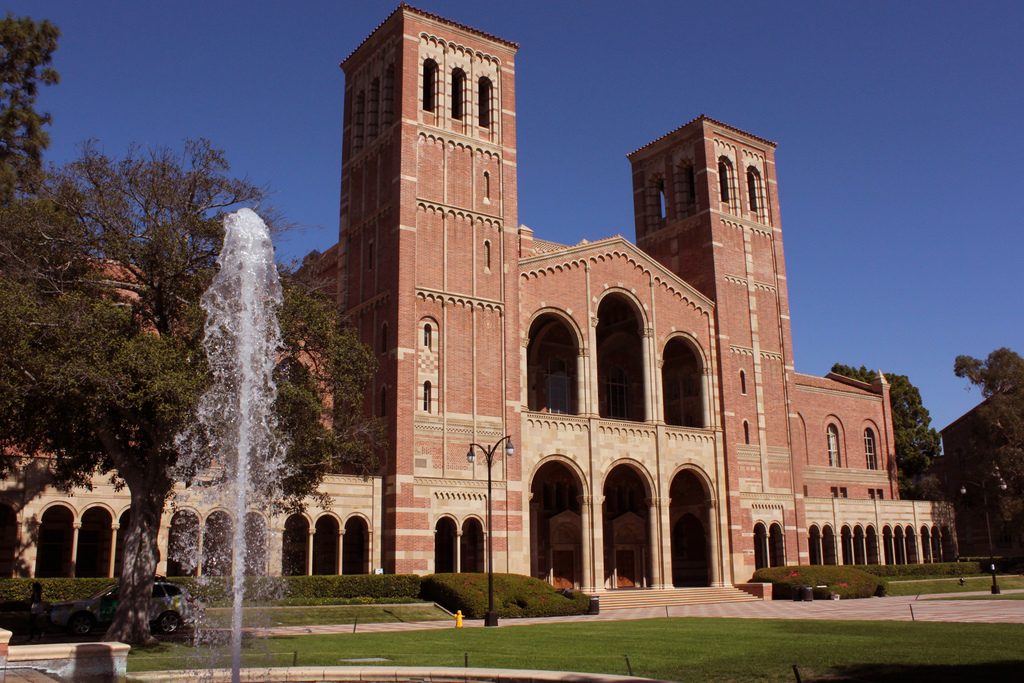
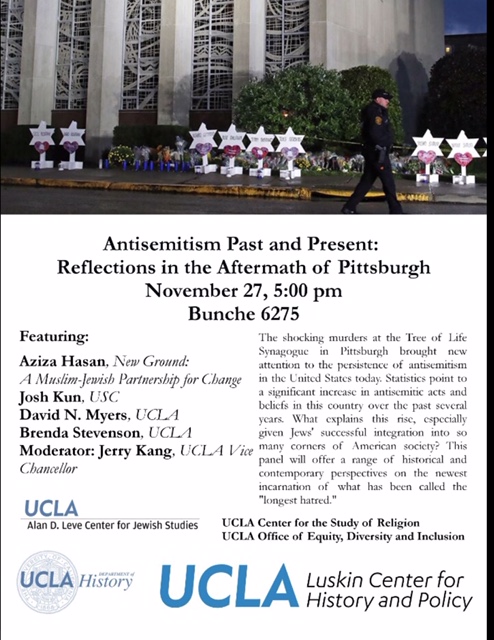
A group of pro-Israel students at UCLA are calling on a scheduled Nov. 27 panel on anti-Semitism to discuss the issue of anti-Zionism and how it translates to anti-Semitism.
The panel, which is titled “Anti-Semitism Past & Present: Reflections in the Aftermath of Pittsburgh” and is scheduled for 5 p.m., is being put on by UCLA’s Alan D. Leve Center for Jewish Studies, and will consist of UCLA’s David Myers and Brenda Stevenson, USC’s Josh Kun and Aziza Hasan, from the Muslim-Jewish Partnership for Change, as panelists; UCLA Vice Chancellor Jerry Kang will moderate the discussion.
Justin Feldman, the president UCLA’s Students Supporting Israel (SSI) chapter; Darion Ouglian, the president of Bruins for Israel; and Hillel co-presidents Jackie Schaeffer and Noy Anisman wrote in a letter to the event organizers and panelists that they should split “half of the panel discussion to classic forms of anti-Semitism (religious/race-based) and half to growing forms of anti-Semitism which emerges organically from the delegitimization and dehumanization of Israel” and acknowledge that anti-Semitism comes in many different “identities, political orientations, faiths, or ethnicities.”
“Our concerns are warranted by the fact of anti-Semitism being expressed today across cultures, religions, ethnicities, nations, and politics,” the students wrote. “This hateful phenomenon is why it is inherently possible for leading members of ‘progressive movements’ such as the Women’s March’s Linda Sarsour and Tamika Mallory to endorse anti-Semite Louis Farrakhan of the Nation of Islam, and shortly get a re-tweet in support, from David Duke of the KKK.”
They added that this “is why the silencing and disenfranchisement of Jewish students on university campuses via the Boycott, Divestment, and Sanctions (BDS), whose leaders deny Jews the right to self-determination, are given normalcy.”
“Especially amid recent tragedies, it is encouraging to know that you have arranged your diverse voices to delve into this contested issue,” the students wrote. “We trust that as speakers you will not shy away from exposing and denouncing all forms of anti-Semitism that threaten Jewish life and freedom. Whether being the white supremacist shooting at synagogue members in Pittsburgh or Hamas missile attacks at Israeli civilians in Israel, or the discriminatory silencing of Jewish and Zionist voices by defamatory organizations at UCLA, we need your voice. Indeed, dismissal of anti-Semitism anywhere is a promotion of anti-Semitism everywhere.”
Feldman told the Journal in a phone interview that they viewed the event as the administration’s way of saying that everything is “A-OK” for Jewish and pro-Israel students on campus.
“There are actually many issues that they’ve swept under the rug that need to be talked about,” Feldman said, adding that UCLA hasn’t publicly stated any disciplinary measures for individuals involved in the May disruption of an SSI event as an example.
Judea Pearl, chancellor professor of computer science at UCLA, National Academy of Sciences member and Daniel Pearl Foundation president, told the Journal in an email that unless such balance is provided at the panel, “the staging of this panel would appear as a sinister attempt to divert attention from UCLA’s unwillingness to deal with its own problem of anti-Semitism which stems, almost exclusively, from anti-Zionist hostilities that are yet to be denounced by the administration.”
Yoram Cohen, a UCLA chemical and molecular bioengineering professor and director of the Soraya Nazarian Center for Israel Studies, told the Journal in a phone interview that while he doesn’t know the specifics of what the panelists will discuss, the recent shooting at the Tree of Life synagogue in Pittsburgh and the National Students for Justice in Palestine conference at UCLA makes the students’ position understandable.
“We should realize that we should combat anti-Semitism in whatever form it takes, whether it’s anti-Israel activities that are specifically because it is against the Jewish people and the people in Israel, or whether it’s anti-Zionism, which masquerades as anti-Semitism,” Cohen said, “so we should be very careful, and I hope that this is part of the discussion that will take place.”
The university did not respond to the Journal’s request for comment at publication time.
Few bands have had the staying of Blondie. The New York-based band first hit it big in the late 1970s, ultimately scoring hit after hit – “Heart Of Glass,” “Dreaming,” “The Tide Is High,” “Rapture,” “Hanging On The Telephone,” “Sunday Girl,” “One Way Or Another,” “Call Me”… Last year’s “Pollinator” album featured collaborations with Sia, The Smiths’ Johnny Marr, Joan Jett, Charli XCX, TV On The Radio’s Dave Sitek and The Strokes’ Nick Valensi and was named one of Rolling Stone’s “20 Best Pop Albums of 2017.”
Blondie co-founder, guitarist and songwriter Chris Stein has also found success as an artist outside of Blondie. His latest book is “Point of View: Me, New York City, & The Punk Scene,” a collection of photographs taken by Stein. Stein and Blondie frontman Debbie Harry will be part of an event at New York City’s Cooper Union on November 30 in which “Point of View” will be discussed alongside Rob Roth, Blondie’s creative director; the event is free and open to the public, but an RSVP is recommended.
I had the pleasure of speaking with Chris Stein by phone. We chatted about his Jewish roots before talking about “Point o View” and his other endeavors.
Jewish Journal: Were you bar mitzvahed?
Chris Stein: No, my parents were “reds.” (laughs) So we never really practiced, but we did have a big birthday party when I was 13.
JJ: Did being Jewish ever come up when you were with Joey Ramone or other punk rock scene people who of The Tribe?
CS: Nah, I don’t think so. It was always kind of unsaid. I was close to Joey but I don’t think we talked about it specifically that I can remember.
JJ: How long did you spend putting together your new book?
CS: The book was put together over the course of a year, pretty much, dealing with film. I suppose if we had digital cameras back then it might have been a lot faster. But I had a good editor on the book, I enjoy the process.
JJ: Did you have all the film readily available? Or was a lot of it in storage?
CS: I have it all here where I live. It’s not a huge amount of stuff, it’s all in binders. It’s just a huge pain in the ass looking for individual images because there’s really no way to mark the stuff. There’s really no way to categorize it when you think about it. It’s just there… Most of the original film containers are gone, it’s just pages and binders. So that’s a time-consuming process.
JJ: What was your entry into the art world beyond music?
CS: My mom was a painter and a window designer. She knew [Willem] de Kooning and all this stuff, so I was always exposed to it.
JJ: But in the case of collaborations over the years with Warhol, Basquiat and all that, how did your entry into that world happen?
CS: I went to art school, the School of Visual Arts in Manhattan, so there was always that crossover. I was always doing photography.
JJ: Beyond that, you always had a lot of interesting projects going on, like TV Party. When did you first start to diversify beyond just being a guy in a band?
CS: Everyone just kind of multitasking back then. It was just what we did. Some people were strictly musicians, but [David] Byrne was always doing photography…
JJ: Is that still the case today? Do you have projects going on beyond Blondie, your photography and your books?
CS: We’re always doing other things. For Blondie, we’re always being approached about films and TV.
JJ: The album Pollinator was interesting in that you used outside writers for a lot of the songwriting. Was that something you would do again?
CS: Yeah, sure. Actually, we got another great song from Johnny Marr that we’ll definitely do, we’ll record it. I don’t know if we’ll do as much on the next album, but for sure. It’s nice to make connections with younger artists that are out there working.
JJ: So there is another Blondie album planned right now?
CS: Yeah. I haven’t yet finished dealing with the book, so I haven’t really been into songwriting mode. I’ve got to start doing that pretty soon. But we’ll do another one with [producer] John Congleton because he was so much fun to work with.
JJ: Being more than 40 years into a successful career, is there anything you are still hoping to accomplish?
CS: Yeah, of course, I can always think of stuff. (laughs) A long list of things, for sure.
JJ: Let me phrase that a different way. Is there a career accomplishment you are most proud of? Or is it simply a proud accomplishment to still be doing it over 40 years later at a high level?
CS: Yeah, we’re getting a lot of love these days. We kind of have complete acceptance now that we didn’t have 20 years ago. That’s a nice thing.
JJ: Ultimately is there something you wish more people knew about you, beyond you being someone that wrote a lot of hit songs?
CS: I don’t know. I just would like more Twitter followers. (laughs)
JJ: Not Instagram, but Twitter specifically?
CS: Twitter is for the political aspect of it, so I’m always on there complaining about things.
JJ: So in closing, any last words for the kids?
CS: I don’t know, I think things are good [now]. It’s an interesting period we came up in but things are also exciting now. It’s not terrible to be in the moment.
More on Chris Stein and Blondie can be found online at www.blondie.net.
As directors of Chabad of Thousand Oaks, my husband, Rabbi Chaim Bryski, and I, along with so many in the T.O. community, were here when the tragedies and horrors hit two weeks ago. Following are some lessons I’m learning through it all.
Two nights in a row I was woken up at 1 a.m.– the first night, it was due to the shooting (Israeli news networks were calling to see if we had information we could share), and the second night, it was due to the fires (evacuation orders). The first night was due to the heinous act of a human being; the second night was primarily an act of G-d- while the sources of many of the fires are still not known, the strong winds most definitely fanned those flames to an uncontrollable state.
In both cases, though, what shone forth was that in the ugliest of times, whether it’s seeing the devastation of fires or the worst of human nature—you also begin to see the most beautiful parts of human nature. Somehow, they work in tandem.
It is almost a cliché to say we are supposed to fight darkness with light, and it doesn’t always feel sophisticated, but the reality is that our job as Jews is to uplift the people around us with goodness. It’s an incredible antidote to pain and despair. On Thursday, people were donating blood for the victims, my husband was joined by many other clergy members at the T.O. Teen Center and many brought food to the T.O. Center for the first responders and grieving families. Early Friday morning, as we along with many others evacuated, families, friends, and strangers, opened their homes for their loved ones, or for friends of friends; people purchased gift cards and clothing for those who had tragically lost their homes; and many drove to neighbors’ homes to make sure others were OK, especially the elderly or handicapped.
When we were evacuating, I quickly realized that of all we own, there is very little that we ultimately needed to take with us. Important documents, a small case of jewelry, three albums from our 19 years of marriage, clothing. And of course, the ultimate possessions that we live and would die for- our sleeping children, and our three Torahs in the shul. The end. Would it be heartbreaking to lose our home and Chabad House right after we finished all this construction? Devastating to lose many valuables, especially things that have sentimental value? Of course. But it’s just stuff. Not people. Not Torahs. Nothing that we live and die for.
We evacuated to Tarzana, and stayed at my husband’s cousins, Rabbi Yanky and Hindy Kahn, who graciously hosted all seven of us for what ended up being a three-day weekend and treated us like royalty. As I tucked my children into bed Friday night after a beautiful Shabbos dinner, I felt strangely at peace. It made me muse about the meaning of the word Home. It’s true that Home is where I kick off my shoes after a long day, kibbitz with my kids, maybe even drink the last few sips of seltzer straight from the bottle. But I realized that Home is more than a place of physical and even emotional comfort. Home is a state of mind that all is OK and will be OK no matter what- because the truest things that are important can always come with me- my identity, my values, my way of life and my attitude towards life. When a Jewish couple gets married, we bless them under the canopy to create a “binyan adei ad,” an everlasting edifice.
Surely this can’t mean a physical everlasting home. People move all the time. And we all know too well that houses can literally vanish from the unforgiving flames of an atomic-like fire. That Friday night, as I sang the Shema prayer with my children, I more fully understood what this everlasting edifice refers to. For all I knew, my house was already up in flames. And yet my Home was fully intact- the familiar comfort instantly available as we sang the familiar words that Jewish mothers have sung to their children since the beginning of time, and Jews of all ages have uttered from the cradle to the grave.
Having an everlasting Home is what allowed my grandmother, although on the run from a young age in Communist Russia, to have daily moments of familiarity and comfort and solace- in the mezuza her father would kiss and savor for a few minutes before hiding it back in his drawer.
Webster defines Home to mean “the social unit formed by a family living together.” And there we were- 30 miles from our house, and yet Home, because we were with one another. Not just physically but in heart and mind and values.
The other Webster definition that intrigued me was, “a place of origin.” Here, too, the spiritual implication is that Home, or origin, is about living with a deeply-rooted identity; with my Jewish values that my ancestors lived and died for. “A place of origin” means that one can be uprooted, and yet never be uprooted, at the same time.
I drive up the grade to Camarillo, and down Westlake Boulevard in Thousand Oaks, and through the hills of Calabasas, and marvel, each time, at the incredible work of our firefighters. Every patch of blackened mountain that abruptly ends at the main road, or abruptly ends right where a home begins, tells the story of the tremendous efforts of all the brave men and women in uniform who fiercely protected that which is sacred to us. And I drive past the Borderline Bar on my way home, and see the touching tributes and accolades to our hero, Sgt. Ron Helus, who gave up his life in the process of protecting others,’ and once again I am reminded that a country of greatness, indeed a world of decent human beings, begins with each individual making a choice to choose, often courageously, to do good.
Rebbetzin Shula Bryski is co-director of Chabad of Thousand Oaks and has a writing business at shulaswritingservices.com