fbpx

November 1, 2018

Pro-Israel Groups Urge U-Mich to Crack Down on Academic Boycotts
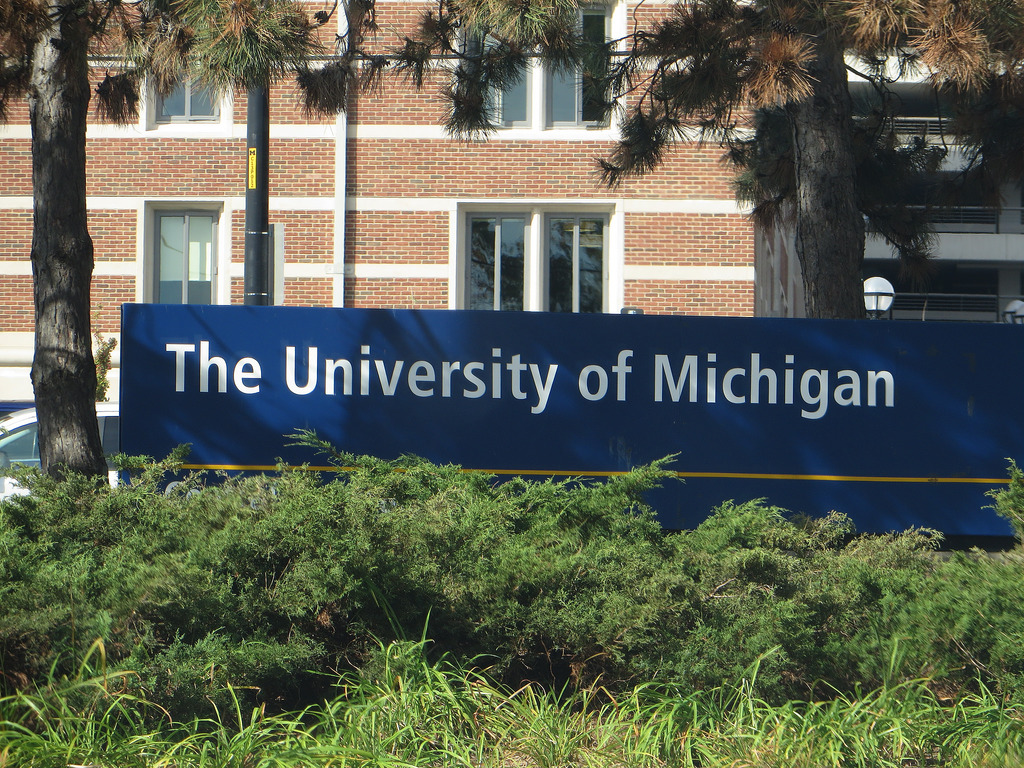
Photo from Flickr.

Pro-Israel groups StandWithUs, The Lawfare Project and the Louis D. Brandeis Center for Human Rights Under Law, penned a letter to University of Michigan President Mark Schlissel and the university’s board of regents, urging the administration to crack down on academic boycotts of Israel among faculty members.

The letter, which has been obtained by the Journal, began by acknowledging the university’s condemnation of anti-Israel boycotts and disciplining Professor John Cheney-Lippold for refusing to write a letter of recommendation for a student to study abroad in Israel. However, the groups were discouraged that the university will not commit to a thorough investigation of such academic boycotts.

“It seems highly likely that other students have been affected by the political positions espoused––and adopted–– by these individuals in a way that would be discriminatory under your now-enumerated policy,” the letter states.

Other tactics used in academic boycotts of Israel include rejecting academic events that are in anyway affiliated with Israel, programs at Israeli institutions and speeches given by Israeli officials.

“We are concerned that faculty may advance the academic boycott at their students’ expense without any accountability or oversight,” the letter states. “For example, a student may spend countless hours under faculty supervision researching and drafting a scholarly paper with a goal of publication, only to have the faculty member refuse to review the final product because the student chooses to publish the article in a journal based at or in collaboration with an Israeli university.”

The letter noted that there was recently a town hall on campus that was sponsored by university academic departments and promoted the Boycott, Divestment and Sanctions (BDS) movement.

“In light of this report, we are deeply concerned that these faculty may take further steps in support of BDS that discriminate against and disadvantage pro-Israel and Jewish students,” the letter stated. “Without a broad institutional commitment to combating the effects of BDS activism by professors and academics at the University of Michigan, students will be left with little recourse.”

The letter concluded, “It is imperative that your administration clarify its current policy to reflect zero-tolerance for faculty discrimination and efforts to limit student educational opportunities––whether the conduct is inspired or advanced by BDS or by any other discriminatory movement or government. In particular, it is vital that university policy spell out the potential ramifications for faculty who interfere with a student’s academic privileges and/or opportunities based on that faculty member’s personal political views–– and not based on the student’s academic merit.”

Pro-Israel Groups Urge U-Mich to Crack Down on Academic Boycotts Read More »
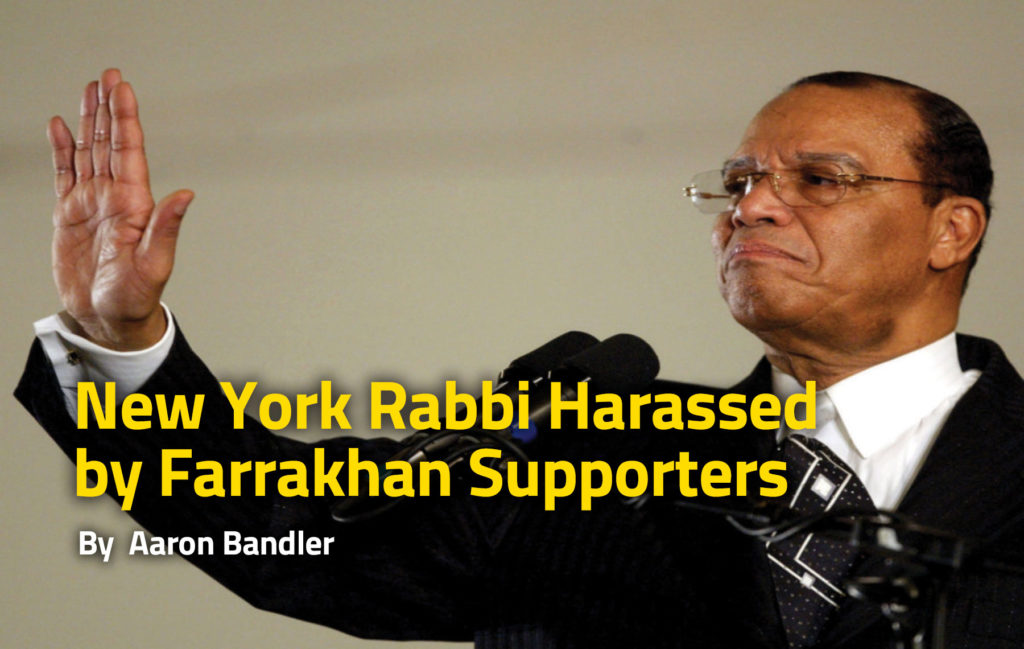
New York Rabbi Harassed by Farrakhan Supporters

A rabbi in New York shared in a Facebook post that he was harassed by a couple of supporters of Louis Farrakhan, who is known for his anti-Semitic views, during his evening commute.

Rabbi Avram Mlotek of Base MNHTN said that while he was on the subway, a man asked if he was “a real Jew.” When he said that he tries to be, the man replied by calling him an “impostor.”

This man told me repeatedly that Israel was not mine, that I was a fraud, and that Jews are responsible for the mess we find ourselves in today in the city of New York and all over the world,” Mlotek wrote.

The man then showed him a picture of Farrakhan and asked him who he was. Mlotek said that Farrakhan is an anti-Semite, the man replied, “No, that’s a real Jew. You’re a f***king fake.” The post continued:

At this point another man on the subway said, “He ain’t gonna take your bait.” The first man then said, “Yeah, brother. Black power.” The second man about me, “He a photo-copy” and lifted up his fist in the Black power symbol. The first man went on: “And a bunch of them are gays. Fu*king faggots. You gonna get off this subway stop, man?” “I’m going to go home to my wife and kids,” I said. “Yeah, you a c******r,” he said. “Have a blessed night,” I said as I got off the train. On a crowded subway home, no one besides a second man who seemingly held similar ideologies said anything.

Farrakhan recently compared Jews to “termites” in a video.

New York Rabbi Harassed by Farrakhan Supporters Read More »

Three More Pittsburgh Victims Laid to Rest Thursday

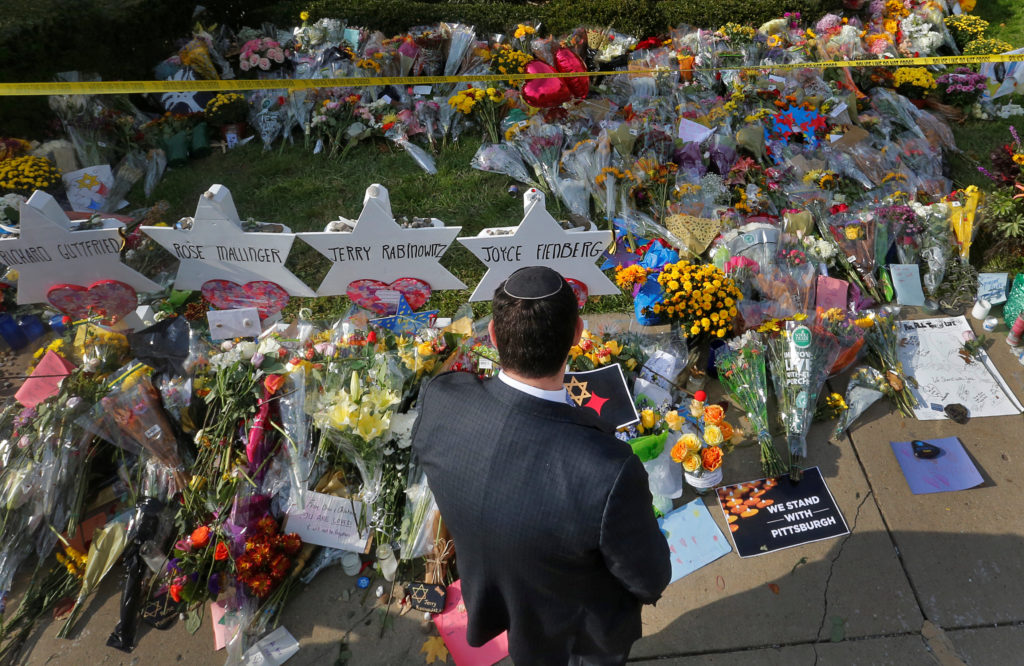
Three more Pittsburgh shooting victims were laid to rest on Thursday: married couple Sylvan and Bernice Simon – 86 and 84 respectfully – and Dr. Richard Gottfried, 65.

The Simons had been married for 62 years, and were married at the Tree of Life synagogue. They were regular attendees at the synagogue.

Sylvan was a retired accountant and military veteran who enjoyed watching sports, particularly the Pittsburgh Pirates, and cracking jokes Bernice, a former nurse, was an avid cook who enjoyed going with her daughter, Michele Simon Weis, to sample food at Costco, engaging in philanthropy and listening to classical music.

She was always there for me,” Weis said at her parents’ funeral. “She was my very best friend.”

The couple was known for being warm and friendly; for instance, they’d hold hands as they wave at the children playing baseball nearby the synagogue.

Their house was also adorned with “Support Our Troops” and “God Bless America” stickers as well as a picture of Mount Rushmore emblazoned with the words “America the Beautiful.”

The entire Simon family was planning on getting together for a family birthday celebration after the Saturday morning services at Tree of Life, but the celebration never occurred due to the shooting.

“Let’s take my parents’ great love, admiration and understanding for each other, which they shared with all of us, to serve as a beacon of light for everyone to shine throughout the world in an attempt to mitigate – and ultimately eliminate – the kind of hatred that fostered this horrific event,” Marc Simon, the son of Sylvan and Bernice, said at the funeral.

Dr. Richard Gottfried was a dentist who was planning for retirement before the shooting occurred. He and his wife, Dr. Margaret “Peg” Durachko, ran private dental practices together as well as volunteered at free dental clinics.

Gottfried was a father-like figure to many, including to his grand-nephew, Jacob, 16, whose father died when he was 9.

When my dad passed away, he was really supportive in that time and he was just an awesome person to talk to and be around,” Jacob told Time.

Gottfried was also a lover of wine and University of Pittsburgh sports teams.

“Evil took him away,” Durachko told station WTAE through a friend. “And she wants people to know that the only way we can honor Rich is to start destroying that evil when we see it in our own lives, and start filling it with love, filling it with service, and trying to make a difference. And that will be Rich’s legacy.”

Three More Pittsburgh Victims Laid to Rest Thursday Read More »

A Moment in Time: “We Are” – A Response to the Tragedy at Congregation Tree of Life in Pittsburgh

We are Parkland.
We are Newtown.
We are Orlando.
We are Las Vegas.
We are Charlie Hedbo.
We are Virginia Tech
We are Charleston
We are San Bernadino
We are Laramie
We are Oklahoma City
We are Columbine
We are the Congregation Tree of Life in Pittsburgh
We are all these places where violence has inflicted terror on humanity.
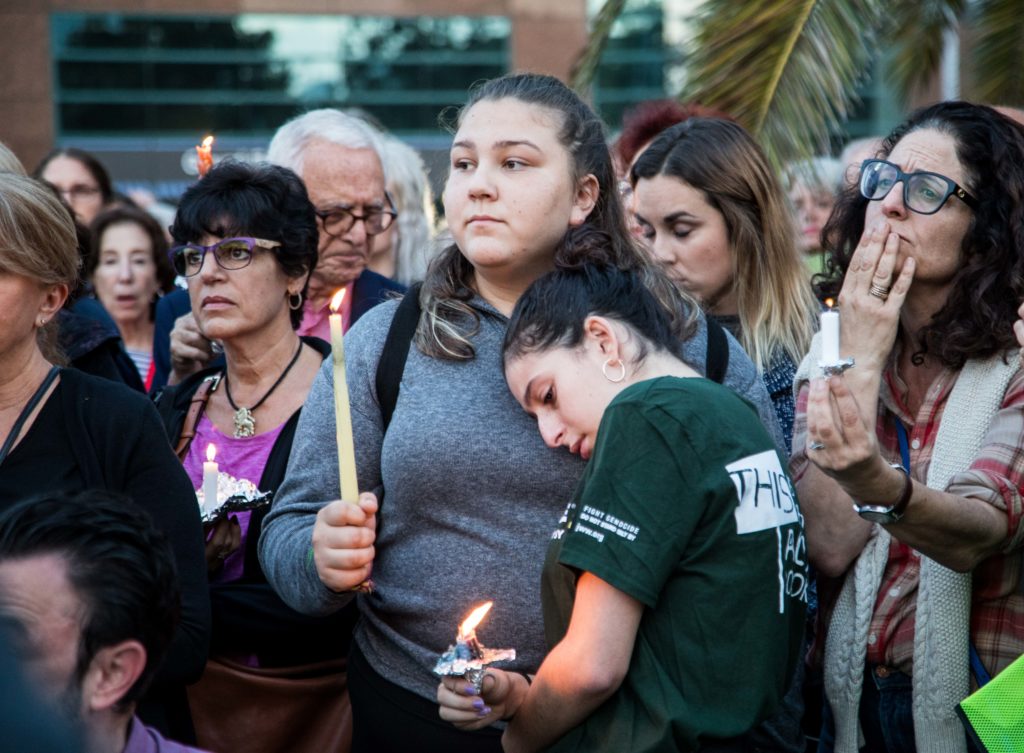
And today WE are Culver City, and we bring a message of SHALOM
We are Jews
We are Christians
We are Muslims
We are Hindus, Sikhs, and Buddhists.  We are Bahai.
We are atheists and agnostics.
We pray to God, to Adonai, to Allah.
We love our children.
We are black, we are white, we are Latino.  We are Asian.  We are LGBTQ.
We are Democrats.  We are Republicans.
We are immigrants.  We are native.
We are survivors.
We are redeemers.
We are.
We are and we love and we dream and we hope.
We are.
We pray and we listen.  We embrace and we care.
We are.
We march toward truth.  We replace darkness with light.
We are.
We pursue justice.  We march for peace.  We gather with unity.
We fight the evils of antisemitism, a disease that has plagued Judaism – and all who care about humanity – for 3500 years.
We inherit the right to be safe in our schools, our houses of worship, and our places of recreation.
We inherit the responsibility to demand more of our community when that safety is compromised.
We are.
And we always will be.
As the prophet, Amos taught, “Let justice roll down like water, and righteousness like a mighty stream.”
And as our liturgy, like a loving embrace, reminds us:
Baruch Atah Adonai – hapores sukat shalom aleinu v’al kol Yisrael, v’al kol Yerushalaim, v’al kol yoshvei tevel.
Blessed are You, Adonai, Ruler of the universe, who spreads a Sukkah, a shelter of peace, over all of us, over Israel, over Jerusalem, and over all who dwell on earth.
Amen.
Rabbi Zach Shapiro
A change in perspective can shift the focus of our day – and even our lives.  We have an opportunity to harness “a moment in time,” allowing our souls to be both grounded and lifted.  This blog shows how the simplest of daily experiences can become the most meaningful of life’s blessings.  All it takes is a moment in time.
 
Rabbi Zach Shapiro is the Spiritual Leader of Temple Akiba of Culver City, a Reform Jewish Congregation in California.  He earned his B.A. in Spanish from Colby College in 1992, and his M.A.H.L. from HUC-JIR in 1996.  He was ordained from HUC-JIR – Cincinnati, in 1997.  He was appointed to the HUC-JIR Board of Governors in 2018.

A Moment in Time: “We Are” – A Response to the Tragedy at Congregation Tree of Life in Pittsburgh Read More »

The Old New Math (Oh, and a Reminder: We’re All Going to Die) - A poem for Parsha Chayei Sarah (Aliyah 1) by Rick Lupert

The Old New Math – A poem for Parsha Chayei Sarah

And the life of Sarah was one hundred years
and twenty years and seven years;

The Torah is no place for a new math joke
but I understand this almost as well as I do
my ten year old’s homework.

I’m sometimes asked to check it and
the best I can do is verify that it does indeed exist
and that things are written where

there were formerly blank spaces.
But ask me if it is correct and I’ll refer
you to his teacher.

The new math is like the ancient math.
Somehow my generation got away with
just saying one hundred and twenty seven.

I see the holiness in the work my
son brings home from school
and I understand it just as well.

Give me burial property with you, so that
I may bury my dead from before me.

There’s no Jewish publication that doesn’t
include advertisements for the final plot of earth –
Often highlighting lovely hills, and

spots beneath trees, and views of the city –
None of which (I think) I’ll need when I eventually
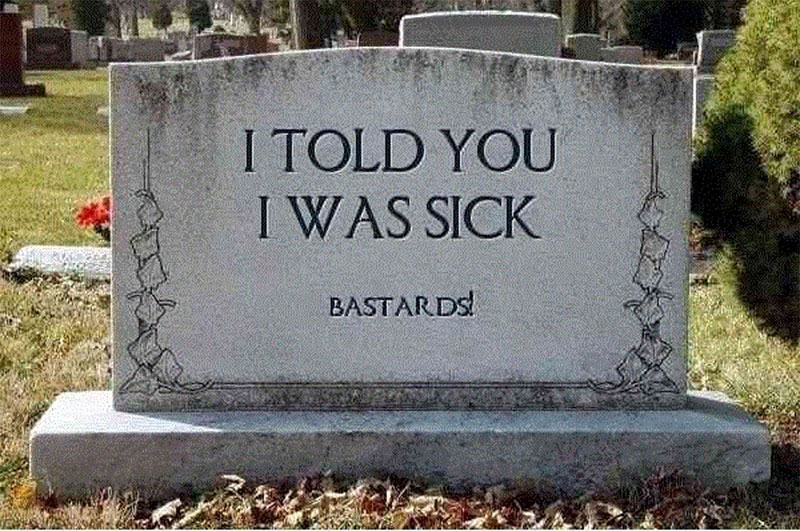
find my home in the dirt.

I get suspicious about the idea of paying for this
in advance. What would they do with me if I simply
refused to make an arrangement while still taking breaths?

Probably stick me in the back with the other death-beats.
It’s hard enough to save for retirement without adding in
a cost for the hereafter.

I guess I need a place to hang my bald spot.
Something nice that people can visit when they
miss everything silly I had to say.

Yes, underneath a tree, and on a hill and
with a view. You can only stare at a headstone
for so long.


God Wrestler: a poem for every Torah Portion by Rick LupertLos Angeles poet Rick Lupert created the Poetry Super Highway (an online publication and resource for poets), and hosted the Cobalt Cafe weekly poetry reading for almost 21 years. He’s authored 21 collections of poetry, including “God Wrestler: A Poem for Every Torah Portion“, “I’m a Jew, Are You” (Jewish themed poems) and “Feeding Holy Cats” (Poetry written while a staff member on the first Birthright Israel trip), and most recently “Donut Famine” (Rothco Press, December 2016) and edited the anthologies “Ekphrastia Gone Wild”, “A Poet’s Haggadah”, and “The Night Goes on All Night.” He writes the daily web comic “Cat and Banana” with fellow Los Angeles poet Brendan Constantine. He’s widely published and reads his poetry wherever they let him.

The Old New Math – A poem for Parsha Chayei Sarah Read More »

How Good is America for the Jews?

Most of the commentary since the synagogue tragedy in Pittsburgh has focused on a rise in anti-Semitism in America. Because everything seems to be political at the moment, “It’s Trump’s fault” has been a popular meme on the left; while “Don’t forget Jew-haters on the left” has been the obligatory retort from the right.

Regardless of where it comes from, though, the central claim is that things are getting worse for the Jews.

Before Pittsburgh, graffiti of a swastika on a synagogue wall was a major story– a cause for serious alarm in the Jewish world. Then, suddenly, Pittsburgh happened. Instead of a spray can, the Jew-hater picked up an AR-15 and murdered 11 Jews.

From a swastika on a wall to the murder of 11 Shabbat worshippers is a communal earthquake.

To give you a sense of the magnitude, the last synagogue shooting in America happened in Detroit in 1966, and it was by a deranged congregant who shot the rabbi. There have been a few isolated shootings at Jewish places, but Pittsburgh is the first synagogue shooting by an anti-Semite in U.S. history – and by far the deadliest.

In the face of such horror, it’s hard to focus on how welcoming and amazing America has been to the Jews; how we have thrived in this oasis of freedom after feeling the sting of persecution for centuries.

Indeed, the golden age of American Jewry kicked off in the 1950s. In Jonathan Sarna’s “American Judaism: A History,” he quotes Anti-Defamation League director Benjamin R. Epstein, who described the two decades following World War II as a “period of tremendous progress” and a “golden age” for the Jews.

During those years, Epstein recalled, American Jews “achieved a greater degree of economic and political security, and a broader social acceptance than had ever been known by any Jewish community since the [ancient] Dispersion.”

It’d be foolish to say that anti-Semitism went away. It never did; it never will, in America or elsewhere. As Sarna writes: “Anti-Semitism by no means disappeared, of course, any more than nativism, anti-Catholicism, or racism did.”

But it’s fair to say that America did not make it easy or popular to be an anti-Semite.

Anti-Semites “found themselves placed on the defensive as Judaism’s status rose,” Sarna writes. “Forced to justify their anti-Jewish prejudice in the face of America’s increasingly tolerant norms, they beat a hasty retreat.”

This broad acceptance of the Jews is what most of us grew up with and got used to. Our contributions to American society have been so pervasive and substantial that some commentators speak of Judaism and Americanism in the same breath. We have embraced American freedom and opportunity with a full heart, and, in deep gratitude, have given back all we could.

It’s not a coincidence, then, that according to a 2017 Pew survey, more Americans — 67 percent— feel warmly toward Jews than toward any other faith group.

So, when we get spooked by a disaster such as Pittsburgh, it’s not just because we’re terrified but because we recognize its abnormality. Something about Pittsburgh felt so un-American, so foreign.

It’s easy to forget all this while our ears are ringing with alarming cries of a rise in anti-Semitism; and while our community argues over whether it’s worse from the left or the right.

Anti-Semitism will never go away; it’s the nature of the disease. The rise of the internet and proliferation of social media has further magnified swastika sightings and anti-Semitic incidents from the left and right, including on college campuses.

But as we stay vigilant against these troublesome signs, let’s not overlook the enormous outpouring of love and concern for the Jews that has come from across the nation. It’s hard to imagine a country, outside of Israel, where a mainstream newspaper would actually feature large Hebrew letters on its front page—as the Pittsburgh Post-Gazette did last week when it honored the victims of Tree of Life by putting the beginning of the Mourner’s Kaddish on its front page.

Those Hebrew letters, which have gone viral, are a quirky reminder of how fully integrated we have become in American society; and of how anti-Semites will never win popularity contests in this country.

For American Jewry, America has become like family. We give a lot and expect a lot. We’re no longer on foreign land. This is our country.

Pittsburgh has been a shock to our system not because America is bad for the Jews– but precisely because it has been so good.

How Good is America for the Jews? Read More »

Two Nice Jewish Boys Episode 113 – The Dark Side of Innovation

Hi-tech and innovation have brought many good things to the world. Social media connected us to one another and in doing so gave power to the citizens of the world. Search engines gave us access to knowledge and the day may come when autonomous cars will rid us of accidents on the road and save millions of lives.

But start-ups may also have dark sides. Facebook helped, unwittingly, spread fake news and foreign governments used it to intervene in the democratic process in America. Bitcoin and other cryptocurrencies are used for drug and weapon trafficking, far from the eyes of law enforcement. And then there’s privacy. It’s that thing we used to have, and maybe never will again.

So innovation goes both ways. That we know. But what happens when companies innovate to provide tools for governments to intercept their citizens’ activities, extract information about them and maybe ultimately – prosecute them and violate their basic human rights?

In recent years more and more Israeli companies are blamed for doing exactly that. In a huge investigative report on Haaretz – one of Israel’s leading newspapers, reporters Hagar Shezaf and Yonathan Yakobzon, delved into the dark pasts of a few of these companies. What they found was alarming. Hagar Shezaf of Haaretz, joins us today to talk about the investigation and the piece she co-wrote.

The report on Haaretz
Hagar’s pieces on Haaretz
Hagar Shezaf on Twitter

Two Nice Jewish Boys Episode 113 – The Dark Side of Innovation Read More »

Obituaries: Activist and Philanthropist Anita Hirsh, 82

Jewish activist and philanthropist Anita Hirsh died Oct. 27 at her home in Studio City. She was 82 years old. 

Hirsh was born in 1936 to Natalie and David Freedman, Russian refugees who had escaped the Bolshevik Revolution.

Throughout her life, Hirsh was devoted to making life better for those in her community and in other countries. The Los Angeles native advocated for persecuted Jews around the world and in the 1970s brought diplomatic attention to Jews in the Soviet Union, helping many of them safely immigrate to Israel.

Hirsh’s accomplishments don’t end there. She helped establish five nursery schools for underserved Jewish, Christian and Arab children in Tel Aviv. She also developed the Hirsh Family Native Habitat Walk in the L.A. River Greenway Trail. She founded the Hirsh Family Early Childhood Development Center in Jaffa to promote coexistence between Israeli Jews and Arabs. Along with her late husband, Stanley, she built the Hirsh Family Kosher Kitchen, which provides food for hundreds of thousands Los Angeles residents, and she most recently supported the construction of Jewish Family Service’s social services Gunther-Hirsh Family Center on Fairfax Boulevard.

Hirsh is survived by her four children, Steven, Adam, Elizabeth and Jennifer, and five grandchildren, Talya, Noa, Aaron, Eden and Kobe.

The family requests that donations be made in her honor to Jewish Family Service of Los Angeles.

Obituaries: Activist and Philanthropist Anita Hirsh, 82 Read More »

Rabbi David Stav: How does a community grieve after the massacre in Pittsburgh?

[iframe style=”border:none” src=”//html5-player.libsyn.com/embed/episode/id/7404530/height/100/width//thumbnail/yes/render-playlist/no/theme/custom/tdest_id/689387/custom-color/dfdfdf” height=”100″ width=”100%” scrolling=”no” allowfullscreen webkitallowfullscreen mozallowfullscreen oallowfullscreen msallowfullscreen]

Rabbi David Stav

Rabbi David Stav, one of the leading spiritual voices in Israel, discusses how a community can cope with an unprecedented tragedy, such as the horrific shooting in a Pittsburgh synagogue that left 11 dead.

Follow David Suissa on Facebook, Twitter and Instagram

Check out this episode!

Rabbi David Stav: How does a community grieve after the massacre in Pittsburgh? Read More »

Israeli Series ‘Euphoria’ Gets HBO Remake

A new version of the 2012-13 Israeli television series “Euphoria,” about teenagers and sex, drugs, identity issues, social media, friendship and love, is being adapted for a 2019 debut on HBO. The cast includes Jewish actors Aaron Abrams, Maude Apatow, and Eric Dane, who join Zendaya as narrator Rue, a drug-addicted 17-year-old.

Abrams, who has appeared in the movies “Paper Towns,” “Brad’s Status,” and “Puzzle” and guest starred on “Shameless” and “Silicon Valley,” is best known for his recurring roles as Jackson Barber on “The Americans,” Casey on “SMILF,” and Ron Anderson on “The Walking Dead.”

Apatow, the daughter of director Judd Apatow and actress Leslie Mann, started out in her parents’ projects “Knocked Up,” “Funny People,” and “This is 40,” and  went on to recur on “Girls” and appear in the films “Other People,” “The House of Tomorrow,” and “Assassination Nation.” She also co-stars in a series of Jergens body lotion commercials with her mother.

Dane is known for his roles on “Grey’s Anatomy” and TNT’s “The Last Ship,” which airs its series finale on Nov. 11.

Ron Leshem, Daphna Levin and Tmira Yardeni, creators of the Israeli “Euphoria,” will executive produce the new version, alongside writer Sam Levinson and executive producers s Ravi Nandan, Kevin Turen, Hadas Mozes Lichtenstein, Mirit Toovi, Yoram Mokadi and Gary Lennon.

Israeli Series ‘Euphoria’ Gets HBO Remake Read More »