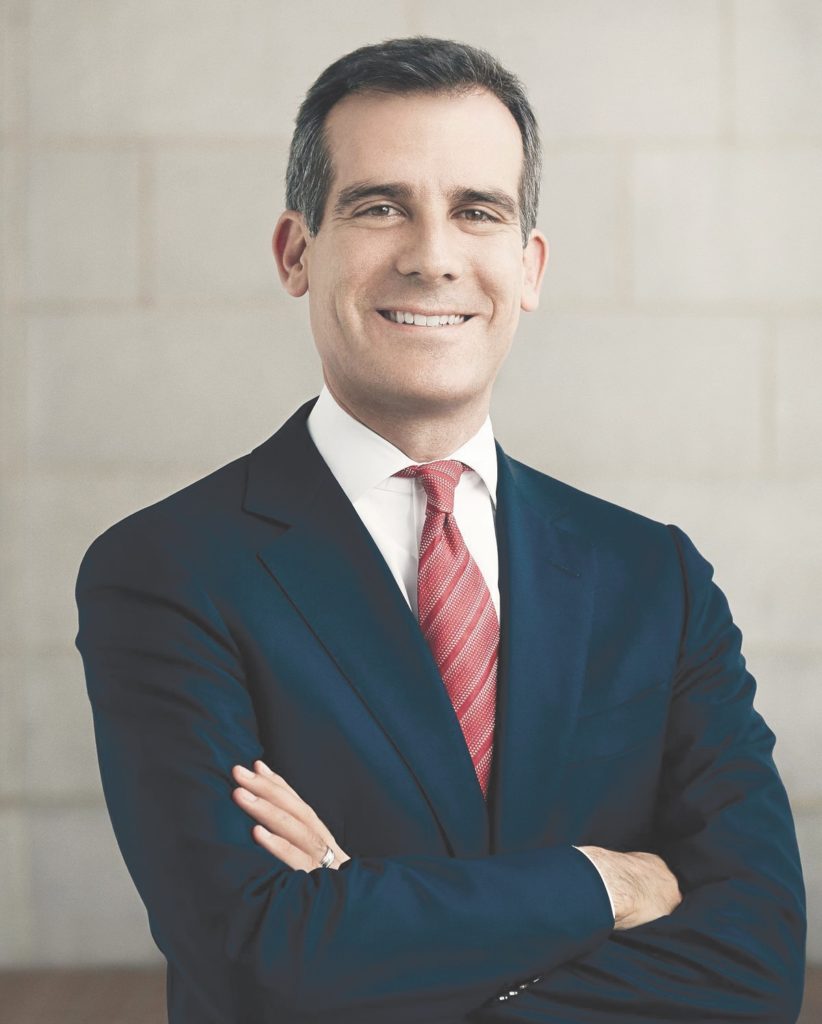
L.A. Mayor Eric Garcetti 2018 Rosh Hashanah interview [full transcript]
Last month, I interviewed L.A. Mayor Eric Garcetti in his office at L.A. City Hall. An edited version of the interview ran in this week’s Rosh Hashanah issue. This is a full version of the interview.
RYAN TOROK: This is a very cool office, by the way.
ERIC GARCETTI: This has been the mayor’s office since the building opened in the ‘20s, late ‘20s, ’28.
RT: How much of this [furniture and artwork] is reflective of your own taste, a lot of it?
EG: I lost the pictures. I had pictures before. There was the formal desk here, a bunch of nondescript furniture, and a weird mural on the wall that was like a Greetings from L.A. postcard, with the Observatory. This, obviously, I kept [he said, pointing to a sign on his office wall] but I wanted it to say “L.A.” and I wanted it to be brighter. It was really dark in here, with massive drapes. So, I lightened it up. I took some art from MOCA and LACMA, so these are both from classic California modernists, and this is Ed Moses, who just passed. All the furniture is designed by a famous California designer and architect. I got rid of my desk; just that meeting table, because that’s what you mostly need for collaboration, some formal place to sit.
RT: Where do you stay when you’re sitting at a computer?
EG: There’s a little, small office back there and a computer. I’ll be on my laptop. I don’t spend much time on the computer at all, so I do most of my email on my phone, if I do any at all. But I take meetings in here. Sometimes here, and then our press conference room if we have a crowd bigger than ten. I can do meetings of up to 40 or 50 people in there. But I’m usually out in the city. I would say I’m in the office less than half the time, for sure, maybe a third of the time, a quarter of the time.
RT: You said somewhere that you typically work an 18-hour work day, is that right?
EG: Probably all in, yeah. We subtract a couple of hours for some family time somewhere in there, hopefully, but the bookends of the day are probably 16, sometimes as long as 18 hours. I basically wake up here, check what happened last night, talk to the police chief or texting somebody back. In the night, I might be talking to a supervisor at 10 o’clock at night about homelessness or something. You’re never not on the job. I would say being mayor is pretty much—because something could happen at any time. You can be working for the city, a different city, and you spend five hours, essentially here because you’re on the phone with folks and doing stuff; what’s going on, if a power outage has happened. I was on a rare, personal family vacation, but I was texting people in long streams, trying to figure out when the power would be on for their house and getting better information for them. Don’t run for mayor if you don’t want to basically be working all the time. But I am good at trying to carve out family time.
RT: How difficult is that balance, that work/life balance?
EG: It’s tough. I mean, that’s one thing I won’t sacrifice. I’ve watched some people involved really burn themselves out, or they’re at a different point in their life where their kids are off to college or something, so they’ll go to three or four events a night. I don’t do many of those events. I might do one, maybe two, and I don’t do them every night because even though I’ll be working at home, I tuck my daughter into bed. If I’m not there for dinner or for tuck-in time, I don’t think the Chamber of Commerce will remember if I went to three or six of their galas, but Maya [his daughter] will remember if Dad was home. So, my priority is pretty straight there.
RT: Are there particular organizations that are non-profits, maybe specifically, Jewish non-profits, that you think are doing great work that you lend your name and voice to?
EG: Absolutely. And one of the things if I can’t go to a lot of their events is I’ll do a recorded video for them, same speech, essentially, that I do in person. Yeah, there’s a ton of organizations. Let’s see. JVS, obviously, which is linked to the oldest non-profit in the city, the Hebrew Benevolent Society. It does a lot of great work, whether it’s job training, community strengthening. There’s a lot of Jewish-led organizations, obviously, when you think about people like Stephanie Klasky-Gamer, who has L.A. Family Housing, which used to be—anyway, it’s L.A. Family Housing now, which I think is the premier homelessness organization, or anti-homelessness organization. On a personal level, I get from the Federation all sorts of stuff. I think the Zimmer Museum is doing great work and looking to grow. I’m a subscriber to PJ Books…
RT: Are you?
EG: … although we’ve got to get some more women-focused books there. I was very involved at the time with the Progressive Jewish Alliance, which is now Bend the Arc. They’re part of a coalition of folks, individual rabbis, that are doing great stuff as well. Temple Judea on the issue of homelessness, an advisory group of faith leaders that includes some great rabbis, like my own rabbi, Sharon Brous. L.A. is filled with organizations. Some of them are so small. There might be a school on Fairfax that happens to be doing something quietly on the side, or the folks that do emergency response folks, like backup…
RT: Hatzalah?
EG: Hatzalah. Thank you, guys. Had a brain fart there. Hatzalah. There’s people who step up and fill voids all the time from the community, and I think a lot of big organizations in town have very strong Jewish leadership, whether it’s Jerry Neuman, who’s the incoming Chair of the Chamber of Commerce, or Eli and Edie Broad. I think they follow a long tradition, which my family is part of, too.
RT: You’re Jewish on your mother’s side, and you became more serious about your Judaism in college, is that correct?
EG: Probably when I went to Oxford, actually. A little bit in college at Columbia, but it was when I was studying graduate studies at Oxford. It was interesting. I have people [I met at Oxford] that now are all over the news, from Rabbi Shmuley [Boteach], a pretty conservative voice, to Peter Beinart, he was in my Rhodes class, who got arrested—not arrested—detained at the [Israeli] airport.
RT: One was detained in Israel. The other [Boteach] was defending Roseanne.
EG: Exactly. But we are a big tent of Jews. I think we’re the original big tent, quite literally. We put the big tents in the desert, so a lot of people use that as a political term. I think we invented it. But, yeah, that’s when I got more serious about exploring—I mean, the two peaks were probably Gindling Hilltop Camp between sixth and seventh grade, and then a new chapter began where I just felt more faith and connected. But I had been pretty uneducated in terms of a Jewish religious upbringing because I come from a pretty secular tradition in my mom’s family, but always felt a strong sense of identity, but not as much religious practice. So now, that’s something that I’ve come more to.
RT: Is that largely because of [IKAR Rabbi] Sharon Brous?
EG: No, no, parallel to Sharon. There’s all sorts of things. I think Sharon and I participated in something that I can pinpoint, which is Reboot. I did that, and I think that was part of thinking about this more like how can you integrate practice into your daily life, and that was a part of it. It was a space that Jews who had not necessarily been hard-core Jews to figure out what Judaism means to them and what’s the role of Judaism in the world. But we also had some practice involved in that. And then Sharon started IKAR, and when I showed up there, it was the first feeling I had of oh, this is what a shul is supposed to be. I went to high school with that person. I recalled that person. We were in Student Council. We’d been activists together. It felt like the family writ large, which is what I think a congregation either becomes or should be. Other times, I went to my cousin’s shul growing up or went to camp, and felt like I belonged, but felt like a little bit of an outsider because it wasn’t my congregation, because I didn’t have one. And now, since that camp, because I’m a member of it at Wilshire Boulevard, those places feel like home.
RT: You must really connect to Wilshire Boulevard from the standpoint that they’re really prioritizing art and architecture and creating these kinds of spaces.
EG: It’s a gorgeous space. It connects me with the history of Judaism in Los Angeles, but it also connects me with the future, because they took a pretty bold investment. The Judaism story in L.A. is the story of westward expansion, right?
RT: Right.
EG: And eastward abandonment, in some cases. And even Wilshire Boulevard started to have as equal, if not bigger, pull on the West Side until they decided they were going to redo the campus. Erika Glazer stepped up. They built a school where they had an engagement with the Mid-Wilshire/Koreatown area…
RT: Sure.
EG: …and the human services aspect with the center they opened up.
RT: The Karsh.
EG: Yeah, the Karsh Family Center, which was built. The Karshes made a huge bet, too. So, to me, it connects with me on both sides: the beauty of Judaism in both senses; aesthetic beauty and the moral beauty of it.
RT: Do you consider yourself any particular denomination?
EG: No. I go to conservative shul at IKAR, so I guess that would make me more conservative in practice. And I love that, but there’s something about the strands of the social justice that permeates Reform Judaism that appeals to me, too. IKAR is a conservative practice that brings in the urgency of social and political reflection.
RT: There’s actually been a debate recently in the pages of The Jewish Journal about whether or not Tikkun Olam and social justice are legitimate Jewish values. As someone who’s also spent time studying Torah and Talmud with Rabbi Brous, what do you say to something like that?
EG: There is a lot of reflexive Judaism, whether that comes from Orthodoxy or from more liberal Jews, where it’s easy to simplify Judaism, and I think Judaism is just inherently complex. The complexity of it is its beauty, so if you’re a politician who only says Tikkun Olam, you’re not very deep into the practice of what Judaism is. If you think that that is the central tenet, it can be for you a guiding principle, but Judaism evokes so much richness and vice versa. For Orthodoxy to say this is only about practice, if the Orthodox become the Catholics and the Reform folks become the Protestants, and one is in a personal relationship with a sense of justice, and the others fulfill the practice and fulfill the covenant, I don’t think either one of those caricatures would capture the fullness of what Judaism is. It does demand, I think both scriptural adherence and practice, but it also has taught us to be thinkers and to evolve, and as we think, to pull from the world history of Jews, who have gone through so much. So, to me, Judaism without either, loses its soul a little bit. In other words, you can’t just cloister yourself off and wait for the Messiah to come, and you can’t just say, hey, my Judaism is just about activism. Great, and I’m glad that Judaism has that influence, but I think that there are things that you miss if you also are not reflecting on why practice has evolved and why the Book of Judaism is so tenacious.
RT: What are some of the issues that are most important to you these days?
EG: I think, for me, the biggest issue is poverty in general, poverty in this time of plenty. It’s reflected in homelessness. It’s reflected in educational gaps. It’s reflected in racial disparities. Poverty, really, to me, is the defining issue of our age. I think the second is kindness and decency. The Trump era has called everyone’s bluff about do you want to be yellers and fighter and screamers even if you think you’re more just than the other side, or do we have a space for peaceful dissent and for listening…It’s a very specific thing, but in material terms, devoting our lives to ending poverty and providing equal starting lines for people is what keeps me awake. Second, is whether or not we’ll ever get there if we don’t have some kind of kindness and decency and focus on actual work rather than fighting.
RT: When you talk about poverty, are you speaking about homelessness, or are you also speaking about people who are housed but just don’t have enough to get by?
EG: Both. I think it’s the whole thing. Homelessness is the deepest manifestation of poverty in many ways, but not the only one. I think connected to poverty is the trauma of poverty. It’s not just a material thing; it’s a psychological thing that we have no mental health system in this country. The manifestation of homelessness is poverty of a different sort. I think if you frame so much of these national debates on how can we have universal healthcare, decent education and jobs, build more housing. Those are all really reflections of the same basic powerlessness that people feel that the trauma of poverty brings to people who are directly living in poverty. Now, it has been brought to all of us if we’re lucky enough not to be living in poverty, but we still feel it, we see it walking like zombies on our streets. We can sense it in a school where children haven’t been exposed to as many words or networks of opportunities. Those things, to me, define this moment. It would be perhaps more understandable if this wasn’t, in every other way, a moment of such plenty and of such growth. So, the positive side of what I love is this is a moment of creativity, a blossoming of creativity, a concentration of innovation and investment, a building out of a new physical infrastructure. In every other way, I feel like Los Angeles is soaring. This nation should be soaring, and even this world, which is reducing a lot of material suffering and has less war, as tragic as certain wars are, this should be a great moment. Yet, I think there’s a fragility to it all that we’re recognizing and an unfair distribution of it.
RT: It sounds like a Brous High Holy Day sermon.
EG: There you go. Let’s do it. I’m ready. I’ll tell her she can take a day off.
RT: Are you going to IKAR this year for the holidays?
EG: Yeah.
RT: Where else will you be going?
EG: I don’t know yet for sure. I think it’s going to be—I was just looking. I’m going to be at Wilshire also, I think for Kol Nidre. I’m going to be, not at Judea, but I’m going to be at—what’s the other one in Northridge—Temple Aliyah, I think. And I think we’re going to try to get to an Orthodox—B’nai…
RT: B’nai David-Judea?
EG: I think it’s B’nai-David Judea, yes, yes, Pico Robertson. And maybe, if I have time, go to the Project.
RT: Pico Union [Project]?
EG: Pico Union, yeah.
RT: Do you know Craig Taubman?
EG: Yeah, very well. I haven’t gone over for High Holidays. I’ve been there for a lot of other stuff.
RT: That’s another example, I would think, of a Jewish community on the East Side trying to bring people back over in that part of town.
EG: Oh, it’s great, it’s awesome. Makes me feel at home in a Latino neighborhood with Jewish practice and the strands woven in from the surrounding areas. I was just looking through my hour-long dives every quarter into ancestry.com and was looking up a bunch of addresses. Some things came up on censuses where my grandparents and great-grandparents lived in Boyle Heights. I realized that my great-grandfather lived literally across the street from the Breed Street Shul, and it was closed. There’s three other homes in Boyle Heights that different parts of the family lived in, but it was cool to see how close they literally were.
RT: Do you know Steve Sass, the guy who’s been [leading the renovation of the Breed Street Shul]…
EG: Yeah, yeah, it’s amazing to see what’s going on.
RT: Have you been following at all what’s going on in Boyle Heights with this gentrification?
EG: Yeah, mostly in the paper. It’s a funny thing for me because both sides of my family grew up in Boyle Heights, the Jews and the Mexicans. So, they didn’t know each other. My parents met here downtown. By then, my mom’s family lived in West L.A.; my dad’s in South L.A., which is where he grew up, but their parents and grandparents were all from Boyle Heights. Gentrification is always—it’s a loaded word. Everybody wants the positives of improvements: less crime, of fewer empty storefronts, of more activity on the street, but people don’t like—and I prefer this word: displacement—and I feel strongly about that as well. There’s too much displacement. Look, there’s a natural part of that. Echo Park used to—if Jews were coming into Echo Park today, I don’t know if you can say that was gentrified. Elysian Park had the first Jewish cemetery. You see these waves of people, and sometimes it’s not just “ethnic” gentrifiers, which is what gets a lot of the attention. It’s more class. You may have middle class, professional Latinos who replace working-class Latinos, so it’s not necessarily racial, but it’s just tougher and tougher to find places near the center to live if you don’t have means, if you’re working for minimum wage or working two or three jobs. I’m very sympathetic with that. I don’t think that’s the fault of an art gallery. I think that’s the fault of a housing crisis, which is everywhere, and the price of homes in Riverside affects that as much as a gallery next door or a coffee house. In Silver Lake, when I was a Council member from 2000 to 2010, there was a lot of talk about gentrification. The censuses those two years showed per capita income had gone up, adjusting for inflation, $100. It was essentially the same level of poverty for middle class or working-class folks. The price of coffee had gone up from probably $2 to $10 if you wanted it. There’s that kind of coffee measure. I don’t know if it’s called gentrification of the coffee cup, but it was a more difficult place to come into, and it’s also more complicated if you fault the family three generations lived in Boyle Heights wanted to sell their home and have some savings to retire someplace with a decent quality of life. Even knowing that you bought for $50,000 can be sold for $850,000, what’s the impact for everybody else around there? But, to me, all this comes down to the way you fight displacement, the way you fight the negative parts of gentrification, is build more housing, preserve more affordable housing. But that can’t all be mandated. It has to partially be done by everybody stepping up and saying yes to the construction of more stuff in the neighborhood, building really densely around our heavy investments in public transportation, and recognizing that we still have a lot of land and space and we’ve got to be willing to, even as we preserve some single-family homes, build up, because most people aren’t going to be able to afford a single-family home for the next generation.
RT: Do you believe that one of the ways to solve the affordable housing crisis is to mandate that developers have to allocate some certain units to low-income families?
EG: Yeah. I’ve believed it for 15 years—not units. The flip side is if you don’t, you have to pay us so we can build those units, so that’s what we passed last year with the linkage fee. You can’t get around paying us cash if you want to build your own site, but one way or the other now, if you do market-related housing in Los Angeles, you have to. But I also believe the City should make it easier for developers to build, so we passed something called Transit-Oriented Communities, which we implemented just this past year, and over 5,000 units. This increases height and density near transit stops, and the more that you, on your own dime, build low-income units, and the more affordable those are to the very lowest-income people, the higher and denser you can go. The results have been astounding. Five thousand units, and more than 1,000 of them, on their own dime, are subsidized for lower-income and sometimes extremely low-income Angelenos, without a single tax-payer dollar. So, they get something out of it: they can build more than they would have, so they can put some of that profitability back into subsidizing units for folks that otherwise might be displaced.
RT: Do you believe that when the Metro is completed, for instance, the line that they’re building on Wilshire, particularly people from the West Side are actually going to use that?
EG: Yes, absolutely. I think the subway for sure. The Expo Line, I know a lot of people use it. It’s way over our estimates, but it’s still kind of slow going. It stops for intersections and people say it’s not that much quicker. I like it because I get to read a book or something, but it’s not faster. That subway will be faster than a car, even when there’s no traffic, so absolutely people will…and for the Olympics it’ll be amazing because Olympic Village will be in UCLA and a lot of events right here.
RT: By the time the Olympics happen, you might be President, right?
EG: Or just a happily retired Angeleno, or a house dad raising Maya before she goes off to college.
RT: If you do decide to run [for president] as a Democrat who has been pretty clear about his support for Israel, how do you feel about the wing of the Democratic party that is anti-Israel?
EG: I don’t think it’s mutually exclusive to be for human rights and to be for Israel. I think there’s this false dichotomy that’s out there. You’ve seen it with some folks who don’t really—I would encourage people to spend time in Israel to actually learn. I think on one hand there’s propaganda you get from one side that oh, my God, Israel is evil and must be defeated and it’s only an occupation, there’s no other side, and Israelis are all bad. On the flip side, sometimes we overeducate when people come to Israel. Okay, we’ll take you to the West Bank, but let me give you all the pro-Israel propaganda. I trust human beings to be smart, and I think if they see on the ground what an amazing nation Israel is and what an amazing country is, and how complicated a lot of the things are there, they’ll understand the security needs people have and also be able to engage in hopefully creating a lasting peace. My worry these days is that people are just like American politics are friends to the extremes in Israel and in Palestine, and then accordingly they’re friends one way or the other. There’s a huge middle that always defined us is quickly receding. Here in the Democratic party, I think that the overwhelming majority of Jews are Democrats. I think they’re progressive Democrats who understand that sometimes the overly conservative politics of Israel don’t represent them but is a core part of who we are that Israel should be defended and she should be uplifted and our loyalty should be about improving her, not about abandoning her.
RT: When did you go for the first time?
EG: I went to Israel the first time in, I think 1987 [he was a junior at Harvard at the time]. I was 16-years-old and I had spent time on a relief mission with the North American Conference of Ethiopian Jewry in Ethiopia. I was between the two airlifts, Solomon and David, or David and Solomon. So, the folks that had been left behind after the first airlift were the ones who couldn’t walk to the Sudan, so we were in these Jewish villages where it was like elderly mothers with their children, but not their husbands, and we brought in, under the guise of tourism, suitcases full with medical equipment, brought some doctors, [we were] just a bunch of guerilla Jews going in there to help those folks. Then we went from there to Israel to see where the Jews who had left were being resettled and integration into Israel of Ethiopian Jews.
RT: Do you see any parallels when you went back to the Jews at that time versus the asylum seekers like people from Eritrea today?
EG: Absolutely, absolutely. Here or in Israel?
RT: I was speaking specifically Israel, but if you want to talk about people seeking asylum here as well.
EG: It’s very easy in both nations to see the power of closing the gates, of walling up the nation and of pointing fingers. That’s not, to me, what Judaism has ever been about or who we are. I think we’re at our greatest when we’ve been able to integrate in Israel and here, Soviet Jewry, Ethiopian Jewry, North African Jewry. That’s when we are at our best, not just as Jews, but as human beings when we’re extending our arms to brothers and sisters and cousins and others, whether it’s in an ethnic way like Jews, or in a civic way like we have in America. There’s too few examples of that in the States these days.
RT: Where is the city today and where are you today with the fight with the Federal government over grant money versus L.A. operating as a sanctuary city?
EG: It’s more of a distraction than a reality, but an important one to fight against. I think it’s a dog whistle that President Trump and his allies blow because it mobilizes votes for them. We know more about protecting our streets than he does. I’m never going to stop listening to police over politicians when it comes to the safety of my own family, my own city. We know it works. It came from an ultra-conservative police Chief, Darryl Gates. This isn’t some weird lefty thing. This is like cops knowing how to win trust of communities, and we protect immigrants because immigrants protect us. So, Washington will play politics with our safety and our lives, but we’re just going to do what works. So, there’s been some dollars pulled back. I find it ironic that this President who has some sort of obsession with MS-13 and hasn’t even lived around them, is taking money away from a police department that’s the finest fighting force against MS-13 in the world. So, he literally took funding away from cops’ grants that we use for our anti-gang efforts, which goes to fighting, among others, MS-13. So, here’s the guy who who’s going to protect us from MS-13, taking dollars away from hardworking cops in L.A. who go after MS-13? How’s that for some irony?
RT: I wonder how he even learned about MS-13.
EG: I think, like most things, he has an idea in his head. That’s what the problem with Washington is today. There’s much of what this President says that I find so personally abhorrent and anti-American. It’s not who we are. But there are some things that he says that are correct questions. I just don’t trust that he has any answers. We want the American work force to be treated fairly. We need to renegotiate some trade rules. But then he’s so off on certain things. I think he just hasn’t spent time with immigrants in immigrant communities. Has he ever sat down and listened? I think the one time he did, with Dreamers, it actually did move his heart, because what human being couldn’t be moved. He said, “Don’t worry. We’ll take care of them,” and he hasn’t been able to. It’s not so much always that he’s always a bad person. No one human being is. I just think he’s also ineffective about the good things he wants to do, and I’d rather have somebody effective. I’d rather have a country that is kinder. So, the work of Washington won’t slow us down here. It would be really nice to have a partner, but they can’t stop us on our work to create 100 percent renewable energy; they can’t stop us to combat climate change; they can’t stop us to patrol our streets with the values that are America’s and Los Angeles’s; they can’t stop us from investing in infrastructure; they can’t stop us. There’s a power in this country that doesn’t come from Washington to us. It’s vice versa, always has been. If anything, they’ve unified us, not between these divisions which are between red and blue and urban and coastal heartland. There’s Washington and the rest of us, and if this week didn’t point this out, the culture of corruption, of ineffectiveness and of division, are such a contrast to the world we live in here. And we don’t sugarcoat our problems. This is the homeless capital of America. We’ve got the worst traffic in America. We’ve got too much poverty. But on the other hand, we’re in the trenches actually doing stuff, and they’re nowhere to be found.
RT: If I may, I saw a video of you singing Lean on Me at IKAR last year. Are you going to be singing something this year?
EG: I do whatever my rabbi asks of me. That was a last-minute change, and since it was the High Holidays, I couldn’t look up the lyrics, so I was there—I was supposed to sing This Land is Your Land, which I’d done the last two years for the prayer for our nation. She was like, What about Lean on Me? We had ten minutes’ notice. With a couple bad notes, I think we pulled it off.
RT: You’re an accomplished pianist, too, right?
EG: Yeah, I’ve been playing since I was a little kid. I have a piano in my office. My chops are a little rusty, but I play as often as I can.
RT: Mr. Mayor, thank you so much.
EG: Absolutely.
RT: I really appreciate your time.
EG: Happy Hoidays for the New Year to come.
RT: You, too.
L.A. Mayor Eric Garcetti 2018 Rosh Hashanah interview [full transcript] Read More »