fbpx

August 15, 2018

University of Arizona Hires Hezbollah Supporter to Teach Course on Politics

New documents obtained by Judicial Watch reveal that the University of Arizona is paying Noam Chomsky, a long-time critic of Israel who has praised Hezbollah, at least $62,500 a year to teach a political course for the university.

According to Judicial Watch, Chomsky was initially brought on as a guest lecturer, and then became a part-time “consultant” for the university, where he was paid $10,000 per lecture and was only required to show up for six lectures. The university then signed Chomsky to a three-year deal from 2017-2020 with annual salary of $250,000; the average yearly salary for a full-time engineering professor at UA is $80,000. The university disputes the $250,000 figure, claiming that Chomsky will only receive 25 percent ($62,500) of that salary.

Chomsky is teaching a general education course at the university called “What Is Politics?”, a general education course that discusses “political analysis” and “how governments differ” as well as giving seminars on linguistics.

Chomsky has long been a critic of Israel. In 2014, he told Democracy Now!’s Amy Goodman in 2014, “In the Occupied Territories, what Israel is doing is much worse than apartheid. To call it apartheid is a gift to Israel.” Chomsky also said that interview that he is “strongly supportive” of the Boycott, Divestment and Sanctions (BDS) movement.

His criticism for Israel goes as far as expressing support for the Hezbollah terror group; in 2006, Chomsky said that “Hezbollah’s insistence on keeping its arms is justified” after he met with the terror group in Lebanon.

“I think [Hezbollah leader Sheik Hassan] Nasrallah has a reasoned argument and [a] persuasive argument that they [the arms] should be in the hands of Hezbollah as a deterrent to potential aggression, and there is plenty of background reasons for that,” Chomsky said.

As the Committee for Accuracy in Middle East Reporting in America (CAMERA) points out, shortly after Chomsky’s comments Hezbollah launched “an unprovoked attack on Israel.”

Additionally, UK Media Watch’s Adam Levick noted in an Algemeiner column that Chomsky recently told the UK Independent, “Israeli intervention in US elections vastly overwhelms anything the Russians may have done.” Levick also cited past statements from Chomsky in which he claimed that anti-Semitism is only an issue because “Jews in the US are the most privileged and influential part of the population” and that “Hitler’s conceptions have struck a responsive chord in current Zionist commentary.”

Chris Sigurdson, The UA’s vice president of communications, has defended the decision to have Chomsky teach a class by arguing that the campus has frequently hosted conservative speakers, such as filmmaker Dinesh D’Souza.

University of Arizona Hires Hezbollah Supporter to Teach Course on Politics Read More »

The New American Jew

The Jewish community is undergoing a fundamental revolution, resulting in the emergence of a new kind of American Jew. 

The traditional 20th century communal system was constructed around the centrality of a federation-synagogue partnership. Today, we find an emergent 21st-century framework reflective of the rise of boutique organizations and alternative expressions of Jewish participation. The peer-networked leadership model, a central attribute of the last century, has given way to a framework of self-selected, empowered leaders.

The transition from power-centered organizations to knowledge- and skill-based institutions serves to define these new contemporary structures. The current focus, for example, on single-issue constituencies is replacing the multipurpose institutions that dominated the post-World War II era. If the traditional communal agenda was centered on such priorities as Israel, the Holocaust and Soviet Jewry, then the postmodern agenda is directed toward individual Jewish engagement and alternative expressions of identity.

In an age when Jewish peoplehood is under assault, will these new expressions of Jewish culture and practice reinvigorate Jewish collective expressions or further weaken the connective bonds that once defined us as a civilization?

Beyond Community
Many external factors are influencing our individual behavior and social culture, subsequently restructuring how we understand and relate to the idea of community:

The changing nature of work is being fueled by significant economic shifts tied to globalization, the emergence of new technologies and the communications revolution. These changes also have contributed to the acceleration of income disparity between the very wealthy and most of the American workforce. 

The communications revolution is fundamentally restructuring how people and institutions operate and interact. The array of social media instruments is accelerating the flow and increasing the amount of information being exchanged.

The millennial generation is recasting institutional engagement and loyalty. Traditional societal notions of membership, affiliation and community are changing with the introduction of alternative forms of participation in society. Sociologists are seeing resulting shifts in the creation of cultural identity and expressions of social connectivity that require a rethinking of the importance of distinctive generational characteristics and behaviors.

The loss of trust in leaders and institutions is profoundly altering the social landscape. With membership in traditional organizations declining, the lines of connection between people are being radically altered. Few leaders wield influence and standing among their followers as they once did, leading to new constructs of influence, power and authority.

The ability to acquire and apply knowledge in this information age is rapidly and profoundly restructuring our economy, politics and social relationships. We are witnessing the rise of a knowledge-based culture that operates differently from the industrial, physical-labor model we have known for generations. Those with access to particular types of information and who are skilled at its application and dissemination have considerable power in shaping social ideas.

The role of liberal religion is declining in American society at large and within the Jewish community in particular. The historic power and presence of religion within our society is giving way to other competing social structures and causes. Where once religious fidelity was seen as central to American social identity, today 42 percent of Americans report that they have changed their religious affiliation, with many labeling their current status as “religious none” (holding no religion)!

These six elements help to shape some of the characteristics, behaviors and practices contributing to 21st-century Jewish life.

As these rapid and significant changes take place, a number of factors are contributing to a different set of behaviors defining the “new,” 21st-century American Jew:

  • Lower synagogue affiliation patterns with the emergence of alternative religious expressions
  • A drop-off in membership and support of key, legacy Jewish institutions and the selective engagement with Jewish boutique or startup models
  • Major transitions in Jewish giving patterns, as evidenced by increased directed giving to causes inside and outside of the community
  • A profound growth in Jewish social media messaging as well as the rise of alternative and “virtual” Jewish communities
  • A series of social and cultural divisions that involve fourth- and fifth-generation American Jews whose ideas, values and practices are in tension with the newer Jewish Americans, including Russians, Iranians and Israelis
  • The political and religious divide between Israel and the Diaspora is contributing to American Jewry’s changing behaviors, attitudes and priorities
  • American-Jewish Orthodoxy’s growth in demographic, political and religious influence is contributing to a shifting balance of power within the community
  • Multiple and competing Jewish identities — as symbolized by the rise of the “sovereign self,” the privatizing of the Jewish experience and the changing character of Jewish lifestyles — is profoundly impacting Jewish institutional practices.

The New Jewish Cultural Model
Market forces are contributing to new patterns of Jewish identity and expression.

Consumer dominance: Where institutions once set the standard of practice, today individuals are driving the market. This phenomenon is predominantly reshaping not only how the communal system operates but has impacted the Jewish “product” line of services and resources. The Jewish consumer today is shaping the marketplace, reflecting a similar pattern within the general culture.

Social networking: Today, virtual communications have replaced traditional modes of engagement. This technological revolution is altering not only individual behaviors but also how institutions access and engage their constituencies. A new Jewish ecology of websites, organizations and movements has emerged in response to the changing generational landscape.

Privatized Judaism: We are amid a revolutionary transition as services, programs and resources are being privatized. A growing portion of the Jewish enterprise will no longer be provided by communal institutions but through a privatized set of offerings. The “selling” of modern Judaism may represent the single most significant factor in shaping the new Jewish culture and its economy.

From one, many: Where we once accepted a narrow set of institutional options, today we can choose from an expanding array of organizational resources offered by new institutions and online services. This explosion of choices permits individuals the opportunity to build a personalized Jewish connection, and it has contributed to making the new Jewish culture more robust and diversified in such arenas as Israel, arts and culture, social justice and religious expression.

Emergence of a Jewish aristocratic class: With the overall concentration of wealth and the corresponding emergence of family and community foundations designed to manage expanding philanthropic resources, we are seeing a disproportionate amount of funding being generated from a relatively small donor base within the Jewish community. A new aristocratic class is continuing to provide support to traditional institutions while also investing in startups. The dramatic shift from “umbrella” funding to targeted giving has been the financial engine driving this new Jewish cultural paradigm.

Shifting from centralized governance to local management: One of the core elements of the new, civic Jewish culture is the decline of centralized systems of communal decision-making and shared governance, as the federated and religious systems have ceded power to newly created boutique institutions. The consensus-based agenda that once promoted a broad array of competing priorities within Jewish life has eroded, replaced by a fundamental repositioning of social concerns that has led to the evolution of a decentralized community model. Where once communal power and authority were concentrated in particular institutions and among an interconnected leadership elite, today such power is dispersed.

End of ideology: If the last century was identified as a period of Jewish ideological engagement marked by distinctive political causes and religious camps, then the current environment would suggest we are in an era in which attachments to core beliefs are being set aside in favor of pragmatic choice. Jews are now positioned along a spectrum of social movements, in some cases giving up traditional labels and loyalties.

From visionary leadership to institutional maintenance: As with the demise of ideology, “leaders” have opted to rein in their institutional visioning in favor of organizational “maintenance.” Within this new cultural framework, there has been a major redefinition of institutional practice, in which many organizations are moving toward an emphasis on donor services and personal, selective engagement. In seeking to be “in relationship” with their key stakeholders, and fearful of losing their critical membership base, these organizations are at times sacrificing mission and vision as a means of preserving these core connections.

Closures, mergers and consolidations: Just as there has been expansion, there is a corollary response resulting in the closure of certain legacy organizations. As one of the primary outcomes of this shift, we are experiencing a major recalibration of our institutional system as reflected by downsizing, mergers and, in some instances, the closing of organizations and synagogues.

Culture of experimentation: In light of the significant demographic, social and cultural changes underway within the community, institutions have redirected their resources to capture “the new and innovative” as a way to maintain members, attract donors and build their “brand.” This focus on experimentation represents a significant shift, with organizational priorities now centered on three core elements: survival and sustainability, generational exposure and social appeal.

Culture of free: We are witness to new models of affiliation and engagement as membership rosters decline and donor participation diminishes. A new and different social environment promotes a “culture of free.” As organizations replace traditional norms of associational participation, we can identify several innovative patterns of engagement that institutions are using to market their services in fundamentally different ways. A shift from formal affiliation or membership to fee-for-service arrangements is now underway. Communities are bundling membership packages that allow families and singles to buy, through a single purchase plan, access to several institutions. A part of this focus on “free” represents a countercultural response to the high cost of Jewish living that has been emblematic of communal life for several decades.

Closing Thoughts
We are witnessing the remaking of the American Jew, shaped by both the global forces of change and by the imprint of a new communal paradigm. How Jews understand who they are and what it means to be Jewish are questions being asked in response to these new developments. As the “New American Jew” emerges, they will hold different ideas and beliefs about the place that Judaism and the Jewish experience inhabit within their worldview.

We are witnessing the presence of multiple Jewish communities that reflect the options available in the current Jewish economy. An extraordinary energy seems present within this diversity, allowing for the creative explosion of Jewish messages, programs, resources and services. New structural and social realities are reshaping the contemporary Jewish communal marketplace. 

Today, Jews are accessing information, creating community and building relationships within the Jewish eco-system. We are living in an exciting but fundamentally different American-Jewish paradigm.


Steven Windmueller is the Rabbi Alfred Gottschalk Emeritus Professor of Jewish Communal Service at the Jack H. Skirball Campus of the Hebrew Union College-Jewish Institute of Religion, Los Angeles. A version of this article first appeared on the eJewish Philanthropy website. Windmueller’s writing can also be found at thewindreport.com.

The New American Jew Read More »

‘Screwing Stalin’ Puts the Fun in Dysfunctional

On erev Rosh Hashanah at a Brighton Beach, Brooklyn, rooming house in 1966, three generations of Grazonskys convene, collide and ultimately celebrate in “Jews, Christians and Screwing Stalin,” a world premiere comedy opening Aug. 17 at the Matrix Theatre. 

As we’re told by Zayde Murray (John Pleshette), who is in heaven but enters periodically to address the audience and comment on the action, “This is your typical Jewish kitchen-table comedy filled with bitterness, anger, sarcasm and love.” 

The play is populated by colorful characters, including a feisty Trotskyite bubbe who shtupped a Soviet revolutionary; her alcoholic ne’er-do-well son; a busybody tenant; and a grandson who’s bringing home his pregnant Catholic-Presbyterian Southern belle fiancee to meet the family.

Playwright and director Mark Lonow, who collaborated on the script with his wife, Jo Anne Astrow, based the story on his own dysfunctional Russian-Jewish socialist family, peppering the script with Yiddish phrases his bubbe would use. Although it was initially written as a drama, Lonow took the advice of legendary Hollywood director Carl Reiner and Broadway mogul Jimmy Nederlander and reconceived the play as a comedy.

Lonow and Astrow, who have been married for 49 years, met as young actors in New York, where they bonded over a love of theater and caviar, and founded an improv group. “Every time we almost broke up, something worse happened and we had to take care of it, and we realized we really didn’t want to break up,” Astrow said. 

 An actor and the co-owner of The Improv comedy clubs since 1979, Lonow now concentrates on writing and directing for the theater and is drawn to Jewish subjects, though he is not religious. Speaking to the Journal during a rehearsal, he said, “I think Yiddish and I write English,” quoting Mel Brooks. “All the characters I’ve created as a writer or a performer are Jewish. This [play] is very based in Jewishness.”

“Even though [the play is] very Jewish, anyone who has a family with crazy characters in it — and who doesn’t — will relate to this.” —John Pleshette

Several of the actors are Jewish, including Pleshette, whose grandfather changed his surname from Kravitz to Pleshet when he immigrated to pre-state Palestine, adding the “te” later. 

A doctor’s son, Pleshette grew up comfortably on New York’s Upper East Side, but nevertheless found this show’s working-class family real and relatable. He canceled travel plans to be able to take the role of Zayde Murray. “It’s also touching and poignant,” said the actor, who has had roles in “Knots Landing” and “Murder One.” “Even though it’s very Jewish, anyone who has a family with crazy characters in it—and who doesn’t—will relate to this.”

Standup comic and actress Cathy Ladman (“I’m Dying up Here,” “Curb Your Enthusiasm”) temporarily put aside plans for a one-woman show to play Bubbe. “I’ve really drawn so much from my grandmother, the accent and the put-upon ‘life is hard’ kind of thing. So many of the words and the flavor reminded me of her,” said the Queens, N.Y. -bred performer, whose Jewish roots have Russian, Austrian and Polish parentage. “I feel very much at home with these characters.”

The people they’re based on are long gone, but Lonow imagines they would like how they’re being portrayed. “My grandfather would find it very amusing,” he said. “My grandmother would smack me in the back of the head, going, ‘That’s what you write about me?’ But I think they would really enjoy it.” 

For the audience, Lonow promises “a night of laughter to the point where they hurt.”


“Jews, Christians and Screwing Stalin” runs Aug. 18–Sept. 23 at the Matrix Theatre. For reservations and information, call (323) 960-4412 or go to www.plays411.com/brooklyn

‘Screwing Stalin’ Puts the Fun in Dysfunctional Read More »

Election Tales of the Chasidim

With the possibility of war in Gaza still in the rearview mirror — avoided for now, but not yet resolved — the Israeli never-a-dull-moment truck moves to its next destination: early elections. It is mid August, and all we want is a little respite. No, say our political leaders. You still have to worry about Gaza, just a little, and still have to deal with the aftermath of the Nationality Law — demonstrations, social media frenzy, political propaganda — and also to make time for pondering a crisis in the coalition. A real crisis. So much so that Prime Minister Benjamin Netanyahu issued an ultimatum at the beginning of this week: Either we get to an agreement or we go to an early election. 

An agreement on what? On the next dramatic legislation this coalition must deal with. That is, a new Draft Bill that is supposed to settle, once and for all, the issue of Charedi draft deferment. Israel’s Supreme Court rejected an earlier version of government legislation and set a deadline by which new legislation must pass, or else there will be no deferments. Legally speaking, Israel will be forced, against its will, and against logic, to immediately move to draft thousands of unwilling Charedi youngsters. 

The bill is ready. It is supported by the Israel Defense Forces (IDF), and by a large majority in the Knesset. It is supported by a majority of the coalition. It can easily pass. But one faction of one Charedi party objects to it. The Gur Rebbe opposes the bill and ordered his representative in the Knesset, a deputy minister, to resign if the law passes. Netanyahu faces a dilemma: He can pass the bill and open a breach with an important Charedi ally; he can let the deadline pass and deal with a crisis following a Supreme Court decision; or he can dissolve the coalition and get more time (assuming the court gives a new coalition a chance to pass a bill). Judging by his recent ultimatum, his choice is made: legislation or early elections. Possibly in February or March.

Netanyahu made this decision for purely political reasons, both short and long term. Short term — he is the least concerned of all coalition partners about his prospects in the next election. Netanyahu is popular, his poll numbers are high, his political position is solid. It is very hard to envision an election outcome that will rob him of his current job. Longer term — an early election, if it comes before a decision is made on the legal investigations against Netanyahu, can strengthen his argument that the public wants him to stay in power. He will get elected when the public is already aware of his supposed misdeeds, or at least some of them. Long term, and this is also important, as Netanyahu sees the alliance between rightist Likud and the Orthodox parties as essential, and makes a determined and consistent effort to keep it intact.

Prime Minister Benjamin Netanyahu is the least concerned of all coalition partners about his prospects in the next election.

But this time, there is irony involved in Netanyahu’s insistence on a never-enrage-a-Charedi policy. In fact, most of his Charedi partners, members of United Torah Judaism, and of Shas — except for the Chasidic sect — are well aware of this irony. The legislation that is currently proposed is mild and conciliatory. It is a deal that the IDF is willing to deal with, and that most ultra-Orthodox legislators are willing to live with. They know that a better deal will never materialize. The court will not allow it, most coalitions will not allow it. Thus, the Charedi representatives know that rejecting the bill, and having new elections, carries a risk: They might wake up with a different coalition, one that will demand a tougher bill. They don’t just know it, they are afraid of it. Some of them even suggested to the prime minister to pass the bill with their support, and promised not to follow the few representatives who might quit the coalition. 

So, why does the Rebbe insist on rejection? For this, there are at least two answers. One, because of principle. Damn the consequences, his representatives will never sign on to a bill that allows for expansion of the draft. Two, because of his detachment from political realities. If the first option makes him seems idealistic, the second option makes him seem a little foolish. Both can lead us to believe a somewhat disturbing reality: Israel might go to an early election because of an unexplained decision of an elderly leader of a small and radical religious sect. 


Shmuel Rosner is senior political editor. For more analysis of Israeli and international politics, visit Rosner’s Domain at jewishjournal.com/rosnersdomain.

Election Tales of the Chasidim Read More »

COVER STORY: Obsolete or Indispensable?

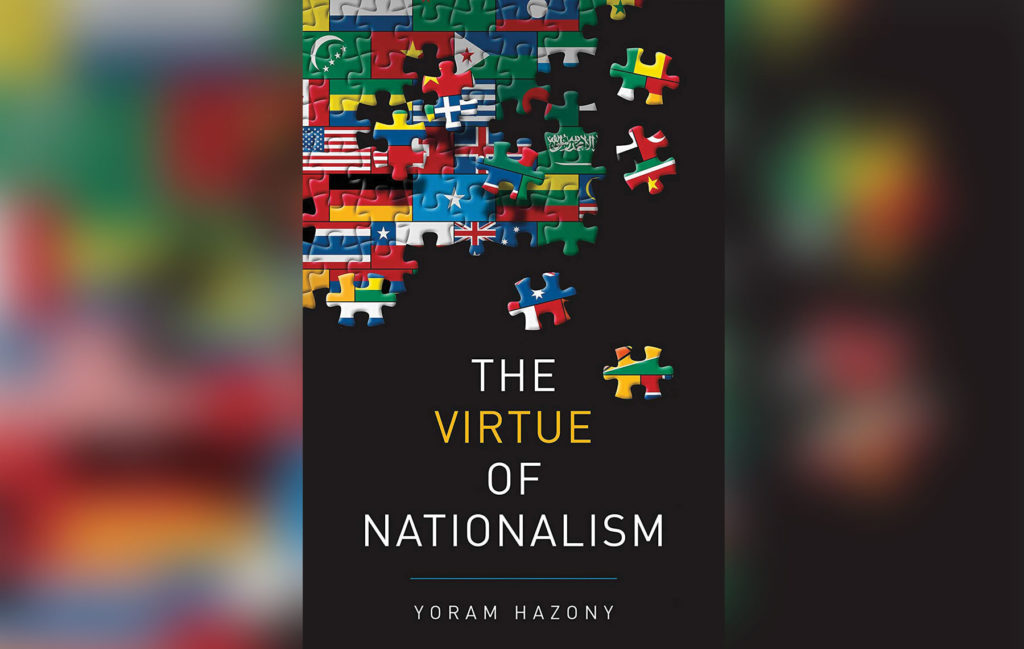
A new book argues that the nation-state is the best form of political organization humanity has yet discovered.


When Israel adopted a Basic Law in July defining the country as “the nation-state of the Jewish people,” opposition was instantaneous and widespread. The objections fell into two categories. Some opponents agreed with the law’s basic premise but objected to specific provisions. Others, however, were dismayed by the very idea of defining Israel as a Jewish nation-state, believing that this definition inherently discriminates against non-Jews. Indeed, liberal opinion today increasingly views the nation-state as a relic of an unsavory past that the West has thankfully moved beyond.  

It’s this view that Dr. Yoram Hazony, a longtime friend, challenges in his new book, “The Virtue of Nationalism.” Hazony argues that for all its flaws — and he’s far from blind to them — the nation-state is the best form of political organization humanity has yet discovered.

In the process, he also challenges a conception of Judaism increasingly popular among liberal Jews: the view that “universal values” like equality and human rights are the essence of Judaism. By definition, universal values aren’t unique to Judaism; they are equally applicable to and accessible by non-Jews. But Hazony argues that Judaism celebrates what Rabbi Jonathan Sacks has called “the dignity of difference.” It’s the only great civilization in history that never sought global application of its laws, customs, and religious practices; rather, the Bible explicitly envisioned a limited Jewish state surrounded by other, non-Jewish states.

It’s worth emphasizing just how exceptional this is. The other two great monotheistic religions, Christianity and Islam, both sought global domination. At its height, the Muslim empire stretched from Spain to India; Christianity had the Byzantine Empire in the East and the Holy Roman Empire in the West. Almost every major non-monotheistic civilization was also imperial, including Persia, Rome, Greece and China. And empires continued straight through to modern times‑ recent examples include the British Empire and the Soviet Union.

[Hazony argues] that the Hebrew Bible gave the world the very idea of the nation-state, at a time when the surrounding world consisted of either empires or tribal societies.

The Hebrew Bible, in contrast, assigns the Jews a limited territory with specific boundaries. Like everything in Judaism, their exact location is disputed. But even the maximalist conception of this territory is minuscule compared to Biblical empires like the Assyrian, Babylonian and Egyptian.

Moreover, Hazony notes, the Bible explicitly forbids the Jews to exceed those boundaries. In Deuteronomy, for instance, God warns, “Meddle not with [the children of Esau], for I will not give you of their land. No, not so much a foot’s breadth. Because I have given Mount Seir to Esau for a possession … Do not harass Moav, nor contend with them in battle, for I will not give you of their land for a possession, because I have given Ar to the children of Lot for a possession … And when you come near, opposite the children of Ammon, harass them not, nor contend with them, for I will not give you of the land of the children of Ammon any possession, for I have given it to the children of Lot for a possession.”

Nor is Judaism’s self-limitation merely physical. Unlike Islam and Christianity, Judaism hasn’t traditionally been a proselytizing religion; it sees no need for the entire world to be Jewish. And aside from the seven Noahide laws, Judaism’s extensive legal code is meant to govern Jews alone. 

This doesn’t mean Judaism has no universal moral principles. Indeed, Hazony argues that the biblical idea, later adopted by Protestant nation-states like Great Britain and the Netherlands, requires any legitimate government to satisfy a “moral minimum,” and he considers any theory of nationalism that doesn’t include such a moral minimum unviable. Nevertheless, the Bible recognizes that how these principles translate into specific laws and practices might differ from nation to nation. 

All of the above leads Hazony to argue that the Hebrew Bible gave the world the very idea of the nation-state, at a time when the surrounding world consisted of either empires or tribal societies. The rest of his book is devoted to explaining why he believes this biblical political model is still the best we have.

Cohesion and trust

A nation-state is one in which a substantial majority of the population shares certain characteristics, like a common language or religion and a common history, especially of uniting against outside aggression. These shared characteristics, transmitted from generation to generation, provide nation-states with a level of cohesiveness and trust that’s difficult to achieve in states lacking such commonalities, Hazony argues. 

This cohesiveness and trust in turn make many other moral goods possible. Indeed, Hazony says, it’s no accident that most of the civil and political liberties we take for granted today developed in nation-states like Britain and the Netherlands. 

I’m naturally sympathetic to that argument, not least because I chose as an adult to relocate from America to the world’s only Jewish nation-state. But until recently, that sympathy was widely shared. For centuries, Hazony writes, “a nationalist politics was commonly associated with broad-mindedness and a generous spirit.”

What changed this was World War II — or more accurately, a post-war narrative that blamed nationalism for the war’s outbreak. But before discussing why that narrative is wrong, let’s consider some of the positive goods the nation-state bequeathed us.

First, Hazony argues, the nation-state is the largest political unit in which rulers and ruled can still feel a connection — not a personal connection, since government officials obviously won’t know most citizens personally, but the connection that derives from a shared history, language, religion or culture. And only that sense of connection, in which a shared heritage creates bonds of mutual loyalty, can make a ruler or dominant faction willing to circumscribe its own power.

It’s no accident that most of the civil and political liberties we take for granted today developed in nation-states like Britain and the Netherlands. 

Since circumscribed power is a necessary condition for democracy, it’s no surprise that democracy first developed in nation-states like Britain. Clearly, not all nation-states have been democracies. But no larger political unit ever has.

The nation-state’s cohesiveness and trust is also a necessary foundation for freedom, tolerance and individual rights, including for minorities, Hazony argues. That may strike many people as counterintuitive. But historically, majorities have usually felt confident enough to circumscribe their power and grant equal rights to all only when they felt that minorities posed no serious threat to the majority’s shared heritage. When dominant groups feel threatened, they often seek to suppress competing groups. 

That’s why nation-states like Britain, India and Israel — as well as ostensibly “neutral” states that are effectively nation-states, like the United States, Canada and Australia, with their strong Protestant Anglo-Saxon cores — have historically proven comparatively free and stable, Hazony says. In contrast, countries lacking the cohesion provided by a clear majority with a shared heritage have typically either become dictatorships, torn themselves apart in civil wars, or both — think Yugoslavia or Syria. And every multinational empire in history has ultimately done the same.

Moreover, because a nation-state, by definition, is surrounded by other states with different languages, religions, cultures and laws, it has no choice but to tolerate these differences, even if it loathes them. Not only does this inculcate habits of tolerance, but “this formal grant of legitimacy to political and religious diversity among the nations then became the basis for the toleration of dissenting communities within the state,” Hazony argues. 

Obviously, this doesn’t mean every nation-state will be tolerant and respectful of minorities; hatred appears to be endemic to human nature, and no form of political organization is immune to it. But despite sometimes horrific abuses, Hazony argues that nation-states overall have a better track record than multinational empires. 

Indeed, precisely because the latter control so much more territory, they can often wreak far greater devastation: See, for instance, the centuries-long persecution of Jews throughout Europe under the Christians’ Holy Roman Empire, or Communism’s decades-long persecution of minorities throughout the Soviet Union and Eastern Europe. At worst, nation-states can persecute minorities in one country. Empires can do so across entire continents.

The value of diversity

Another significant advantage of nation-states is that they provide scope for national experimentation, not just in politics, but in science, economics, art and other fields. A multinational empire, in contrast, will necessarily converge toward uniformity, at least on certain issues. And because no individual or group has yet attained perfect wisdom, the experimentation allowed by a world of nation-states is more likely to produce new or improved ideas and practices that other states can adopt. 

A salient example, though not one Hazony cites, is the idea that instead of hereditary monarchs who rule for life, executives could be elected by the people and periodically replaced by them. Many countries eventually adopted this idea. But it entered the world only because America broke away from the British Empire, giving it the freedom to launch what was then a revolutionary experiment.

Hazony’s arguments raise one obvious question: If he’s right that the nation-state has historically fostered freedom, democracy and civil rights, why is it widely viewed today as inherently aggressive and oppressive?

Granted, when nation-states experiment, the results will sometimes be disastrous. But if a nation-state adopts a failed policy, the consequences are limited to that state. When empires adopt failed policies, the suffering is much more widespread. Soviet Communism, for instance, created economic havoc and political persecution across a vast territory stretching from Eastern Europe to central Asia. 

Finally, and perhaps also counterintuitively, nation-states have an inherent disincentive to aggressive expansionism. Empires typically seek to bring as many countries as possible under their aegis. But because the nation-state’s cohesiveness depends on the existence of a sizable majority with certain shared characteristics, conquering other states whose populations don’t share those characteristics would inevitably undermine this prized asset. 

This, incidentally, is why no Israeli government, including several wrongly branded as annexationist, has ever annexed the West Bank and Gaza, why numerous governments sought to negotiate peace deals ceding them, and why polls have consistently shown a majority of Israeli Jews favoring such a deal in principle. Israelis understand that permanently annexing millions of Palestinians is antithetical to maintaining a Jewish nation-state. 

Because Arab states repeatedly attacked Israel from these territories before Israel captured them in a defensive war, it’s understandably unwilling to cede them without good reason to believe that situation won’t return. Thus the fact that every bit of land ceded to the Palestinians so far has become a launching pad for attacks on Israel, coupled with the repeated failure of Israeli-Palestinian negotiations, has increasingly led Israelis to question whether a Palestinian state is a viable solution to this problem. Yet even so, support for annexation remains minuscule.

Hazony’s arguments raise one obvious question: If he’s right that the nation-state has historically fostered freedom, democracy and civil rights, why is it widely viewed today as inherently aggressive and oppressive? The answer is World War II, whose horrors are commonly blamed on nationalism — or in Hazony’s words, on “German soldiers using force against others, backed by nothing but their own government’s views as to their national rights and interests.” 

Yet in reality, he says, Nazi Germany wasn’t a nation-state, but a classic imperial state. Its desire to conquer all of Europe, and then the world, was the age-old goal of every imperialist, whereas the nation-state, as noted, inherently requires limited borders. Indeed, Hazony writes, the Nazis understood themselves as imperialists. They explicitly sought a “Third Reich,” the German word for empire, inspired by the “First Reich,” aka the Holy Roman Empire (which, despite its name, was dominated by Germanic states for much of its history). 

In fact, Hazony argues, every large-scale war in history has resulted from imperial ambitions; other examples include the Napoleonic wars and the Cold War, in which Communist expansionism and Western efforts to contain it sparked hot wars worldwide. That’s because imperial states typically seek to enlarge their empires, and therefore necessarily draw many other countries into their wars. Nation-states also obviously fight wars, but because they require limited borders, those wars are necessarily limited in scope. 

Modern-day empires

Hazony’s recurrent comparisons between nation-states and empires may seem like a straw man. The bloody empires of old, with their expansionist wars and persecution of minorities, appear to have little in common with modern forms of multinational or global governance like the European Union (EU) or the United Nations. And it’s the latter that modern liberals believe should replace the nation-state.

But Hazony sees little fundamental difference between older empires and what he terms the “liberal empire” envisioned by many Westerners today — “one in which liberal theories of the rule of law, the market economy, and individual rights … are regarded as universal truths and considered the appropriate basis for an international regime that will make the independence of the national state unnecessary.” And nothing illustrates this better than the EU itself.

Unlike previous empires, the EU was formed by member states’ consent — a nontrivial distinction. Yet it suffers from many of the same ills that have historically plagued empires.

First, it lacks the cohesiveness and trust generated by a shared heritage. Consequently, after a mere few decades, it’s already under strain from centrifugal forces. Unhappiness over “dictates from Brussels” is widespread throughout the union’s periphery — Greece, Italy, Hungary, Poland and, of course, Britain, which in 2016 became the first country to vote to quit the union.

Pundits often deem this griping irrational, arguing that many of the problems these nations decry stem from national policies rather than EU policy. But that merely underscores Hazony’s point: People find it easier to believe ill of “the bureaucrats in Brussels” than of their own politicians precisely because they believe their own politicians are more likely to care about their country’s welfare than politicians with no connection to their country. Nor is this mere self-delusion. By definition, EU officials are concerned with what they consider the good of the union as a whole; often, that will end up being the good of its dominant members, which may not be good for weaker members. See, for instance, EU austerity policies, which benefited strong creditor states like Germany but hurt peripheral states with weaker economies.

Nor is it surprising that one of the most consistent gripes about the EU is its “democratic deficit.” As noted, no political unit larger than a nation-state has yet managed to be democratic. Certainly, the EU is more democratic than previous empires. But voters still have no way to oust EU policy-setters when they dislike EU policies. 

Moreover, like all empires, the EU has steadily aggrandized its power, far beyond what most member states originally envisioned. It now governs large swathes of its members’ political and economic life, from setting monetary policy to dictating rules on labor, education and the environment to running courts that can and do overrule national laws. 

Thus while the division of power between the EU and its member states originally left space for national experimentation, this space is steadily shrinking. Indeed, Hazony argues, in any federative arrangement, the federal government will tend over time to centralize power and restrict member states’ autonomy. 

Even the EU’s most touted achievement, preventing war, doesn’t hold up under scrutiny; it has escaped war for decades solely because it was protected by American troops. Without this protection, it would have faced the same military aggression as states not under America’s umbrella, first from the Soviet Union (see Eastern Europe) and then from Russia (think Ukraine and Georgia). At that point, it would either have fought back or collapsed.

Finally, Hazony argues, empires typically believe their own solutions merit universal application, and indeed are the only “correct” ones. Therefore, they constantly strive to impose these solutions on others and cannot tolerate dissent that challenges the universality of their core truths. 

In this regard, liberal internationalism is no different from communism, religious fundamentalism or any other ideology that believes itself the sole possessor of a universal truth. The salient example is liberal internationalists’ intolerance of nationalism itself. 

Because the EU and other multinational institutions are predicated on nation-states ceding their own sovereignty, Hazony argues, they cannot abide supporters of national sovereignty. As he notes, this is evident in the “public shaming campaigns” now common in the West against anyone who challenges liberal internationalist dogma, as well as in the loathing for nation-states like Israel, post-Brexit Britain and the U.S. (the latter long predates the presidency of Donald Trump).

The Brexit negotiations are a good example, albeit not one Hazony cites. Brussels adamantly refuses to grant Britain the same deal the EU has with dozens of non-European countries: free trade but no free movement of people or contributions to the EU budget. Yet the scope of EU-British trade means the EU has an interest in preserving free trade with Britain, and it clearly doesn’t object to such agreements in principle. Thus it’s hard not to see this as a classic imperialist attempt to punish Britain for rejecting the empire’s core truth, the wisdom of multinational government, and discourage other parts of the empire from following suit.

In Israel’s case, Hazony cites the obvious example of Gaza. Today, Israel is vilified far more over events in Gaza than over events in the West Bank. But if hatred of Israel were really “because of the occupation,” one would expect the opposite. Unlike in the West Bank, in Gaza Israel did exactly what the world claimed to want, removing every last settler and soldier; ever since, the territory has been a launching pad for nonstop attacks on pre-1967 Israel. Yet hatred toward Israel over Gaza has only intensified since the pullout. 

Hazony considers it no surprise that the Jewish state is a particular thorn in liberal internationalists’ side. First, this is because Judaism insists on the value of its own unique laws and traditions, and hence implicitly on the value of national uniqueness in general. Second, it’s because of World War II’s special significance in antinationalist thought. 

Because many liberals view the Nazis as the ultimate proof of nationalism’s evil, they find it particularly galling that the Nazis’ principal victims drew the opposite conclusion — that the Nazi genocide was made possible not by nationalism, but by Jewish powerlessness, and therefore, the creation of a new, Jewish nation-state was an inherent good rather than an evil. Or in Hazony’s blunt formulation, Israelis see Israel as “the opposite of Auschwitz.” But to many liberals, “Israel is Auschwitz,” because it embodies the nationalism which they wrongly believe produced Nazi Germany. 

This explains not just the often pathological hatred of Israel, but also the fact that more and more liberals believe a Jewish nation-state has no right to exist. Of course, they enthusiastically champion a Palestinian nation-state, but Hazony explains this seeming contradiction through Immanuel Kant’s theory of progress toward enlightened world government: Tribal societies must first become nation-states before advancing to global government. Thus liberals who view the nation-state as a step forward for non-Western countries think that Israel, as a Western country, should know better, and consider its refusal to continue down the road to enlightenment unconscionable. 

Yet given the widespread view of global governance as the “moral” choice, perhaps Hazony’s most surprising indictment is his stark formulation of what this choice means: “Here, ‘moral maturity’ is equated with the renunciation of one’s own judgment as to what is right, and of one’s own power to act in the service of what is right.” It’s truly astounding that liberals, who claim to value moral autonomy, have now become the strongest advocates of ceding it.

Why the nation-state law?

Though Hazony’s book was written before the nation-state law was enacted, his arguments underscore a fact that was once widely understood but clearly no longer is: Israel has always been a democracy that generally protects minority rights not despite its self-definition as a Jewish state, but because of it. Indeed, its record on protecting non-Jewish minorities sometimes surpasses that of “liberal” Europe. For instance, Israel has never forbidden civil servants to wear headscarves, like France, or barred mosques from building minarets, like Switzerland. Also, unlike Europe, it funds semi-autonomous Arabic-language public schools to help its Arab minority preserve its language and culture. And that’s precisely because its sensitivity to particularistic Jewish interests allows it to empathize with others’ particularistic interests. 

Israel has always been a democracy that generally protects minority rights not despite its self-definition as a Jewish state, but because of it.

Nothing in the nation-state law changes this. Indeed, the most puzzling aspect of this law is that it says nothing that hasn’t been axiomatic for decades: Israel is the nation-state of the Jewish people, and within its borders, only Jews will exercise national self-determination — a provision that neither negates equal social and political rights (as opposed to national rights) for non-Jews nor precludes the possibility of a Palestinian state in the West Bank and Gaza, which are outside its borders. Israel’s capital is Jerusalem. Its language is Hebrew. It is open for Jewish immigration. It will strive to preserve the heritage of Diaspora Jews and strengthen their ties with Israel. It will seek to rescue Jews or Israeli citizens anywhere (the term “Israeli citizens” includes non-Jewish citizens). It views Jewish settlement as a value (where isn’t specified, but the Hebrew word used usually refers to inside Israel rather than the territories). 

In fact, many of its provisions are already codified in existing legislation. And even the one ostensible novelty, the “downgrading” of Arabic’s status, isn’t really much of a change, as legal scholar Netanel Fisher noted: Arabic has never been equal to Hebrew (for instance, court cases can’t be filed in Arabic), and such status as it had was preserved through a clause stating that nothing in the law “undermines the status enjoyed by the Arabic language in practice before this Basic Law came into effect.” 

Moreover, the law in no way supersedes existing Basic Laws enshrining Israel’s democratic system of government and basic human rights. Most notably, the 1992 Basic Law: Human Dignity and Liberty explicitly protects “the dignity of any person as such,” and courts have consistently interpreted this as barring discrimination, on the reasonable grounds that discrimination violates a person’s dignity. 

In Israel’s constitutional system, each Basic Law is merely one article of a constitution-in-the-making, and is meant to be read in concert with all the others, not in isolation. Therefore, as in any constitution, protections enshrined in earlier articles — in this case, for democracy and human rights — need not be reiterated in subsequent articles addressing different issues, such as Israel’s Jewish identity.

All this explains why even the heads of the Israel Democracy Institute – a left-leaning organization not enamored of Israel’s current government – said at a media briefing in July that the law “doesn’t change anything practically,” “won’t change how the country is run” and is merely “symbolic and educational.” There’s simply nothing in it that undermines democracy, equality or minority rights; these values are no more vulnerable today than they were before the law passed. 

Yet if the law truly did nothing but reiterate old truths, why did many Israelis suddenly feel a need to codify these truths in quasi-constitutional legislation? And why was it vehemently opposed not just by people who wish to erase Israel’s Jewish identity, but by many who genuinely want to preserve it? 

Primarily, because the very idea of a Jewish nation-state has been under growing assault — from international institutions, liberal intellectuals both in Israel and abroad, increasingly assertive and stridently anti-Israel Arab activists, and above all, Supreme Court justices. Many justices believe, in former court president Aharon Barak’s famous phrase, that the “Jewish” half of Israel’s Jewish and democratic identity should be interpreted at a “level of abstraction so high that it becomes identical to the state’s democratic nature.” Consequently, they have repeatedly issued rulings undermining Israel’s ability to preserve particularistic aspects of its unique heritage. 

Many Israelis therefore felt a need to reassert Israel’s Jewish identity in a Basic Law that would give this identity equal standing with the state’s democratic nature. But many others, not without cause, feared the consequences of flaunting this identity in a world increasingly hostile to it.

The very fact that reiterating truths held self-evident for decades could cause such an uproar today shows just how far the idea of the nation-state has been eroded. And it also shows why, far more than we need new laws codifying the Jewish nation-state in particular, we need a vigorous intellectual defense of the nation-state in general. Hazony has offered just such a defense.


Evelyn Gordon is a journalist and commentator living in Israel.

COVER STORY: Obsolete or Indispensable? Read More »

A Moment in Time: When You Find Yourself in Deep Water

Dear all,

While I was at the pool at our Tel Aviv Hotel, I noticed a sign that is rather ordinary – yet quite profound. While it simply indicated the deep verses shallow ends of the pool, it also served as a metaphor.

This Saturday night, the Jewish world enters Elul, the month preceding Rosh HaShanah (the Jewish New Year). The entire month demands that we soul-search, look at ourselves in the mirror and strive to unload baggage that has weighed us down. We create opportunities to make amends and build bridges, to repair relationships and restore balance.

And while it can take a lot of work, we often find that getting out of deep water often begins by making one small step in the right direction.

What step will you make at this moment in time?

Now, if you feel like you are in so deep that you have no footing to make that step, life-preservers are out there. Reach for them so they guide you toward solid ground. They come in the form of prayers, songs, body movements, study, and rituals. Harness them while you regain your life-balance!

With love and shalom,

Rabbi Zach Shapiro
Temple Akiba of Culver City

Rabbi Zach Shapiro is the Spiritual Leader of Temple Akiba of Culver City, a Reform Jewish Congregation in California. He earned his B.A. in Spanish from Colby College in 1992, and his M.A.H.L. from HUC-JIR in 1996. He was ordained from HUC-JIR – Cincinnati, in 1997. He was appointed to the HUC-JIR Board of Governors in 2018.

A Moment in Time: When You Find Yourself in Deep Water Read More »

Meg Wolitzer’s Novel Comes to Life in ‘The Wife’

When it comes to dealing with Hollywood, author Meg Wolitzer has learned that patience is essential. Her novel “The Wife” was published in 2003. The following year, screenwriter Jane Anderson began adapting it, and 14 years later it has finally been made into a movie starring Glenn Close and Jonathan Pryce. The film has already earned rave reviews ahead of its Aug. 17 release.

“It’s delayed gratification; that’s how it goes. But the payoff in the end is seeing your work being taken seriously and appreciated by other people,” Wolitzer told the Journal. The reason for the long gestation period, she said, was that the central character is a woman of a certain age, and studios and financiers weren’t interested. Even when Close came on board, it was still hard to get funding. “It’s not about an asteroid hitting Earth,” Wolitzer said.

However, the fact that the movie is coming out when gender roles, female empowerment and working women’s issues are at the top of people’s minds makes it especially timely. “It’s about the marriage of this couple, and power and compromise. And it’s about the contracts that we make in a relationship, set against the world as it has treated men and women,” Wolitzer said. “There are issues in it that we’re still wrestling with today in so many ways.” 

In the film, Joan Castleman (Close) has supported her famous novelist husband Joe (Pryce) since they met in the late 1950s, when she put her own writing ambitions aside for his sake.  But as he’s about to receive the Nobel Prize for literature, secrets come to light that rock the foundation of their marriage.

“These are issues I’ve been talking about for a very long time in my work,” Wolitzer said. “I’ve often written about men and women, women and power, and ideas of how we get our say in the world: who has a voice, who doesn’t. But Joan is not a victim. That was important to everyone involved in this.”

Anderson kept Wolitzer in the loop as she wrote and revised the script, and although the role of the Castlemans’ son (Max Irons) was beefed up, other threads in the book were cut for time’s sake. In the novel, Joan’s wealthy, WASPy mother does not approve of her daughter marrying Joe, who is Jewish. “There’s a strain of anti-Semitism that impels Joan toward Joe more and away from her mother,” Wolitzer said. “Making them different from each other created a tension that brings them together.”

 “It’s about the contracts that we make in a relationship, set against the world as it has treated men and women. There are issues in it that we’re still wrestling with today in so many ways.” —Meg Wolitzer

Wolitzer’s novels often include Jewish characters, with her latest, “The Female Persuasion,” among them. But their religion is explored only if it’s relevant “and true to who they are,” she said. 

Wolitzer’s own Jewish upbringing in Syosset, N.Y., was secular, but she has fond memories of celebrating the holidays with her family and attending the Sholem Aleichem Folk Institute Sunday school. “We had a Yiddish reader, ‘Mottele and Gittele,’ a sort of Yiddish ‘Dick and Jane,’ ” she said. 

Today, she is not affiliated with a temple, “but I celebrate the Jewish holidays in my own way with my family,” Wolitzer said. She’s married with two grown sons — a lawyer and a musician. In becoming a writer, she followed in the footsteps of her mother, novelist Hilma Wolitzer. “She was always incredibly encouraging to me as a writer and that meant a lot to me. She never said, ‘Maybe you should try something else’ because she was worried about me,” Wolitzer said. “To this day I’m very grateful to her.”

“The Wife” is the fourth of Wolitzer’s dozen novels to be adapted for the screen, following Nora Ephron’s directorial debut of her novel “This is Your Life,” the TV movie “Surrender, Dorothy” with Diane Keaton, and “The Interestings,” which Amazon made into a pilot but passed on the series. Wolitzer was disappointed, “but I’ve had more [projects] made than most writers,” she said. “It’s a miracle when something actually makes it to the screen because so many things have to happen involving money and timing.”

She did not visit the set of “The Wife” during filming in Scotland and Sweden, but attended the Toronto Film Festival premiere last fall, and has seen it again while making the rounds of pre-opening premieres. “The audience responded in this incredible way. You don’t get that [feedback] with a book,” she said. 

“It’s very gratifying to see characters I’ve created with specific idiosyncrasies and lines of dialogue suddenly appear on the screen,” she added. “I never write with that in mind. I don’t see their faces that clearly but when it happens it’s a lovely thing, especially in this case. It’s so exciting to have these extraordinary actors play these parts. It’s thrilling for me. I was riveted by the performances. And as a film lover, it’s very exciting to see this come together.”

Wolitzer is working on a new novel and has been busy promoting “The Female Persuasion” on a book tour since its release in April, but said it was worth putting her work aside to participate in activities for “The Wife.” 

“I just attended a screening in the Hamptons. It made me so proud. I didn’t make the film, but I felt like a shepherd of it, introducing it to the audience.”

She is gratified to see her book—newly reissued as a tie-in with the film—complete “this long journey to become a film that I think is great,” she said. “I’m a grateful novelist.”


“The Wife” opens in theaters on Aug. 17.

Meg Wolitzer’s Novel Comes to Life in ‘The Wife’ Read More »

Dear Alexandria Ocasio-Cortez

Mazel tov! You have become quite the media sensation since your unexpected New York primary win in June. Of course, instant celebrity does come with a price — hyperscrutiny, as you saw last week.

My Jewish Journal colleague Ben Shapiro, noting that you have been called “the future of the Democratic Party” and that you have repeatedly stated that Republicans are afraid to debate you, offered to donate $10,000 to your campaign if you would come on his daily podcast and discuss issues for an hour.

You responded with a now notorious tweet: “Just like catcalling, I don’t owe a response to unsolicited requests from men with bad intentions. And also like catcalling, for some reason they feel entitled to one.”

Shapiro then tweeted: “Discussion and debate are not ‘bad intentions.’ Slandering someone as a sexist catcaller without reason or evidence does demonstrate cowardice and bad intent, however.” Shapiro also pointed out that, as an Orthodox Jew, he’s never made a catcall in his entire life. 

Thus ensued an epic Twitterfest that was often not very nice to you. Perhaps the funniest came from the parody Mossad account: “Well that was confusing. We just offered the Palestinian Authority $1,000,000 to sit down and negotiate with us and then they accused us of catcalling.”

Though I disagree with nearly everything you have said, and perhaps more important, how you’ve said it, I do feel bad that you’ve been taught that playing the victim card is the best way to win — and that your progressive acolytes have indeed responded as though it was.

But guess what? It’s only a win for anti-feminists. Real feminists don’t play the victim card, especially since this was hardly victimization. How is an invitation to debate or a donation to your campaign sexist?

See, this is the problem, Alexandria: You and your millennial cohort were never taught real feminism. You were taught platitudes about “the patriarchy” that aren’t even true. You were taught to see anything you don’t like as sexist.

When I was your age, 28, I was a writer and editor at The New Republic. There were a couple of men there who didn’t think women were up for writing about politics. My female colleagues and I spent every day there proving them wrong. And it is because we did prove them wrong that young women like you are able to win congressional districts today.

But here’s the thing: We worked extremely hard to make that happen. And if we were asked questions that we didn’t know the answers to, we didn’t giggle and flip our hair back or arrogantly spew out assertions that have no basis in reality. We did this thing called research. 

I know that research wasn’t prioritized when you were in college. Theory was. But you’re now out in the real world, and post-modern theory just doesn’t cut it out here. You can’t reduce everything to sexism (ironically while running around getting your picture taken everywhere).

By falsely making yourself into a victim, you not only demeaned real victims of sexual assault, but all female candidates who actually know the issues. My generation of women worked hard to show our equality. Your answer seems to be: Why work hard when I can just play the victim card?

Can you imagine Nikki Haley ever doing this? Or more to the point, Hillary Clinton?

Is this how you’re planning to handle yourself in Congress? If a Republican asks for more information on a bill you’re sponsoring, will you respond, “Stop catcalling me!”

I don’t want to be harsh. You probably regret your tweet. But I must still ask you, as a woman, as a feminist, as a human interested in bettering humanity: Stop undoing everything we did for your generation. 

While you run around campaigning for others, find time to do in-depth research on issues, both domestic and foreign. Your assertions have ranged from nonsensical to unrealistic. Even The Washington Post has marked each of your “eye-raising claims” as false or misleading.

You’re now in a somewhat difficult situation. Overnight, you’ve become politically prominent, with reporters (justly) expecting you to be familiar with lots of complicated issues. It’s OK to slow down and catch up.

Then, when a conservative pundit invites you to debate, you can say, “No, I’m too busy,” or even better, “Absolutely.” 


Karen Lehrman Bloch is an author and cultural critic living in New York. 

Dear Alexandria Ocasio-Cortez Read More »

Not All Protests Created Equal

America was born and raised in protest. From the colonies that rebelled against the British monarchy in the 1770s to the fight for civil rights in the 1960s to the Women’s Marches of today, protest is a cherished American tradition. We have the freedom to speak out against injustice, and we like to use it.

But not all protests are created equal.

Take the ongoing controversy with the protesting athletes of the National Football League. It started in 2016 when Colin Kaepernick, the San Francisco 49ers quarterback, made media headlines by taking a knee during the playing of the national anthem to protest police violence. Now, it’s become all the rage among a multitude of players, and the league has no clue how to handle it.

I’m really torn on this issue. On the one hand, what I love about sports is that it gives me a refuge from the seriousness of politics. It’s my getaway. After long days of worrying about peace in the Middle East and the effects of tax cuts, I can chill out and worry about how LeBron James will mesh with the young core of the Lakers or whether the Patriots’ Tom Brady can still be an MVP at 41.

At the same time, how can I not have empathy for athletes who want to effect change in society? How can I not respect their right to protest injustice?

What complicates the picture is impact: Does any of this work? How useful are gestures of protest during the playing of the national anthem? If anything, it seems to have triggered a backlash among fans who oppose the gestures, leading to a decline in attendance and television ratings. Protest, evidently, works both ways.

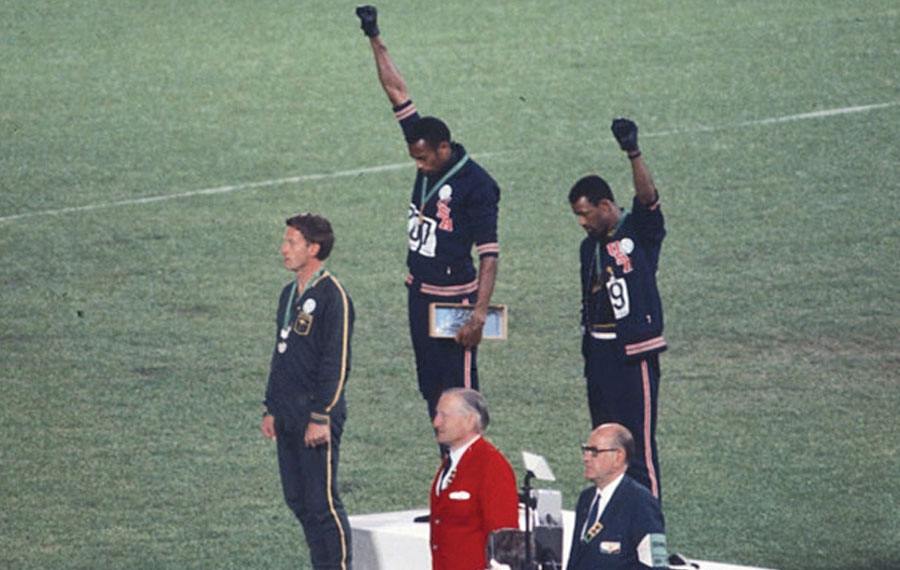
If you want a sports gesture with impact, look at the 1968 Olympic Games in Mexico City. America at the time was embroiled in the epic struggle for black civil rights. Heroes like Martin Luther King Jr. led freedom marches. Six months after King’s assassination, two African-American track-and-field athletes, Tommie Smith and John Carlos, were on the Olympic podium to accept their medals. While the U.S. anthem played and with the eyes on the world on them, they each raised a fist in a black glove in solidarity with their oppressed brethren. It became an iconic image — an emblem of a troubled era.

At the same time, how can I not have empathy for athletes who want to effect change in society? How can I not respect their right to protest injustice?

This singular impact is missing with the NFL protests. What the protests have done, more than anything, is divide the country. Instead of drawing attention to an injustice, they have drawn attention to a gesture. The fact that NFL games will be played every week for the next five months only ensures that the gesture itself will remain the center of attention.

What will people talk about? They’ll talk about what the league should do, what the players should do, what the owners should do, what the fans should do, what the sponsors should do, what the union should do, etc. In other words, they’ll talk about anything except what America should do to correct injustice.

We can expect plenty of stories about which player made which gesture at which game, but not as many stories about which players initiated efforts to build bridges between local law enforcement and troubled neighborhoods.

Maybe one of the issues is that our era simply lacks the urgency and blatant injustice of the 1960s, when Jim Crow laws in the South prevented blacks from using the same public facilities as whites, live in many of the same towns or go to the same schools; when interracial marriage was illegal and many blacks couldn’t vote because they were unable to pass voter literacy tests.

It also doesn’t help when you use a weekly sporting event as an instrument of protest. Eventually, the gestures get stale. People forget what you’re protesting. You lose the cause; you lose the juice.

In any case, injustices in America clearly persist and protesters must find creative ways to make an impact.

Last Sunday, I spoke with my friend Rabbi Shmuel Herzfeld as he was preparing to go to the “Unite the Right” white supremacist rally in Washington, D.C. Not satisfied with just marching and protesting, he told me he would blow the shofar as hard as he could to “drown out the evil shrieks of the Nazis.”

What complicates the picture is impact: Does any of this work? How useful are gestures of protest during the playing of the national anthem?

I was so moved by his idea that we decided to post the story on the Journal website and disseminate it on social media. Just like the raised fists of Tommie Smith and John Carlos 50 years earlier, the rabbi had found a singular gesture to accentuate his message.

That is my wish for NFL players: Find a way to make a statement that will rally more people to your cause and put the focus on your mission. Just as watching football is a great American tradition, so is effecting real change.

Not All Protests Created Equal Read More »

Winners and Losers – What You Need to Know About the Aug. 14 Primaries

August 14 featured a slew of primaries involving candidates who have either issued Jew-hating statements or made statements critical of Israel, and most of them won.

Among the most notable of these candidates is Rep. Keith Ellison (D-MN), who has been criticized for his past associations with Louis Farrakhan and is currently facing allegations of abuse. He won the Democratic-Farmer-Labor (DFL) primary for Minnesota attorney general on August 14; Ellison will square off against former state Rep. Doug Wardlow (R) in November.

Rashida Tlaib, the Palestinian-American congressional candidate who has stated that she believes in withholding aid from Israel “if it has something to do with inequality and not access to people having justice,” won the Democratic primary on Michigan’s 13th District on August 14. She will not be facing a Republican opponent in the general election.

The Jewish Democratic Council of America (JDCA) said in response to Tlaib, “Threatening to cut military assistance to Israel is inconsistent with the values of the Democratic Party and the American people.”

J Street also told Jewish Telegraphic Agency that they’re reaching out to Tlaib to clarify her recent comments stating, “This whole idea of a two-state solution, it doesn’t work.” JStreetPAC has endorsed Tlaib.

Similarly, Ilhan Omar, who once tweeted that “Israel is hypnotizing the world,” won the Democratic primary in Minnesota’s Fifth Congressional District, another heavily Democratic district.

On the other hand, Paul Nehlen, who once stated that “Jews control the media” that Jews “are never to be trusted,” lost handily in the Republican primary in Wisconsin’s First Congressional District, receiving only 10 percent of the vote.

Winners and Losers – What You Need to Know About the Aug. 14 Primaries Read More »