fbpx

August 9, 2018

Warming Up for the High Holy Days

This is the first of six weekly columns by Rabbi Zimmerman leading up to Yom Kippur.

In these waning days of summer, when we want to hang on to every last moment of the dwindling daylight hours, wafts of the High Holy Days begin to enter our consciousness. In the middle of planning one last summer excursion, we may realize we have to make plans. 

Every year, the High Holy Days arrive without fail, whether we are ready or not, and remind us: No matter what’s going on in the world, returning “home” is possible. 

Even though Rosh Hashanah is not until Sept. 10, it’s important to start warming up, so that when we arrive at the new year, we are ready and open. 

The rabbis declared that the entire month preceding Rosh Hashanah is meant for soul preparation and spiritual accounting. This 30-day period in the month of Elul is designed for taking stock of where we are, who we are and who we are meant to be.

Elul is about getting back into right relationship—with other people in our lives, with ourselves, with God and with community. This season is about moving from brokenness to wholeness. In truth, this season began with Tisha b’Av (the 9th of Av), when everything fell apart. We spend Elul working to repair and reconnect in the reality of the present.

This year, the first day of Elul begins Saturday night, Aug. 11.

On this first day, the shofar begins to blow, and it blows each day for the entire month. Rabbi Moses ben Maimon (Maimonides) says the shofar calls us to wake up from our sleep. He writes in his Mishnah Torah, “Search your ways and return in teshuvah … examine your souls” (Repentance 3:4).

On the first day of Elul, Moses ascends Mount Sinai after the incident with the golden calf, which nearly broke our relationship with the Eternal. Moses stayed there for 40 days, pleading for forgiveness for the people. On Yom Kippur, God gives Moses the second set of tablets, indicating a reconciliation. This journey mirrors the process we are supposed to go through in this season: We assess our lives and recommit to our core values and best selves.

Elul is about getting back into right relationship — with other people in our lives, with ourselves, with God and with community.

In this six-week series, I will offer suggestions and resources for your personal Elul reflection and accounting. I’ll also write about the major themes and metaphors that weave through the Elul and the High Holy Days. 

As my mentor Rabbi Laura Geller teaches, the High Holy Days only “work” when you do your own “work.” Too many of us come with expectations that something will happen to make this season meaningful. I promise you this: The degree to which this year’s High Holy Days are meaningful for you will be in direct proportion to the amount of time you set aside to do personal reflection and accounting.

Let’s begin. 

1. Find a notebook that can be your Elul 2018 journal. You can write your responses to the questions I am posing, and your thoughts.
2.  Take out your calendar and make a list of all the significant events of the year. What did you learn? What had meaning for you?
3. It’s traditional to recite Psalm 27 every day this month. It’s a wonderful psalm to journal about and/or discuss with a friend.
In verse 4, the psalmist writes: “One thing have I asked of God, that will I seek after: That I may dwell in the house of God all the days of my life.”
 4. What is “A house of God” for you? When and where have you felt connected to the Divine?

The promise of this season, claims Rabbi Alan Lew, is nothing less than transformation. 

Next week, we’ll take the next step in that journey.


Rabbi Jill Berkson Zimmerman is a rabbi-at-large. She can be found online at ravjill.com

Warming Up for the High Holy Days Read More »

Nation-State Law Was Not Necessary

Israel’s new “Nation-State” Basic Law is neither overtly racist nor suggestive of apartheid. Yet, it is a bad and unnecessary law and ought to be repealed. Israel already has its Declaration of Independence that sets the principles of the State of Israel as the Jewish and democratic nation-state of the Jewish people. 

There is much in the new law that is redundant: The principal language of Israel is Hebrew; the Israeli flag and national anthem are national symbols; Independence Day, Memorial Day and Holocaust Remembrance Day are holidays; Jerusalem is the eternal capital of the Jewish people.

The law is worrisome for several reasons. It formally demotes the Arabic language from an official language to one with “special status,” a slap in the face to the 20 percent minority of Arab-Israeli citizens and Israel’s Druze community. The message of the law to Palestinians in the West Bank and Gaza is that the State of Israel is the exclusive homeland of the Jewish people despite Palestinian claims for a nation-state of their own alongside Israel. The message to Palestinian Israeli citizens is that they are second-class citizens.

In 1992, a Basic Law was passed that emphasized human rights and equality under the law for all Israeli citizens. The nation-state law fails to mention equality, thus posing a veiled assault on Israel’s democratic tradition and the 1992 law. Future courts and legislatures can use this new law to de-emphasize Israeli democratic traditions.

One wonders why this law was enacted now. Is it a political attempt by Prime Minister Benjamin Netanyahu, who advocated strongly for its adoption, to shore up his right-wing political base before the next election? 

Another bill currently making its way through the Knesset would raise the number of Orthodox yeshiva students required to serve in the army, a move bitterly opposed by the ultra-Orthodox parties, which have threatened to quit the coalition and force new elections should it become law. Netanyahu needs them in his coalition. Polls show his Likud party would gain no more seats were an election held today. 

The most pressing question for Israelis besides security is the relationship between democracy and Judaism.

The nation-state law has driven a deeper wedge between Israel and Diaspora Jewry. Tensions exist between the prime minister and the Reform and Conservative movements in North America due to his reneging on his own Kotel Agreement, his allowing ultra-Orthodox coalition partners to introduce a conversion bill that would exclude non-Orthodox conversions, and his alliances with President Donald Trump and American Christian evangelical extremists. 

Many in Netanyahu’s party oppose the law, such as President Reuven Rivlin, Benny Begin, Moshe Arens and Dan Meridor.

The vast majority of Israelis don’t want a medieval model imposed on their modern country. Israelis’ most pressing concern besides security is the relationship between democracy and Judaism. As long as Jews remain a significant majority (70 to 80 percent), the conflict between democracy and Judaism appears manageable. 

Section No. 7 of the law enshrines the settlements as an important goal of the country, an issue at the top of the right-wing agenda for decades. To most objective observers, Israel’s identity as a Jewish and democratic state will be assured only by containing settlements to the large blocks that will remain in Israel in an eventual peace agreement and stopping the spread of settlements beyond the security fence that would make partition impossible. Only a two-state solution to the Israeli-Palestinian conflict can preserve a strong Jewish majority, thereby preserving democracy and the Jewish character of the state. 

The nation-state law serves a worldview that’s damaging to Israel, a move toward ethnic religious nationalism dominating Israeli political affairs and the separation of Israel from millions of its supporters in the Diaspora. That is not what the nation’s founders envisioned for Israel.


Rabbi John Rosove is Senior Rabbi of Temple Israel of Hollywood and the National Chair of the Association of Reform Zionists of America.

Nation-State Law Was Not Necessary Read More »

Video: Israeli Child Recalls When Hamas Rockets Hit His Home

StandWithUs posted a video of an Israeli boy sharing the details of a Hamas rocket striking his home while he’s in a room with his dad, who was hospitalized in the strike.

The boy, identified in the video as Shalev Levy, said that when the first rocket alarm went off, he and his dad, Avi, stayed in a bomb shelter; when it ended Avi went outside.

Suddenly, another rocket alarm sounded and then Shalev heard a “boom.”

“When I went out to see what was happening, I saw that in my sister’s room there was a smoke and fire and I went to the living room and dad shouted and told me to leave the house quickly,” Shalev said. “When he said that I saw that his arm was bleeding.”

The video ends with Shalev saying that he used a cloth to bandage his father’s arm and then asked his neighbors for help.

According to the UK Guardian, Hamas and other Gaza terror group launched more than 180 projectiles into Israel; Israel has responded with 150 airstrikes into Gaza. Three Palestinians have died and numerous Israelis have been injured.

Hamas is claiming that there is a ceasefire agreement between them and Israel; Israel is denying this but acknowledged “that quiet would be met with quiet,” per the Times of Israel.

To get an idea of the constant barrage of threats those in southern Israel have to had to deal with lately:

Oshrit Sabag, who resides in Nahal Oz, told the Guardian, “We’re mostly scared that there will be another war. We’ve had tens of fires. Houses were burnt. Now rockets and mortar bombs. It’s chaos.”

Video: Israeli Child Recalls When Hamas Rockets Hit His Home Read More »

Jewish Factions, Made in the USA

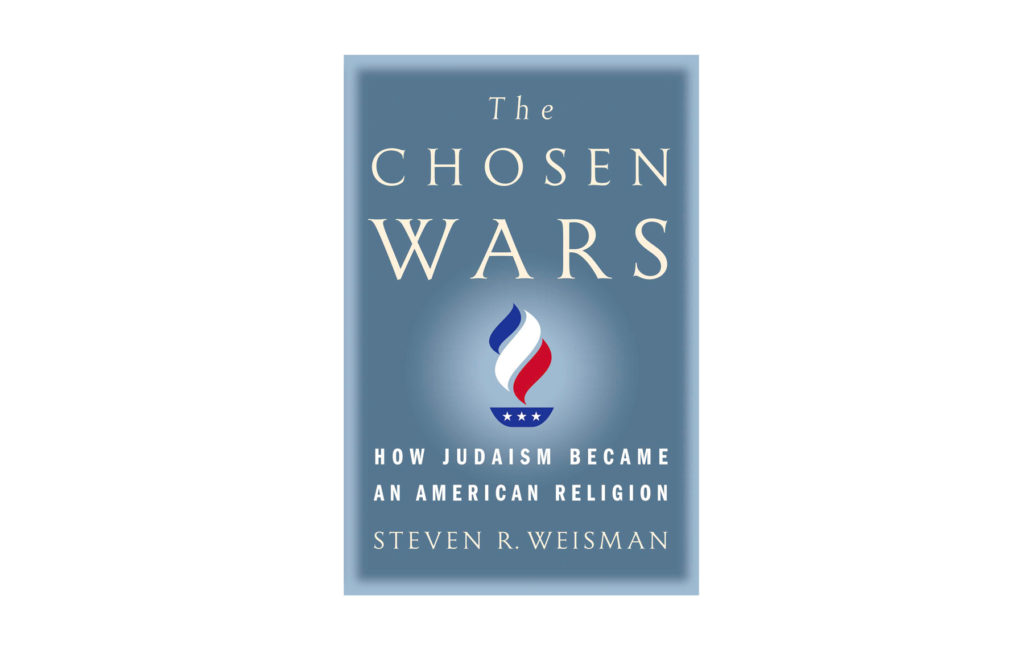
Only rarely does an author succeed in writing a book that reframes how we perceive our own history. “The Chosen Wars: How Judaism Became an American Religion,” by Steven R. Weisman (Simon & Schuster), is one such book, and it could not arrive at a more appropriate time in that history. Today, the Jewish world is deeply divided, and one of the most consequential points of conflict is whether the ordination of American rabbis — and the conversions and marriages that they perform — will be recognized at all in Israel.

Weisman, a veteran of The New York Times and the author of books on subjects ranging from morality (“The Great Tradeoff: Confronting Moral Conflicts in the Era of Globalization”) to taxation (“The Great Tax Wars”), invites us to explore both the roots and branches of American Judaism, a religious culture that “emerged out of turmoil and tradition to redefine itself in its distinctive forms,” as he explains. “Even the splitting of American Judaism into three main branches was a singularly American phenomenon.”

He opens his fascinating and provocative book by harking back to — and demythologizing — one of the most notorious events in American Jewish history. On July 11, 1883, the first rabbis ever to be ordained on American soil were honored at a banquet at the Plum Street Synagogue in Cincinnati. “For reasons that remain unclear, the caterer decided to serve crabs, shrimps, clams, and frogs to the guests, an egregious violation of kosher laws,” he reminds us. “Some rabbis stormed out, according to an eyewitness, and the event turned into a faux pas heard round the Jewish world.”

Thus began the fracturing of Judaism in America. “[T]he star-crossed banquet sounded a call to battle among traditionalists and helped drive American Jews apart into disputing (and disputatious) factions,” he writes. Within a couple of decades after that fateful afternoon, “the opposing factions coalesced into Reform, Conservative, and Orthodox Judaism.” 

While Weisman acknowledges that “a spirit of dynamism and change” has always characterized the history of Judaism, he insists that the Jews who came to these shores from all over the world “produced a particularly American response, influenced inevitably by the culture of a country that disdained religious hierarchies while allowing and even encouraging citizens of all faiths to create institutions reflecting their own, distinctive understanding of God.” The result, he declares, was that “American Jews could be Jews in an American way.”

Diversity and disputation have always been facts of life in Judaism, but the core values of American democracy encouraged even greater independence of mind.

The Americanization of Judaism, as he shows us in a narrative both colorful and powerful, manifested itself in every aspect of life, faith and community. Jews could not afford to close their businesses on both Saturday and Sunday, and so they felt compelled to adopt the Christian practice of Sunday closing if only because their Christian customers vastly outnumbered their Jewish ones. They now enjoyed the personal freedom that came with life in “a secularly neutral state,” and they wanted “no ‘chief rabbis’ to dictate rules for a disparate Jewish population.”  And, once exposed to the discoveries of modern science, “it became impossible in the modern era for educated and uneducated alike to think that the Earth was six thousand years old or created in six days.”

Jews may have arrived in the New World as “converts or secret Jews aboard one of Columbus’s ships in 1492,” Weisman suggests, but we know with certainty that 23 Jewish victims of the Inquisition sought refuge in New Amsterdam in 1654. Conflict was always a fact of life in the American Jewish community; as early as the early 1700s, the author writes, “Ashkenazi arrivals often viewed their Sephardic brethren as elitist, complacent, and more lax in their observances, but many Sephardim argued that the opposite was the case, looking down on Ashkenazi Jews as abrasive and uncouth.” By 1795, the first Ashkenazi synagogue in America was established in Philadelphia by “Germans wanting to pray according to the German and Dutch rules.” A synagogue founded in New York in 1825, B’nai Jeshurun, became the first synagogue in America to conduct its services in English.

At least one signal event in American Judaism started with a controversy over the use of an organ in the synagogue and ended with a landmark ruling on religious liberty. When a reform-minded congregation in Charleston, S.C., installed an organ in 1841, a few dissenters filed a lawsuit in the state courts, where the ruling in favor of the “organ congregation” was based on the fundamental notion that “religious laws were not enforceable by civil courts in the United States, as they had been in Europe.” Thus did the Jewish reformers establish “the principle that each Jewish community should determine its own practices, based on a democratic process and without interference by a minority citing traditional Jewish law.” 

Of course, diversity and disputation have always been facts of life in Judaism, but the core values of American democracy encouraged even greater independence of mind. “The fight among rabbis, and between rabbis and their congregations, focused on how much Hebrew to include in the service, which prayers to eliminate, and whether to permit men and women to sit together,” Weisman writes. Even more consequential matters — above all, the scandal of legalized slavery — divided the Jewish community: “[L]acking a clear direction or interpretation of the Bible, Jews tended to adhere to the beliefs of their neighbors, whether North or South — another example of their desire to Americanize their identity.” 

We learn from “The Chosen Wars” that one early leader of American Judaism, a rabbi who arrived from Bohemia at the age of 27, aspired to create “a uniquely American prayer book, which he wanted to call “Minhag America (American Custom).”  His goal was “to unite the disparate elements of the Jewish community,” but the impossibility of his project was obvious even to his contemporaries: “The German will not give way to the Polish, nor he to the English, nor the latter to the Portuguese Jew,” according a Jewish periodical that considered the project in 1847.

Yet Weisman allows us to glimpse the traditions of diversity and debate that have always characterized the Jewish community in the New World, and he invites us to recall and honor “the heritage American Jews received from their turbulent past.” That is the true American minhag.


Jonathan Kirsch, attorney and author, is the book editor of the Jewish Journal.

Jewish Factions, Made in the USA Read More »

Bubbe Cakes, the Unforgettables and Talking to Strangers

We humans have powerful filtration systems that we use all the time. You can call these filters lenses or defense mechanisms, protection or rose-colored glasses, and we use them to choose what we want to see and hear. Each of us creates our own little version of “reality,” which we usually like to stay securely within. We are such masters of this process that it happens without our even realizing it. It’s hardly surprising, then, that we miss the signals we receive from the world beyond our comfort zone.

This is one of my major lamentations when I visit the United States, where 8 out of 10 people will be wearing headphones to avoid human interaction at all costs. Aside from the fact that this is an incredibly unromantic way to live, blocking out conversations, laughter and flirtations with strangers by plugging in to tune out is, in my opinion, one of the great tragedies of modern times.

While I’m one of those people who could be seen as “plugged in” when it comes to technology, I like to completely unplug when it comes time to travel or even while enjoying mundane things like taking public transportation or eating in a restaurant. Because being so aware of my surroundings makes me open to magical experiences, I have more than my fair share of them, and because my passions originate in the food realm, often I find myself in extremely fortuitous eating situations.

Take, for example, my recent trip to visit friends in the Catskills in upstate New York. After a night of heavy “reminiscing,” I didn’t want to wake my friend to ask her where to find the coffee maker. I remembered that she had told me of a great little coffee shop in town called Café Adella Dori. I drove myself there on winding, leafy roads early in the morning, walked in and ordered myself a coffee and had a hard time picking from the case of fresh baked goods, each one looking more appealing than the next. Immediately, I recognized the coffee was not a typical American cup of filtered coffee but a richer, more nuanced one with the bitter, earthy notes of a good African robusta.

I have more than my fair share of magical experiences, and because my passions originate in the food realm, often I find myself in extremely fortuitous eating situations

Half expecting the young woman who served me to be a student working part time in the café, I told her that I thought the coffee was the best cup I’d had thus far in the States. “Oh, thank you, the beans are from Cameroon,” she said. “Where do you live?” “I live in Uganda,” I told her excitedly. “I knew it tasted like African coffee!” As the conversation unfolded with Eva Barnett, the 35-year-old owner of the café, it turned out that the name of the café was not Italian as I had originally thought but a combination of the name of her Bubbe Adella and of her mother, Dori, of Romanian descent — just like my Romanian bubbe and aunt.

Eva showed me around the café, decorated with old photographs of Adella and Dori and what she calls the “Mommy hall of fame,” a long corridor adorned by black-and-white snapshots she asked her customers to bring in of their mothers in honor of Mother’s Day that was so popular it became a fixed feature wall of the restaurant. While giving me a tour of her kitchen, Eva told me the story of her bubbe, Adella Gross (nee Frank), who was was born in Romania and at age 20 was deported from her village of Lazar and sent to Aushwitz. After somehow surviving the war, she remained with only two brothers, with whom she returned to a nearby village and met Eva’s zayde, Yossi Gross. They married and immigrated to to New York City, where Yossi’s family was, with Eva’s mother, Dorina, in tow.

Yossi got a job in a kosher butchery and they settled in Rego Park in Queens, where Bubbe worked in a garment factory sewing. They kept a kosher household and were very active in their shul. Every Shabbat, while her grandfather was at shul, her grandmother would put out a huge spread of baked goods for the other Romanian women, mostly widows who had lost their families in the camps. Eva grew up knowing this spread as “Bubbe cakes.” Eva remembers the women dissecting ingredients and trying to patch together the recipes from the memories of the tastes of their childhoods, their own bubbes gone long since.

Here is a recipe for Blueberry Drop Scones I ate while drinking coffee and talking to a stranger named Eva whose bubbe passed down many things to her mother, one of which was a love of baking. She carries these scones in the caféhonor of them both and their very important Shabbat baking ritual.

Eva and I talked about her idea to conduct her own Shabbat rituals in her café after meeting and talking with a customer who, as it turns out, is a cantor from the Upper West Side of Manhattan. After getting to know each other, they realized they both wanted to create community by inviting local residents — Jews and non-Jews — to break bread together by participating in pot luck dinners starting this fall.  They met over coffee while the wall of unforgettables in Adella Dori watched over them — most likely arguing over recipes in a place far away.  I’m going to try to score myself an invitation to one of those meet-ups and when I attend, my headphones will be off and my heart will be fully open to the company of strangers, some of whom have already become friends.

Adella Dori’s Fresh Blueberry Scones
12 oz. cold butter, chopped into small cubes
5 cups all-purpose flour
1/3 cup sugar, plus 2 tablespoons for sprinkling on top
2 tablespoons baking powder
2 1/2 teaspoons salt
2 large eggs
2 cups cream, plus 2 tablespoons for brushing tops
2 cups farm fresh blueberries

Preheat oven to 350 degrees. Chop butter into cubes. Mix with all dry ingredients in mixer on low speed. Once butter is about pea-sized, add in eggs and cream until just combined. Be careful not to over-mix. Toss in the berries and finish mixing by hand. Use a 4-oz. ice cream scoop to drop batter onto a parchment-lined baking sheet 2 inches apart. Brush cream onto to tops of scones and sprinkle with extra sugar. Bake for 35-40 minutes. Scones should be golden and firm.

Yield:13 scones


Yamit Behar Wood, an Israeli-American food and travel writer, is the executive chef at the U.S. Embassy in Kampala, Uganda, and founder of the New York Kitchen Catering Co.

Bubbe Cakes, the Unforgettables and Talking to Strangers Read More »

From Maryland to ‘Delicious Israel’

Authoritatively positioned behind a counter at Burekas Panso in the heart of Tel Aviv’s historic Levinsky Market, Inbal Baum cuts up a plate of luscious savory pastries crafted with flaky dough and fillings that include potato and spinach. She hands out samples for a group of strangers to taste while kibitzing with the operators of the community institution of 70-plus years. 

The shops in this market mostly are operated by multiple generations of largely Turkish, Greek and Iranian owners, and visitors come here to sign up for Baum’s Delicious Israel culinary adventures. 

An American-born-and-raised child of Israelis, Baum founded Delicious Israel in 2011 when there was a burgeoning interest in all things food and drink, and a growing awareness of Israel’s endlessly rich food landscape. Baum and her team of 16 (and counting) offer other food-centric gatherings, including Shabbat dinners, Tel Aviv and Jerusalem open-air market walking tours and hands-on cooking classes with private chefs throughout the country. 

“I grew up with a very strong connection to Israel because my experience here was [on] family vacations,” she said. “You’d wake up and eat. You’d go to the beach and eat. The whole day [would be] filled with food, love, family and all the good things.” 

Baum, 37, was raised in the Maryland suburbs of Washington, D.C. She went to college at UC Berkeley, where she encountered a climate of anti-Israeli sentiment. 

After taking time off to travel, she became “a very unhappy lawyer” in New York and pivoted to teaching yoga near Cabo San Lucas, Mexico. Baum eventually decided it was time to make good on her longtime desire to live in Israel. She made aliyah nine years ago and found a job with a tech startup, but it wasn’t long before she began asking herself hard questions to figure out a new, more satisfying professional path.

Baum spends her days nurturing relationships with chefs, farmers and vendors, and engaging with all aspects of Israel’s complex food culture, then sharing her insights with eager audiences. 

Soul-searching and market research helped crystalize the answer: “A food tourism company was the perfect collaboration of all the things I loved being around,” she said, smiling. 

Baum spends her days nurturing relationships with chefs, farmers and vendors, and engaging with all aspects of Israel’s complex food culture, then sharing her insights with eager audiences. 

A few hours of exploring Levinsky’s timeworn storefronts with Baum’s guidance is filling and fulfilling. We absorb Jewish Diaspora history and flavors, with fresh meringue “kisses” and other almond-laced Greek treats at Konditoria Albert, a Mediterranean mezze platter from Turkish Yom Tov delicatessen, and smoked and cured fish specialties at Lupo fish delicatessen. They all taste amazing and come with added context and Baum’s interpersonal connections to the people behind the foods. 

Baum always leaves ample time for a group to savor Benny Briga’s gazoz beverage creations at the outdoor Café Levinsky 41, the most Instagramable moment of the tour’s stops. Our group — some of whom are first-time visitors to Israel while others have a deep familiarity with the country — pepper the silver-haired Briga with questions about the meticulously sourced ingredients he uses for his famous natural carbonated drink. The photogenic profusion of colorful ingredients typically includes seasonal fruits, floral garnishes and even alfalfa sprouts that together taste like sweet spring in a glass.

“[Israel’s] not an easy country to live in, by any stretch,” Baum said. But, she added, “The advocacy is important to me,” referring to the benefits of her role as a cross-cultural and culinary connector. 

Her words are a reminder that food can be a powerful ambassador. n

From Maryland to ‘Delicious Israel’ Read More »

Fighting Fascism on College Campuses

It’s hard to keep up. The Iranian professor who blamed Israel for “every dirty, treacherous, ugly and pernicious act happening in the world” — is he at Columbia or Rutgers? The SJP student who physically threatened “Zionist students” — is he at Stanford or San Francisco State? And what about the “Zionists not welcome” graffiti and the university president who refused to denounce it? 

There’s no question that the environment for Jewish students gets worse every year. There’s also no question that the entire campus culture has changed dramatically in the past two decades. Coincidence? Perhaps. But what is the subject that professors lie about most? What subject most often riles up protesters to disrupt classes and shut down speakers? Israel and the Jewish people, of course.

Students for Justice in Palestine (SJP) and other anti-Israel groups are well-funded, blatant about their hatred of Jews and their desire to see Israel destroyed, and brilliant at anti-Jewish propaganda. But the problem also seems to be with leaders of Jewish centers on campus who say: We don’t want to “fuel the fire” of anti-Jewish activity on campus. Don’t fight back.

When Hen Mazzig, an Israeli writer and speaker who has been involved with campus advocacy for nearly a decade, was told by the staff at San Francisco State’s Jewish center that he shouldn’t speak on campus because “it might create a provocation,” he finally had had enough. “As I heard the Jewish professionals speak, all I could think about was, how did we get here? This is my own community, and I couldn’t be more disgusted and ashamed.”

Mazzig, 28, had suffered one of the worst incidences of campus fascism in 2016: 300 students at University College London violently disrupted his ability to give a talk. Mazzig and the Jewish students had to barricade themselves in a room and then be evacuated by police. 

What subject most often riles up protesters? Israel and the Jewish people, of course.

But Mazzig is also a former Israel Defense Forces commander. He knows a war when he sees it, and he knows that appeasement never works.

“We can no longer stay quiet to ‘keep the peace,’” Mazzig said. “We must remember that the Holocaust didn’t start with violence; it started with intolerance and hate speech.”

Teaming up with Mark Bloome, an entrepreneur and philanthropist, Mazzig created Zig Zag, a proactive, strategic organization that aims to empower students to address Jew hatred head-on. 

“This is a war against the Jewish people,” Bloome said. “It didn’t begin with the founding of Israel and it won’t end there. On campuses, it comes down to one question: Why aren’t Jewish students getting the same protection as other minorities?”

Why indeed? “It’s time to transcend the shtetl mentality that permeates much of the Jewish community,” Bloome said. “You can’t be nice in the face of evil.”

The first thing they did was replace the word anti-Semitism with ethnic racism or Jew hatred. “Why use a term that was coined by a Jew hater to sanitize his Jew hatred?” Bloome asked. 

Second, Mazzig selected 14 students from across the U.S., Canada, and the U.K. to become Zig Zag fellows and embark on a yearlong journey “to become elite fighters in the battle for Israel on campus.” Next, they held a conference in NYC. They had speakers from various groups provide detailed information on laws and strategy, but what struck me was how bright and articulate the students were — they are already leaders. And Israel is already giving back: Whatever they do in life, these students will use the skills they’re developing through Zig Zag.

Mazzig himself is a Jew hater’s worst nightmare—kind, soulful, dignified and openly gay. Mazzig, like Gal Gadot, represents the real Israel — the Israel that is constantly being lied about.

“If we can’t respect ourselves, how can any community respect us?” Mazzig said. “Zig Zag is about regaining this respect; it is about standing strong and not bowing down to hate, strategically. Our initiatives are going to reverberate across the country, across the world.” 

Mazzig borrows a line from Proverbs: “For by wise guidance, you will wage war.” 

Yalla.


Karen Lehrman Bloch is an author and cultural critic living in New York.

Fighting Fascism on College Campuses Read More »

Gaza Judge Says That ‘Jihad’ Against Israel Is an ‘Individual Duty’

Gaza Judge Omar Nofal, who serves on Gaza’s Sharia court, said on Hamas TV on August 8 that “jihad” against Israel is an individual duty.

Nofal’s interview on Hamas TV, translated by MEMRI, begins with Nofal hyping the “72 Virgins of Paradise” as well as “the crown of honor” that martyrs earn in the afterlife.

“How can anyone cling to this world after hearing all of these great rewards?” Nofal said. “You can see that our young people have renounced life in this world, and hastened (to become martyrs).”

Nofal claimed that this is one of the reasons why “the Palestinian people have emerged victorious in all battles.”

“You can see that when the rockets are raining down, our young people march toward martyrdom,” Nofal said. “On the other hand, as soon as our enemies hear the siren – I’m talking about sirens and balloons, not rockets – when they hear the sirens, all of them – the police, the civil defense and, the soldiers – throw themselves to the ground and have a panic attack.”

Toward the end of the clip, Nofal states, “Regarding the situation in Palestine, I say that jihad is an individual duty incumbent upon the entire nation. Nobody is allowed to forsake this jihad.”

Nofal’s comments come amidst Hamas shooting rockets and fiery kites and balloons into Israel. Israeli Ambassador to the United Nations Danny Danon is calling on the U.N. to put the full responsibility on the escalation in violence on Hamas.

“Alarms have once again shattered the hope of the children of southern Israel for a quiet summer vacation – no country would tolerate such a situation,” Danon said. “The international community must condemn Hamas and place the responsibility for this unacceptable onslaught on the terrorist organization”

Gaza Judge Says That ‘Jihad’ Against Israel Is an ‘Individual Duty’ Read More »

Jewish Democratic Council of America (JDCA) Condemns Upcoming Neo-Nazi Rally

UPDATE: When asked for comment, Republican Jewish Coalition (RJC) Digital Director Neil Strauss referred the Journal to the RJC’s statement on Charlottesville in 2017, which read, “We mourn the loss of life at Charlottesville this weekend, and will continue to pray for all those impacted. Anti-Semitism and all forms of hate are anti-American, anti-Jewish, and antithetical to any sense of decency. We regret that we continue to be faced with these issues, but the RJC will never shy away from our role of standing up to racists, fascists, and Nazis.”

Strauss also told the Journal, “I would also reiterate that we don’t believe racism and anti-Semitism have any place in our political system or civilized society.”

ORIGINAL:

Some Jewish groups are denouncing the upcoming “Unite the Right 2” white supremacist rally, which is happening a year after the infamous Charlottesville rally.

The Unite the Right 2 rally is taking place on August 12, where neo-Nazis and white supremacists will be marching from Freedom Plaza to Lafayette Square in front of the White House, where alt-right figures, such as known anti-Semite Paul Nehlen, will be speaking. Organizers of the rally have stated that swastika flags are not allowed, but American and Confederate flags are.

Jewish Democratic Council for America (JDCA) condemned the upcoming protest.

“The Jewish Democratic Council of America (JDCA) condemns in the strongest possible terms the Unite the Right rally in our nation’s capital this weekend,” the JDCA said in a statement. “This protest, marking one year since the horrific events in Charlottesville, promises to be another display of the racism, anti-Semitism, and bigotry that has grown in our country during the Trump administration. We implore protestors to demonstrate peacefully, and applaud the Metropolitan Police Department for taking every measure to prevent the rally from devolving into violence.”

The JDCA also denounced the various white supremacist and neo-Nazis running as Republicans in the November election.

The Anti-Defamation League (ADL) is calling on people to “reject white supremacists’ message of hate.”

“Since Charlottesville, white supremacist violence has impacted communities across the country,” the ADL’s action page states. “But the backlash of everyday Americans against their hateful ideology has proven a strong deterrent. Together, America is stronger than hate and our values are stronger than bigotry.”

Jewish Democratic Council of America (JDCA) Condemns Upcoming Neo-Nazi Rally Read More »