fbpx

August 1, 2018

Imagine Dragons and Orthodox Judaism

Dan Reynolds is the Grammy Award-winning lead singer for the rock band Imagine Dragons. Last summer, Reynolds organized LoveLoud, a controversial music festival to benefit LGBT youth. It was controversial because Reynolds is Mormon and the festival took place in Utah.  

The documentary “Believer,” which debuted on HBO in June, is about the LoveLoud festival and tracks Reynolds’ journey from artist to activist. 

In the documentary, Reynolds, who is not gay, talks about the internal struggle and cognitive dissonance of living as a Mormon and loving Mormonism while disagreeing with the Mormon church on LGBT issues. When he realized that taking a stand could save lives, Reynolds said he could no longer stay silent.

According to the documentary, teen suicide rates in Utah have risen dramatically since 2008, compared with the rest of the country. That’s the year the Mormon church invested tremendous resources and millions of dollars to try to pass Proposition 8, which eliminated the rights of same-sex couples to marry in California. The message closeted LGBT Mormon teens heard during that time was one of rejection, hate and disgust. Many believed they had no place in the church or in their family, and that taking their own life was the only option. Suicide rates skyrocketed.

LoveLoud was the band’s nonpolitical message of love to the Mormon church and Mormon teens. To the church, the message was a plea for compassion and hope for a different institutional direction. For the teens, it was a message of support and unconditional love. 

Imagine Dragons used to sing, “Pain. You made me a believer.” That was the old way. We cannot rely on pain to make us believers. We need to feel safe in our religious communities.

Like Mormonism, Modern Orthodox Judaism is populated with mostly middle-class, highly educated followers who are focused on family and comfortably entrenched in the conveniences and culture of the modern world. Mormons’ socio-religious concerns and issues often mirror those of Orthodox Jews. As such, we can learn a lot from each other.

The film struck a chord with me when Reynolds spoke about his faith and his struggles. I felt like I was watching someone articulating many of my core struggles. He spoke about following the Mormon path and how that makes you feel safe, but once he deviated slightly from that path, nothing felt safe.

On a communal level, Reynolds spoke of trying to change Mormonism from the inside instead of forsaking his faith and leaving the community. On a humanistic level, he was trying to save the lives of those who are being consumed by the raging war between their desire to believe and their awareness of their sexuality.

We all need to be aware of the stakes. Thankfully, our community is not experiencing a suicide epidemic, but there is a pain epidemic. Some people fit neatly into the “Orthobox,” but those who do not spend their lives choosing between painful options. Nothing is safe.

Imagine Dragons used to sing, “Pain. You made me a believer.” That was the old way. We cannot rely on pain to make us believers. We need to feel safe in our religious communities.


Eli Fink is a rabbi, writer and managing supervisor at the Jewish Journal.

Imagine Dragons and Orthodox Judaism Read More »
Jewish Humor Flavors Post-WWII ‘Bye Bye Germany’

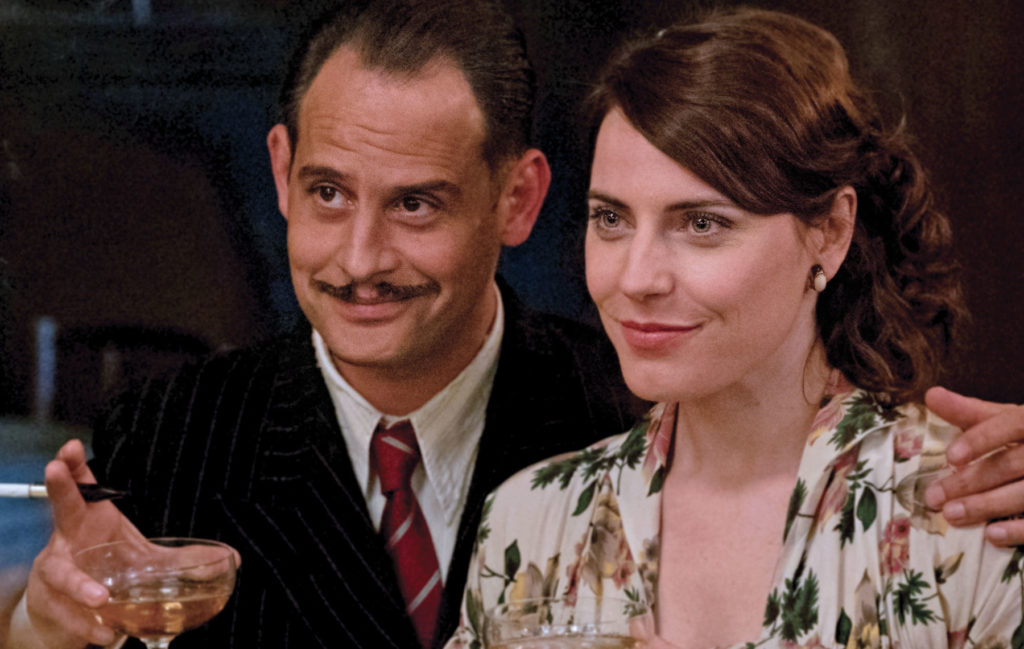
Of the many films that have been made about the Holocaust experience, few focus on survivors’ lives after the war, and maybe none do so with as much charm and humor as “Bye Bye Germany,” a film festival favorite that will be released on DVD on Aug. 7.

Set in Frankfurt in 1945-46, the dramedy follows Jewish entrepreneur David Bermann (Moritz Bleibtreu) and his friends, as they scheme to sell overpriced linens to gullible Germans in order to raise the funds to leave Germany behind. Meanwhile, Bermann is suspected of collaboration with the Nazis, and the astonishing reason why unfolds as he reveals to a United States Army investigator (Antje Traue) how his talent for telling jokes was a ticket out of the Sachsenhausen concentration camp and saved his life.

Director Sam Garbarski, 70, himself the son of German Jewish Holocaust survivors, collaborated on the script by Michel Bergmann, whose autobiographical novels “Die Teilacher” and “Machloikes” inspired the film. He spoke to the Journal by phone from his home in Belgium.

“If you look at literature and cinema, this period between 1945 and 1955 has never been treated because people just didn’t talk about it. It was taboo,” Garbarski said. “[Germans] probably felt uncomfortable about what they had done and didn’t want to talk about it. Survivors didn’t talk to their children about it. My parents didn’t, and I was not the only one. I filled the gap and let Bergmann’s story become my story.”

While David Bermann and his fellow survivors’ experiences in the film are based on true stories, “the one thing that is not true is the American major was a man,” Garbarski said. He switched the character’s sex to provide a romantic storyline, “but the interrogation was true.”

Garbarski’s aim was to convey how the survivors felt, “how horrible it had been for each of them, then having hope and starting over again. I wanted to show the strength of Ashkenazi Jews, their humor and the self-irony that gave them the strength to survive,” he said. In Bermann’s case, humor served him well because he made the Nazi camp commandant laugh. “He survived because he told jokes to the killers of his family, which is not an easy thing to live with.” 

Garbarski knows little about the details of his late parents’ experiences during World War II. “I know that my mother had been in a labor camp and my father had been in a concentration camp. They felt uncomfortable talking about it, and I felt uncomfortable insisting,” he said. “The rare things I know, I want to keep them for myself.”

He can only speculate why his parents didn’t leave Germany after the war, like the thousands who left for America, Palestine and elsewhere. He suspects that there was more than one reason, but in particular, echoing what Bermann says in the film, “They didn’t want to leave this beautiful country to the Germans.”

“I wanted to show the strength of Ashkenazi Jews, their humor and the self-irony that gave them the strength to survive.” — Sam Garbarski

Garbarski, however, left Germany for Belgium in his youth. “I followed a woman,” he said. The relationship didn’t last, but he stayed and had a family that now includes two grown children and two granddaughters. His son is studying business administration in San Francisco and his daughter is an actress. She plays a waitress in “Bye Bye Germany.”

The director, who describes himself as “a cultural Jew with a little bit of tradition, but not religious at all,” nevertheless identifies strongly as a Jew. He pointed out that his first feature film, “Rashevski’s Tango,” had a Jewish theme, involving Holocaust survivors and a funeral in Israel. 

After a 27-year career as a director of television commercials, Garbarski had no trouble segueing into features that include “Irina Palm” and “Vijay and I.” 

“You just make the commercials longer,” he said. “Filmmaking is filmmaking. If you can tell a story in 30 seconds, you can tell it in two hours.” 

His next film, based on a script he wrote with a friend, is not a comedy. “It’s a tough story, an impossible love story, set in 1954,” he said. “It’s very Jewish.” 

Gratified that he’s been lucky enough “to be able to make the films I want to make,” Garbarski hopes that “Bye Bye Germany” reminds people that the lessons of the Holocaust still bear repeating. 

“Every generation, we start again with the same atrocities and the same stupidity. [Although] Jews may not be the main target, right-wing extremists are starting up all over the world, even in the States. Refugees have to start all over again in other countries,” he said. “It’s frightening and it’s all going on again.”


“Bye Bye Germany” will be released on DVD on Aug. 7.

Jewish Humor Flavors Post-WWII ‘Bye Bye Germany’ Read More »

In My Bones I Sensed a Site of Nazi Torture

Last night on my run I ran into a concentration camp.

I was sweating in my pink sports bra and listening to the Clash on my iPhone 6 when suddenly I encountered a sign that indicated I was about to cross inside of KZ Kemna. Just like that. Just like the signs back home might say, “Burger King, 2 miles.”

Bumping casually into a concentration camp was not exactly on the list of things I needed to experience in life.

After 13 years of living in Germany, I might have understood that such a thing was possible, but there’s no way to prepare for that. It’s not like, “Oh hey, tonight I happened to jog past a library or a swimming pool or even a women’s prison.” And having grown up in sunny Venice Beach, picking lemons from my mother’s tree and rollerblading down the boardwalk and buying taffy at Davy Jones Liquor Locker, it is even stranger. I am a long way from home and, as a little girl, wouldn’t have thought in a million years that I would someday move to the country where my great-grandparents were murdered.

And yet, there I was on that random country road. The jogging route was not my usual; I had chosen it because it looked so pretty with its thick, damp birch trees. The Wuppertal neighborhood of my Airbnb rental was somber and gray, and I had been grateful to find the soothing, green road into the hills. But after passing the last gas station and the last metal factory and the last B&B offering authentic Croatian cuisine, weird, cold prickles washed over my arms like an acid bath. The animal part of me smelled that something horrible was about to happen.

Just like in the old cartoons when there’s an angel on someone’s shoulder, a small voice inside me said, Time to go home now. I felt colder and colder. The acid wash hurt my arms. Then bam, there it was: the road sign informing me that this was the site where more than 4,000 people had been brutally tortured by the Nazis from 1934 to 1934.

Just a modest monument. Nothing huge. Later I read the Wikipedia entry, which says that the men’s screams could be heard by people living and working nearby, and that the owner of the property refused to allow any big memorial there until 1983.

The animal part of me smelled that something horrible was about to happen.

There were a few bouquets flowers lying on the pavement by the entrance, browned and dying and tied with red ribbons.

I know I’m not the first person who understands that trauma is passed on to future generations through the body and in the DNA.

Something in my bones resonated with that trauma a full five minutes before I reached the sign.

I don’t claim to know how to heal it. All I know is that healing it is most definitely the task.

I do know a tiny bit of it heals every time I sing for a German audience. And it heals when I chat with my Syrian neighbors and wish them “Happy Ramadan.” And it heals when my sweet landlords here in Wuppertal drive me to the theater when it’s raining so I won’t catch a cold waiting for the bus. And when they invite me to use their garden on my days off, with its cherry trees full of fruit and raspberries on the vine and its pink roses just barely opening.

Sometimes I wonder what my great-grandparents would think of my living and singing opera here. I’ve always imagined they’d say:

Atta girl. You’re here, so that’s proof the f—— lost. But pay close attention, bubbeleh. Don’t think it couldn’t happen again. Do everything in your power not to let it — not to any of your brothers and sisters anywhere. Let go of tribalism and let go of that you-only-count-if-your-in-my-little-club sh– (in my fantasies, my great-grandparents cuss.) Take very good care of one another and don’t let dangerous assholes get ahead. 

If only I could hear them tell me exactly how.


Sara Hershkowitz is an opera singer, writer, activist and teacher. Born in Los Angeles, she currently divides her time between Berlin and L.A. 

In My Bones I Sensed a Site of Nazi Torture Read More »

Facebooking Friendship

“Don’t stand on ceremony.” It was one of my mother’s favorite expressions. And a few of her friends gave her plenty of reasons to use it. Like when they didn’t visit her in the hospital after major surgery, or when they didn’t check in with her after my grandmother died. 

It would drive my dad insane. “How can you call her after she did this to you?” He must have said that about a thousand times. But it would never change my mother’s position. These were her close friends whom she loved and did everything for; if they didn’t reciprocate, she thought, there must be a good reason.

Over the years, I’ve toggled back and forth between my parents’ positions. But for the most part, I’ve been blessed with such caring, giving friends that it really hasn’t been an issue. 

All of this changed with the advent of social media, most especially the intertwining of politics and friendship. Politics used to be a backdrop to relationships; it was there but no one except extremists would allow it to affect a friendship. Today, politics is one of the first things people ask about when meeting new people. 

But there’s another element at play — you can call it the Facebooking of friendships. We are liking, disliking, unfriending and blocking friends in real life with a touchscreen ease and frequency. One friend told me that an old friend recently unfriended her — in real life — because she didn’t like how she makes decisions. Another friend was booted from her social circle for not dealing with her son in the manner they deemed appropriate.

Here in New York City, superficial friendships well predate social media, but the level has definitely been cranked up a few notches in recent years. One father told me that when he goes to his kids’ events, he does a quick social status scan and if there’s no one there “worth his time,” he leaves. A few women at my son’s school only talk to me when they like what I’m wearing. A couple I know only socializes with other couples who own second homes in the Hamptons.

Is it any wonder that studies show we are getting lonelier and lonelier?

I had my first encounter with the new face of friendship when I began to defend Israel publicly in the summer of 2014. Half of my friends — friends of 20-plus years — stopped talking to me. In the past six months, I’ve been dealing with one of those major, life-changing events. Many of those same friends were too busy to check in with a quick, “How’s it going?”

I can hear my mom sweetly rationalizing and my dad yelling back at her. But I find myself moving to my dad’s position more and more. Why? Because those friends — those friends who I thought were friends for life — have been almost weirdly replaced by some of the most beautiful souls I have ever encountered. Friends who happen to be largely politically aligned, but on the areas that we’re not, we shrug. Who cares? Why does that matter?

What matters is how we treat one another. And these new friends have been there for me every painful step of an exquisitely painful process. 

We are liking, disliking, unfriending and blocking friends in real life with a touchscreen ease and frequency.

The truth is, the new face of friendship needs a spiritual facelift. My mother’s desire to forgive the unforgivable, to try to find the light in people who hurt her immeasurably, was kindhearted but ultimately misguided. Because if we are to truly value friendship, how can it be valued when it is not true? 

Unlike familial relationships, friendship is indeed conditional. But only fools make it conditional on politics or designer clothing. Friendship should be conditional on shared values. And when it is, friends can inspire us to be the best we can possibly be. 

In Judaism, not only are friends sometimes valued even more than relatives, it is what friends offer each other — loyalty, support, love, guidance — that is of most importance. “Judaism is not about the lonely soul,” Rabbi Jonathan Sacks writes. “It is about the bonds that bind us to one another and to the Author of all. It is, in the highest sense, about friendship.” 

Like a soul needs beauty, of course, friendships need tending, nourishing. Every moment of which is well worth the work.

“A faithful friend is the elixir of life,” wrote Ben Sira in his apocryphal book, “Ecclesiasticus.” That holds true today, with or without Facebook.


Karen Lehrman Bloch is an author and cultural critic living in New York..

Facebooking Friendship Read More »

Trump Administration Slaps Sanctions on Turkey for Imprisoning American Pastor

The Trump administration leveled sanctions against two Turkish officials on August 1 in response to Turkey’s imprisonment of an American pastor.

Fifty-year-old evangelical pastor Andrew Brunson from North Carolina is being accused by the Turkish government of espionage having ties to the Kurdistan Workers’ Party and the Gulenist Movement, which the Turkish government considers to be terror organizations. Brunson is currently under house arrest and faces up to 35 years in prison.

The Trump administration is demanding that Turkey free Brunson, claiming that there is no evidence that Brunson committed any wrongdoing. They are sanctioning Turkish Justice Minister Abdulhamit Gul and Interior Minister Suleyman Solu in response.

“Pastor Brunson’s unjust detention and continued prosecution by Turkish officials is simply unacceptable,” Treasury Secretary Steven Mnuchin said in a statement. “President Trump has made it abundantly clear that the United States expects Turkey to release him immediately.”

The Turkish Foreign Ministry responded with a statement that they “vehemently protest the sanctions” and that “a reciprocal response will be given without delay to this aggressive attitude which serves no purpose.”

Turkish President Recep Tayyip Erdogan has pushed for President Trump to accept a deal in which Turkey exchanges Brunson for businessman Fethullah Gülen, who Erdogan blames for orchestrating the failed 2016 coup attempt against him.

According to professor Efraim Inbar, the president of the Jerusalem Institute for Strategic Studies, Erdogan has allied himself with the likes of Hamas and the Iranian regime and has provided support for ISIS despite claiming that he fights them. Erdogan’s government has also promoted an anti-Semitic TV series that portrays Jews as insidious villains.

Trump Administration Slaps Sanctions on Turkey for Imprisoning American Pastor Read More »

60 Orthodox Rabbis Voice Support for LGBT Community in Israel

Sixty Orthodox rabbis voiced their support for the LGBT community in a letter as Israel’s Gay Pride parade set to occur on August 2.

The letter condemns the insults hurled at the LGBT community and warned that such intolerance can lead to instances such as at the 2015 Pride parade, where a 16-year-old Jewish teen was stabbed to death by an orthodox man.

“Our dear and beloved Jewish LGBT brothers and sisters, we, the undersigned, Orthodox rabbis who are committed to the Torah of life and love of kindness, feel a religious and moral obligation to make an alternative religious voice heard … a supportive voice,” the rabbis wrote.

They added, “The use of offensive and insulting language such as ‘perverts’ towards people created in God’s image is unacceptable and dangerous, and certainly when those words come from rabbis who order us to ‘Watch our words.’”

Other rabbis have condemned the LGBT community as an “abomination” and claim that children raised by same-sex couples would be raised in “a reality of moral distortion.”

60 Orthodox Rabbis Voice Support for LGBT Community in Israel Read More »

Jewish Cafe Owner Targeted for Trump Views

Several weeks ago, Ruben Duran, 51, was driving on the 101 Freeway when he noticed a restaurant in the heart of Boyle Heights that he didn’t recognize. “I remember thinking it looked nice,” he said. “I Googled it and figured I’d come in when I had a chance.”

The restaurant in question was Asher Caffe and Lounge, which officially opened its doors on July 12. Earlier this week, Duran, who is Mexican American and lives in Highland Park, finally visited the cafe for a late breakfast with his twin brother, Tony.

Less than a week before, the kosher cafe made national headlines when the owner, Asher Shalom, an Israeli immigrant who has called Los Angeles home for 30 years, became mired in controversy over his pro-Donald Trump and perceived anti-immigrant views.

During the grand opening, around 30 protesters, led by a group called Defend Boyle Heights, clashed with Los Angeles Police Department officers. Shalom also had private security on hand in anticipation of the protests.

“The words they used outside weren’t, ‘You’re pro-Trump’ or ‘You’re a Republican,’ ” Shalom said. “It was much worse than that.”

Shalom told the Journal he heard anti-Semitic slurs hurled his way, including “dirty Jew.” He found feces smeared on his establishment, received threatening phone calls at the cafe and noticed a flurry of negative Yelp reviews.

Defend Boyle Heights, which didn’t respond to requests for comment, describes itself on its blog as an “anti-gentrification coalition devoted to community and our hood.” It organized the protest after discovering posts Shalom shared from pro-Trump accounts on his Facebook page, including, “I wish Democrats would fight as hard for Americans as they do for illegals.”

Shalom defended the accusations against him and was largely apologetic about his Facebook posts, referring to them as “a mistake” in a phone interview with the Journal.

“I myself am an immigrant and most of the people working for me are immigrants,” he said. “They love me and I love them and I’ll do anything for them. I don’t have anything against immigrants. I apologize and this was all a mistake. With this business, I’m trying to do something that’s good for the community, not just for Jews.”

He added that his pro-Trump views have less to do with immigration policy and more to do with business policy and U.S.-Israeli relations.

A Westwood resident and member of Westwood Kehilla Synagogue, Shalom moved his business Asher Fabric Concepts to Boyle Heights five years ago. The cafe is across the street in a mostly industrial area with few food options.

The posts also caught the attention of the Boyle of Heights Chamber of Commerce. Just before the grand opening, Shalom’s membership was revoked.

“These statements are not in line with the Chamber’s values and objectives,” the organization wrote in a statement. “In accordance with our bylaws, Asher Caffe and Lounge’s membership was revoked, membership dues were refunded and our participation in their grand opening was cancelled.”

In an email to the Journal, Jennifer Lahoda, the chamber’s board president, denied previous reports that the chamber was involved in the protests and had called for a boycott of the cafe.

Shalom said he appealed the board’s decision and is waiting to hear back. Lahoda told the Journal the board is set to make a decision in the next 30 days.

“I’m not sure what they’ll do,” Shalom said. “Both sides have apologized to each other. [Lahoda] said I’ll get a meeting with them soon. I’m sure they’re under a lot of pressure.”

Duran said that beyond curiosity, a compulsion to defend Shalom brought him and his brother, who both identify as Trump supporters, to the cafe.

“We’re here because we thought we needed to come back this place up,” Duran said. “I heard about them throwing feces and I was so upset. I just thought, I can’t believe they’re doing this crap.”

And what about the food?

“It’s great,” Duran said, between bites of salad. “We love it.”

Jewish Cafe Owner Targeted for Trump Views Read More »

Netflix Claims Farrakhan Documentary Won’t Be Released, Blames ‘Internal Miscommunication’

Netflix has announced that a documentary of Louis Farrakhan will not be released on their platform, stating that indications to the contrary were due to an “internal miscommunication.”

Farrakhan tweeted that on July 30 that the documentary would air on Netflix on August 1, although that tweet has since been deleted. Some lists of upcoming releases on Netflix showed the documentary as appearing

“This film will not be released on Netflix,” a Netflix spokesperson told Fox News on July 31. “Due to an internal miscommunication, it appeared to be scheduled for release on Netflix, but it is not. We apologize for any confusion this has caused.”

Not everyone is buying Netflix’s explanation.

“Clearly, someone at Netflix thought they were going to stream this starting today,” Hot Air blogger John Sexton wrote on August 1. “Someone also told Farrakhan it was a done deal which is why he was promoting it. I wonder if that’s what killed it.”

Sexton added, “Farrakhan’s teasing of the show on Twitter and the subsequent questions posed to Netflix by Fox News and others probably led someone higher up in the company to realize they were about to make a big mistake.”

The documentary, titled “The Honourable Minister Louis Farrakhan: My Life’s Journey Through Music,” which was produced by Farrakhan’s son Joshua in 2013 and features musicians like Stephanie Mills and Stevie Wonder, according to The Hollywood Reporter. The documentary was shown to attendees at Farrakhan’s Nation of Islam Saviours’ Day Convention in 2014.

Farrakhan has come under public scrutiny for his ties to certain Democrats and progressive leaders as well as his litany of anti-Semitic statements.

Netflix Claims Farrakhan Documentary Won’t Be Released, Blames ‘Internal Miscommunication’ Read More »

Nationality Law: Optics Vs. Impact

I understand why so many people are freaking out over the recent legislation making Israel the “nation-state of the Jewish people.” The optics aren’t good. While much of the Nationality Law affirms the obvious symbols of a Jewish state — the flag, the national anthem, holidays, etc. — other parts are more controversial. These include clauses relegating the Arab language to a “special” status rather than an official one, and promoting the establishment of Jewish communities throughout Israel.

Like I said, bad optics. But what about actual impact? 

Yuval Shani, executive vice president of the Israel Democracy Institute, an independent think tank known to be highly sensitive to anything that threatens Israel’s democratic character, told The Jerusalem Post: “It is not a game changer and has very little problematic implications. It won’t change how the country is run.”

 Having said that, Shani added: “It is not an injury but an insult.”

So, while Arabs and other minorities will not suffer injury and will have the same civil liberties as before — the same freedom of speech, freedom of religion, freedom to protest, freedom of the press, etc. — many of them may feel insulted and diminished because the “Jewish” part of “Jewish state” will become more official. 

Said another way, the Zionist elephant in the room will now be sitting at the table, munching on the hummus.

I guess it was just a matter of time before the great paradox of the Zionist project — A state for the Jews with equal rights for non-Jews? A Jewish state that recognizes other religions? — would come in for some reckoning. How could it not?

The Jewish democracy project was always destined to be a delicate dance between two crucial ideals in constant tension.

 I confess that what I find bothersome in all the hysteria is a seeming lack of appreciation for the incredible difficulty in managing this paradox, not to mention the precarious tension inherent in the very idea of a Jewish democracy.

Presumably, critics of the Nationality Law would have had no problem with beefing up the “democratic” part of the equation. That would have triggered no controversy. But to beef up the Jewish part? That’s not as popular.

“Democracy” signifies human rights, freedom, equality, social justice and all the noble ideals associated with modern societies.

“Jewish” signifies religion, tribalism, exclusivity and all that is unfashionable about less enlightened nation-states.

Viewed through that lens, any move seen as downplaying democracy and playing up Jewishness is asking for trouble, even if the trouble is mostly symbolic. That is what happened with the Nationality Law: Israel played up its Jewishness and the world pounced.

Through the firestorm, we don’t hear much about Israel’s courageous accomplishment on the democratic side of the ledger. Amid the toxic talk about Israel turning into a racist state, you would never know that the luckiest Muslims in the Middle East are the ones who live in the Jewish state, a state under siege and in a continuous state of war.  

If the law “is not a game changer” and “won’t change how the country is run,” why are people freaking out over the recognition of the Jewish character of the Jewish state? 

With all of their challenges, it is only in Israel where Arabs and Muslims enjoy such a high level of basic rights and freedoms. The new law changes none of that, good or bad. What it does is touch an emotional chord — it reminds non-Jews that they live in a Jewish country.

I don’t want to minimize that sentiment, but I don’t want to blow it out of proportion, either.

It’s instructive that most criticism of the new law is indeed blown out of proportion, as with the Jewish leader who predicted it would result in “enormous damage” to the “legitimacy of the Zionist vision.”

Really? As much as I agree that the optics are bad and a case could be made that the law wasn’t necessary, such over-the-top reactions end up making a case that the law may, in fact, be necessary.

After all, if the law “is not a game changer” and “won’t change how the country is run,” why are people freaking out over the recognition of the Jewish character of the Jewish state? In other words, if the world explodes in horror at a step to reaffirm Israel’s Jewishness, maybe that in itself is a reason for Israel to take that step.

“National self-determination for the Jews in the State of Israel does not compromise by one iota the democratic or human rights of any of its other citizens,” wrote British journalist Melanie Phillips, who has written on the Middle East for decades. “No country in the world offers national self-determination to its minorities, for the simple reason that to do so would make those minorities themselves a nation.”

In any event, the Jewish democracy project was always destined to be a delicate dance between two crucial ideals in constant tension. The rising hysteria against the new law has turned this dance into a fistfight. 

If you ask me, those are also bad optics.

Nationality Law: Optics Vs. Impact Read More »

More Expletive-Laden Anti-Zionist Social Media Posts Emerge from Stanford Student Who Threatened Violence Against Zionists

Stanford student Hamzeh Daoud has been under fire for a recent Facebook post threatening physical violence against Zionists. More social media posts of his have been unearthed that reveal similar invectives.

In a July 31 letter sent to Stanford President Marc Tessier-Lavigne, attorney Jerome M. Marcus, who is representing an anonymous student at Stanford, highlights the following posts from Daoud:

· “f*ck your liberal Zionist ass. f*ck your jewish state. and f*ck the notion that makes you believe that the resilience [sic] and beauty that embodies judaism, jewish people, and the jewish religion is Israel. Israel is a state that needs to be dismantled. Any other opinion is complicity.”

· “For those that don’t speak arabic; this translate [sic] to God curse Israel. God curse the sh*t out of Israel :)! <3”

· “Salam! Your daily dose of f*ck Israel and have a nice day!”

Daoud has deleted his various social media accounts, but the aforementioned posts were captured in screenshots.

Marcus noted in the letter that “Zionism is an important element of the Jewish faith.”

“Jews pray three times a day for the return of the Jewish people to Zion and Jerusalem; they pray so every time they say grace after meals, and whenever they comfort a Jewish mourner, among many, many other times,” Marcus wrote. “These religious commitments are shared by many Jewish people around the world.”

Marcus added that the aforementioned posts from Daoud shows that he has “uncontrollable contempt and rage for this part of the Jewish faith,” meaning that he cannot uphold his duties “to create an inclusive, supportive, and stimulating residence community” as a Resident Assistant at a Stanford dormitory, a job that Daoud is slated to start in the fall.

“Stanford is now clearly on notice that Daoud has threatened violence in the very recent past and that he has displayed gross intemperance as well as intolerance of views other than his own on issues that are important to him and to other students,” Marcus wrote. “Stanford cannot responsibly continue to employ such a person without, at a minimum, completing a full investigation of all of his statements, as they all provide a valuable window into how he is likely to speak and conduct himself in the future.”

Marcus then pointed out that Stanford has previously intervened with student speech that deemed as harmful to campus climate, highlighting the following instances:

· Cutting funding from the Stanford Anscombe Society for planning to “discuss traditional values and marriage” in a press conference.

· Suspending housing for the Sigma Alpha Epsilon fraternity after some of its members made degrading jokes toward women.

· Students that put posters deriding those who are opposed to Immigrations and Customs Enforcement (ICE) were required to attend a meeting with the Associate Dean of Students where they had to give a rationale for why they put up the posters because other students took offense to them.

“There seems no room for doubt that if a Stanford student had made statements like those made by Daoud, but directed at black students, or gay students, or women students, or Muslim students, he would not be afforded the opportunity to change his physical threats into a statement of a plan to demolish their ‘asses intellectually,’” Marcus wrote. “And even if that change were made, there can be no doubt that Stanford would not be indifferent to the resulting threat to ‘abolish’ a black student’s or a gay student’s or a woman student’s, or a Muslim student’s ‘ass’ intellectually, whatever that means. Neither would it be tolerated if a Stanford student publicly tweeted ‘f*ck’ any such group or category of people.”

Marcus told the Journal that he hasn’t heard back from Stanford yet. Stanford has also not responded to the Journal’s request for comment.

More Expletive-Laden Anti-Zionist Social Media Posts Emerge from Stanford Student Who Threatened Violence Against Zionists Read More »