The Impossible Story: An Investigation Into the Shooting Death of Baltimore Police Detective Sean Suiter – PART 3
Part 3: Ballistics

This multi-article series revisits the available evidence and reporting around the shooting death of Homicide Detective Sean Suiter on November 15, 2017, adding analysis and some new information to the conversation so far. This information is provided in advance of the findings of an independent panel, commissioned by the department, that has promised insights and recommendations.
This first article looks at the trajectory of Commissioner Kevin Davis in his handling of this case in media and similar cases in the past. Part 2 deconstructs the reported timeline of events, comparing it to police audio records. Part 3 considers the ballistics discoveries and evidence. Part 4 looks at the emergence of the suicide and other theories, as well as the role of the federal government. The Addendum looks at the video evidence, released with the findings from an Independent Review Board. The Conclusion enhances the audio and video further and arrives at a homicide conclusion.
“Ballistically matched”
That Baltimore Homicide Detective Sean Suiter was killed by his own weapon has been central to every understanding of the case. Yet, some of what was reported about the ballistic evidence has contained errors or half-truths in how such findings are determined. The complete story has been made further hazy by the dramatic and confusing way that Commissioner Kevin Davis and others revealed the ballistic findings.
In this article, I will deconstruct the reported ballistics (and other gun-related) evidence, in consultation with several firearms experts and others. This article will seek answers for two primary questions: 1. How did the Baltimore Police Department (BPD) determine that Suiter was shot with his own weapon? 2. When did it determine this?
Whether or not there is sufficient proof that Suiter was killed by his own weapon, the answers to these two questions may not have been what the public was told. Along with other basic information in this case, like what time Suiter was shot, it has been challenging to get clarity on these issues.
Of the two questions, the first is more technically complex but easier to unravel…
Evidence: The Bullet
Two days after Suiter was shot, Commissioner Davis said that shell casings had been discovered on the scene that were “ballistically matched” to his gun. Shell casings are metal cartridges that surround a bullet and are expelled as soon as a gun is fired. They do not penetrate targets.
Davis only ever mentioned one bullet, found five days after Suiter’s shooting. He announced its discovery on November 22nd, during the same press conference at which he declared, “We also now know that Detective Suiter was shot and killed by his own gun.” Davis never said outright that the bullet itself was “ballistically matched” to Suiter’s gun. That claim appeared in a story in March by the Baltimore Sun’s Justin Fenton and Kevin Rector in March:
Days after the shooting, during a deeper search of the vacant lot, then-Police Commissioner Kevin Davis said he was “very encouraged” by the discovery of new evidence. Sources say it was a bullet found embedded in the dirt, which investigators at first believed could be from a suspect’s gun. After testing, police concluded it was the fatal bullet but came from Suiter’s gun.
The problem is that BPD departmental guns cannot actually be matched to bullets by “testing.” This came up in 2011, when an independent panel was commissioned to look into death of BPD Officer William Torbit. Torbit was accidentally shot by a fellow officer in trying to control a crowd outside of a nightclub. The panel provided a number of recommendations to help prevent similar problems in the future. It was led by the same people who are currently looking into Suiter’s death.
One of the panel’s recommendations was for BPD to invest in a new model of gun, because the departmental weapon, the Glock, does not leave “unique identifying marks on the bullets,” making it “forensically impossible to trace a bullet and match it to a particular weapon” and “hard to identify the responsible shooter and his/her position.” I confirmed this with several ballistics experts. Carl Leisinger III, a retired police officer and fourteen-year ballistics expert noted, “A Glock is not the easiest the gun in the world to match. In most cases, you would come up with an inconclusive.”
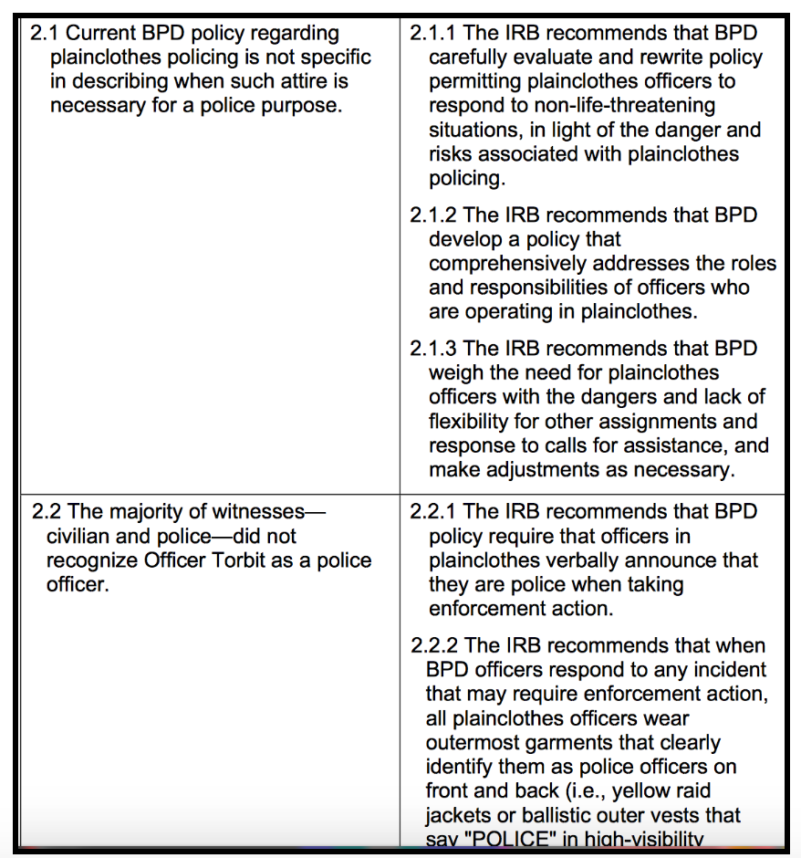
The Torbit panel recommended that BPD “consider using alternate weapons or some modification to the barrels to ensure accountability in the future.” BPD has stayed with the unmodified Glock. (Indeed, BPD has followed almost none of the panel’s other recommendations, which highlighted issues that persist today.)
During the November 22nd press conference, WBFF’s Paul McGrew brought up the 2011 Torbit report: “If multiple police firearms are shot at a crime scene, how can police differentiate which bullets are shot from which guns?” Davis admitted that he was “just learning” about the report but confirmed that the determination was not simple:
Where a firearm and its associated evidence like shell casings or bullet fragments or bullets are recovered in relation to a crime victim is all part of evidence as well. I did confirm that we did recover Detective Suiter’s firearm and three shell casings that have been ballistically matched to his firearm. So if you can imagine, Paul, where the shell casings were recovered and where the firearm was recovered in relation to where Detective Suiter died are all important things in the investigation.
Davis was pointing to a process called “shooting scene reconstruction.” Experts consulted for this article explained how autopsies, trajectory analysis, and crime scene photographs are used in this process. Joseph Gannola, a retired New York Police Department (NYPD) ballistics analyst and trainer, said that, absent a technical match, shooting scene reconstruction is “basically a scientific guess. You’re coming to your best possible conclusion. It doesn’t make it fact. It makes it a theory or conclusion.”
In order to reconstruct the shooting scene, BPD would’ve had to rely on Suiter’s partner and the first responders to the scene.
I did hear from one source, who has second- or third-hand access to the investigation, that there is more to prove that Suiter was killed by his own weapon than the ballistic information. This source agreed that the ballistic information was incomplete and/or misleading. There have been no shortage of leaks around this case, some that did not pan out. This information has not yet been confirmed.
The DNA
Davis’ November 22nd announcement about the bullet included the detail that “Detective Suiter’s DNA was recovered” from “the fatal round.” Historically, it was considered impossible to collect DNA from a fired bullet, because of its exposure to high heat. There are recent studies suggesting that it can be done with more sophisticated processes, although the success rates are still modest.
The discovery of Suiter’s DNA on the bullet suggested either that the bullet hit him or that he loaded it into the gun. It doesn’t necessarily indicate both. The lack of anyone else’s DNA on the bullet does not necessarily rule out anyone else loading it, either.
The Shell Casings
Davis was careful not to say that the bullet itself was “ballistically matched” to Suiter’s gun. He said that about the shell casings. Matching a Glock firearm to shell casings is much easier than to a bullet. And yet, it’s not a perfect science.
“The Glock leaves a signature retrace mark on shell casings, a square firing pin,” Leisinger noted. It does not leave a distinct mark per weapon, though. So if more than one Glock is fired, he said, ballistics experts would rely on “accidental marks” on casings, also known as toolmarks, which would be unique to the gun at that moment. Matches are determined by firing another bullet from the same gun and looking at patterns. “Sometimes you don’t have enough toolmarks,” Leisinger explained.

Stephen Batzer, Ph.D, a twenty-year forensic engineer, said that the toolmark matching is most successful at “ruling stuff out”:
You can look at a casing and see that it was fired out of something that has six rifling grooves, whereas this gun has five. The process is still really good for saying, ‘This did not come from that gun, we know that for certainty.’ But when you try to say, ‘I know that this casing was fired out of this gun,’ that is a lot harder… Those images [apparent matches] are very convincing… But are there false matches? Am I able to look at another image and say, ‘That’s a match too?”
Batzer made the point that guns within one police department might produce similar-appearing results: “You’re going to have sequential serial numbers. A lot of the marks would be similar.”
Gannola, who spent much of his career in the NYPD ballistics lab, felt more confident that individual Glock weapons could “likely” be matched to shell casings. The research and writing on this polarizing practice reflects the difference between experts like Betzer and Gannola. Still, Gannola admitted that toolmark matching probably doesn’t meet the Supreme Court’s “Daubert standard” of a tested methodology with an identifiable rate of error:
There is nothing like the ten points of comparison standard in fingerprinting. I don’t see that happening with firearms identification science. There is too much of a chance of external marks happening from anything. People who have worked in ballistics laboratories for a long time have the most sense of it being based on training and experience.
Toolmark identification has met some successful challenges in court and been criticized by the National Academy of Sciences. The trend has shifted from the language of certainty in ballistics towards the language of “similarities,” with caveats like “not all other weapons were excluded.” Today, ballistics evidence is more often corroborating rather than conclusive, though the science is advancing.
So if the shell casings found at the shooting scene were “ballistically matched” to Suiter’s gun, that means with relative certainty that they were fired from a Glock like Suiter’s. Whether or not they came from Suiter’s weapon at the exclusion of any other Glocks, there is still room for error. That degree of error has not been established and varies from one forensic expert to the next.
“Freshly fired”
In case anyone listening to Davis’ press conferences during November and December still had doubts about the ballistic evidence, Fenton and Rector’s follow-up article in March provided more evidence. It opened as follows:
When Baltimore Police Detective Sean Suiter was shot in West Baltimore last fall, responding officers found their dying colleague lying face down in a vacant lot. He’d been shot once in the head — and his freshly fired service weapon was beneath his body.
Every one of the ballistics experts I interviewed felt strongly that the “freshly fired” detail was suspicious. “You really can’t tell when [a gun] was fired,” Leisinger stated. “All you know is it was fired. But to say it was recently fired, that’s almost TV talk.” Gannola agreed: “For someone to say something was recently fired, I don’t know what they’re basing that on.” He said the recent Las Vegas mass shooter might have had a “red hot” barrel with “smoke coming out of it” but that wouldn’t happen after “a few rounds.”
Batzer, a retired Army Colonel, gave the most specific response: “If you heard the shot then you can tell if it was freshly fired. You can smell around the barrel. You can pull the slide back and feel if the barrel is warm. If you didn’t hear the shot, then you have no way of reliability determining that it was just fired.”
“So within a minute?” I asked. “If that,” he answered.
It seems that either “freshly fired” was a fiction or whoever first picked up Suiter’s gun was very, very close by when he was shot.
Timeline: The Leaks
The answer to the question of “how” BPD determined Suiter was killed by his own gun seems to be, based on the information so far, shooting scene reconstruction – an imperfect science based on other imperfect information. It is more challenging to figure out when BPD determined it.
Two days after Suiter was shot, WBAL’s Jayne Miller reported the following information:

Davis reluctantly addressed this rumor at a press conference that afternoon:
Justin Fenton (Sun): Is there a possibility – a possibility – that his gun was used to shoot him?
Davis: So Justin, we are looking at every possibility…
David Collins (WBAL): Do ballistics show any other weapons fired, other than Officer Suiter’s?
Davis: Not at this point David.
Brian Kuebler (WMAR): Can you say how many shell casings you recovered?
Davis: What I’ll probably do is tell you that we recovered shell casings, but I don’t want to get into the exact quantity.
Kuebler: Do they all match the departmentally issued firearm?
Davis: Ballistically matched.
A shell casing match only indicated that Suiter’s gun was fired, not that it killed him. The reporters’ sources seemed to be much further along. Did investigators have other evidence to implicate Suiter’s gun in his death so soon after he was shot? Or, did they jump to an assumption?
The commissioner would end up concluding everything that Miller tweeted two days after Suiter was shot. It would take him five more days and a dramatic bullet discovery to get there.
The Bullet Discovery
On the Monday after Suiter’s death, Davis announced that something had been found that morning on the vacant lot that could help “identify the killer.”

The autopsy, completed the day before, revealed something that led investigators back to the crime scene, he said, where they discovered… something. He wouldn’t say what it was; he didn’t want to “jeopardize the investigation.”
It happened anyway. The discovery was caught on camera that morning. WBAL’s David Collins filmed a team of investigators having a eureka moment:
There seems to be some over-acting on the part of the officer in the white shirt.
Moreover, none of the officers shown on camera are Crime Scene Unit investigators. They have been identified as a homicide detective; a detective from the Special Investigation Response Team (the woman digging in the dirt); and a district captain, the dramatist in the white shirt.
It is concerning that the officers showed up at the crime scene without CSU professionals, says Sandra Guerra Thompson, co-founder of the Houston Forensic Science Center:
One piece of evidence can have multiple uses… You need people who know what they’re doing. The evidence needs to be properly handled, packaged, and the chain of custody must be properly documented. These kinds of concerns are serious, especially when you have officer-involved incidents.
That night, Collins’ colleague at WBAL, Jayne Miller, tweeted a close up picture of what the investigators found:
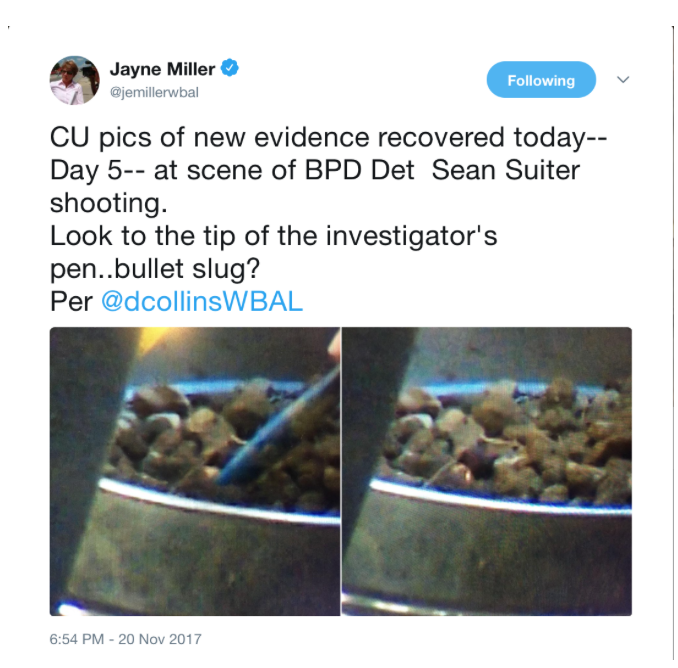
Unless Miller is an expert at identifying bullets in a pile of rubble, her question would seem to be rhetorical. Someone was pointing at the object, after all.
So, on the same day that the commissioner wouldn’t say what was discovered, his own captain, investigators, and crime scene unit photographers (“CU”) openly shared everything about it with WBAL reporters. Did Davis even mind? We can ask the same question about all of the leaks in this case.
The drama around the bullet discovery led some BPD observers to conclude that it was staged for the cameras:
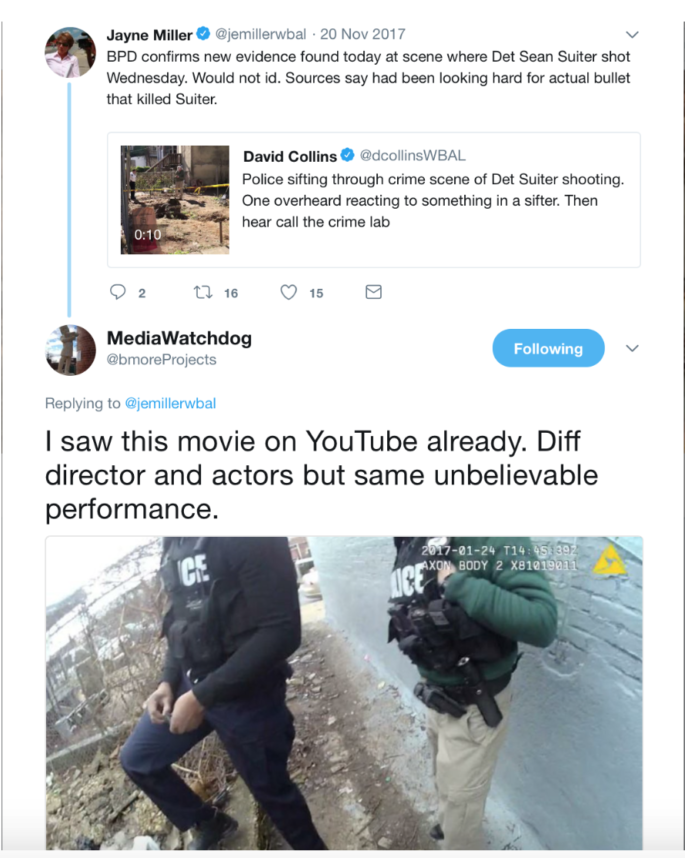
MediaWatchdog shared an image here from one of several recent scandals involving BPD officers caught staging evidence discovery on camera.
Real or staged, the bullet discovery gave Davis a full day of positive press. It also justified the extreme lockdown of the Harlem Park neighborhood, he claimed: Once you “release a crime scene,” he said, it can be “contaminated.” The crime scene in question was the vacant lot, though, not the whole neighborhood.
Some reporters were also skeptical of the bullet discovery. The Sun’s Fenton asked, “It’s a small patch of land, how is it that anything is still being found? You had five, six days to scrutinize that patch of land.” Indeed, Davis had talked about how six federal agencies showed up to help. Reporters described the lot being “scoured” all weekend.
Again, WBAL’s Miller had an answer:
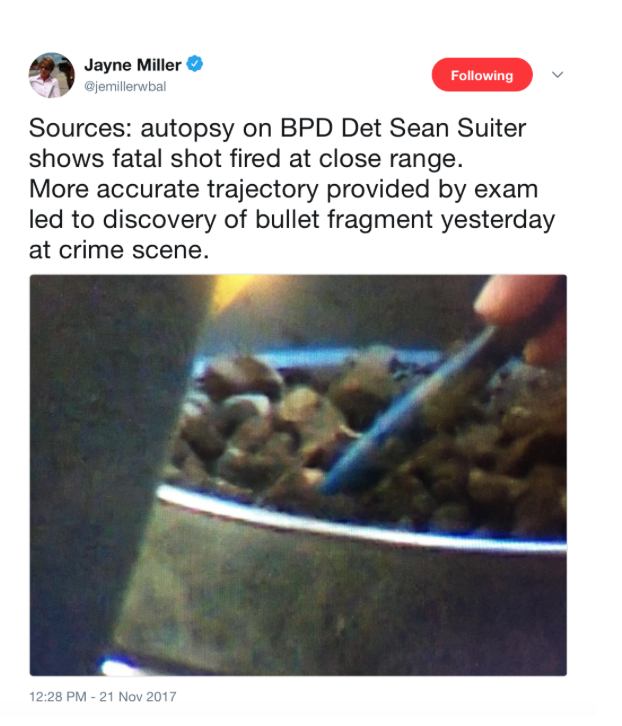
The “more accurate” trajectory led to the determination that Suiter’s death was a homicide. Was there a “less accurate” assumption before?
In any regard, the story around the bullet discovery created the impression that the bullet itself finally proved that Suiter was shot with his own weapon. Everything BPD said and did contributed to that impression. The truth is not that simple or scientific.
Amelia McDonell-Parry contributed to this story.