
fbpx

July 22, 2018

Rotem Reshef on her New Art Series: ‘Spectrum’

After receiving a prestigious scholarship from the America-Israel Cultural Foundation, Rotem Reshef honed her process even more by participating in a summer residency at the School of Visual Arts in New York.  As she began to explore the transition of the four seasons, she created “Time Traveler” for the University of La Verne in Southern California. In 2018 in Tel Aviv, she debuted “Intervals” which expanded her focus even further.  As we discussed the unique space at Soho House and the warm climate in LA, she created 22 works which feature gradients of cold, warm, and hot.  Reshef’s newest series, “Spectrum“, was installed at Soho House West Hollywood on July 1 and will be on display through July 30, 2018 (by appointment only).

If you’re in Los Angeles this month, reach out to Kipton Cronkite, curator of the exhibition, and he’ll take you on a private tour or simply preview the works here.

Q: WHY DID YOU CREATE “SPECTRUM” … THE NEW SERIES CURRENTLY AT SOHO HOUSE WEST HOLLYWOOD?
A: Spectrum was created specifically for the Soho House West Hollywood after seeing the space in early 2018. I wanted to create a series of paintings as one unit, but one that was also divided into singular paintings that could work by themselves. In the last two years I have been interested in the transitions of seasons, as they might be portrayed in the era of climate changes and global warming. “Spectrum” comes as a continuation of this thematic exploration.
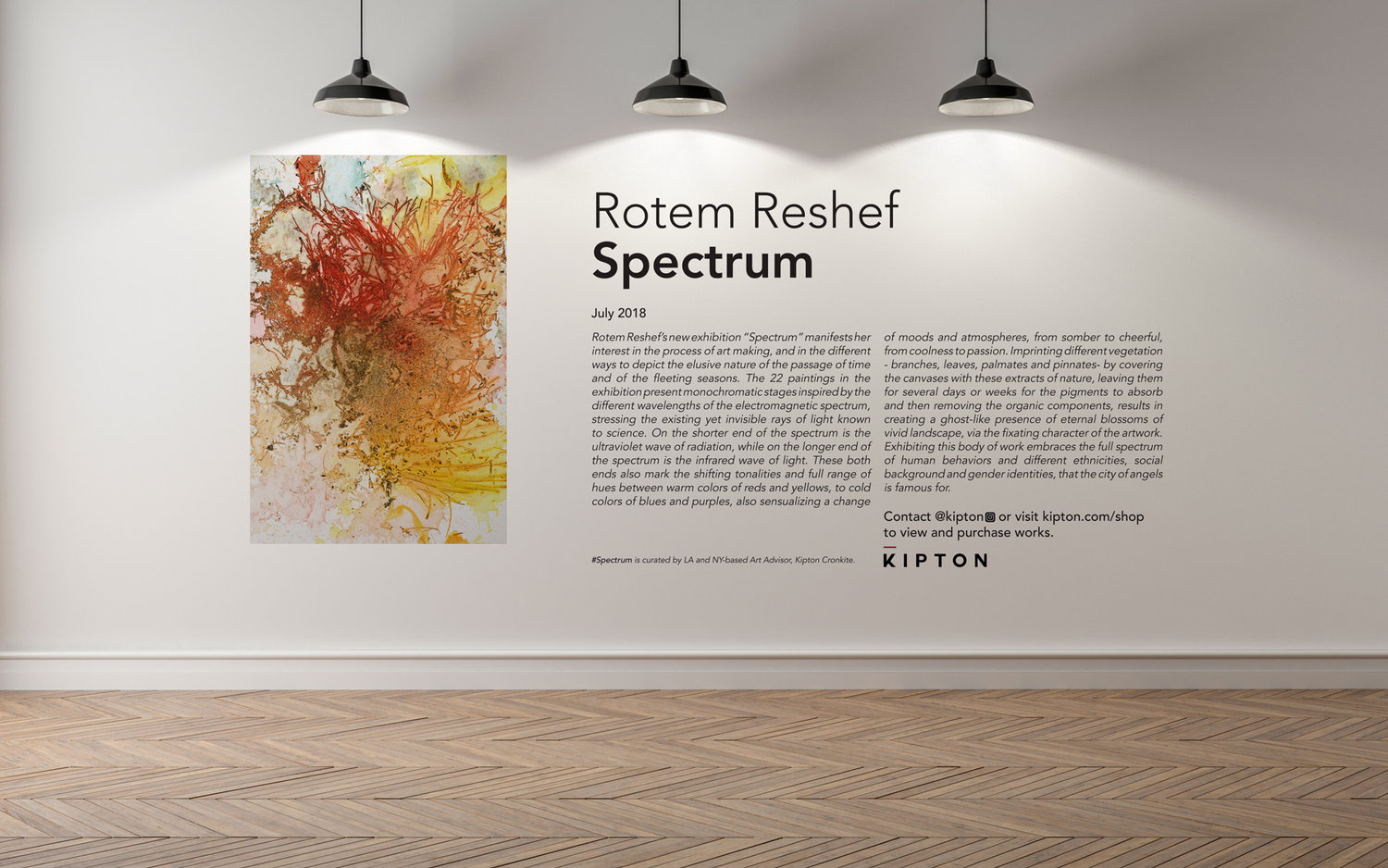
" Spectrum " is a series of 22 paintings created for Soho House West Hollywood (July 1 - 30, 2018)

Spectrum” is a series of 22 paintings created for Soho House West Hollywood (July 1 – 30, 2018)

Q: WHAT INSPIRES YOU?
A: Despite living an urban life, I am inspired by my everyday experiences and interactions with the nature around me. Inspiration can come from falling leaves that I find on the ground or on my car, or by trees that are framed by the windows of my studio. The juxtaposition of the flora and fauna with the urban environment of cement and smog, comes through my work via the tonal and textural tension between the vibrant colors in their restrained forms. The paint is bright but suggests dryness, similar to the restrained nature that appears here and there in the urban surroundings. I am of course inspired by culture and other creators working in arts, theater, fashion or cuisine, among other things. Inspiration is all around.
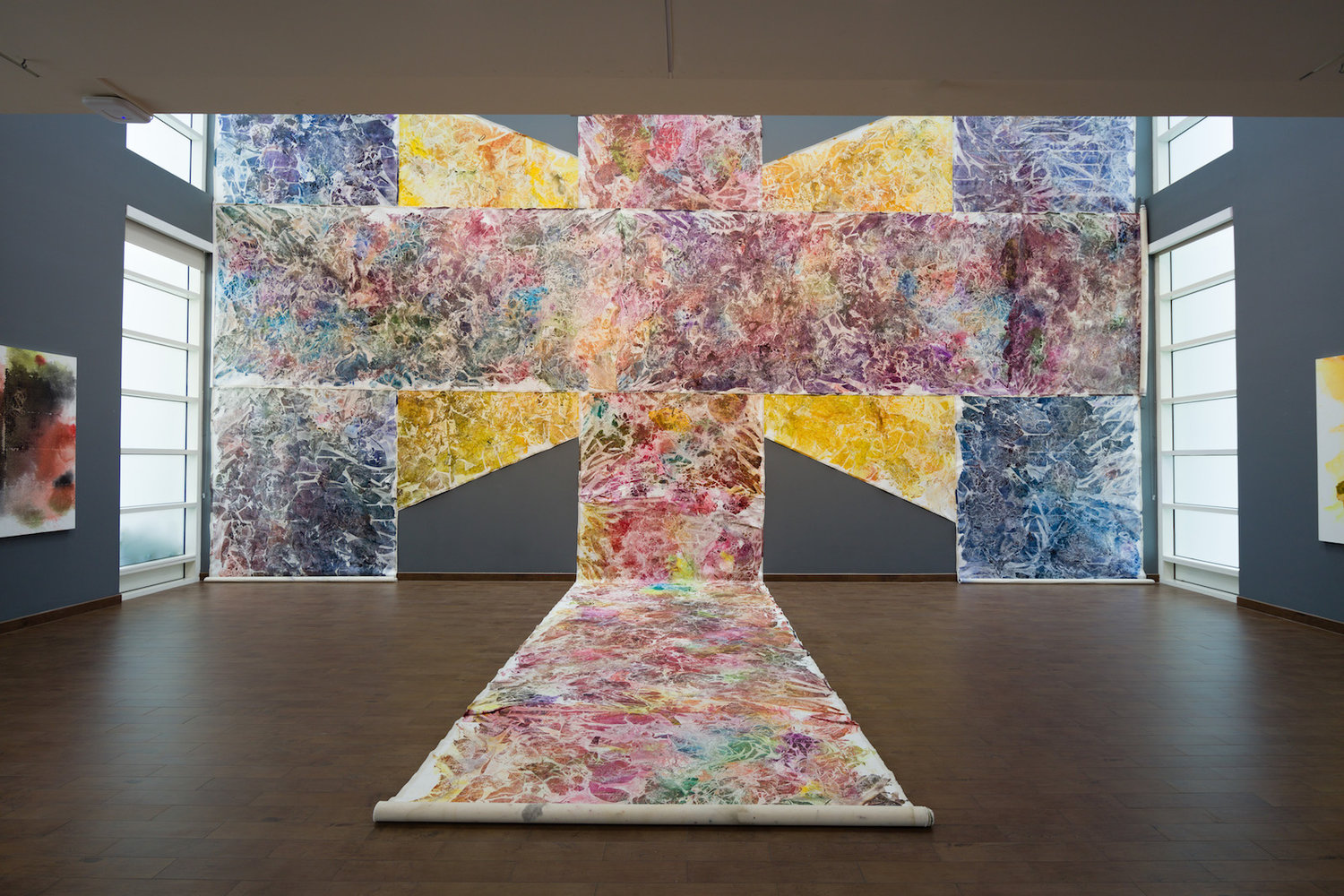
"Time Traveler: Part II, Compass",  California Lutheran University, Thousand Oaks, CA (2017)

“Time Traveler: Part II, Compass”, California Lutheran University, Thousand Oaks, CA (2017)

Q: TELL ME ABOUT YOUR ARTIST IN RESIDENCY AT THE SCHOOL OF VISUAL ARTS IN NYC.
A: In 2015 I spent a summer as an artist in residence at the School of Visual Arts in New York. Although I am dividing my time between my studios in Tel Aviv and New York, it was very interesting to be surrounded by art students and teachers who are established artists themselves.  It almost felt like going back to art school as a student myself and I devoted most of my time to explore and develop my art. The inputs I got through the residency and the feedbacks I received while I held my solo exhibition there, were eye opening, and encouraging toward more experimentalism and risk taking in my work.
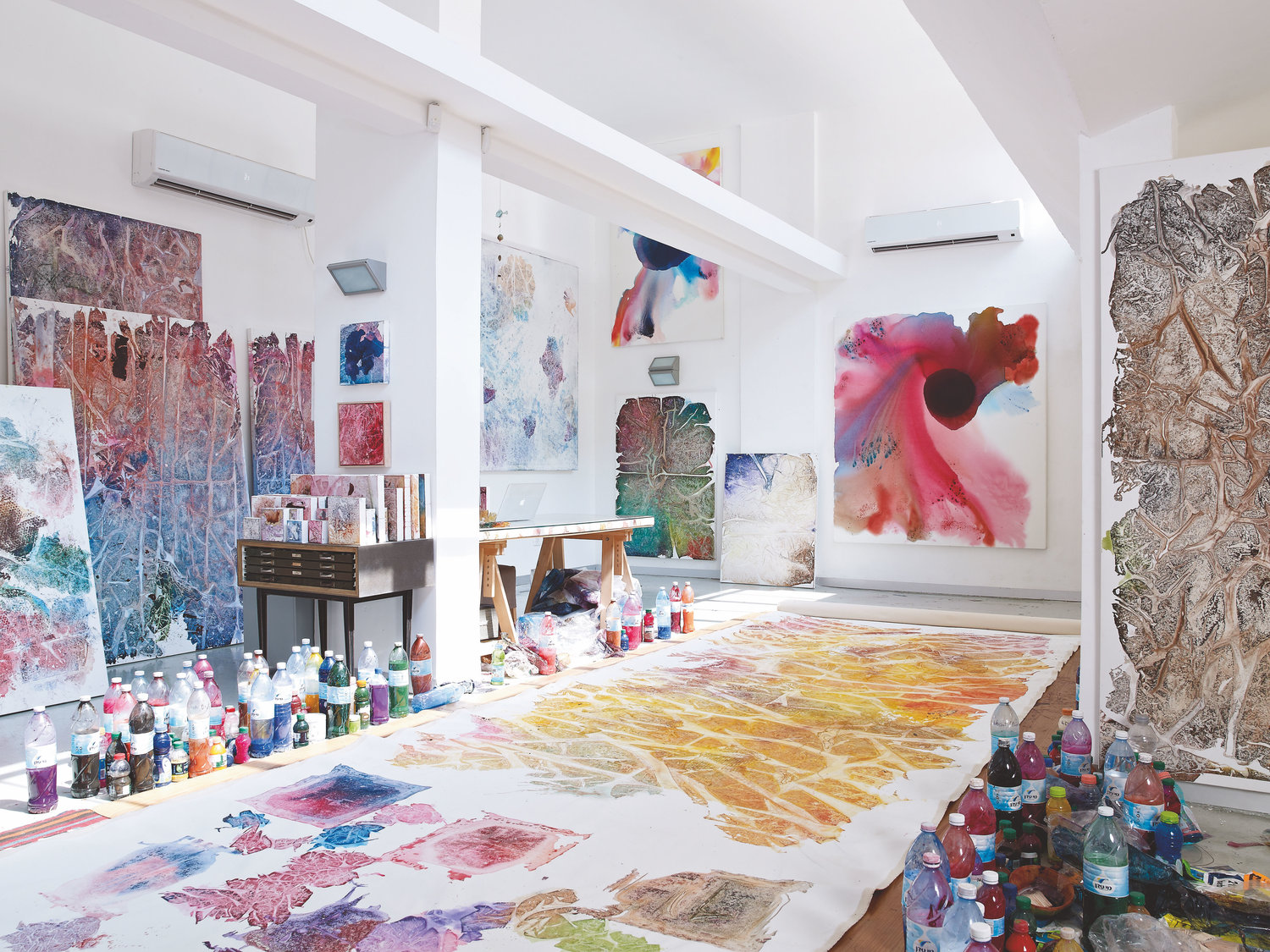
Inside Reshef's Tel Aviv Studio (2016)

Inside Reshef’s Tel Aviv Studio (2016)

Q: WHAT WAS THE PUBLIC FEEDBACK OF YOUR 2018 PUBLIC INSTALLATION IN TEL AVIV?
A: The reactions were tremendous, both from people in the local art scene, from my followers on social media and from the general public. It also received nice reviews in the press. Since it is a mural on the facade of The Artists House, a very popular and well known institute in Tel Aviv, it is being seen by hundreds of people every day. The impact on the building itself and on the surrounding neighborhood is so significant, that at this point it became an open ended installation.
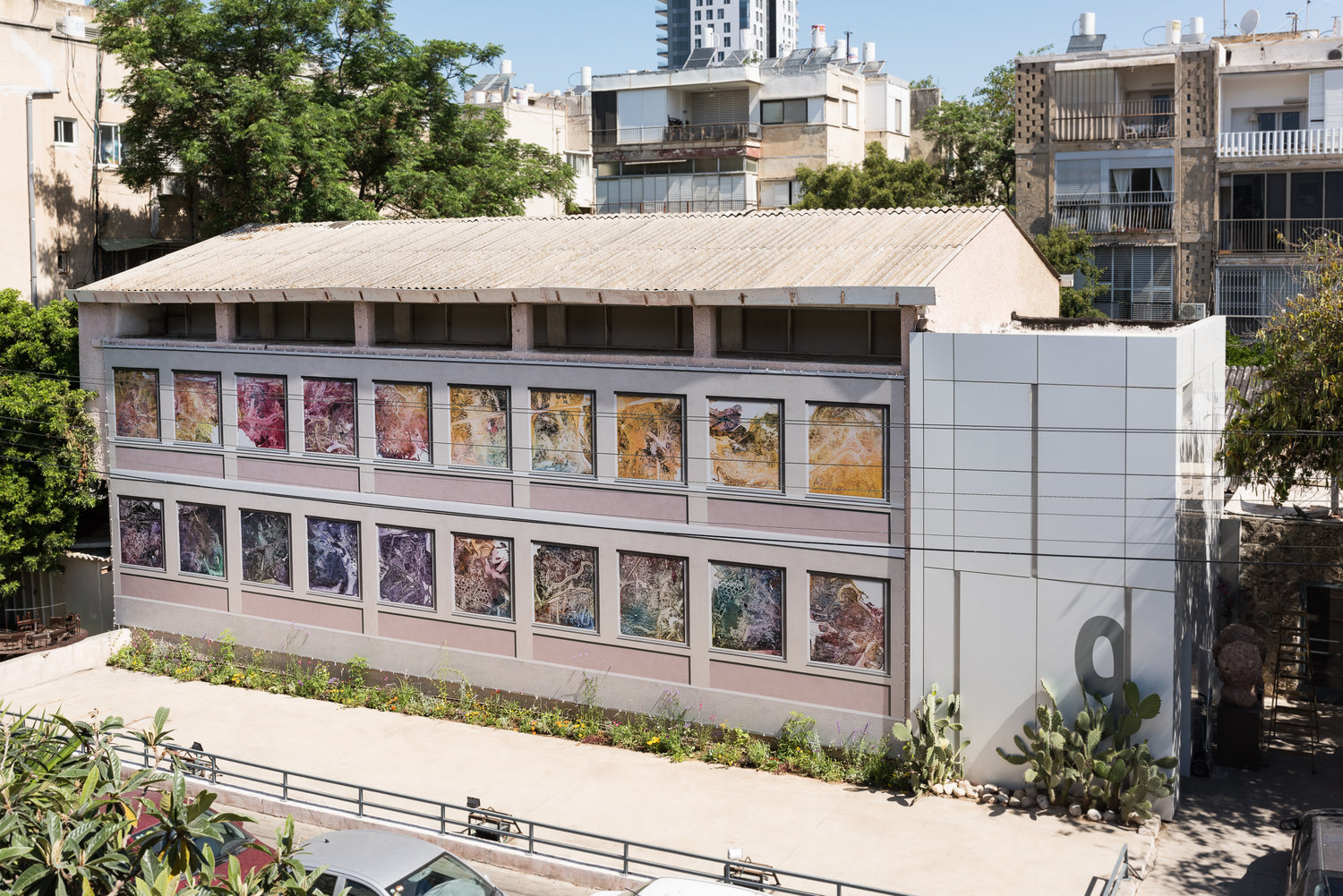
“Intervals” at The Artists House in Tel Aviv, Israel (2018)

Q: WHEN YOU CREATE YOUR PAINTINGS, PLEASE EXPLAIN YOUR PROCESS
A: I’m a process based artist. In my paintings I don’t work towards a specific outcome but embrace the process of creation. In contrast to painters that use an easel, or a wall, or even brushes, I make the paintings with canvases that are placed on the floor, and work with diluted paint, alongside different materials that are placed on the wet surface. For “Spectrum” I used different vegetation – branches, leaves, palmates and pinnates. I covered the canvases with these extracts of nature, leaving them for over a week for the pigments to absorb, before removing the organic components. The results created a ghost-like eternal blossoms of vivid landscape, that merge nature with artificially, temporality with eternity.
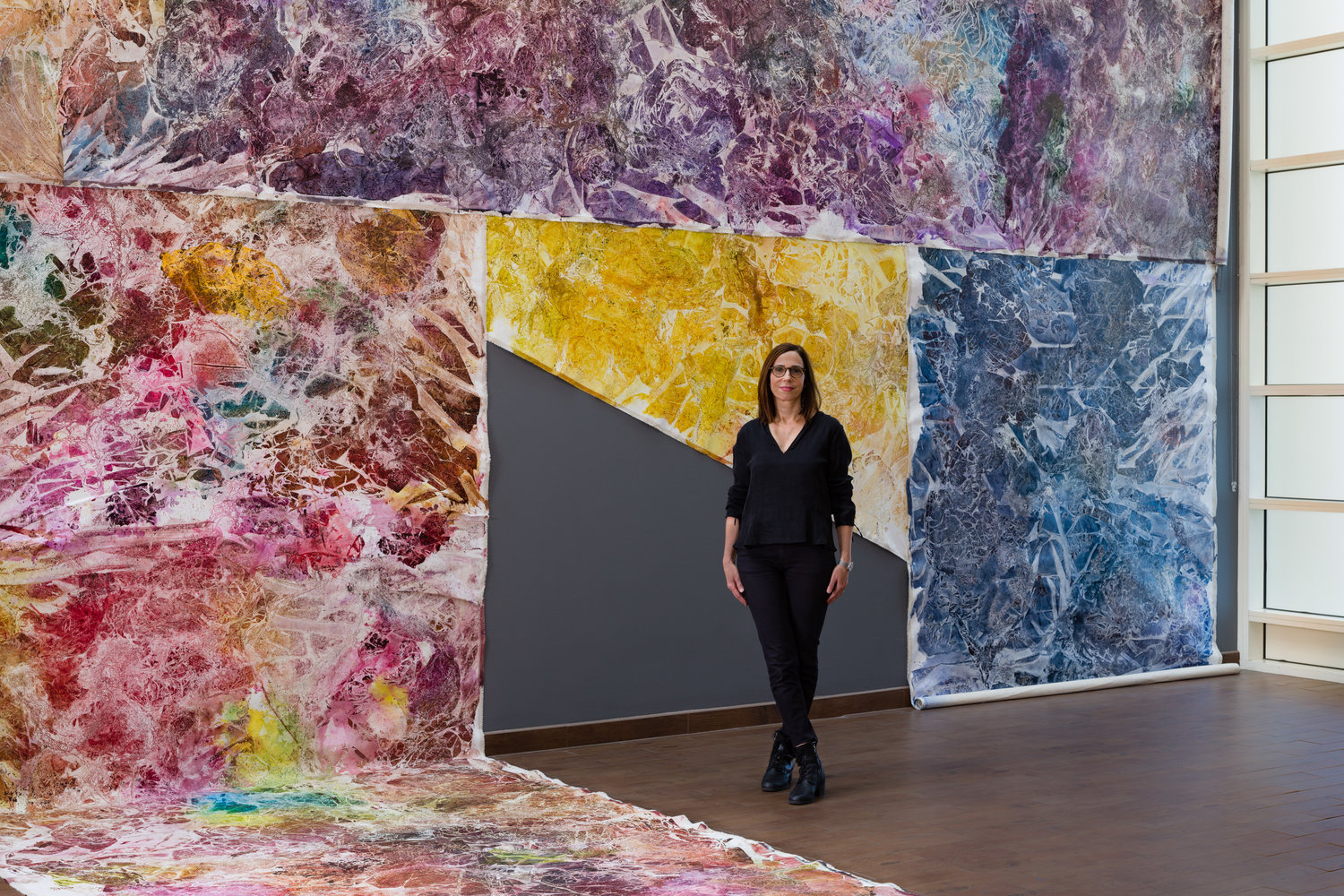
Rotem Reshef with "Time Traveler: Part II, Compass", California Lutheran University, Thousand Oaks, California (2018)

Rotem Reshef with “Time Traveler: Part II, Compass”, California Lutheran University, Thousand Oaks, California (2018)

Q: HOW IS THE ARTIST CULTURE IN TEL AVIV DIFFERENT FROM THE ARTIST CULTURE IN NYC?
A: Both cities are very vibrant and dynamic, very busy, not to say hectic. Both have amazing artists, but of course the scene is Tel Aviv is smaller, much less known, there are fewer galleries, fewer collectors and fewer institutions. The New York art scene has a long history and it is much more established. The Tel Aviv art scene is still evolving and growing. I enjoy spending time in both places, one balances the other.

Q: TELL ME SOMETHING ABOUT YOURSELF NO ONE KNOWS
A: Although I’m a city person, I guess agriculture runs in my blood. My great grandfather was a farmer and an author, and as an owner of many orange orchards, was among those who built the brand Jaffe Oranges. My grandma worked in the Israeli research institution for agriculture (Volcani Center), my father was the head of the Botanical Gardens in Tel Aviv for many years, and here I am, collecting trimmed branches, imprinting them on canvases and creating my art with them.

“Although this repetition of seasons occurs every year, it never repeats in the same way,” says Reshef. “Each season of every year, is one-of-a-kind creation of nature that disappears, only to re-emerge again, differently.”

— ROTEM RESHEF

Rotem Reshef on her New Art Series: ‘Spectrum’ Read More »

L.A. City Attorney Mulls Prosecution of Anti-Israel Disruptors of UCLA Event

It began as yet another frustrating example of a university refusing to take swift action in a case of aggressive disruption of a pro-Israel event. The belligerent shutdown of a Students Supporting Israel panel discussion occurred at UCLA on May 17, 2018. That incident has skyrocketed to become the most important potential prosecution of anti-Israel campus disruption in the nation since the Irvine 11. A top Los Angeles City attorney is now actively reviewing the file of evidence and police complaints for possible prosecution under state laws that criminalize the disruption of public meetings, as well as other related statutes.

In the now well-known case, on May 17, Students Supporting Israel gathered in a UCLA function room for a panel discussion titled Indigenous Peoples Unite. Disruptors–suddenly and loudly–stormed into the room mid-session. One person tore down the students’ flag, demonstratively pulled away a desk placard, and cursed threateningly close to the face of a panelist. With bullhorns, whistles, staged dancing, and slogan shouting, the event was shut down. The disruption and nose-to-nose intimidation of the students attending the SSI event was documented in a video, beginning at minute 41.

Although the UCLA administration publicly promised a referral to prosecutors, no such action was taken against the various protestors — both students and non-students, because UCLA campus police were awaiting formal complaints by the intimidated students. Only after such a formal police report is filed do police investigate and determine if a referral to prosecutors is called for. Then, prosecutors weigh the evidence and decide if prosecution is warranted. All students contacted by this reporter stated they did not know they were entitled to make a police report.

After media revelations about UCLA’s inaction, two Jewish groups sprang into action–the Louis D. Brandeis Center, headed by constitutional attorney Alyza Lewin, and the StandWithUs Saidoff Legal Center, headed by attorney Yael Lerman. The Washington-based Brandeis Center flew its attorney, Aviva Vogelstein, to Los Angeles. Together, Lerman and Vogelstein personally escorted numerous students as well as one member of the community into the UCLA police department where they all filed formal written and verbal complaints.

One such police complaint, obtained by this reporter, was filed by a community member in the room during the event, Laura Leve Cohen, a major donor to the UCLA’s Center for Jewish Studies, where she serves as an advisory board member. Cohen’s complaint opens with the words: “Have you ever been confronted by an angry mob and not able to leave? I hadn’t.  Until Thursday evening, May 17th, 2018 … Midway through the presentation, an angry, out-of-control mob stormed into the classroom, shouting and chanting. Simply put, we were trapped by a crowd of student protestors, surrounded on all sides, and unable to leave the room.”

After processing the collection of complaints, the UCLA police department opened Case 18-1206, assigning it to one of its seasoned detectives, Selby Arsena. Detective Arsena has racked up a many-years-long track record investigating campus violence. One of these included a 2011 stabbing case that resulted in a 12-year prison sentence.

In mid-July, Arsena delivered his file to Los Angeles City prosecutors at their Pacific Branch, located in a curved building also known as “the Airport Courthouse,” near Los Angeles International Airport. Quickly, the case was assigned to the office’s assistant supervising attorney, Spencer Hart, a highly-regarded prosecutor with experience in high-profile cases. One notable Hart prosecution involved jail time for a student found guilty false imprisonment at UCLA. A source in the prosecutor’s office characterized Hart’s record of successful prosecutions as one which earned “the No. 2 position in the office.”

Both Arsena and Hart declined to comment for this article.

Just a few days after case 18-206 landed on Hart’s desk, he was emailed a seven-page letter, submitted jointly by the Brandeis Center and the StandWithUs legal center, a copy of which was obtained by this reporter. The joint letter was a polished and detailed review of the evidence, legal precedent, and case law.

“There is strong California precedent to prosecute and convict disruptors who violate criminal law in their attempt to silence speakers on campus,” the letter asserted. It continued, “In a similar fact pattern in 2011, a jury convicted ten student members of the Muslim Student Union of a misdemeanor for disrupting former Israeli Ambassador to the United States, Michael Oren, in a coordinated effort at a public event at the University of California-Irvine (“UC Irvine”) … [later] upheld by a panel of three Orange County Superior Court judges. We believe that the facts in the case before you, Criminal Report #18-1206, merit similar prosecution and would result in similar convictions.”

The Brandeis-SWU letter specified the alleged potential criminal violations Brandeis and SWU had previously itemized in a letter to UCLA administrators: “§ 403 – disturbance of an assembly or meeting, § 415 – disturbing the peace; § 182 – criminal conspiracy to do the aforementioned’” and added two more based on additional research: “§ 242 – battery; § 664 – unsuccessful attempt to commit battery; and § 594 – vandalism.” The letter is jointly signed by Lewin, Vogelstein, and Lerman, the three of which have become the most active in the effort to see the matter prosecuted.

Lewin commented: “This disruption was egregious and unlawfuland must be properly prosecuted.”

While Lewin, Vogelstein, and Lerman have led the effort to have police reports filed and argued for prosecution, numerous Jewish and pro-Israel organizations have voiced support for the idea. Just days after the disruption, the Zionist Organization of America’s legal department sent a letter to UCLA insisting that a violation of state criminal law was clear.

If prosecutions and convictions result from the May 17 UCLA event shut-down disruption, it is expected to help define the criminal limits of such disruptions at campuses across the nation.

Edwin Black is the award-wining New York Times bestselling author of IBM and the Holocaust as Financing the Flames.


UCLA Responds: Letter to the Editor

L.A. City Attorney Mulls Prosecution of Anti-Israel Disruptors of UCLA Event Read More »

Pulitzer-Winning Food Critic Jonathan Gold Dies At 57

Pulitzer Prize-winning food critic Jonathan Gold died on July 21 at the age of 57 after being diagnosed with pancreatic cancer earlier in the month.

Gold won the Pulitzer in 2007 while writing at L.A. Weekly, the only food critic to have won the prestigious award. He was writing critiquing food for the Los Angeles Times before he died.

Gold was a well-known figure in Los Angeles, as he would scour out lesser-known restaurants and turn them into popular spots with his biting reviews. He aimed to connect Los Angeles residents with each other and was always happy to show tourists around his native city.

In 2016, Gold was interviewed by the Jewish Journal about the documentary about him, City of Gold:

He leaves behind his wife, Los Angeles Times Arts and Entertainment editor Laurie Ochoa and his two children, Isabel, 23, and Leon, 15.

Pulitzer-Winning Food Critic Jonathan Gold Dies At 57 Read More »

Despair and Hope: The Challenges of Tisha B’Av

[My photo: Ruins of the the Second Temple destroyed by Rome in 70 CE]

One of the least commemorated holydays in the Jewish calendar cycle is commemorated today (Sunday, July 22, 2018), Tisha B’Av (i.e. the 9th day of the Hebrew month of Av), the day marking the destruction of the two Temples in Jerusalem (586 BCE by the Babylonians and 70 CE by Rome).
 
Each destruction was traumatic in the ancient Jewish world. Historical documents record that blood flowed like a river through the streets of Jerusalem, that the survivors became slaves to the conquerors and that God was driven into exile with the people.
 
Beyond the geopolitics of those horrific events, sages of later centuries linked the two destructions to the Jewish people’s behavior.
 
Following the first destruction, they explained mip’nei cha-ta-einu gi-li-nu m’ar-tzei-nu (“because of our sins we were exiled from our land”). The prophets identified particular sins as the cause including the perversion of justice, the disregard for the needs of the widow, orphan and stranger, and the worship of the false gods of profit and materialism.
 
Following the second destruction, the rabbis of the Talmud explained mip’nei sinat chi-nam gi-li-nu m’ar-tzei-nu (“Because of gratuitous hatred [of one Jew for another] we were exiled from our land”).
 
Over the centuries Tisha B’Av became a day of national mourning for the Jewish people. For modern Jews, focusing on the sins of the people as the first cause of the destruction raises difficult theological and moral problems after the Holocaust. Yet, even if we believe we are individually and collectively innocent of the oppressive and hard-hearted conditions that characterize our era, Rabbi Heschel reminds us that “some are guilty, but all are responsible” and that as witnesses to those social ills we must act out of duty and a sense of justice.
 
For modern Jews as well, gratuitous hatred of one Jew for another is a trend that ought to disturb all who value the unity of the Jewish people.
 
The traditionally ascribed causes of the destruction of the first and second Temples remain extant today, and thus Tisha b’Av has modern relevance and meaning. This Holyday is a veritable warning of how history can be repeated if we aren’t vigilant in our advocacy of justice on the one hand and love of the Jewish people despite our differences on the other.
 
Towards the end of the day, during the Minchah afternoon service, the mood of Tisha B’Av abruptly changes. At that hour, tradition teaches, the Messiah will be born. Thus, our mourning is transformed into celebration and our dejection is converted into anticipation of reunification with God and our people.
 
Though national in character, Tisha B’Av also has a personal corollary and application. Rose Kennedy lost four of her children during her lifetime. She taught them, as recalled by Ted Kennedy in his memoir True Compass, the following:
“The birds will sing when the storm is over; the rose must know the thorn; the valley makes the mountain tall.”


Despair and Hope: The Challenges of Tisha B’Av Read More »