fbpx

July 18, 2018

‘Damascus Cover’ Delves Into Mideast Intrigue

The journey from page to screen can be long and arduous, as demonstrated by the new film “Damascus Cover.” Thirty-one years after novelist Howard Kaplan’s Middle East spy novel of the same title climbed best-seller lists, the film adaptation by director Daniel Zelik Berk is now opening in theaters and will soon be available online.

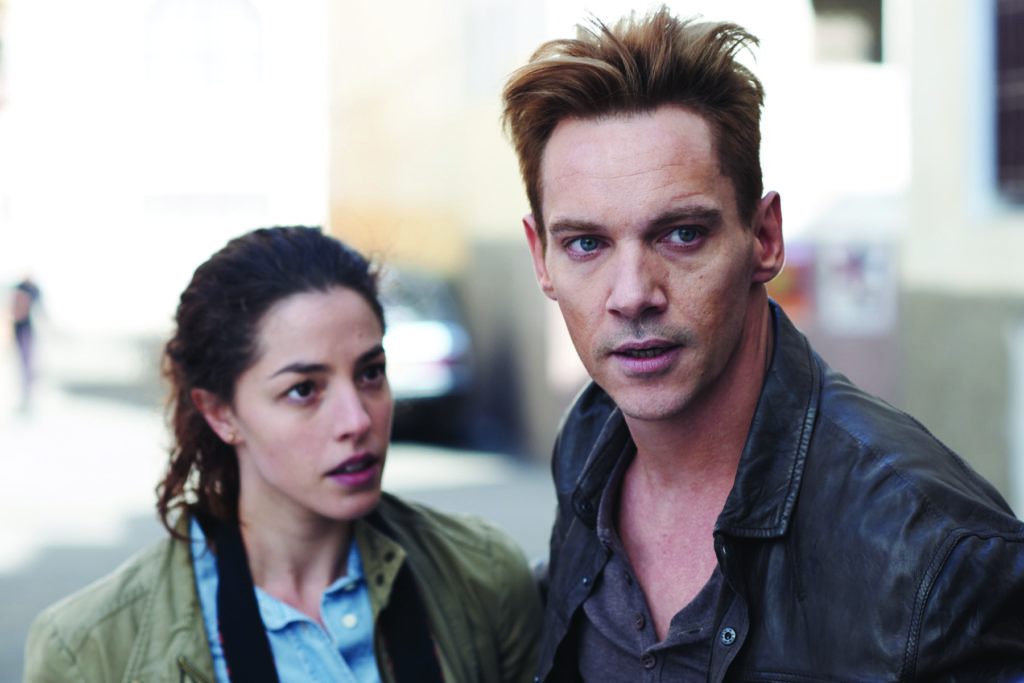
The movie stars Jonathan Rhys Meyers as Mossad operative Ari Ben-Sion, and the late John Hurt gives his final screen performance as Ben-Sion’s boss at the Israeli agency.

Berk, a former lawyer who worked in film acquisition, distribution and development before he became a producer, had been searching for a story to adapt and direct. Having also worked as a cultural affairs envoy for the Israeli Consulate, he wanted to make a film about Israel and read the novel at a friend’s suggestion. He spent almost a decade getting the story made into a movie, overcoming financing, logistic and budgetary obstacles. But first he had to write the script.

In the novel, set in the 1970s, Ben-Sion is tasked with smuggling Jewish children out of Syria. His mission in the movie, set in late 1989 amid the fall of the Berlin Wall, is to rescue a chemical weapons scientist from Syria — “A time of change when there was hope,” Berk told the Journal. 

The movie involves Israeli and Syrian spies, ex-Nazis, an American photographer (Olivia Thirlby) and a mysterious figure known as The Angel. 

“There’s twists and turns, and you’re trying to guess who The Angel is,” Berk said. “When you find out, it makes sense. It’s a nice twist and it’s satisfying.”

Shot in Morocco with a few second-unit days in Berlin and Israel for establishing sequences, the film includes several Israeli actors, including Igal Naor (“False Flag”), Tsahi Halevi (“Fauda”) and Neta Riskin (“Shelter”).

To immerse himself in the lead role, Rhys Meyers got tips from a former Mossad operative who served as an on-set adviser and instructor in spycraft and the Israel Defense Forces’ system of self-defense and fighting called Krav Maga. And for an emotional understanding of the Middle East conflict and his character, Rhys Meyers drew upon the complicated, violent history of conflict between the Irish and the British, which he was exposed to while growing up in Dublin, Ireland.

“It’s not the same situation as the Middle East but I understood the tension, living day-to-day in that kind of environment,” Rhys Meyers said. “It’s a vicious circle, because the children grow up in conflict zones and don’t know any other way to be. It’s an atmosphere of fear and paranoia, and the ones who suffer for it are the children.”

“There’s twists and turns, and you’re trying to guess who The Angel is. When you find out, it makes sense. It’s a nice twist and it’s satisfying.” — Daniel Zelik Berk

Rhys Meyers said he was attracted to the script because “it had all the elements of an old-school spy story, not the high-tech spy stories we have now. No cellphones. And there are no gaps in the script where you have to spend $50 million to keep people entertained.” 

The Ben-Sion character intrigued him as well.

“He’s incredibly complex because of the things that have happened to him,” Rhys Meyers said. “He recently lost a child. He also screwed up his last mission. He’s not in a good place, which makes him perfect as a patsy. He doesn’t know until close to the end of the film that he’s being used to root out a bad egg.”  

Known for his roles in the TV shows “The Tudors,” “Elvis,” “Roots” and “Vikings,”  and the movies “Match Point” and “The Tenth Man,” Rhys Meyers said he considered “Damascus Cover” a career highlight.

He also has three other films due in theaters in the coming year: “The Aspern Papers” — which he called a “dark and unsettling story” — is based on a Henry James novel and set in Venice, Italy, with co-stars Vanessa Redgrave and Joely Richardson; “Wake Up,” about a cop who awakens from an accident accused of a murder he didn’t commit; and “Holy Lands,” a family drama set in New York and in Israel, where his character’s father (James Caan) moves to become a pig farmer — Rhys Meyers’ second Israeli-themed film shot outside of Israel. 

While Rhys Meyers has never been to Israel, Berk, a committed Zionist, has visited many times. Raised Conservative in Pittsburgh, Pa., and La Jolla, Calif., Berk said he participated in the March of the Living trip to Europe and Israel while in college, which “ignited my Judaism. I came back from that trip really changed.” The trip also prompted him to transfer to Brandeis University for “a more Jewish experience.” 

Berk and his wife, Blair, a lawyer, are members of the IKAR congregation and celebrated their daughter Blythe’s bat mitzvah in Jerusalem four years ago.

Berk said he hopes to make a film someday in Israel, where he recently held a screening for the cast and crew of “Damascus Cover.” The film will debut there on Netflix in October.


“Damascus Cover” opens in theaters on July 20. It will be available on iTunes and on-demand July 27, and on Hulu after its theatrical run.

‘Damascus Cover’ Delves Into Mideast Intrigue Read More »

‘Generation Wealth’ Examines the Culture of Excess

In her 2012 documentary “The Queen of Versailles,” filmmaker Lauren Greenfield told the story of billionaires who went bankrupt trying to build the biggest mansion in America amid the Great Recession of 2008. The film went beyond the perils of money and real estate to explore American society in general, including body image issues and the pursuit of beauty, youth and fame. 

In her latest documentary, “Generation Wealth,” Greenfield explores those issues further, using her vast photographic and film archive as a catalyst to tell more cautionary tales about money failing to buy happiness. 

Greenfield’s subjects include porn stars, strippers, a child pageant queen and a boy celebrating his bar mitzvah with scantily clad dancers at the Whiskey a Go Go. But she also turns her lens on herself and her Jewish family.

“I always have been more of the journalist, staying out of the picture,” Greenfield told the Journal. “But this time, I was turning 50 and thinking about what I had done, and I felt like it was time to be more transparent about the process. I wanted it to be more of my journey, and I started interviewing my parents and my kids as representatives of their generations. There were things that came out in the conversations with my mom and with my son Noah that we had never talked about before off-camera. I felt like it spoke to all of us being complicit in this story.”

Although Judaism isn’t specifically discussed, Greenfield finds familiar Jewish themes in the film.

“In the end, it’s really all about family and community and values, doing something positive for society, and that’s part of Judaism,” she said. “My dad talks about how his dad taught him that you have to make the world a better place or have a social impact with your work and your life, but there has always been this conflict between materialism and those values.”

Greenfield’s father, a professor, was raised in an observant Russian-Jewish family; her mother, a psychologist, came from Reform German-Jewish heritage. Her family celebrated Jewish holidays but her parents “didn’t really push a lot of religion on me,” she said. Greenfield had her bat mitzvah at Temple Isaiah in West Los Angeles, where her Harvard-bound son Noah, now 18, followed suit, and her 12-year-old son Gabriel will have his bar mitzvah next spring.

“I felt like now was the time to ring the bell about going toward an unsustainable future, both for the environment, for the economy, for families and for our souls.”
— Lauren Greenfield

In 2017, Temple Isaiah’s Rabbi Joel Nickerson invited her to show images and clips from the unfinished film at Yom Kippur services. 

“I asked him why, and how [he thought the film] relates to the themes of Yom Kippur,” Greenfield recalled. “He talked about having an awakening and thinking about how we are living our lives. That really resonated with me. I think the whole third act of the film is influenced by that — this idea of how it’s possible to wake up  and, even in the depths of despair, there is a possibility for insight and agency.” 

Greenfield also wanted to explore the theme of addiction “that drives all of the subjects, even myself,” including obsessions with technology, plastic surgery, spending, or in her case, work. “I think addiction comes from a kind of emptiness or void we are trying to fill,” she said.

She wasn’t afraid to expose her own flaws and foibles in the film. “I love that the Jewish tradition supports the ability to be self-critical,” she said.

A theme Greenfield stresses in the film is that the meaning of the American Dream has been perverted.

“The American Dream of my dad’s generation meant the possibility of social mobility, defined by hard work, discipline and frugality. The goal was to give your kids a better life. It was success for a purpose, building a community, roots and family. But it has morphed into a kind of bloated dream defined by celebrity and access and narcissism,” she said. “I felt like now was the time to ring the bell about going toward an unsustainable future, both for the environment, for the economy, for families and for our souls.”

Greenfield spent three years on “Generation Wealth,” which includes images she culled from her archive of more than 500,000 photos she snapped over 25 years (some of which are in a photo exhibition now on tour in Europe). Screenings at the Sundance and South by Southwest film festivals earlier this year elicited very emotional reactions, she said. 

“It’s a film that brings up a lot of personal issues for people that are very complicated, about relationships and money and their bodies,” she said. “But I felt like I had to show the devastating reality of what the consequences are.”
While viewers may feel anger, pity or revulsion toward the film’s subjects, “we also learn from them,” she said. “They are the truth-tellers. At the end, many of them are saying that they didn’t follow what really matters. [The subjects] who have seen the dark side give us hope that we can live differently.”

Greenfield — who is now working on a “verité political film” and “starting a new company to represent female voices in films, commercials and branded content” — said she hopes audiences will get the message that problems with wealth and materialism are prevalent throughout American culture.

The story underlying her films, “is not just a family building the biggest house in America, or just Donald Trump or just Kim Kardashian — it’s about us,” she said. “We are all complicit in ‘Generation Wealth.’ This is our culture and we need to be responsible for it.”


“Generation Wealth” opens in theaters July 20.

‘Generation Wealth’ Examines the Culture of Excess Read More »

Baron Cohen Exposes Who America Isn’t

Sacha Baron Cohen did a cannonball jump back into the American television pool this week with his new Showtime series, “Who Is America?” 

Four cringe-inducing interviews by four colorful Cohen characters provided part of the answer to the question in the show’s title. A specific branch of Mussar — the rabbinic philosophy of character development — provided the rest.

While Baron Cohen skewered extremists on both sides of the political divide, the sketch that drew the greatest social-media response — posted to Twitter and YouTube to promote the show — has Baron Cohen playing Col. Erran Morad, an Israeli antiterrorism expert. 

As the Morad character, Baron Cohen executes a multilayered scheme to obtain congressional support for his “Kinderguardians” program to end school shootings by arming and training children from age “16 up to 3” to shoot and kill. The gambit works, almost too easily, and along the way exposes the twisted thinking of several key players in the gun lobby.

The only person to emerge unscathed from the sketch is Rep. Matt Gaetz (R-Fla.), who responsibly refuses to support training 3- and 4-year-olds in the use of firearms because, “Typically, members of Congress don’t just hear a story about a program and then indicate whether they support it or not.” But Gaetz unwittingly sets up the joke as the scene cuts to three legislators and a former congressman doing exactly that.

I usually dislike “gotcha” interviews and cringe humor. I also understand some critics’ concerns that Baron Cohen’s antics will undermine the public’s waning trust in the news media and entrench extremists. Most importantly, the show does not elevate the sociopolitical conversation in America; it actually drags it through the mud.

It’s painful. Nonetheless, “Who Is America?” is important because it is the postmodern incarnation of Navardok Mussar. 

The Mussar movement rose to prominence during the 19th century, and its central premise was that humans are deeply flawed and their ability to experience spiritual greatness can be achieved only through intense character development. 

Three schools of Mussar developed: Slabodka, Kelm and Navardok. Slabodka emphasized people’s inherent greatness as a deterrent to sin — a variant of the American exceptionalism myth; Kelm believed extreme discipline would tame man — an Ashkenazi version of aristocratic restraint; and Navardok taught that sin was an act of self-indulgence, so its followers set out to destroy the ego.

Negating the self was not just theoretical in Navardok. Its followers developed fieldwork exercises. They were renowned for walking into hardware stores and asking for a sack of apples, or entering a pharmacy and saying they wanted to buy nails. The idea behind these acts was to show that the shame or embarrassment we feel in these situations is a reflection of the damage to our vanity; to damage the ego until it was gone. The good self that emerged without the ego was the true self.

“Who Is America?” is damaging America’s vanity. Baron Cohen is exposing the fringe elements of our society in order to destroy them. The emergence of America’s good self, once the extremists are gone, is our true self.

Who is America? Not these crazy people. The rest of us are America.

When we watch the extremists embarrass themselves, we feel shame, but Navardok Mussar suggests that it is the pain of an extrication process that is necessary to discover our true selves — a diverse, respectful and sane society.


Eli Fink is a rabbi, writer and managing supervisor at the Jewish Journal.

Baron Cohen Exposes Who America Isn’t Read More »

Israeli Ambassador’s Iftar Plays Matchmaker for Islam 

I kept studying the invitation embossed with the blue-and–white Israeli escutcheon — the menorah flanked by olive branches. I was captivated by the novelty of the Jewish state hosting me, a Muslim, for Ramadan dinner.

Dismissing the delightful irony, I prepared for Maghrib, Islam’s evening prayer.  With faucets running, I methodically made my Islamic ablutions. Refreshed, I applied perfume, tucked a chiffon headscarf into my handbag and, after a final glance in the mirror, left the Jefferson Hotel in Washington, D.C.

The car was waiting. In 30 minutes I was expected at the Israeli ambassador’s home for iftar, the breaking of the Ramadan fast.

Speeding past manicured lawns and patrician homes, I was slightly intrigued. I expected to spend the evening mostly among Israeli Jews — always interesting, but for me, far from novel. After 45 years of traveling to the region, two years of living in Saudi Arabia and almost a dozen visits to the Jewish state in the past five years, I was fairly certain: Israel, while very much ensnaring me in enchantment, now held few surprises in store.

Arriving early, I spied a dark-haired man pacing outside the gates: Israeli security, I decided and prepared my ID. Instead, like me, he was a guest who had also arrived too early. Squinting at the flag pin on his lapel (definitely not Israeli), I asked his nationality. Smiling broadly, he answered, “I’m from Kurdistan! My name is Rahim Rashidi.”

Hilarious! I hadn’t even set foot inside but was already incapable of distinguishing a Muslim from a Jew. And what were the chances? I had just returned from Kurdistan! What was a Kurd doing here?

Certainly, Kurdistan had resonated with affection for Israel. Many Kurds, in several areas of Kurdistan, had expressed passionate pro-Israel sentiment to me. The lionhearted Peshmerga — the famed Kurdish military — whom I met fresh off the battlefields with ISIS, held the Israel Defense Forces in particularly high regard. The Kurdish hills had reminded me deeply of Judea. As we continued conversing, Rahim and I crossed the threshold of the Israeli ambassador’s home to a warm welcome.

It was only that night that I sensed the measure of Israel’s profound acceptance, appreciation, admiration and nurturing of Islam. 

Surrounded by the other guests, I struggled to identify nationalities, ethnicities and religions. My curiosity began to mount. Forty-five years of Middle Eastern globetrotting aside, the familiar was beginning to feel unfamiliar. 

Seasoned though I was in my Israeli travels, perhaps Israel still had some secrets to relinquish?

After his welcome, Ambassador Ron Dermer turned over the podium to a Muslim expert on Sufism and medieval Islamic treatise. After almost 17 hours of fasting, the professor was, thankfully, brief. Juice and Medjool dates were served, and as our veins were moistened, the reward, we all hoped, was sealed, as we say in Islam.

I turned to the woman next to me, the bureau chief for i24 News, an Israeli TV channel. Her soft beauty was Sephardic. She talked about her French upbringing and childhood visits to Riyadh, Saudi Arabia (her father was Saudi and her mother Algerian). A very strange Israeli, I decided, failing to comprehend. It was only when she gave me her card and I looked at her name that I understood she was, like me, a Muslim!

I was surprised at my inability to recognize fellow Muslims! Israel saw us more clearly than we saw ourselves. 

I studied the room. What a Rolodex the Jewish state had accumulated! How could there be so many of us? And such heterogeneity! The diversity of Israel’s Muslim guests was jaw-dropping. Excuse me? Was anyone boycotting Israel anymore?

There were Muslims from Europe — both West and East — the Americas, the Middle East, Turkey, West Africa, North Africa and so many others I didn’t get to meet. There was even an Iranian, for crying out loud.

Clearly, Israel’s Islamic dance card was full.

How had Israel cultivated such engagement with Muslims, I wondered? Besides Mecca during Hajj season, this room held the most ethnically and spiritually diverse groups of Muslims I had ever seen. Who knew? Israel provided such a good shidduch — an arranged marriage — for Islam! Maybe all Muslims needed to end 15 centuries of sectarian conflict within Islam was an Israeli shadchen — a matchmaker?

Time for Maghrib.

Aligning myself on the Persian rug, I joined the only other woman praying that evening. Salaat — at least something was familiar! I stood to the left of a West African woman and wife to an ambassador, draped in a gold-trimmed dress. A matching scarf framed her perfectly made face. Though fully veiled, she lacked the austerity of Wahhabi women I had known in Riyadh.

Enacting the fluid motions of our prayer synchronously, our gestures were fractionally different — unsurprising, given that Muslims come from dozens of different sects and make homes in more than 187 nations. She was reared in a highly pluralistic society where Muslims lived side by side with Christians, their faiths informing one another. Her Sunni Islam was deeply infused in Sufism. 

Other Muslims were straight out of central casting. 

Two portly Egyptian wallflowers — father and son — wore suits sans neckties, typical of both the post-colonial Arab world and post-revolutionary Iran. Bowing with an ancient gallantry, each smiled shyly as I described my time in Um Al-Dunya (Mother of the Universe, as Egypt is affectionately known).  

Elsewhere, a patrician ambassador to a Middle Eastern country that has established treaties with Israel chatted with me over dessert, flanked by his refined wife, a honey blond more Armani than Arab in appearance. Theirs was the sartorial elegance of moneyed Muslims enormously comfortable with their faith, their complex region, and Europe’s post-colonial legacy there.

Soon, I ran into a Muslim I knew. Raheel Reza and I enjoyed a brief reunion—-. Pakistani-born, Reza had been raised Sunni (Again, me and my assumptions — I had always thought her Shia), although today she identifies as a Muslim humanist.

Ever the dynamo, she tugged at my hand, insisting I meet a friend. She led me to a remarkably tall, bearded imam wearing sweeping black robes and a white turban — my first encounter with a Shiite cleric. 

Taller than Jim Comey, how the heck had he slipped in unnoticed?

The reform-minded imam was, like us, a sworn enemy of Islamism. Peculiarly, he was Australian. He wore a huge, hand- carved ring. (Muslims often wear semiprecious stones in line with the Prophet’s recommendations). Rendered in chalcedony, the ring was from Qum, the religious epicenter of Shi’ism.

As clerics go, he was strangely debonair. I blurted out the first thing that came to my mind: Was his turban (that made him even taller) “ready made” or did he wrap it daily? (Wrapped from a single piece of cloth, he answered). And yes, it was also ‘bespoke’ from Qum. 

Nothing off-the-rack for this man of cloth!  Just wouldn’t be kosher!

Iranian in origin and training, the imam was a descendant of the sixth-century legendary Arab Hatim Tai of the Arabian Peninsula, his ancestors’ tomb immortalized in the “Arabian Nights” folk tales.

By now, I was feeling not only ignorant but, as a Muslim in Israel’s Rolodex, distinctly undercredentialed. 

Israel’s iftar revealed how remarkably well Israel curated Islam. 

Israel was more intimately acquainted with a greater diversity of Muslims than my experience of almost 50 years of leading a Muslim life — living in, traveling to and coming from large parts of the Muslim-majority world. Despite my dozen visits to the Jewish state, it was only that night, outside of Israel, that I sensed the measure of Israel’s profound acceptance, appreciation, admiration and nurturing of Islam. 

Like a rainbow emerging from a summer downpour, after that iftar new worlds of Islam came into beguiling view. Israel’s prism of Islam had revealed the full spectrum of our multicolored iridescence: African Islam, Australian Islam, secular Islam, pluralist Islam, humanist Islam, Shiite Islam, Sufi Islam, Islamic mysticism and traditional Sunni Islam.

As we bid our farewells, drove home, and the graceful Washington lawns faded to black, I knew the others leaving that luminous evening felt as I did: Our gentle shidduch — home to Yerushalayim Shel Zahav, Aharon Appelfeld’s port city on the shores of eternity — had strengthened not only our union with Israel, but most surprising of all, our own bonds of brethren within Islam. Baruch HaShem and Allahu akbar: A Ramadan bracha, indeed.


Qanta A. Ahmed is a Muslim physician, author and broadcast media commentator. Her first book is “In the Land of Invisible Women: A Female Doctor’s Journey in the Saudi Kingdom” (Sourcebooks 2008).

Israeli Ambassador’s Iftar Plays Matchmaker for Islam  Read More »

Trump’s Disgraceful Moment

On July 16, President Donald Trump gave a deeply disgraceful press conference with Russian dictator Vladimir Putin. The presser began with Trump announcing that although the Russia-United States relationship has “never been worse than it is now,” all of that “changed as of about four hours ago.” It was downhill from there. Trump proceeded to state that he held “both countries responsible” for the deterioration of the relationship, then supported Putin’s argument that Russia hadn’t interfered in the 2016 American election in any way: “I have President Putin, he just said it’s not Russia. I will say this: I don’t see any reason why it would be. … I have confidence in both parties.”

Both parties. One party being a murderous dictator, and the other the intelligence community that works for him.

All of which is disgusting, of course.

That doesn’t mean, as Democrats have suggested, that Trump is in bed with the Russians. Far more likely, it means that Trump’s ego is one giant gaping wound, constantly draining rage over the suggestion that his election victory was somehow ill-won. To the refusal of former FBI Director James Comey to publicly clear him in the collusion investigation, Trump responded by firing Comey; now he’s responded to the Robert Mueller investigation’s indictment of 12 Russian government hackers by proclaiming that Putin might be innocent after all. This isn’t about some nefarious plot. It’s about Trump’s ridiculous ego problem.

None of that acts as justification for Trump’s behavior, of course.

But it does explain why when Trump says stuff, it often doesn’t matter.

More than a year ago, I wrote that Americans were beginning to tune out Trump. “Many Americans have been treating Trump as a guy to ignore except when he bothers them, an approach that seems pretty reasonable at this point,” I suggested. But could Trump’s rhetoric make a difference with regard to foreign policy? Over at The New Republic, Jeet Heer criticized the idea that it couldn’t, stating that “the very nature of our modern world, and the United States’ supremacy, makes it impossible to dismiss an American president’s word.”

The rest of the world has already dismissed Trump’s verbiage on various occasions. 

But that’s obviously untrue. The rest of the world has already dismissed Trump’s verbiage on various occasions. For example, according to The Wall Street Journal, he told NATO members that he would “do my own thing” if their countries didn’t increase their military spending. What was the upshot? Nothing. NATO leaders quickly closed ranks and stated that NATO was as strong as ever, ignoring Trump’s pyrotechnics. They figured, correctly, that Trump’s national security establishment  would not facilitate a pullout from NATO; and that if they gave him some sort of rhetorical victory, he’d go back to watching “Shark Week.”

When it comes to trade, however, Trump’s words matter — because they’re backed by policy. Trump’s tantrum at the G-7 had real ramifications for American policy because he immediately used his executive power to launch tariffs at a bevy of American allies.

So, is Trump’s Russia policy more like NATO or more like the G-7? Putin probably figures it’s more like NATO: If he were to suddenly invade Lithuania, Trump couldn’t be trusted to stand down. And were Putin to escalate his election intervention, even those working within Trump’s defense establishment couldn’t be trusted to stand idly by — after all, Trump is bashing his own Justice Department, which is ably prosecuting Russian agents.

The Trump administration’s Kremlinology, in other words, isn’t the same as the Obama administration’s Kremlinology. Republicans were constantly enraged by Obama’s words because his softness was constantly backed by policy — the Obama administration and Obama weren’t two separate entities. The same simply isn’t true of Trump, whose administration operates independently of the president at a variety of levels.

Again, that’s not a defense of Trump. But it is an argument that the panic induced by his verbiage should be tempered with the knowledge that he says a lot of stuff, and that members of his own administration ignore most of it when it comes time to implement policy. They know it, Putin knows it and the press knows it. Only Trump seems blissfully unaware of the disconnect between the nonsense he spews and the policy his administration promulgates. In this case, we’re better off for that disconnect.


Ben Shapiro is editor-in-chief at The Daily Wire. A version of this article first appeared in National Review Online.

Trump’s Disgraceful Moment Read More »

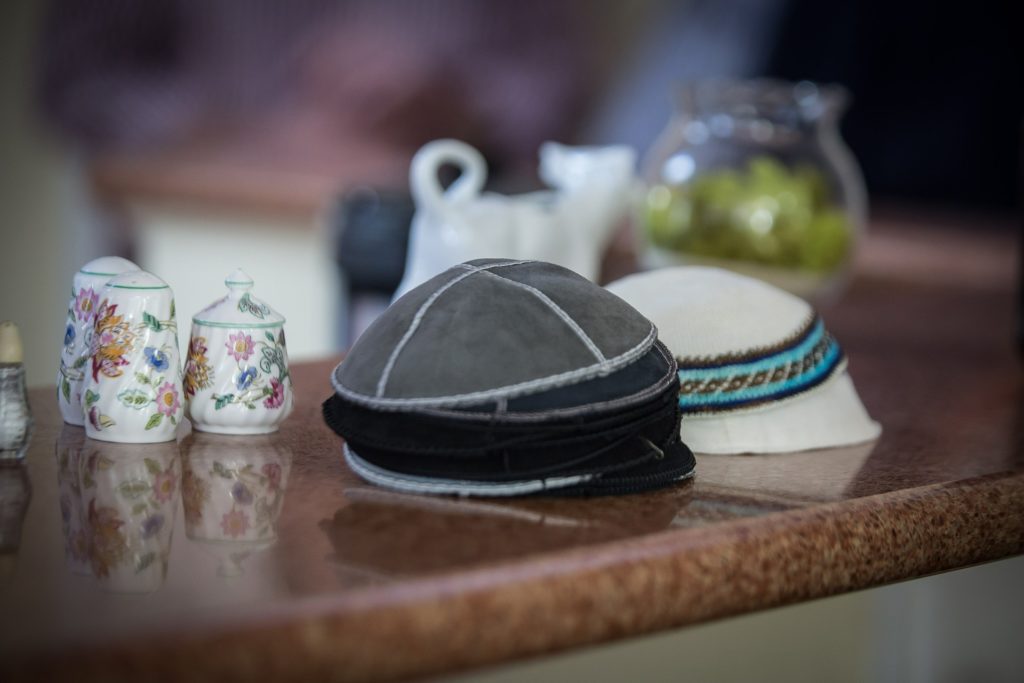
It’s Time to Take Back the Kippah

The same day that The Jerusalem Post published a game-changing op-ed by Israeli writer Hen Mazzig under the headline “Reclaiming the Kippah,” news reports circulated of a young man in Bonn, Germany, assaulting a 50-year-old Johns Hopkins University professor in a park, shouting: “No Jews in Germany!” Police respondng to the scene then mistook the professor as the assailant, tackling him and punching him  before putting him in handcuffs.

How did the young man, later identified by police as having “Palestinian roots,” know the professor was Jewish? Because the professor was wearing a kippah.The incident could not have underlined Mazzig’s point more sharply: The kippah — signifying our identity as Jews — has been taken away from us. It’s well past time to take it back. 

“To wear a kippah is to publicly declare yourself as a member of a hated minority,” Mazzig wrote. “Our people were always told to be ashamed of something: who we are, our religion, our attire, even the fact that we have national aspirations. … For centuries, [the kippah] distinguished Jews from non-Jews, and at various points in history became one of the strongest symbols of Jewish courage and pride.”

Mazzig is calling for that moment again, not as a provocation but rather as self-identification, when our identity again is being used against us.

Mazzig is not religious. He doesn’t keep Shabbat, and he eats non-kosher food. “But I most certainly am a Jew; I am proud to be a Jew and I am proud to identify as a Jew.”

At a time of in-your-face identity politics, the kippah is subtle, quiet and dignified. The kippah whispers. It has no need to be brash or seek outside validation. And yet its capacity to stir the soul is profound.

Mazzig wants to reclaim the kippah not just from anti-Semites, but also from strict Orthodox Jews, who equate it with following all 613 mitzvot. “Wearing a kippah should not be a symbol of allegiance to a particular sect of Judaism,” Mazzig wrote, “but a symbol of solidarity with one of the most historically oppressed people on earth.”

The kippah has no need to be brash or seek outside validation.

I understand that observant Jews may not embrace Mazzig’s mission as easily as I have. But we are at a particular moment, with anti-Semitism spiking and young Jews in the Diaspora disconnecting. This is a moment to look at the larger picture, and I think Mazzig is onto something.

As a gay Jew who travels the world to speak about Israel, Mazzig believes that wearing a kippah can help teach tolerance and acceptance. “We can be ambassadors for our people, in everything we do, by identifying as proud Jews,” Mazzig wrote.

Mazzig acknowledges that wearing a kippah can be dangerous. “While I do not plan to walk down the streets of France with a kippah, I do want to be visible. I often speak about how we should be proud to be Jews, but it is easy to say that when I look Arab,” wrote Mazzig, whose mother is from Iraq and whose father is a Berber from Tunisia. “With a kippah, I am truly practicing what I preach.”  

The kippah as ethnic symbol is a subtle, dignified way for us to reclaim our identity while many are intent on erasing it. I’ve worn my grandmother’s delicate Star of David around my neck for years. When I lived in Washington, D.C., I felt a strong need to wear it on the outside of my shirt, to be seen and accepted as a Jew in a very un-Jewish city.

In New York, I typically keep it hidden. In the past, I did that because New York is so Jewish, I felt no need to show it. But I will be honest: I now don’t feel entirely safe showing it. I’ve bought Israel Defense Forces shirts for my son but let him wear them only inside our apartment. Would I love for him to wear a kippah? Absolutely. Would I be nervous? Absolutely.

But this is where Mazzig’s mission comes in. What if all of the Jewish men in New York wore kippahs? What a beautiful unity — a sacred bond — that would create.

Throughout our history, Jews have been told who we are, leading to every possible tragedy. Enough. We are indigenous to the land of Israel, and we are no longer going to be used as scapegoats, even by our own people. 

The small, elegant kippah can play the role it was perhaps meant to play: keeping us connected, both to God and one another, when every attempt is being made to tear us apart.


Karen Lehrman Bloch is an author and cultural critic.

It’s Time to Take Back the Kippah Read More »

Thinking About Thinking

I have these awkward moments in my office when someone will walk in and see me doing absolutely nothing. I’m not looking at a computer screen or texting or reading a paper or making deals on the phone. I’m just sitting there — thinking.

I think all the time. The world is so chaotic, our community is so diverse and complicated, I can’t imagine how I would do my job without these bouts of deep reflection.

The problem is, thinking is getting harder and harder to do. My Twitter feed, for example, keeps getting in the way. If it’s on, I’m constantly distracted. If it’s off, I’m stressed that I’ll be missing something.

Even worse, I’m now expected to contribute to this digital flow of interruptions. I’m expected to send out tweets all day long.

This doesn’t come naturally to me. I guess you pick up certain habits when you write a weekly column for 12 years. I use the week to think about the column, consider different ideas, research, craft, edit, publish and then start over again for the next week. This is a far cry from blasting a tweet on a minute’s notice.

If the soul of the Twitter world is reaction, the soul of a weekly paper is reflection. In a sense, the paper is a reminder of the value of thinking.

Thinking is an art, and it’s worth thinking about it. Our thoughts shape our actions. Our thoughts have the power to temper our most destructive emotions. When we just react, we forego the power of thought.

We live in a world that wants us to react, rather than think. This is a form of mind control. Advertisers have always understood this.  

We live in a world that wants us to react, rather than think. This is a form of mind control. Advertisers have always understood this. The seducer doesn’t want you to think, evaluate, reflect. He wants to trigger a reaction, an impulse. First an impulse to like and then an impulse to buy.

The social media revolution has turned everyone into an advertiser. Every tweet, every image, every post is an attempt to trigger a reaction. This is the ideal environment to obliterate deep thought.

My favorite speakers are those who make me think and make me ask questions. The problem is there’s no money in questions. The money is in the answers. All those sharp pundits on CNN, MSNBC and Fox would never be there if they weren’t bursting with answers. Producers don’t look for reflective thinkers; they look for clever speakers with quick answers.

If you’re looking for deep thought on television, you’ll have to watch old episodes of “Firing Line” with William F. Buckley Jr. I’m addicted to these shows. Because when intelligent opinions clash, the viewer is forced to think through the issues. It’s a mental exercise. It asks us to slow down and think.

Is there anything in today’s world that asks us to slow down and think?

In the Jewish tradition, of course, there is Shabbat, which Rabbi Abraham Joshua Heschel calls “a cathedral in time.”

“He who wants to enter the holiness of the day must first lay down the profanity of clattering commerce, of being yoked to toil,” Heschel writes in “The Sabbath.” “He must go away from the screech of dissonant days, from the nervousness and fury of acquisitiveness and the betrayal in embezzling his own life.”

When we find the space to think, we can reflect on what kind of thoughts will enrich our lives.

Shabbat symbolizes the creation of the space we need to slow down and reflect. If we don’t go out of our way to create that space, the fury of the digital world will take over. Our impulses will guide us.

When we find the space to think, we can reflect on what kind of thoughts will enrich our lives. We will be mindful of what thoughts bring us down and what thoughts uplift us; what thoughts paralyze us and what thoughts move us forward. We will be more likely to think through the consequences of our words and actions.

Creating “Shabbat moments” of quiet reflection during our hectic days can help keep us balanced. These little timeouts for deep thought can nourish our souls. 

And yet, we seem to be intimidated by silence. We walk the streets wearing our earphones, listening to music; we drive around listening to podcasts; we live our lives glued to noisy screens.

Silence is one of the ingredients for deep thought, but it’s not the only one. I do some of my best thinking walking around the Jewish Journal’s noisy and fascinating neighborhood of Koreatown. I’m not sure why that helps me think.

But now that I think of it, maybe it’s because I’m looking at humanity rather than just sitting alone in my office.


Follow David Suissa on Twitter: @suissatweets

Thinking About Thinking Read More »

Local Kosher Café Faces Boycotts, Anti-Semitic Slurs Because Owner Is Trump Supporter

Asher Caffe and Lounge opened its doors in Boyle Heights for the first time on July 12 and was greeted with protests and chants of anti-Semitic slurs because the kosher restaurant’s owner is a supporter of President Trump.

Asher Shalom, the owner of the restaurant, shared a Facebook post from a Donald Trump fan page that stated, “I wish Democrats would fight as hard for Americans as they do for illegals.” He also shared a post from someone named Garth Limburg that read, “We bring people from sh*thole countries because sh*thole Democrats need sh*thole votes so they can turn America into a sh*hole.”

Additionally, Shalom re-tweeted a February 2017 tweet from Trump that read, “Our legal system is broken! ‘77% of our refugees allowed into the U.S. since travel reprieve hail from seven suspect countries!’ (WT) SO DANGEROUS!”

These posts led a group called Defend Boyle Heights, which hails itself as “an anti-gentrification coalition,” to advocate a boycott against the restaurant due to their “anti-immigrant” owner.

“We already know the dangers the Gentry bring to our communities with their trigger happy hands to call the cops on regular hood sh*t,” Defend Boyle Heights wrote on Facebook. “Now we have #GentryTrumpSupporters and make money off the communities they hate so much! F*CK ‘EM!”

When they learned of the exact timing of the restaurant’s opening, Defend Boyle Heights wrote in another Facebook post, “Show up tomorrow and let them know that the Gentry Trump Supporters are NOT welcomed in our hood in any creative way you please!!!” They also referred to Shalom as a “xenophobe.”

Shalom’s son, David, told The Daily Wire that they faced “anti-Semitic slurs” as well as “pro-Palestinian chants” during the protests. The protests also consisted of chants of “these racists have got to go” and “Gentry, get the f*ck out” as well as protesters harassing restaurant customers with cries of “Shame!”

Here are a couple of videos sent to the Journal from the boycotts:

Additionally, the Boyle Heights Chamber of Commerce revoked Shalom’s membership to their organization and also called for a boycott.

Shalom responded to the criticism with a statement that he immigrated to America 30 years ago and that several of his employees are immigrants.

“I believe that all people should be treated with humanity, dignity and respect – there is no hate tolerated at Asher Caffè & Lounge,” Shalom said. “It has always been my vision to create a communal space for Boyle Heights where family, friends and colleagues can come together over good food and to celebrate what makes our community so great.”

Currently, the restaurant has a three-star rating on Yelp. While there were plenty of posts alleging that Shalom is a “racist” and a “xenophobe” for supporting Trump, others were complimentary of the restaurant.

“A nice grab and go place with helpful staff, and pretty décor,” Yelp user named Queen R. wrote. “Also if you can’t find parking- they bring it to your car!!! This was perhaps the most amazing thing.”

Another user named Ayton A. wrote, “Love having another great kosher option to eat near my office in DTLA. The place is conveniently located & has ample parking. The food is excellent and the service is great. My favorite is the shakshuka and the Margherita flatbread.”

Local Kosher Café Faces Boycotts, Anti-Semitic Slurs Because Owner Is Trump Supporter Read More »

Week of July 20, 2018

Week of July 20, 2018 Read More »