fbpx

July 18, 2018

Jewish Groups Slam Zuckerberg for Refusing to Take Down Holocaust Denial Content from Facebook

Facebook CEO Mark Zuckerberg said in a recent interview that while he finds Holocaust denial content posted on Facebook to be disgusting, the social media platform will not remove such content, resulting in blowback from Jewish organizations.

Zuckerberg was asked by ReCode’s Kara Swisher in a July 18 interview if he would take down conspiracy-theory content such as what is promulgated by the Infowars website. Zuckerberg replied by saying that Facebook would take down content that results in violence. He then turned to Holocaust deniers to illustrate his reasoning.

“I’m Jewish, and there’s a set of people who deny that the Holocaust happened,” Zuckerberg said. “I find that deeply offensive. But at the end of the day, I don’t believe that our platform should take that down because I think there are things that different people get wrong. I don’t think that they’re intentionally getting it wrong.”

Swisher interjected by stating that Holocaust may actually be intentionally getting it wrong, prompting Zuckerberg to respond by noting that it’s difficult to prove intent

“The reality is also that I get things wrong when I speak publicly,” Zuckerberg said. “I’m sure you do. I’m sure a lot of leaders and public figures we respect do too, and I just don’t think that it is the right thing to say, ‘We’re going to take someone off the platform if they get things wrong, even multiple times.’”

Zuckerberg added that instead, such content just wouldn’t be widely promulgated by Facebook’s algorithms.

The Facebook CEO’s comments resulted in backlash from Jewish organizations. Simon Wiesenthal Center Associate Dean Abraham Cooper said in a statement that Facebook officials told the Simon Wiesenthal Center in 2009 that Holocaust denial content would be removed from the platform.

“Holocaust denial is the quintessential ‘fake news,’” Cooper said. “The Nazi Holocaust is the most documented atrocity in history, allowing the canard of Holocaust denial to be posted on Facebook, or any other social media platform cannot be justified in the name of  ‘free exchange of ideas’ when the idea itself is based on a falsehood.”

Anti-Defamation League (ADL) CEO Jonathan Greenblatt said in a statement, “Holocaust denial is a willful, deliberate and longstanding deception tactic by anti-Semites that is incontrovertibly hateful, hurtful, and threatening to Jews. Facebook has a moral and ethical obligation not to allow its dissemination. ADL will continue to challenge Facebook on this position and call on them to regard Holocaust denial as a violation of their community guidelines.”

In response to the blowback, Zuckerberg sent a statement to Swisher that read, “I personally find Holocaust denial deeply offensive, and I absolutely didn’t intend to defend the intent of people who deny that.”

Facebook has also issued a statement doubling down on their policy.

“Reducing the distribution of misinformation—rather than removing it outright—strikes the right balance between free expression and a safe and authentic community,” the company said. “There are certain forms of misinformation that have contributed to physical harm, and we are making a policy change which will enable us to take that type of content down.”

Jewish Groups Slam Zuckerberg for Refusing to Take Down Holocaust Denial Content from Facebook Read More »

Swedish Parliament Candidate: Israel Should Deport All Jews to the U.S.

A woman running for Swedish parliament said in a recent interview that her “fantasy” is for all the Jews in Israel to be deported to the United States.

Feminist Initiative Party candidate Oldoz Javid told the Feministiskt Perspektiv in a July 13 interview that Israel caused “people to flee from their own homes, taking their land and stolen their livelihood and freedom.”

Therefore, Javid suggested her “fantasy-based solution” to the matter.

“Israel’s best friend is the United States, another infernal regime with vastly large land areas,” Javid said. “So why not invite their friends over to their land and make room for them on the farm?” They seem to enjoy each other’s company. And the Palestinians can live in peace and again build up the country that once was theirs. I can allow myself at least [to] get [to] a dream about such a solution, right?”

Javid later asked Feministiskt Perspektiv to remove that portion of the interview, claiming that it would be misconstrued as anti-Semitic.

She is already under fire for her comments.

“Here’s [an] inconvenient fact for Swedish politician fantasizing deporting Israelis to US so Palestinians can get ‘their’ land back,” Rabbi Abraham Cooper said in a statement sent to the Journal, “Jewish people have [a] 3,500 year history in their land. What were Swedes doing when Israelis gathered in Solomon’s Temple in 800 BCE? Vikings showed up [in] 800 AD.”

Swedish pro-Israel activist and writer Annika Henroth-Bernstein wrote on Facebook that Javid’s fantasy sounded “like a final solution to me.”

Anti-Semitism is a serious problem in Sweden; for instance, in December 2017 a group of men threw Molotov cocktails at a Swedish synagogue that was hosting a Hanukkah party. Two-hundred protesters in Malmo hurled anti-Semitic slurs after President Trump recognized Jerusalem as the capital of Israel.

As a 2017 New York Times op-ed noted, synagogues and Jewish day schools have to be heavily armed and secured and Jews don’t feel safe adorning Stars of David around their neck.

Swedish Parliament Candidate: Israel Should Deport All Jews to the U.S. Read More »

Rob Long and David Suissa

Rob Long: Hollywood Writer Talks Trump

[iframe style=”border:none” src=”//html5-player.libsyn.com/embed/episode/id/6826704/height/100/width/480/thumbnail/yes/render-playlist/no/theme/custom/tdest_id/689387/custom-color/dfdfdf” height=”100″ width=”480″ scrolling=”no” allowfullscreen webkitallowfullscreen mozallowfullscreen oallowfullscreen msallowfullscreen]

Award-winning Hollywood showrunner Rob Long talks about happiness, craziness and, of course, Donald Trump.

Follow Rob and Ricochet on Twitter 

Check out this episode!

Rob Long: Hollywood Writer Talks Trump Read More »

Who Killed Raphael’s Son? Part 3

Editor’s note: This is the second of a five-part excerpt from the novel “The Luminous Heart of Jonah S.” by Gina Nahai published by Akashic Books.


The witness — bald with sunburned scalp, a long, oval face, and a blind right eye — was George P. Carter III, a.k.a. the Altoid Man. Something of a West L.A. institution, he had appeared on the scene in the mid-2000s—a tall, slim, and elegant figure with a closed eye and an affinity for spotless white sweaters and crisply pressed tan or light-gray pants. At the time, he was a PhD student at UCLA, had a Culver City address, and a seven-day-a-week surfing habit in Paradise Cove in Malibu. 

Then one morning he showed up on the corner of Santa Monica Boulevard and Whittier Drive, across the street from the Beverly Hilton Hotel—the preferred venue for many a charity dinner, million-dollar bar mitzvah, and, throughout that decade, numerous Oscar luncheons—holding up a sign that read, LAPD BLINDED MY EYE AND REFUSES TO APOLOGIZE OR PAY FOR IT.

The sign’s fine print described a weekend altercation between him and the police: he was driving in the area—the border between Beverly Hills and Century City — and the cops pulled him over for no reason; he objected, since “we don’t live in North Korea,” so they beat him, blinded his eye, and took him to jail. Afterward, they wouldn’t even apologize.

He appeared so sophisticated and held the sign with such dogged earnestness, he managed to slow down the already-excruciating traffic on the corner.

Below the fine print, a larger-type font declared that George P. Carter III was not homeless or hungry, didn’t want motorists’ money or their expressions of pity. He wanted “justice” for himself, compensation for his eye, and an apology from the police chief, the mayor, and the president of the police commission.

He got a lot of curious stares, a few people honking their horns and giving him a thumbs-up, but no reaction from the police. So he returned the next day.

Monday through Friday for the next five or six years, the Altoid Man arrived at his post on the seven a.m. bus and stayed exactly twelve hours. Every ten minutes or so he would put the sign down, reach into his pocket, and retrieve a box of “original” Altoids, pop one in his mouth, and resume his stance. He took a half-hour lunch break at noon, and sat out the weekends when the traffic on his corner was light. Over the years his appearance showed signs of attrition. He grew increasingly thin and disheveled, his clothes became ragged and dirty, and his sign turned weather-beaten and nearly illegible — but he never gave up his Altoid habit or his steadfast demand for reparations from the LAPD.

In time, he and his sign faded like celluloid figures off a black-and-white reel; he became just another angry soul riding the buses and wandering the streets of L.A., but he never stopped fighting the good fight. Just in case he was attacked by the police again, he carried a disposable camera in his pants pocket and pulled it out every time a cruiser slowed down or stopped near him.

He told Leon he had been riding the 4 bus from downtown to the beach, which was what he always did, going back and forth all night to avoid sleeping on the street, where he’d be vulnerable to “more police brutality,” or in a shelter, where the company was intolerable “since I don’t drink, do drugs, or speak Spanish or Ebonics.” He’d had to get off the bus at two a.m. to fulfill a pressing urge, “and I don’t mean just pissing.”

He liked Mapleton for that purpose, he explained, because there was a large construction site not too far away from Sunset. From there, he had seen “everything, I can give you minute-by-minute details, but fuck you if you think I’m gonna tell you a fucking thing without first getting my dues from the fucking LAPD.”

“I don’t care what it looks like,” Leon told O’Donnell in his office. “The wife might have helped him escape, but she didn’t kill him.”

There were only two chairs in O’Donnell’s office — an ergonomic executive desk chair for him, and a metal-framed, no-seat-pad or armrests, sorry-excuse-for-a-seating-implement for guests. The latter was so narrow, it barely contained the entirety of Leon’s frame.

Leon wiggled on the chair until he felt semi steady, then assumed a “this is a teachable moment” tone and attempted to bring his boss up to date.

Forget, for a second, that Neda was half Raphael’s Son’s weight, with bird bones and not enough strength to lift a ten-pound dumbbell above her head at the gym; that even if surprised, Raphael’s Son could have crushed her forearm with one hand. Forget, also, that she didn’t have a single nick or cut on any of her fingers; that she had endured nearly eighteen years of living with Raphael’s Son and had no special reason to want to be rid of him now. Or that, with him dead, she would have been poor by the standards to which she was accustomed: Raphael’s Son had no life insurance, and had not kept a written record of where his assets were hidden. And, of course, forget that there was no body and no weapon, no witnesses or other clues.

Leon’s gut told him that Raphael’s Son was not dead. He was just hiding somewhere with the money. He had staged the “accident” and coached Neda to report seeing him bloody and lifeless so he would be declared dead, the case against him abandoned, his creditors giving up on trying to recoup any of their assets, and he could go right on cheating helpless old widows into ripe old age. Even assuming he was dead, however, there was no chance — none at all — that Neda was the killer.

“The fact is,” he explained to O’Donnell, “Iranian Jewish women do not kill.” Even if they did — and they don’t — they would not kill their husband. 

Leon’s gut told him that Raphael’s Son was not dead. He was just hiding somewhere with the money.

It’s true some things have changed for Iranian women since they came to the United States. Cheating on one’s husband, which was rare to nearly nonexistent, is no longer out of the question. But having a nice, quiet affair with a friend’s husband in Bel Air while your own spouse is off chasing hookers in Southeast Asia is not nearly the same thing as sending the man to his grave. In America, Iranian women have reached a milestone or two. They have become brain surgeons and CEOs, renowned artists and engineers and architects, but killers they were not and will never be.

“I would go on,” Leon concluded his lecture, “but I see you’re pressed for time.”

O’Donnell had checked his watch three times in the last three minutes. He checked it again and said, “Well, that’s the biggest bunch of bullshit I’ve heard all day.”

The last person to see Raphael’s Son alive, assuming one believed Neda’s story of having found him dead in his car, was his bookkeeper and personal slave, Edward Araxamian, in the Century City offices of Soleyman Enterprises on the evening of Monday, June 24, 2013. The building’s security cameras and sign-in log showed him arriving at work that Tuesday morning at 9:40 a.m., and leaving nearly fourteen hours later, at 11:30 p.m. In between (this according to the hallway and elevator cameras), Araxamian had taken eight bathroom breaks (he had an overactive bladder fueled by a constant stream of Turkish coffee which he made on a camping stove in the office kitchen), thirteen cigarette breaks (he also had a long-standing death wish that became more urgent the longer he worked for Raphael’s Son), and one lunch break (he bought a stale bagel from the Starbucks in the building lobby, took three bites, threw it away, and smoked two Marlboros instead). His key card had been scanned in the building’s parking structure at 11:34, and his image had been captured behind the wheel of the ancient blue Volvo station wagon he had bought in Orange County from a beautiful middle-aged woman named Marilyn; she had told him she was a poet and introduced him to her cat, and then she had voluntarily knocked off $1,000 from the asking price of the car “because I sense you’re under pressure.” She was right, if “under pressure” means wanting to set himself or someone else on fire several times a day.

From the outside, the apartment building where Eddy lived appeared condemned and uninhabited. There were no balconies, and the windows had to remain closed to keep out the noise and pollution of the freeway, and because the frames would bend and stick too often. The intercom was left over from the ’70s. There were no names or apartment numbers next to the rows of buttons, probably because most of the tenants were in the country illegally and did not wish to be found.

Leon parked his car at the 7-Eleven across from the building and dialed Eddy’s number. The phone was turned off, probably to avoid the rush of callers fishing for information about the case, his voicemail full. But the Bengali who owned the 7-Eleven told Leon that Eddy was home. The Bengali’s wife was Eddy’s mother’s emergency contact: bedridden and barely able to use the phone, the mother spent the entire day alone while Eddy was at work. The 7-Eleven was open twenty-four hours, and Eddy checked in with the Bengalis every time he left or returned home.

“I’m very worried,” the husband told Leon when he inquired about Eddy. “He’s never missed work before.”

In the front vestibule, the elevator, such as it was, had been broken since the day it was installed, so Leon climbed up three flights. He had to knock three times before a man’s voice invited him to “get lost.” Then he had to identify himself and threaten to keep knocking till the door fell open.

Edward Araxamian, a.k.a. Eddy Arax, Caucasian male, 5 feet 11 and 143 pounds, suffering from high blood pressure, arrhythmia, major depression, and post-traumatic stress disorder, lived with his sixty-eight-year-old, ailing, legally blind mother in a one-bedroom apartment in a three-story gray cement building one block down from the San Fernando Road exit off Route 134 in Glendale. His was not the Glendale of the twenty-first century, with its megamalls and overpriced sushi bars, Armenian-owned Persian bakeries with rows of marzipan in forty-two colors displayed in the window, and the original kebob place — an outdoor restaurant owned by an Armenian named Raffi that served only rice and kebob, none of the “Royal Persian Cuisine” of Westwood and Beverly Hills. Where Eddy lived, the landlord was an Armenian from the former Soviet Union (not to be confused with Armenians from Iran, since there’s a lot of bad blood between the two factions: the Iranians are gentle, law-abiding citizens; they’ll tell you that Soviet Armenians are thieves and cutthroats who give their people a bad name). Rent was collected every two weeks, in cash, and never claimed on a tax return. City inspectors — Latinos, for the most part, who depended on the generosity of the landlord to afford luxury cars for their wives — vouched for the safety of the building, sight unseen.

Eddy was a good and honest man with an astonishing memory, but he had no high school or college degree, and wasn’t trained to do anything except smoke and drink Turkish coffee. He was also adept at dodging bombs and sidestepping land mines, which he had learned by “serving” the Islamic Republic for three long years in the Iran-Iraq War until he nearly died from the effects of one of Saddam’s dirty bombs and received a medical discharge; but Los Angeles wasn’t exactly rife with demand for such skills. He spoke Persian with a heavy Armenian accent, and his English was elementary at best. He did, however, have command of a good number of words in Bengali.

These language issues aside, Eddy was in the United States on a tourist visa that had expired six years earlier. Back then, he had spent a year looking for a bookkeeping job, but no American with two pennies in his corporate account was willing to trust a person who, when asked where he obtained his license, named a school that did not exist. The Iranian business owners he approached for jobs did not hold his immigration status against him; they were, after all, recent refugees themselves. What kept them from hiring him was that they couldn’t bear to look at his face.

Thanks to Saddam’s dirty bomb, Eddy’s face, neck, and hands were a patchwork of light skin mottled with large yellowish-brown blotches. On the right side, his upper jawbone had crumbled, so that the flesh of his cheek hung limply between his nose and ear, like plastic that had melted and cooled. On the left, his cheek had caved in because he had lost all his molars. The skin on his forehead was crumpled, and the front part of his scalp was all scar tissue. The only part of the face that had remained intact were his eyes, and these, anyone who looked at him long enough would see, were bottomless holes of sadness.

It was the sadness, and the fact that he couldn’t read or write English, didn’t have a driver’s license, and radiated cigarette smoke, that prevented other Iranians from hiring him for an accounting job. They did, however, want very much to help Eddy, so they handed him “a small offering” — a hundred dollar bill, maybe, for his troubles. They might as well have spat on his father’s grave.

The apartment was small, and smelled like laundry detergent and fabric softener. An ugly brown leather couch doubled as Eddy’s bed. A round glass table, the kind sold in the small Korean-owned stores up and down Venice and Robertson Boulevards, functioned as dining table and desk. There was an ancient TV perched atop the arms of a dining chair, and a three-drawer plywood dresser, painted a faint pink with white plastic knobs, that leaned against the part of the wall closest to the kitchen area. The dresser looked like it had been salvaged from a little girl’s room and purchased in a yard sale. The kitchen consisted of a two-burner portable stove, a narrow refrigerator, and a washer and dryer all crammed into an alcove with a sink. The stove and a carving board sat on top of the washer and dryer; the top of the dresser served as storage space for cooking utensils and condiments. Eddy himself looked like he had had one Turkish coffee too many that day.

“So what’s going on?” Leon said as he searched around for a place to sit. “Where’re you hiding him?”

Eddy was not amused. “I already talked to the American cop.”

“Who? O’Donnell?”

“Whatever his name is. And some Armenian woman called too, but I told her to fuck off.”

“But you don’t mind if we talk,” Leon said, apparently without irony. That showed what a lousy detective he was: you had only to see the way Eddy cringed at the very sight of Leon to realize just how much he did mind.

In the bedroom behind Eddy, a woman moaned pitifully every few seconds.

“Go ahead,” Leon nodded toward the door. “I’ll wait.”

Instead, Eddy headed to the “kitchen.”

“So is he dead or not?” he asked with obviously feigned indifference.

“What do you think?” Leon tested.

The lab had determined that there was only one person’s blood in the car, and that it was Raphael’s Son’s. The coroner had decided there was too much of it for Raphael’s Son to have survived without an immediate and extensive transfusion. The forensic team had yet to find a single trace of the man anywhere outside the car.

There was the moan again. Eddy sighed and rubbed his left eye with his fist.

“What the fuck do I know?” 

“If he’s dead, and you were the last to see him, I’d say you may know a great deal.” Eddy’s face flared with rage. “I hope he burns in hell, is what I know.”

The rawness of the statement sent a shiver up Leon’s spine. He tried hard not to look away from Eddy.

Eddy started to mash a cooked apple with the flat side of a fork. Cautiously, because it appeared too old and unstable to support his weight, Leon sat down on the arm of Eddy’s sofa bed.

“So you do believe he’s dead.”

Eddy opened a twelve-section, seven-layer pill container and took out a capsule, opened it, and poured the contents over the mashed apple.

“This thing tastes like poison,” he said, mixing the powder much too forcefully and making sure he looked only at the plate. He added some sugar and what looked to Leon like chocolate powder, crushed the paste some more, then finally picked up the plate and a teaspoon.

“I have to feed her this,” he said as he walked past Leon. Two steps later he stopped, let out what sounded like an ironic laugh, and peered back at Leon.

“I don’t know if he’s alive or dead,” he said, “but if he’s dead, I’m willing to swear the Riffraff did it.”

To be continued.

Who Killed Raphael’s Son? Part 3 Read More »

A ‘Touching’ Moment

After I spoke on a panel, the panel’s moderator stood behind me, reiterating the point I’d just made, while resting his palm on the top of my shoulder, his fingers extending to my clavicle. It was public. It wasn’t sexual. It wasn’t malevolent. It wasn’t a grope, assault or abuse. And it certainly wasn’t rape. God forbid that it is any of those things for me or anyone, ever. But it was utterly unnecessary. And it made me uncomfortable. 

Instead of owning my discomfort, I made excuses. This was no big deal. He held no power, no ability to inflict physical or professional harm. It was generational: The intent was avuncular or paternal, even if it felt patronizing and invasive. It was vestigial discomfort from messages I received about touch in Orthodox Jewish schools. It was my inner New Yorker, dormant after a decade of California grooviness, awakening to someone touching me unexpectedly from behind. So if it wasn’t “wrong,” then why did it feel that way? 

Talking with friends about sexual harassment, the imbalance of power and lack of gender equity in the Jewish community is a regular conversation for me. Whether it’s equal pay or equal representation, these discussions are multinational and local, playing out against the greater conversations around #MeToo, chronicling sexual harassment and assault, and Time’s Up, a call to expand opportunities for women, to “join the resistance” and “smash the patriarchy.” 

From rabbinic times to present day, men have owned most Jewish leadership positions. And even in a moment that’s tuned in to the conversation on gender equality, the Forward’s 2017 salary survey of Jewish communal organizations’ leadership shows only eight women listed in the top 56. As “Yael,” a former Jewish nonprofit professional, told me, women in Jewish organizations “know we’re there to service these men, stroke their egos, be the good girls and make sure they get what they need.” This expectation validates the status quo: men lead, women support. 

Talking with friends about sexual harassment, the imbalance of power and lack of gender equity in the Jewish community is a regular conversation for me.

With this hierarchy so systemic, power is consequently at an imbalance. Yael was in her 20s when her supervisor, 25 years her senior, would comment on her body, make her uncomfortable by touching her arm, and “go up to the line but didn’t really cross it.” She struggled with infertility; her boss suggested it was because the sex wasn’t good. But he was also a father figure who “made me feel cared for as a person and as a professional. … If I could shunt off the creepy stuff, it would be great. In the Jewish community, boundaries are down and everyone acts like they’re related, anyway. He took advantage of that intimacy and lack of boundaries.” 

If Jewish organizations and institutions operate on the perception that we’re all family, why shouldn’t we all be able to show blunt appreciation and affection that sometimes feels smothering or oppressive? Because, family often comes with complicated emotions attached, but that’s not something everyone wants in their workplace.

Think about the role of touch in your professional environment: showing closeness, expressing support or bridging a conflict. “Job well done!” — handshake, high-five or fist bump. “So great seeing you again!” — hug, back slap, European air kiss. “I’m so sorry for your loss” — handshake, embrace, hand on shoulder to impart strength.

Touch asserts dominance; a person with more status can touch one with less. The #MeToo label includes stories of assault but also of lack of respect and abuse of power in the workplace. 

Touch is valuable and powerful, but how that physical contact is received is situational. A hug from your sibling isn’t the same as a hug from a colleague. When my mother died, some embraces healed, others hurt; on Sept. 11, 2001, I accepted contact from just about anyone. And with shomer negiah (abstaining from touching the opposite sex) a value for some in our community, we should think twice before reaching out to touch someone.

The complication around touch predates any hashtag; in the time of #MeToo and Time’s Up, being in the Jewish communal workspace adds a layer to an already complicated conversational space. In this reactive world, it’s worth taking a beat before we reach out and touch someone, not because we’re afraid of litigation but because touch is too powerful to be used irresponsibly.

A ‘Touching’ Moment Read More »

A Moment in Time: Are You Willing and Able to Help?

Dear all,
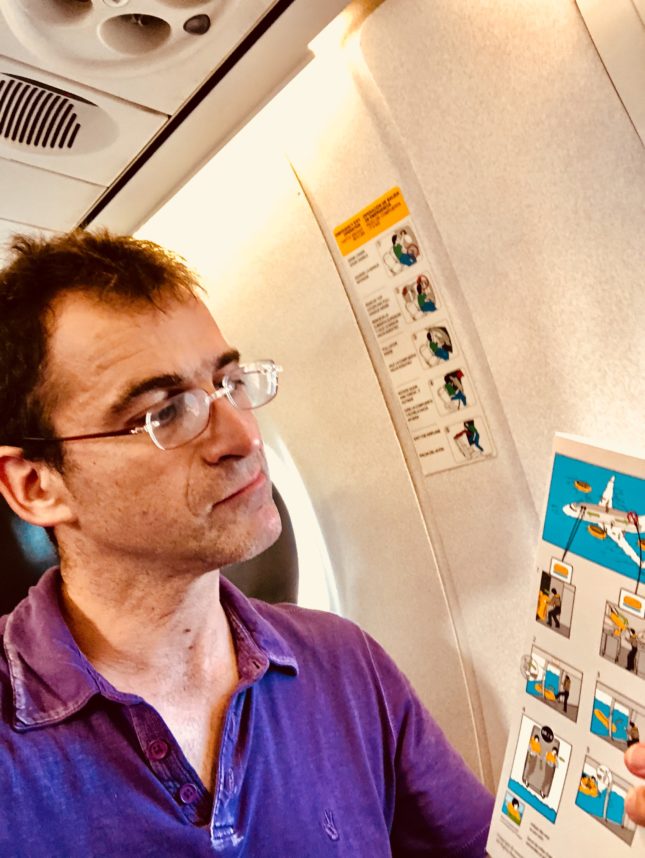
I was seated in the exit row when the flight attendant introduced herself and asked, “Are you willing and able to help in case of an emergency?”  I responded affirmatively and then perused the emergency procedures.
Are you willing and able to help?
Imagine if this question were set as a reminder on your calendar each day.
Who in your home needs help?
Who in your neighborhood needs help?
Who in your community needs help?
Who in your extended family needs help?
Who in our world needs help?
Be the person who is willing to help.  Be the person who strengthens those around you.   And if you aren’t sure what to do, peruse this emergency procedure:
If your brother falls low, and his hand falters beside you, then you shall strengthen him (sojourner or resident alike)” (Lev. 25:35)
Be the strength.  Be the hand.
Be there.
At any given moment in time.
With love and shalom,
Rabbi Zach Shapiro
Rabbi Zach Shapiro
A change in perspective can shift the focus of our day – and even our lives.  We have an opportunity to harness “a moment in time,” allowing our souls to be both grounded and lifted.  This blog shows how the simplest of daily experiences can become the most meaningful of life’s blessings.  All it takes is a moment in time.
 
Rabbi Zach Shapiro is the Spiritual Leader of Temple Akiba of Culver City, a Reform Jewish Congregation in California.  He earned his B.A. in Spanish from Colby College in 1992, and his M.A.H.L. from HUC-JIR in 1996.  He was ordained from HUC-JIR – Cincinnati, in 1997.  He was appointed to the HUC-JIR Board of Governors in 2018.

A Moment in Time: Are You Willing and Able to Help? Read More »

Living the High Life: Ron Silver and His Three Bubbes

I admit to being one of those New Yorkers with a bad attitude toward change. Not only do I dislike change in general, but when it comes to my adopted city, I’m gutted every time I return to find my old neighborhood restaurants have closed, changed hands — or even if they have redecorated. As a chef, I like consistency and simple, sure things, and I’m sensitive to red flags on a menu that I perceive as “hipster” items that threaten my nostalgic feelings about a place.

So imagine how much I expected to hate the Bubby’s “new” location (it opened five years ago) at the entrance to the High Line park in the meatpacking district. How could this imposter Bubby’s possibly live up to the memories I had created 20 years ago at its original Tribeca location, a brunch spot that may as well have been an extension of my living room when I lived downtown? 

But I needn’t have worried because chef, restaurateur and Bubby’s owner Ron Silver and his competent team oversee every aspect of his restaurants and are still at the top of their game. Bubby’s high-end comfort food joints known for nostalgia-inducing American dishes have- been a staple of the brunch scene in New York for 28 years. I met Silver at Bubby’s High Line location to discuss his restaurants and his latest project, a new company, Azuca, which makes edible cannabis-infused sweeteners and syrups. 

While Bubby’s is famous in New York for its old-fashioned fruit pies, pancakes, flaky biscuits and burgers (read hangover food), what sets it apart from the rest of the commercial food chains’ similar menus is the ingredients it chooses. Everything at Bubby’s is locally sourced from purveyors and farms in the area. From the best butter, lard, local fruits and cream for the pies to its farm-fresh eggs and meat, the quality of the ingredients in a Bubby’s meal is noteworthy, even in a city where customers are spoiled by top-notch produce. 

As it turns out, the affable and absurdly creative Silver has led a life punctuated by a series of stranger-than-fiction chapters that have made him into the success he is today, the first of which happened in childhood. When Silver was very young, his father died and his mother remarried. His stepfather’s mother became his third grandmother. Because he was close to all three bubbes growing up and can’t remember a time he wasn’t influenced by them, this served as the inspiration behind the name of his business, which he opened in his Tribeca neighborhood in 1990. Although none of his bubbes is alive anymore, the walls of his restaurants are adorned with old photographs of them at various stages of their lives, and it seems they’ve been watching over him ever since.

Bubby’s owner Ron Silver and his competent team oversee every aspect of his  restaurants and are still at the top of their game.

In 2003, Silver opened a Bubby’s in Dumbo, Brooklyn. The huge waterfront restaurant was, by his admission, a nightmare from the start. It was busy all the time, and Silver had a hard time managing his bustling Tribeca location with the one in Brooklyn.

To make matters worse, after nine years in the same location, the landlord decided to hike the rent to the point where it was untenable to stay. The eatery made an agreement to end its lease in 2012, and Bubby’s had a huge blowout closing party and left its Dumbo location for the final time.

The day after the closing party, Brooklyn’s waterfront neighborhoods were hit hard by Hurricane Sandy, inundating businesses and residences with multiple feet of water and leaving damaging debris and broken glass in her wake. Had Silver remained in that location, the losses he incurred may have put a stop to his plans to open his current restaurant, a fantastic location at the entrance of High Line Park and across from the famed Whitney Museum that is frequented by locals and tourists.

Stranger still, Silver once arrived at his restaurant to find a message that some investors were interested in discussing with him a franchise opportunity —  in Japan. Silver recalls telling his manager to call them back and “tell them to blow me.” He wasn’t trying to be mean, he told me — he was trying to be realistic. After all, no one knows better than a restaurateur that it is no small feat to juggle suppliers, eggs that come from three farms, and all the million other details of his farm-to-table restaurant concept, much less in a country such as Japan, a country with limited agricultural space. 

But the Japanese investors wouldn’t relent. Because Silver is at heart a mensch, he agreed to a meeting with the agent and tried to explain to him, to no avail, that he wasn’t trying to be negative but, practically speaking, he felt it was virtually impossible for a Japanese branch of Bubby’s to succeed without his hands-on knowledge and expertise.

It turns out, the Japanese group of investors was Japanese Railways, which was looking to debut the New York favorite as part of a celebration of the 150th anniversary of the opening of the port of Yokohama to Western trade. In 2009, through a licensing agreement, Bubby’s opened in Yokohama, the first of six Bubby’s to open in Yokohama and Tokyo. Silver told me he goes to Japan about twice a year and, what’s more, his artwork is on display on the walls of all six restaurants there. 

You would think all this activity and being the father of four boys would keep Silver and his wife, Melissa, busy, but this past May, Silver announced the launch of his new company, Azuca, a line of fast-acting cannabis edibles made from chef-quality ingredients. “There have been three constants in my life,” Silver told me in his loft-style office above the restaurant, decorated with his modernist, Picasso-style paintings, “cooking, cannabis use and art.” 

Through his experiences as a chef and entrepreneur, Silver said he recognized the cannabis industry’s demand for a trustworthy edible product that offers a fast-acting, consistent effect.

“Edibles are notoriously unpredictable in their effects: You can never tell how long it will last, when it will hit and its overall effect,” he said. Silver’s talents — part chef, part creative mind — led him to discover a patent-pending technology that alters the shape of the cannabis molecules and makes them more water-soluble, enabling a more rapid, predictable and controllable effect.

Azuca will launch its THC product line and tinctures in Massachusetts (where marijuana is legal) later this month, and offers its hemp-derived, non-psychoactive Cannabidiol (CBD) products at the Bubby’s restaurants in lemonades, coffees, teas and cocktails.

After our interview, I sat at the bar at Bubby’s and ordered two CBD-infused drinks, one called a black and white and the other a watermelon lemonade, each promising 25-milligram doses of CBD. Both were delicious, although I wouldn’t normally sweeten my drinks to this extent as a matter of personal taste. But within 10 minutes of consuming them, I felt a calm feeling come over me that I hadn’t experienced in a very long time. 

There was no “high” to speak of, no rush or buzz, just a very mellow calm that could be described as a post-vigorous exercise (or sex) type endorphin boost.

 Unfortunately, while I waited for my next appointment, I realized that I had a case of the munchies and the fact that everything on the menu looked appealing. It’s at this moment I realized the shrewd business genius of Ron Silver. Maybe it was because I was under the influence of the CBD, or maybe it was the photographs of Silver’s three bubbes staring back at me from the walls, but I’ve never had such a remarkable bowl of chicken soup in any restaurant in New York. No doubt Silver’s bubbes approve.


Yamit Behar Wood, an Israeli-American food and travel writer, is the executive chef at the U.S. Embassy in Kampala, Uganda, and founder of the New York Kitchen Catering Co. 

Living the High Life: Ron Silver and His Three Bubbes Read More »

California Supreme Court Blocks Ballot Measure Splitting CA Into Three States

The California Supreme Court has blocked a measure that would split California into three states from reaching the ballot in November.

While the court hasn’t ruled on the constitutionality of the law, they felt that the law was invalid because “the potential harm in permitting the measure to remain on the ballot outweighs the potential harm in delaying the proposition to a future election.”

The Planning and Conservation League, an environmental group, argued in court that that the measure, Proposition 9, is essentially a constitutional amendment, which would require two-thirds approval from the state legislature or further signatures.

Tim Draper, the tech billionaire who sponsored the initiative, argued that splitting California into three states would provide voters with the opportunity to have more of an electoral impact.

Under Prop 9, California would be split into three states: Northern California, which would include San Francisco, Sacramento and Eureka; Southern California, which would include Fresno, Bakersfield, Orange County and San Diego; and California, which would include Los Angeles, Ventura County, San Luis Obispo and Monterey.

Political analysts believe that California and Northern California would be blue states and Southern California would be a purple state.

Polls indicate that California voters are overwhelmingly opposed to the measure; even if Prop 9 passed it would likely require congressional approval.

California Supreme Court Blocks Ballot Measure Splitting CA Into Three States Read More »

In Praise of Tikkun Olam

It’s almost Tisha b’Av, and along comes Jonathan Neumann’s “To Heal the World?: How the Jewish Left Corrupts Judaism and Endangers Israel.” He makes plain and clear his intent to discredit the American-Jewish focus on social justice, as well as our community’s vocal leaders of the pursuit of justice. 

Mincing no words, Neumann writes, “Since their own faith tradition does not actually commend their politics, these liberal activists have fabricated some fakakta theology of universalism that erodes Jewish fraternity and distances its adherents from Israel, and whose logic culminates in the eradication of the Jewish People and its religion.” Never mind the distinctly progressive character of Jewish institutions in the United States and Israel over the past 100 years, including those who fought for and established the State of Israel: Neumann’s literary contribution is a scathing attack on virtually all of today’s Jewish justice leaders, from Ruth Messinger (who is portrayed as simply wanting to placate anti-Semites by caring more about non-Jews than Jews) and Rabbi Michael Lerner (whose opposition to the “Joshua Tradition” is derided as a rejection of Judaism), to my dear colleagues Rabbis Aryeh Cohen (who Neumann alleges is picking and choosing his Judaism) and Shmuly Yanklowitz (who along with his organization, Uri L’Tzedek, Neumann derides as concerned more with child labor than with undocumented immigrants). 

“Evidently, civil illegality is applicable only when it fits the social justice agenda,” Neumann adds. Scholar Arthur Green, Rabbis Arthur Waskow, Jill Jacobs, Jonah Pesner — Neumann’s work is an encyclopedic collection of virtually every progressive leader — most of them rabbis — portrayed as enemies of the Jewish future. How apropos to read this during this season of communal introspection, the rabbis reminding us that the Temple was destroyed because of sinat chinam, often translated as “gratuitous hatred.” Neumann’s attack against Jewish social justice activists, far beyond polite political disagreement, tempts our community to re-enact the not-so-civil battle that led to the churban, the destruction.

Neumann posits an answer to a nearly unasked question: Is “tikkun olam,” translated poetically as “healing the world,” a foundational stone for Jewish thought and philosophy? Are Jews theologically duty-bound to engage in secular policy change and restructuring the world to protect the most vulnerable? Some say yes, others say no, and even as Neumann surveys the diverse perspectives among progressive rabbis, he mercilessly answers this relatively irrelevant question by pointing to the concept’s largely 20th century reconstruction out of biblical, liturgical, talmudic, midrashic, and mystical concepts.

Instead of questioning the authenticity of Tikkun Olam as a Jewish value, we might ask Neumann why he chooses to attack the most life-sustaining, engaging, inspiring aspect of our unique religious tradition.

His chapter on “The Prophetic Legacy” muddies these voices of conscience, which for centuries served as counterweights to abuse of power by numerous kings and the wealthy. He uses his neocon ally Norman Podhoretz’s term “liberological” to reject the progressive approach to prophecy and instead recasts them as primarily concerned with his own concerns, namely the centrality of ritual and the ills of a lawless society. While not incorrect that they did have such concerns, Neumann denies the fullness of their concerns. Indeed, Rabbi Abraham Joshua Heschel wrote, “[The Prophets’] breathless impatience with injustice may strike us as hysteria. … To the prophets even a minor injustice assumes cosmic proportions. … It seems incongruous and absurd that because of some minor acts of injustice inflicted on the insignificant, powerless poor, the glorious city of Jerusalem should be destroyed and the whole nation go to exile. Did not the prophet magnify the guilt?” 

Neumann even dismisses the notion of the seven Noahide Laws, which our tradition suggests are laws for all of society, asserting that they have unclear relevance. Again, they don’t fit his narrative of a Jewish law code devoted centrally and solely with the future of the Jewish people.

Instead of questioning the authenticity of tikkun olam as a Jewish value, we might ask Neumann, neither rabbi nor Jewish scholar, why he chooses to attack the most life-sustaining, engaging and inspiring aspect of our unique religious tradition, namely our longstanding commitment to protect the most vulnerable members of society? Why does he eliminate the Prophets’ overwhelming concern for the downtrodden, the poor and marginalized, the outcasts of society, selectively reading their biblical books, when Isaiah, Jeremiah, Amos, Joel and so many others condemned the political and wealth-induced corruption of their days? Why does this contributor to Commentary seem to cast classic conservative talking points into a book presumptively about Jewish thought?

The Jewish God, who our liturgy teaches “supports the fallen, heals the sick, frees the captive and keeps faith for those who sleep in the dust” is almost nonexistent to Neumann, and he ignores the notion that we are to emulate divine justice pursuits in this world, imitatio Dei, despite the overwhelming textual undergirding that “Justice, justice, shall you pursue.”

Neumann asserts that social justice is nothing more than an artificial construct within Jewish circles, arguing that it was intended to promote a particular political agenda. He defines “social justice” as nothing more than “leftist politics.” Ignorance may be bliss, but Neumann’s alternative facts are death for our people’s voice as a “light unto the nations” (Isaiah 42) another notion he ignores. It is hard to understand why the author mentions Heschel only once, despite his centrality to the modern Jewish social justice leaders that he denigrates. And why does Neumann completely ignore 20th-century philosopher Emmanuel Levinas’ contributions altogether? His partial, eisegetical interpretation of sources crafted in presumably his own vision of Judaism creates a half-baked narrative that seems every bit as political as Neumann’s choice to cast aspersions on our people’s leadership role in 20th-century justice work, which has surely served as one of the greatest Jewish contributions to Western history, culture and spirituality.

Let’s be clear: No other religious or ethnic community has more consistently centered its voting beyond self-interest than the Jews, in a post-Holocaust world when anti-Semitism could have led us to a withdrawal from the rest of the world, and it has served us well: Progressives — socialists and communists — led the charge and fought to create the Jewish state. We have experienced a meteoric rise out of the ashes of Auschwitz and even out of Charles Lindbergh and Henry Ford’s anti-Semitic America. Ours is a worldly religion built upon thousands of years of prophecy committed to liberation and self-reflection, from Nathan’s successful rebuke of King David to Yeshayahu Leibowitz’s rejection of the Israel Prize because of his opposition to Israeli military activities with Palestinians; from the Prophet Amos’ sermon that eviscerates the state-sanctioned pilfering in the Northern Kingdom (Midrash teaches this sermon results in his beheading) to the continuous strength of the Jewish social justice movement with all its many voices.

Jews are self-reflective and even self-critical. Not only the great secular Jews who are largely responsible for building the State of Israel, but also our Torah scholar-rabbis, the talmudic critics of sinat chinam and the false piety that punctuated the culture during the days of the Second Temple. The sinat chinam that we bemoan during Tisha b’Av was legally sanctioned hatred within Jewish legal parameters, but nevertheless a pure toxicity that poisoned the Jewish people and forced us into 2,000 years of exile. 

A talmudic story for Tisha b’Av tells of two competing young cohanim (priests) running up the ramp leading to the altar in the ancient Temple, in a zeal to be the one celebrated for cleaning the ashes from the altar, one literally stabbing the other in the back to prevent him from taking the glory from him — a murder in the name of religion — the harsh example of deadly religiosity echoes in our hearts to this day as precisely the danger of Torah without the heart. Sadly, this is what Neumann’s book suggests is authentic Judaism, a historical amnesia that would return us to the pre-exilic, power-centered, self-obsessed piety that the great talmudic theologians insist destroyed the Temple.

“However noble the motive of American Jews,” Neumann relates at the end of his work, “their pursuit of tikkun olam is a betrayal of the traditional faith of their people.” Perhaps instead of casting American Jewry as treasonous, as Neumann implies here, we might instead celebrate our community’s contributions to the full gamut of our nation’s political and intellectual history, enabled by our undying commitment to building a better world for all, including our own tribe. Tikkun olam, which is literally “fixing the world,” is just one tool within a very large Jewish toolbox for expressing our commitment to others in our love for the Other, the transcendent God who has commanded us to establish fair weights and measures, to accompany the Prophets in their insistence that vulnerable communities be protected from the ravages of greed, to pursue justice with justice, and to seek peace.

This Tisha b’Av, Jonathan Neumann has reminded me through his unsuccessful attempt to discredit the giants of Jewish justice work, built upon omission of huge swaths of textual bases for “doing justly, loving mercy, and walking humbly with God” (Micah 6:8) why the sinat chinam we bemoan is worth rejecting, and reassert my commitment to join the millions of Jews worldwide who have demonstrated over and over again that our compassion-centered religion makes us, indeed, an “Or L’goyim,” a light unto the nations as the Prophet Isaiah imagines. And as a result, the Jewish people will be strong. I might even write a letter to demand that the now-orphaned immigrant children be reunited with their families. God calls upon us to do just that.


Rabbi Jonathan D. Klein is the executive director of Clergy and Laity United for Economic Justice, a multifaith advocacy organization based in Los Angeles and Orange counties, and director of Faith Action for Animals. He can be reached at jklein@cluejustice.org.

In Praise of Tikkun Olam Read More »

Why Tikkun Olam Can’t Fix American Judaism

This past spring, Rabbi David Wolpe dared to banish politics from his pulpit. The denunciations in these pages of his principled stand again revealed American Jewry’s massive political bias. Headlines proclaimed: “What You Call Politics, We Call Torah” and “A ‘Politics Free’ Pulpit Is an Empty Pulpit.” The articles made it clear that there’s only one form of kosher Jewish “politics” in America: worshiping at the altar of tikkun olam.

How odd. Those who believe evangelical Christians — and Israeli politicians — corrupt democracy by not separating church and state, freely mesh synagogue and state. Those who mock settlers for treating the Bible like a modern real estate manual, proclaim God is a liberal Democrat. 

Sinai Temple’s Wolpe bravely suggested that it’s arrogant to decide “the Torah points in only one political direction.” More practically, it’s counterproductive in a Jewish community that loves paying homage to “diversity” to then hate those who dare deviate from American liberal groupthink. 

The American Jewish house is on fire. People are fleeing synagogues — in fact, any affiliation with organized Judaism — as if these institutions were aflame or toxic. The non-Orthodox are intermarrying at a pace that makes the naughty thrill and comedic misfires of the TV sitcom “Bridget Loves Bernie” look like a relic from the 1700s not the 1970s. Today, Bernie and  Bernadette so don’t care about Judaism — or may have been so alienated by official Jewishdom —  that political correctness commissars such as Michael Chabon use Reform graduation ceremonies to target intramarriage as the real problem — creating “a ghetto of two.”

“Intermarriage isn’t a problem, it’s an opportunity,” the new mantra preaches. But how can a community survive with no red lines: not regarding belief, not regarding belonging, not regarding intermarriage, not regarding Israel? By definition, communities need definition. 

Dodging this intellectual, ideological, spiritual, psychic, and demographic emergency, most American Jews distract themselves with other missions. Before mobilizing for or against a candidate, a president, a Supreme Court nominee or a particular policy, shouldn’t rabbis mobilize for Judaism, for Shabbat, for Jewish rituals, for Jewish learning, for Jewish values, for peoplehood, for Israel and for an American-Jewish revival? 

Wouldn’t that be brave — rather than following the political herd? Wouldn’t that be interesting — rather than phoning in yet another sermon lazily bashing most American Jews’ favorite piñata, the oh-so-easily-bashable Donald Trump? Wouldn’t that be novel — challenging the congregation with some unexpected, even unsettling, Jewish insights rather than whipping up  everyone into yet another my-how-wonderful-we-are-and-how-inferior-those-boobs-who-disagree-with-us-are frenzy? Wouldn’t that help shape a Jewish future in America — rather than further Americanizing and dooming the Jewish present?

In his controversial new book, “To Heal the World?” young British writer Jonathan Neumann  goes further, suggesting that American Jewry’s politicization isn’t a distraction but the danger. He’s reporting a hijacking. He fears the new cult of tikkun olam, essentially warmed-over Marxism masked by a Bukharian yarmulke and a rainbow tallit, lures Jews away from a rich, authentic Judaism. Cherry-picking convenient passages from the tradition, he charges, social justice warriors have defined modern American Judaism in such a way that is just far too convenient for fitting into the bicoastal elite circles they most revere. “Isn’t it just a little bit incredible,” Neumann asks, “for the teachings of the ancient faith of Judaism to happen to comprise without exception the agenda of the liberal wing of today’s Democratic party? It’s extraordinary just how few people have questioned how plausible this is.”

How can a community survive with no red lines: not regarding belief, not regarding belonging, not regarding intermarriage, not regarding Israel?

Neumann warns that Jews are embracing a version of liberalism that jeopardizes the community’s future — especially because its false cosmopolitanism risks cutting connections to the Jewish people and the state of Israel. Thus, his punchy, peppery subtitle: “How the Jewish Left Corrupts Judaism and Endangers Israel.”

The phrase tikkun olam appears toward the end of the Aleinu prayer — as you recite “al ken nekaveh” silently. In context, it reads, “letaken olam bemalchut shadai” — to perfect the world within God’s domain — or under God’s kingdom. Neumann notes that the phrase originally advanced “the cause of Jewish social justice” by calling to establish “a Kingdom of God on Earth.” Eventually, universalism replaced godliness as the standard, and liberal activism replaced Judaism as the vehicle. By the 1990s, this minor phrase became, according activist and venerable Reform Rabbi David Saperstein, “the most common organizing principle of Jewish identity.” 

The tikkun olam overstretch, Neumann shows, reduces modern Judaism to an “E-Z listening” format, covering American liberalism — but hostile to Jewish continuity, communal solidarity or Israel’s particularity. Making the case for particularism, for tribe, for Jewish peoplehood, Neumann argues: “Without differentiation, any identity grouping, religious or otherwise — will become diluted and dissolve.”

“Tikkun olam-ers” are at once annoyingly fluid and exhaustingly doctrinaire. They jump ever so nimbly from passion to passion as the political agenda changes — always finding some fig leaf with a doctored pedigree to Judaize their latest political stance. In the 1960s, Rabbi Arthur Waskow transformed the haggadah into a civil rights primer. By the 1980s, the times demanded an all-“green” environmentalist text. Charging that Waskow appropriates “Jewish festivals to advance political causes,” Neumann, in his book, sarcastically asks God: “How malleable are Thy works?” 

Alas, making the seder too hip cripples its purpose: “Everything, it seems, is worthy of discussion on the Seder night,” Neumann sighs, “except the actual Exodus and what is has traditionally meant to the Jewish people.”

These contortions reflect a deep American-Jewish insecurity, that what we really stand for, who we really are, would never bring former President Barack Obama to the seder table. It’s like making your first date a blockbuster movie, hoping Hollywood can generate the seductive charms you fear you lack. 

Tikkun olam also has modernized, sanitized, liberalized and de-Judaized the Prophets. Defining them by their most liberal riffs, by their occasional proto-Marxist affirmations of doing good, uniting as one, and pursuing peace, offers what Neumann calls a “highly selective … misreading” of a complex, more resilient, message. This distortion misses most prophets’ crusade to improve Jewish ritual practice. And once again, it dilutes the stickiness, the traction, that Jewish particularism brilliantly provided for Jewish universalism.

Inevitably, reinforcing their politics with just the right biblical prop, recruiting God to their side, tikkun olam-ers make our religion easy but their politics brutal. “Our good faith is suspect when we demand so little of ourselves,” Neumann warns — but our politics become incendiary when we judge others so harshly. There’s no debating, bargaining or compromising when every issue becomes an existential clash between good and evil. 

In many ways, it’s an old story with a new twist. Since emancipation, Jews have yearned to be accepted, adoring liberalism at is most universalistic. An old joke has three salesmen on a train. After playing cards, they start talking religion. One says, “I’m a Catholic.” The second says, “I’m a Protestant.” When the third says, “I’m a citizen of the world,” the first two chime in, “Oh, you’re Jewish.” 

Since the 1930s, most American Jews have blurred their liberalism and Judaism — viewing their Democratic vote as the defining American-Jewish mitzvah — and marker. During the New Deal, Jews supposedly had three “velten” — Yiddish for worlds: “die Velt (this world); yene Velt  (the world to come) and Roosevelt, a president who won as much as 90 percent of the Jewish vote. Four decades later, sociologist Milton Himmelfarb wryly observed that “Jews earn like Episcopalians and vote like Puerto Ricans.”

We need a knotty, messy, multidimensional, complex Judaism to guide us and challenge us in our often knotty, messy personal and public lives. 

Although scholars have argued for decades about just what made so many American Jews liberal, all agree it runs deep. Some say it reflects the biblical Prophets’ ethics. Some say it continues the Russian Revolutionaries’ ideals. Others say it encourages the most welcoming Americans. Liberal Jews believe that being liberal is as fundamental to American-Jewish identity as an immigrant-done-good, rags-to-riches story, some brass candlesticks from the old country, and grandma’s chicken soup recipe. Former President George W. Bush’s press secretary Ari Fleischer recalled that when he “horrified” his parents by coming out as a college Republican, they told sympathetic neighbors in Westchester, N.Y.: “at least he’s not a drug addict.”

To merge Judaism and liberalism, modern American Jews have to overlook one highly inconvenient truth: The more pious Jews are, the more politically conservative they’re likely to be — in Israel and the United States. Moreover, Neumann laments, liberalism usually paves the way out of Judaism — not in.

Neumann focuses on the theological loop-de-loops that liberal rabbis execute to harmonize our 3,500-year-old tradition with the latest liberal political stance. He mocks what is a kind of “Mad Libs Judaism,” with liberals wrenching quirky biblical quotes or talmudic teachings out of context to stick it into precooked political rants. He makes readers realize that whereas, once, the Jewish masses drifted away from more conservative elites into an American identity, today the liberal elites are leading the charge into an Americanized — and bastardized — Judaism.

In truth, his history is a bit sketchy. Shortchanging the 1960s to root Jewish tikkun olam-ism in Protestant activists’ early 20th-century social gospel movement is like bypassing Rev. Martin Luther King Jr. and Malcolm X to root the civil rights movement in Booker T. Washington and W.E.B. Du Bois. There’s some truth there but it buries the lede. 

Tikkun olam-ism is yet another intellectual, ideological and cultural offshoot of “the movement” that revolutionized American society — and thus one more baby boomer imposition bullying the rest of us. A comprehensive history of tikkun olam would analyze how liberal social-changers, not just conservative stay-the-coursers, politicized American religion in general. That fusion became so important to American-Jewish liberals, that many felt hurt when the movie “Selma” sidelined Rabbi Abraham Joshua Heschel’s role.

The story of Heschel — and of King — adds an important nuance. Judaism, far more than Christianity, is a community-oriented religion which encourages Jews to inject “Jewish values” — religion-based sensibilities — into the public square. Moreover, even the most secular Zionist builds on the Torah’s bridging between public and private life. 

Neumann worries about lack of proportion and lack of Jewish content. I would distinguish between tikkun olam and the modern perversion of Tikkun Olam (in capital letters) with an annoyingly drawn –out, Americanized pronunciation of the second word. The lower-case tikkun olam is one of a series of Jewish values, visions and virtues.

Judaism wants Jews injecting some religious and moral principles into politics. Modern tikkun olam, by contrast, makes the pursuit of a particular form of social justice American Judaism’s overriding mission. It overreaches by being too comprehensive — and too present-oriented. Tikkun olam-ers have declared a politically correct war against Judaism’s central message that the best way to achieve universal ideas is through particular loyalties to your family, the Jewish community, the Jewish people, your nation and, today, the Jewish state. That false god of universalism Enlightened Jews first worshiped has metamorphized into today’s liberal Frankenstein. Most modern liberals don’t understand that the cosmopolitan rootlessness they worship leads to a moral rootlessness that is anti-Jewish, anti-Zionist — and ultimately amoral. The cult of modern tikkun olam thus threatens Am Olam, the eternal people.

Overemphasizing the marginal story of Abraham arguing with God to save Sodom and Gomorrah misreads Abraham’s lifelong mission to do good through his intense relationship with his God and his people. Even worse, misreading Genesis to pivot around “creation” turns Judaism into a universalist cult. “Is your starting point Revelation or creation,” Neumann asks. “Without the personal and commanding God of Abraham, Isaac and Jacob there is no covenant, and without a covenant there is no Jewish people.” More sobering, the modern version of social justice-oriented universalism is hostile to Israel while leaving “the theology bereft of any cogent reason for Judaism to persist.

Neumann’s timely book unleashes a powerful intellectual fusillade in what must become the great fight of our lives. The American-Jewish future, along with American Jews’ relationship to our tradition, our people and our homeland, Israel, is at risk. If American Jews continue wrenching Jewish values from the context in which they grew and which proved so useful for passing on ideals, they will succeed in so liberalizing Judaism that their kids or grandkids will merely be Jew-ish — Americans with a slight Jewish twist to them — or not Jewish at all. 

If, however, we can restore the balance, we have a shot. 

Beware the soft totalitarianism of the modern tikkun olam know-it-alls, even while cherishing social justice seekers’ lyrical idealism. We need a knotty, messy, multidimensional, complex Judaism to guide us and challenge us in our often knotty, messy personal and public lives. 

Inevitably, our harsh, all-or-nothing political culture will caricature Neumann as conservative, anti-liberal, against tikkun olam — code-words for “evil” among the closed-minded-who-profess-open-mindedness. But his conclusion salutes the constructive idealism of those “who have been sold the fiction that tikkun olam is Judaism’s primary teaching.” He knows, however, that “noble intentions alone do not a holy people make.” 

Neumann challenges American Jews to choose: reject this “self-righteous,” my-way-or-the-highway movement “that is prostituting Jewish civilization for petty partisan profit,” or watch American Jewry continue stumbling toward more “estrangement from the Jewish People … distance from Israel” and “assimilation.” Instead, Jews must “reimagine the possibilities that their ancient heritage has something unique to say” by seeking a good life and a better world through identity, through their peoplehood, through this ancient heritage and community.”

In 1988, American-Jewish liberal Leonard Fein — in full modern tikkun olam-ist mode, said,  “Politics is our religion; our preferred denomination is liberalism.” I prefer Fein in his more subtle, Zionist, tikkun olam mode. In a marvelous passage I absolutely had to include in my new anthology “The Zionist Ideas,” he wrote, at the height of Israel’s 1982 Lebanon War, when so many fretted about Israel’s soul: “There are two kinds of Zionists in the world: most of us are both. We want to be normal, we want to be special: we want to be a light unto the nations, we want to be a nation like all the others. … I vastly prefer a people that chooses to risk a collective nervous breakdown, as we do, by endorsing both visions, both versions …” 

American Jews already learned this lesson. In the 1880s, the Reform movement, worshiping that false god of liberal universalism, renounced peoplehood, and denounced attempts to found a Jewish state. It took genocidal nationalism at its worst — the Holocaust — and liberal nationalism at its best — Israel’s founding — to cure the Reform movement of those delusions. Starting in the late 1930s, then spurred by Israel’s founding in 1948 and Israel’s victory in 1967, Reform Jews helped shape American Jewry’s “great consensus,” pro-American and pro-Israel, pro-liberal universalism through Jewish peoplehood particularism. The balancing act was occasionally complex — and we occasionally flirted with Feinian nervous breakdowns. But the balancing act itself exhilarated, inspired and empowered. 

Bravo to Jonathan Neumann for calling us out for losing our balance. And good luck to the rest of us as we try restoring that glorious seesawing between looking inward and searching outward, between David the shepherd killing wolves to save his sheep and the Prophet Isaiah’s imagining lions lying down with lambs, between defending ourselves and fixing the world, between peoplehood and personhood, between accepting what is and about dreaming about what can be, between “belonging to” and being “free from.” 

Judaism has flourished in that precarious intersection, trying to stand while fiddling on the roof, trying to fight while brandishing guns and our moral code. We’ve outlasted waves of enemies. We’ve survived occasional nervous breakdowns. We’ve now raised a generation that responds to Israel experiences enthusiastically precisely because they offer vigorous, layered, deeply Jewish alternatives to the American-politics-impersonating-Judaism they’re spoon-fed in too many synagogues. And thanks to the vigorous debate we need about our laziest assumptions and haziest visions, deep in my heart, I do believe that we shall overcome modern tikkun olam-ism some day. 


Gil Troy, a distinguished scholar of North American History at McGill University in Canada, is the author of “The Zionist Ideas: Visions for the Jewish Homeland — Then, Now, Tomorrow.” 

Why Tikkun Olam Can’t Fix American Judaism Read More »