fbpx

July 11, 2018

Rob Reiner’s ‘Shock and Awe’ Exposes Lies About WMDs

As one of the most successful multi-hyphenates in Hollywood, actor-writer-producer-director Rob Reiner has been associated with many of TV and cinema’s most iconic titles, from “All in the Family” and “This Is Spinal Tap” to “Stand by Me,” “When Harry Met Sally,” “The Princess Bride” and “A Few Good Men.” 

With his latest project, “Shock and Awe,” set between the 9/11 terrorist attacks and the 2003 U.S.-led invasion of Iraq, Reiner tells the true story of journalists who proved the George W. Bush administration fabricated the existence of Iraqi President Saddam Hussein’s weapons of mass destruction to rationalize going to war.

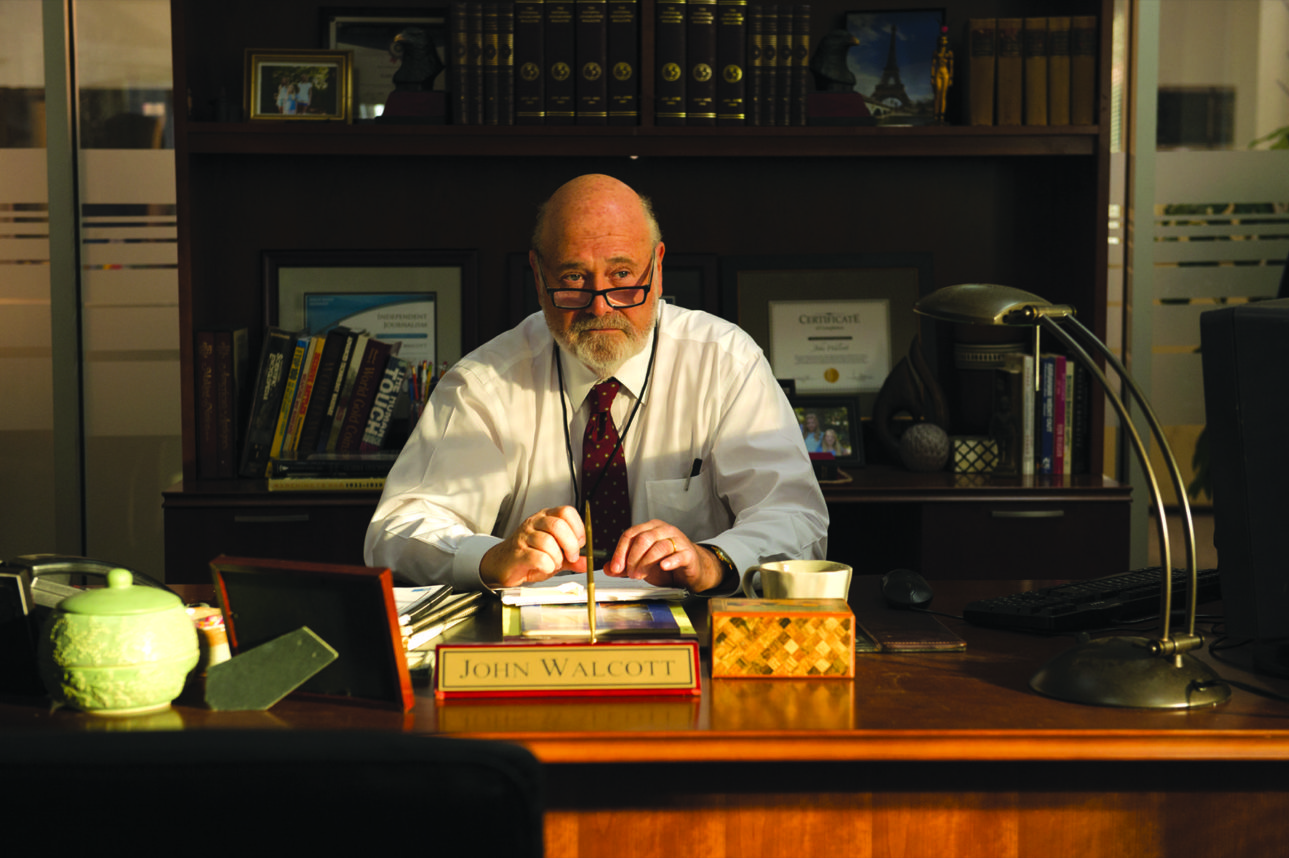
The film, which took Reiner 15 years to make, stars Tommy Lee Jones, Woody Harrelson and James Marsden as Knight Ridder newspaper reporters Joe Galloway, Jonathan Landay and Warren Strobel. Reiner stars as Washington Bureau Chief John Walcott. 

“This was a film I wanted to make right after the invasion of Iraq,” Reiner, 71, told the Journal. “In 2003, I had an idea to maybe make it as a satire, like ‘Dr. Strangelove,’ and I worked with Larry Gelbart on the script, but we couldn’t get it the way I liked it. I tried again as a dramatic film and that didn’t work. Then I saw this documentary by Bill Moyers about these four journalists from Knight Ridder and thought, ‘This is perfect way into it.’ ”  

The four reporters served as advisers on the film. “They were on the set when we shot the sequences with the journalists. They were intimately involved in the whole process,” Reiner said. “We tried to stay as close as possible to what actually happened. We wanted to expose the lies that got us into the war, show how difficult it was to get to the truth and show the tremendous cost of not getting that truth to the American people.”

Reiner did not intend to play Walcott, but Alec Baldwin dropped out two days before he was scheduled to shoot. Reiner’s wife, Michele, suggested that he step in. “I thought, ‘Well, I’m available and I work cheap. But I didn’t really want to do it because I don’t like acting and directing [at the same time]. Your focus is completely split,” Reiner said, although with “This Is Spinal Tap,” “And So It Goes,” and “Alex & Emma” he did both. 

Before tackling the role, Reiner received another bit of spousal advice. “Michele said, ‘Try to be a little less Jewish.’ I said, ‘I don’t know if I could do that. I’m a Jewish guy from the Bronx.’ ” 

Reiner has often played Jewish characters, including Izzy Rosenblatt in “Primary Colors,” Sheldon Flender in “Bullets Over Broadway” and Max Belfort in “The Wolf of Wall Street.” And even though “All in the Family’s” Mike “Meathead” Stivic was Polish-American, “I saw him as Jewish,” Reiner said.

Although his parents, Carl and the late Estelle Reiner, were atheists, “they raised us as Jews from a cultural and historical standpoint,” Reiner said. “When other kids were going to Hebrew school, they had a rabbi come and teach the neighborhood kids Jewish history and Yiddish, and my grandmother spoke Yiddish in the house. We always celebrated Passover because that was a historical event.

“Jews have always placed a great emphasis on exploring the mind and education. Those things were impressed upon me, along with decency and how you treat your fellow man,” Reiner added, categorizing his current religious beliefs as humanistic. “I think we’re all part of the family of man. We’re all connected in a very profound way.”

A staunch advocate of liberal causes, Reiner worked to overturn California’s Proposition 8 and pave the way for marriage equality, and chaired the state’s First Five Commission to advocate for children under age 5. 

“My mother was part of a group called Another Mother for Peace, an antiwar group during the Vietnam War. They had a famous poster that said, ‘War is unhealthy for children and other living things.’ My father marched in the moratorium [march against the Vietnam War],” he said. “There was a lot of discussion about civil rights around the table. I grew up in a household where these things were talked about.”

Reiner briefly considered running for governor in 2006 but he believes he can be more effective outside of elected office. “Right now, the only thing I’m thinking about is preserving democracy and putting the brakes on this creep toward authoritarianism,” he said. 

“Creeping fascism is rearing its ugly head,” he said. “Jewish people certainly know what that’s like. You’re seeing the same kind of rhetoric coming out of [President Donald] Trump’s mouth. The idea of ‘the other’ being to blame for your misfortune is what Hitler spread. And it’s difficult for the mainstream media to break through the constant lies. I’m not saying what happened in Germany will happen, but there’s no guarantee that democracy survives. Right now, we see it slipping away from us at a pretty rapid pace.”

Reiner worries about the Supreme Court in the wake of Justice Anthony Kennedy’s retirement, and that the president has “completely destroyed our relationships with our allies [while] sucking up to [Russian President Vladimir] Putin,” he said. “The checks and balances that the Founding Fathers set up have been eroded, and the press is under attack. The country is going in a very strange direction.” 

That’s why he feels more compelled to make films like “Shock and Awe” now. “I’m getting to that point in my life where I don’t know how many more TV shows or movies I’m going to do. So I want to be able to say as much as I can about how I view the world,” he said. “I’m trying to find ways of injecting my thoughts and ideas into the work.”

Reiner has two projects in development: a drama series for Paramount and a series based on Jeffrey Toobin’s book “The Nine,” about the Supreme Court. He doesn’t plan to act in either series as of now but wants to continue performing. His recent roles include playing Zooey Deschanel’s father on “New Girl” and a judge on “The Good Fight.”

“Creeping fascism is rearing its ugly head. I’m not saying what happened in Germany will happen, but there’s no guarantee that democracy survives. Right now, we see it slipping away from us at a pretty rapid pace.” — Rob Reiner

“I get a lot more satisfaction and pleasure out of directing, but I really do like to act. It’s like a vacation because you don’t have any pressure,” he said. “You don’t have to think about making a million decisions and you just get to play. It’s fun to do.”

As an actor, Reiner is proudest of being part of “All in the Family.” “It not only pushed the envelope, it destroyed the envelope,” he said. “It was groundbreaking. It dealt with real issues and it was funny.” 

As a filmmaker, he said, “the one that meant the most to me was ‘Stand by Me,’ because it was most reflective of my personality and my sensibility. I met Michele during the making of ‘When Harry Met Sally,’ so that means a lot to me. And ‘The Princess Bride’ means a lot because it was my favorite book growing up.”

His show business icon father, now 96 and still working as an actor, director and writer, has always been his greatest inspiration. “Yes, there is the pressure of having to live up to certain things,” Reiner acknowledged. “But I admired him tremendously and looked up to him. I wanted to be like him.” 

Reflecting on his career so far, Reiner said, “I like the fact that some of these movies I’ve made seem to be standing the test of time, but you never know. That’s up to other people to figure out. You just go along and hopefully do things that people enjoy and that make an impact on them somehow, and adds something to the experience of life on the planet.”

He believes “Shock and Awe” meets those criteria. “This movie means a lot to me. It’s not an easy one to watch, but it’s a cautionary tale of what we have to be vigilant about if we’re going to protect democracy,” Reiner said. “It’s an important film and I hope people see it.”


“Shock and Awe” opens in theaters July 13.

Rob Reiner’s ‘Shock and Awe’ Exposes Lies About WMDs Read More »

Farrakhan’s Bigotry Finds Traction Across the Political Spectrum

Louis Farrakhan, octogenarian leader of the un-Islamic, anti-white Nation of Islam, has been active ever since the 1960s, sowing the seeds of racism, anti-Semitism and hate for our blessed American nation. So why worry about an aging bigot today? Suddenly, Louis Farrakhan’s life’s work is paying off, winning accolades from the far right to the progressive left. 

Hatred is seeping into the mainstream of our political culture, not hidden in smoky backrooms or behind anonymous social media postings, but proudly touted on the internet and in interviews — a guaranteed path to gain name recognition, recruit voters and grab media attention.

Here are examples from the Republican side of the aisle:

In California, John Fitzgerald, a proud Holocaust denier, captured 23 percent of the vote in the “open primary” in a California congressional district northeast of San Francisco. This made him the official GOP candidate and, initially, won him the automatic endorsement of the state Republican Party, which inexplicably waited two months before it rescinded the endorsement. Among Fitzgerald’s eye-popping platform planks was an endorsement of the Farrakhan’s scurrilous pseudo-history “The Secret Relationship Between Blacks and Jews,” falsely alleging that the tiny number of colonial Jewish merchants “dominated” the massive slave trade between Africa and the Americas.

In Illinois, the Land of Lincoln, Arthur Jones, who boasts that he was once head of the American Nazi Party, ran unopposed and won a GOP congressional primary in a district that includes parts of the city of Chicago, defending this position: “To me, the Holocaust is what I said it is — it’s an international extortion racket.” Republican Gov. Bruce Rauner hesitated before declaring that the GOP faithful should vote for anybody, even a Democrat, other than the neo-Nazi Jones.

In Wisconsin, in retiring U.S. House Speaker Paul Ryan’s district, Holocaust denier Paul Nehlen vaulted to the front of would-be successors. Before Twitter suspended his account, Nehlen photoshopped an image of Meghan Markle, Prince Harry’s biracial, American bride, with the face of Cheddar Man, the dark-skinned man supposed to be the first modern Briton.

Lest Democrats be complacent, Rep. Danny Davis not long ago said, “I personally know [Farrakhan], I’ve been to his home, done meetings, participated in events with him. I don’t regard Louis Farrakhan as an aberration or anything. I regard him as an outstanding human being.” Asked specifically about Farrakhan’s history of anti-Semitic statements, Davis was dismissive and said that many people in politics have a history of inflammatory comments. But then Davis backtracked — or sidestepped — from those remarks, stating that he would like to know what Farrakhan has said about Jews “recently.” Only belatedly did Davis criticize Farrakhan.

Hatred is seeping into the mainstream of our political culture, not hidden in smoky backrooms or behind anonymous social media postings, but proudly touted on the internet and in interviews.

Davis is an old inner-city politician from Chicago. Even more disturbing was Farrakhan’s intergenerational political romance with Tamika Mallory, co-chair of January 2017’s Women’s March. Mallory, an avowed Farrakhan admirer, showed up at his recent annual Saviour’s Day Address and had her photo taken with him. Far from apologizing, she doubled down, proudly sharing her attendance on Instagram. She even likened Farrakhan to the crucified Jesus: “If your leader does not have the same enemies as Jesus, they may not be THE leader! Study the Bible and u will find the similarities. Ostracizing, ridicule and rejection is a painful part of the process … but faith is the substance of things!”

In California, Maria Estrada, the Democratic candidate for State Assembly from Los Angeles, had this to say last year on Facebook: “Democrats turn a blind eye to the genocide against Palestinians and justify it by bringing up the Holocaust. As if what happened 70 years ago justifies it. Anyone who believes they are one of ‘God’s chosen people’ automatically feels superior and justified in all they do. Religious fanaticism is used to justify apartheid and crimes against Palestinians and no one should be okay with it. #FreePalestine. … It is extremely problematic when delegates are being flown to Tel Aviv by AIPAC, and even more problematic when Palestinian children are being arrested, taunted and murdered in the name of Zionism, … The complete denial and/or justification of what is occurring in Gaza in the name Zionism is hypocritical and inexcusable.” Estrada who absolved Hamas of any responsibility, tweeted “I, for one, enjoy listening to Farrakhan’s sermons.”

Like Louis Farrakhan and other anti-Semites before him, Estrada has taken a page from Farrakhan’s anti-Jewish playbook and invoked “God’s chosen people” to justify her vilification of Jews, not just Zionists. She apparently took no notice that Farrakhan’s hateful dog whistle also transcends the racial chasm between Black nationalists and white racist anti-Semites who marched in Charlottesville last August. Alt-right Charlottesville guru Richard Spencer wants to meet with Farrakhan, to work together toward “the sort of self-determination we and the broader alt-right support.”

Fifty years ago, the Rev. Martin Luther King Jr. inspired young people of all races to dream of a colorblind America. Today, we are witness to bigots from the far left and the far right who praise Farrakhan, energized by his divisive demagoguery. These extremists are hard at work wending their way into the mainstream of our society.

Younger generations of Americans — Democrats, Republicans and everyone else in between — better wake up and decide whose vision will guide our nation in the 21st century.


Rabbi Abraham Cooper is associate dean of the Simon Wiesenthal Center and Global Social Action Director. Harold Brackman is a long-time consultant for the Simon Wiesenthal Center and its Museum of Tolerance, and co-author of “From Abraham to Obama: A History of Africans, African Americans, and Jews.” 

Farrakhan’s Bigotry Finds Traction Across the Political Spectrum Read More »

Who Killed Raphael’s Son? Part 2

Editor’s note: This is the second of a five-part excerpt from the novel “The Luminous Heart of Jonah S.” by Gina Nahai published by Akashic Books.


Gone. As in: faked his own death and, with the help of his wife who has always been under his thumb, avoided the trial and absconded with everyone’s money.

Gone. As in: Probably skipped the country by now, off to Israel or Iran where he’ll lie on the beach in Eilat or at the Caspian, wait out the storm, and turn up somewhere else in the world in a few years, still rich and fat and pretending to be a good Jew.

As in: The son of a bitch wins again.

News of the missing body was announced on the Tumblr page of Angela Soleyman, an Iranian Jewish attorney who despised Raphael’s Son and was happy to say it. She attributed the bulletin to the website of the Los Angeles Jewish Herald.

No sooner had Angela’s Tumblr post gone live than the Herald began to receive calls from livid readers denouncing the publication, Tumblr and all social media, and, especially, Angela Soleyman. She, the callers informed the nineteen-year-old intern who had the misfortune of working the switchboard that day, was a loose cannon with too many college degrees and not an ounce of common sense to help her get along in the world. She was also a monstrous liar who had left out of her so-called reporting (since when does anyone with Internet access become Peter Jennings?) the rather relevant fact that she was an unhappy soul with a very sharp ax to grind against the Iranian community because she was in her early forties and had not managed to find a man stupid enough to marry her. That she had spent years trying to embarrass Iranian Jews and give them a bad name. She should be fired by the Herald, banned by the State of California from ever touching a keyboard again. That’s what the Iranian callers said.

The Americans who called wished to express: a) the depth of their disinterest in whatever fate had befallen yet another rich Iranian; and b) their abiding resentment of the entire community for being bold enough to live in the most desirable neighborhoods of Los Angeles, send their children to the most competitive schools, and excel in the most difficult and lucrative professions while, at the same time, keeping mostly to themselves and each other, speaking Persian everywhere they went, and insisting that their children marry other Iranians. It was simply too cheeky, too unimmigrant-like, for these Eye-ray-nians to be living next door to and eating in the same establishments as the icons and avatars of American culture. The women get their nails done at the same Vietnamese-owned-and-operated, sixteen-dollars-for-a-manicure and you get to pass right through the paparazzi lines even though you’re not a celebrity — yet — shop on Bedford Drive in Beverly Hills that Kim Kardashian, that goddess of L.A. culture, frequents.

First-generation immigrants must live in undesirable areas and work their fingers raw doing laundry or selling noodles, or slave in factories and eat cabbage, so that their children can go to school and become middle class. That’s what all the Russian and Polish and Western European Jews did when they first arrived on these shores. Only these Eye-ray-nians don’t know how to take a number and stand in line.

The collective response to the news of Raphael’s Son’s missing corpse alarmed the Herald’s editor, an American who had never understood his fellow white people’s visceral resentment of the Iranian population in L.A.

“I would note,” he said politely to the first few callers before he realized it was a losing battle and told the intern to take messages, “that Ms. Soleyman is not affiliated with this publication and does not represent its views.”

The Americans concluded, once again, that the Herald was too liberal and hung up. The Iranians insisted that, regardless of who paid her bills, the Herald had provided Ms. Soleyman with “fake news” — an act that was especially egregious given that Angela had always had a way of turning any message — good, bad, or indifferent — into a source of anguish and embarrassment for her own people.

Angela S. was a 5-foot-9, 138-pound, Princeton undergrad, Yale law (but she wasted all that education and gave up her $180,000-a-year job at a private law firm to become a writer because she believes in truth, justice, and being poor), Iranian Jewish woman of a certain age — forty-one — who had offended just about every person in the upper income bracket of the community in LA (and most of Long Island) because she was, in the most aggravating sense of the word, frank.

She had a conviction, fashioned, no doubt, out of resentment of the fact that she was childless and unmarried and without prospects, that Iranian Jews had been silent and insular and fearful of the judgment of others for too long—first, because they were persecuted minorities who survived by remaining invisible, and later, when they were allowed out of the ghettos and into the top echelons of Iranian society, because they had an image to cultivate and maintain — and that they needed her to bring them all out of the shadows so they could shout from every laptop their own and their neighbors’ personal histories, their secrets and flaws and differences, their confessions and complaints and all those other so-called facts they had tried for three thousand years to conceal.

The question of who died and made Angela truth-teller extraordinaire remained, as yet, unresolved, but it was one thing for her to “speak frankly” to one or two or a dozen other people, and something entirely different — indeed, reckless — to begin to operate an instrument of mass destruction.

Angela’s blog on Tumblr, The Pearl Cannon, was named after a real piece of artillery built by a Jewish blacksmith in nineteenth-century Iran. Like her, the cannon spewed a great deal of ammunition every time it was fired up. Like her too, it had its own mind and went against the grain: Instead of shooting its explosive charge forward through the muzzle, the real Pearl Cannon exploded through the back and lay waste to its own team. The only difference was that the Pearl Cannon, having revealed its fatal flaw at the first try, was permanently retired from battle. Angela, on the other hand, kept writing. 

“Let me say it like it is,” she wrote in the closing lines of her column that Monday. “The wolf in a seal’s body is about to pull his biggest rip-off yet, his wife and the Riffraff are going to help him disappear with everyone’s money, and the cops in this town are too incompetent and unmotivated to care.”

That last comment, about the cops, dug deep into the detective who was called to the scene that Monday. Leon Pulitzer was another L.A. writer who thought he was doing time in an ordinary job until fame and fortune caught up with him. He had been in law enforcement for twenty years, never finished a book, and still fancied himself a “crime writer in training.” At six o’clock on the day of the murder, he was summoned to the site when his boss, Detective III Jay O’Donnell, found out that the victim and his family were Iranians.

“Get over here and tell me what the wife’s saying,” O’Donnell had ordered Leon, who was still in bed. “These people all speak English but make no sense.”

Leon was about to protest that he was neither a translator nor a mind reader when O’Donnell mentioned Raphael’s Son’s name. He arrived on Mapleton to find it swarmed with police cars and spectators, television news vans and camera crews and paparazzi, and all the usual hangers-on who popped out of the ground every time there was a hint of celebrity-related news anywhere in Los Angeles.

In the case of Raphael’s Son, the Holmby Hills address was enough to attract a good amount of media attention, given the neighborhood’s famous living residents and especially its most renowned dead person — Michael Jackson — who had been “put to sleep” in 2009 with the help of his in-house physician, in a rented mansion around the corner from Raphael’s Son’s. More recently, the drama surrounding the divorce of the couple who owned the LA Dodgers had made the area a paparazzi favorite. The Dodgers couple, court papers revealed, owned two houses in Holmby Hills, two in Malibu, and three elsewhere in the country.

According to the wife — a smart but starved-looking little critter with a chihuahua’s nervous demeanor who, before the divorce, had paid a hair dresser $10,000 a month to dry and comb her and her husband’s hair—the first house, purchased for $21 million, was intended as their residence; the second house, immediately next door to the first and purchased for $6.5 million, was used for doing “extra laundry.”

Outside the house, Neda stood in her bloodied white terry cloth bathrobe purchased for $275 at the spa of the ugly and expensive Montage hotel on Cañon Drive in Beverly Hills, and her bloodied white terry cloth slippers with the single pink rose, purchased for $5.99 at the Rite Aid (where all the pharmacists are Iranian, the cashiers are Filipino, and the store clerks are Latino; white people, it seems, do not work at Rite Aid) across the street from the hotel.

Glassy-eyed and terrified, she had already given her statement to the uniform, Jose Montoya, who had arrived on the scene in his black-and-white, and was now repeating it for O’Donnell.

Leon stood next to him and listened: The last time she saw her husband alive, Neda explained, was Friday evening. At the time, they hadn’t been on speaking terms for about ten days, which wasn’t unusual for them, though she couldn’t recall the reason for the latest estrangement. Her husband had been unusually busy at work, and his bedroom, separate from hers, was situated at the opposite end of the house, so that he could have come and gone half a dozen times in one night without her taking notice.

On Sunday night she had eaten dinner alone, in the “functional” ground-floor kitchen (not to be confused with the other, more expensive “just for show” kitchen also on the ground floor). After dinner she had watched an old episode of The Borgias on Showtime in the family room, then retired upstairs to her bedroom by ten p.m.

She had not seen the girls before she went to bed Sunday night either. She thought the older one had been studying at the library, and that the younger one — well, to be honest, she had no idea what the younger one had been up to. As had become her routine in the last three and a half years — since Raphael’s Son had made himself and his family social pariahs—Neda had downed two Xanax, plus half an Ambien, plus two melatonin gelcaps, to fall asleep. Hours later, a loud noise had awakened her. She believed the time was “three thirty-something,” but she could be wrong. The Xanax had worn off and the melatonin was useless, but she was still groggy from the Ambien, so she had drifted in and out of sleep for the next hour before she finally got up, driven, she said, by the “feeling that something had happened,” and ventured out of her room to investigate the source of the disturbance.

Without first checking the house, she went straight into the yard, hiked down to the gate, heard the sound of the Aston Martin’s engine still running, and saw the front of the car pressed against the metal bars.

Here, Neda stopped, drew a hollow, stunted breath, turned more ashen, and told O’Donnell, “I’m sure he was dead.”

At this, O’Donnell smiled broadly and turned away from Neda toward the ever-growing circle of onlookers at the edge of the police tape. Like any normal Angeleno, O’Donnell hated the paparazzi, thought they were less than pond scum, that they should have their cameras confiscated and their asses kicked to the curb as long as they were chasing other people. But if it was he they chased . . . well, in that case… O’Donnell’s heart quivered at the thought that he might be quoted, even featured, on TMZ or E! So he sucked his stomach in and stood with his feet wide apart, wiped his face every few minutes, and did his best to look professional and photogenic.

“Ma’am,” he said, one eye on Leon and the other on the television cameras, “this is Detective Pulitzer. I believe he speaks Farsi. In case you’re more comfortable.”

The security cameras outside the house were dummies intended to scare off inexperienced thieves. Raphael’s Son had disabled them when he bought the house because he didn’t want any record kept of his own comings and goings. The lights that should have illuminated the driveway and the gate had been dark since the Department of Water and Power launched its Compact Fluorescent Energy-Efficient Lightbulbs campaign in 2009; the lightbulbs conserved energy by going dark after a week or two, or breaking as they were being installed.

O’Donnell sent Neda into the house with a female cop to change out of the bathrobe and slippers that were now evidence, told Leon to follow her in and “see what you can squeeze from her between pals,” then sauntered with as much reluctance as he could feign toward the Channel 9 news van.

The path from the gate toward the main building led up a slowly rising, pleasantly winding walkway paved with smooth white stones and lined on both sides by an emerald-green lawn dotted with giant palm trees and white marble benches. On the left, a dark blue infinity pool lay above a sharp slope toward a terraced area with a tennis court and, below it, an orchard. On the right, a massive river gushed out of a set of polished black rocks and into a tropical pond complete with a bamboo bridge, waterfall, wet bar, fire pit, and a cabana.

The front door was twelve feet high, made of black oak with shiny brass hardware; the foyer was as large as a decent-size hotel lobby.

The family room, where Leon met Neda once she had changed out of her bloody clothes, was as large as his house. Divided into three sets of sitting areas, it was furnished with oversize armchairs, wrought-iron-and-glass coffee tables, heavy drapes and fine Persian rugs, and, here and there, mammoth books with titles like Tuscan Villas and The Jewels of Elizabeth Taylor.

Perched on a giant sofa with light-blue and lime-green upholstery, Neda looked like a small stuffed animal afraid it would be picked up by a maid and thrown in the trash before its owner could save it.

She had cleaned the blood off her face and hands, but she hadn’t managed to rub the smell out entirely, and thus she remained: Head slightly cocked to the right, hands abandoned on her lap, staring at the coffee table in front of her with that dull, steady gaze of the overly medicated or the lobotomized which she had perfected over the years. She told Leon she had no idea who would have wanted Raphael’s Son dead. It’s true he had “differences” with some people, but he was an observant Jew, she said, as if this alone might make him immune to harm. 

When she had answered all of Leon’s questions, she gave him permission to talk to her daughters.

The older girl, Nicole, had bright red hair and hazel eyes, and the smooth, round face, impeccable white skin, and softly aquiline nose of the girls in dreamy fashion magazine photos. She was the type of child — quiet, kind, smart, and studious — most parents dreamt of having, then spend years worrying about: Her quietness made her insipid, her kindness allowed others to take advantage of her, her intelligence frightened boys, and her studiousness meant she had no friends.

She told Leon she had been at the library till nine o’clock the night before. She had come home through the garage and gone straight to her room, where she had stayed till she was awakened by Esperanza’s barking through the foyer as she spoke to the emergency operator on a cordless phone. Nicole hadn’t seen anyone when she came home, didn’t remember if her parents’ cars were in the garage. She had no idea who else was at home, but that again wasn’t unusual for their family.

“We’re not the communicative type,” she explained. “Most of the time, everyone’s in their own room with the door locked.”

She spoke with her eyes cast down and her skin blushing a faint pink. She hadn’t heard the crash that awakened Neda, didn’t know what time Esperanza started to scream. Asked if she had any idea who might have wanted to harm her father, Nicole studied Leon’s face, then shrugged ever so slightly and said, in a voice that was at once removed and ridden with heartache, “Everyone.”

“My mother has this idea that we’re this nice, respectable, normal family, like all those other Persians,” she said after awhile. “She’s always talking about her aabehroo. She knows people hate us. She knows my dad cheated his friends and even cheated on her all the time, but she doesn’t say anything, hasn’t once stood up for herself or my sister because, what do you know, it’s bad for our fucking nonexistent aabehroo.”

That word, aabehroo, is one of those for which no equivalent exists in the English language. It alludes to the impression that others hold of an individual’s virtue and respectability. To have aabehroo means that the world regards a person in high esteem. You may be born with aabehroo because of your family history, but holding on to it requires a great deal of restraint and self-sacrifice. It means making sure you do everything in compliance with society’s idea of what is right, that you live honorably and protect the sanctity of your family’s name and reputation. It means being capable of feeling deep, personal shame before an exacting, infinitely multitudinous jury.

Asked if she had any idea who might have wanted to harm her father, Nicole studied Leon’s face, then shrugged ever so slightly and said, in a voice that was at once removed and ridden with heartache, “Everyone.”

You have to have lived in a place like Iran, Leon thought, grown up with a strong sense of propriety and shame, and feared the judgment of others, in order to understand such a word. You certainly can’t imagine what it means, really, if you’ve lived most of your life in America. In this land of perpetual hope and endless good fortune, this country built on the promise of “life, liberty, and the pursuit of happiness” — where else in the world is happiness a right? — where even the dead look good and healthy, dressed up and painted and coiffed in the coffin as if on their wedding day, there’s no awareness, perhaps no need, nor would there be any tolerance, of that kind of sacrifice.

He was about to go back to Nicole’s other comment — about Raphael’s Son having cheated on Neda — when a uniform knocked on her door. There might be a witness — of sorts — who claimed he had seen everything. He had come forward on his own, but he insisted he wasn’t going to talk to “any Podunk street cop.” He had crucial information about the day’s happenings, and he would only share it with the chief of police. n

Who Killed Raphael’s Son? Part 2 Read More »

Hysteria Over Judicial Nominee Is Unfounded

President Donald Trump has made his Supreme Court pick: Judge Brett Kavanaugh of the D.C. Circuit Court of Appeals.

This pick has led Democrats to bouts of near-apoplexy. According to Democrats, Kavanaugh represents a harbinger of death and destruction. Of course, Democrats would have said the same about any candidate nominated by Trump. The Democrats’ official Twitter account issued a dire warning: “A vote for Kavanaugh would be a vote to rip health care from American families and deny women their right to make their own health care choices.” The Women’s March issued a statement “in response to Donald Trump’s nomination of XX.” Naturally, that statement suggested that XX’s nomination would represent a “death sentence for thousands of women in the United States.” Protesters at the Supreme Court began chanting against an unnamed nominee before Trump even picked Kavanaugh publicly.

Here’s the truth: Kavanaugh is a textualist judge who will adhere to the Constitution. But he’s also a gradualist. The chances of Kavanaugh and Chief Justice John Roberts voting to overturn Roe v. Wade are slim to none. It’s far more likely that the two of them form a new minimalist center to the court, gradually paring back overreaching Supreme Court decisions rather than destroying them wholesale. After all, Kavanaugh is the same judge who crafted the original logic stating that Obamacare was a tax rather than a fine — the same logic Roberts would use to uphold Obamacare against constitutional challenge.

But the left’s hysteria over Kavanaugh’s selection tells us a lot about what it expects from the Supreme Court: complete adherence to a Democratic political platform. For decades, we’ve heard that Republicans ought not use litmus tests to determine judges; for decades, we’ve heard that Democrats ought to apply open litmus tests to judges. In the view of the left, the Supreme Court isn’t the “least dangerous branch,” as in Alexander Hamilton’s memorable Federalist No. 78 phrase — it’s the most powerful moral oligarchy, establishing favored rights from a marble-gilded building in Washington,  D.C., with the power of lifetime appointment to back its decisions. 

America was not built on the backs of unelected people in black robes.

Undergirding the left’s fear of a Supreme Court that abides by constitutional text is a deep dislike of the Constitution itself, combined with a fear of Americans voting on crucial issues. The Constitution is, by its very nature, a conservative document: It enumerates only limited powers of the government and enshrines rights that cannot be breached by legislatures. The left would prefer a nearly unlimited government, with only a few rights protected from legislative overreach — and those rights it does wish to see protected aren’t articulated in the Constitution. Thus, conservatives view the Second Amendment as a fundamental right spelled out in the Constitution but search in vain for a Constitutional right to abortion; leftists prefer to relegate the Second Amendment into the ashbin of history but cherish the unstated and groundless right to abortion.

But leftist logic makes a mockery of the role of the judiciary itself. Nobody would want a judge to rewrite a contract in order to reach the judge’s favored conclusion — judges are there to judge. Yet the left wants judges to rewrite the Constitution regularly and to trump popular legislation in the process. Roe v. Wade must be protected under the “emanations and penumbras” of the Constitution, but a religious baker must be forced by the government to bake that cake in violation of First Amendment protections of freedom of religion.

The founders conceived of the judicial branch as a mere shield against violations of the Constitution, not as a sword on behalf of political outcomes. Hamilton wrote: “The courts must declare the sense of the law; and if they should be disposed to exercise WILL instead of JUDGMENT, the consequence would equally be the substitution of their pleasure to that of the legislative body.” Indeed, Hamilton continued, should the Supreme Court become a super-legislature, it should be dissolved.

America was not built on the backs of unelected people in black robes. Those people were granted a specific task. And a return to their delegated power would be a welcome relief for a country that too often looks to its supposed moral superiors for guidance on issues best left to the American people.


Ben Shapiro is a best-selling author and editor-in-chief at The Daily Wire.

Hysteria Over Judicial Nominee Is Unfounded Read More »

An Ode to the Moon

While waiting for my 6-year-old daughter’s annual checkup at the pediatrician’s office, as she happily twirled on the red and blue spinning chairs in the children’s area, I picked up a copy of National Geographic magazine from the bin beside my seat, and read: 

“Everything we are and everything in the universe and on Earth originated from stardust, and it continually floats through us even today. It directly connects us to the universe, rebuilding our bodies over and again over our lifetimes.”

This quote struck me for its beauty and because I’ve recently been thinking about celestial time. In this sped-up, hyped-up news cycle, the world growing smaller and time moving faster, I find it calming to think about other ways of measuring time and space. 

Humans used to mark time by observing celestial bodies, but now we live by clocks and calendars. I am thankful for electricity, but our devotion to light at all hours comes at a cost: How many of us can see the stars? And without the stars, we lose something else — the sense of celestial time and space, not on the scale of a wristwatch with ticking seconds, but rather, the scale of planets and stars and galaxies. 

As a girl, I was captivated by the moon, as my daughter is now. Growing up in a secular Jewish family, I would have been shocked to hear that this celestial body is an integral part of Judaism. I associated our ancestral religion not with stars, sky and interstellar distances, but with the uncomfortable pews of the synagogue we attended a few times each year on the other side of town. 

Although I did not know it, the moon was inextricably linked to these few holidays my family practiced, their dates determined by the lunar months of our tribal calendar. 

I love to think back on those holidays that secretly bound our family to the
lunar cycles, even in a mid-Atlantic suburb in the 1980s: Passover on the 15th of Nisan, the full moon round above our quiet streets. Hanukkah on the 25th of Kislev, our small, rainbow candles sustaining the gibbous moon as she waned.
Rosh Hashanah, on the first day of Tishrei, the sky dark as we heard the ancient shofar blast.   

It makes sense that the ancient Israelites would marry their rituals to the cycles of the moon. 

Not only was it their calendar, but it has a poetic logic, as well. 

Growing up in a secular Jewish family, I would have been shocked to hear that this celestial body is an integral part of Judaism.

Ritual has much in common with the moon. Both are free, beautiful and available to all. And no matter how far we stray from home, both accompany us on our journey. 

Both help us understand the cyclical nature of being, giving us the power to say goodbye to our past selves. And both help us link our baffling transitions —  birth, puberty, love, death — into a greater rhythm. This rhythm extends beyond the human; it is part of life itself. This summer, an urban coyote has taken up residence in our neighbor’s yard, and when the moon is full, we hear it howling from 20 yards away.  

Sometimes I wonder if our ancestors could have imagined that all these years later, with our vastly different lives, our miraculous technology, we would still gather to celebrate these holidays they celebrated at the precise moment in the lunar cycle at which they celebrated. 

I wonder if they would have been surprised to learn that our bodies and the earth are made of stardust, or if
they would say, yes, that’s what it says in the creation story. God made the sun to rule over daytime and the moon to rule over the night. And whatever the earth is made of, of course humans are made of that, too. 

It’s so easy to be worn down by the work of getting through the day. But if we remember to look up in the evening, the moon’s simple, elegant orbit reminds us that we are part of a system that is greater than any of us can comprehend. How brief our time here is, and how precious. 


Alicia Jo Rabins is a writer, musician and Torah teacher who lives in Portland, Ore.

An Ode to the Moon Read More »

What Would My Grandparents Think?

I’m looking at a torn photo of my mother as a toddler, being held by her father. On the back, someone had scrawled 1938. I keep staring at the photo because it is unusually somber, poignantly capturing the mood of the era.

One should be careful, of course, not to read too much into old photos, especially when the year is associated with both economic destitution and the nightmare of Kristallnacht. But I was looking through some old photos to get a sense of the lives of my four Russian grandparents, and though this one stands out, it, too, tells part of the story.

For the most part, the photos reflect what I remember as a child. They emit what could be called “working-class grateful.” My maternal grandfather started at Ford as a mechanic and ended up with his own gas station, Aba’s Garage in Woodbine, N.J. In most photos, he’s covered in grease but with a smile that always seemed to light up the world.

My Uncle Moe drove a kosher meat truck; I still have the bell that he would ring in front of each house. My paternal grandfather worked in a factory in Philadelphia until he was able to start his own ironing board company. A natural, dignified work ethic permeated their lives; complaints fell into the realm of comedy.

Living in New York City, one comes into contact with innumerable cultures on an hourly basis. Not coincidentally, the same natural work ethic and pride prevail. And it is precisely this fusion of cultures and achievement that gives the city its unique creative energy. 

Today’s national conversation about immigration is, in a word, revolting. One side seems to have forgotten that immigrants built this country. The other side seems oblivious to the depths of their own hypocrisy: They shout “privilege” with soulless abandon while offering up a laundry list of entitlements. 

It is in fact this sense of entitlement that I find most annoying about Alexandria Ocasio-Cortez, the 28-year-old who just won the Democratic primary to represent a chunk of the Bronx and Queens. And for a socialist millennial who calls Hamas terrorists “civil rights activists,” there are many annoyances to choose from. The government, Ocasio-Cortez demands, must do x, y and z for her community.

Today’s national conversation about immigration is, in a word, revolting.

I wonder what my grandparents would think of the identity politics game that Ocasio-Cortez manipulates so well. They often “passed” as white, yes, but apparently not a week would go by when someone wouldn’t remind them that they were in fact not white. Given the pogroms and the Holocaust, this was, as my dad used to say, small potatoes.

It is precisely this perspective that is so sorely lacking from this new face of the Democratic Party: Generation Entitlement. Real racism, of course, still exists. But where it doesn’t exist, the left’s answer is: Make it up! Often at the expense of people whose families were slaughtered for being Jewish less than 75 years ago.

My grandparents never took their freedom for granted.  And in exchange for that freedom, they wanted to give back to this country in any way they could. It was anti-entitlement, the embodiment of John F. Kennedy’s words: “Ask not what your country can do for you; ask what you can do for your country.”

Much of this came from a well-tended Jewish soul, but it also came from a vision of what it meant to be an American. I find it hard to believe that the hard-working residents of the Bronx and Queens fully understand the game Ocasio-Cortez is playing — and would be horrified if they did.

Maybe, as intersectional leftists now say, I should “stay in my lane” — talk only about my own peeps. OK. Then I would like to ask Ocasio-Cortez to do the same. The next time she tweets kisses to Hamas — showing that her knowledge of foreign affairs is even less informed than her knowledge of economics — she should be told to stick to her specialty: identity politics.

My grandparents came here with nothing, fleeing persecution, and made this country a better place. They weren’t white and they weren’t privileged — except in one respect: They understood how lucky they were to be on land that honored freedom. Not for one day did they take that freedom for granted; that is the only sense of entitlement that I will pass on to my son.


Karen Lehrman Bloch is an author and cultural critic living in New York.

What Would My Grandparents Think? Read More »

We’re Overdosing on Emotions

When I get into a debate or an argument, my No. 1 objective is not to lose my cool. The minute I do, I lose. I can be passionate, but I can never get angry. Getting angry changes the topic. It becomes the issue.

But how do we control our emotions when things drive us completely batty?

Consider the case of 30-year-old Kino Jimenez of San Antonio, a man who obviously despises President Donald Trump. He despises him so much that, apparently, he can’t stand to look at anyone who voted for him.

So, last week, when he saw a Texas teen at a Whataburger restaurant wearing a “Make America Great Again” cap, he ripped it off, hurled a drink at the teen’s face and uttered obscenities. The episode was captured on video and went viral.

Regardless of how I feel about Trump, the minute I saw Jimenez act like a self-righteous bully, he lost me. Jimenez’s behavior made me think only of Jimenez: How dare you assault a law-abiding person on the basis of political beliefs? Have you ever given any thought to why 63 million Americans would vote for a man you so despise? Has it occurred to you that Trump voters may have genuine grievances, and that they also have a right to vote? 

America has become a nation of angry bashers, from the left and the right. This may make us feel good, but all it does is arouse more anger.

Bullying is not dissent. It’s rejection. It’s nullification. It’s allowing our emotions to get the better of us.

Emotions can rouse our souls, but taken too far, they can poison it. When hatred and anger take over, we lose the ability to think straight. Many Trump-hating Democrats are so angry that they’re not in power they can’t see their way to regaining it. Instead of planning and strategizing, they’re yelling and demonizing.

“I’m not a fan of Trump’s policies, his vulgarity, his exaggerations and his outright falsehoods when he speaks,” Clarence Page wrote in the Chicago Tribune to his Democratic brethren. But what does Page suggest for going forward? “Don’t get mad,” he writes, “get smart.”

Trump haters are better at getting mad than getting smart. As Frank Bruni of The New York Times reminded Democratic voters: “Simply bashing Trump — bashable though he may be — didn’t do the trick for Hillary Clinton.”

Simply bashing rarely does the trick. America has become a nation of angry bashers, from the left and the right. This may make us feel good, but all it does is arouse more anger. And anger doesn’t build — it destroys.

“What is dangerous about anger,” Chief Rabbi Jonathan Sacks writes, “is that it causes us to lose control. It activates the most primitive part of the human brain. … While in its grip we lose the ability to step back and judge the possible consequences of our actions. The result is that in a moment of irascibility we can do or say things we may regret for the rest of our lives.”

For that reason, adds Sacks, “Maimonides rules there is no middle way when it comes to anger. Instead we must avoid it under any circumstances. We must go to the opposite extreme. Even when anger is justified, we must avoid it. There may be times when it is necessary to look as if we are angry. That is what Moses did when he saw the Israelites worshipping the Golden Calf, and broke the tablets of stone. Yet even then, says Maimonides, inwardly you should be calm.”

The smart Democrats are the ones who are staying cool and plotting their comeba

I know, if you’re a Trump hater, it’s not easy to stay calm. You have a million reasons to get angry. After eight years of President Barack Obama, it’s unthinkable that a man like Donald Trump could run your country. It’s not just unthinkable. It’s unacceptable. Your single-minded mission is to resist, to undo, to not accept. This is high-anxiety living. It’s living in a state of constant outrage, constant anger.

The smart Democrats are the ones who are staying cool and plotting their comeback. They are the ones who are doing the hard work of getting out the vote for the midterm elections in November. Yes, they can march and rally, but inside, they are calm. They know that acting unhinged runs the risk of sending more voters into the rival camp.

In the Jewish community, we like to justify everything we do — even acting in anger — by claiming  Jewish values. One of our favorite values is caring for the stranger.

But let’s remember that resisting anger is also a Jewish value, and that strangers come in all shapes and colors. Some strangers even wear Trump hats.


Follow David Suissa on Twitter: @suissatweets

We’re Overdosing on Emotions Read More »