fbpx

July 11, 2018

Justice Ruth Bader Ginsburg’s Visit Inspires Israel to Intensify Work on Closing Gender Gap

Leaders of Israeli women’s rights organizations, members of Israel’s Supreme Court and other prominent officials have vowed to intensify efforts to close the gender gap in their country following U.S. Supreme Court Justice Ruth Bader Ginsburg’s visit to Tel Aviv and Jerusalem.

Ginsburg was in Israel to receive the Genesis Lifetime Achievement Award from The Genesis Prize Foundation (GPF). All sitting Justices of Israel’s Supreme Court, as well as all living former presidents of the Court, attended the ceremony honoring Ginsburg, who visited Israel for the first time in 23 years. For a video overview of the Justice’s trip, visit:

https://www.youtube.com/watch?v=nNVhLTHnSz4

“My colleagues and I were delighted to welcome Justice Ruth Bader Ginsburg, a living legend for all of us,” said Esther Hayut,  president of the Supreme Court of Israel, who hosted Ginsburg at the Israel Supreme Court. “Her visit was an extremely important reminder of the commitment to gender equality we share with her.”

Ginsburg’s visit became a focal point in a series of events with leaders of Israeli women’s NGOs. It followed The Genesis Prize Foundation’s announcement of grant competitions in Israel and North America, where $3 million in funds will be allocated to support organizations working on such issues as enhancing socio-economic opportunities for women; prevention of violence; promoting gender equality among minority groups in Israel; fighting against harassment in Jewish communal workspaces; and encouraging girls and young women to pursue careers in Science, Technology, Engineering and Math (STEM). Core funding for these competitions comes from The Genesis Prize Foundation and its partner, Israeli philanthropist Morris Kahn.

“The latest Global Gender Gap Report, published by the World Economic Forum [WEF], ranked Israel as 44th out of 144 countries, denoting a position nine places lower than a decade ago,” said Stan Polovets, co-founder and chairman of The Genesis Prize Foundation. “Such a low ranking for such a progressive country as Israel is unacceptable. As is the trend.”

The WEF report attributes Israel’s decline in the rankings to a persistent 40% wage gap between men and women, low levels of women’s participation in politics and senior government posts, and an insufficient representation in top management roles in the private sector.

Justice Ruth Bader Ginsburg’s Visit Inspires Israel to Intensify Work on Closing Gender Gap Read More »

UC Davis SJP Admits They Want to See Israel Destroyed

Whether they realize it or not, the UC Davis Students for Justice in Palestine (SJP) chapter admitted in a recent op-ed they don’t think Israel should exist as a nation.

UC Davis SJP wrote an op-ed for The California Aggie in response to an Aggies for Israel op-ed that accused SJP of leveling anti-Semitic invectives toward Jewish and pro-Israel students in March. SJP claimed in their op-ed they were merely protesting Israeli government policies.

“Palestinian houses are simultaneously being demolished, and Palestinians are being imprisoned, slaughtered and tortured,” UC Davis SJP wrote. “We demand to have our voices heard because the voices of Palestinians are being killed off one by one. We will continue with these efforts because we will not allow the victims of Israeli colonization to be forgotten on this campus.”

The op-ed proceeded to ramble on about how it was hypocritical for students to be pro-Israel and stand with progressive causes, even promulgating the falsehood that the Israeli government forcibly sterilizes African migrants. But SJP let the cat out of the bag in the op-ed’s concluding paragraph.

“It is an ideological fantasy to really believe that progress is possible so long as the state of Israel exists,” UC Davis SJP wrote. “Underlying this naive fantasy is the belief that a state that engages in racist laws, systematic killings and home demolitions can also function as a beacon of peace. The goal of Palestinian resistance is not to establish ‘love’ with those who are responsible for the suffering of the Palestinian people; it is to completely dismantle those forces at play. So continue to watch in ‘horror,’ because we are here to stay.”

In other words: UC Davis SJP doesn’t want any part of a two-state solution, they want Israel gone altogether.

Charline Delkhah, a recent UC Davis graduate who served as the president of Aggies for Israel, explained in a July 9 Aggie op-ed that Jewish and pro-Israel students felt intimidated by SJP’s actions on March 5:

“This year, Students for Justice in Palestine (SJP) held an event on the Quad sharing stories and poetry and showcasing Palestinian art, literature and clothing. Board members of Aggies for Israel (AFI) attended the event as bystanders and as students of the UC Davis community. Members of SJP decided to use the platform of the event to spew hate at those who showed up. Their ‘invite[s]’ for board members of Aggies of Israel to speak about how ‘they are able to defend a country of genocide and killing,’ were followed up by the yelling of ‘shame,’ (alluding to what was yelled at Jews during the Holocaust). As one may expect, our hearts started racing uncontrollably.

“The hate speech did not end there. A few minutes later, one of the speakers specifically singled me out, ‘invited’ me up again to speak and stated how AFI ‘is complicit’ and that we ‘lie and are hypocritical.’ This speaker continued by saying, ‘[We] are alone on this campus because [we] stand for racism, genocide and massacre,’ and that, ‘The UC Davis community stands for Palestinian people.’ He then turned the direction of the audience to my fellow board members with the intention of intimidating them and silencing their beliefs. In that moment we felt so alone, so scared, so unprotected and subjugated — as if no one cared for us or our protection on campus.”

Delkhah added that UC Davis SJP has been waging a campaign to oust student president Michael Gofman because he’s a pro-Israel activist. She also explained that the UC Davis administration hasn’t taken any action against the campus SJP chapter because of freedom of speech.

“Why are actions like hate speech, anti-Zionism and anti-Semitism going unnoticed?” Delkhah wrote. “Why are Jews and our safety not cared about by the administration? I, along with other members of the Jewish community, demand answers from the administration. We will no longer stay silent on these matters, especially when we do not feel safe on our own campus.”

H/T: Algemeiner

UC Davis SJP Admits They Want to See Israel Destroyed Read More »

Sexy Israeli Web Series “Confess” May Get U.S. Hookup

“Confess TLV,” a provocative web series set in Tel Aviv about people who meet via hookup apps is being developed for American TV. Actress-writer-producer Julie Delpy has plans to bring the series to AMC—and change the setting to the United States. The anthology will still focus on digital media’s influence on modern sexuality.

In the eight-episode Israeli version, topics include stories about a lesbian who discovers her date is married to a man and has kids, a German tourist seeking Israeli men for kinky encounters, and a man whose fetish is overweight women.

Delpy, who was nominated for Academy Awards for her adapted screenplays for “Before Sunset” and “Before Midnight,” will write “Confess” and serve as executive producer along with Jake Witzenfeld and Moshe Rosenthal, the creators of the Israeli series.

Sexy Israeli Web Series “Confess” May Get U.S. Hookup Read More »

“Witness”: Ariel Burger shares Lessons from Elie Wiesel’s Classroom

Learning about the life and work of Elie Wiesel can truly be transformational. As a man, he was one of the most enlightening thinkers responding to and expressing moral outrage to those who would perpetuate human rights abuses the world over. As a writer, he captivated readers with his blunt, yet delicate, prose about the depths of human depravity. His insights into the nature of the Holocaust changed the perception of the event for millions of people who might not have known about it otherwise. His testimony to the horrors of fascism and dehumanization was always tempered by the outlook that humanity is better than its base instinct allows it to be. Tolerance, pluralism, truth: these were the qualities that most interested Wiesel, and the world is much poorer since his recent passing.

Yet, one aspect of Wiesel that is less tangible to grasp is who he was on an interpersonal level. While we have plenty of documentary evidence to show that he was a compassionate theorist and an extraordinary man of letters, the man behind the persona is less transparent. For all intents and purposes, by the end of his life, Wiesel was a public figure akin to Martin Luther King, Jr. or Gandhi. He was a soul whose ideas moved politicians, theologians, entertainers, and citizens alike. Yet, here was also a man who suffered through so much, who somehow had the strength to radiate light with every endeavor. How was this possible? For admirers and newcomers alike, this question is as intriguing as it is challenging; how much do we want to know personally about our heroes?

In Witness: Lessons from Elie Wiesel’s Classroom (Houghton Mifflin Harcourt, 2018), Rabbi Dr. Ariel Burger displays the side of Wiesel that he knew, the Wiesel that is recognized as a once-in-a-lifetime-scholar and a spiritual innovator. Burger, a compassionate heart, fiery soul, and sharp religious mind in his own right, presents a personal side of Wiesel that we normally didn’t see. This is the humane Wiesel, the Wiesel who nurtured students and who shook the foundations to demand more decency in society. On a personal level, I was thrilled to learn that Rabbi Burger wrote this book because I knew it would show the true Wiesel. And indeed, more important than anything I can say about Rabbi Burger, Elie Wiesel’s endorsement rings loud and clear:

“I [Elie Wiesel] have known Ariel for almost a quarter-century. He is gifted as a scholar, artist, humanist, and leader. I trust him and choose him to be my doctoral student and teaching fellow at Boston University, where he excelled in both roles. The blend of knowledge and natural teaching ability That he embodies is unique. Ariel’s distinctive presence, combining creativity, insight and sensitivity with clarity of thought, makes him a natural teacher and leader, one who can help continue my work.”

Rabbi Dr. Ariel Burger

Besides these plaudits, the glowing quotes from luminaries like my teacher Rabbi Dr. Yitz Greenberg and Dr. Parker Palmer only lend themselves to the deft and serious portrayal of Wiesel that Burger renders throughout the book.

And certainly, Rabbi Burger would know Wiesel better than most people. Rabbi Burger was a close student of Wiesel’s, even serving as his teaching assistant for five years at Boston University. The classroom was, perhaps, the most intimate platform for Wiesel’s brand of transformative leadership. Burger describes this access to Wiesel’s pedagogical deftness as “A rare thing… Over the years, I saw hundreds of students transformed.”

Consider this classroom interaction that Berger describes in a moving passage in the book:

“Professor, what kept you going after the Holocaust? How did you not give up?’ Professor Wiesel [answered]: ‘Learning. Before the war, I was studying a page of Talmud, and my studies were interrupted. After the war, when I arrived at the orphanage in France, my first request was for that same volume so that I could continue my studies from the same page, the same line, the same spot where I had left off. Learning saved me.”


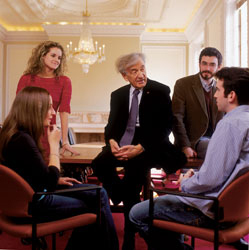
In the classroom with Professor Elie Wiesel. Rabbi Dr. Burger is second from right. Photo by Webb Chappell

Witness is not a book written from the perspective of a distant scholar: Indeed, Burger notes that, “This book is based on twenty-five years’ worth of journal entries, five years of classroom notes, and the interviews with Elie Wiesel’s students from all over the world.” This essential book allows readers to gain a closer look at Elie Wiesel as a scholar, a counselor, and a thinker.  We all know Wiesel the Activist who spent his life working for people suffering everywhere to protest injustice and oppression and to bear “witness,” but there are other more personal dimensions to this story as well. Now we can see Wiesel the Soul. May we continue to be inspired by the life and teachings of Elie Wiesel. We owe Rabbi Dr. Ariel Burger our gratitude for this special opportunity.


Rabbi Dr. Shmuly Yanklowitz is the President & Dean of the Valley Beit Midrash, the Founder & President of Uri L’Tzedek, the Founder and CEO of The Shamayim V’Aretz Institute, the Founder and President of YATOM, and the author of thirteen books on Jewish ethics. Newsweek named Rav Shmuly one of the top 50 rabbis in America and the Forward named him one of the 50 most influential Jews.

The opinions expressed here represent the author’s and do not represent any organizations he is affiliated with.

“Witness”: Ariel Burger shares Lessons from Elie Wiesel’s Classroom Read More »

Warriors Star Visits Israel and Anti-Zionists Lose Their Minds

Draymond Green, the All-Star forward of the reigning champion Golden State Warriors, triggered anti-Zionists with his recent trip to Israel, where he had the opportunity to fire Israeli guns.

Green visited Israel as part of a Friends of the IDF trip, where he met with Israeli President Reuven Rivlin and gave him a jersey.

Rivlin tweeted praise of Green:

Green also learned about Israel Defense Forces (IDF) weaponry and was able to fire Israeli guns:

https://www.instagram.com/p/Bk0iVZCDPiN/?utm_source=ig_embed

Cue the anti-Zionists:

https://twitter.com/ShaunKing/status/1016913297340272640

The Nation’s Dave Zarin wrote that it was “shocking to see Draymond Green smiling and shooting guns in their company.”

“Imagine Green visiting the Ferguson police department while fires were still smoldering in 2014,” Zarin wrote. “He never would have done it, yet this visit was somehow fine: legitimizing a regime that just engaged in a massacre. It was exactly the kind of propaganda trip, embedded in the Israeli military and shielded from Palestinian life, that Michael Bennett and other NFL players refused to participate in last year, because of the parallels between the plight of Palestinians and the #blacklivesmatter struggle against police violence in the United States.”

Those criticizing Green would be wise to read a May column by Jewish Chronicle writer Dan Sugarman, who wrote that he recanted his criticism of Israel’s handling of the Gaza border violence once it became clear that most of the killed Palestinians were Hamas and Islamic Jihad terrorists.

“Shoot at those charging at you and Hamas would have its martyrs,” Sugarman wrote. “Fail to shoot and Hamas would break through the barrier and bring suffering and death – its stated aim – to Israelis living only a few hundred metres away from that barrier.”

Warriors Star Visits Israel and Anti-Zionists Lose Their Minds Read More »

CA Dem State Assembly Candidate Under Fire for Praising Farrakhan and Other Anti-Israel Comments

Maria Estrada, who is running in the for state assembly in Assembly District 63 of southeastern Los Angeles, is under fire from Jewish organizations for her praise of Farrakhan and other anti-Semitic comments.

The Progressive Zionists of the California Democratic Party wrote in a Facebook post about how Estrada once praised Farrakhan’s sermons on Facebook and compared Israel to the Nazis.

“On May 10, 2017 she posted a cartoon replacing the Magen David on the Israeli flag with the swastika of the Nazis, but the next day she apologized for her post,” the Progressive Zionists wrote. “However, on October 6, 2017 she claimed non-Jews could not be Zionists without being influenced by Jewish friends or loved ones. In this same exchange, she commented that she ‘enjoys listening to Farrakhan’s sermons’, as well as claiming Democrats turn a blind eye to Palestinians, and justify it by bringing up the Holocaust. As if what happened 70 years ago justifies what is happening now.’”

Farrakhan, of course, has a lengthy record of vile anti-Semitic comments, including referring to Jews as the “Synagogue of Satan” and promulgating the conspiracy theory that Israelis and Zionists were behind the 9/11 terror attacks.

When asked by The Forward about her praise of Farrakhan, Estrada used the “I am anti-Zionist, not anti-Semitic” defense.

“Listening to Farrakhan doesn’t equate to being anti-Semitic,” Estrada said. “There is no doubt he is wrong on many issues, including Judaism. Listen to him speak on the American media, imperialism and several other issues.”

Additionally, on July 10 Estrada posted a screenshot of the definition of genocide while writing “#FreePalestine” on Facebook. She wrote in another comment, “The argument from Zionists is that the number of Palestinians has grown. Apparently they aren’t killing enough Palestinians for them to consider it a genocide.”

The Progressive Zionists have called on Estrada to drop out of the race.

“Maria Estrada’s repeated expressions of anti-Semitism disqualifies her from seeking public office,” they wrote. “We call on Maria Estrada to resign from this race, apologize for her blatant anti-Semitism, and take the necessary time to consider her harmful and hateful words.”

Other Jewish organizations have criticized Estrada’s statements.

“We are deeply disturbed by Maria Estrada’s comments praising Farrakhan, an avowed anti-Semite who leads a group that traffics in hate not just towards Jews but also the LGBTQ community,” Anti-Defamation League (ADL) Los Angeles Regional Director Amanda Susskind said in a statement sent to the Journal. “Despite his continuing popularity among his loyal followers, Farrakhan’s views about Jews put him far outside of the mainstream.  Such hatred should not be difficult to denounce. We hope that Ms. Estrada will denounce him for the bigot he has shown himself to be.”

Simon Wiesenthal Center’s Associate Dean Rabbi Abraham Cooper and consultant Dr. Harold Brackman wrote in a July 10 Journal op-ed, “Like Farrakhan and other anti-Semites before him, Estrada has taken a page from Farrakhan’s anti-Jewish playbook and invoked ‘God’s Chosen People’ to justify her vilification of Jews, not just Zionists. She apparently took no notice that Farrakhan’s hateful dog whistle also transcends the racial chasm between Black Nationalists and White racist anti-Semites who marched in Charlottesville this past August. Alt-right Charlottesville guru Richard Spencer wants to meet with Farrakhan, to work together toward ‘the sort of self-determination we and the broader Alt-Right support.’”

American Jewish Committee Director of Political Outreach Julie Rayman also rejected Estrada’s “anti-Zionism, not anti-Semitism” defense.

“The Israeli government’s policies, like the policies of any government, are of course subject to criticism,” Rayman said. “Yet the use of Nazi imagery and bigoted tropes against Jews crosses a line into something far more sinister. Ms. Estrada’s comments and posts should be condemned by all people of good will.”

Estrada has not responded to the Journal’s request for comment.

Estrada is currently part of a runoff election with incumbent Democrat Anthony Rendon, the Assembly speaker.

CA Dem State Assembly Candidate Under Fire for Praising Farrakhan and Other Anti-Israel Comments Read More »

Daughter Finds Light in Bernstein’s Shadow

On the cover of “Famous Father Girl: A Memoir of Growing Up Bernstein” (Harper), we see a photograph of two people, one of them iconic and one whom most of us have never seen before.  There’s Leonard Bernstein, handsome and commanding, a conductor’s baton in his right hand, a wedding ring on his extended left hand. And then there’s a little girl seated in front of him as he puts an orchestra through its paces. She looks exquisitely bemused by all the goings-on around her. 

The girl is Jamie Bernstein, and she’s the “Famous Father Girl,” as she was dubbed by a classmate when she was in second grade. Although she characterizes the time and place of her childhood as “a Bernstein-heavy universe,” the story she tells is as much about herself and her family circle as it is about her famous father.  

Her mother was Felicia Cohn, “petite and elegantly beautiful, with a long, swan-like neck.” Born into a privileged family in Chile, Felicia traveled to New York to pursue an acting career, and she had enough Yiddishkayt to name her dog “Nebbish,” although Felicia later complained when her in-laws “Yiddishized my name to ‘Jamela.’ ” The household staff was Spanish-speaking, and her parents were known as “La Senora” and “El Caballero,” an irony that does not escape the grown-up Jamie: “As kids, we had no idea that our father’s background among striving Jewish immigrants in the Boston suburbs might be incongruous with being called a caballero.”

While Jamie fully appreciates her father’s place in the cultural firmament, she also recalls the intimate ways in which a child perceives a flesh-and-blood parent. A “characteristic Daddy smell,” as she puts it, “was the blend of cigarette smoke and flatulence.” And she shares the childhood moment when she tried to get her father’s attention while he was sitting on the toilet, smoking a cigarette and poring over a score. “Oh, I’ll be with you in a minute, darling — let me just finish this movement.” When he realized the double meaning of his remark, “he exploded in laughter.”

Hers was a childhood spent in rarefied circles. “Only much later did I realize how extraordinary it was to be surrounded on a regular basis by (let the name-dropping begin) Dick Avedon, Mike Nichols, Betty Comden and Adolph Green, Lillian Hellman, Steve Sondheim, Jerry Robbins, Sidney Lumet, Betty (Lauren) Bacall, Isaac Stern.” Looking back, she now realizes that the presence of celebrities in the family home was a symptom of his father’s dedication to career. “[T]he membrane between work and play was, for him, virtually nonexistent.”

The story Jamie Bernstein tells is as much about herself and her family circle as it is about her famous father.

By adolescence, however, Jamie was fully aware of her father’s position and the prerogatives that came with it. She was an early and ardent Beatles fan. “To say I was a Beatlemaniac does not begin to convey the depth of my obsession.” And when John Lennon learned that her father was a fan of Lennon’s book of poetry, “In My Own Write,” Leonard was invited to attend the epochal appearance of the Beatles on “The Ed Sullivan Show.” Jamie, of course, came along. The moment when they knocked on the dressing room door for a private audience remains a peak experience: “No actual event in my life would ever be more exciting than the seconds containing that anticipatory knock, on that particular door, on that particular day.”

Some insights took even longer to surface. Her godfather was composer Marc Blitzstein, and she recalls when news reached the family that he had been murdered by sailors on a night out in Martinique. “I didn’t find out for many years that it was a homosexual hate crime,” she recalls, “which must have made the loss even more ghastly for my parents.” And when she describes the much-lambasted fundraiser for the Black Panther Party that her parents hosted in the ’60s, she sees it as the high point in a relationship that would soon go into decline.

“I saw them as they saw themselves in that moment: Lenny working hard, making music, spreading beauty in a tough world — and Felicia, with her passion for social justice, representing their joint commitment to a nation that protected all of its citizens,” she writes. “I could feel how they felt right then: united, aligned, purposeful, loving. They probably never felt quite that good together again.”

As she entered adulthood, Jamie began to understand the backstory of her father’s colorful life.  When she was offered a job at the Tanglewood summer festival, she began to hear “a lot of stories about Leonard Bernstein’s wild youth at Tanglewood — including his amorous escapades with other men.” Much later, Jamie and her siblings learned the truth from a letter their mother had written to their father in the year of their wedding: “You are a homosexual and may never change,” wrote Felicia. “I am willing to accept you as you are, without being a martyr and sacrificing myself on the L.B. altar.”

One recollection struck me as especially resonant. Jamie describes a visit to a disco while on vacation in Vail when she was still a teenager. When the theme from “Zorba the Greek” started to play, her father pulled her onto the dance floor, twirled a handkerchief in the air, and directed her to dance in a circle around him. “What else could I do?” she recalls. “I was trapped: a mortified moon, doomed to eternal orbit around an ecstatic, sweaty, handkerchief-twirling sun.”

And yet, no matter how she experienced her famous father, Jamie Bernstein is the real star of her remarkable and endearing book, a memoir that rings with candor, authenticity and love.


Jonathan Kirsch, author and publishing attorney, is the book editor of the Jewish Journal.

Daughter Finds Light in Bernstein’s Shadow Read More »

Caramel Chicken: A Slanted Door Sensation

One of my pastimes when I’m in the United States is to catch up on the restaurant industry news by reading the trades. It’s one of those double-edged swords to read the trades because you could be tempted to think that every chef is opening one booming restaurant after another. But I know better: Being a successful chef like Jean-Georges Vongerichten, David Chang or Wolfgang Puck, all of whom run highly successful franchises from one corner of the country to the other, is as rare as being an astronaut and probably comes with a lot more agita than working for NASA.

One item that caught my eye was that chef Charles Phan officially shelved his plans to open a much-anticipated Los Angeles outpost of his famed San Francisco eatery, Slanted Door. In 2015, Phan announced that he was excited about the developments taking place inside the City Market South in downtown L.A.’s Fashion District. But as time went on and other chains began opening installations at that venue, for reasons unknown, it seems that Phan’s high-end, modern Vietnamese cuisine and stellar wine list was not going to happen in L.A., after all. 

It is unquestionable that L.A. has the hottest food scene in the country right now, drawing celebrity chefs from both coasts for arguably the best produce in the world and the longest growing seasons. According to industry insiders, the lower cost of living, cheaper labor and high quality of products mean better profit margins for L.A. restaurants over the far more costly options in New York and San Francisco.

Slanted Door’s accolades include “best Vietnamese restaurant in America” and “Mick Jagger’s favorite place to dine in San Francisco.” That’s quite a compliment for Phan, a graphics artist and architect turned chef and restaurateur. Having left one profession to become a chef and restaurateur, I’ve always admired Phan’s story and his cooking style, which is based on his love of his mother’s home cooking. 

One of my favorite dishes and the most popular dish on the menu at Slanted Door is called Silky Caramel Chicken, and once you taste it, you want to keep eating it over and over again. Because Phan has decided to drop L.A. from his list of potential restaurant sites, I’d like to teach you how to make this dish at home, so you can have a small taste of the Slanted Door experience without having to trek to San Francisco. 

 You may not believe me until you make this, but I have never met a soul who didn’t love this dish.

You may not believe me until you make this, but I have never met a soul who didn’t love this dish — little kids and big kids alike, whiners, complainers, foodies, health nuts and everyone else. It’s not particularly healthful or “green,” and it has few vegetables in it. I always serve it over white rice, which is another unhealthful option, but I read somewhere that the combination of garlic and ginger is hugely beneficial.

I usually make this when I feel like something fast or have last-minute company. If you already have cooked rice, this will be your quickest way to a takeout-style stir fry in less time than it takes for takeout to be delivered. It takes only minutes of prep and another 12 minutes to cook. You could jazz it up or down, but I hope you will try the recipe as written before you add any fancy ingredients to it. Remember that I have love in my heart as I say this: Don’t mess around with perfection — just don’t — but that said, feel free to leave out the chiles or ginger when you are making this for kids. 

Although there is an inordinate amount of sugar in this recipe, which I replace with honey, it’s balanced by the salty fish sauce as well as the vinegar. Go with brown rice instead of white if that makes you feel better about the fiber aspect of the dish but know that white rice is traditional here. Sometimes, I like to add roasted peanuts to my caramel chicken, leaving it with a Kung Pao type of vibe. However, it’s just as good, if not preferable, to have it without.  You may want to double this recipe because it’s even better the next day.


CARAMEL CHICKEN

Adapted from the Slanted Door restaurant

SAUCE
1 tablespoon fresh ginger, finely grated
6 cloves fresh garlic, finely minced
1/3 cup honey
1 tablespoon dark brown sugar
1/2 teaspoon freshly ground black pepper
1/8 cup rice vinegar
1/8 cup fish sauce
1 teaspoon soy sauce or tamari
1 teaspoon sriracha hot sauce (optional)

CHICKEN
1 pound (about 5) boneless, skinless chicken thighs, cut into 1-inch pieces
1/2 cup mild red or green chiles (or bell peppers), thinly sliced (optional)
1/4 cup chopped scallions, green parts only
1/4 cup roasted peanuts (optional)

FOR SERVING
2 cups cooked brown or white rice
1/4 cup fresh cilantro leaves, for garnish

Mix sauce ingredients and pour 1/4 cup of sauce on raw chicken to marinate for 10 minutes.

Place oil in wok or cast-iron skillet and heat until shimmering.

Place chicken in one layer in the pan and let cook, shaking or stirring until chicken begins to caramelize on all sides — about 6 minutes. Suddenly, the chicken will become a caramelized, divine-smelling, restaurant-quality pile of golden nuggets.

Add peppers and scallions and stir fry for another minute. Then add remaining sauce and cook for another 5 minutes or so until all the chicken is the color of shellac and sauce has thickened. Throw in roasted peanuts, if using, and serve over rice. Garnish with cilantro. 

Note: Don’t be tempted to use chicken breast for this recipe. It dries out terribly when you try to caramelize it. Skinless, boneless thigh meat won’t dry out and is a great thing here. If you must, use a combination of thigh and breast meat.

Makes approximately 2 servings.


Yamit Behar Wood, an Israeli-American food and travel writer, is the executive chef at the U.S. Embassy in Kampala, Uganda, and founder of the New York Kitchen Catering Co. 

Caramel Chicken: A Slanted Door Sensation Read More »

Familial Bonds in ‘Ant-Man and the Wasp’

Hollywood churns out superhero movies faster than a speeding bullet, films that can seem oversaturated with formulaic stories that prioritize CGI explosions over human emotions. They are often entertaining but rarely contribute anything meaningful to modern culture.

Fortunately, while “Ant-Man and the Wasp” doesn’t skimp on action scenes, it still leaves enough room for laugh-out-loud humor and a large dose of heart and soul. “Ant-Man and the Wasp” is really about the power of family and its timely message makes it a wholesome film that elevates the cultural conversation.

Superheroes have notoriously bad or absentee parents. Superman is rocketed to Earth by his dying father. Spider-Man lives with his aunt because his parents are dead. Batman witnesses his parents’ murder. Wonder Woman grew up without a father and her mother lied about it. Consequently, superhero family life and parenthood, if shown at all, are generally portrayed in a negative light.

But in “Ant-Man and the Wasp,” the family dynamic shines.  The story revolves around three daughters who try to save their parents. In the first “Ant-Man” film, Scott Lang turns his life around to be there for his daughter Cassie, and in the sequel, Cassie literally saves him from a meddling FBI agent. 

The central plot of  “Ant-Man and the Wasp” revolves around Hope Pym and her father, Hank, attempting to rescue Hope’s mother from the Quantum Realm. Ghost, the sympathetic villain, became metaphysically unstable as a child when she tried to save her father from a quantum explosion. The fallout left her feeling constant pain but also enabled her to “phase” in and out of physical space.

“Ant-Man and the Wasp” reminds us that parenting without engagement and direction can be just as harmful as neglect.

After Hope and Hank rescue their mother from the Quantum Realm, Hope heals Ghost using the power of Quantum Energy, cementing the idea that Ghost feels better when a mother takes care of her.

The film highlights how daughters need their parents and that a functional family life is worth saving. “Ant-Man and the Wasp” celebrates family and the special relationship between parents and their children with a wholesome and traditional message.  

In addition, Ghost’s pain is the pain of a child with incredible potential who is neglected or abused by parents who do not provide him or her with the structure necessary to harness their greatness. 

One of the greatest gifts of modernity is the opportunity to explore the world beyond our front door. Good parents support their children on their journeys of self-discovery. They are present physically and emotionally. “Ant-Man and the Wasp” reminds us that parenting without engagement and direction can be just as harmful as neglect. Similarly, suppressing curiosity and withholding the tools of discovery from children robs them of realizing their full potential. 

“Ant-Man and the Wasp” can be used to elevate our conversations with friends and especially family. See it as a family and discuss it as a family. Learn from one another together as a family.

Soulful people should support Hollywood’s virtuous productions like “Ant-Man and the Wasp” and motivate studios to create more wholesome content. By doing so, together we can transform Hollywood into “Holywood.”


Eli Fink is a rabbi, writer and managing supervisor at the Jewish Journal.

Familial Bonds in ‘Ant-Man and the Wasp’ Read More »

Ruth Zukerman Spins Cycling Into Success

Spinning class aficionados know SoulCycle and Flywheel as the biggest names in the indoor bike business, but they may not know that Ruth Zukerman is the woman behind both. 

A divorced single mother of twins, Zukerman spun her love of stationary biking into a multimillion-dollar enterprise with SoulCycle in 2006. After surviving the dissolution of her business partnership, she struck gold a second time, opening competitor Flywheel in 2010. It now has 41 U.S. locations, four of them in the Los Angeles area. The July 13 episode of the PBS series “Breaking Big” chronicles her rise to success.

Zukerman, a former dancer who had given up the dream of dancing professionally in New York, got married and had twin daughters. After her marriage broke up, a friend suggested she try a spin class, and she was immediately hooked.

“There was something about this form of exercise,” Zukerman told the Journal. “It was emotionally cathartic. You can close your eyes and exert all this energy. The movement was choreographed to an incredible playlist, similar to dancing. At the end, you feel euphoric and empowered and that you can handle whatever is coming your way. The whole experience resonated with me. The classes helped me get through my divorce.”

Zukerman loved spinning so much that she became an instructor and joined forces with a friend and an investor to open SoulCycle, which became an immediate success. She didn’t want to divulge the details of the partnership’s demise but said she learned a valuable lesson from it. “Whenever you’re going into a business partnership with anybody, make sure you’re legally protected,” she said. “I did not do that and it cost me a lot.”

Finding even greater success the second time around with Flywheel still surprises her. “I’ve had the tendency to underestimate myself, stemming from self-esteem issues that were ingrained in me growing up,” she said.

The daughter of a physician father and a psychotherapist mother, Zukerman grew up in Roslyn, N.Y., in an affluent, predominately Jewish neighborhood. She was a cheerleader and dancer, popular and a good student, but “had a very tough, challenging mother. She caused some damage. She had a lot to do with my self-esteem problem. I’m still working on that,” Zukerman said. 

“There was something about this form of exercise. It was emotionally cathartic. You can close your eyes and exert all this energy.” — Ruth Zukerman 

Her family, of Polish, Russian and German-Jewish heritage, was Reform, her father’s side more practicing than her mother’s. “I accompanied my father to temple on the High Holidays. After he passed away, I didn’t go to synagogue anymore. It was too difficult for me,” she said. “But as my daughters got older, it became important for me to raise them Jewish, for them to have a Jewish identity. I’m very proud to be a Jew.” Kate and Rachel will turn 28 this month, and Zukerman said she hopes to take them to Israel soon.

Zukerman, who lives on Manhattan’s Upper West Side, continues to teach classes at Flywheel, which is opening a new location in Denver this month. Otherwise, expansion is on hold while she focuses on marketing Fly Anywhere, an at-home bike that incorporates the performance-tracking technology found at Flywheel. 

“I’m proud of my relentlessness, that I persevered through a lot of really tough challenges,” she said. “I didn’t let them get me down and stop me from succeeding again. I picked myself up and started another business on my own. It’s always a struggle for women. We’ve definitely made progress but we have a long way to go. I think that the more examples we see, the more hopeful we are.”


The “Breaking Big” episode featuring Ruth Zukerman airs at 8:30 p.m. July 13 on PBS.

Ruth Zukerman Spins Cycling Into Success Read More »