fbpx

July 6, 2018

Table for Five: Pinchas

Weekly Parsha: One Verse, Five Voices

Why should the name of our father be done away from among his family, because he had no son? Give unto us a possession among the brethren of our father. And Moses brought their cause before the Lord.  Numbers 27:4-5

Rabbi Nicole Guzik
Sinai Temple
I stood in front of a mirror with three of my college girlfriends. The mirror was inscribed with the following: You are beautiful inside and out. The four of us get together once a year and remind one another of what seems so hard to individually internalize. Together, we remember that we are strong, kind, loyal, beautiful women.

Our dinners have no agenda. No judgment. We are women who want to raise strong, kind, loyal, beautiful women, but often let personal insecurities speak over what we know to be core to our character. Although we stood in front of a mirror declaring our worth, the entire dinner was one of reflection and offering. We left feeling full; satiated by friendship and sisterhood. 

It is rare to see a pact of sisterhood in the Torah. The daughters of Zelophehad come forward before the whole assembly. They come forward together. Rashi explains that their individual names are specified to indicate that they were of equal importance. How easily one could have let personal ego trump their collective agenda. How easily one could forget the magnitude of women banding together for a cause and purpose over a brief moment to be perceived as better, smarter, prettier.

The daughters of Zelophehad teach a poignant lesson: Women are stronger as they stand side by side. May our daughters understand that inner beauty pours forth when we stop seeing one another as threats and start seeing one another as sisters. 


Rabbi Silvina Chemen
Kehilat Beth El, Buenos Aires
Excerpted from myjewishlearning.com
The story about Zelophehad’s five daughters — Mahlah, Noa, Hoglah, Milcah and Tirzah — encapsulates the challenges that women faced and what they had to do in order to affirm their rights with dignity.

According to the Talmud (BT Bava Batra 119b), Zelophehad’s daughters were wise (chachamot), astute interpreters (darshanyiot) and pious (rachmanyiot). “Wise” because they spoke in the precise moment when the decision was issued; “interpreters” because they in essence said, “If our father had a son, we would not have spoken — because he would have the inheritance”; and “pious” because they did not want to marry men who were not worthy.

The achievement of Zelophehad’s daughters was a landmark in women’s rights regarding the inheritance of land, from those days up to now.

In addition, the story of these five women offers a compelling lesson for all those who believe their destiny is fixed or that divine justice has abandoned them. It encourages us to think differently and provides a message of hope for all those faced with obstacles.

Perhaps the most important legacy of Zelophehad’s daughters is their call to us to take hold of life with our own hands, to move from the place that the others have given us — or that we have decided to keep because we feel immobile — and to walk, even to the most holy center, to where nobody seems to be able to go.

After all, nothing is more sacred than life itself and the fight for what we believe is worthy.


Rabbi Tal Sessler
Sephardic Temple Tifereth Israel
Professor Yuli Tamir, Israel’s former minister of education, once authored a political article titled “Siding With the Underdogs.” Siding with the underdogs is a seminal feature of the sacred Torah narrative. Judaism commences with a devastating critique of tyrannical empires and its hegemonic values of autocratic power, and the personality cult of its despots. Abraham’s Mesopotamia and Moses’ Egypt constitute a clear case in point. The Torah favors the Hebrews, a dehumanized group of slaves undergoing genocide, over the military and economic might of Egypt. The Torah is indeed “siding with the underdogs.”  

Secondly, the Torah engages once more in what Nietzsche called a “transvaluation of values,” by consistently favoring the younger sibling over the older sibling throughout the intergenerational familial sagas of the book of Genesis. 

The Torah is, among other things, a radical philosophy of the Other. We are commanded no fewer than 36 times to love the Other. 

Our parsha seeks justice for the quintessential Other and underdog of the Ancient Near East: the legal status of women. God himself instructs Moses to safeguard the rights of women to inherit their paternal plot. 

With the inheritance rights of daughters established here, the Torah continues its pattern of undermining prevailing gender roles and the patriarchal structures of its epoch, leaving the work of subsequent expansion of its core values for posterity, a civilizational endeavor which continues to this day, inter alia with the #MeToo movement.


Rabbanit Alissa Thomas-Newborn
B’nai David-Judea Congregation
Rashi explains that when God agreed with the daughters of Zelophehad, God said: “This is the way this section of the Torah is written before Me on high.” And so Rashi concludes, “We learn that the eyes of the daughters of Zelophehad saw what the eyes of Moshe did not.” 

How could these women see what Moshe — the only person who saw God face to face —  could not see? What does this mean?

The daughters of Zelophehad offered a personal lens through which to relate to Torah. They showed us that halachah speaks with relevance to our raw and emotional experiences because Torah is a dialogue between each of us and God. And so, the daughters of Zelophehad took the Torah Moshe saw and they made it their own — as we all must. But perhaps most profoundly, they modeled how to see and share the ongoing revelation of God’s Torah in halachic discourse — with humility, commitment to tradition, and deep love for God. The Midrash tells us they were devout, learned women who turned to Moshe with a legitimate question at the right time.

May we follow in these holy women’s footsteps — each finding our voice and being willing to engage the tough questions of our time with humility and the mission to further unfold God’s Torah on high.  


Rachel Stomel
Center for Women’s Justice, Chochmat Nashim
A wise man once said, “Right is right even if no one is doing it; wrong is wrong even if everyone is doing it.” 

When a wave of sin ensnares the entire nation, a man named Phinehas “rose up from the midst of the congregation” (25:7) to do what is right. Wrong is wrong, even if everyone is doing it. Shortly afterward, the daughters of Zelophehad stand up to economic discrimination in the laws of inheritance: “And they stood before Moses, and before Eleazar the priest, and before the princes and all the congregation” (27:2). Right is right, even if no one is doing it.

After both incidents, God voices approval: Of Phinehas, God assures that “he was very jealous for My sake” (25:11) and similarly emphasizes that “correctly do the daughters of Zelophehad speak” (27:7). A new, eternal law, allowing daughters to inherit from their sonless fathers, is introduced into the Torah because of these women.

But did God really need Phinehas to stand up to his peers? Was God unaware that the law was unjust until the daughters of Zelophehad pointed it out? 

Here’s a radical thought: Perhaps injustice and wrongdoing are built into the divine system so we can be partners in its refinement and hone our own sense of morality and activism. 

Bereshit Rabbah 44 declares, “The commandments were given but for the purpose of refining creation through them.” We are not meant to dismiss our sense of justice when it is at odds with the law. On the contrary! Channel your indignation to make change. 

Table for Five: Pinchas Read More »

Letters to the Editor: Week of July 6

UCLA REACTS TO EVENTS PROTEST
On May 17, the UCLA registered student organization Students Supporting Israel (SSI) sponsored a panel discussion titled “Indigenous Peoples Unite” to discuss the history and experience of Armenian, Kurdish and Jewish people. Protesters entered the room and disrupted the event, intimidating the panelists and interrupting the program (“Protesters Disrupt UCLA SSI Event,” May 25). 

To their credit, the event organizers remained calm and invited the protesters to join the discussion, but the protesters refused to do so. Campus police officers soon entered the room and, consistent with their training, ushered the disruptors out of the room so the event could continue. Although no one was physically hurt, the behavior of those disrupting the event is intolerable; we have activated UCLA’s student conduct process and have provided information concerning some of the protesters who are not students to the Los Angeles City Attorney’s Office for review. 

This entire academic year, UCLA has worked hard to design policies that manage speech and protest during major events. Although we have done so successfully for various large-scale events, smaller ones such as the May 17 event did not trigger the preparation that might have helped minimize the disruption. Moving forward, we plan to increase our vigilance as well as improve education and training so that the basic rules of engagement are clear. UCLA respects freedom of speech and the freedom to engage in lawful protests, but we will not tolerate disruptions that are so severe as to prevent speakers from reaching a willing audience or prevent an event from proceeding. 

Multiple campus departments, including campus police and Student Affairs, are working together to ensure that our policies are understood and followed, and if violated, enforced. 

Despite this incident, we are proud to host a wonderfully diverse community, including Jewish students, staff and professors who have created a vibrant Jewish community on our campus. Jewish students receive the same protections as any other students here at UCLA, regardless of their religious or ethnic identities or political beliefs. We will hold everyone to the same standards,suchthateveryorganization, community or identity group can share their ideas and exchange their views without the bullying tactics we saw at the May 17 event. At UCLA, this is what we stand for.

Jerry Kang
Monroe Gorden
Kang is UCLA’s vice chancellor of equity, diversity and inclusion. Gorden is the vice chancellor of student affairs. 


PEACE PLANS LIKE GAME OF CHANCE
It is unreasonable and presumptuous for Shmuel Rosner to reject Washington’s new Israeli-Palestinian peace plan without knowing what the plan contains (“Rejecting Peace, Free of Charge,” June 29). Your readers would expect Rosner would give peace a chance, especially given the heavy costs of the Israeli-Palestinian conflict. 

President Donald Trump appears to view his plan as the basis for Israel-Palestine negotiation, while the right-wing Israeli government appears opposed to peace negotiations. No wonder the government hopes the Palestinian Authority will say no to the plan so Israel can blame the Palestinians for its failure. Peace advocates, on the other hand, hope the Palestinians will use the plan to restart negotiations.

Barry H. Steiner
Professor Emeritus of Political Science, Cal State Long Beach 


TROUBLE WITH DEMONIZING TRUMP
In his column “Charles Krauthammer and July 4th” (June 29), David Suissa tactfully blames both political parties for rising incivility, but the new Democratic policy of “public shaming” is over the top. 

To his credit, Sen. Chuck Schumer criticized Rep. Maxine Waters’ call for public harassment of President Donald Trump’s Cabinet members, but most Jewish liberals are afraid to speak out. The decision of Jewish liberals to join the demonization of Trump has been a disaster from the start. The Democratic boycott of the Jerusalem embassy dedication, for example, was an insult Israelis won’t soon forget. And what did we get for it? Jews are still detested by “progressive” liberals who rail against “white privilege” and think Jews are the worst examples of it. 

Rueben Gordon via email 


WHY JEWS BECOME REPUBLICAN
Steven Windmueller has written an insightful exposition of the philosophical and political differences between Jewish conservatives and liberals (“Jeffersonian vs. Jacksonian Jews,” June 22). But in a certain way, I think he puts the cart before the horse. 

Many Jews who grew up as liberal Democrats joined the Republican Party because they decided that party is better for Israel, a subjective and debatable proposition. After becoming Republicans, they then adopted many conservative views on domestic issues. 

As a moderate Democrat who loves Israel, I find it impossible to become a Republican. To me, the Republican Party has long been the party of selfishness (guns), greed (taxes) and intolerance (immigration). In the past decade, it has also become the party of lies, demagoguery and authoritarianism. These are not my idea of Jewish values. 

Surely, there must be a way for Jewish Republicans to support Israel without abrogating such central Jewish values.

Michael Asher via email 


DARK DAYS OF THE ALTALENA
I was pleased that the Journal ran the story of the Altalena, which happened 70 years ago, and chose a cover photo of the ship in dark and gray colors (“Sinking the Altalena,” June 22). 

Indeed, this was a dark time in the beginning of the new State of Israel. It is important that David Suissa wrote in the same issue of the Journal that we have to “struggle with our demons.” The Jewish media and community will generally not present this story as the Journal did, perhaps in an attempt not to deal with those dark days and not to be blamed for evil deeds. 

We should never forget the dark days in the history of Israel and we must learn the lessons for the next generations. I’m glad that Israeli President Reuven Rivlin feels the same way.

Tamar Youssefian via email 


TIME TO SOLVE IMMIGRATION ISSUE
Governmental agencies must consider unintended consequences when estab- lishing laws and policies. Just because a cause seems compelling does not mean that Congress, the president or the courts should rush blindly to “fix it” without con- sidering consequences. 

Such is the case with immigration, asylum and, currently, migrant child separations (“Immigration Attorney on the Nuts and Bolts of Migrant Child Separations,” June 29). There is a legal procedure for foreigners to apply for immigration or claim asylum. Many do and many also cross the border illegally. When this happens, they are usually incarcerated until a court decides what action to take. When a woman is incarcerated, the normal and safest approach is to not have her child incarcerated with her — bad people are in jails. If a citizen or legal resident is convicted of a crime and is sentenced to prison, her child or children do not accompany her. Why is migrant child separation any different? 

We are a generous and sympathetic country, but we cannot take in an unlimited number of migrants. There must be reasonable limits. It is past time that we find a sensible solution to the immigration and asylum problem that shows compassion but that also works for our country. 

C.P. Lefkowitz Rancho Palos Verdes 

IfNotNow Contradiction 

The story by Gil Troy explained how the anti-Israel organization IfNotNow teaches young Jews to view Israel only through the prism of Hamas and the Palestinians and to continuously protest against Israel (“The New Jewish Temper Tantrum,” June 8). Yet, two weeks later, in your What’s Happening section, you then promote IfNotNow with an item about its (anti- Israel) film series and its latest film. In 14 days, did you change from being pro-Israel to anti-Israel? 

Richard Melman via email 


NEW JCC ON THE WESTSIDE
I read Steven Windmueller’s story “A Deep Dive into Jewish L.A.” (June 29). The story provides an overview of the religious, cultural and political components of Jewish Los Angeles as a part of community building. Interestingly enough, it does not talk about actual “Jewish Community Centers” being a part of the “community building.” 

My husband and I recently moved from Orange County to West Los Angeles. We resided in Orange County for 30 years. We were active at the Alpert JCC in Long Beach and the Merage JCC in Irvine. Much to our dismay, we have not found a Jewish Community Center on today’s Westside that provides similar opportunities to meet our needs. 

To me, this is a travesty. Although the JCC on Olympic near Fairfax is named the Westside JCC, the Jewish population has migrated much farther west to cities such as Santa Monica, Venice, Pacific Palisades, West Los Angeles, Brentwood and Beverly Hills. The entire Los Angeles Jewish community should be entitled to a state-of-the-art JCC on the Westside that offers an array of intergenerational social, religious, cultural and educational programming and services. 

The visionaries of our synagogue, Wilshire Boulevard Temple, were able to think outside the box and create a thriving second synagogue/campus on the true Westside at Barrington and Olympic. Surely, the Los Angeles Jewish community, perhaps with the assistance of The Jewish Federation, should be able to raise the necessary funds to build a state- of-the-art JCC that is truly on the Westside.

Melanie Alkov Los Angeles 

Letters to the Editor: Week of July 6 Read More »

Yad Vashem Slams Joint Israel-Poland Statement on Revised Holocaust Law

Poland’s heavily criticized law criminalizing speech about Poland’s role in the Holocaust was revised on June 27 to rescind jail time, prompting a joint declaration of victory from Israel and Poland. However, Yad Vashem slammed the joint declaration as revisionist history.

The joint statement, issued by Israeli Prime Minister Benjamin Netanyahu and Polish Prime Minister Mateusz Morawiecki, stated “that the term ‘Polish concentration/death camps’ is blatantly erroneous and diminishes the responsibility of Germans for establishing those camps.”

Yad Vashem agreed that it was inaccurate to use such a term, but they were irked with the joint statement’s claim Poland’s Government-in-Exile and various underground Poles attempted to help the Jews.

“The existing documentation and decades of historical research yield a totally different picture: the Polish Government-in-Exile, based in London, as well as the Delegatura (the representative organ of this Government in occupied Poland) did not act resolutely on behalf of Poland’s Jewish citizens at any point during the war,” Yad Vashem said in a statement on their website. “Much of the Polish resistance in its various movements not only failed to help Jews, but was also not infrequently actively involved in persecuting them.”

The statement added that Polish aid to the Jews was “relatively rare,” whereas it was quite common for there to be attacks against Jews in Poland. Those that did try to help Jews were just as scared their fellow Poles as they were of the Nazis.

The statement concluded that it wasn’t enough to only repeal the criminal statute.

“The repeal, however, reverses the explicit exception that was made for academic research and artistic endeavor in the wording of the amendment,” the statement read. “Other sections that remain unchanged make it actionable under civil law to impugn the good name of the Polish State and the Polish Nation.”

Yad Vashem concluded, “Our stance in principle is that any attempt to limit academic and public discourse on historical issues to a single unchangeable national narrative by means of legislation and punishment is inappropriate and constitutes a material infringement of research.”

Yad Vashem Slams Joint Israel-Poland Statement on Revised Holocaust Law Read More »

Ancient DNA - A Poem for Haftarah Pinchas by Rick Lupert

Ancient DNA – A Poem for Haftarah Pinchas by Rick Lupert

When I had not yet formed you in the womb, I knew you
Jeremiah 1:5

Jeremiah – still, still, still not a bullfrog
afraid of his Father, cowers like a child
afraid the words that will emerge from
his mouth, will be the words of a child,

has forgotten Who put the words in there
has forgotten Father has known him
since the womb, since before the womb.
A bond formed by an incomprehensible

fusion of holy DNA. Jeremiah, the
forever child, sees the almond tree
Father planted, sees the bubbling pot.
Sees the trouble brewing in the north.

Is given the confidence to prevail there.
And so too it is with our children.
Our children who we know since
before they the womb. Our children

whose words we parse like scientists.
Our children whose DNA is our DNA.
We just travelled through the south,
through cities our northern friends said

we should boycott, whose people we
found to be more friendly than family
only to arrive home and reacquaint

ourselves with the ancient trouble
in the north. Trust your ancient DNA
when you go to where you go.
The north shall rise again.


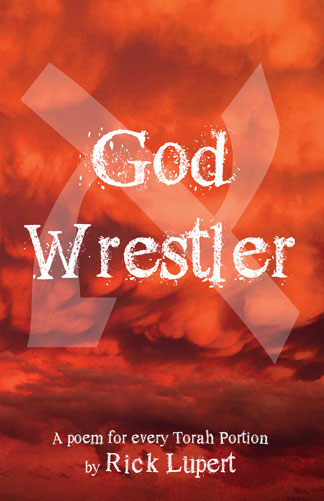
God Wrestler: a poem for every Torah Portion by Rick LupertLos Angeles poet Rick Lupert created the Poetry Super Highway (an online publication and resource for poets), and hosted the Cobalt Cafe weekly poetry reading for almost 21 years. He’s authored 22 collections of poetry, including “God Wrestler: A Poem for Every Torah Portion“, “I’m a Jew, Are You” (Jewish themed poems) and “Feeding Holy Cats” (Poetry written while a staff member on the first Birthright Israel trip), and most recently “Beautiful Mistakes” (Rothco Press, May 2018) and edited the anthologies “A Poet’s Siddur: Shabbat Evening“,  “Ekphrastia Gone Wild”, “A Poet’s Haggadah”, and “The Night Goes on All Night.” He writes the daily web comic “Cat and Banana” with fellow Los Angeles poet Brendan Constantine. He’s widely published and reads his poetry wherever they let him.

Ancient DNA – A Poem for Haftarah Pinchas by Rick Lupert Read More »

Rosner’s Torah Talk: Parshat Pinchas with Rabbi Michael Wolk

Rabbi Michael Wolk grew up on Long Island and studied at the Jewish Theological Seminary and Columbia University.  He attended rabbinical school at JTS and has been the rabbi of Keneseth Israel Congregation in Louisville since 2012.  As someone who spent his formative years in the large Jewish community of NY, he has enjoyed learning about the deep roots of and being part of a smaller Midwestern community.  Rabbi Wolk is an avid fan of European cantorial music and is proud of having learned Nusach HaTefillah in classes at JTS, HUC, and YU; the schools of three different denominations.

This week’s Torah Portion – Parashat Pinchas (Numbers 25:10-30:1) – begins with Pinchas being rewarded for his problematic act of killing the Israelite and his Midianite paramour in the previous portion. A census is then conducted and God tells Moses how to divide the land between the tribes and people of Israel. The five daughters of Tzelafchad ask Moses to grant them the land of their father, who died with no sons, and God accepts their claim and adds it to the Torah’s laws of inheritance. Moses names Joshua as his successor, and the Parasha ends with a detailed list of daily offerings and of offerings brought on different holidays. Our talk focuses on the leadership transition from Moses to Joshua.


https://www.youtube.com/watch?v=25JnMBG15SI&feature=youtu.be


Previous Talks on Pinchas:

Rabbi Roberto Arbib

Rabbi Shmuel Goldin

Rabbi Annie Tucker

Rabbi Stuart Weinblatt

Rabbi Alexander Davis


Rosner’s Torah Talk: Parshat Pinchas with Rabbi Michael Wolk Read More »