
Middle Schools’ Program Breaks Barriers Between Muslim and Jewish Students
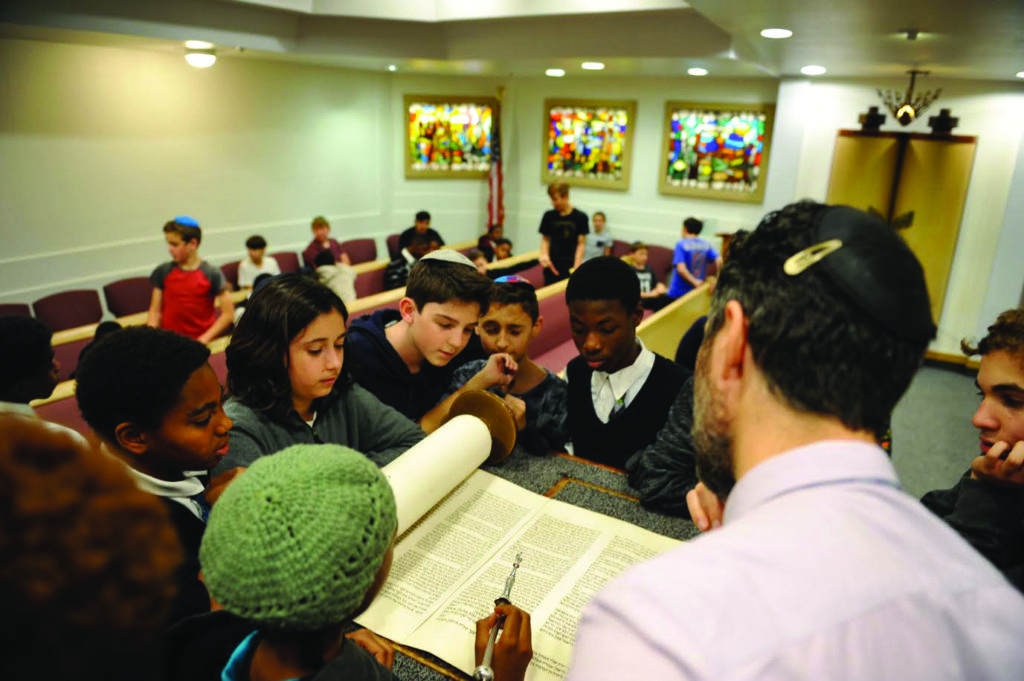
Seventh-graders at Temple Beth Am’s Pressman Academy in the Pico-Robertson neighborhood and at the Islah Academy Muslim school in South Central Los Angeles recently discovered that despite their different ethnicities, religions and backgrounds, they had much in common.
“Out of all of the amazing experiences with you, my favorite one was learning about Muslim traditions, prayers and holidays,” 12-year-old Pressman student Molly Menashe wrote in a letter to her new Muslim friends at the end of their school-year’s pilot program. “It is one thing to learn about Islam in a textbook, but it is so much more meaningful to learn about it by observing you pray and creating friendships with you. I hope the experience has been meaningful to you, as you have learned more about Judaism and our traditions and rituals.”
The program was created last year by Pressman’s Rabbi Chaim Tureff and Islah’s Principal Azizah Ali-Regan. The students met for the first time in October at Kenneth Hahn State Park in Baldwin Hills. They followed up with three face-to-face meetings at the two schools and a final video conference at the end of the school year.
“We tried to base the visits on doing activities together, some sort of learning together, then eating together and playing together,” Tureff told the Journal in a phone interview. “When Azizah and I met and planned out the year, we thought that the best thing to do was start by meeting in a neutral place so everyone was comfortable.”
Tureff said that while there was some initial apprehension from parents at both schools (some wouldn’t let their kids have their pictures taken with students from the other school, and others kept the kids home on days of the activities), the majority were supportive.
“For me, it was something that our community really needed to do to branch out,” Ali-Regan told the Journal by phone. “I think it was instrumental, because the students were able to convince their parents that this type of dialogue, this type of collaboration, is necessary.”
For the first meeting, Tureff wrote some questions to get the conversations started. “[The students] talked about different things that were challenging for them that were the same at both schools,” he said, “like prayer, or learning the Torah or learning the Quran, or the dress code — things that all middle school students go through. They started to find some common ground.”
After lunch, the Pressman students watched the Islah students’ afternoon prayer service, and the afternoon ended with group singing. As the year progressed, the students took trips to the other group’s school, and visited their respective synagogue or mosque.
“It is one thing to learn about Islam in a textbook, but it is so much more meaningful to learn about it by observing you pray and creating friendships with you.” — Molly Menashe, 12
When the Pressman students visited their new friends at Islah, they worked together in small groups to make emoji pillows. When Islah students came to Pressman, they all made tzedakah boxes. “We talked about charity and what it means in the Quran and what it means in the Torah,” Tureff said.
“It was all heartening,” Ali-Regan said. “Our students had never been in a facility like a temple, and some of their students had never been in a mosque. Just to be able to be invited in and to look at each other’s sacred text and to have an appreciation for it,” she said. “We have all these misconceptions about each other’s faith and religion, but for me, I think it was so interesting because the students were really focusing on the things we have more in common.”
Ali-Regan’s and Tureff’s hopes were realized in the end-of-year letters written by the students. “When I first got to the Islah Academy I was really uncomfortable because it was something new,” Pressman’s 13-year-old Sam Lininger wrote. “Eventually, I just got out of my comfort zone because of how welcoming everyone was. From all these visits I have learned that we really all have the same beliefs and we just show them in different ways.”
For Tureff, the program was the culmination of a long-held dream. He has been working at Pressman since 2002, and when he became the school rabbi in 2009 he immediately began looking for ways to partner with other communities. He established a partnership with a nearby Catholic school for a couple of years but “It wasn’t what I envisioned,” he said. “Because our kids live in such a bubble, I felt it was important to reach out to the greater Los Angeles community.”
Then, at a conference in 2015 designed for educators seeking partnerships with schools of different faiths, Tureff met Ali-Regan. But it wasn’t until Ali-Regan became the principal of Islah Academy that the two educators had the opportunity to establish the program.
Tureff hopes students on both sides take the experience with them, so “they can stand up and say something when somebody says something that’s not true,” he said. “It’s not necessarily that you’re going to change anybody, but you might.”
Pressman’s Zoe Green, 12, certainly has taken the experience with her. “This whole year we have been learning and growing and talking about what nobody talks about when they first meet. Religion,” she wrote in her letter. “We don’t need the same religion to be friends, we don’t need to believe in the same things, celebrate the same holidays. The only thing we need is our voices and our hearts to make friends.”
Buoyed by the success of this first year, Tureff and Ali-Regan have plans to continue and expand the program, including adding a parent education component.
“With so much going on in our world, it was a beautiful opportunity to educate and break down some barriers,” Tureff said. “It was incredible. I thought we brought some light into the world.”
Middle Schools’ Program Breaks Barriers Between Muslim and Jewish Students Read More »

