fbpx

May 23, 2018

Intimacy, Irony Suffuse Barak’s Memoir

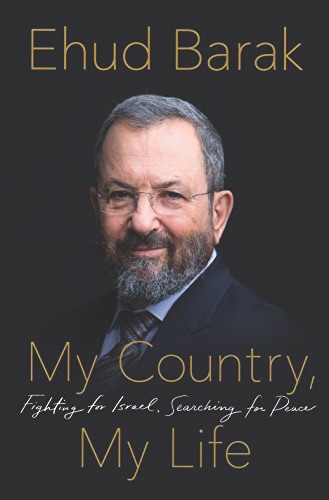
A poignant and chilling story about the 1972 hijacking of a Sabena airliner is told by Ehud Barak in his newly published memoir, “My Country, My Life: Fighting for Israel, Searching for Peace” (St. Martin’s). As commander of the special forces of the Israel Defense Forces (IDF) known as Sayeret Maktal, it was Barak’s responsibility to choose the men for the rescue mission. Two brothers, Yoni and Bibi, volunteered for the crucial but dangerous assignment.

“We want you to decide,” they said. On that day, Barak chose the younger brother. “Today it’s Bibi,” Barak said. “But Yoni, this is not our last operation. I will make sure you are there the next time.”

Bibi, of course, was Binyamin Netanyahu, and Yoni was his older brother, Yonatan. The retelling of the incident allows us to see the current prime minister of Israel at an early and decisive moment in his long career, a private encounter that only Barak or Netanyahu himself is able to share with us. Beyond that, of course, Barak allows us to witness the tragic irony of the 1972 incident — Yoni was later sent on the rescue mission to Entebbe, where he was fated to be the only Israeli soldier to lose his life.

The same intimacy and irony suffuses all of Barak’s memoir. Barak is not merely writing about history; he was an active participant in the history of Israel as described in “My Country, My Life.” Barak is among the most decorated soldiers in the history of the IDF. Famously, he put on makeup and women’s clothing during a clandestine operation in Beirut to assassinate the Black September terrorists who carried out the slaughter of Israeli athletes at the Munich Olympics. As prime minister of Israel, he sat across the table from Yasser Arafat at the Camp David summit in 2000, coming as close as any Israeli government official so far to achieving a two-state solution. He has known and served with virtually all of the key figures in the history of Israel since he first put on an IDF uniform in 1959, “three months shy of my eighteenth birthday.”

Barak’s memoir often reads like a breathless international thriller or a blood-and-guts war story, and it rings with the kind of authentic and colorful detail that only a first-hand participant can bring to the narrative. I was fascinated to learn, for example, that Barak favored a .22-caliber Beretta pistol to the Uzi machine gun for use in an operation like the storming of a hijacked airliner because the smaller weapon is more practical in confined quarters. And Barak reveals that he came within shooting distance of Arafat during a 1968 military operation in Jordan, but the Palestinian leader was able to escape the field of battle on a motorcycle. Indeed, Barak knows what constitutes an “existential threat” to the State of Israel with more precision than most observers of the Middle East because he has held the weapons of war in his own hands and commanded countless others in battle.

“This book is only partly the story of my life. It’s also about Israel, the country whose birth I had the privilege of witnessing, and with which I’ve shared childhood and adolescence and, now, its increasingly troubled middle age.” — Ehud Barak

“This book is only partly the story of my life,” he explains. “It’s also about Israel, the country whose birth I had the privilege of witnessing, and with which I’ve shared childhood and adolescence and, now, its increasingly troubled middle age. I want not just to chronicle my country’s, or my own, achievements along the way. I am also determined to document the setbacks. The mistakes. Misjudgments. Missed opportunities. And the lessons that we can, and must, learn from them.”

Who is better qualified to assess the policies of the government now headed by Bibi Netanyahu than his former commanding officer? And, while Barak credits “Bibi’s mix of strength, endurance and luck” for his successes as a soldier in the IDF, he is more critical and demanding when it comes to Netanyahu’s statecraft. “My concern is the vision he is peddling, at home and abroad, about Israel, the notion that we are too weak to confront whatever dangers might threaten us,” Barak writes of Netanyahu. “Having spent half my life in the military and nearly a decade as prime minister and defense minister, I’m in a better position than most to know this is nonsense.”

Barak is one advocate of making peace with the Palestinian Arabs who cannot be fairly accused of passivity or pacifism. On the eve of the mission in Beirut, which ended the lives of three high-ranking Palestinian leaders, he explained to the men under his command why it was necessary to do so: “I said that what we were being asked to do in Beirut was not an act of revenge but a preemptive attack, and a deterrent,” he writes. “It was a way of preventing the people we were targeting from unleashing further Munichs, and leaving no doubt in the minds of potential future terrorists that their acts would carry a heavy price.”

As the last member of the Labor Party to serve as prime minister since 2001, Barak also recognizes that he must stand up for a vision of Zionism that was once the official policy of the Israeli government but is not much talked about nowadays.

“Senior right-wing cabinet ministers like Defense Minister Avigdor Lieberman and Education Minister Naftali Bennett are committed to establishing a ‘Greater Israel’ with permanent Israeli control over all the West Bank territory we’ve held since the Six-Day War a half century ago,” Barak writes. “That’s bad for the Palestinians, of course. But, just as when I went to Camp David, my overriding concern is what it would mean for Israel. This Greater Israel will unquestionably be larger in terms of territory. Yet it shows every sign of being smaller in other ways — less cohesive, less Jewish, less open and democratic, and more isolated — both internationally and from diaspora Jewish communities — than the state whose embattled beginnings I witnessed as a child seventy years ago.”


Jonathan Kirsch, author and publishing attorney, is the book editor of the Jewish Journal.

Intimacy, Irony Suffuse Barak’s Memoir Read More »
Nell Scovell on Surviving the Hollywood Boys’ Club

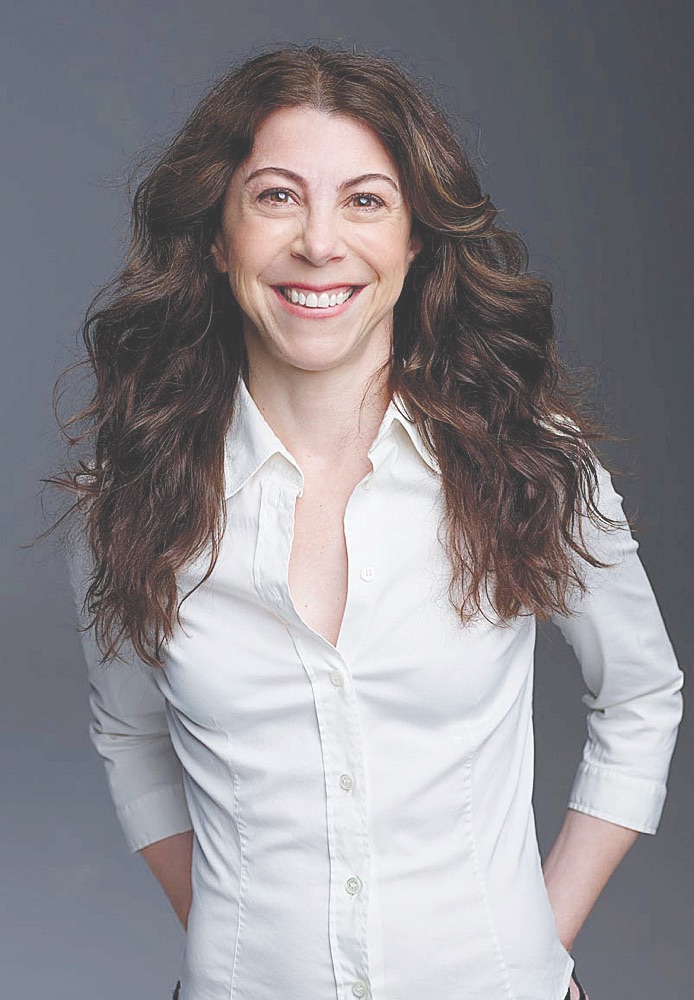
Nell Scovell is one of the few women who has managed to carve out a strong writing career in the male-dominated world of television. She created the series “Sabrina the Teenage Witch” and worked on such shows as “The Simpsons” and “NCIS.”

As a journalist, she’s contributed to Vanity Fair, Vogue and Rolling Stone. In March, she released a book about her experiences, titled, “Just the Funny Parts … And a Few Hard Truths About Sneaking Into the Hollywood Boys’ Club.”

In a recent event at the Skirball Cultural Center, Scovell appeared alongside television writer, director and producer Greg Daniels (“The Office”) and late-night talk show host Conan O’Brien. The trio’s friendship dates to 1987, when they were all young, unknown writers on a short-lived variety show called “The Wilton North Report.”

Scovell told attendees about her stint as a high school sports reporter for The Boston Globe. Daniels talked about his gig as an SAT tutor. O’Brien recalled his time as a salesman at Wilson’s House of Suede & Leather.

When O’Brien complimented Scovell on her ability to craft jokes, Scovell said it was her father who trained her to come up with lines quickly. She cited her work compiling Top 10 lists for David Letterman and recalled one from the Top 10 Least Popular Summer Camps: “Camp Tick in beautiful Lyme, Connecticut.”

“My book ‘Just the Funny Parts’ could easily have been ‘Just the Angry and Bitter Parts,’ but that would have been an eight-volume set.” — Nell Scovell

The three also talked about the high failure rate of comedic ideas and the tenacity required to move from project to project.

“People only see the stuff that really works,” O’Brien said, “but to get there, you have to go through reams and reams of yellow pads of s— that never gets produced.”

Scovell said she felt the same way about her book. The title, “Just the Funny Parts” could easily have been “ ‘Just the Angry and Bitter Parts’,” she said, “but that would have been an eight-volume set.”

As only the second woman to write for David Letterman, Scovell took a bold step in 2009 when CBS News producer Robert Halderman discovered a diary that revealed Letterman had been having an affair with his assistant, Stephanie Birkitt. Halderman then attempted to blackmail Letterman.

In the wake of the scandal, Scovell wrote an article in Vanity Fair, calling out the lack of gender diversity in late-night TV writers’ rooms — and a hostile, sexually charged atmosphere at the Letterman show in particular. The piece inspired a cultural debate and eventually led to Scovell collaborating with Facebook Chief Operating Officer Sheryl Sandberg on the book “Lean In,” which created a worldwide movement. Sandberg wrote the foreword to Scovell’s book.

Scovell’s speaking out came almost eight years before the #MeToo movement, and in her book she notes how standing up really helped her find peace and purpose in life.

“Combining passion and mission is a clear path to happiness,” she writes in the book. “Nothing is more satisfying than having a positive impact on people’s lives. This realization also explains why I love writing jokes. On a much smaller scale, laughter is a sign of impact. That impact may be fleeting. … But for me, that moment is bliss.”


Mark Miller is a humorist and stand-up comic who has written for sitcoms. His first book is “500 Dates: Dispatches From the Front Lines of the Online Dating Wars.”

Nell Scovell on Surviving the Hollywood Boys’ Club Read More »

Creativity in Two Shakes of a Goat’s Tail

My writing had gotten stale. I needed a creative boost. I’d taken workshops over the years, but I always had the nagging feeling that they lacked something. What could it be? A celebrity instructor? Genius students? A tropical location? No. As it turned out, the thing that was missing from my classes was baby Nigerian dwarf goats.

If browsing through my Facebook feed has taught me anything over the past year, it’s that goat encounters are all the rage. I learned I could sign up for writing, drawing and painting workshops, and even yoga classes — all featuring goats enhancing the experience.

The workshop I chose was titled, “Write, Create & Laugh With Baby Goats: A Workshop for Creativity, Joy & Well Being.” Instructor Terrie Silverman of Creative Rites first had encountered the goats at a goat yoga workshop and immediately thought their benefits could be applied to writing. She proceeded to put together a program, in conjunction with Michelle Tritten of Hello Critter, owner and caretaker of the goats.

Her pitch to attendees was, “You’ll commune with the baby goats while being led through fun writing, drawing and mindfulness exercises, to release the critic, create from a place of joy and acceptance, and tap into the wisdom, whimsy and Zen of the baby goats.” That sounded way more enjoyable than my college seminar, “Style and Tone in Faulkner and Hemingway.”

When I arrived at the arts studio on Larchmont Boulevard, Silverman welcomed us and introduced us to the two goats, Billy and Burlap. My attention was absorbed by these gentle, short-attention-span creatures. Silverman had us take out our notebooks and pens as she posed a number of thought-provoking questions. While watching and petting these adorable goats, I wrote and shared with the others what I noticed about the goats and myself, what I thought the world looked like to them, what the goats could teach us, and how they affected me.

My brief experience with the goats inspired me to savor the moment, be in touch with my instincts, not get bogged down with words, remember to play and not take myself so seriously.

My fellow goat writers and I agreed that after even just a short time with these wonderful creatures, they helped us to not care as much what people think and develop more of a single-minded focus.

But perhaps we were still too much in our heads, thinking instead of feeling. And so, drawing paper and crayons were distributed. Our assignment was to let go of our inner critic and create a picture of how the goats made us feel. I hadn’t colored with crayons since kindergarten. It felt therapeutic.

I left the workshop feeling far less creatively stale. My brief experience with the goats inspired me to savor the moment, be in touch with my instincts, not get bogged down with words, remember to play and not take myself so seriously.

Could this goat thing be more than a wacky California trend? Maybe if we hung around animals more often, there’d be less need for medication and therapy, and less bad behavior. Or at least less stale writing. So, don’t be surprised if you run into me shopping for my emotional support goat.


Mark Miller is a humorist and stand-up comic who has written for sitcoms. His first book is “500 Dates: Dispatches From the Front Lines of the Online Dating Wars.”

Creativity in Two Shakes of a Goat’s Tail Read More »

Comedians Stand Up for Judaism

For years before they met, Los Angeles-based stand-up comedians Natasha Leggero and Moshe Kasher traveled alone on the road.

Today, having now been married for three years, and as parents to a newborn daughter, the couple are able to work together and travel wherever they want.

As individuals, both achieved acclaim on stage and on major late-night television shows. Together, their recent gig in Austin, Texas, was filmed and turned into their new Netflix special, “The Honeymoon Stand-Up Special.” In it, Leggero and Kasher perform two separate sets, then go onstage to roast other couples in the audience.

“We started thinking we could travel together just doing our stand-up,” said Kasher, 38, in a phone interview with the Journal. “We talk about our marriage on stage and do live relationship counseling with couples [in the audience].”

Leggero, 44, was heavily pregnant while filming the special. Onstage, she wore a short, glittery dress with a massive fur coat, which emphasized her belly.

“I was Catholic my whole life, but obviously not practicing, because I’m also intelligent.” — Natasha Leggero

“Having a baby and being pregnant is definitely a new experience,” Leggero said. “It’s something to write jokes about, and it’s something new that’s happening to you. It’s kind of miserable, which for me is always the best for comedy. When you’re falling in love or getting married, or having a TV show, those things feel good but sometimes they’re not the best thing for comedy.”

Kasher joked, “Natasha likes to perform while miserable because her audiences are also miserable while she performs.”

At one point in the show Leggero joked, “I am pregnant. Please, hold your applause. I’m still in the abortion zone.”

In his act, Kasher joked that people were trying to persuade him that being a parent was the greatest thing in the world. “It feels like they’re trying to convince me to eat sh–,” he said.

Kasher and Leggero dated for three years before marrying. During that time, Leggero took conversion classes with Conservative Rabbi Neal Weinberg at Judaism By Choice in Pico-Robertson. The couple attended the course’s 19, four-hour-long classes, where they learned about Shabbat, the prayers and wedding customs.

“The rabbi makes these classes available every single night except for Friday,” said Leggero. “It’s intensive. There’s not even a bathroom break.”

“The rabbi comes into the bathroom, stands behind you as you urinate,” Kasher quipped, “and sings ‘Adon Olam,’ because there’s no rest for the wicked.”

The two were married in their backyard in Los Angeles in 2015. They hold Shabbat dinners every Friday night.

“I was Catholic my whole life, but obviously not practicing because I’m also intelligent,” Leggero said. “The Shabbat practice is really the jewel of Judaism. If I could just do that, and also share it with my child, I’d be really happy.”

Kasher, who has a Chasidic father and whose brother is David Kasher, the newly appointed associate rabbi at IKAR, said, “As a typical convert, Natasha is very evangelical about us keeping Shabbat. Every Friday, she is the one who says we have to light candles, we have to do Shabbat. It definitely is a big part of our lives.”

For now, Friday nights are spent at home, as Kasher and Leggero raise their baby. But they hope to be able to go on the road together again. “I know I’m not doing another special while pregnant,” Leggero said. “I’d like to wait for our darling child to be 4 or 5 so she can open for us.”

“The Honeymoon Stand-Up Special” is currently streaming on Netflix.

Comedians Stand Up for Judaism Read More »

Religion Lost and Found in ‘The Last Schwartz’

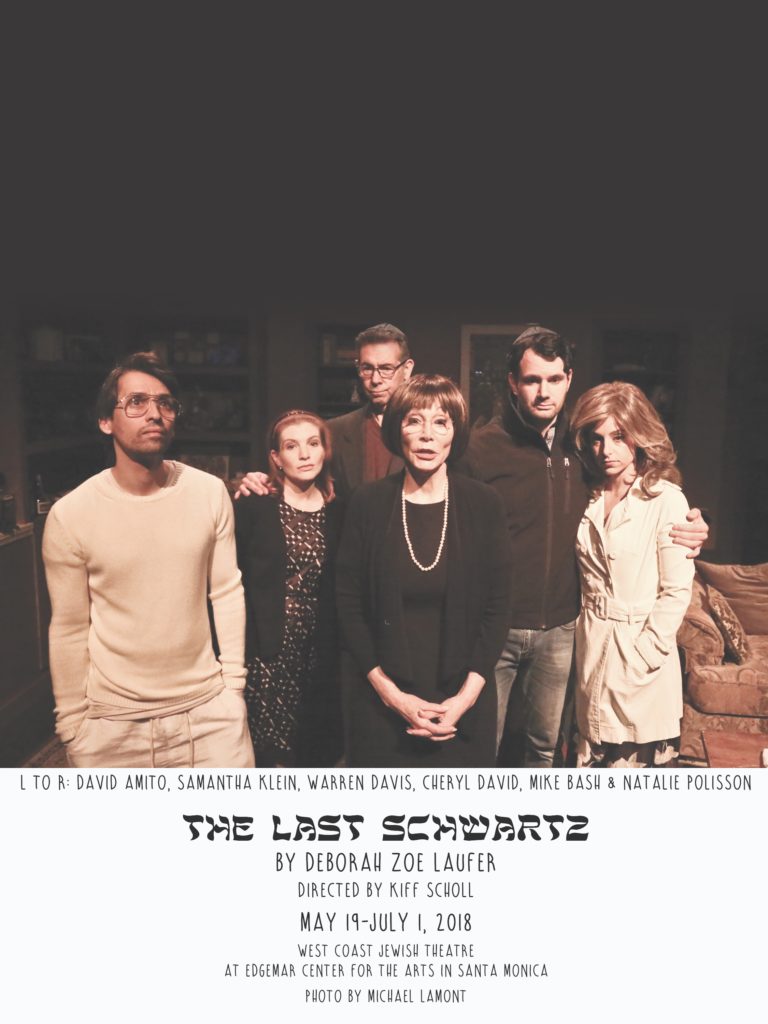
Family dysfunction is mined to darkly comedic effect in the West Coast Jewish Theatre production of Debra Zoe Laufer’s “The Last Schwartz,” the play’s first Los Angeles staging in 10 years.

It’s set on the anniversary of the family patriarch’s death, and the adult siblings have gathered in the parental home for the yahrtzeit. Their petty arguments play for laughs, but deep-seated resentments and differences emerge that are a lot more serious.

“It’s about a family that’s losing their religion,” director Kiff Scholl said at a rehearsal with the cast. “The theme of the play is all about Jewish identity. It’s repeatedly addressed, confronted, ignored, promoted and dismissed. The family members are at different stages of relating to their Judaism.”

In the play, Norma is the self-righteous keeper of the flame. She is estranged from her son and husband and clings to tradition because it’s all she has left. Herb, successful and secular, is married to the high-strung Bonnie, who converted to Judaism and is unhappily childless after five miscarriages. Simon, an awkward, withdrawn astronomer, is going blind. And playboy Gene shows up with his shiksa starlet girlfriend Kia, scandalizing the family. However, that’s just the first of several shocking developments that force them to reevaluate their beliefs.

“I’m always looking for plays that talk about the Jewish experience in ways that not only reflect my audience but ask questions, because this is what Jews do,” West Coast Jewish Theatre Artistic Director Howard Teichman told the Journal in a phone interview. “[This play] met that criteria and fit the comedic bill as well. “We’re in such times today that we need a good laugh,” he said.

Like her character Norma, actress Cheryl David is observant. An L.A. native, she’s a member of the Stephen S. Wise Temple and sings in its choir. It was important to her to send her daughter to a Jewish school. No stranger to playing Jewish mothers, she starred in “Jewtopia” on both stage and screen over a nine-year period.

“[Norma] is so alone,” David said. “Mama and Papa are gone, and she wants the Jewish tradition to continue. When you take on a character, you have to find her humanity.”

Herb isn’t that sympathetic either, “but he’s been through a lot with his wife so I’m not so quick to judge him,” Warren Davis said of his character. “He has rejected a lot of his religion, and I can relate to that personally. I grew up in an Orthodox Jewish home in New York. My mother was very religious but my father was not. I was bar mitzvah. But I was the only Jewish kid on my block. My friends on my street were all Catholic. Being Jewish didn’t quite take for me. I had too many questions and didn’t get answers.”

“I’m always looking for plays that talk about the Jewish experience in ways that not only reflect my audience but ask questions, because this is what Jews do.” ­ — Howard Teichman

The play’s theme strongly resonates with him. “It’s the idea of four siblings, all very different yet connected by blood, … these are the people you’re stuck with. You make the best of it,” he said. “I think anybody can relate to that.”

Sami Klein, who grew up in an observant home in Skokie, Ill., finds herself even more connected to her Judaism today. She sympathizes with her character’s plight. “No matter how bad the things she does, my heart goes out to Bonnie,” she said. “You can’t judge someone until you walk in their shoes.”

“There’s a lot of pandemonium going on in this family and Simon is alienated from it to a certain extent,” David Amito said of his character. “The idea of not being able to fit in is something I relate to.”

The son of a Jewish father whose parents lost their families in the Holocaust, and a Buddhist Austrian-Sri Lankan mother, Amito grew up Jewish but with the perspectives of both religions.

Natalie Polisson plays Kia. She grew up Christian in Indiana but recently discovered she has Jewish roots. Her mother, who was adopted, did a DNA test and learned that her birth father was an Ashkenazi Jew. “I’d love to learn more about Judaism,” she said.

While he isn’t Jewish, Mike Bash identifies with his character. “Gene has lost the faith, is not religious, and I am the same,” he said. “My father was a Catholic deacon and wanted me to do something within the clergy. He was constantly pushing me, and I went the other way.”

The cast members believe that audiences, Jewish and not, will relate to the Schwartz family and the issues they’re forced to confront. “These characters drive each other up a wall, but they’re family,” Polisson said. “Their faith brings them discord but it also brings them together.”

“Everyone goes through this stuff with their families,” Klein echoed. Compared to the Schwartzes, she said, “maybe people will feel that their families are a little
less weird.”

The show has now closed.

Religion Lost and Found in ‘The Last Schwartz’ Read More »

Marking the Beat With Ari Melber

He’s the attorney turned award-winning journalist who beams through your television screen on MSNBC five nights a week with his show, “The Beat with Ari Melber.”

Born in Seattle but now living in New York, the 38-year-old Melber was named MSNBC’s chief legal correspondent in 2015.  In the early aughts, Melber contributed several articles to the Jewish Daily Forward, and in 2004 he served as a Southern California deputy political director for John Kerry’s presidential campaign, responsible for Jewish outreach.

The Journal recently caught up with Melber who discussed in an email interview his move from law to journalism, where he keeps his Emmy and his penchant for quoting hip-hop lyrics during his show.

Jewish Journal: How did you transition from law to journalism?

Ari Melber: I got some experience appearing as a guest on several news channels, and I thought over the years I would be able to mix practicing law and writing with providing analysis on TV. I didn’t know that would lead to a full-time opportunity that would take me away from my law practice. When MSNBC made me an offer to join, I jumped at it.

“Anchoring breaking news from the studio can be thrilling, but is probably the part of the job that requires the most coffee.”

JJ: MSNBC’s ratings have been known to surpass FOX’s at times. Do you think this could have any bearing on upcoming elections?

AM: Yogi Berra said, “Predictions are hard to make, especially about the future,” and I don’t tend to trust anyone making sweeping predictions about large events in the future. There is evidence showing Donald Trump’s election has stirred more interest in the news, more civic activity and certainly more political controversy throughout our nation. That has an impact on journalism in multiple mediums, and probably on voter turnout. But I have no idea what will happen in the midterms.

JJ: As MSNBC’s chief legal correspondent, you’ve covered the Department of Justice, the FBI and the Supreme Court, and served as an NBC News legal analyst. Which is most challenging and which do you enjoy most?

AM: In law school, you spend days with a single Supreme Court case and can still struggle to grasp all of the nuances. So doing live breaking coverage of Supreme Court cases, and trying to ensure every detail is accurate on live TV, is one of the hardest parts of the job for me. Covering the FBI and criminal investigations is challenging for a very different reason: The internal process is largely secret, and leaks can even be punishable under the law, so reporting out what’s happening and getting it right is difficult even if you are meticulous and well-sourced. And anchoring breaking news from the studio can be thrilling, but is probably the part of the job that requires the most coffee.

JJ: You regularly use hip-hop lyrics on your show to explain political or legal scenarios. How did that practice originate?

AM: Law and politics are often overly complicated because there are people that don’t want the rest of us to know what’s going on. It always rankled me — in law school and the legal profession —  when lawyers would speak to each other in their own exclusive language. My job is to be accurate and clear. I’ll reach for just about any reference or analogy that might help. That includes rap lyrics, which have great wisdom, especially about the criminal justice process. But it can also mean tapping Grateful Dead lyrics, or old movies, or “The Beat” staff’s clear favorite — dad jokes.

JJ: Who has been your favorite interview subject?

AM: On the law, Sheriff Joe Arpaio and Professor Alan Dershowitz both make for fascinating discussions of how our justice system works. In politics, Rand Paul, Kamala Harris and Ted Cruz have all made for spirited interviews.

JJ: Where do you keep your 2016 Emmy for reporting on the Supreme Court?

AM: I usually wear my Emmy around my neck like Flava Flav and take it off right before the show starts.

JJ: What are you looking forward to professionally?

AM: [Former CBS News President] Fred Friendly used to convene some of the most accomplished people from across the spectrum for these national discussions on public issues. I would love to be a part of bringing together people for those kinds of seminars, like all the living attorneys general from both parties, to talk about the rule of law. We have more media and more options than ever before, which is interesting and certainly more diverse than the old days of four networks, but we are losing our ability to convene broad national conversations. That has profound implications for civic life.

JJ: Are there any other media formats that you’d recommend for people to follow?

AM: Podcasts are probably the greatest democratization of media since the internet itself. The professionalization of media on the internet has left less attention for truly grassroots voices and independent blogs. But we’re seeing a lot of that diversity still thrive in audiences and commercially, on podcasts. So I’d tell anyone interested in hearing new voices to go plug your topics into a podcast search and see what you find. I like Pete Holmes, the Bodega Boys, Alec Baldwin, Erin Gloria Ryan, Stretch and Bobbito and my former colleague Touré, whose new podcast is a big hit, even though he did not accept my idea for a title, “It’s Time to Get Funky with Touré.”

JJ: Do you have a philosophy that guides your life?

AM: Pay more attention to what people do than what they say. Study the sacrifices people made to get where they are. Big dreams are great and a Plan B is even better.


Mark Miller is a humorist and stand-up comic who has written for various sit-coms. His first book is “500 Dates: Dispatches From the Front Lines of the Online Dating Wars.”

Marking the Beat With Ari Melber Read More »

The Royal Wedding of Shavuot

Last Saturday, the world was transfixed by the fairy-tale royal wedding of Prince Harry and Meghan Markle. Markle was the embodiment of a Disney princess: a mixed-race, American-born, divorced television star who is now the Duchess of Sussex.

No expense was spared for the celebration. The entire event was estimated to have cost more than $40 million.

There are reasons to criticize such an ostentatious display of wealth and power and people’s fascination, bordering on obsession, with royal weddings. There are better ways to spend $40 million. Nonetheless, there is something spiritually significant about the royal wedding.

At the same time this wedding was taking place, Jews around the world were  celebrating Shavuot, which in Jewish mysticism is often viewed as a metaphor for marriage. On Shavuot, we remember and renew the marriage between God and his people. The wedding canopy was the cloud of glory on Mount Sinai. The witnesses were heaven and Earth. And our ketubah — marriage contract — is the Torah. On Shavuot night we study Torah to express our commitment to our Beloved.

God marrying the Jewish people is a fairy tale. We rose from humble beginnings to the peak of spiritual aristocracy. A broken, downtrodden people were saved from the throes of destruction by an all-powerful God, and as if salvation was not enough, God “put a ring on it” and took the Jewish people to the altar. The midrash says that the entire world was silent during the revelation at Sinai. The world was watching.

Ideally, the joy and celebration of our marriage to God should match the pomp and circumstance of the royal wedding.

There is great appeal in the mystical marriage metaphor. It helps us understand an idea too large to comprehend. But the metaphor is clumsy without context. The royal wedding is that context. Imagine we are all Meghan Markle, and now we are all married to the Crown. Ideally, the joy and celebration of our marriage to God should match the pomp and circumstance of the royal wedding.

There is a talmudic law to make a blessing upon seeing royalty. The rabbis of the Talmud encouraged all Jewish people to run just to see the face of the monarch. They even relaxed a rabbinic prohibition regarding ritual impurity and cemeteries so that more people could see royalty.

Why was it so important to the rabbis for us to see royalty? The Talmud explains “sh’im yizkeh, yavchin.”  — “when one merits [to see a Jewish king], one will understand.”

Despite the reservations we may have about overindulging in the royal wedding spectacle, we should imbibe this grand display so that we may understand, by way of example, the spiritual significance of our marriage to God. We should look at the iconic photo of Meghan Markle gazing lovingly at Prince Harry with a dazzling smile and a twinkle in her eye, so that we might look to God the same way.


Eli Fink is a rabbi, writer and managing supervisor at the Jewish Journal.

The Royal Wedding of Shavuot Read More »

Jewish Fundraiser Hosts Schiff

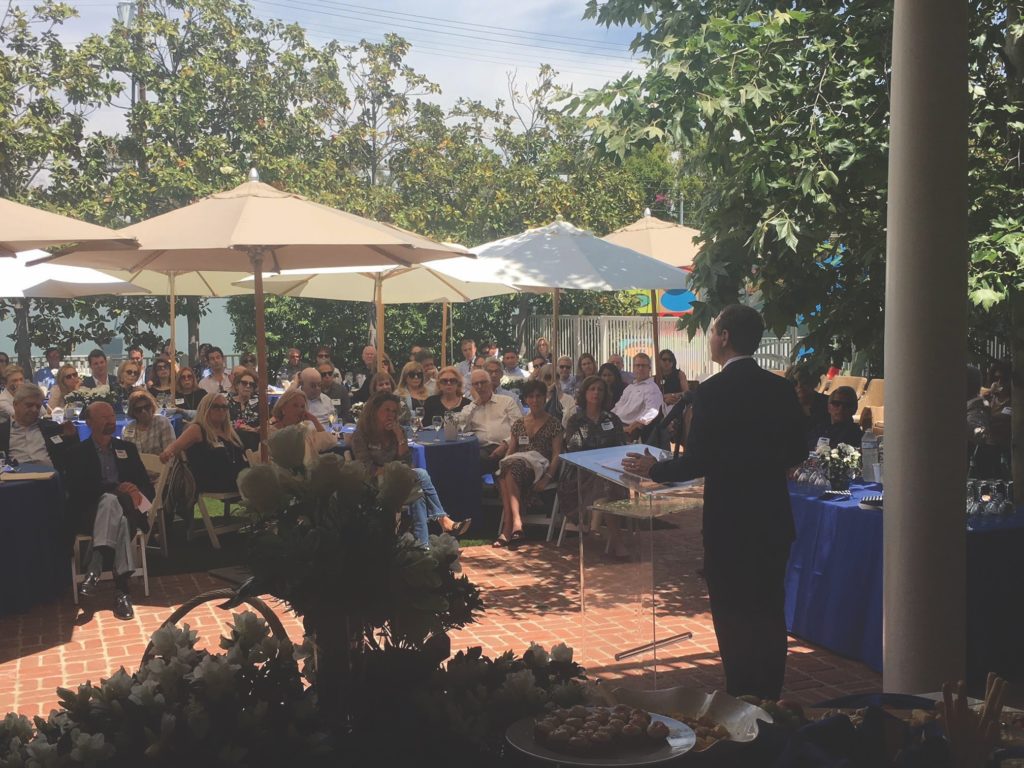
Ada Horwich’s Beverly Hills backyard was a sea of Democratic blue, from the tablecloths to the napkins next to the buffet spread. And many of her home’s windows proudly displayed blue 2016 “Hillary for President” stickers.

“The theme of today is blue,” Horwich, development chair of the Jewish Democratic Council of America (JDCA), told the close to 90 invited guests. “That’s because we’re going to turn red to blue this November.”

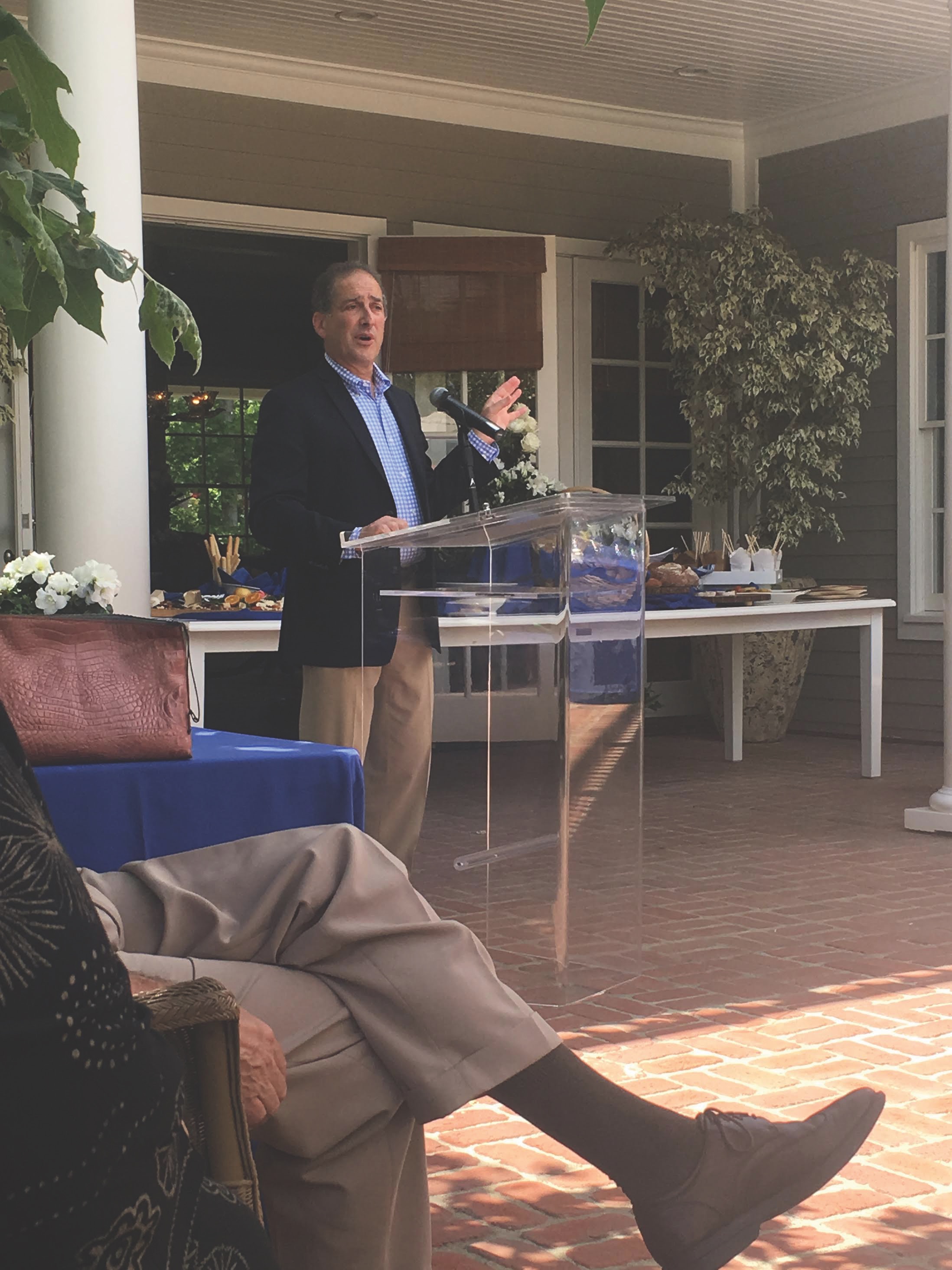
The May 6 luncheon was a JDCA event held to discuss campaign plans and mobilize the local Jewish community to help Democrats reclaim the House of Representatives in the November midterm election. The special guest and main speaker was Congressman Adam Schiff.

Founded in 2017 by former Florida Congressman Ron Klein, JDCA is a political organization that actively promotes Democratic officeholders, candidates and legislative policies that align with its members’ Jewish values and support a strong U.S.-Israel relationship.

“Republicans, for the most part, are not standing up to the president and are not fulfilling their constitutional responsibilities of representing us as Americans,” Klein told the gathering.

JDCA Founder Ron Klein discusses the midterm elections. Photo courtesy of JDCA.

Contending that damage is being done to the country every day by the Donald Trump administration and its GOP supporters in Congress, Klein said it was imperative that either the House or Senate be returned to Democratic control come November. His talk focused mainly on Congress, where a net change of 23 seats this November would give Democrats the House majority. Referencing JDCA research, he identified 43 congressional districts with at least 10,000 Jews living in them.

“Other groups will appeal to African-American voters and Hispanic voters, but our focus will be specifically on the Jewish community,” he said. “The belief is that Jewish voters are good voters, but we drop off in the midterms like everybody else.”

Klein said he believes Jewish voters can impact close races. He cited the March 13 special election in Pennsylvania’s 18th Congressional District, where Democrat Conor Lamb won the seat by a mere 657 votes against his Republican rival Rick Saccone — despite the fact that Trump won the district handily in the 2016 general election.

Klein said that in the lead-up to the special election JDCA identified 11,000 registered Jewish Democrats in the area and did extensive outreach to them.

“I’m not going to tell you that we were the only ones that caused the election to go that way, but we contributed to that,” he said. “When you have that kind of margin, it’s clear that every vote counts.”

Klein later told the Journal that JDCA is planning future luncheons around the country, including in Chicago and New York, to drum up support ahead of the midterms and to meet the organization’s $2 million fundraising goal to fund more outreach.

“The impact we’re capable of having depends on the donations we get,” he said. “That will dictate our resources and bandwidth.”

Robert Meadow, a Democratic pollster with Lake Research Group, told attendees the message of “every vote counts” needs to reach the Jewish community throughout Southern California. Among the districts he mentioned was the 25th, which has a 5 percent Jewish population and includes Palmdale, Simi Valley and Lancaster.

He also cited the 45th and 48th districts, which cover parts of Orange County. Both have a voter base that’s 4 percent Jewish.

“Those are also very competitive districts where [Hillary Clinton] won, that are currently represented by Republicans where we have excellent Democratic challengers,” he said. “The Jewish population can make a huge difference.”

Congressman Schiff, a central player in the House Intelligence Committee’s investigation into Russian election meddling, helped drive home the message of the importance of the November elections.

“I know you’ve heard many times that this is the most important midterm,” he said. “Well, this time it is. It’s not hyperbole.”

“As Jews, we should be as concerned as anyone about Russia’s actions as they fit into the context of a global move towards authoritarianism.” — Congressman Adam Schiff

Schiff said Jews should be “as concerned as anyone” about how Russia’s actions fit into the context of a global move toward authoritarianism. Still, he added, referencing avowed neo-Nazis running for public office in the United States and recent attacks on a free press, the threat from outside powers like Russia is “less than the threat from within.”

He said taking back either the House or the Senate come November is “the only way to put a check on what’s going on until that time comes when we can replace the occupant at 1600 Pennsylvania Avenue.”

Other  prominent community members in attendance included former L.A. City Controller Wendy Gruel, former Los Angeles County Supervisor Zev Yaroslavsky and state Senators Ben Allen and Henry Stern. Attorney Jesse Gabriel was also on hand to chat with guests ahead of his June 3 runoff in a special election to replace Matt Dababneh for the state Assembly’s 45th District seat, which represents much of the west San Fernando Valley.

Scott Racine, 67, a retired tax lawyer who lives in Gabriel’s district, told the Journal this was his first JDCA event. A lifelong Democrat, he came to see Congressman Schiff, an old acquaintance. He left encouraged by JDCA’s vision.

“I don’t want to get myself ‘kinehora,’ but this has me feeling optimistic about the upcoming midterms,” he said, invoking the Yiddish phrase that translates to “not the evil eye,” meaning essentially not to jinx. “There will be a lot of tight races,” he added, “and every little bit counts.”

Jewish Fundraiser Hosts Schiff Read More »

Shavuot Sessions Point to Jewish Diversity

“What does it mean to be God-fearing?”

Steve Lackner, a program manager in the U.S. Air Force, posed that question to a small group of people who had come out for a night of Shavuot learning at Pico Shul on May 19.

Responses ranged from being disciplined and religiously observant, to doing good deeds. Lackner validated each of the responses and then gave an example by discussing the story of Shifra and Puah, two midwives in ancient Egypt who defied the decree of Pharaoh to murder the first-born children of the Israelites. It was their fear of God, Lackner said, that compelled them to disobey Pharaoh’s order. And, he added, it was also the first recorded act of civil disobedience.

Pico Shul’s Tikkun Leil Shavuot went well past midnight, as part of the holiday tradition of commemorating the Jewish people being given the Torah on Mount Sinai by staying up all night to study. The gathering, organized by Pico Shul’s Rabbi Yonah and Rebbetzin Rachel Bookstein and billed as “Shavuot Night Live,” was one of many such events held at synagogues throughout Los Angeles.

The range and breadth of Shavuot classes provided people from different backgrounds with the opportunity to experience many different flavors of Judaism, and highlighted the diversity of Jewish thought and experience in the city.

“Who among us would you trust with the button? One who fears God or the atheist?” — Steve Lackner

At Pico Shul, Lackner left his audience with a question addressing faith in God versus atheism. He spoke of a scenario where, during a debate, a man asked a renowned atheist what he would do if there were a button that would give a man everything his heart desired but would also kill one anonymous Chinese peasant. “Who among us would you trust with the button?” Lackner asked. “One who fears God or the atheist?”

Additional speakers included stand-up comedian Sarah Afkami. In an exaggerated Persian accent, Akfami imitated her father introducing eligible bachelors to her and her sister as if they were cars for sale.

Rapper Kosha Dillz performed a freestyle rap about Shavuot. He then delved into a story about traveling from Poland to Colorado to perform at Red Rocks Amphitheatre. He had made the decision to travel across the world for the concert, thinking it would be his big break. However, as he was selling merchandise after the show, an employee told him he was not allowed to do so and kicked him out. He told the crowd he was embarrassed by the story but wanted to share it anyway.

“I think showing your true colors is what this holiday is all about,” he said.

At Young Israel of Century City, Senior Rabbi Elazar Muskin led about 70 men and women at 1:30 a.m. in a discussion of halachah, specifically whether it is forbidden to kill lice on Shabbat or if lice are so microscopic as to be unobservable, and thus not governed by the laws.

“Whatever the naked eye can see, that is halachah,” Muskin said.

At Temple Emanuel of Beverly Hills, out-of-the-box thinking was the name of the Shavuot game. The Reform synagogue held an escape room-themed Shavuot. Titled “Escape to Sinai,” the program prompted people to solve puzzles, unlock clues and discover the mysteries of Revelation.

Progressive egalitarian community IKAR held a Shavuot program called “This, Too, Is Torah.” Attendees gathered until 1 a.m., learning in traditional and not-so-traditional activities about how everything can be Torah. Held at Shalhevet High School, the evening included, among other things, cooking, meditation and text study.

At Temple Beth Am, a Conservative congregation near Pico and La Cienega boulevards, people engaged in learning sessions from 8:45 p.m. until 4:45 a.m. The evening began with Journal Senior Writer Danielle Berrin moderating a discussion with Beth Am Rabbis Adam Kligfeld and Ari Lucas and Journal columnist Rabbi Eli Fink speaking about “Living on the Edge.”

Additional discussions at Beth Am included “God Is Dangerous and So Is God’s Torah,” featuring Rabbi Aryeh Cohen; and “Climbing to the Mountain: A Game of Spiritual Transformation,” with Rabbi Yechiel Hoffman.

Shavuot Sessions Point to Jewish Diversity Read More »

The Blessings of a Brush With Death

Editor’s note: On Nov. 17, the Journal ran a story about the Nov. 3 car accident that almost claimed the life of beloved local teacher and performer Marcus J Freed. Now, 6 1/2 months later, the British-born actor, educator and author tells his story.

I was less than 60 minutes from death. Lights were flashing. Monitors were bleeping. Medics were doing everything they could to save my life.

Last November, my walk to a Shabbat dinner did not go as planned. While crossing Olympic Boulevard, I was hit by a white Lexus and thrown onto its hood. I fell to the ground and the next thing I knew, I was getting up with blood on the side of my face.

“I thought you were dead, for sure,” an onlooker said.

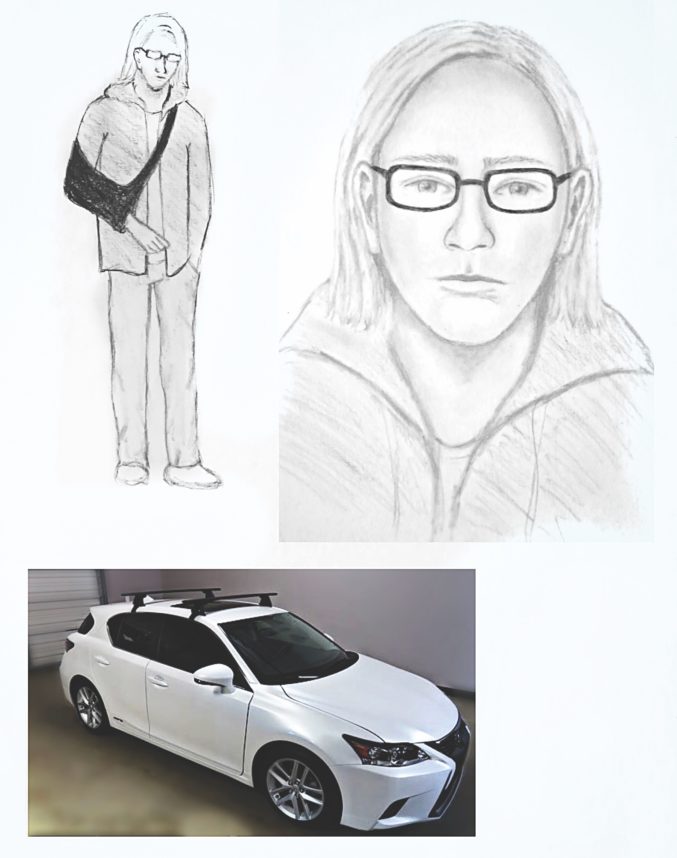
Four of us gathered on the pavement: me, the driver and two witnesses. I was in shock and asked to be taken to my friend Metuka’s house. The Lexus driver was a blond 20-something named Jonathan. Of course, I should have asked for his contact details but I was suffering a major brain hemorrhage — the kind that kills you if you don’t get to a hospital within two hours — and I wasn’t thinking straight. I gave him my business card and asked him to follow up, but I never heard from him again.

Artist sketch of the hit-and-run driver and a white Lexus similar to the car from the accident.

Within 30 minutes I was unconscious.

“Marcus, you are in Cedars-Sinai hospital,” a female voice said. I looked up and several faces surrounded me. “We have to cut off your shirt.”

This concerned me. “It’s a floral print shirt from a shop in London called Marks & Spencer’s,” I explained. “Would you mind carefully taking it off, please?”

“We can’t do that. You are wearing a neck brace. We are not allowed to move you.”

“OK.” I was disappointed because it was a lovely shirt, but they had a good point.

“Marcus, your brain is bleeding and we are preparing you for brain surgery.”

“Really? When can you get me in?” Maybe they had a spare appointment in the next few days?

“Right now,” she shot back. “Or you might die.”

“Oh,” I replied. “Thank you for everything you are doing. I’m going to close my eyes for a bit. Hope it goes well. See you on the other side.” Never let it be said that the English stop being polite under pressure.

“I focused on handing my soul over to God. ‘B’Yado Afkid Ruchi’ (Into your hands I entrust my spirit) is the final line of ‘Adon Olam.’ That was the only thing that was in my control. The choice was fear or faith, and I chose faith.” — Marcus J Freed

My mind immediately turned to my spiritual training. This was a potential moment of death and I was ready. The most important thing to do was to elevate my thoughts. If I got upset, scared or tried to hang onto life, there was a danger that my soul could get stuck between worlds as a wandering spirit or ghost. I focused on the one thing I could control: trusting God.

I saw two squares of light, one white and one gold. This was a near-death experience. I felt the white light represented my coming back to Earth and reawakening in the “Marcus body”; the gold light was my gateway to the next plane of consciousness. I had a brief flash that my parents would suffer some trauma if I passed on, but they would recover. I focused on handing my soul over to God. “B’Yado Afkid Ruchi”  (Into your hands I entrust my spirit) is the final line of “Adon Olam.” That was the only thing that was in my control. The choice was fear or faith, and I chose faith.

What happened next was extraordinary. My parents immediately flew to Los Angeles. I was besieged with visitors in the intensive care unit. Four days later, my brain hemorrhaged again and I underwent a second surgery. My friend Audrey Jacobs pulled together a miraculous crowdfunding campaign. The reach was astonishing. It felt like I had died, visited my memorial service, seen who had attended and heard what they had said. My heart cracked open with love.

Six months later, the brain injury has healed but my physical recovery is slow. I use a wheelchair for longer walks on Shabbat. Because the Lexus driver never followed up and the Los Angeles Police Department closed the case, I hired a forensic artist and had composite sketches done. I filmed the witnesses and made an online campaign video. Some English celebrities in Los Angeles, including James Corden, retweeted the video.

Was this event a tragedy or a blessing?

The rabbis teach us that everything is ultimately a blessing, even if that blessing is not instantly revealed. I believe it. This life-changing event has revealed tremendous love from family and friends, and deepened my love for so many people.

Being forced to slow down has made me focus on repairing the areas of my life where I was underperforming. This recovery period has given me time for internal work, to see where I can improve as a human being.

One hundred percent recovery is possible; to get back to where I was before and surpass it with new improvements. It’s like an upgrade.d

I am slowly getting back my work as an actor and business coach. My accident was a God-given gift that has made me focus on why I am here on the planet.

“Man’s days are numbered,” Job said, and I am more aware of that than ever. For years, I suppressed the more controversial stories that I wanted to bring to stage or film, for fear that I would upset people or face rejection, but coming so close to death has reminded me that I only need fear God.

When it comes to speaking deeper truths to motivate my business coaching clients, I have found few things more life-affirming than coming back from near death after a double brain bleed.

My current theory is to “never waste a good accident,” see the good in and appreciate all of these blessings. There won’t be any yogic handstands or surfing or break dancing for a good while yet, and no big parties because public gatherings are still too loud and overstimulating. There will be no driving after dark because lights are still too bright. But there are so many things I can do, and I focus on those instead.

Getting hit by a car was one of the best things that ever happened to me.


Marcus J Freed is an actor and business coach. You can see his “manhunt” video at marcusalive.com.

The Blessings of a Brush With Death Read More »